
The intersection of infrastructure choice and shifting economic realities has never been more critical than it is today. As hardware manufacturing dynamics shift globally, the underlying costs of server components are creating massive ripple effects throughout the IT industry, forcing companies to drastically rethink their digital deployment strategies. When the basic building blocks of digital infrastructure become significantly more expensive, the traditional debate of bare metal versus cloud stops being a purely technical conversation and immediately becomes a financial one.
Navigating this complex landscape requires a deep understanding of exactly how different environments process data, handle resource allocation, and ultimately bill the end user. This comprehensive guide explores whether returning to raw physical hardware is the ideal solution for enterprises looking to shield themselves from an increasingly unpredictable billing landscape. We will examine how companies can protect their bottom line, secure their proprietary data, and maintain absolute control over their technological destiny during a period of intense market volatility and rising component costs.
Why Server RAM Prices Are Rising
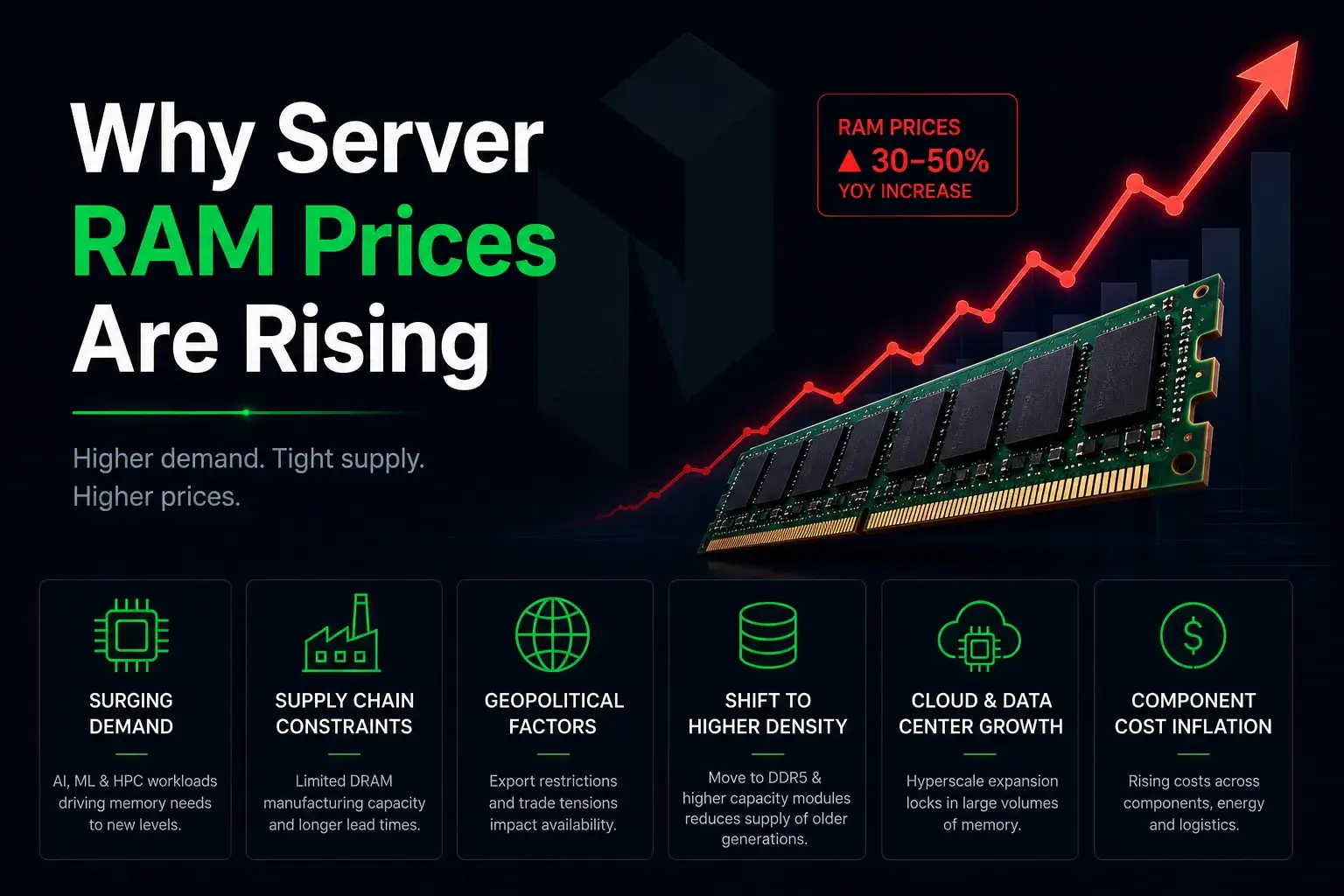
The global technology supply chain is currently experiencing a massive realignment that heavily impacts the cost of enterprise grade memory. RAM manufacturers are deliberately altering their production output, creating an artificial scarcity that naturally drives up the per gigabyte price of memory modules worldwide. This reduction in DRAM manufacturing is an incredibly strategic move designed to stabilize their own profit margins, but it passes a massive financial burden directly onto data center operators and global cloud providers.
Blog contents
As these underlying component costs skyrocket, the major hyper-scalers inevitably pass those price hikes directly onto their customers by quietly adjusting their instance pricing and memory-intensive tiers. Furthermore, the explosive demand for artificial intelligence and massive computational modeling has absorbed vast amounts of available global memory. This creates a bottleneck that severely impacts traditional web hosting and enterprise computing. Understanding this fundamental macroeconomic shift is the first step in realizing why your monthly cloud bills are slowly creeping upward despite your actual usage remaining entirely unchanged.
Understanding Bare Metal and Cloud Computing
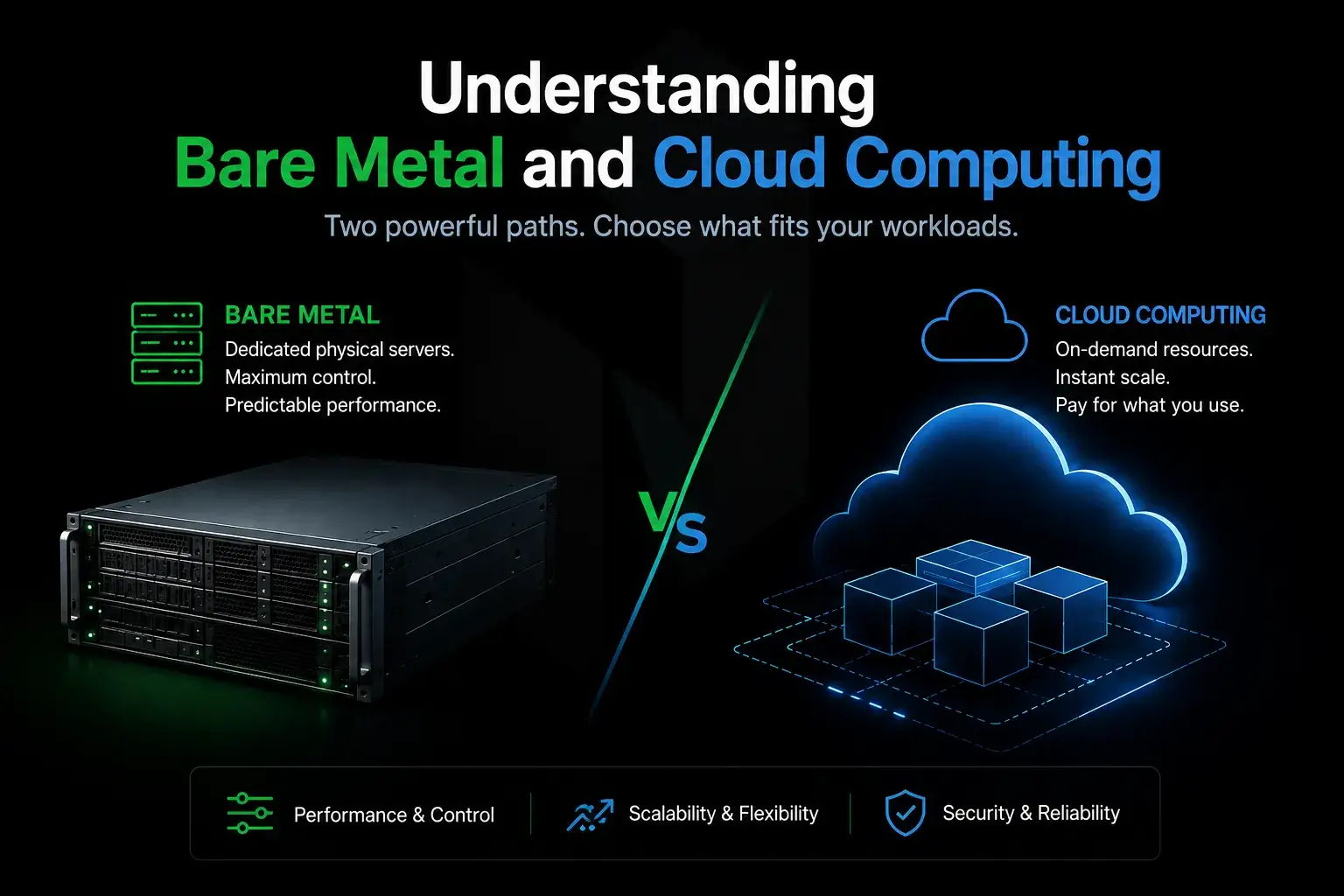
Before diving into complex financial comparisons, it is absolutely essential to clearly define the two major architectural environments dominating the modern internet. While both models essentially involve renting computational power housed inside a massive, highly secure facility, the way that power is distributed, managed, and sold to the end user is fundamentally different. This foundational knowledge allows IT directors to look past marketing terminology and understand exactly what is happening at the silicon level when a user requests a web page or queries a massive database. Understanding the distinction between bare metal and cloud solutions ensures your organization does not accidentally invest millions of dollars into an architecture that actively works against your long term strategic business needs.
What Is a Bare Metal Server
A bare metal server is a physical server entirely dedicated to a single tenant, offering raw, unthrottled access to its internal components. The defining feature of bare metal servers is that they are dedicated entirely to a single customer, providing direct access to the physical hardware without the need for a virtualization layer, which enhances security and performance. In this environment, there are no software hypervisors installed by the service provider and no virtualized boundaries artificially segmenting the processing cores or memory banks. You lease the entire motherboard, all of the RAM, and every single storage drive, granting your engineering team complete control over the entire technology stack.
This architecture provides the highest possible level of raw performance because every single computational cycle is devoted exclusively to your specific corporate workloads without interference. Because physical servers dedicated to your operations do not share their network interfaces, they are incredibly secure and perfectly well suited for enterprises that require massive computational throughput without the unpredictable delays introduced by sharing. Ultimately, bare metal offers an uncompromising foundation for the most demanding digital tasks.
What Is Cloud Computing
Cloud computing relies on massive networks of physical servers that use complex virtualization software to slice the underlying hardware resources into thousands of smaller, isolated virtual machines. Cloud computing involves virtualized resources over the internet, allowing businesses to leverage services for scalable web hosting, data storage, software applications, and disaster recovery. This allows multiple users to seamlessly share the same hardware and the exact same physical processor and memory pool without ever interacting with one another directly. It is an incredibly powerful model that abstracts the underlying hardware entirely, allowing users to provision new instances with a few clicks and pay only for the exact seconds of computing time they actually consume.
While highly agile, this multi-tenant cloud environment requires an inherent layer of operational overhead to manage the complex distribution of virtualized resources. Major platforms like microsoft azure and Amazon Web Services have popularized this model, providing incredible business agility at the expense of raw, dedicated computational power and absolute hardware isolation.
Bare Metal Versus Cloud Key Differences
| Feature Category | Bare Metal Servers | Cloud Servers |
| Performance | Raw, unthrottled processing power with zero virtualization overhead. | Susceptible to hypervisor micro-delays and the "noisy neighbor" effect. |
| Scalability | Requires manual hardware provisioning and meticulous capacity planning. | Offers instantaneous, infinite elasticity via automated API calls. |
| Cost Structure | Highly predictable, flat monthly rate ideal for stable workloads. | Variable, pay-as-you-go pricing that can spike with high usage. |
| Security & Compliance | Ultimate physical isolation on unshared silicon for easier auditing. | Multi-tenant environment relying on complex software-based isolation. |
| Management | Absolute control, but your team is responsible for all server health and routing. | Provider handles physical hardware replacements and facility power seamlessly. |
Choosing the correct path forward requires a brutal examination of how these two deployment models handle the daily realities of running enterprise software. The fundamental architectural differences create stark contrasts in how an application performs under heavy load, how an engineering team responds to sudden traffic spikes, and how the finance department forecasts the quarterly IT budget. By breaking down these critical categories side by side, the distinct operational advantages and inherent compromises of each ecosystem become incredibly obvious. Making the right choice between bare metal servers and cloud servers will dictate your operational reality for years to come.
Performance and Virtualization Overhead
In a virtualized compute infrastructure, the hypervisor software constantly manages and distributes physical resources across dozens of virtual machines, which inherently consumes CPU cycles and introduces micro-delays. This virtualization layer acts as a permanent performance tax that prevents your application from accessing the full raw power of the underlying processor. Dedicated servers completely eliminate this software stack layer, allowing your databases and computational workloads to interact directly with the hardware, resulting in significantly faster query resolutions and uncompromising high throughput. When the hypervisor is removed, performance naturally skyrockets.
Scalability and Flexibility
Agility is the absolute hallmark of virtualized infrastructure, allowing engineering teams to double their global server footprint in a matter of minutes via automated API calls. Scaling a dedicated physical machine, however, requires a deliberate, manual process of ordering new hardware, racking the server, and configuring the network ports within the data center. While virtualized compute infrastructure offer infinite, instantaneous elasticity, bare metal requires meticulous capacity planning and a deep understanding of your long term growth trajectory to avoid hardware shortages during critical business events.
Cost Structure and Pricing Models
The financial philosophy behind these two options dictates entirely different corporate budgeting strategies. Cloud services operate on an operational expenditure model where you pay a premium for convenience, often resulting in highly variable, unpredictable monthly invoices based on exact data transfer and compute usage. Physical hardware flips this model entirely, offering vast amounts of processing power and unmetered bandwidth for a highly predictable, flat monthly cost that makes long term financial forecasting incredibly simple and accurate, proving highly cost effective for established enterprises.
Security and Compliance
Maintaining absolute digital custody of your proprietary data requires you to understand exactly where those bytes reside on a physical disk. Because virtual servers share the same underlying motherboard and network interfaces with unknown third parties, achieving strict regulatory compliance requires complex, software-based isolation techniques that can be difficult to verify during an audit. Bare metal architecture provides ultimate peace of mind by guaranteeing that your sensitive data is stored on fully isolated, unshared silicon that only your explicit team members can ever access, ensuring maximum physical security and enhanced security.
Management and Maintenance
When you leverage a public cloud platform, the massive provider acts as your invisible data center technician, seamlessly replacing faulty hard drives and managing global power grids without you ever knowing there was a hardware failure. Transitioning to bare metal servers means you are entirely responsible for the operating system, deep network routing, and overall server infrastructure health. While this grants your team unprecedented customization and full control, it also absolutely demands that you employ highly skilled system administrators capable of managing the raw infrastructure effectively and executing critical software updates.
Bare Metal Versus Cloud Performance Comparison
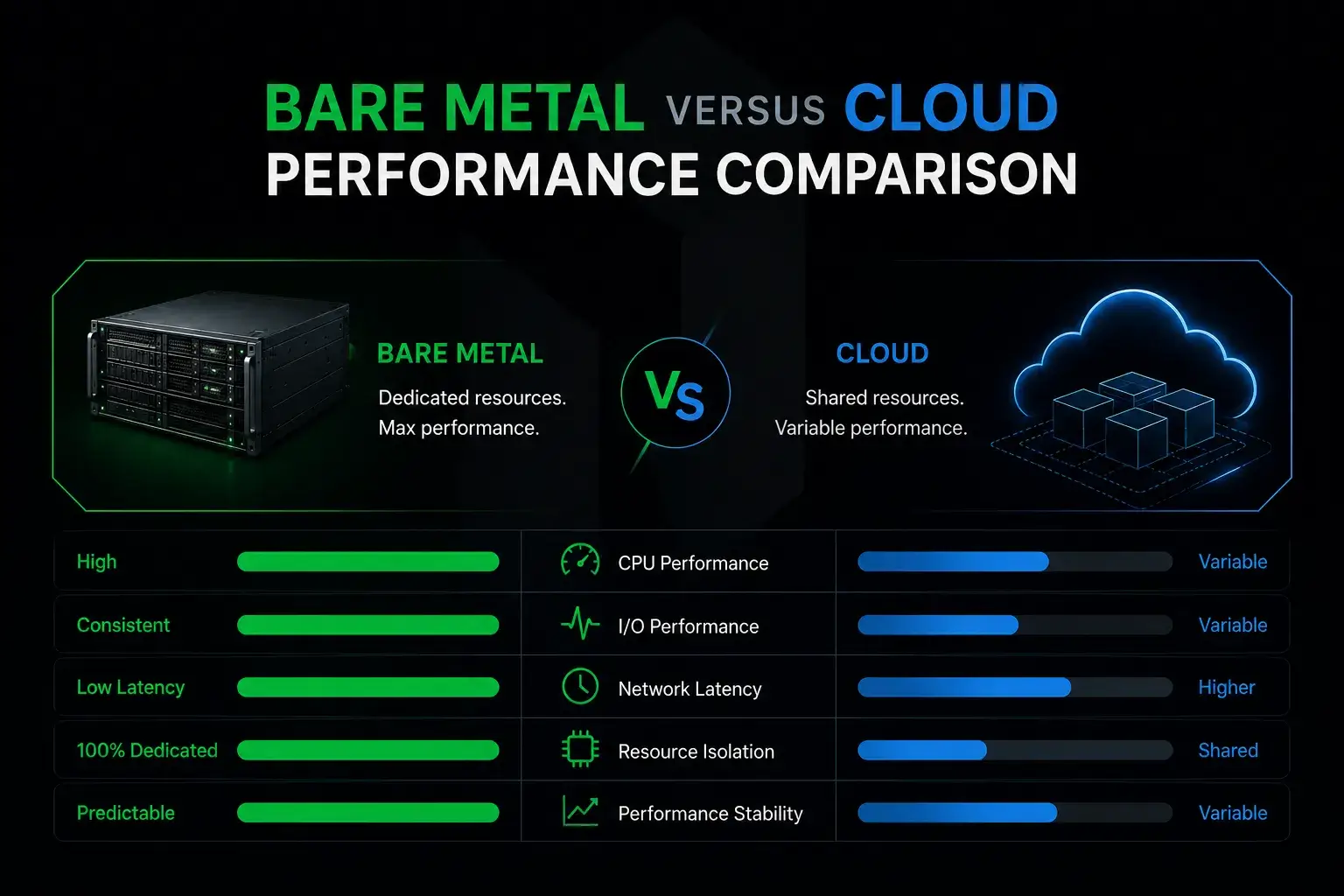
When raw speed and computational reliability are the primary objectives, comparing the two environments requires looking closely at how resources are physically delivered to the application layer. The way your digital infrastructure handles complex processing tasks directly impacts the end user experience, making performance a non-negotiable factor for serious enterprises running mission critical applications.
Dedicated Resources vs Shared Environments
A shared environment inherently forces your application to wait its turn when competing for access to the physical processor, leading to a phenomenon known as CPU steal time where your instance is temporarily paused. Dedicated resources guarantee that one hundred percent of the CPU cores and memory modules are entirely reserved for your processes, eliminating bottlenecks completely. This exclusivity ensures that your critical business operations always receive priority access to the hardware resources without exception, a stark contrast to shared hardware where other tenants constantly fight for computing cycles.
Latency and Processing Speed
Network latency is the silent killer of user engagement, and complex virtualization layers can introduce slight variations in packet delivery times that negatively affect real-time applications. By routing data directly through dedicated physical network interface cards, bare metal environments provide incredibly fast, stable connections that are absolutely essential for high frequency trading algorithms and multiplayer gaming servers. The absence of a hypervisor ensures that data moves from the processor to the network port as quickly as the laws of physics allow, resulting in extreme low latency.
Workload Consistency and Stability
Virtual servers are highly susceptible to the "noisy neighbor" effect, where a massive traffic spike on an entirely unrelated website degrades the performance of the physical server you share with them. Bare metal machines are immune to this external volatility, providing rock solid, perfectly consistent performance metrics 24 hours a day. If your workload requires sustained, heavy computational lifting over long periods, physical hardware is the only way to guarantee absolute environmental stability and predictable computing power.
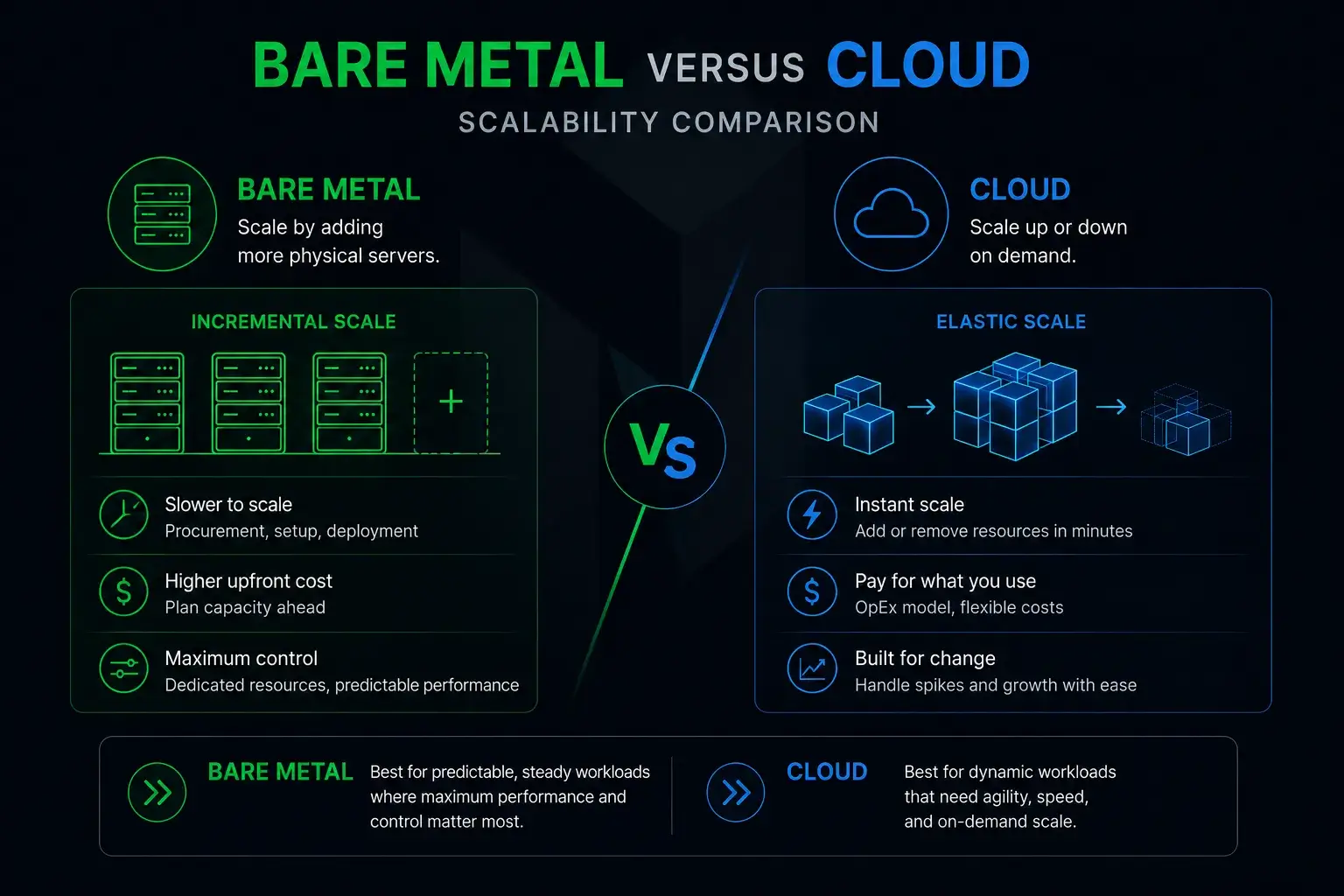
Bare Metal Versus Cloud Scalability Comparison
How quickly you can add or remove computing resources defines your ability to respond to changing market conditions and sudden consumer demand. Understanding the mechanical limitations of scaling both environments is crucial for preventing severe outages during critical promotional events or unexpected viral traffic surges.
Instant Scaling in Cloud Environments
The cloud is built entirely for immediate elasticity, allowing your infrastructure to automatically spin up hundreds of new virtual machines the very second your web traffic begins to surge. This instantaneous provisioning ensures that a viral marketing campaign never crashes your digital storefront, as the environment seamlessly expands to digest the increased load. It provides the ultimate safety net for highly unpredictable business models that demand absolute business agility.
Hardware Based Scaling in Bare Metal
Expanding a bare metal footprint requires you to physically provision and network entirely new server chassis, which inherently takes time and manual configuration. Bare metal servers provide dedicated resources that ensure predictable and consistent performance, but scaling them can be slow and requires significant upfront investment. While this process is much slower than launching a virtual machine, it results in a massive injection of raw, unthrottled computing power that far exceeds the capabilities of a similarly priced cloud instance. It is a highly deliberate scaling mechanism designed for permanent, structural business growth rather than temporary traffic spikes.
Flexibility for Dynamic vs Stable Workloads
If your website traffic looks like a chaotic rollercoaster, the massive flexibility of virtualized environments perfectly accommodates those dynamic shifts without requiring you to own idle hardware during the slow periods. However, if your daily operational workloads are highly predictable and consistently heavy, the massive flexibility of the cloud becomes an unnecessary expense. Steady, predictable workloads are always processed far more efficiently on dedicated machines built exactly for your baseline requirements, making them the ideal solution for long-term stability.
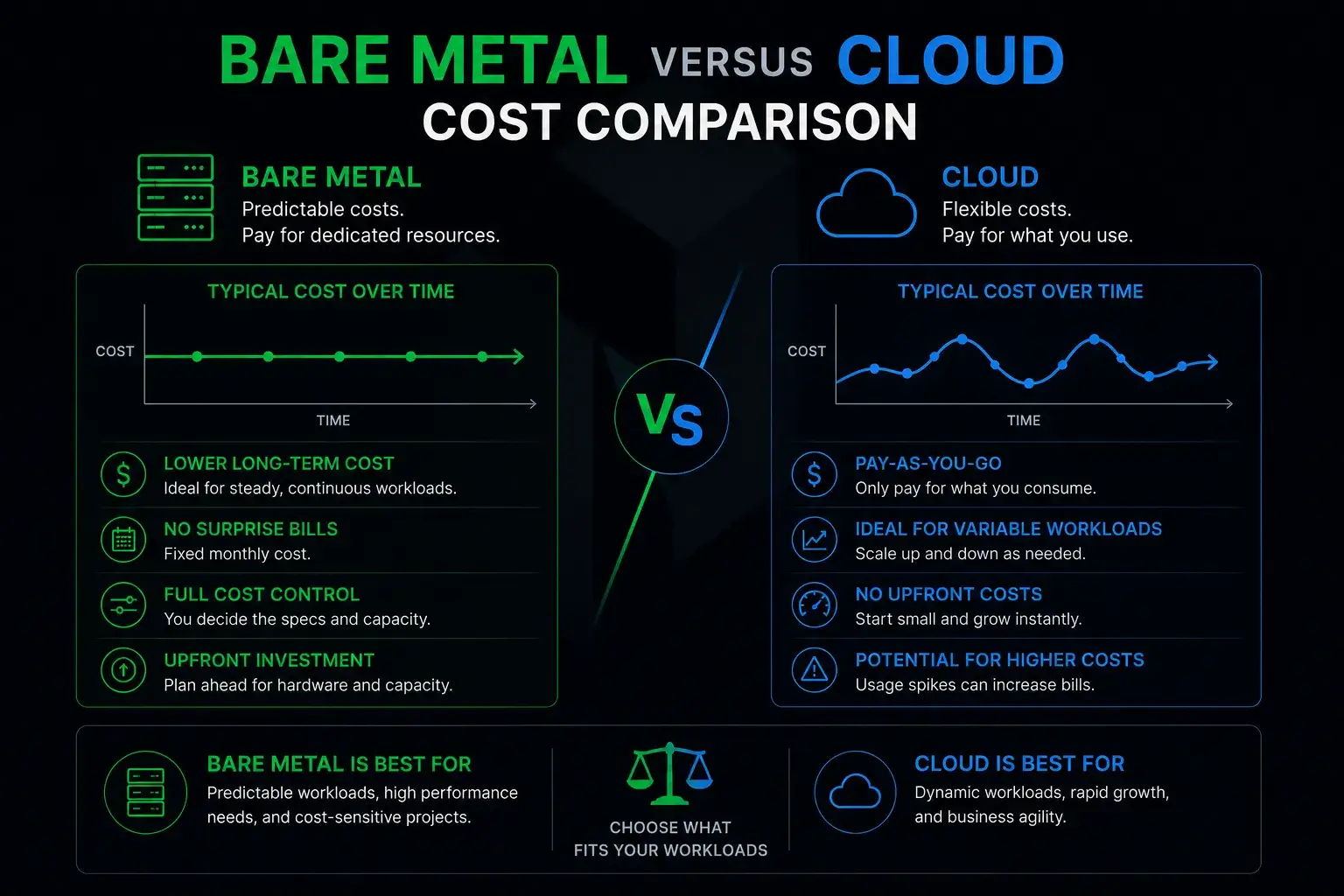
Bare Metal Versus Cloud Cost Comparison
The total cost of ownership is the ultimate deciding factor for most executive boards, especially when foundational component costs are rapidly shifting. You must look far beyond the initial monthly sticker price and analyze the hidden fees, data transfer rates, and long term scaling expenses associated with both cloud computing and physical deployment.
Upfront vs Pay as You Go Pricing
Virtualized hosting thrives on the pay as you go model, eliminating the massive upfront capital expenditures required to purchase enterprise grade hardware. Cloud computing typically follows an operational expenditure (OpEx) model with pay-as-you-go pricing, making it ideal for variable or short-term workloads. While this makes it incredibly easy to launch a startup with zero initial investment, the variable pricing model means your monthly bill can spiral out of control if you leave massive databases running unchecked. Dedicated servers require a predictable, flat monthly commitment that heavily rewards companies capable of accurately forecasting their IT demand. While bare metal servers offer predictable budgeting advantages for established enterprises with stable workloads, they also incur costs related to hardware upkeep, software updates, and the infrastructure needed to house and cool the servers.
Long Term Cost Efficiency
When you run complex applications continuously 24 hours a day, the per-hour billing structure of a virtual instance quickly becomes astronomically expensive. For steady state workloads that operate around the clock, leasing a dedicated physical machine is vastly cheaper over a multi-year projection, as you stop paying the massive convenience premium attached to cloud flexibility. Bare metal servers require a significant upfront investment, but they can be more cost-effective in the long run for consistent, high-demand applications due to the elimination of recurring cloud service costs. Once your server infrastructure stabilizes, dedicated hardware provides the absolute best return on investment and proves to be highly cost effective.
Impact of Rising RAM Prices
As global RAM prices skyrocket, cloud providers naturally adjust their pricing tiers to reflect the increased cost of memory dense virtual instances, making memory heavy workloads incredibly punishing on your monthly budget. Because bare metal servers provide vast amounts of RAM included in the base chassis price, they act as a financial shield against these targeted cloud price hikes. By securing a dedicated server now, you lock in substantial memory capacity without subjecting your finance team to the fluctuating, usage-based memory penalties imposed by hyper-scale vendors.
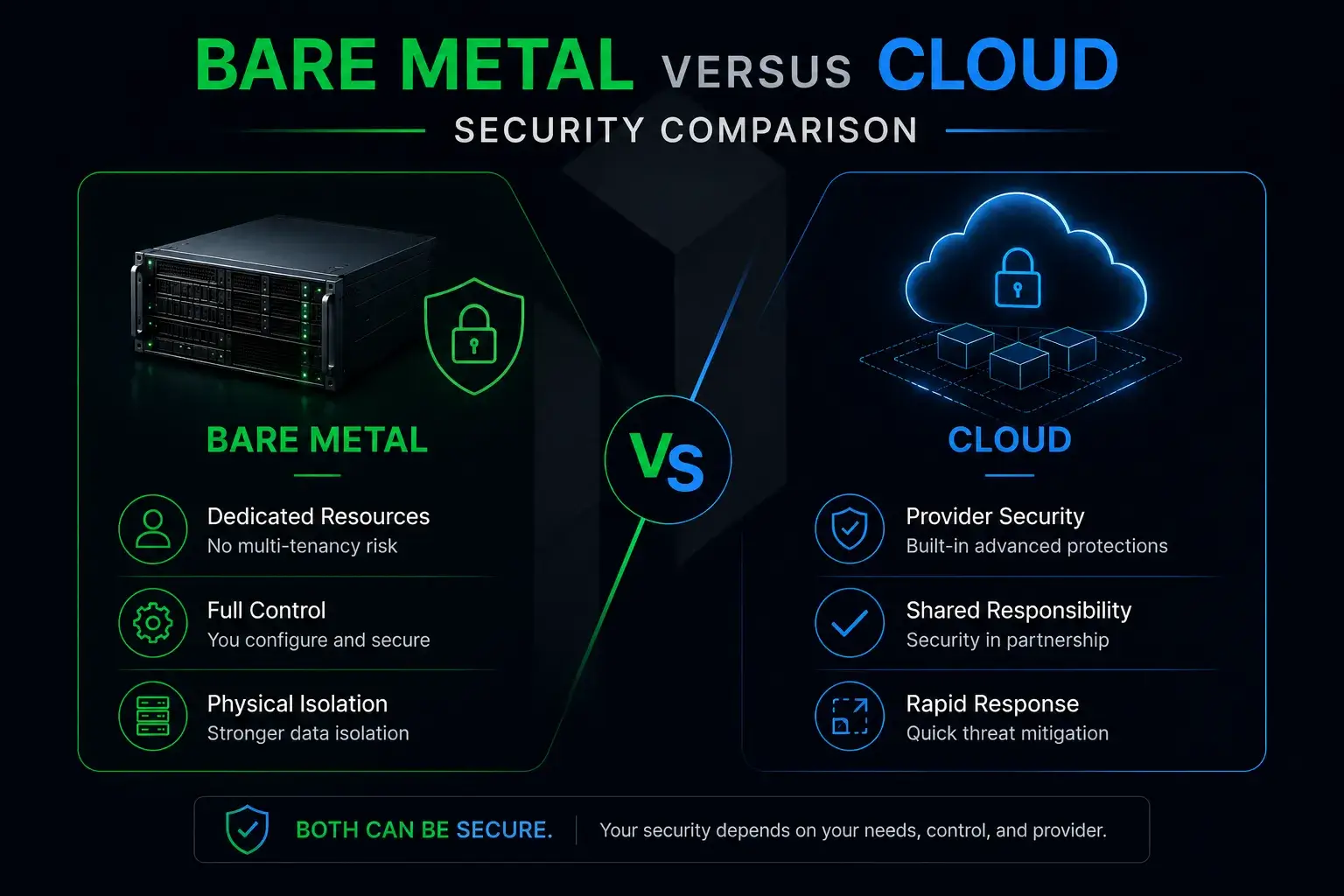
Bare Metal Versus Cloud Security Comparison
Protecting your digital assets is a foundational requirement, and the architectural differences between physical and virtual environments deeply impact your overall risk profile. You must choose an environment that aligns with your specific regulatory burdens, internal safety policies, and comprehensive disaster recovery plans.
Isolation and Dedicated Infrastructure
The strongest form of digital security is absolute physical isolation. Bare metal servers provide enhanced security through physical isolation, as they are dedicated to a single tenant, eliminating the risk of cross-tenant attacks and hypervisor vulnerabilities. Because a bare metal machine does not share its processor or memory with any other entity, it is physically impossible for a hacker to compromise your data by exploiting a vulnerability in a neighboring virtual machine. This uncompromised perimeter allows your security engineers to build bespoke firewalls and deploy proprietary encryption hardware that is fundamentally incompatible with a shared cloud environment. Giving the user complete control over the hardware ensures maximum physical security.
Multi Tenant Risks in Cloud
Despite billions of dollars invested in hypervisor safety, public clouds remain inherently multi-tenant, meaning your highly sensitive data resides on the exact same silicon as thousands of other companies. While catastrophic hypervisor escapes are rare, the shared nature of the environment introduces complex configuration risks where a single mismanaged IAM policy can expose massive data buckets to the public internet. Operating in a shared space alongside other tenants demands continuous vigilance and absolute perfection in your security configurations.
Compliance and Data Control
Navigating strict government regulatory compliance frameworks such as HIPAA or PCI DSS is drastically simplified when you can physically point to the exact server storing your encrypted data. Bare metal servers are particularly well-suited for applications requiring high levels of security and regulatory compliance, as they offer physical isolation and dedicated resources that reduce the risk of data breaches. Dedicated hardware fulfills the most rigorous regulatory requirements by granting you absolute physical and digital custody of the storage drives. Conversely, proving complete data sovereignty within a massively distributed, borderless virtual cloud network can be a costly and administratively exhausting process during an external audit.
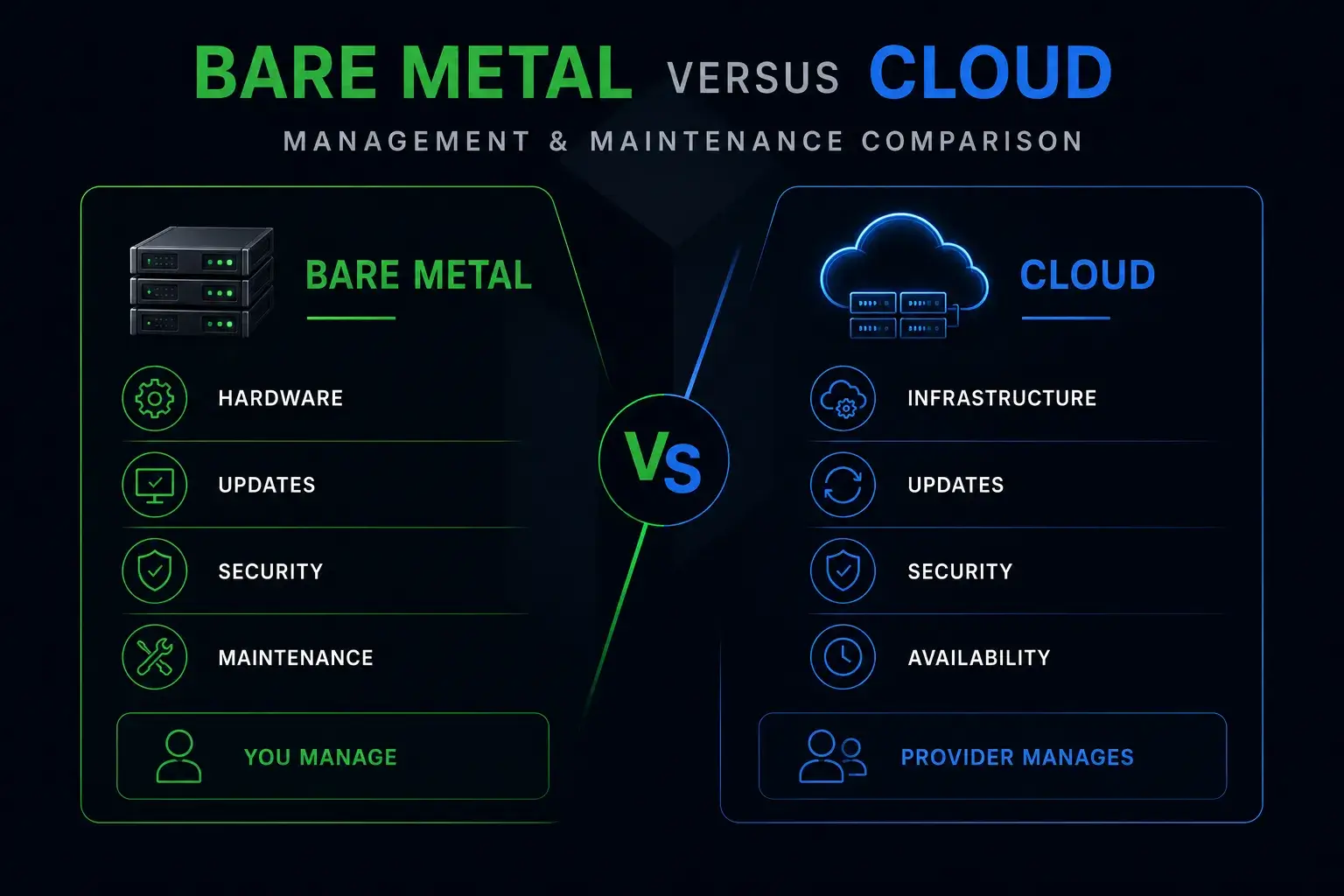
Bare Metal Versus Cloud Management and Maintenance Comparison
Taking absolute ownership of your infrastructure means taking absolute responsibility for its ongoing health. The division of labor between your internal engineering team and the hosting provider completely changes depending on which architecture you select, dramatically impacting your daily business operations.
Infrastructure Setup and Configuration
Launching a virtual instance is a highly sanitized experience that takes seconds, requiring absolutely zero knowledge of how to physically cable a server rack or configure a top of rack switch. Setting up a dedicated machine requires a much deeper understanding of bare metal provisioning, network routing, and operating system installations to ensure the raw hardware resources are properly optimized before going live.
Hardware Management Responsibility
When a hard drive inevitably fails in a cloud environment, the provider transparently shuffles your data to a healthy drive while their technicians replace the physical component, leaving your team completely uninterrupted. Managing a bare metal ecosystem means your team must actively monitor the hardware health, diagnose failing memory modules, and coordinate with the data center technicians to execute hardware replacements without causing catastrophic application downtime.
Deployment Speed and Provisioning
The cloud computing paradigm dominates the metric of speed to market, allowing developers to spin up complex testing environments, execute their software, and destroy the environment before lunch. Bare metal deployments require provisioning time, as automated scripts must wipe the drives, install the base operating system, and configure the dedicated network interfaces before the machine is handed over to your team. While modern bare metal provisioning is fast, it simply cannot beat the instantaneous nature of a virtual API call.
Automation and Ease of Management
Cloud providers offer massive ecosystems of managed services, load balancers, and managed databases that allow a tiny team of engineers to run a massive global platform with minimal effort. Achieving this level of automation on dedicated hardware requires your team to manually install, configure, and maintain open source orchestration tools. While cloud services offer flexibility in resource allocation, they typically provide fewer customization options compared to bare metal servers, which allow for extensive hardware and software configuration. You must be willing to trade the easy, out-of-the-box management tools for the absolute power of customized configuration and full control.
Control Over Updates and Environment
Cloud providers frequently force critical hypervisor updates or mandatory maintenance windows that can suddenly reboot your virtual servers during business hours. Having your own dedicated physical server ensures that you have ultimate authority over when the operating system is patched and when the server is restarted. This absolute control prevents unexpected maintenance interruptions and allows your team to schedule software updates solely when it makes the most sense for your specific business cycle.
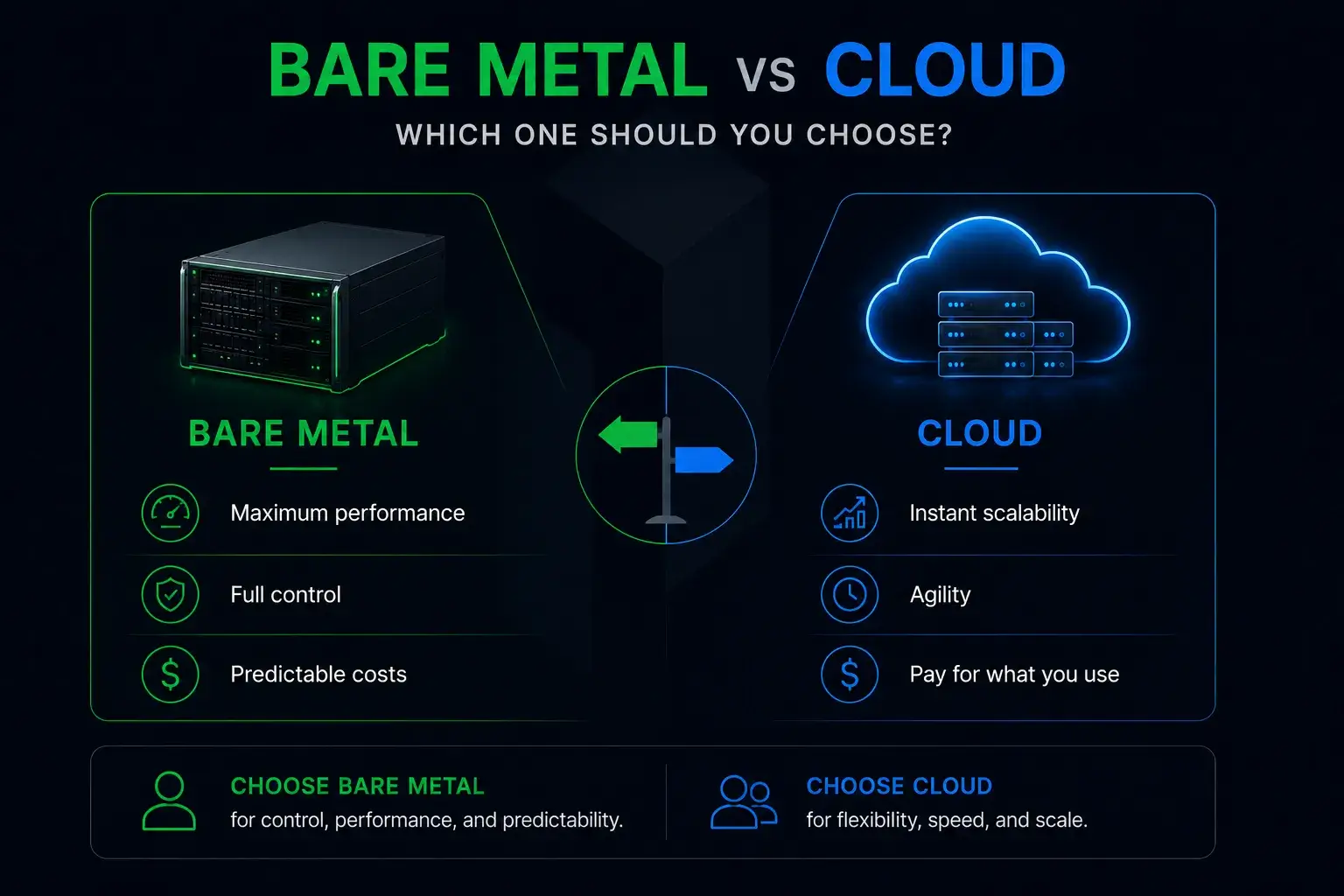
Bare Metal Versus Cloud Which One Should You Choose
Ultimately, the decision between dedicated servers and virtualized cloud solutions requires a deep, honest assessment of your specific technical capabilities and financial constraints. There is no universally perfect answer, only the architecture that best supports your unique corporate objectives over the next three to five years. Many advantages exist on both sides, but aligning them with your business needs is paramount.
Choose Bare Metal If You Need Maximum Performance
If your enterprise heavily relies on processing massive datasets for big data analytics, executing complex machine learning models, running high frequency trading algorithms, or requires intensive high performance computing, dedicated infrastructure is your only logical choice. Bare metal servers are ideal for high-performance computing applications, as they can be tailored with specific hardware configurations to meet the intensive demands of workloads, including GPU acceleration and high-speed networking. When your application demands uninterrupted access to maximum CPU power, massive RAM allocations, guaranteed minimum bandwidth, and low latency network connections, physical servers dedicated exclusively to your workload deliver the relentless performance required to dominate your industry.
Choose Cloud If You Need Flexibility and Speed
If you are operating a rapidly growing startup with highly unpredictable traffic patterns, or if your engineering team frequently tests massive deployments that only run for a few hours, the public cloud is the perfect ecosystem. Cloud computation is preferred for flexibility in environments with rapidly changing needs, such as startups with varying traffic loads. Cloud computing operates on a pay-as-you-go model, making it cost-effective for businesses with variable usage patterns, as it offloads maintenance and updates to the cloud provider. The ability to instantly scale your resources with incredible global reach without any upfront capital expenditure allows highly agile teams to innovate rapidly and survive massive, unexpected viral traffic spikes on the internet.
Key Factors to Consider Before Deciding
Before signing a massive infrastructure contract, you must carefully evaluate your baseline operational workloads, your actual data transfer volumes, and the technical depth of your internal engineering team. If your workloads are steady and highly predictable, sticking with the cloud means you are dramatically overpaying for elasticity you simply do not use. You must run the long term financial models to see exactly where the cloud convenience premium outpaces the raw power of dedicated hardware. A popular example is an enterprise that adopts a hybrid infrastructure, leveraging the cloud for burst traffic while keeping mission critical applications securely housed on bare metal servers. Organizations often adopt a hybrid approach using bare metal for core workloads and cloud computing for handling traffic peaks.
How Netrouting Supports Your Infrastructure Shift
When the financial realities of rising RAM prices and variable cloud billing force your enterprise to reevaluate its core server infrastructure, Netrouting provides the absolute best path forward. We engineer premium, dedicated environments designed to give you the ultimate control over your budget and your performance without compromising on global connectivity or minimum bandwidth guarantees.
Enterprise Grade Hardware and Configurability
Our bare metal solutions are built entirely upon enterprise grade processors and massive memory modules from the world's leading manufacturers, ensuring your applications never lack the raw horsepower they demand. We offer unprecedented hardware configurability, allowing you to custom build exact server specifications that perfectly align with your massive database requirements, eliminating the resource waste commonly found in pre-packaged cloud instances. We provide the ideal solution for teams that demand full control over their software stack.
Network Control and Global Footprint
Transitioning to bare metal servers does not mean sacrificing your global reach. Netrouting operates a massive, resilient Tier 1 global network across multiple continents, providing your dedicated hardware with ultra low latency routes to your international user base. By combining the unthrottled power of bare metal computing with our premier internet backbone, we ensure your mission critical applications remain fast, secure, and incredibly cost effective regardless of where your customers reside.
Frequently Asked Questions About Bare Metal vs Cloud
The transition between complex infrastructure environments naturally generates highly specific technical and financial questions from executive leadership. To help you finalize your architectural strategy, we have compiled the most common inquiries regarding the performance limitations, deployment realities, and long term economic impacts of choosing raw hardware over virtualized ecosystems.
What exactly does single tenant mean A single tenant environment means that you are the sole user of the entire physical machine. There are no other tenants sharing your CPU, RAM, or storage drives, ensuring absolute privacy, zero resource contention, and maximum high performance.
Is a hybrid infrastructure difficult to set up A hybrid infrastructure seamlessly connects your dedicated servers to public cloud environments, allowing you to enjoy the many advantages of both. While it requires advanced network routing, premium providers like Netrouting offer the expertise necessary to bridge your bare metal machines with major cloud services for ultimate flexibility.
Why are bare metal servers better for machine learning Machine learning requires continuously processing vast amounts of data through complex mathematical models. High performance computing tasks like this will quickly exhaust the artificial limits of virtual servers. Bare metal offers direct, unrestricted access to powerful GPUs and massive memory banks, making it vastly superior and more cost effective for these intense corporate workloads.
Can I run my own virtualization layer on bare metal Absolutely. Giving the user complete control means you can install your own hypervisors directly onto the physical hardware. This allows you to create your own private cloud space, entirely customized to your exact business needs, ensuring both enhanced security and highly efficient resource allocation without paying exorbitant public cloud fees.
Conclusion
The ongoing debate of bare metal vs cloud is no longer just a matter of technical preference; it has evolved into a highly critical financial calculation. As global component costs continue to rise and cloud providers quietly pass those memory premiums onto their users, enterprises can no longer afford to default to public cloud environments out of mere habit. Operating a highly profitable digital business in this new economic reality requires a surgical approach to infrastructure planning.
If your organization relies on heavy, predictable workloads or processes vast amounts of data around the clock, migrating to bare metal servers offers an unparalleled opportunity to stabilize your IT budget. By locking in dedicated hardware, you completely bypass the variable pricing penalties of the cloud while simultaneously unlocking raw, unthrottled high performance. Conversely, if your operations are highly experimental or experience massive, unpredictable traffic swings, leveraging the cloud remains the most viable path to maintaining necessary business agility.
Ultimately, the most successful companies will be those that actively audit their environments, moving their steady-state mission critical applications to cost effective physical servers while reserving cloud deployments strictly for volatile elasticity. Whether you choose the absolute control of bare metal or the dynamic scaling of virtualized environments, partnering with a premium provider like Netrouting ensures that your foundational technology remains a resilient, powerful engine for your continued global success.