Paying for a dedicated server with crypto cuts through the friction that slows down traditional procurement, no card approvals, no currency conversion delays, no waiting for a wire to clear. If you need to buy a dedicated server with Bitcoin, the market has expanded significantly: a growing number of serious IaaS providers now accept BTC alongside conventional payment methods. The question is no longer whether you can pay with crypto, it's which provider gives you the hardware, network, and support that actually match your workload.
How to choose the best crypto-friendly bare metal hosts . The best crypto-friendly bare metal hosts have the right hardware, network, DDoS protection and more. This guide explains what to look for when choosing the best bare metal hosts for your Bitcoin server. Netrouting also explains the trade-offs you have to make when choosing a provider. For more context, see Dedicated managed hosting that accepts crypto? ....
We accept Bitcoin for our dedicated server orders. Evaluating crypto-friendly providers requires assessing not only their payment rails but also the breadth of managed and unmanaged services they offer to support your infrastructure needs.
Blog contents
The hardware for our dedicated servers is enterprise-grade Dell and Supermicro hardware.
How to Buy Dedicated Server with Bitcoin
The process of purchasing a dedicated server with Bitcoin is different than buying with a credit card.
How Hosting Providers Accept Bitcoin Payments
Once you have picked a configuration, Netrouting issues the invoice and you settle it in Bitcoin through BitPay, our payment processor. BitPay quotes the exact amount, holds the exchange rate for a short window, and confirms settlement back to us. The payment is completed inside BitPay's checkout, and each transaction carries a reference you can use to track its status.
Confirmation typically takes 1-3 on-chain blocks. Once the transaction has been confirmed by the network, provisioning is automatically started. At Netrouting bare metal is ready in less than 60 minutes from this point onwards.
BitPay applies its own account and verification rules to the payer, and those rules apply to every order. Settling through an established processor also means the payment is quoted, receipted, and reconcilable against your invoice, which matters when finance has to book the expense.
One practical note on on-chain payments: the network charges a transaction fee that moves with congestion. That fee sits on top of the invoice amount and is paid by the sender, so factor it in when you fund the payment.
Ways to Accept Bitcoin Core vs. Lightning Network
On-chain BTC (Standard) is the most accepted method to issue invoices, while the Lightning Network (LN) is faster and nearly cost-free but designed for everyday payments and small or recurring amounts, not all providers support LN for server invoices.
The majority of online stores where you can order a dedicated server with crypto also support other cryptocurrencies beyond BTC, such as ETH or USDT. If your treasury holds other altcoins, then you can make purchases using these also. Many hosting providers have expanded their cryptocurrency payment options to accommodate diverse client preferences, ensuring that teams can select the digital asset most aligned with their treasury management strategy and existing holdings when purchasing dedicated infrastructure services.
Why Buyers Choose Crypto Payment Methods
Three buyer profiles drive demand for this payment method:
- Finance teams that want fewer intermediaries. A crypto invoice settles in one step, with no card processor, no acquiring bank, and no reversal window sitting between you and your provider.
- International buyers, companies based in regions where card payments or bank wires are slow, expensive or even prohibited can instantly settle invoices using BTC.
- Crypto-native businesses with digital asset treasuries would rather purchase a dedicated server directly from their treasury holdings in digital assets (as opposed to first converting to fiat currency).
For all three groups this is a practical decision about settlement speed and cost, not an ideological one.
Why Pay for Dedicated Servers Hosting with Cryptocurrency
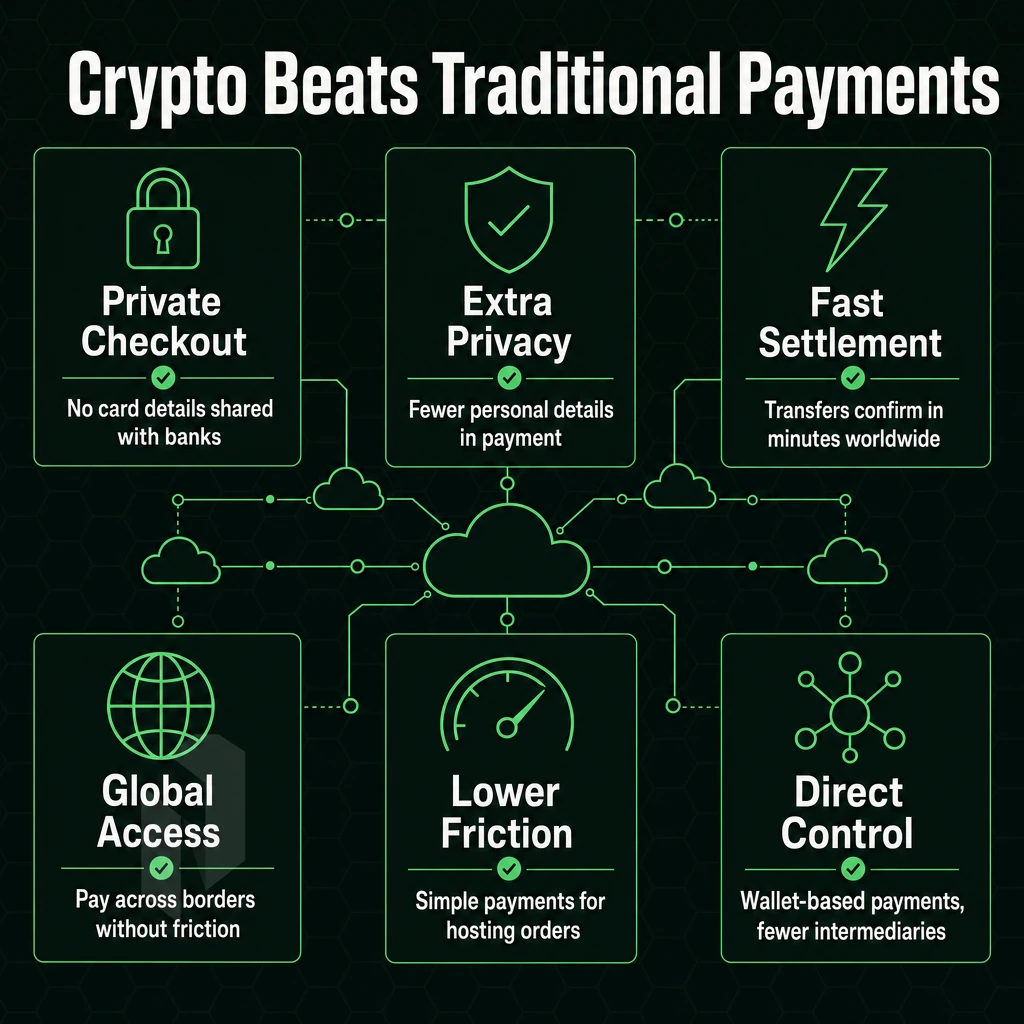
When you choose to pay for a dedicated server, the payment itself is important more than you think. Payments made in cryptocurrency can remove a number of ‘friction points’ from traditional billing. Here are the advantages, and hopefully you’ll find that crypto payments are the best way to pay for your new dedicated server. In conclusion buying with cryptocurrency streamlines procurement by eliminating intermediaries and reducing the administrative overhead that traditional payment rails impose on infrastructure purchases.
Organizations processing high volumes of infrastructure orders find that cryptocurrency payments reduce settlement delays and eliminate the chargeback exposure inherent in card-based transactions. Hosting providers that accept cryptocurrency payments typically offer the same tier of managed services and technical support as those using traditional payment methods, ensuring operational parity regardless of settlement rail.
Speed, Access, and Reduced Friction
Card and wire payments route through several institutions before they reach your provider, and every hop adds delay, a fee, or another approval step.
Being able to settle an invoice from anywhere in the world is a real advantage.
Card processors can add hidden fees to your processing, such as foreign transaction fees, currency conversion spreads, and chargeback processing fees.
Alignment With Crypto-Native Workloads
For teams running blockchain nodes (like full nodes or archive nodes), validator nodes, or lightning nodes (like lighthouse nodes or shopping carts), it’s natural to pay in the same crypto they’re operating in. This alignment makes sense for several reasons.
Firstly, accounting is made much simpler in terms of the assets that need to be monitored. Secondly, it ensures that the in-asset treasuries of such teams can remain to operate to pay hosting bills. Thirdly, it simply expresses their philosophical way of operating: to maintain operation of decentralized, blockchain-based infrastructure.
Of course, on-chain payments have their trade-offs. Congestion can impact confirmation times and increase the transaction fees. For smaller, recurring payments, however, the team can settle these off-chain first using Lightning, in the end, for only near-zero costs on-chain.
Note that for the monthly billing cycles of dedicated server hosting customers, even technical-savvy teams running their own Lightning infrastructure may find Bitcoin on-chain transactions are not the most practical way to settle these payments. Running a full node using bitcoin core requires stable uptime and sufficient disk I/O to keep pace with block propagation, making dedicated infrastructure a practical choice for serious operators.
Payment Method Comparison for Dedicated Server Orders
| Payment Method | Settlement Finality | Hidden Fees | Global Accessibility | Chargeback Risk |
|---|---|---|---|---|
| Credit / Debit Card | Days (reversible) | FX spread, processor fees | Limited by issuer / region | High |
| Bank Transfer (SEPA / Wire) | 1-3 business days | Wire fees, FX conversion | Moderate | Low |
| On-Chain Bitcoin | ~10-60 min (irreversible) | Network fee (variable) | Global | None |
| Bitcoin Lightning | Seconds (irreversible) | Near-zero routing fee | Global | None |
Lightning suits small, recurring amounts, while on-chain Bitcoin suits larger one-off payments where the network fee is a rounding error. Support varies by provider and processor, so confirm what is live before you order. Netrouting’s dedicated hardware servers are suitable for blockchain and validator workloads, high-throughput, low-latency traffic. The server configurations that crypto applications need are determined by those workloads. Teams provisioning bitcoin dedicated servers for these use cases benefit from root-level control and predictable resource allocation that shared hosting cannot provide.
Root access grants operators more control over system-level configurations, kernel parameters, and network stack tuning that directly impact node performance and reliability. Operators seeking maximum single-thread performance for cryptographic workloads often select configurations built on AMD EPYC processors, which deliver competitive per-core clock speeds and memory bandwidth for signature verification and block validation tasks. Configurations featuring AMD Ryzen processors offer an alternative for workloads prioritizing multi-threaded performance and power efficiency over raw single-core speed, particularly for development environments and test node deployments.
Common Use Cases: What People Run on Bitcoin-Paid Dedicated Servers
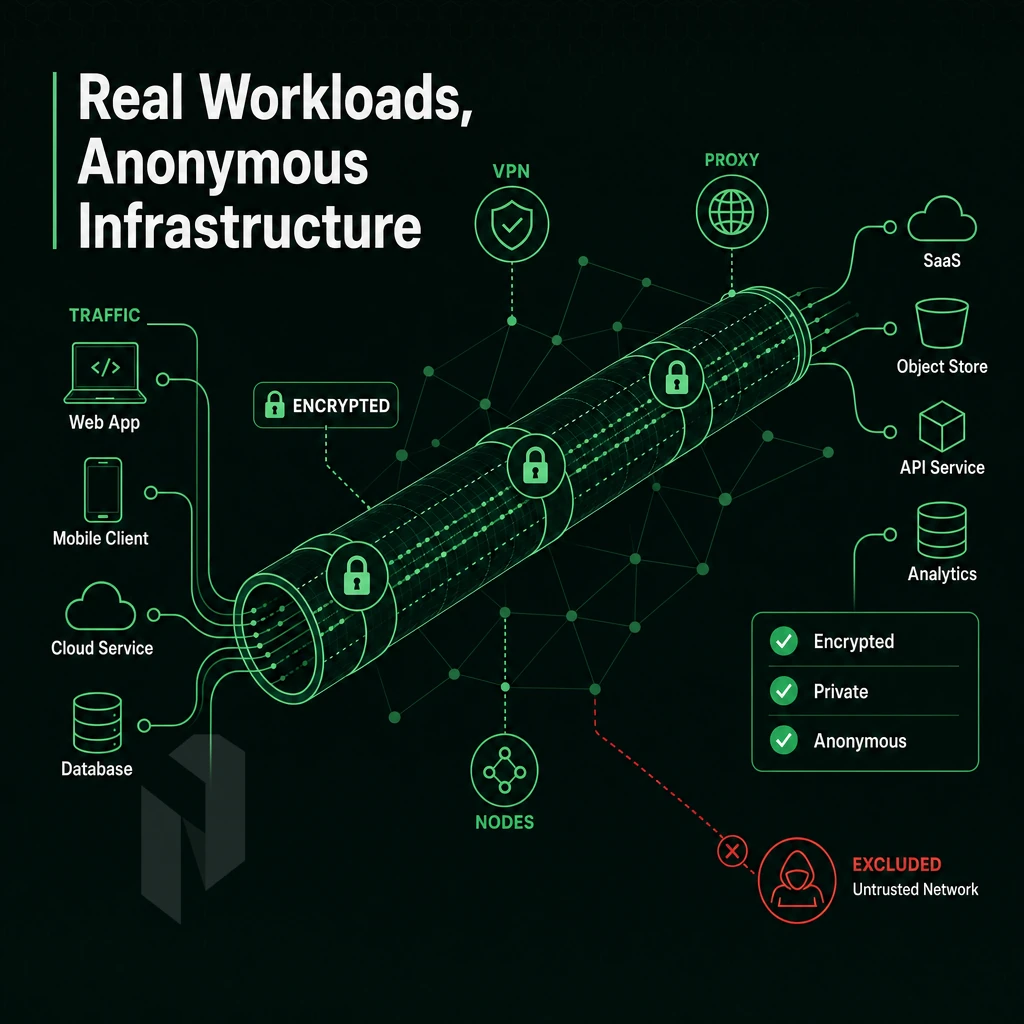
Dedicated hardware typically attracts a specific class of crypto-native operator: those who require full root access to the servers, the highest levels of raw performance on a consistent basis. Additionally, Payment options that do not involve banks. Below are some of the workloads that typically attract such users. Modern providers increasingly offer AMD EPYC processors alongside Intel Xeon options, giving operators the flexibility to optimize for core density, memory bandwidth, or per-thread performance depending on their specific node architecture.
Teams evaluating CPU options for cryptographic workloads frequently compare AMD Ryzen processors for development environments against EPYC-class chips for production node infrastructure, balancing cost with the parallelism required for transaction verification. Root-level access enables operators to implement custom firewall rules, intrusion detection systems, and kernel-level security hardening that shared environments cannot accommodate.
Blockchain Nodes and Validator Infrastructure
- Run full or validator nodes. Running blockchain technology requires dedicated resources. While a simple Ethereum or Bitcoin full node today already stores over 1 TB of chain data, the corresponding validator node, in addition to storing chain data, also signs transactions in real time. Thus, contention for shared CPUs would immediately have to be put to an end. In this context, required NVMe storage and high RAM of validator and full nodes are not options for VPS solutions, since required I/O throughputs cannot be guaranteed by VPS solutions.
- Run a Lightning node: As payment routing is latency sensitive and always on, a LN node requires a dedicated server with unmetered 10 Gbps connections to keep channels open and to charge competitive routing fees. Any downtime of the server will result in force-closed channels and lost funds.
Note: Validator nodes carry slashing risk. Confirm your provider's hardware replacement SLA before deploying, Netrouting targets same-business-day replacement under standard terms. Verify that your provider implements multi-layered security protocols including physical access controls, network segmentation, and intrusion detection to protect validator infrastructure from external threats and unauthorized physical access.
Dedicated Servers Use Cases for High-Traffic Bitcoin Apps
- Burst traffic generated by exchange and DeFi backends, such as order books and liquidity pools running on virtual environments, can be handled by bare-metal node servers, which have the necessary throughput. Built-in DDoS protection ensures that financial services, which are exposed to the public, are protected from targeted attacks.
- VPN providers and CDN operators run large fleets and settle a lot of infrastructure invoices. Paying in Bitcoin clears quickly and sidesteps the card limits and FX spreads that come with high-volume international billing.
- Game servers and community web apps. Crypto-native gaming communities and high-traffic forums that have lots of players online need lots of CPU and RAM that scales with the number of players online or the number of concurrent sessions.
Why Bare Metal Beats VPS for These Workloads
All of these use cases require predictable and uncontested resources. With full root access you can, for example, change kernel parameters, install custom network stacks and run containerized applications without hypervisor overhead. That control gap between dedicated and virtual server space is largest when it is needed most, i.e. with very demanding applications.
Once you have determined what you want to run, you will also want to understand how Bitcoin payments are processed from checkout to provisioning. Operators running sensitive workloads often prioritize providers that implement multi-layered security controls at the physical datacenter, network perimeter, and operating system levels to protect against unauthorized access and intrusion attempts.
How the Bitcoin Payment Process Works for Dedicated Servers
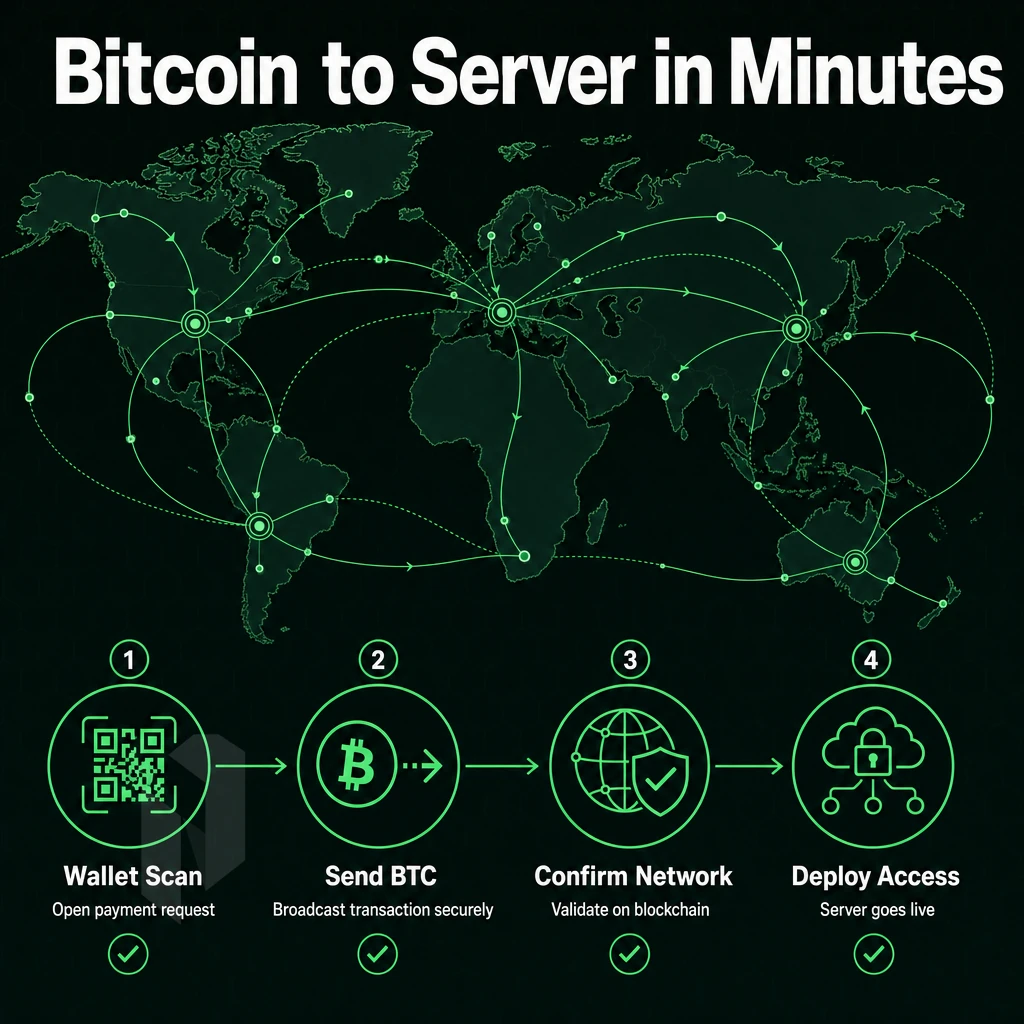
Paying with Bitcoin for dedicated servers involves several steps.
Bitcoin Dedicated Servers: How to Accept Bitcoin at Checkout
Start by choosing a server configuration (CPU, RAM, storage, bandwidth) and adding it to your shopping cart. Proceed to checkout and, in the payment section, select from a list of available cryptocurrencies, including Bitcoin and more. Many providers offer configurations powered by Intel Xeon or AMD Ryzen processors, allowing you to match CPU architecture to your specific workload requirements. At Netrouting, crypto orders settle through BitPay, so the crypto leg of the payment is handled by an established processor rather than by us directly.
Netrouting processes crypto payments through BitPay. BitPay generates the invoice for your order, locks the quoted rate for a short window, and confirms the payment to us once it settles. You complete it inside BitPay's checkout, from your own wallet or exchange account.
The invoice will lock in the correct amount to be paid, using the current exchange rate. Most payment processors will hold this rate for around 15-30 minutes, therefore the transaction must be sent within this time frame, in order to avoid the invoice being re-generated with a new quote.
Follow the BitPay checkout to complete the payment from your own wallet or exchange account. The checkout shows the exact amount and how long the quote is held, so send it before that window closes.
On-Chain Confirmation and Fast Provisioning
A typical Bitcoin transaction needs 1 to 3 on-chain confirmations before a provider marks it as paid, that's 10 to 30 minutes of block time. Some providers accept zero-confirmation transactions for low-risk orders, but most with the technical expertise to run dedicated server hosting wait for at least one confirmed block.
Automated Provisioning. We provision your dedicated machine servers within 60 minutes, complete with network configuration, OS installation and user credentials.
Accept Bitcoin Cash, Other Cryptocurrencies, and Billing Cycles
Many providers of Bitcoin hosting beyond BTC also offer hosting for other popular cryptocurrencies like Ethereum, Litecoin and Bitcoin Cash.
The billing cycle for a dedicated server is usually on a monthly basis. Some providers, however, offer to bill on an hourly basis and pay with crypto for their cloud compute offerings, rather than for a single-tenant server. The setup fees for a server are listed separately on the initial invoice and must be included in the total amount to be paid.
A dedicated server for crypto can be provisioned the same way as with card payments. Both utilize a settlement layer, so compare providers on hardware, network, and support.
What to Look for in Bitcoin Dedicated Servers Providers
Some providers who accept Bitcoin lack suitable infrastructure. Carefully review these key features before committing, or you risk losing time, performance, and money.
Hardware and Configuration Options for Cryptocurrency Transactions
Hardware quality sets the ceiling for what can run on your servers. Thus, high-quality servers are built with the latest platforms from Intel (Xeon) and AMD (EPYC). These servers offer the required core density, memory bandwidth and ECC memory support. For more context, see Blockchain.
A good provider will offer both pre-configured and fully customized dedicated servers tailored to your needs, featuring NVMe storage, hardware RAID, and high amounts of memory.
We use top class hardware such as Dell and Supermicro. This allows for maximum performance by using up to 2 TB of RAM and up to 24 drives. We can also configure servers to meet specific needs.
Network Quality and DDoS Protection
In doing throughput sensitive work, bandwidth caps really suck. So, look for dedicated ports with unmetered bandwidth in the 10 Gbps class, with some wiggle room for growth.
DDoS protection should be included by default rather than being offered as an additional service. The most important part of data center DDoS mitigation is always-on L3/L4 mitigation in order to give our customers time to upgrade their plans should an attack occur. Our network carries 2.4 Tbps+ of capacity across 10 locations. All services have baseline protection enabled by default.
Dense IX peering, not just upstream transit, helps to reduce latency and improve resiliency. Look at the peering of your provider at IX exchanges and where the datacenter is actually located.
AMD Ryzen Provisioning, Support, and Transparency
Crypto payments confirm in minutes. This is the kind of speed your server should be able to provision. Look for a hosting provider that can guarantee you a physical hardware server deployed within 60 minutes of payment confirmation. If they cannot commit to that window, their operations are not built for this.
Human support matters more than chatbots. A 24/7 NOC with a documented ticket response guarantee shows real accountability, we back that with a 1-hour response guarantee 24/7/365.
Even the best infrastructure means nothing if billing is opaque. Watch for these hidden fees: surprise cross-connect charges, bandwidth overages, and setup costs not disclosed before your first crypto payment.
- This needs to be checked against the agreed SLA uptime percentage (the default for many is 99.9%).
- Look for certifications like ISO 9001, ISO 27001 and a SOC 2 audit.
- Verify accepted coins, Major cryptocurrencies accepted beyond BTC (i.e. ETH, USDT, etc.) provide flexibility at time of checkout.
For Blockchain and Crypto workloads, especially those relying on bitcoin payments, the data center location where you deploy is a performance variable, not an afterthought.
Netrouting's Dedicated Servers for Crypto and Blockchain Workloads
The location of your distributed ledger nodes and trading engines is almost as important as the hardware they run on. Our global server locations let us offer dedicated server hosting across 3 continents, all within low latency of key financial and crypto-trading hubs, without the unpredictable costs hyperscalers charge for compute resources.
Key Locations for Crypto and Blockchain Workloads
We identified six sites suited for latency-sensitive blockchain applications. All bitcoin dedicated servers are hosted in carrier-neutral data centers with dense IX peering, minimizing network congestion between your servers and the exchanges, nodes, and counterparties you connect to.
| Location | Key Peering / Connectivity | Primary Crypto Use Case |
|---|---|---|
| Amsterdam | AMS-IX, LSIX, FRYS-IX, GNM-IX | European crypto hub; dense IX reach for node operators |
| Frankfurt | DE-CIX | DACH and CEE exchange connectivity |
| New York | 60 Hudson Street, DE-CIX New York | East Coast US financial infrastructure |
| Hong Kong | Submarine cable, Equinix HK IX | APAC financial gateway; Asia crypto markets |
| Singapore | Tata Communications Tier 1, local IX | Southeast Asian hub; broad APAC reach |
| Miami | FL-IX, NAP of the Americas | Latin America gateway; Bitcoin-active markets |
The Hague, Rotterdam, Stockholm and Bucharest are other locations throughout Europe. These locations are used for disaster recovery, for East European coverage and for lowest latency to the Balkans. This would be of interest to those running redundant Bitcoin or altcoin nodes for major cryptocurrencies.
Hardware Built for Blockchain Demands
All of our servers are powered by the latest AMD EPYC and Intel Xeon processors. The AMD EPYC processors support up to 512GB of RAM as well as multiple NVMe devices for high performance archival nodes.
All of our servers come with unmetered 10Gbps connectivity and can support up to 40Gbps for high volume work, plus always-on attack mitigation at no additional cost. Given the nature of the crypto space, volumetric attacks are common and we have you fully covered.
BTCPay Server and Full Control of Your Infrastructure
Dedicated raw hardware servers give you complete control over the software stack. For self-hosted BTCPay Server instances, Lightning nodes and validators, shared environments are too risky.
Most Blockchain Operators Start In Amsterdam / Frankfurt, NY For US Regulated Entities, HK / SG For APAC First, Miami For Latin America Connectivity. Choose The Closest Geolocation To Your Counterparties, As Latency Compounds With Every Block Of Confirmations. Below We Present You With A Review Of Netrouting’s Full Offerings For Those Ready To Commit.
Why Choose Netrouting to Buy a Dedicated Server with Bitcoin
Netrouting is built for buyers who need infrastructure-grade physical node, not consumer hosting dressed up with a crypto payment option. When you buy a dedicated server with Bitcoin, the hardware and network behind it matter as much as the payment method.
- Enterprise hardware, configured to your workload. Every dedicated server runs on Dell or Supermicro chassis with Intel Xeon or AMD EPYC processors, up to 2 TB RAM, and NVMe storage options. Custom dedicated servers are available for non-standard requirements, chain nodes, validation nodes, and high-density compute included.
- Fast provisioning after payment confirmation. dedicated host servers are online in under 60 minutes. No waiting days for a human to rack hardware.
- Full root access, no restrictions. You get full control of the OS, kernel, and network stack. Run any Linux distribution, any daemon, any custom build.
- 2.4 Tbps+ network on our own AS6206 backbone. Unmetered bandwidth at 10 Gbps is standard on dedicated servers. Always-on L3/L4 volumetric attack protection is included at no extra cost, no hidden fees, no surprise billing.
- 10 data center locations across Europe, North America, and Asia. Amsterdam, Frankfurt, The Hague, Stockholm, Bucharest, Rotterdam, Miami, New York, Hong Kong, and Singapore give globally distributed deployments real geographic flexibility.
- 24/7 NOC with a 1-hour ticket guarantee. Human support, ISO 9001, ISO 27001, and SOC 2 certified operations.
Netrouting accepts crypto payments through BitPay. Contact sales to confirm supported coins and walk through configuration options for your workload. Explore our dedicated servers or reach out to compare options directly.
Key Takeaways: Dedicated Servers and Bitcoin Payments
Crypto payments are a legitimate, practical way to buy dedicated server hosting. Bitcoin and other supported coins let you clear an invoice fast, without FX spreads or a card processor's reversal window. The payment method matters, but it's secondary to the hardware underneath it.
single-tenant hardware delivers the raw performance and full control that on-chain nodes, staking nodes, and latency-critical workloads demand. Evaluate any hosting provider on hardware quality, network capacity, provisioning speed, and human support, not just whether they accept bitcoin.
Netrouting offers enterprise-grade dedicated servers across ten data center locations spanning Europe, North America, and Asia. Every server ships with always-on traffic scrubbing, unmetered bandwidth options, and fast provisioning, physical machine ready in under 60 minutes. No hidden fees. No surprises. If you're ready to buy a dedicated server with crypto, explore Netrouting's dedicated server configurations here.
Frequently Asked Questions About Paying with Bitcoin
Do Providers With reliable infrastructure Accept Crypto for Dedicated Servers?
Yes. Netrouting accepts Bitcoin as a payment method for dedicated servers across all locations, Amsterdam, Frankfurt, Miami, New York, Hong Kong, Singapore, and more. You select your server configuration, choose Bitcoin at checkout, and complete the payment through BitPay. Once the transaction confirms, your server enters the provisioning queue.
Besides Bitcoin, what other cryptocurrencies can I pay with?
Contact the Netrouting sales team for the current list of accepted cryptocurrencies. Bitcoin is the most commonly requested option, but availability of other coins, such as Ethereum or stablecoins, depends on the payment processor in use at the time of your order. The sales team can confirm what's live before you commit.
How long does provisioning take after a Bitcoin payment confirms?
Netrouting provisions dedicated physical server servers in under 60 minutes once payment is confirmed. Bitcoin transactions typically require a small number of network confirmations before the payment is marked complete on our end. Factor in your expected confirmation time, usually 10-30 minutes for standard fee transactions, and your server will be online well within the hour.
Do I need to verify my identity to pay with crypto for a dedicated server?
Standard account registration is required to place any order with Netrouting, regardless of payment method. This includes a valid email address and basic contact details. Crypto payments are processed by BitPay, which applies its own account and verification rules to the payer. Contact the sales team before ordering if you have questions about what that involves for your order.
What happens if I send the wrong amount or my transaction is delayed?
Open a support ticket immediately. Netrouting's helpdesk operates 24/7/365 with a one-hour response guarantee, so the team can intervene before your payment window expires. Underpayments are typically held pending a top-up or manual review. Delayed transactions caused by low on-chain fees may require the team to extend your payment window, don't wait, contact support as soon as you spot the issue.
Can I pay monthly recurring invoices in Bitcoin?
Yes. Bitcoin isn't limited to the initial purchase, you can use it to settle recurring monthly invoices for your dedicated server. Because Bitcoin payments are manual rather than auto-charged, you'll need to initiate each payment before the invoice due date. Setting a personal reminder a few days ahead of billing avoids any service interruption.
Is a dedicated server better than a VPS for running a blockchain node?
For most production decentralized network nodes, yes. A dedicated server gives you exclusive access to CPU, RAM, and disk I/O, no noisy neighbours competing for resources. Full nodes for cryptocurrency payment networks like Bitcoin or Ethereum require an exact amount of dedicated storage and consistent I/O throughput that shared virtualisation environments, whether on hourly billing or monthly plans, often can't guarantee. Netrouting's raw server servers support up to 24 drives with hardware RAID, making them well-suited for archival and full-node workloads that would saturate a typical VPS.
Paying in Bitcoin does not change what you get. Same hardware, same network, same support. It changes how quickly the invoice clears and how few parties sit in the middle of it.
That matters most for latency-sensitive deployments, cross-border orders that would otherwise wait on a wire, and teams holding a crypto treasury who would rather pay from it than convert to fiat first.
Your choice of provider will define every other choice you go on to make. Hence look for a real unvirtualized server service, a proper carrier-grade network, and a checkout that lets you pay for a dedicated server with crypto natively, not via some manual workaround bolted on afterwards.
Netrouting’s offering of dedicated servers in 10 European, North American and Asian locations is backed by a 2.4 Tbps+ network. On top of that, all servers come with unmetered 10 Gbps connections as well as DDoS protection that is always on. At checkout, Bitcoin payment is available. The dedicated servers by Netrouting can be viewed in detail here. If you have special needs for your workload, please don’t hesitate to contact our sales team.