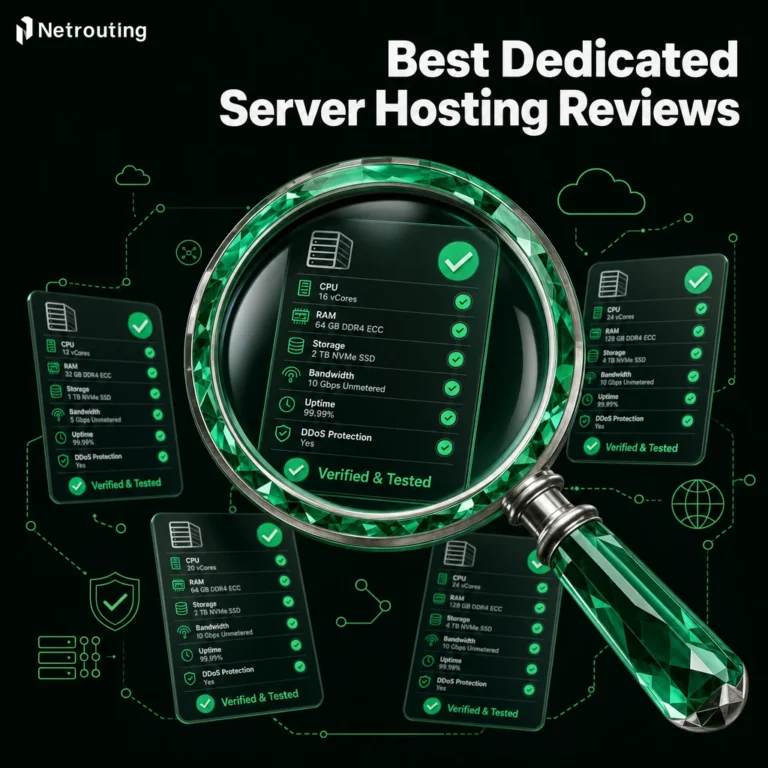
Dedicated server hosting is a form of hosting that provides high levels of performance and control. Because many believe that dedicated server hosting is expensive, however, it is often not considered by companies who would in fact benefit from it. However, there are now many cost effective dedicated hosting options available, which are more cost effective than most IT buyers realize, with low costs for hardware as well as a global footprint from hosts.
Finding a dedicated server is not the hardest part. Then you have to choose the right locations to minimize latency for your users. Even the most cheap dedicated server configurations can deliver superior latency compared to distant cloud regions when strategically placed near your user base. Selecting a provider with robust peering agreements and direct connections to major internet exchanges further reduces low latency, ensuring consistent response times for global audiences. For more context, see netrouting.com/dedicated-servers.
Providers that offer generous bandwidth allocations at each location enable you to serve content-rich applications without worrying about overage fees or throttling during traffic spikes. Providers operating multiple data centers across continents give you the flexibility to deploy servers closer to regional user clusters, improving both latency and compliance with local data residency requirements.
Blog contents

In this guide, we explain in more detail how the prices for dedicated servers are composed. We also explain which configuration is the most cost-efficient for typical workloads. We also provide a checklist for choosing a hosting provider. The main criteria are: network, SLA, support. But also: response time, deployment time. Our goal is to help you choosing the dedicated server that best fits your needs.
What Is a Cheap Dedicated Server Hosting Provider?
bare-metal hosting is defined as one physical server or machine for one tenant or customer, usually you. This type of hosting does not utilize any shared server resources that could be impacted by other tenants, or neighbors, on the same server for example.
The key question to ask when comparing dedicated servers to shared hosting is whether the increased performance of dedicated servers provides enough value in terms of performance per dollar versus shared hosting for serious workloads. For community perspectives, see Cheap dedicated server advise : r/selfhosted .
What Dedicated Server Hosting With Fast Storage Actually Means
Compared to hosting with a shared server or in a virtual machine, with a dedicated server you do not compete for CPU cycles, RAM and I/O access. Instead, you are allocated the entire server, i.e. all cores and all gigabytes of RAM, to your workload.
Root access is enabled by default. This means you have full control of the OS, can set custom kernel parameters, and are not restricted by your hosting provider as to the software you run and how you configure it.
Defining Affordable Disk Space in This Context
By “affordable” I mean we get the maximum amount of service out of each dollar of hardware. Thus a dual-socket AMD EPYC server with NVMe storage and 10 Gbps of bandwidth, all of it unmetered. Is vastly more valuable to you than some cheap “entry-level” server with severely limited hosting services and with a ton of charges for egress etc. Pairing that processing power with fast storage ensures your applications can sustain high throughput without bottlenecks at the disk layer.
- Full hardware dedication, no noisy-neighbour CPU contention.
- Predictable monthly cost with no surprise egress fees.
- Enterprise-grade components: Dell and Supermicro platforms.
Where Dedicated Servers Reach Maximum Performance
Workloads like high-frequency trading, video transcoding, and database-intensive applications quickly expose the limitations of shared infrastructure in data centers. Here, a dedicated server with a 24-core AMD EPYC 7402p processor and 512 GB of RAM is able to handle loads that would quickly overwhelm a VPS cluster. Selecting the right number of cpu cores depends on whether your workload benefits more from high single-thread performance or from parallel processing across many threads.
Modern data centers equipped with redundant power and cooling infrastructure ensure these servers maintain consistent uptime even under sustained heavy workloads. Dedicated infrastructure minimizes downtime by isolating your workload from noisy neighbors and providing predictable resource availability that mission-critical applications depend on. Servers equipped with enterprise-grade NVMe drives further accelerate I/O operations, reducing query latency for transactional databases and real-time analytics platforms.
We deliver affordable dedicated servers to bare metal very fast, in under 60 minutes! The powerful 2.4 Tbps+ network is included as well. So, what does dedicated servers offer in terms of quality of service and how does it compare to virtual servers?
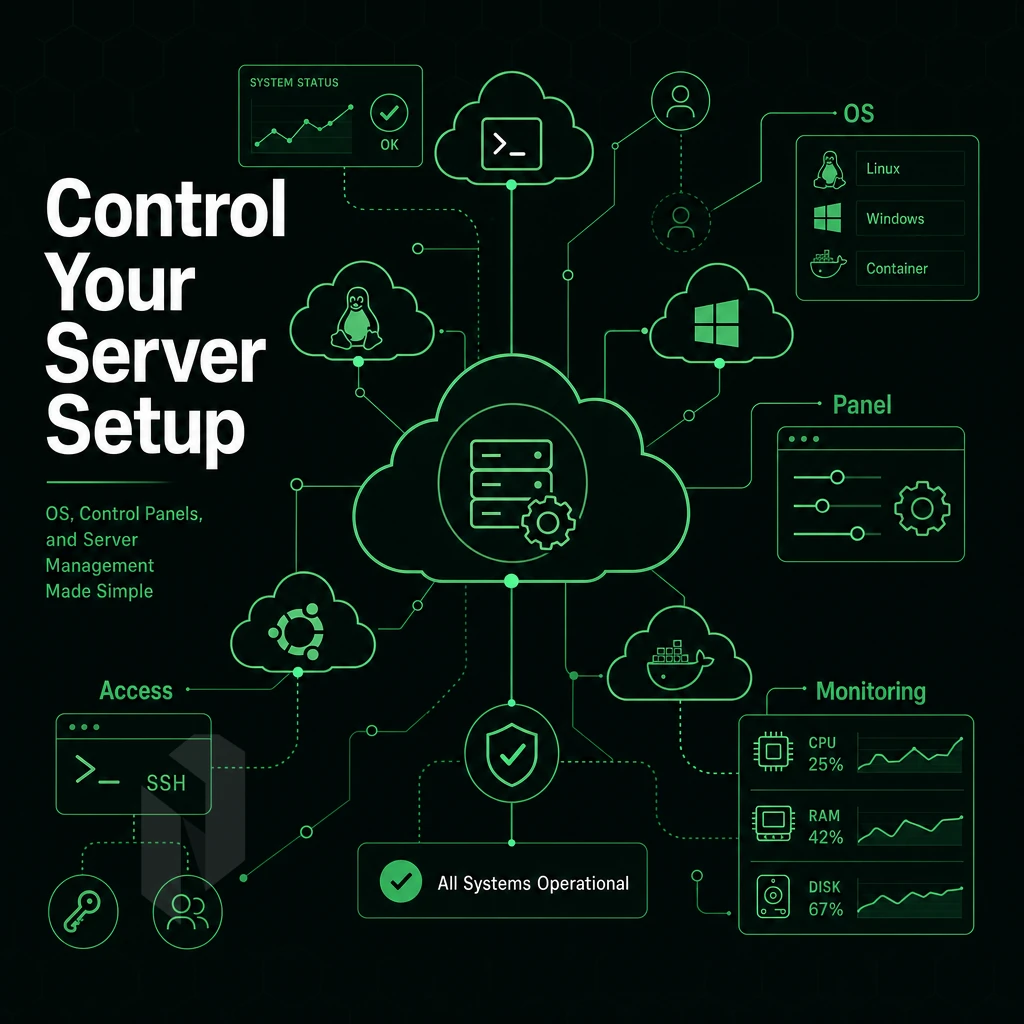
Operating Systems, Control Panels, and Server Management
Affordable dedicated server hosting is an affordable option that gives you 100% control of all the layers in your stack, including the Operating System. Your choices here greatly affect the flexibility of your team and the amount of overhead that your operations team will have to handle for maximum performance.
AMD Servers in Operating Systems and Windows Environments
Linux is the most common Operating System used in web hosting. For long term support, Ubuntu LTS, Debian, AlmaLinux and Rocky Linux are popular choices to host high traffic websites, applications and databases.
If your application is written in .NET or you need to run Active Directory and/or MSSQL databases, we can provide Intel Xeon-powered Windows Servers that are cost-effective when compared to standard licensing costs. We support both the Windows Server family as well as the Enterprise family across our dedicated hardware. For more context, see Web hosting service.
Control Panel, Root Access, and Modern Data Centers
A control panel for hosting such as cPanel or DirectAdmin allows your team to manage numerous websites or client accounts as if they were running numerous individual sites. This centralized approach simplifies onboarding for new users and reduces the learning curve when managing multiple domains or hosting accounts. Many control panels also provide online dashboards that let administrators monitor resource usage, configure email accounts, and deploy SSL certificates without requiring command-line expertise.
The ability to have full access to a server (unrestricted root) is what distinguishes dedicated servers from shared server environment.
Security Measures and Server Hardware Management Options
Our Managed Hosting services shift these responsibilities to us, and include updates to the OS, security hardening and monitoring to name a few. Regular backups and proactive monitoring also help prevent data loss, ensuring business continuity even during unexpected hardware failures or security incidents. Volumetric attack protection is especially critical for mitigating ddos attacks that can overwhelm network infrastructure and cause prolonged service outages.
Clients consistently report great service when their provider combines technical expertise with responsive communication, ensuring issues are resolved before they impact production workloads. Proactive monitoring and rapid incident response minimize downtime, keeping critical services available and protecting revenue during peak business hours.
For most growing infrastructure teams, managed server management reduces risk without losing control. All of the above options for hardware, network and management are offered by a single provider: Netrouting.
Frequently Asked Questions About Data Centers
Does running Intel Xeon on own hardware beat a virtual machine in data centers?
A dedicated server gives you exclusive use of physical hardware, every CPU core, every gigabyte of RAM, every storage drive is yours alone. A VPS shares the same physical machine with other tenants, so CPU and I/O resources are divided and can be contested. Dedicated servers deliver consistent, predictable performance that VPS instances simply cannot guarantee under load. This exclusive allocation of resources enables blazing fast performance for latency-sensitive applications that demand consistent response times under peak load conditions. Organizations migrating from a virtual machine environment often see immediate improvements in disk I/O and network throughput once they transition to dedicated hardware.
What does affordable dedicated server hosting with Intel Xeon processors typically cost?
Pricing varies by hardware generation, RAM, storage, and bandwidth, so the best approach is to contact a provider directly for a current quote. What matters more than a headline figure for computing power is total cost of ownership: look for predictable monthly billing, no surprise egress fees, and included extras like volumetric attack protection and a private network.
What operating systems can I run on a dedicated server?
Most providers support all major Linux distributions, Ubuntu, Debian, CentOS, AlmaLinux, Rocky Linux, plus Windows Server editions. With full root or administrator access, as commonly used in professional data centers, you can also install custom or minimal OS images, run containerized environments, or deploy a hypervisor like Proxmox VE to host your own virtual machines. The only hard limits are hardware compatibility and any licensing requirements for proprietary operating systems.
Is Unmetered Unlimited Bandwidth Really Unlimited on Dedicated Servers?
Unmetered means you are not billed per gigabyte transferred, it does not mean the port speed is uncapped. Your server connects at a fixed port speed, commonly 1 Gbps or 10 Gbps, and you can use that connection continuously without overage charges. Netrouting, for example, includes unmetered 10 Gbps on dedicated servers built with modern hardware, with options up to 40 Gbps for high-throughput workloads. Always confirm the port speed and fair-use policy before assuming "unmetered" equals unrestricted throughput. Sustained high bandwidth utilization is ideal for content delivery networks, large file distribution, and real-time streaming services that require consistent throughput around the clock.
How quickly can a dedicated server be provisioned?
Provisioning time depends on whether the hardware, including cpu cores, is pre-racked and whether your chosen configuration is in stock. Custom builds, non-standard RAM, additional drives, or specific RAID setups ordered through online stores typically take longer and are quoted individually. If speed matters, ask the provider which configurations are available for rapid deployment before you order. Many providers now offer online configuration tools that let you select components and see real-time availability, streamlining the ordering process for standard builds.
Do affordable dedicated servers include DDoS protection?
Not always, some budget providers charge extra for any mitigation even in custom setups, leaving unprotected servers exposed to volumetric attacks. Netrouting includes always-on L3/L4 distributed denial-of-service mitigation with every service at no additional cost, automatically detecting and blocking network-layer attacks and their associated bandwidth consumption without any configuration required. Confirm what is included before signing, bolt-on protection can significantly change the real cost of a "cheap" server.
What is root access and why does it matter on a dedicated server?
root access gives you full administrative control over the server's operating system, a great service feature that lets you install any software, modify system configuration, manage users, and run processes with no host-imposed restrictions. Without it, you are limited to whatever the provider permits, which rules out custom kernels, non-standard daemons, and most security hardening workflows.
On a dedicated server, full root access is standard; on shared web hosting or some managed VPS tiers, it is often withheld. It is the single most important factor separating true dedicated hosting from constrained environments.
Dedicated servers have a decisive edge over VPS servers in terms of actual performance, namely in CPU performance, RAM and infrastructure isolation. While marketing departments claim that more RAM or faster CPUs are decisive, in reality it is the actual hardware, e.g. the generation of the CPU, the type of storage, the number of ports, etc. The difference between affordable dedicated servers and enterprise-grade dedicated servers is largely closed by the use of NVMe storage and unmetered 10 Gbps uplinks.
The hardware is paired with a good backbone. Netrouting is hosting dedicated servers on the latest Intel Xeon and AMD EPYC servers in 10 locations worldwide (Stockholm, Amsterdam, Frankfurt, Miami, New York, Hong Kong, etc.).
You can view all the servers we offer and contact our sales team to get a custom setup for your needs.