Choosing a good dedicated servers provider can lock in your performance, support, and cost for months or years. Choosing well means your dedicated servers and infrastructure will migrate quickly, consistently, and with minimum intervention.
We try to cut through a lot of the 'plastic' information available online and draw upon our 10 years of dedicated servers and infrastructure experience.
Here are the 5 key factors that separate good dedicated server companies from terrible ones to spend your money on. We'll go over each factor in detail for dedicated servers, including hardware, network, deployment, support, and the total cost of ownership when compared to the cloud. By the end of this post you’ll have a solid framework for evaluating dedicated server providers and a shortlist that’s based on reality as opposed to marketing hype.
Blog contents
What Dedicated Servers Actually Are (and Why They Differ from VPS)
A dedicated server is a complete server dedicated to your use, with no other tenants or shared resources. It is this physical isolation from other servers that differentiates dedicated hosting from other types of hosting services.
Dedicated Hosting Service vs. Shared and Virtual Hosting
Shared hosting has dozens of sites competing for CPU and RAM. VPS slices one physical server into virtual servers, better than shared hosting, but those virtual servers still share the physical server with your neighbors.

Dedicated servers are unique in that they remove two key issues found with Shared Servers and Virtual Private Servers: noisy-neighbors and hypervisor overhead. With dedicated servers, you have complete control and access to all cores, all memory (up to the physical capacity of the server), and all I/O operations. This level of isolation means the entire server operates exclusively for your applications without resource contention from other users.
This architecture makes dedicated servers particularly well-suited for intensive workloads that demand predictable performance and maximum resource availability. Organizations seeking performance enhancements often choose dedicated servers specifically to eliminate the unpredictable slowdowns caused by shared infrastructure and virtualization layers. This combination of full resource control and physical isolation delivers unmatched performance for applications where consistency and speed are non-negotiable.
What Bare Metal Servers Actually Mean
Bare metal servers are physical servers running workloads directly on the actual hardware.
Typical dedicated server plans include root access, hardware RAID, and allow you to pick your OS. Most providers support a wide range of linux operating systems including Ubuntu, Debian, CentOS, and Rocky Linux for maximum flexibility. Many providers also support the windows operating system for customers who require Microsoft-based environments or specific enterprise applications.
Who Offers the Best Dedicated Server Options?
A good dedicated server hosting service is dependent on several factors including the load on your servers, where your customers are located and what kind of support you require.
We offer dedicated web hosting in 10 locations: Stockholm, Amsterdam, The Hague, Frankfurt, Bucharest, Rotterdam, Miami, New York, Hong Kong and Singapore.
We deploy bare metal servers within 60 minutes or less. This is the base from which we can start to evaluate other hosting providers against the real important criteria.
Key Criteria for Evaluating Dedicated Server Providers
| Provider | Performance | Support | Uptime SLA | Network | Best For |
|---|---|---|---|---|---|
| Netrouting | Latest Intel Xeon and AMD EPYC; up to 2 TB RAM, 24 drives, hardware RAID | 24/7 NOC; 1-hour ticket guarantee; server management and managed hosting services available | 99.9% SLA; bare metal provisioned in under 60 minutes | 2.4 Tbps+ backbone (AS6206); unmetered 10 Gbps; free private network between resources; always-on L3/L4 mitigation | Businesses needing a dedicated hosting service with global reach, dense IX peering, and a free private network |
| Hyperscaler cloud platforms | Broad instance catalog; shared tenancy by default; bare metal options limited | Tiered support plans; enterprise tiers costly; extensive documentation | 99.9%-99.99% depending on service and region | Global backbone; high egress costs; built-in CDN and load balancing | Teams already deep in a managed-service ecosystem needing PaaS breadth |
| Budget bare-metal providers | Older-generation hardware; limited custom configurations; basic server management | Ticket-only; slower response windows; minimal managed hosting services | 99.9% standard; hardware replacement timelines vary | Shared uplinks; limited IX peering; no guaranteed private network | Cost-sensitive projects with predictable, low-complexity workloads |
| Regional colocation-only operators | Customer-supplied hardware; no standard dedicated hosting service offering | Remote hands available; limited proactive server management | Power and cooling SLA only; server uptime is customer responsibility | Carrier-neutral cross-connects; network quality varies by facility | Enterprises that own hardware and need carrier-neutral space |
A strong all-round dedicated hosting provider for most buyers would be Netrouting. As they have been offering dedicated servers with current-generation hardware for many years on top of a 2.4 Tbps+ private network that even includes a free private network between resources. On top of that, they offer managed hosting services and 24/7 server management support under a 99.9% SLA.
Companies that require a global presence with dedicated servers for hosting in Europe, North America and Asia outside of the large hyperscalers with their unpredictable egress charges. Should definitely start with Netrouting and then choose the appropriate provider tier from there. After that, the question is how much of the operational layer you want to manage yourself.
Managed vs Unmanaged Dedicated Servers: Choosing the Right Level of Control
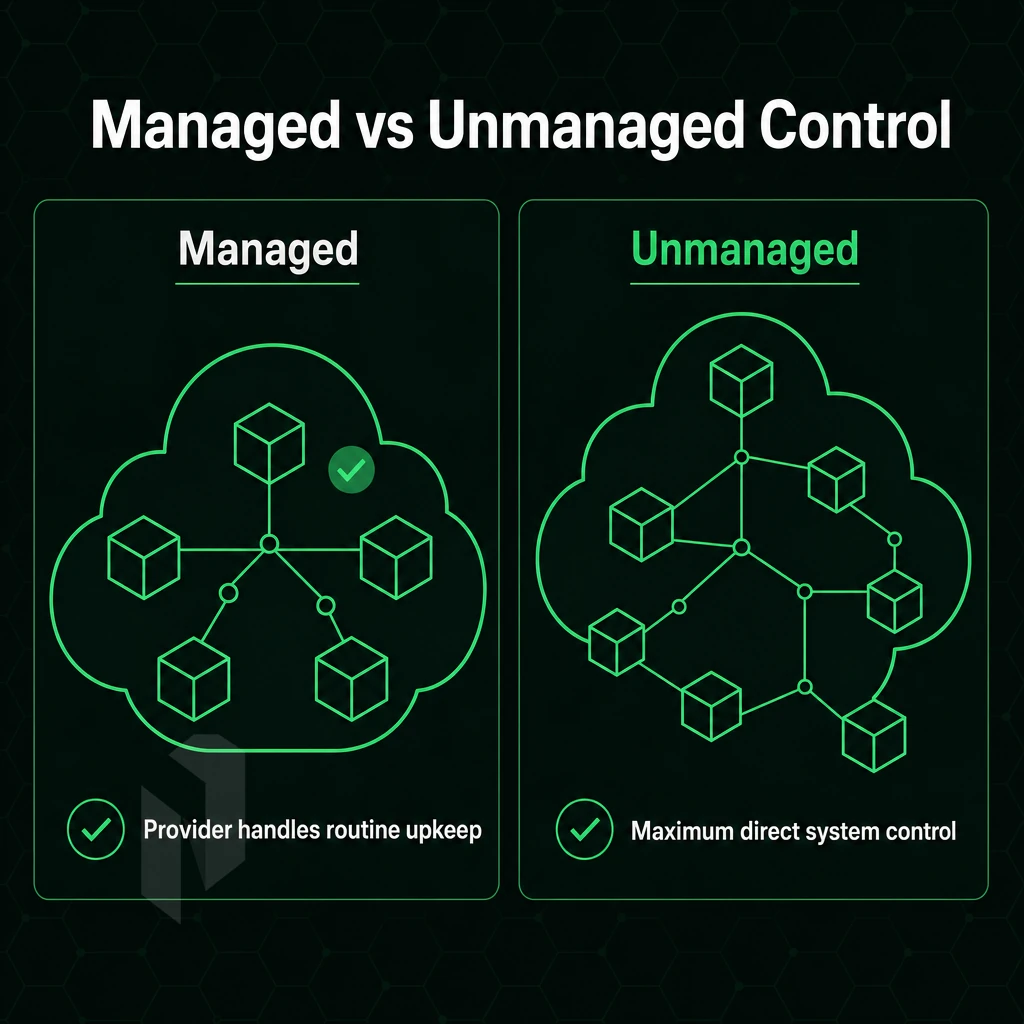
Most dedicated servers fall on a spectrum between fully autonomous servers, where you control the OS, patches, and software, and fully managed servers, where your provider handles operations so you can focus on your application.
Assessing Your Administration Needs
- Assess your team’s server administration capacity. If you have in-house Linux or Windows system administrators, then unmanaged hosting provides the greatest amount of flexibility. However, if you have a small, under-resourced or development-focused team then managing servers could become a burden.
- Document your security requirements. Unmanaged cloud servers are yours to patch and secure as you see fit. Managed hosting on the other hand shifts this burden to your hosting provider, a relief to many operating without dedicated operations staff.
Note: Skipping regular operating system updates on an unmanaged server is the single most common cause of preventable breaches. Build a patching schedule before you deploy.
Choosing Your Control Level
- Root access: Unmanaged servers allow full access to a server (all packages, daemons, config files, etc ). Managed servers have the same access, but also include monitoring and patching on top of that. Deciding on root access is part of picking a server type.
- Software licenses are a factor to consider. Many Managed Control Panel options include the cost of licenses for software such as cPanel or DirectAdmin in the price. With Unmanaged Servers you will need to obtain and manage the licenses for these products yourself.
How Much Do Dedicated Servers Cost to Host?
Pricing for dedicated servers is typically determined by server type (hardware), by level of service (management), and by location.
Just because you can spend less money on a dedicated server, doesn’t mean you should. For lean organizations, a managed internet hosting service can be less expensive than the cost to hire additional staff to manage unmanaged servers and infrastructure.
Organizations evaluating dedicated server hosting should calculate the total cost of ownership including personnel, software licensing, and potential downtime before making a decision. When comparing dedicated web hosting to cloud alternatives, factor in the predictable monthly costs and absence of surprise egress fees that often inflate cloud bills.
We offer both self-managed bare metal servers and fully managed dedicated servers at Netrouting.
All Our Dedicated Servers: Hardware Specs That Drive Performance
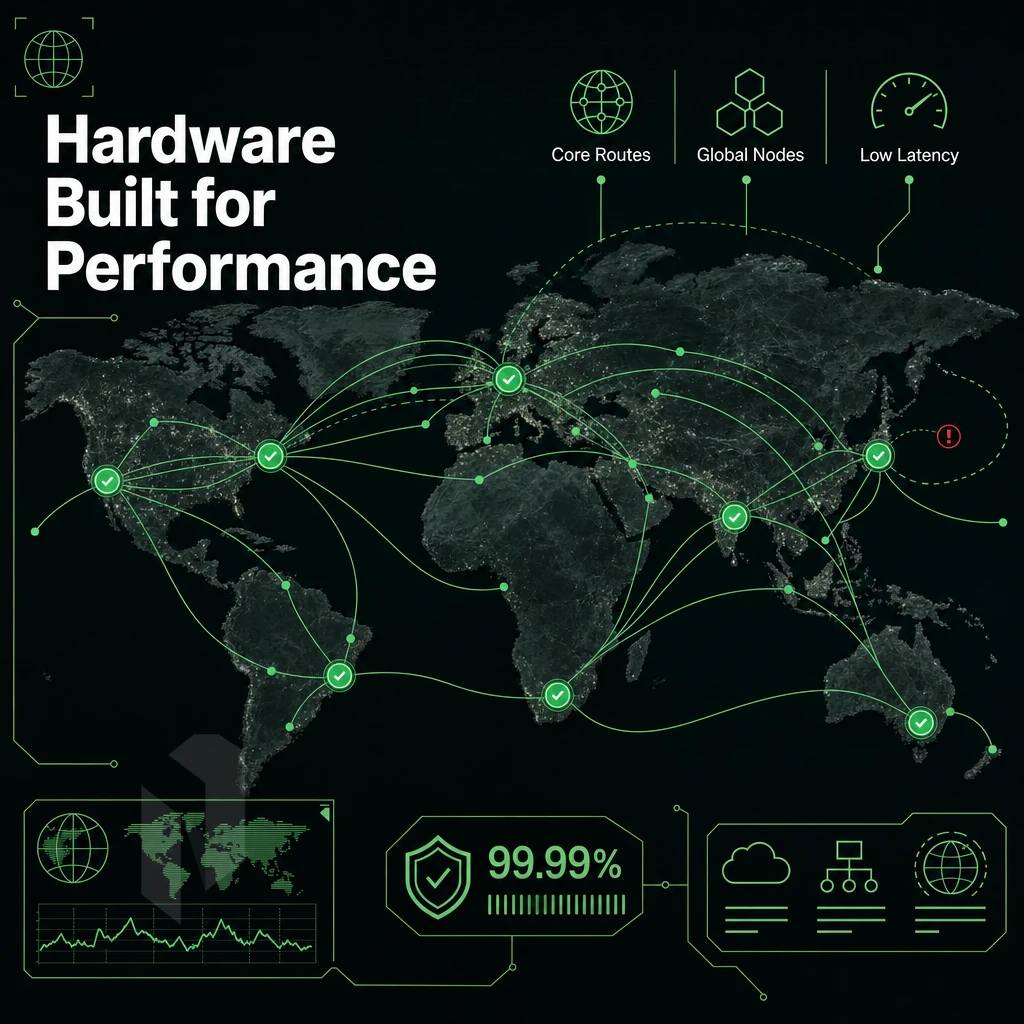
Not all dedicated server providers are built equally. The real measure of server hardware quality is how well your workloads will perform under load, not just on paper. Evaluating server hardware specifications should include examining component reliability ratings, thermal management capabilities, and the provider's hardware refresh cycle to ensure long-term stability.
Computing Power: CPU and Memory
Our dedicated servers are offered on Dell and Supermicro platforms and are supplied with the latest models of Intel Xeon and AMD EPYC processors. Each server configuration includes enterprise-grade ssd storage options designed to deliver consistent IOPS for database-intensive applications and high-traffic websites. Customers can scale storage space vertically by selecting configurations with multiple drive bays to accommodate growing data requirements without migrating to new hardware.
RAM can scale up to 2TB per physical server. On dedicated servers running in-memory databases, virtualization hosts, and real-time analytics, memory becomes a bottleneck way before the CPU and all that extra RAM is put to very good use.
Storage: SSD, HDD, and RAID Arrays
Supports up to 24 drives per server. SSD storage reduces latency for high-performance transactional workloads, while a hardware RAID array also improves sequential throughput.
What Does Managed Dedicated Servers Hosting Include?
Managed hosting includes OS patching, security hardening, and proactive monitoring, yet you retain full control via root access. Our data centers are backed by a 99.9% uptime service level agreement and same-business-day hardware replacement.

Dedicated Servers With GPUs for AI and ML
We offer a variety of NVIDIA GPUs for inference and training workloads, including RTX 6000, A10, A40, and A100. These dedicated servers are paired with high-memory GPUs and EPYC or Xeon hosts to deliver ample computing power for your AI workloads, all without the hyperscale overhead.
Netrouting’s bare metal hosting offers competitive pricing combined with the highest quality Dell and Supermicro hardware, deployed within 60 minutes within 10 datacenters worldwide.
While strong hardware is key to good dedicated servers, the network connecting them to users and protecting them from attacks matters far more for real-world reliability.
Network Quality, DDoS Protection, and Private Network Capabilities
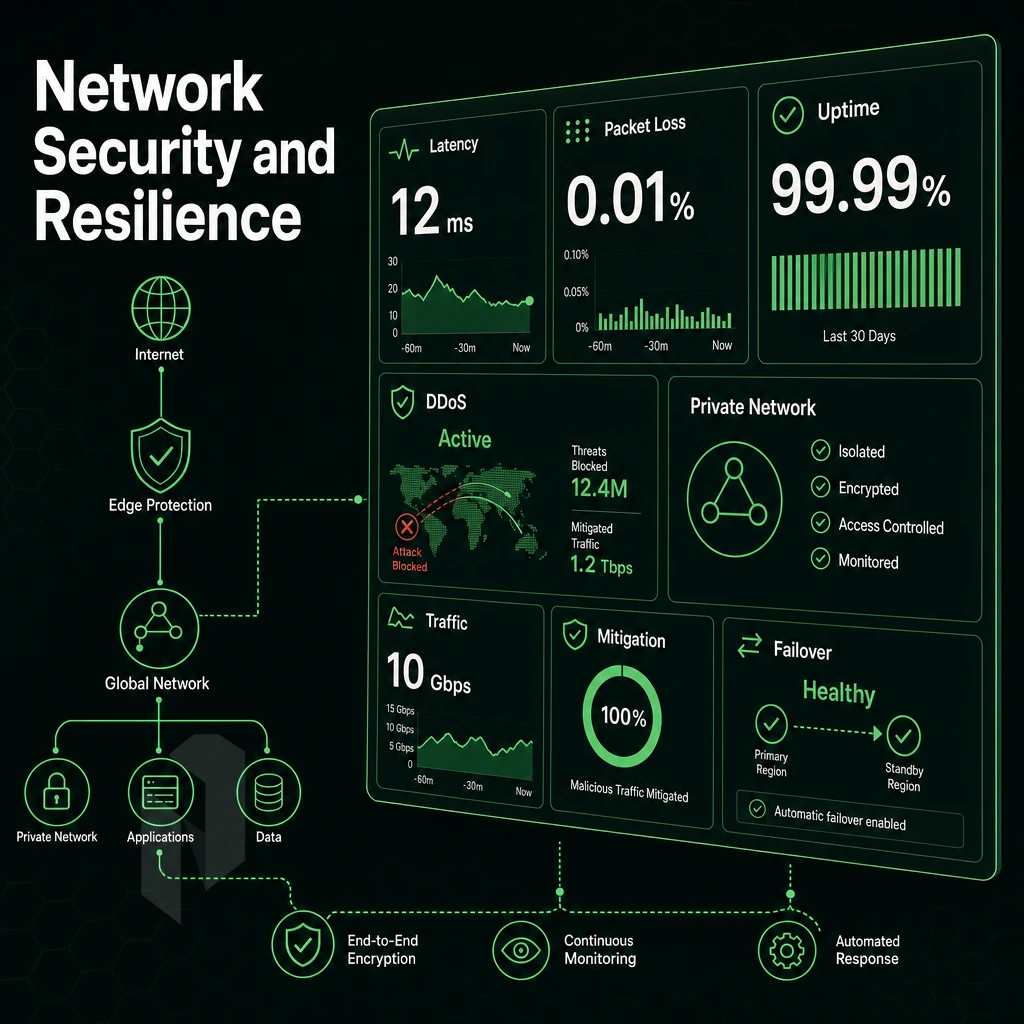
While hardware specs are important for high-traffic workloads, the network supporting your bare metal servers is even more important to deliver consistent performance vs. dropped packets under load. The number of carriers available, peering depth, and ability to mitigate DDoS attacks are key differentiators between budget dedicated servers and high-end providers.
All Our Servers Ship With Unmetered Bandwidth and Built-In DDoS Protection
All servers on our network include unmetered 10 Gbps bandwidth, with ports scaled to 40 Gbps for high-demand applications, no throttling or surprise overage on outbound traffic.
L3/L4 DDoS protection is included 24/7/365 as part of our standard offerings. Our L3/L4 DDoS protection has a mitigation capacity in excess of 1 Tbps and will automatically mitigate volumetric attacks so they never reach your servers.
We are operating AS6206, a Tier 1 Backbone with more than 2.4 Tbps of total capacity.
Free Private Network Between Your Resources
Every deployment includes a free private interconnect (up to 40Gbps) between your servers. This allows for things such as mirroring a RAID array between multiple servers or even separating an application from a database, all without sending traffic across the public internet.
Which Dedicated Servers Provider Is Best for High-Traffic Workloads?
Netrouting is your answer to higher bandwidth, greater uptime and better protection against attacks. Our dedicated servers and hosting solutions can be tailored to your needs, whether it is the speed of connections on ports, the amount of dedicated IP addresses or BGP on multiple locations.
You can tailor all aspects of your hosting solution to your specific needs, such as storage, computing and connectivity. In the following section we’ll explain when dedicated hosting or cloud hosting is the better choice for you.
Dedicated Hosting vs Cloud Hosting: A Side-by-Side Comparison
Dedicated and cloud-based infrastructure choices determine performance, compliance and cost.
Side-by-Side Customized Solution Comparison
| Dimension | Dedicated Server | Cloud Hosting |
|---|---|---|
| Performance | Consistent, no noisy-neighbour contention; up to 40 Gbps throughput | Variable under shared load; cloud servers burst well but can throttle |
| Uptime SLA | 99.9% standard | 99.9% standard |
| Root Access | Full exclusive access to hardware and OS | OS-level only; hypervisor is shared |
| Security | Enhanced security, isolated hardware, custom firewall rules, full audit control | Shared infrastructure; provider manages security patches at the hypervisor layer |
| Scalability | Vertical; hardware upgrades take time | Elastic horizontal scaling in minutes |
| Software Licenses | You control software licenses, bring your own or add managed panels | Often bundled or metered per instance |
| Setup Fees | Typically none at Netrouting; provisioned in under 60 minutes | Usually none; instant spin-up |
| Sensitive Data | Ideal, single-tenant, meets strict compliance requirements | Requires additional controls; multi-tenancy adds risk surface |
When Dedicated Servers Win
High-throughput workloads like online gaming, video streaming, and AI inference demand consistent performance that shared infrastructure can't deliver, making dedicated servers the natural choice. Organizations in highly regulated industries requiring single-tenant isolation also can't scale within a private cloud or VPS hosting tier.
When Cloud Suits Better
For highly fluctuating elastic workloads cloud provides very good scaling with on-demand resources.
On the other hand, Netrouting’s dedicated servers provide the best long term solution as they offer stable and high performing hardware for stable, high throughput workloads with fixed and predictable monthly costs. Next to selecting the right model for your use case, choosing the right specs for your dedicated servers is equally crucial.
Finding the Best Dedicated Servers for Your Workload
Determine the appropriate dedicated server configuration to match your application workload.
Preparation: Define Your Requirements
- Determine your workload type. Web servers and online applications require high single-thread CPU performance. Video streaming and online gaming workloads require high bandwidth and very low latency. AI/ML inference workloads require GPU compute and very large amounts of RAM.
- Decide on the size of CPU, RAM and storage required. High traffic sites need more cores. Some databases are very memory intensive and require 256GB+ of RAM. Storage requirements vary greatly and some require high speed storage such as NVMe while others require large SATA arrays to hold bulk data.
- Choose your operating system. For most workloads, Linux-based operating systems will provide adequate functionality without any associated licensing fees. For environments that are heavily dependent on.NET, Microsoft SQL Server, or otherwise require a Windows-based operating system environment, use Microsoft Windows Server.
Note: Skipping the OS decision early forces a rebuild later. Confirm application dependencies before provisioning.
Execution: Configure and Deploy
- Determine the required bandwidth and network capacity for your selected activities such as streaming and gaming. Ensure that bandwidth for operating system updates and patches does not overwhelm your production bandwidth. Unmetered 10 Gbps uplink connectivity is well suited for these activities.
- Custom solution for non-standard requirements requested. Growing businesses with unusual storage, GPU or high-density power requirements should contact sales directly to have Netrouting engineers design a custom solution not offered in our standard product catalog.
Verification: Confirm Fit Before Go-Live
- Ensure you have the right infrastructure. Validate the final version of the specification against your peak load assumptions. Review the Service Level Agreements (SLAs), hardware replacement cycles and service response times against your required uptime.
Once you have defined your requirements, the final decision criterion is: Can this provider deliver what you need on dedicated servers, consistently, at scale, with the right level of support?
Why Choose Netrouting for Dedicated Server Hosting
Netrouting is a dedicated hosting service built for teams that need real hardware, real control, and a network that doesn't flinch. Our bare metal servers run on Dell and Supermicro hardware, Intel Xeon and AMD EPYC, provisioned in under 60 minutes. Every dedicated server plan includes unmetered 10 Gbps bandwidth, always-on DDoS protection, and a free private network between your resources.
- Own Tier 1 backbone: AS6206 with 2.4 Tbps+ capacity and dense IX peering across our 10 data centers.
- Global reach: Amsterdam, Frankfurt, Miami, New York, Hong Kong, Singapore, Stockholm, Rotterdam, The Hague, and Bucharest.
- Full control: full root control, your choice of operating system, and managed hosting options when you want us to handle server administration.
- Enterprise-grade compliance: ISO 9001, ISO 27001, and SOC 2 certified, well suited for sensitive data and strict security requirements.
- 24/7 NOC: One-hour ticket guarantee, proactive monitoring, no setup fees.
Explore our dedicated server hosting options or contact sales to discuss a customized solution for your workload.
Choosing a dedicated server provider comes down to three things: hardware quality, network reliability, and the right level of managed support for your team. Raw specs matter, but even dedicated hosting on an undersized, poorly peered network will underperform regardless of CPU or RAM. Equally, unmanaged hosting is only a bargain if your team has the time and expertise to own the OS layer.
Netrouting delivers on all three. Bare metal on the latest Intel Xeon and AMD EPYC platforms, a 2.4 Tbps+ backbone on AS6206 with dense IX peering across Europe, North America, and Asia, and always-on DDoS protection included on every server.
Ready to spec your server? Browse Netrouting's dedicated server configurations or contact the sales team for a custom build.