Your application may perform great in your staging environment, but then fall over under real load on shared servers. A dedicated hosting platform removes this variable from the equation, one server, with all of its resources at your complete disposal.
Choosing the right configuration for a dedicated server from your hosting company is key to ensuring it addresses your needs, and not simply moving other problems onto your plate. For more context, see Explore our dedicated servers.
A multitude of factors are involved with hosting services, including the generation of the server's hardware, the operating systems it supports, the amount of bandwidth your server requires, where the server's located, and what support model you choose to go with. This guide will look at the core technical aspects that will allow you to find the right dedicated server for your needs.
Blog contents
The amount of bandwidth you require and the quality of peering, the terms of your SLA and the managed services that are included. By the end of reading this guide, you will have a good framework to compare the various dedicated server options each hosting provider offers on the market with the needs of your workloads.
What Are Dedicated Hosting Services and How Do They Work?
A dedicated server is a physical server, which is rented ‘out of a data center’ 100% to one customer. This customer can use the CPU power, memory (RAM), hard drives and bandwith entirely as he likes. All dedicated server hosting is based on this single client model and therefore there is no influence on performance by other tenants. For more context, see Dedicated hosting service.
What a Dedicated Server Hosting Solution Actually Delivers
A Dedicated Server Hosting solution is a whole server dedicated to your use. It has none of the problems associated with ‘noisy neighbors’ or shared resources being eaten up by others’ demands for compute power, memory or disk space. What you get with a Dedicated Server is all the resources dedicated to your use, and guaranteed, as opposed to being ‘burst-allocated’ and sharing with others when demand increases.
Dedicated hosting providers provide real hardware, such as Enterprise-grade Servers from Dell and Supermicro, Powerful Processors like Intel Xeon and AMD EPYC, Hardware RAID and up to 2 TB of RAM. We at Netrouting set up your bare metal in 60 minutes or less.
How Dedicated Hosting Services Differ from Shared and VPS
Shared hosting is typically a server with dozens of sites hosted on it. Resources of your site fluctuate based on activity of neighboring sites. VPS hosting slices virtualized servers out of the shared hardware, offering better isolation than shared hosting, but still competing for the physical cores and memory of the underlying hardware. Many small businesses and personal websites begin with shared web hosting before scaling to VPS or dedicated solutions as their traffic grows.
Dedicated hosting removes all contention from resources as you are the sole owner of the entire resource envelope for your server. This exclusive allocation of dedicated resources ensures predictable performance characteristics and eliminates the variability inherent in multi-tenant hosting architectures. When you lease an entire server, no other tenant can impact your workload's CPU cycles, memory bandwidth, or disk I/O patterns.
When This Model Makes Sense
If you need a fixed amount of throughput to run your applications (e.g. very high-traffic sites, very latency sensitive games, video on demand), then you will want to use a dedicated server and server infrastructure. Read on to find out exactly how you can provision your own dedicated server infrastructure from start to finish. Organizations evaluating dedicated web hosting should assess their baseline throughput requirements and peak load patterns before committing to infrastructure investments.
How Dedicated Server Hosting Works
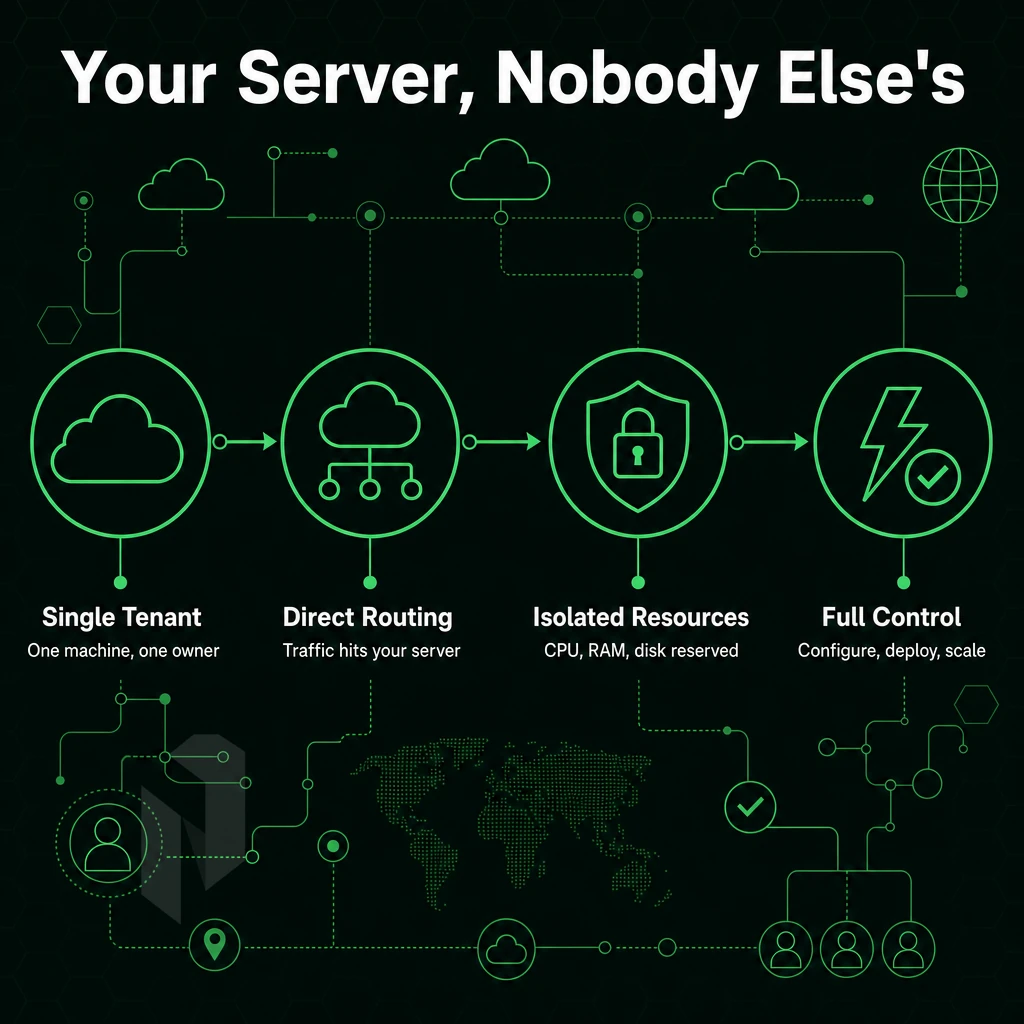
Our bare-metal server solution provides a single physical server which is 100% yours.
Selecting Your Dedicated Web Hosting Services Configuration
As a customer you decide upfront on the server hardware, such as the CPU platform (Intel Xeon or AMD EPYC), the RAM and the storage. The storage can be set up with a hardware RAID, so that in case a drive fails the data is still safe. Our configurations at Netrouting can even go up to 2 TB of RAM and 24 drives.
Provisioning and OS Selection
Once you have ordered a server it will be racked, cabled and imaged ready for use within 60 minutes. At deployment time you can select from a variety of operating systems including Linux and Windows Server. The Linux operating system is the most commonly used by any hosting provider for production workloads, with Ubuntu, Debian, CentOS and Rocky Linux being the most commonly deployed.
The Windows operating system is also fully supported and is ideal for.NET applications and Active Directory environments. Many linux distributions offer long-term support releases that provide stability and security updates for production servers over extended periods.
Root Access and Control Panels
| Management Layer | Access Level | Best For |
|---|---|---|
| Full root access (SSH/RDP) | Complete OS control | Developers, sysadmins |
| cPanel / WHM | GUI-driven server management | Web hosting resellers |
| DirectAdmin | Lightweight GUI panel | Cost-conscious hosting operators |
Full administrative access to your server allows for complete control of the entire technology stack. In contrast, using software as a service control panel tools such as cPanel or DirectAdmin to manage your dedicated server allows you to administer it as if it were a shared hosting account. Even though you have a whole server to yourself.
We shall discuss the merits of dedicated hosting compared to your alternative options of shared hosting and Virtual Private Server (VPS) hosting. This level of full control enables system administrators to optimize kernel parameters, install custom security modules, and configure networking stacks precisely for their application requirements.
When You Need a Dedicated Hosting Provider
Dedicated hosting is not suitable for all workloads. Additionally, Shared hosting and VPS hosting will quickly run into resource sharing overhead before you need to, if you know the signals in the first place.
Workloads That Demand Dedicated Web Hardware
High-traffic websites that experience frequent peak loads can quickly burn through all the Shared CPU and RAM Ceilings on offer. A dedicated server on the other hand, provides 100% use of the computing resources from the physical server, no noisy neighbors and no resource throttling. High traffic websites benefit from the guaranteed resource allocation that prevents performance degradation during concurrent user sessions or sudden visitor surges.
Online stores accepting card payments typically require a PCI DSS compliant “isolation environment”. A Dedicated server, on the other hand provides a clean well audited boundary. Many payment processors and compliance auditors also require dedicated ip addresses to ensure transaction security and proper SSL certificate binding for encrypted checkout pages.
As a dedicated hosting provider, Datacenter.com overcomes these issues by providing unmetered 10 Gbps ports and the required dedicated infrastructure to eliminate the jitter and buffering that can have a serious impact on user experience and your website's performance. Optimizing network architecture ensures that data flows remain consistent even during traffic spikes, preventing packet loss and maintaining service quality.
Enterprises requiring consistent uptime and low-latency delivery rely on dedicated hosting services to maintain performance guarantees that shared infrastructure cannot match. The dedicated web infrastructure at this level also supports advanced traffic shaping and quality-of-service policies that prioritize critical application flows over background processes.
Inference for AI and ML workloads requires GPU compute power that typical VPS hosting cannot provide. Our dedicated GPU servers can be equipped with NVIDIA RTX 6000, A10, A40 and A100 models to meet your specific requirements.
Businesses with multiple websites hosted from one location or subject to strict data sovereignty are better served as dedicated hosting customers, gaining full environment isolation and the ability to configure the OS stack without any platform-imposed restrictions.
Developers requiring custom environments for specialized frameworks or legacy application stacks benefit from the flexibility to install any software dependencies without virtualization overhead or host-level restrictions. Hosting multiple servers under a single dedicated hosting account allows enterprises to segment production, staging, and development environments while maintaining centralized billing and management oversight.
When Dedicated IP Addresses Are the Wrong Choice
Low-traffic sites and start-up’s in early stages of growth, with variable loads, cannot afford the monthly cost of a single dedicated node. For these scenarios, shared or VPS hosting typically offers better cost efficiency until traffic patterns justify the investment in dedicated infrastructure. Once monthly traffic consistently exceeds 100,000 visitors or revenue justifies the investment, migrating to dedicated hosting plans becomes a strategic decision that eliminates resource contention and provides predictable performance.
Hosting providers typically offer migration assistance and consultation services to help dedicated server customers transition smoothly from shared environments when their workloads reach this threshold. Evaluating the total cost of ownership across different tiers helps businesses determine when partnering with a hosting company for dedicated infrastructure delivers better ROI than remaining on shared platforms.
If a team doesn't have a system administrator, managed support for servers (e.g. on virtual machines) might be a better choice than going bare metal in the first place. Many hosting companies offer managed services that include proactive monitoring, security patching, and performance tuning for organizations lacking in-house expertise. Managed services typically include regular security patches applied by the provider's operations team, reducing the burden on internal staff while maintaining system integrity.
A rule of thumb for us is that if your online business is maxing out a mid-tier VPS (e.g. averaging CPU% above 70% and RAM% above 80%) then it’s time to move on to a dedicated server.
After deciding that dedicated hosting infrastructure is the right tier for you, you have to decide on the hardware of your server. Across dedicated hosting plans, the CPU architecture, the amount of RAM, the storage configuration, and the choice of operating systems all play a huge role in how your server will handle peak loads as well as off-peak hours.
Frequently Asked Questions
What services do dedicated hosting providers include in their plans and how do they work?
A single-tenant hosting provider setup gives you an entire physical server reserved exclusively for your workloads, no shared CPU, RAM, or storage with other tenants. You get full root-level access, predictable performance, and complete control over the operating system, software stack, and network configuration.
What Sets dedicated hosting providers Apart From Shared Hosting Services?
Shared hosting places hundreds of websites on a single server, splitting CPU, RAM, and bandwidth among all tenants. A noisy neighbour can degrade your performance at any time, and you have no control over the server environment. Dedicated hosting eliminates that entirely, giving you all the computing power on the machine, consistent performance, root-level access, and the ability to configure the server to your exact specifications.
When should I upgrade from VPS to a dedicated server?
Upgrade to dedicated hosting plans when your VPS consistently hits CPU or RAM ceilings, when latency spikes are affecting end users, or when your workload requires hardware-level isolation for compliance reasons. Other clear triggers include sustained traffic growth that exhausts your current hosting services instance, I/O-intensive workloads like large databases or video transcoding, and security policies tied to operating systems that prohibit multi-tenant environments. If you are running AI inference, game servers, or high-frequency trading logic, a dedicated server is the right starting point, not a later upgrade.
What Do Managed Dedicated Hosting Services Include?
A managed dedicated hosting solution covers OS patching, security hardening, proactive monitoring, and incident response, all handled by the provider's team while you retain full system access. As a managed hosting company, Netrouting offers managed hosting across bare metal, cloud, and colocation, including control panel management via cPanel/WHM or DirectAdmin, or full Proxmox VE cluster management for virtualised environments. You keep operational control of your applications; the provider handles the infrastructure layer beneath them.
How Fast Can a Dedicated Server Plan Be Provisioned?
Netrouting provisions bare metal servers in under 60 minutes through its Rapid Deployment process.
Is DDoS Protection Included With Dedicated Hosting Servers?
Every Netrouting dedicated server includes always-on L3/L4 DDoS mitigation at no extra cost, no configuration required. For high-risk or mission-critical workloads, dedicated hosting providers go beyond what any standard web host promises by offering advanced protection that adds application-layer (L7) mitigation, granular custom policies, and higher scrubbing capacity on top of the included baseline.
Do I need technical knowledge to manage a dedicated server?
If that is not your team's strength, managed dedicated web hosting removes that burden: Netrouting handles patching, monitoring, and security while you focus on your application. For teams running web hosting businesses, a dedicated server plan with managed control-panel software like cPanel/WHM or DirectAdmin provides a familiar interface that reduces the technical overhead further.
Unlike Shared Hosting or Virtual Private Servers (VPS), Dedicated web server solutions provides guaranteed hardware, predictable performance and full isolation. The right Dedicated server management plan for you will depend on three factors: the nature of your workload. The hardware required to run it (number of CPU cores, amount of RAM, type of storage and NIC speed). Additionally, The size of the server provider’s network that you require to be powered 24/7 without any hidden charges.
Hardware chosen for a site remains in place until site reprovisioned.
Netrouting gives dedicated server customers bare metal servers deployed across ten locations, Stockholm, Amsterdam, Frankfurt, Miami, New York, Hong Kong, and more, on a 2.4 Tbps+ backbone with unmetered 10 Gbps included and always-on DDoS protection on every server. Explore Netrouting's dedicated server configurations and contact the team to spec the right build for your workload.