While many hosting providers claim to offer ‘unlimited’ dedicated servers, i.e. unlimited bandwidth, resources, etc., in reality there are often many exceptions and limitations to these promises.
When renting a dedicated server, you are always renting single-tenant hardware. For more context, see Need Dedicated Server with Unlimited, unthrottled bandwidth.
We cut through the hype in our guide to learn what “unlimited” actually means for dedicated servers. We cover the key points to note when reviewing specs and contract fine print to help you choose the right server to match your needs. Whether high volume video streaming, very low latency game servers or simply processing very large amounts of data.
Blog contents
What Are Unlimited Dedicated Servers?
An unlimited dedicated server is a single bare-metal server dedicated 100% to your use, with no limits on data transfer in a given month. By unlimited we mean a marketing term and not an arbitrary ceiling. The real constraint here is always the physical port, not an arbitrary number.
Each bare metal machine provides direct access to physical hardware resources without virtualization overhead, ensuring maximum performance for resource-intensive applications. This architecture makes unlimited dedicated servers ideal for high performance computing tasks that require sustained CPU and memory utilization without contention from neighboring tenants.
Port Speed Is the True Limit
Each server has physical ports to connect to the network. The speed of these ports (e.g. 1 Gbps, 10 Gbps, etc) determines maximum throughput. You can then continuously push traffic to these servers 24/7 up to that maximum throughput. Servers configured with high bandwidth ports enable sustained data transfer rates that support continuous streaming, real-time analytics, and large-scale content delivery without interruption.

At Netrouting our dedicated servers come with unlimited bandwidth on a 10 Gbps port.
Unmetered Dedicated Servers Plans vs. Metered Plans
The only thing that predictably comes from a bandwidth cap is a surprise bill after a particularly busy product launch.
Unmetered bandwidth plans are easier to price for high-throughput use cases like game servers, video streaming services, and VPNs, as the entire port is available to use as needed without variable costs. You simply pay a fixed monthly fee. This predictable pricing model eliminates the risk of additional costs that can arise from unexpected traffic spikes or seasonal demand fluctuations. When businesses benefit from predictable monthly costs, they can allocate resources more effectively and scale infrastructure without worrying about bandwidth overages impacting their budget.
Many organizations running cloud applications find unmetered plans particularly valuable, as they can handle unpredictable user loads without concern for bandwidth charges. This stability becomes especially valuable when usage increases during product launches or marketing campaigns, allowing teams to focus on growth rather than infrastructure costs. Organizations can budget accurately when their monthly transfer costs remain fixed regardless of usage spikes. Unmetered plans prove especially advantageous during traffic spikes, when metered alternatives would trigger overage fees that can quickly exceed the base hosting cost.
Choosing the Right Unmetered Dedicated Servers for Your Needs
It’s best to select a port size based on peak rather than average traffic. A 1 Gbps port will generally be sufficient for most mid-tier server hosting workloads, while higher bandwidth ports such as 10 Gbps are well-suited to more demanding use cases like live streaming or large-scale file distribution. Unmetered dedicated servers from our range scale up to 40 Gbps for the most demanding of high throughput deployments.
In the following section, we examine the practical limits of these port ceilings. A high bandwidth dedicated server with 10 Gbps or greater port capacity ensures consistent performance for enterprises managing real-time data processing or content distribution at scale.
How Unmetered Bandwidth Actually Works on Bare Metal Servers
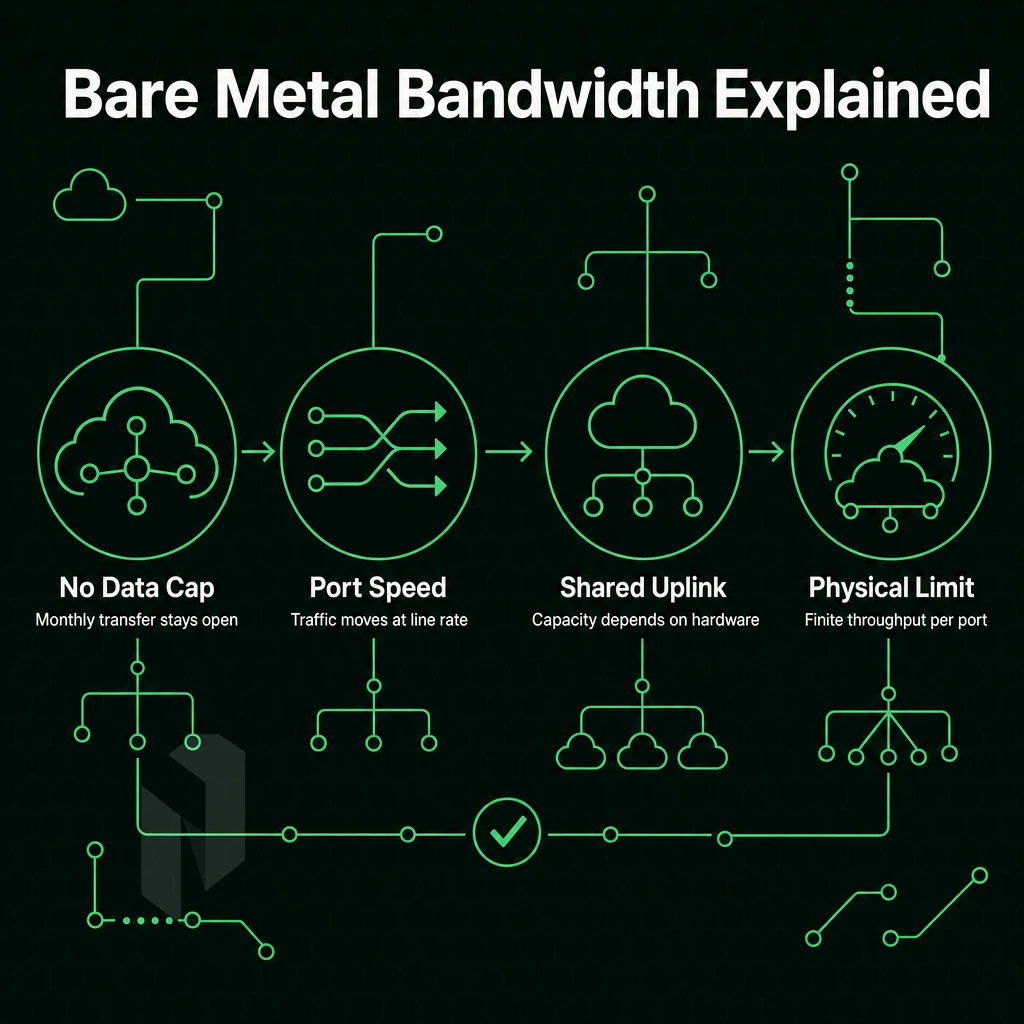
When we say “unlimited bandwidth” on dedicated servers, we mean no data cap on a monthly basis. However, A hard physical limit to the amount of data that can be moved across your servers based on the port speed of your connection. This approach eliminates concerns about exceeding a monthly transfer quota, allowing you to scale traffic predictably without monitoring usage thresholds.
The Fixed Port Speed Model on Unmetered Dedicated Servers
All our servers have a single internet network port. The port speed is fixed at 1 Gbps or 10 Gbps. With unmetered traffic, all traffic is allowed up to the port speed, 24/7. No overages and no transfer cap for the server’s monthly usage.
A 1 Gbps unmetered port would in theory reach around 125MB/s sustained, whereas a 10 Gbps port would reach 1,250MB/s or so. For high bandwidth servers like video distribution, large file distribution and game server clusters the port speed is usually the limiting factor. Organizations running data heavy workloads such as analytics pipelines or database replication benefit significantly from higher port speeds to avoid bottlenecks during peak processing windows.
Consistent Throughput vs. Burst-and-Throttle on Bare Metal Servers
Such a model is detrimental to consistent high throughput for long periods of time. True unmetered dedicated servers maintain the same line rate all the time, without any hidden throttle. Enterprises requiring high availability for mission-critical services depend on consistent throughput to ensure uptime and reliability across distributed infrastructure.
We offer unmetered 10 Gbps on dedicated servers.
Reading Fair Use Policies Before You Commit
The terms of fair use policies can vary greatly from contract to contract. Some may permit continuous full usage rate, while others restrict P2P or even specific services. Be sure to verify whether “unmetered” applies to both inbound and outbound traffic, as well as whether the terms are to define different types of traffic. High bandwidth servers with true unmetered terms will clearly state so, no fine print needed.
| Dimension | 1 Gbps Unmetered | 10 Gbps Unmetered |
|---|---|---|
| Max sustained throughput | ~125 MB/s | ~1,250 MB/s |
| Suitable workload | Low-traffic sites, dev/test | Streaming, gaming, bulk transfer |
| Throttle risk | Low (lower absolute volume) | Depends on provider policy |
| Uptime SLA | 99.9% standard | 99.9% standard |
Verify the Fair Use Policy covers your specific traffic case.
Unmetered Dedicated Server Plans: What to Look For
Unmetered dedicated servers are not created equal. Key variables such as port speed, contract terms and even hardware generation affect actual performance. So research properly before you commit to a server. Selecting hardware with modern processors and sufficient RAM ensures high performance for compute-intensive tasks that demand consistent throughput.
Port Speed and High Performance Connectivity
- Can you please check the port speed tier, a 1 Gbps port will top out around 10 TB per day. For video streaming, proxy servers and other latency sensitive applications a 10 Gbps dedicated port is the bare minimum. On dedicated servers, Netrouting includes the unmetered 10 Gbps port.
- Dedicated ports are required to verify that the port is not shared. If a port is shared then there is contention for use of the port and no guarantee that full rated speed will ever reach the server. This is particularly important for Network Capacity under load.
- Find out what hidden traffic limits are buried in the small print. Advertisements for unmetered bandwidth are often accompanied by hidden soft traffic limits or “excessive usage” throttle points. Check the acceptable-use policy, not just the marketing blurb for the actual service specification.
Note: "Unlimited bandwidth" means unmetered data transfer up to your port's rated speed, not infinite throughput. The port speed is the real ceiling.
Global Network and Protection
- Assess DDoS protection inclusion. Always-on L3/L4 mitigation should be included by default. Check if Netrouting includes basic DDoS protection with every service and make sure it’s included before you sign up.
- Assess the network’s quality and coverage. A global network is only good if it has Tier 1 upstreams and lots of IX peering across all regions. Ask for AS numbers and peering exchange memberships, too. Vague answers are a sign of really bad infrastructure.
Hardware and Billing Clarity
- Select a hardware generation that matches your workload. Note that Intel Xeon and AMD EPYC platforms vary greatly in core density, memory bandwidth, and per-core performance. Be sure to verify the actual CPU generation and not simply the brand name.
- Demand a fixed monthly charge. Unmetered is better than metered or even cloud egress-based services. Make sure your contract does not hide any limitations, extra charges, or even burst-charges that ruin your price competitiveness.
After choosing the right plan for you, you also need to choose the software that runs on top of that plan.
Choosing the Right Operating System for Your Unmetered Server
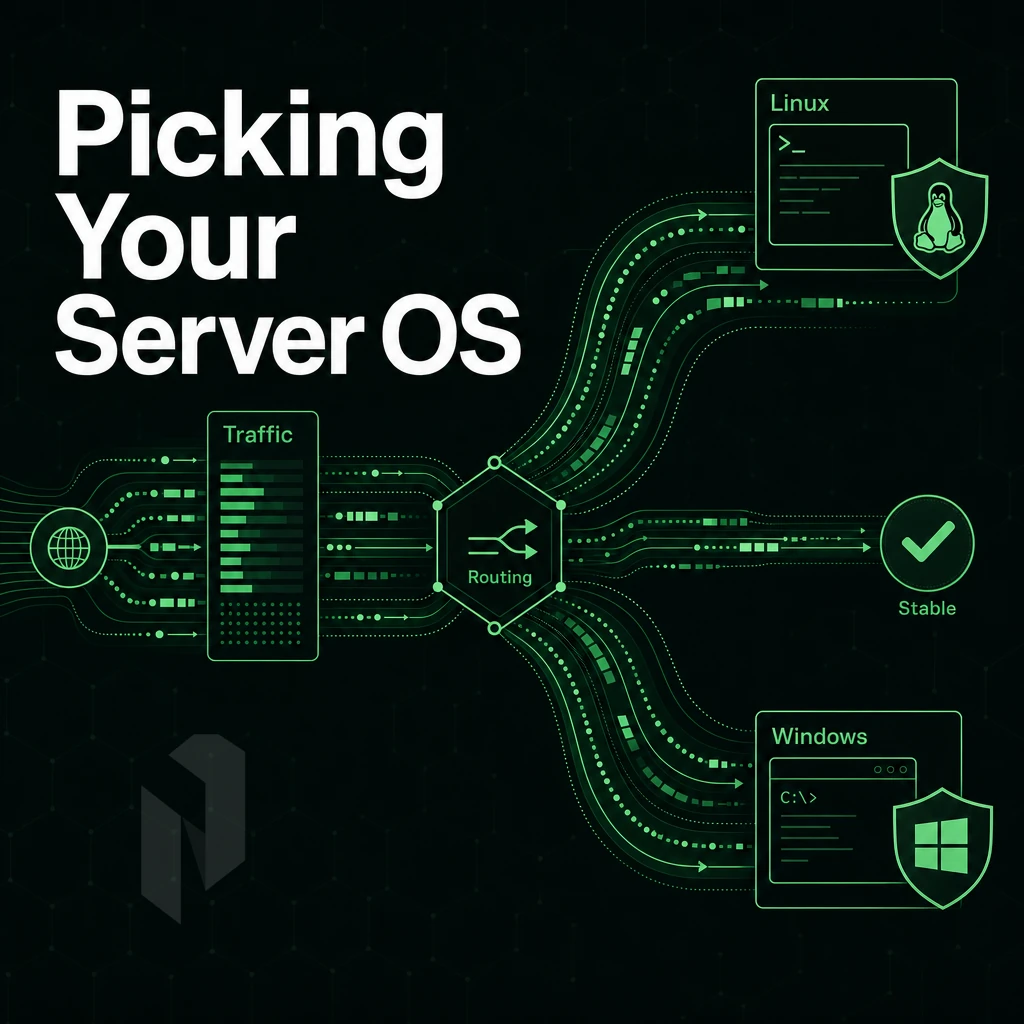
Choosing the right Operating System to deploy on your servers before you start provisioning them can save you a lot of headaches in the long run. The OS you choose determines many downstream variables including package availability, kernel tuning, licensing costs and maintenance efforts. For more context, see Dedicated hosting service.
Choosing Your Operating System
For Linux on bare metal, Ubuntu LTS is one of the few distributions that have a package ecosystem nearly as large as that of the typical distro running in virtual machines.
For enterprise-grade RHEL-compatible distributions, AlmaLinux and Rocky Linux are now the best choices to run on unmetered dedicated servers, as they are binary compatible with CentOS and have long support windows for compliance-driven environments.
Windows Server remains the correct platform for.NET applications, Active Directory integration and SQL Server workloads. Although licensing adds to the total cost of ownership of high bandwidth servers and competitive pricing is rarely a factor for teams already deeply invested in the Microsoft technology stack, the headache of cross-platform porting is simply not worth it.
Server Hosting with Managed OS Support
Because your team may not be interested in managing patch cycles and security hardening for your websites.
For lean engineering teams running high volume workloads on a server, an unmetered 1 Gbps port is valuable. But the operational overhead of running a server at that network port capacity, weighed against the cost efficiency of keeping engineers focused on product value, is worth considering.
Unmetered bandwidth means no surprise bills for high usage. Similarly, choose an OS that doesn’t contain unnecessary performance overhead. With managed hosting, the usual performance overhead of self-managed hosting is eliminated.
Custom Configurations on Dedicated Servers
While our standard images cover most cases, we also support custom configurations on our dedicated hardware.
Costs remain as predictable as ever: no extra charges for other images, no hidden licensing fees on top of what you'd normally pay for Windows Server itself.
High Bandwidth Model Dedicated Server Use Cases
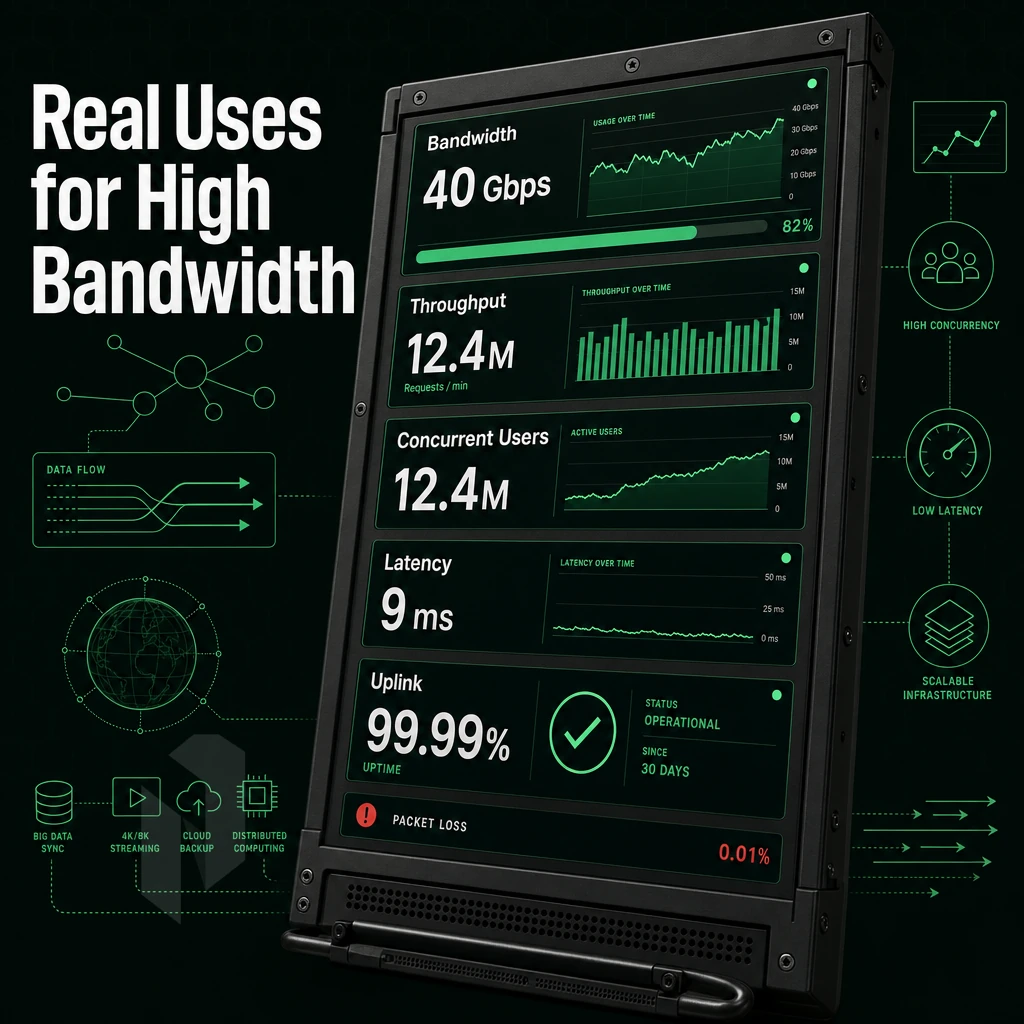
Some workloads just use bandwidth too fast for metered billing to make sense. High bandwidth workloads like streaming, games, distribution and proxies need guaranteed bandwidth. Unmetered traffic on a dedicated port is guaranteed bandwidth without the surprise per-gigabyte charge.
Video Delivery, Streaming, and High-Throughput Distribution
Multimedia delivery in high definition creates constant, high volume, multi-gigabit traffic streams 24/7. Metered bandwidth for thousands of simultaneous users becomes your biggest bill item.
File hosting and large-scale data distribution have similar economics.
Dedicated Servers for Gaming and Low Latency Applications
A gaming server can handle thousands of simultaneous connections. Each connection requires low latency and high packet throughput. A dedicated server on an unmetered port doesn’t have to deal with the typical bottlenecks created by shared resources.
This cushion ensures that latency sensitive applications remain responsive even during local peak hours.
Proxy Services and High Traffic Websites
All traffic from proxy services and VPN providers is routed through their own servers. And because it’s metered bandwidth, this model becomes economically unstable very quickly.
For extremely high-traffic websites (e.g. during a product launch), even normal transfers are multiplied by an order of magnitude within a few minutes. Their dedicated ports (unmetered, as always) handle these increases in traffic without you having to re-negotiate anything or even go through an upgrade in emergency situations.
We detail our 2.4 Tbps+ backbone and unmetered 10 Gbps port options for dedicated servers.
Unmetered Dedicated Servers for the Most Demanding Projects
Shared hosting and standard virtual servers cause resource contention, bandwidth restrictions, and limited hardware access. For AI/ML inference, large-scale media processing, high-frequency data processing, and multi-regional enterprises, bare metal servers are the only viable option.
Why Shared and Virtual Infrastructure Falls Short for Demanding Workloads
Workloads competing for resources on shared infrastructure consume CPU, memory, and I/O, and intense contention hits hardest during peak traffic spikes. For community perspectives, see Need Dedicated Server with Unlimited, unthrottled bandwidth.
Typical standard VPS offerings also include a monthly data transfer limit.
Choosing the Right Bare Metal Tier for Demanding Projects
- Determine your compute profile. CPU intensive work loads (e.g. encoding, simulation) benefit from high core counts and high frequency CPUs while memory intensive work loads (e.g. in memory databases, large model inference) benefit from maximum RAM. The hardware tier should be selected to address the true bottleneck and not simply the highest specification number.
- Assess the required GPU performance of your AI/ML inference workloads and self-hosted large language models, which typically exceed the performance of CPU-only bare metal hosts. Our dedicated GPU hosting is offered in multiple host tiers. Please let us know the specific framework and model size you need to host when you speak with our sales team. Note that configurons matter more than raw GPU count for these workloads.
- Custom Configurations. We can configure non-standard hardware requirements, such as unusual numbers of drives, high density RAM or particular RAID configurations. We would not look to sell a standard SKU against a particular workload.
Note: Provisioning a custom configuration takes longer than ordering a stock server. Submit your requirements early to avoid delays at project launch.
Deploying Inside the Right Data Center
- Match location to latency requirements. Put your inference endpoints close to your users. We have 10 locations in Europe, North America and Asia, so pick the closest datacenter to your primary audience for the shortest round-trip time.
- Control at the network layer and beyond: With bare metal, you get full BGP support, BYOIP and unlimited 10 Gbps connectivity. Use this to configure your routing policy from day one, rather than after launch as an afterthought.
This set of capabilities, deep hardware, full network control and any location worldwide, is delivered by a single provider, designed to service this particular class of workloads.
Why Choose Netrouting for Unmetered Dedicated Servers
Netrouting's unmetered dedicated servers are built for high bandwidth workloads that can't tolerate traffic limits, overage fees, or hidden restrictions in the fine print. Every bare metal server ships with unmetered bandwidth at 1 Gbps standard, scaling to 10 Gbps unmetered, with up to 40 Gbps for the most demanding projects.
- Unmetered bandwidth, no surprises. Our bandwidth model has no monthly data caps, no fair use policies, and no additional fees when traffic grows. Predictable monthly cost, every month.
- 2.4 Tbps+ global network, consistently headroom. Port utilization stays below 40%, so consistent performance and high throughput are the norm, not just at off-peak hours.
- Always-on DDoS protection. L3/L4 mitigation is included at no extra cost on every bare metal server. High traffic websites and latency-sensitive applications stay online under load.
- 10 data center locations. Amsterdam, Frankfurt, The Hague, Rotterdam, Stockholm, Bucharest, Miami, New York, Hong Kong, and Singapore, low latency reach across Europe, North America, and Asia-Pacific.
- Bare metal provisioned in under 60 minutes. 24/7 NOC monitoring and a 1-hour ticket SLA back every deployment.
- ISO 27001 and SOC 2 certified. Enterprise-grade network quality and security across every location.
If reliable performance and unmetered traffic are non-negotiable, explore our unmetered dedicated server options or contact sales to discuss a configuration matched to your workload.
Key Takeaways: Unmetered Bandwidth and Bare Metal Performance
"Unlimited" means unmetered up to your port speed, not infinite. Real-world throughput depends on port size and network quality.
For consistent throughput under peak demand, choose a provider with high bandwidth capacity and low port utilization. Netrouting's bare metal servers run on a 2.4 Tbps+ global network with unmetered 1 Gbps included, purpose-built for data-heavy workloads, high traffic websites, and latency-sensitive applications where reliable performance isn't optional.
Frequently Asked Questions
Are There Free Dedicated Server Options With No bandwidth caps?
No legitimate provider offers a free dedicated server for production use. A real dedicated server requires hardware, power, cooling, and network throughput, all of which cost money. If you see "free dedicated server" advertised, read the fine print carefully: there is always a catch.
What is the cheapest dedicated server hosting option available?
An entry-level unmetered dedicated server option from reputable IaaS providers starts at a modest monthly cost, typically a single-socket server with limited RAM and spinning-disk storage. Netrouting's bare metal lineup begins at the lower end of the market and scales to dual-socket AMD EPYC and Intel Xeon platforms.
The cheapest option is rarely the right option: factor in bandwidth, support quality, and hardware generation before deciding. A slightly higher monthly cost on newer hardware almost always delivers better performance per workload.
Is there a VPS server with unlimited traffic?
Some VPS providers advertise unlimited traffic, but the underlying host node shares physical link capacity across many virtual machines. In practice, sustained high-throughput usage triggers fair-use throttling or additional charges. If your workload genuinely demands high or unpredictable bandwidth, a dedicated server with an unmetered port is the more honest and reliable solution. Netrouting's cloud compute instances are backed by the same 2.4 Tbps+ network as its bare metal fleet, with transparent bandwidth allocations rather than vague unlimited claims.
Does an Unlimited Dedicated Server Really Mean No Limits?
"Unlimited bandwidth" is a marketing term, not a technical guarantee. Every server connects to a physical port with a fixed speed ceiling, 1 Gbps, 10 Gbps, or higher, and that link speed is the real limit.
What is the difference between unmetered and unlimited bandwidth?
unlimited bandwidth means you are not billed per gigabyte transferred, you pay a flat rate and use as much traffic as your network link speed physically allows. Unlimited bandwidth is a looser marketing claim that rarely comes with a defined connection speed or a clear fair-use policy.
Netrouting dedicated servers include unmetered 10 Gbps as standard, with up to 40 Gbps available for high-throughput workloads.
What port speed should I choose for a high bandwidth dedicated server?
A 1 Gbps port suits most web applications and moderate streaming workloads. Video delivery, large-scale file distribution, and online gaming infrastructure typically need 10 Gbps unmetered as a baseline. For workloads that spike unpredictably or run sustained multi-gigabit streams, 40 Gbps gives you the headroom to absorb traffic bursts without throttling. Netrouting offers unmetered 10 Gbps as standard on dedicated servers, with 40 Gbps available for demanding deployments.
Do unmetered dedicated server plans include DDoS protection?
Netrouting includes always-on L3/L4 DDoS protection at no additional cost on every service, including unmetered dedicated servers.
When it comes to a dedicated server, “uncapped bandwidth” means that the server comes with a fixed uplink speed and no data transfer limits. This is not a limitless commodity, however. Additionally, Is something that must be carefully taken into account when sizing out servers to handle very high volumes of data transfer (e.g. video streaming, online gaming, large VPN servers).
Matching the sustained data transfer rate required by your application to the line speed of the server. Additionally, Then choosing server hardware that does not impede the available bandwidth, is key to a trouble-free deployment and avoided expense down the road.
The choice of the OS platform (OS) is also very important.
If you're ready to spec a server, explore Netrouting's bare metal lineup, unmetered 10 Gbps included as standard, with configurations across Amsterdam, Frankfurt, Miami, and beyond. Browse dedicated server options or contact the sales team to discuss a custom build.