TL;DR
- Choose AMD EPYC if you need maximum cores, memory bandwidth, PCIe lanes, and VM/container density. Best for virtualization, cloud platforms, large databases, and I/O-heavy servers.
- Choose Intel Xeon if you rely on enterprise software, legacy applications, or workloads optimized for Intel instruction sets, and need consistent single-core performance with strong ecosystem support.
- Choose AMD Ryzen if you want high clock speeds, excellent price-to-performance, and are running game servers, developer workloads, CI/CD, or small hosting environments.
- Choose AMD Ryzen if you want the best value-for-money CPU for high-clock, latency-sensitive workloads. Ryzen delivers outstanding single-thread and cost-per-performance efficiency, making it ideal for game servers, developer workloads, CI/CD pipelines, and small to mid-scale hosting environments where raw clock speed matters more than memory or I/O density.
While Ryzen often leads in price-to-performance metrics, EPYC and Xeon remain superior for large-scale consolidation, memory-intensive workloads, and enterprise-grade platform requirements.
There is no “best CPU overall” – the right choice depends entirely on your workload.
1. Why CPU Choice Matters
Modern CPUs are highly specialized. A processor that excels at virtualization may underperform in latency-sensitive applications like game servers or transactional databases.
Choosing the wrong CPU can result in:
- Underutilized hardware
- Higher licensing costs
- Power inefficiency
- Poor real-world performance despite strong benchmark scores
This happens because CPUs differ in:
- Core scheduling behavior
- NUMA topology
- Cache size and latency
- Memory bandwidth saturation
- PCIe and I/O contention
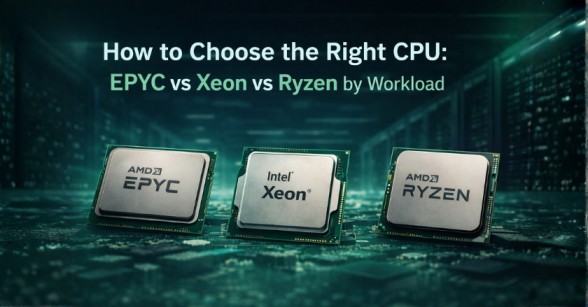
This article compares AMD EPYC, Intel Xeon, and AMD Ryzen by architecture, benchmarks, and real-world workload fit, with the understanding that performance, memory channels, PCIe lanes, and instruction-set support vary by CPU generation, not just by family.
2. CPU Families Explained
AMD EPYC (Server-Class)
AMD EPYC CPUs are designed specifically for data centers and enterprise-scale workloads, following a scale-first architecture.
Key characteristics
- Very high core counts per socket
- Large shared L3 cache and strong multi-thread scaling
- More memory channels than competitors
- Extremely high PCIe lane availability
- Excellent performance-per-watt at scale
Architectural strengths (deeper view)
- Chiplet-based multi-die design optimized for horizontal scaling
- Strong NUMA-aware scheduling
- High consolidation efficiency per socket
Designed for
- Virtualization platforms (VMware, Proxmox, KVM)
- Cloud infrastructure
- Containers and Kubernetes
- Large databases
- Storage and NVMe-heavy servers
Why this matters
- More VMs per server
- Less CPU contention per workload
- Reduced need for dual-socket systems
- Better isolation between tenants in shared environments
Tip:
In dense virtualization and memory-heavy environments,
Netrouting commonly deploys
AMD EPYC 7702–based systems to maximize VM density per socket while
maintaining predictable performance across concurrent workloads.
Intel Xeon (Enterprise & Data Center)
Intel Xeon CPUs focus on enterprise stability, predictability, and platform maturity.
Key characteristics
- Strong single-core and sustained performance
- Mature enterprise ecosystem and certifications
- Support for Intel-specific instruction sets (AVX-512, AMX on some models)
- Broad OEM and ISV support
- Flexible multi-socket configurations
Architectural strengths (deeper view)
- Balanced core-to-clock ratio
- Strong turbo behavior under mixed workloads
- Deep BIOS, firmware, and OEM tuning
- Long lifecycle platform support
Designed for
- Enterprise applications
- Licensed or legacy software
- Databases with mixed workloads
- Environments requiring vendor certifications
Why this matters
- Enterprise applications behave consistently
- Fewer surprises with legacy workloads
- Better vendor certification coverage
- Stable performance under unpredictable load patterns
Operational Note:
For environments that prioritize long-term stability, software certifications, and mixed
workload consistency, Netrouting frequently operates
dual Intel Xeon Gold
platforms.These systems are well-suited for enterprise virtualization, shared environments, and
production workloads where predictable behavior under sustained load matters more than
maximum core density.
AMD Ryzen (Desktop & Entry Workstation)
AMD Ryzen CPUs are optimized for high-frequency performance and affordability, not large-scale consolidation.
Key characteristics
- High clock speeds
- Strong single-core performance
- Lower core counts than EPYC/Xeon
- Limited memory channels and PCIe lanes
- Excellent price-to-performance ratio
Architectural strengths (deeper view)
- High IPC design
- Low per-core latency
- Minimal platform overhead
Designed for
- Game servers
- Developer workstations
- CI/CD pipelines
- Small hosting stacks
- Build and compile workloads
Why this matters
-
- Faster request handling
- Better real-time responsiveness
- Lower cost for performance-focused workloads
Ryzen’s architecture prioritizes clock speed, IPC, and affordability rather than server-class consolidation. As a result, Ryzen frequently outperforms server CPUs in cost-adjusted single-threaded workloads, while still falling behind EPYC and Xeon in environments that depend on larger cache pools, higher memory bandwidth, and sustained multi-tenant operation.
Deployment Tip:
In development, CI/CD, and smaller production environments, Netrouting often utilizes
AMD Ryzen 3700X–class systems due to their strong single-core performance
and efficient cost-to-performance balance.These platforms are well-suited for workloads that benefit from higher clock speeds but
do not require enterprise-scale memory or I/O density.
3. Benchmark Performance: What Really Matters
Single-Core Performance
Best: Ryzen and high-frequency Xeon
Benefits
- Web servers
- Game servers
- Many enterprise apps
- PHP, Java, and scripting workloads
Higher clock speed often matters more than total core count here.
From a value perspective, Ryzen consistently delivers the strongest single-core performance per dollar. While high-frequency Xeon SKUs can match or exceed raw clock speeds and may be preferred in certified enterprise environments, Ryzen’s pricing and platform simplicity make it the most cost-efficient choice for workloads where per-thread performance dominates overall system behavior.
In sustained multi-threaded or memory-bound workloads, EPYC’s platform advantages – particularly memory bandwidth, cache behavior under contention, and I/O scaling – often outweigh Ryzen’s higher peak clocks.
Multi-Core & Parallel Performance
Best: EPYC
Benefits
- Virtual machines
- Containers
- Rendering
- Data processing
- Scientific workloads
EPYC’s high core density and memory bandwidth allow it to scale far beyond desktop-class CPUs.
Memory Bandwidth & Capacity
Best: EPYC
EPYC supports significantly more memory channels per socket, enabling:
- Faster database performance
- Better VM density
- Improved performance for memory-bound workloads
Xeon follows closely, while Ryzen is limited to desktop-class memory configurations.
I/O & PCIe Performance
Best: EPYC
EPYC platforms support large numbers of:
- NVMe drives
- High-speed NICs
- GPUs
This makes EPYC ideal for storage servers, AI pipelines, and high-throughput networking.
Performance Consideration:
For latency-critical and cache-sensitive workloads – such as real-time processing and
game servers—Netrouting has observed strong performance characteristics with
AMD Ryzen 9 7950X3D–class CPUs.The combination of high clock speeds and large L3 cache can deliver measurable gains
in scenarios where single-thread execution and cache efficiency are primary constraints.
4. Architectural Comparison: Why EPYC Can Outperform Ryzen at Similar Core Counts
Even when AMD Ryzen and AMD EPYC processors share similar core and thread counts, their real-world performance can differ significantly due to fundamental architectural and platform-level differences.
- Sustained Power & Thermal Design
Ryzen CPUs are designed for aggressive boost behavior and short-duration bursts, while EPYC processors are engineered to sustain high power draw and consistent performance under continuous load. This allows EPYC to maintain throughput in workloads that run for hours or days without throttling.
- Memory Bandwidth & Capacity
EPYC processors support significantly more memory channels and DIMM capacity than Ryzen. In memory-bound workloads such as databases, virtualization, and in-memory analytics, this additional bandwidth and capacity often outweigh Ryzen’s higher clock speeds.
- Cache Behavior Under Contention
While Ryzen X3D CPUs benefit from large L3 cache for latency-sensitive workloads, EPYC platforms rely on distributed cache architectures optimized for predictable behavior under multi-tenant and NUMA-heavy conditions. This favors EPYC in concurrent server workloads.
- I/O and PCIe Scaling
EPYC platforms offer substantially more PCIe lanes, enabling higher NVMe density, faster networking, and accelerator support. In I/O-heavy environments, this directly impacts throughput and system balance.
- NUMA & Scheduler Optimization
Server operating systems and hypervisors are tuned to exploit EPYC’s NUMA topology and memory locality, allowing EPYC to scale more efficiently across many concurrent processes and virtual machines.
In short:
Ryzen excels at latency and cost efficiency per core, while EPYC wins in sustained, memory-heavy, and highly concurrent server workloads – even when core counts appear similar.
5. Workload-Based CPU Recommendations
Virtualization & Cloud Platforms
Best choice: AMD EPYC
Why
- More VMs per socket
- Better memory scaling
- Lower cost per VM
- Strong performance-per-watt
Containers & Kubernetes
Best choice: AMD EPYC
Why
- Excellent parallelism
- Handles large numbers of microservices efficiently
- Strong NUMA and memory bandwidth characteristics
Databases (MySQL, PostgreSQL, MSSQL)
Best choice: Xeon or EPYC
- Choose Xeon for latency-sensitive or licensed databases
- Choose EPYC for large in-memory or highly concurrent workloads
Web Hosting & Control Panels
Best choice: Xeon or Ryzen
Why
- PHP and CMS workloads benefit from higher clock speeds
- EPYC is better only when hosting very high numbers of sites
Game Servers
Best choice: AMD Ryzen
Why
- Game servers are latency-sensitive
- Higher clock speeds outperform higher core counts
- Lower cost and simpler deployment
Game servers are extremely latency-sensitive and typically scale poorly beyond a few cores. Ryzen’s high clock speeds and low per-core latency consistently outperform higher-core server CPUs in these scenarios.
EPYC is disadvantaged here due to NUMA topology and lower per-core clocks, while Xeon platforms often introduce higher platform and licensing costs without delivering proportional gains for single-thread-bound game engines.
CI/CD, Build Servers, Development
Best choice: Ryzen or EPYC
- Ryzen for small to mid-sized pipelines
- EPYC for large parallel builds and enterprise CI environments
In these environments, Ryzen frequently delivers superior cost-to-compile and cost-to-build ratios, while EPYC becomes advantageous only when pipelines scale horizontally across many concurrent jobs or require large memory pools.
Rendering & Media Encoding
Best choice: EPYC or Threadripper
Why
- Highly parallel workloads scale well with more cores
- EPYC is ideal for rack deployments
- Threadripper suits workstation environments
AI & ML (CPU-based)
- Xeon may excel when Intel-optimized instruction sets are used
- EPYC performs better for parallel preprocessing and data pipelines
- For GPU-heavy AI, EPYC’s PCIe lane count is a major advantage
6. Power Efficiency & Total Cost of Ownership
| Factor |
AMD EPYC |
Intel Xeon |
AMD Ryzen |
| Performance per watt |
⭐⭐⭐⭐⭐ |
⭐⭐⭐⭐ |
⭐⭐⭐⭐ |
| Platform cost |
Medium–High |
High |
Low |
| VM density |
Very High |
High |
Low |
| Licensing efficiency |
Excellent |
Mixed |
Excellent |
| Best use case |
Scale & Cloud |
Enterprise |
Performance Value |
At scale, EPYC often delivers the lowest cost per workload, despite higher upfront hardware pricing, due to its ability to consolidate large numbers of workloads efficiently on fewer systems.
TCO clarification: Ryzen’s lower VM density and platform score reflect its desktop-class platform design, not inefficiency. On a per-core and per-thread basis, Ryzen remains one of the most power-efficient and cost-effective CPUs available for performance-focused workloads that do not require enterprise-scale memory capacity, PCIe density, or I/O throughput.
Key distinction: Ryzen’s efficiency advantage is rooted in silicon-level performance per core and per thread. Its comparative disadvantage appears only at platform scale, where EPYC and Xeon benefit from server-class memory channels, higher PCIe density, and consolidation efficiency.
7. How to Choose: Practical Checklist
Before selecting a CPU, ask:
-
- Is my workload latency-sensitive or throughput-focused?
- How many VMs, containers, or users will run concurrently?
- What memory capacity and bandwidth does my workload require?
- How many NVMe drives, NICs, or GPUs will the system need to support?
- Does my software favor Intel-specific optimizations?
- Am I paying per-core or per-socket licensing fees?
- Do I care more about scalability or cost efficiency?
8. Summary
- AMD EPYC dominates in scale, density, memory, and I/O – ideal for modern cloud and virtualization.
- Intel Xeon remains strong for enterprise workloads, certified software, and mixed performance profiles.
- AMD Ryzen offers unbeatable value for money, delivering class-leading single-thread performance and exceptional cost-to-performance efficiency for developer workloads, CI/CD pipelines, and game servers where clock speed and latency matter more than memory or I/O scale.
EPYC continues to win in environments where cache size, memory bandwidth, PCIe density, and VM consolidation define performance, while Xeon remains relevant for certified enterprise software and long-lifecycle platforms.
The right CPU is the one that matches your workload – not the one with the highest benchmark score.
That’s where Netrouting comes in. Our engineers work directly with you to evaluate workload behavior – including latency, memory usage, I/O characteristics, and scaling needs – and map those requirements to the right CPU platform from the outset. This approach reflects our belief that CPU selection should be driven by workload behavior, not headline benchmark scores, ensuring reliable production performance.














 Mar 27, 2024