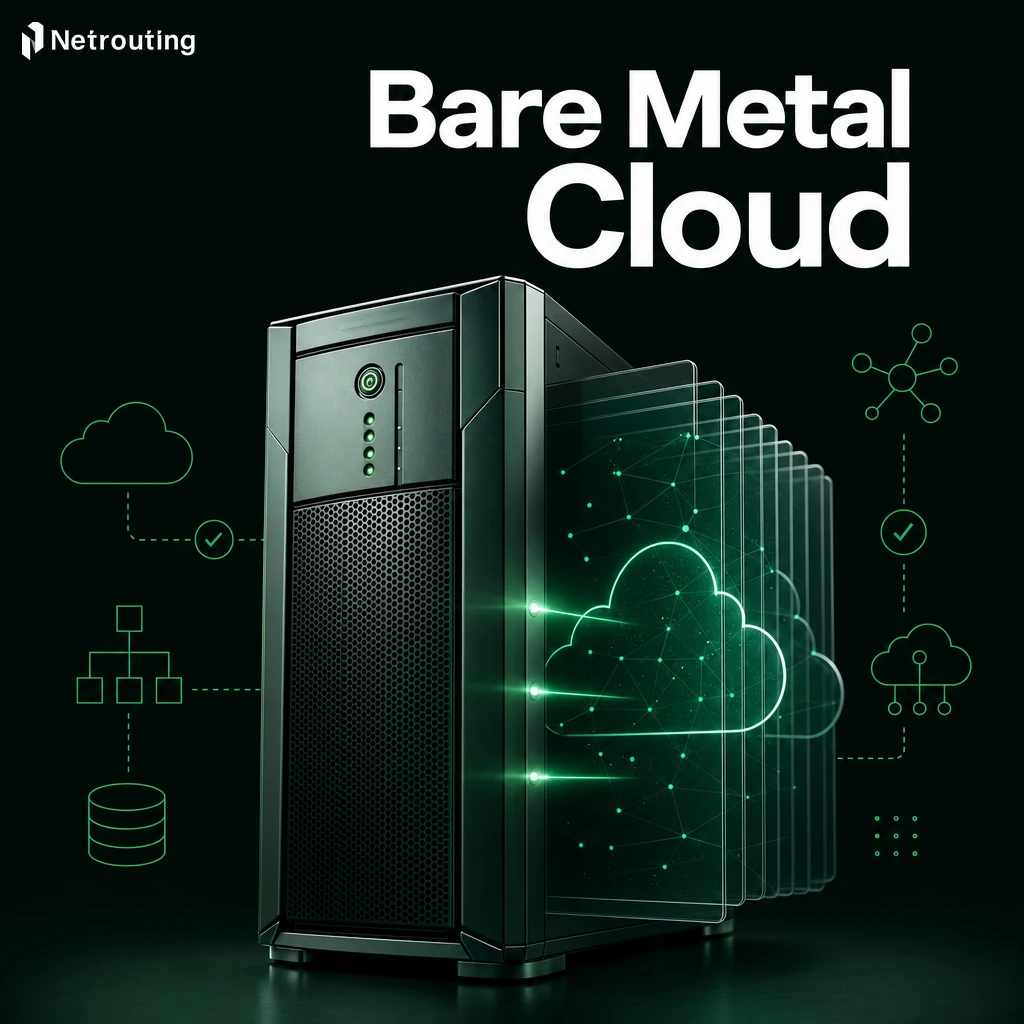
Many applications require hardware performance, however, the provisioning of bare metal servers often takes weeks and comes with long-term infrastructure contracts that do not offer the flexibility of virtual servers. To bridge this gap, you can now use a bare metal cloud to provision single-tenant servers as quickly as virtual servers.
For organizations seeking predictable performance without the delays of traditional procurement, bare metal cloud has become an increasingly attractive option. Organizations can now deploy dedicated physical servers through cloud interfaces, eliminating the traditional trade-off between hardware control and operational agility. For more context, see bare metal servers.
No inefficient overhead of a hypervisor for your applications.
Blog contents
The real challenge with bare metal cloud is knowing when you need it and when you don’t. When do mission critical applications like latency-sensitive databases, high-throughput compute jobs, or compliance-driven workloads benefit from bare metal infrastructure as opposed to shared servers. Understanding the bare metal market landscape helps organizations evaluate whether the premium cost justifies the performance gains for their specific use cases.
Business leaders must weigh infrastructure costs against application requirements when deciding whether bare metal justifies the investment over virtualized alternatives. Organizations often discover that dedicated servers justify their cost when workload profiles exhibit sustained high utilization rather than intermittent bursts.
This article details the inner workings of bare metal cloud, how it stacks up against traditional dedicated servers and virtualized compute environments, and more importantly, which workloads are best suited for the platform. Additionally, we will outline a framework for comparing cloud bare metal providers at key points including network performance, provisioning time, SLA’s. Additionally, Finally the depth of support provided by each vendor to best match your needs against their features.
What Makes Bare Metal Cloud Different for Data Analytics
Bare metal cloud is the merging of dedicated servers (bare metal servers) with cloud provisioning and management. Bare metal cloud combines dedicated physical single-tenant servers (no sharing of resources, no hypervisor overhead) with cloud provisioning and management to bring you the best of both worlds.

How It Differs from Traditional Dedicated Servers Hosting
Bare metal cloud is offering automated deployment within the hour, flexible billing and an API to control everything. The platform provides a self-service interface, allowing users to spin up and tear down infrastructure on demand without manual intervention. Users gain complete control over server lifecycle management, from initial deployment through decommissioning, without requiring vendor approval or manual ticketing processes.
Organizations benefit from streamlined workflows where the deployment process eliminates traditional procurement bottlenecks, enabling infrastructure teams to respond rapidly to changing business requirements. This approach transforms how organizations scale their digital infrastructure, replacing weeks of procurement cycles with automated workflows that provision physical servers in minutes.
How Bare Metal Cloud Differs from Virtualized Cloud for Big Data
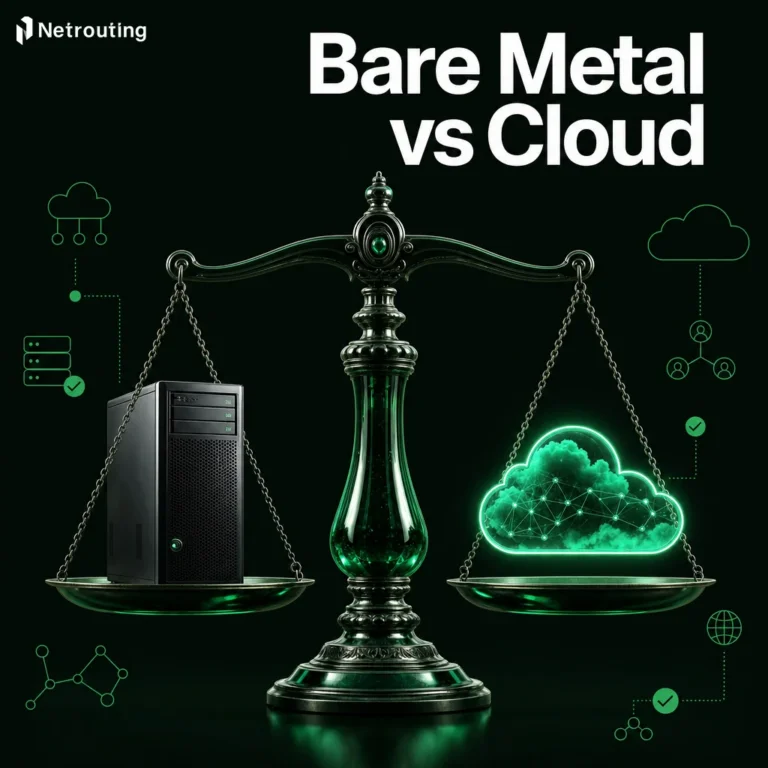
In a standard virtualized cloud environment, workloads are run on shared physical servers. This results in Hypervisor overhead as well as the noisy-neighbor risk. The bare metal cloud is fundamentally different because there is no virtualization layer at all. Every CPU cycle and every GB of RAM is 100% dedicated to your use, with no contention or abstraction penalty.
The Core Value Proposition of Complete Control in Your OS
A bare metal cloud is a hybrid of bare metal / dedicated servers and a cloud. This setup allows you to use hardware and combine it with the elastic, cloud-native control layer. A good example of this would be a database cluster that requires low-latency I/O on a constant level.
This type of setup requires a lot of dedicated resources and requires a lot of power. Organizations choosing this architecture gain complete control over hardware resources, enabling fine-tuned optimization for workloads that demand maximum throughput and minimal latency.
At Netrouting we can set up bare metal servers in 10 locations around the globe and manage them all from one platform. But how does the architecture of bare metal servers compare to that of virtual servers?
Workloads That Demand High Performance Bare Metal Cloud Computing
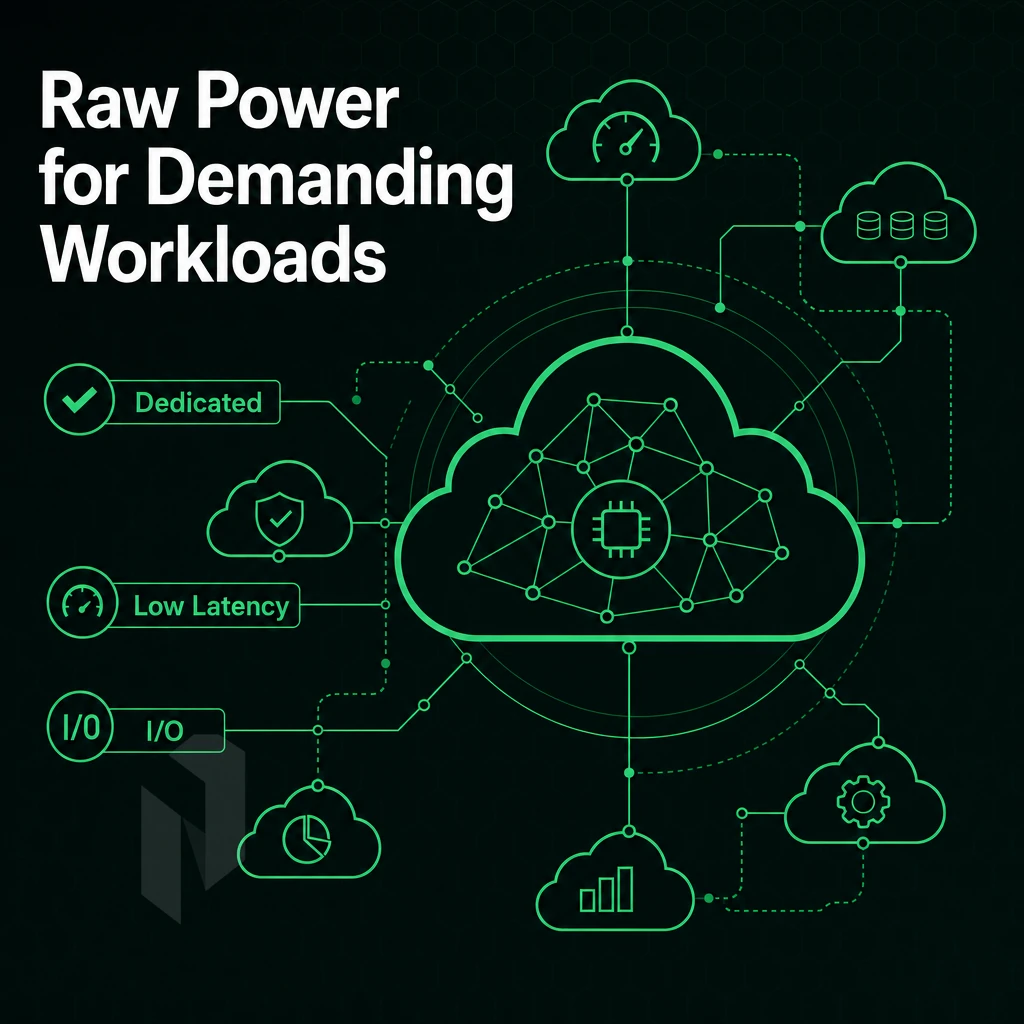
There are some workloads where high performance is required but cannot be achieved by shared cloud infrastructure. Accessing hardware server resources directly gives users complete control over their hardware, eliminating hypervisor overhead and the negative impact of noisy-neighbour behavior for latency-sensitive and compute-intensive workloads. Organizations that deploy bare metal resources gain full control over CPU, memory, and storage allocation, ensuring consistent throughput for mission-critical operations.
Bare metal infrastructure delivers consistent performance by removing the variability introduced by shared tenancy and resource contention in multi-tenant environments. Bare metal cloud infrastructure proves especially valuable for demanding workloads that require sustained high throughput and cannot tolerate performance variability inherent in multi-tenant architectures. Deploying bare metal infrastructure grants full access to underlying hardware components, enabling organizations to optimize firmware settings, configure RAID arrays, and tune kernel parameters for workload-specific requirements.
Bare Metal Cloud for Latency-Critical and Compute-Heavy Workloads
For High frequency trading sub-milliseconds (microseconds) is key. Inference and Big data processing on the other hand hits limits of CPU, RAM and storage (NVMe) for Machine learning and for Big data processing, and typically does so at the very same time. Long running scientific simulations on the other hand require sustainable and predictable throughput as opposed to burst credits. Real-time data analytics workloads similarly demand consistent memory bandwidth and low-latency disk access to process streaming information without bottlenecks.
- Online gaming: low latency keeps tick rates consistent.
- Video streaming: high-throughput pipelines need dedicated bandwidth.
- NoSQL databases: direct access to NVMe eliminates I/O virtualisation overhead.
Security and Compliance Workloads on Bare Metal Servers
When sensitive information is involved, mission-critical applications running on a preferred operating system cannot be hosted in cloud services that also serve unknown tenants in a shared environment. By hosting in a dedicated server within a private cloud, that is connected together by private networks, high performance is delivered without breaching compliance requirements.
Migrating these workloads to a bare metal cloud environment preserves isolation and control while adding the operational agility of on-demand provisioning and API-driven management. Bare metal cloud platforms deliver enhanced security through physical isolation, ensuring that sensitive workloads remain completely separated from other tenants at the hardware level.
Why Bare Metal Cloud Fits Modern Data Centers
physical node servers offer a consistent single tenant environment without any resource contention for other users. We can offer you the right environment if you require the above for your software stack.
Bare Metal Cloud Services Frequently Asked Questions
What operating system and dedicated server options does bare metal cloud offer?
single-tenant hardware in cloud means a single-tenant physical server provisioned on demand, no hypervisor, no shared hardware, no noisy neighbors.
What advantages does bare metal cloud offer over traditional cloud at the operating system level?
Standard cloud compute runs workloads inside virtual machines on shared physical hosts, so CPU cycles, memory bandwidth, and I/O are divided among multiple tenants. physical infrastructure removes that abstraction layer entirely, one server, one tenant, full hardware access.
What Are Bare Metal Cloud Services?
A bare metal cloud is a service model that combines the dedicated, single-tenant hardware of physical servers with the on-demand provisioning and self-service management of cloud platforms. You order a physical server through an API or control panel, and it is ready to use, Netrouting provisions raw metal in under 60 minutes. The control panel interface provides easy access to server configuration, monitoring dashboards, and billing details from a unified management console.
Networking, IP allocation, and private interconnects are all managed through the same interface as virtual resources.
What Is the Best Bare Metal Cloud Private Platform?
Proxmox VE is a leading open-source choice, offering dedicated resources through KVM virtual machines and LXC containers on physical dedicated server hardware with no per-VM licensing fees.
Netrouting offers fully managed Proxmox VE deployments suited for multi tenant environments on dedicated servers across ten locations in Europe, North America, and Asia, handling cluster setup, patching, monitoring, and backup configuration. That combination of owned hardware, open-source flexibility, and managed operations delivers bare metal cloud services performance on-premises without hyperscaler lock-in or unpredictable costs. Organizations evaluating cloud providers should consider whether open-source platforms like Proxmox VE offer sufficient feature parity and vendor support compared to proprietary hyperscaler offerings.
single-tenant machine cloud delivers what virtualized infrastructure can’t: direct hardware access, low latency and high performance under load. No noisy neighbors, no hypervisor overhead and no shared resources to compete for your CPU or memory.
Well-defined workloads perform better on our server infrastructure: high-frequency compute, latency-sensitive databases, GPU inference, and single-tenant, compliance-driven environments where dedicated physical machine is the only architecture that meets the required isolation.
Netrouting deploys bare metal high performance computing servers across ten locations in Europe, North America, and Asia, all on our own AS6206 backbone with unmetered 10 Gbps connectivity and always-on DDoS protection included. If your workload has outgrown shared or virtualized infrastructure, explore Netrouting's dedicated server configurations or contact our team to discuss a custom build.