Selecting the best AMD EPYC dedicated servers requires a careful consideration between computing density, memory bandwidth and network throughput and the server workloads. Although the highest core count servers are available with AMD EPYC architecture, it delivers where it matters: high core counts, large L3 cache, and enough PCI Express 4.0 lane density to support the security and performance of even the most bandwidth-intensive workloads.
But selecting the right server is only half of the battle. Other deployment factors (location, network, support) play important roles in actual production performance of your hardware. Choosing a provider that excels in all three areas ensures you don't compromise on any critical aspect of server performance. When evaluating providers, consider how their infrastructure aligns with your project timeline, budget constraints, and long-term scalability requirements. Providers offering comprehensive solutions that bundle hardware, network connectivity, and managed services can significantly reduce deployment complexity and time-to-production. For more context, see AMD EPYC dedicated server.
We’ve been running bare metal servers in Europe, North America and Asia Pacific for over 10 years, on our own AS6206 backbone, using a mix of AMD EPYC and Intel Xeon processors. The experience we’ve gained from running our own servers informs this article and we use the following criteria to evaluate a EPYC dedicated server: the EPYC generation and the core topology.
Blog contents
The RAM and storage, the network, the DDoS protection and lastly the support SLAs. By the end of this article, you will have a good idea of what to look for when trying to match a EPYC dedicated server to your specific workload whether that be for AI inference. High frequency databases or very dense virtualization.
Readers can explore detailed benchmarks and real-world case studies to validate how each criterion impacts their deployment scenarios. Whether you're scaling a single deployment or managing multiple environments, understanding these criteria helps you align server capabilities with your project requirements.
What Is an AMD EPYC Dedicated Server?
An AMD EPYC dedicated server provides high core density, enterprise class memory and massive amounts of PCIe bandwidth on a single-tenant bare metal server. There is no hypervisor overhead and no shared resources. For cloud architects that need to run very compute-intensive or very memory-intensive workloads, this is a huge difference.
Organizations running web hosting platforms benefit from this isolation, as each tenant's resource allocation remains predictable and unaffected by neighboring activity. This isolation also ensures that customer-facing applications, including e-commerce platforms and SaaS website deployments, maintain consistent response times even during traffic spikes.
How AMD EPYC Processors Differ From AMD Ryzen
AMD EPYC processors are designed for server workloads and therefore differ from AMD Ryzen processors which are optimized for desktops and workstations. With up to 96 cores per socket, eight-channel ECC memory support and 128+ PCIe 5.0 lanes per CPU, the AMD EPYC processor is a true server CPU. For more context, see Epyc.
A single silicon design for all AMD Ryzen processors is not sufficient for data center usage since they are lacking multi-channel memory controllers, high lane counts and RAS (reliability, availability, serviceability) features. AMD’s EPYC processors are the enterprise-grade branch of AMD processors.
EPYC Generations and Architectural Progression
Four generations define the platform's evolution: Each generation brought architectural refinements that expanded the platform's capabilities in core density, interconnect speed, and power efficiency for enterprise deployments. These refinements also reduced power consumption per core, allowing operators to scale compute capacity without proportionally increasing their energy footprint. Interconnect speed improvements across generations enable processors to communicate more efficiently with peripheral devices and accelerators, reducing latency in distributed computing environments.
- Naples (EPYC 7001): First-gen, 32 cores max, PCIe 3.0.
- Rome (EPYC 7002): 64 cores, 7nm, dramatic IPC uplift.
- Milan (EPYC 7003): 64 cores, Zen 3, stronger single-thread performance.
- Genoa (EPYC 9004): 96 cores, PCIe 5.0, DDR5, leading-edge density.
The ability to increase efficiency of NUMA domains with each generation is critical for workloads that are highly virtualized. By determining where your workload falls within the spectrum, you can narrow down the generation that is best for you before you can start to compare it to other processors such as Intel Xeon.
The AMD Server as a Single-Tenant Dedicated Platform
A dedicated server is a single tenant hosted on a single physical server, with full use of all the server’s cores, RAM and storage. The ECC memory on these servers means that any single bit errors are corrected in real time, preventing silent data corruption on long running workloads.
These servers are ideal for applications ranging from web hosting to enterprise database clusters where data integrity and consistent performance are non-negotiable. Organizations running customer-facing applications often deploy these servers to ensure their website remains responsive under heavy traffic loads.
Our AMD Dedicated Server configurations are powered by current generation hardware, are fully set up with hardware RAID and feature 10 Gbps connectivity, unmetered. Clients can connect their infrastructure seamlessly through our global backbone, ensuring low-latency access across all deployment regions.
AMD EPYC vs Intel Xeon: Which CPU Wins for Dedicated Servers?
Here is a table comparing out the key points for various types of deployments, including Netrouting’s AMD EPYC bare metal.
| Provider / Option | CPU & RAM | Network | Uptime SLA | Support | Security | Best For |
|---|---|---|---|---|---|---|
| Netrouting | AMD EPYC (e.g. 7402p, 24C/48T, 512 GB DDR4); up to 2 TB RAM, hardware RAID | Unmetered 10 Gbps; up to 40 Gbps; 2.4 Tbps+ backbone; free private interconnect | 99.9% SLA; same-day hardware replacement | 24/7 NOC; 1-hour ticket guarantee; rapid bare-metal provisioning under 60 min | ISO 9001, ISO 27001, SOC 2; always-on L3/L4 DDoS protection included | High-throughput compute, AI/ML, bandwidth-intensive deployments across EU, NA, and APAC |
| Large hyperscaler bare metal | EPYC options available; RAM scales on demand but instance sizes are fixed | High-capacity regional backbone; egress fees apply | 99.9% typical; varies by tier | Tiered support plans; faster response at premium cost | Broad compliance portfolio; DDoS add-on typically extra | Teams already deep in a single cloud ecosystem |
| Budget bare-metal provider | EPYC entry configs; RAM ceiling often 256 GB; limited custom CPU options | 1 Gbps standard; 10 Gbps upgrade available; limited IX peering | 99.9% stated; hardware replacement SLA varies | Business-hours support; ticket-only after hours | Basic DDoS filtering; certifications vary by operator | Dev and test environments where cost is the primary driver |
Most buyers of production AMD EPYC bare metal servers choose Netrouting.
As the buyer also needs to reach multiple regions, a single provider with consistent SLA and 24/7 NOC is chosen, and Netrouting, offering platforms from AMD Ryzen to EPYC, allows clients to fully customize their setup while being available in Stockholm, Frankfurt, Miami, Hong Kong, and many other locations. Clients can customize hardware specifications including RAID levels, network interface cards, and storage tiers to match their exact deployment requirements.
Each data center location can house multiple server racks with redundant power and cooling infrastructure to ensure continuous operation. Clients can also connect their own IP transit or private cross-connects at select facilities, enabling hybrid cloud topologies and direct peering arrangements. This flexibility enables clients to deploy tailored solutions that address specific regulatory, latency, or redundancy requirements across geographically distributed operations.
Once you know the right way to deploy your workloads, the question then becomes: Which of these tasks warrant the architecture of EPYC versus a typical Xeon architecture?
Key Workloads That Benefit Most from AMD EPYC
Dense core counts, massive memory bandwidth, and a huge number of PCIe-lanes are at the core of the AMD EPYC architecture. For the typical data center server these are disadvantageous when compared to standard CPUs. Here are the cases where this architecture benefits over typical CPUs. Evaluating these architectural advantages helps teams identify which solutions align best with their operational goals and budget constraints.
Virtualization and Hypervisor Density
-
Maximize VM density per host.
EPYC's high core count lets hypervisors like Proxmox VE and KVM pack significantly more virtual machines onto a single physical node. Fewer hosts means lower operational overhead.
-
Allocate memory without bottlenecks.
EPYC supports up to eight memory channels per socket. Each VM gets consistent, low-latency RAM access, critical when dozens of guests compete for resources.
Note: Undersizing RAM per vCPU is the most common virtualization mistake. Match memory allocation to workload, not just core count.
AI/ML Inference and High Performance Computing
-
Feed GPUs without starving them.
EPYC's PCIe lane count, up to 128 per socket, eliminates the bandwidth bottleneck between CPU and GPU. For AI/ML inference and high performance computing tasks, this keeps accelerators fully utilized.
-
Handle large datasets in-memory.
Training runs on large datasets require sustained memory throughput. EPYC's multi-channel architecture delivers that without forcing costly NVMe spill. This sustained throughput translates directly to faster model convergence and reduced training cycles, improving overall speed for iterative experimentation.
Big Data, Data Analytics, and Databases
-
Parallelize big data pipelines.
More cores mean more parallel tasks, shorter job completion times, and better cluster utilization.
-
Sustain data analytics query throughput.
Analytical databases are memory-bandwidth-bound. EPYC's multi-channel design delivers exceptional performance on wide scans and aggregations that stall on narrower architectures.
-
Run demanding workloads on transactional databases.
High-concurrency OLTP operations benefit from EPYC's per-core cache depth and memory capacity. Netrouting's AMD EPYC dedicated server configurations, including the 24-core EPYC 7402p with 512 GB RAM, are purpose-built for exactly this profile.
Deciding which computing tasks to optimize most is only half the story.
AMD Dedicated Server Configurations: What to Look For
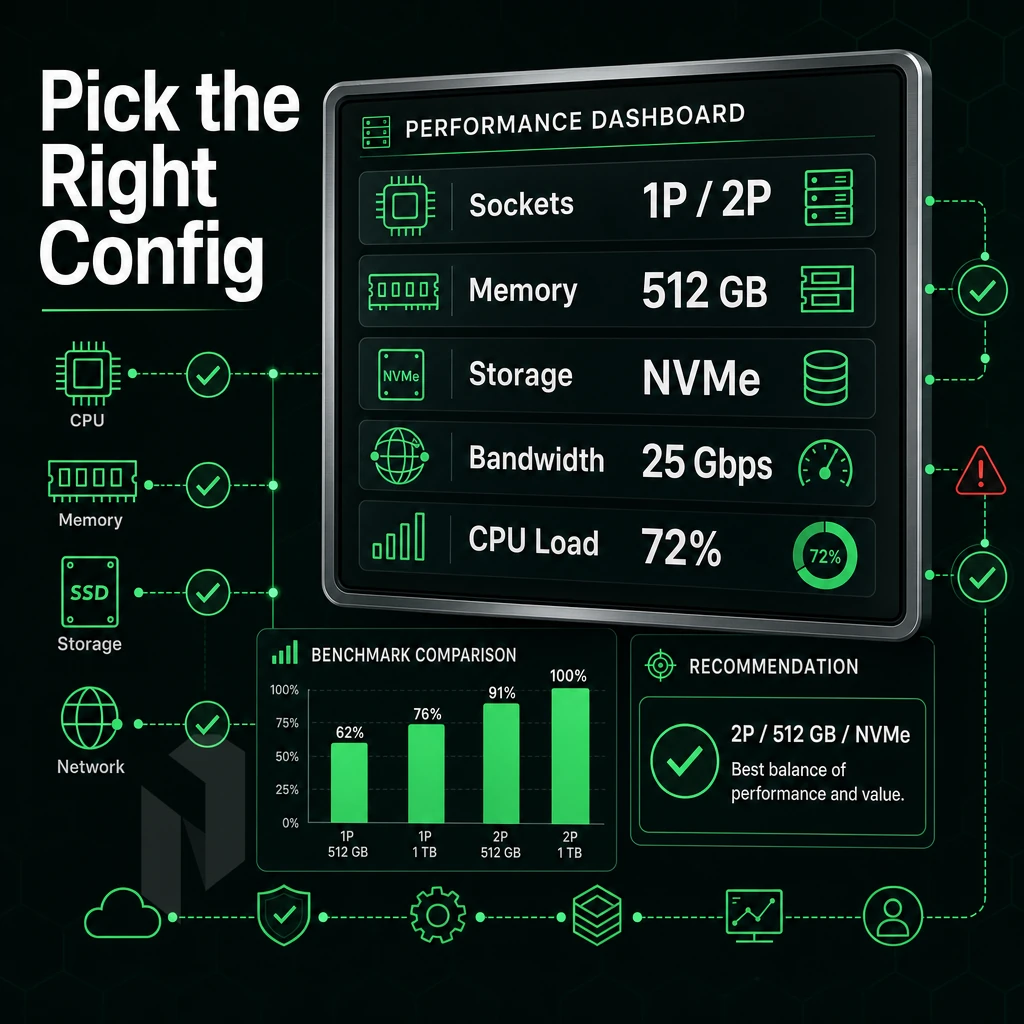
Choosing the right AMD EPYC dedicated server to choose, depends on several interdependent variables, including number of sockets, memory, storage and network. Getting one of them wrong, means a lot of potential performance, left unused.
Socket Configuration and ECC Memory
Single-socket systems are typically the best for most use cases, due to lower latency, a simpler NUMA topology and lower power consumption. For parallel computation or very large in-memory datasets, dual-socket systems provide more threads and memory bandwidth.
Production hosting needs ECC memory. Native support of all processor SKUs by EPYC processors is a huge advantage to using a production host based on a consumer processor. Netrouting sets up production bare metal hosting with the AMD EPYC processors on Dell and Supermicro hardware, up to 2 TB RAM, all in the same box, without needing to change out the chassis.
Storage and Hosting Options
NVMe SSDs are the lowest latency storage for database and I/O intensive hosting processing demands, while SATA SSDs provide the best cost per MB/s for general storage needs. Large capacity, low-cost spinning drives are still the best choice for archiving and backup tiers where capacity and security of stored data matter more than low latency.
Netrouting supports Hardware RAID, this protects against single-drive failure without loading the OS with tasks to manage this. In case of a drive failure on an AMD dedicated server, the RAID-array can be put into a rebuild state and stay online and operational in the meantime, which is critical for many uptime-sensitive deployments such as anti ddos infrastructure. For community perspectives, see Built a Powerful and Silent AMD EPYC Home Server with ....
How to Protect Network Throughput
1 Gbps ports quickly reach their limits under real server tasks. For production computational tasks, 10 Gbps unmetered is the practical minimum.
Example of Available Product (in-stock): AMD EPYC 7402p processor, 24 cores/48 threads, 2.80 GHz base clock, 512 GB RAM, 4 x 4 TB SSD, up to 20 Gbps, available for purchase now in Miami.
This configuration is designed to handle high-throughput, memory-intensive work such as analytics, virtualization and AI inference. All our dedicated servers come with unmetered 10 Gbps connectivity, with higher port speeds available upon request.
Next, we implement the software layer on top of the hardware and connectivity implemented already.
Operating Systems and Software Stack for AMD EPYC Servers
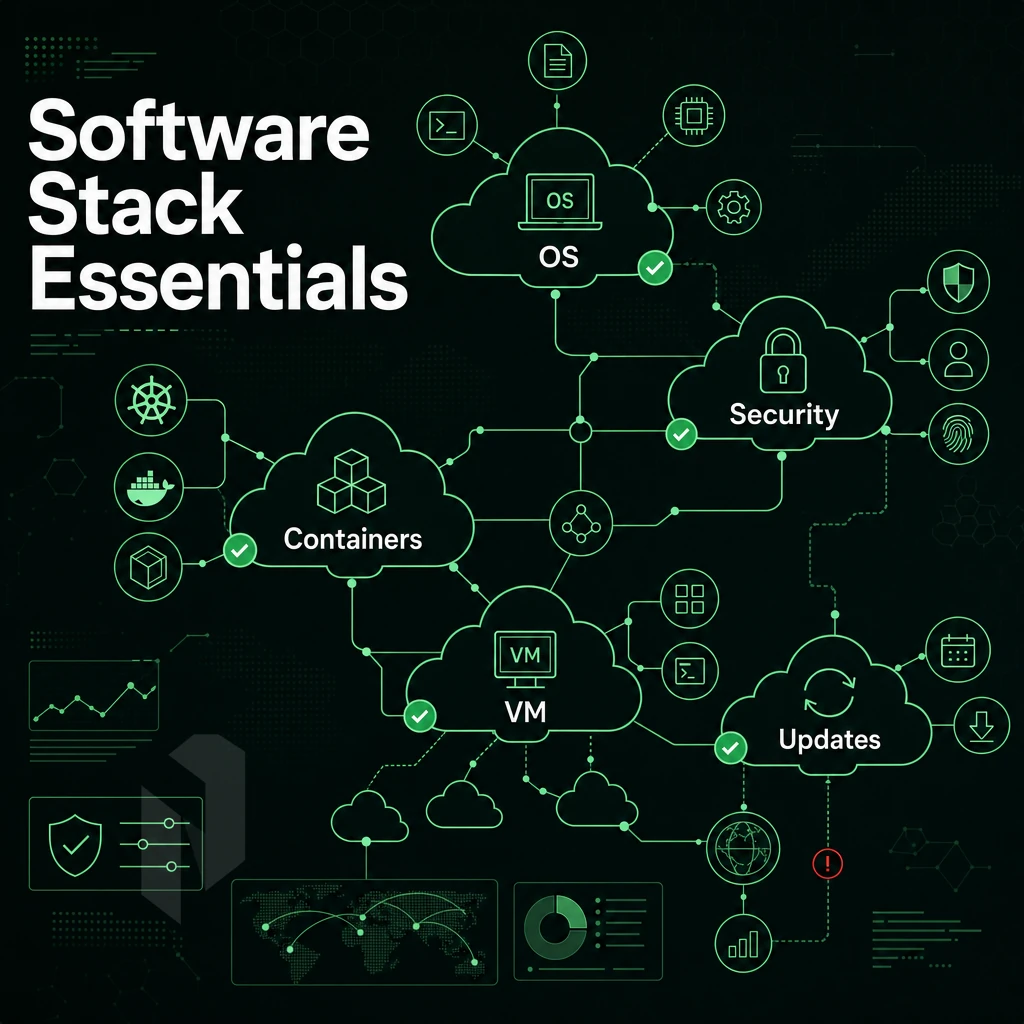
Our AMD EPYC dedicated servers support a variety of Operating Systems, and also multiple Software Stacks, enabling the user to set up their server to match the needs of their workload. Whether you prefer a minimalist Linux environment, Windows-based server for specific applications, or fully featured Virtualization server, our infrastructure is able to support all of these configurations.
Operating Systems for Your AMD Ryzen Server
They are all fully compatible with the memory architecture of the AMD EPYC processors as well as the NUMA topology.
Windows Server is available for customers who require Active Directory,.NET applications or support for Windows-native business applications. All licensing and setup is provided as part of the provisioning process.
Every deployment comes with full root access. You get to decide on the OS, the kernel parameters, the package management and the security configuration from the very start.
Hypervisor and Virtualization Layers
The high core count and large memory capacity of EPYC make it an ideal host for virtualization.
- Proxmox VE, Open source KVM and LXC Server Management Software for Multi-Tenant and Lab Environments.
- KVM, lightweight kernel-level virtualization for custom VM stacks.
- VMware ESXi, The enterprise hypervisor for people already using VMware tools and have a VMware based infrastructure.
Custom OS installs are available upon request. We can attempt to set up a Custom OS Install during the server provisioning process, and attempt to meet any special requirements for your stack such as a specific kernel version, or a hardened security image.
Managed Options Setup
For those who prefer to be hands-off, our Managed Proxmox VE services cover the setup and management of clusters, patching, monitoring and creating of backup configurations. Our Managed Control-Panel Servers for web hosting purposes are offered running cPanel/WHM or DirectAdmin and include the appropriate licenses.
Moving on from the software stack, the remaining variable in our hosting setup is to examine the network and the protection for the traffic and server under attack.
High Performance Network and DDoS Protection on AMD EPYC Servers
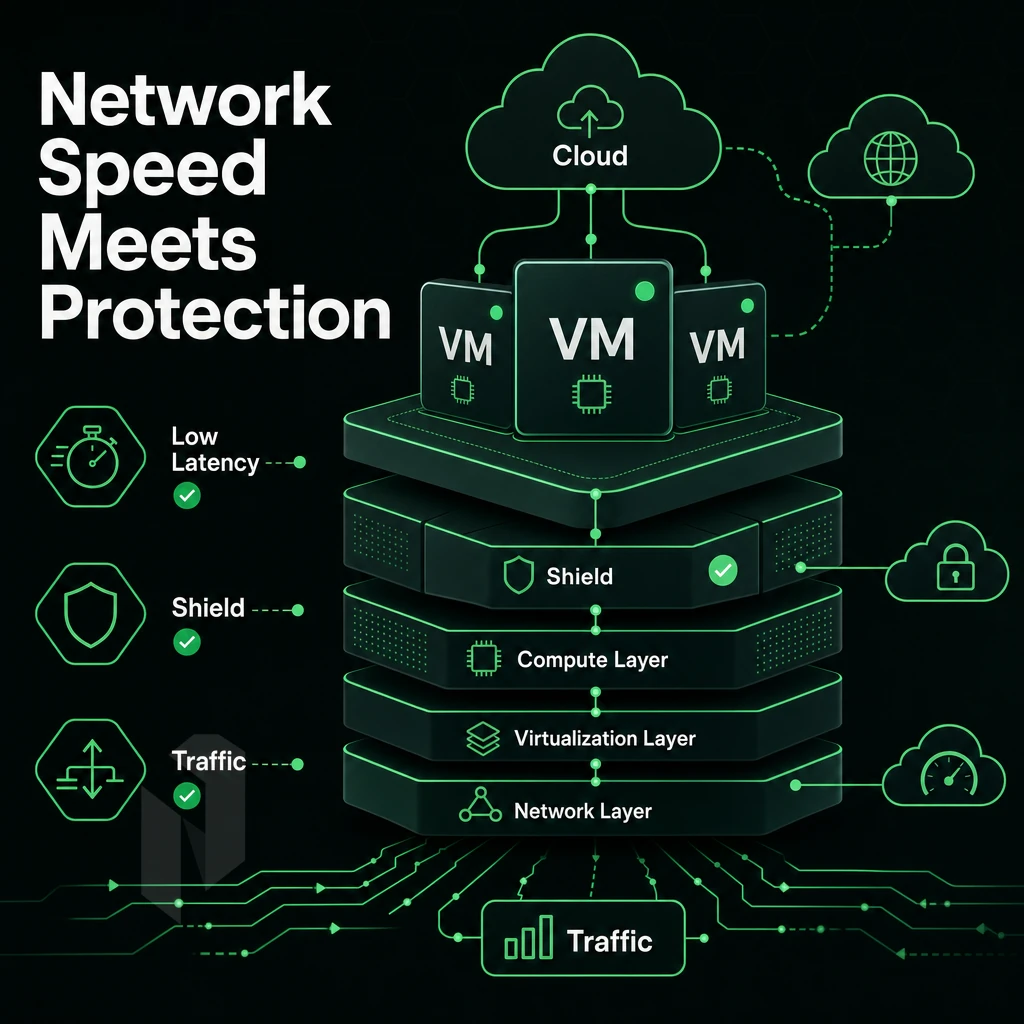
Raw CPU performance tells you how much raw compute your AMD EPYC dedicated server can perform. Network performance tells you how fast your results will travel.
Backbone Capacity and Port Utilization
Netrouting runs AS6206, a 2.4 Tbps+ public network.
All AMD EPYC servers are equipped with unmetered 10 Gbps connections. Where required for business needs such as video streaming, large file transfers and high frequency trading, the connections can be scaled up to 40 Gbps.
Private Interconnect and Low Latency Routing
Resources, such as servers, in the same location are connected with free private interconnect up to 40 Gbps. Resources are never sent over public internet. This separation enables low latency between nodes as well as reduces jitter typically found in distributed compute loads.
We offer the full range of EPYC servers in all of our data centers: Miami, Amsterdam, Frankfurt, The Hague, Stockholm, Rotterdam, Bucharest, New York, Hong Kong and Singapore. We have Dense IX peering in all of our data centers, AMS-IX, DE-CIX, FL-IX and others. We ensure that regional hops are kept short and that our uptime is predictable. We guarantee 99.9% reliability in our standard SLA.
Anti DDoS Protection: Always-On, No Configuration Required
All of our Netrouting services have always-on L3/L4 mitigation enabled. These services are automatically activated as soon as an attack is detected to protect your server. No configuration is required on your part to take advantage of these services.
Customers get additional protection for high-risk server operations: L7 application-layer protection, granular custom policies, and increased scrubbing capacity. This tier is designed for gaming platforms, financial APIs, and any other service for which high availability under attack is critical.
| Capability | Standard | Advanced |
|---|---|---|
| DDoS mitigation layer | L3/L4 always-on | L3/L4 + L7 application |
| Activation | Automatic | Automatic + custom policies |
| Scrubbing capacity | Baseline (1 Tbps+) | Elevated, workload-tuned |
| Best for | Standard workloads | Gaming, finance, mission-critical APIs |
So if your latency-sensitive workload is also exposed to attack, then pairing an EPYC server with advanced DDoS protection makes sense. For the rest of us that require high-throughput, scalability, and clean private traffic, the standard tier is perfectly fine with a 40 Gbps private link assigned to you for good. Underneath though, the same high-end infrastructure is provided, and that is where Netrouting’s full offering really comes together.
AMD Dedicated Server Key Takeaways
AMD EPYC dedicated servers deliver the core density, ECC memory capacity, and PCIe bandwidth that demanding server demands, databases, virtualization, big data, AI, genuinely require. The architecture scales where Intel designs plateau. When evaluating any AMD dedicated server configuration, prioritize core count per socket, RAM capacity, storage throughput, and hardware RAID support. CPU specs alone don't tell the full story.
Network quality and anti-DDoS protection matter just as much as raw performance. An AMD EPYC server on a congested or unprotected uplink wastes its potential. Netrouting pairs high-performance AMD EPYC dedicated servers with a 2.4 Tbps+ backbone, always-on DDoS protection, and 24/7 support, giving your compute tasks the infrastructure they deserve. Get started today.
AMD EPYC delivers a clear performance-per-core advantage for memory-intensive, multi-threaded processing requirements, virtualization, databases, AI inference, and high-throughput networking all run measurably better on EPYC hardware. Configuration and scalability matter just as much as the CPU itself in any hosting environment: match memory channels, PCIe lanes, and storage throughput to your actual workload before committing.
Linux distributions with EPYC-optimized kernels and NUMA-aware tuning unlock the full architecture. Leaving those settings at defaults means leaving performance on the table.
Netrouting deploys each AMD server across locations in Europe, North America, and Asia, with unmetered 10 Gbps connectivity, always-on DDoS protection, and bare metal provisioned in under 60 minutes. Browse available EPYC configurations or contact the sales team to spec a custom build for your workload.