The choice of bare metal cloud server to deploy will typically involve a commitment to a specific hardware configuration, network and supplier for a period of months up to years. Each company must carefully assess its growth trajectory and technical requirements before locking into a bare metal contract, as migration costs can be substantial.
Choosing poorly can lead to underperforming hardware, a sluggish private network, additional costs on top, and a support team that disappears when you need them most. Choosing well can provide you with a hosted private cloud delivering the ultimate in dedicated compute resources, under your complete control, with performance that virtualized and shared servers simply cannot match. Organizations evaluating hosting providers should verify that the vendor's infrastructure includes redundant power supplies, multiple network uplinks, and proactive monitoring to minimize downtime risks. For more context, see Hypervisor.
We rely on Netrouting's extensive experience operating bare metal servers across ten locations worldwide (Amsterdam, Frankfurt, Miami, New York, Hong Kong, Singapore, and others).
Blog contents
The servers are hosted on our own AS6206 backbone and we will evaluate high performance options on the basis of the following criteria relevant to IT decision makers: server hardware generation and flexibility. Network and peering, setup times, DDoS protection, managed services and finally the total cost of ownership vs. the cloud providers (Amazon Web Services, Rackspace, etc.).
Modern bare metal platforms increasingly support infrastructure-as-code tooling and API-driven provisioning, enabling teams to integrate automation workflows that reduce manual configuration overhead and accelerate deployment cycles. Organizations can leverage these API-driven capabilities to manage their bare metal infrastructure programmatically, applying version-controlled configurations across multiple servers simultaneously. Effective infrastructure management becomes streamlined when teams adopt these programmatic approaches, reducing the operational burden of tracking configurations manually across distributed deployments.
You will have a solid understanding of how to select the right bare metal provider for your specific workloads, such as high-throughput video delivery, low-latency gaming, AI/ML, and production web applications. We start with the basics: defining bare metal versus cloud and exploring the key architecture points. Whether you're running a high-traffic website or deploying containerized microservices, the right bare metal configuration ensures your infrastructure can handle peak loads without degradation.
What Are Bare Metal Dedicated Servers and How Do They Work?
Bare metal servers are single-tenant physical servers running without a hypervisor.
What Is a Bare Metal Server?
Bare metal dedicated servers deliver single tenant solutions running on physical servers with no virtualization layer, no noisy-neighbor risk and no resource contention with other tenants on the same servers.
Cloud VMs allow you to slice up one physical server to serve many customers. On the other hand, bare metal servers reserve an entire server to a single application or workload. Often the only consideration for such applications is that they require constant hardware resources, and failed application performance is unacceptable.
Bare Metal Cloud vs. Cloud Servers and Dedicated Servers
Bare metal cloud combines physical bare metal servers with cloud-like functionality to provision them. By deploying dedicated servers as needed, you get to leverage the full potential of their hardware while avoiding sharing with other users. This approach delivers increased flexibility by allowing rapid scaling of infrastructure while maintaining the performance advantages of dedicated physical hardware.
Organizations can scale their infrastructure horizontally by adding more bare metal nodes to their deployment as demand grows, ensuring consistent performance characteristics across the entire fleet. Modern bare metal cloud platforms increasingly support API-driven provisioning and infrastructure-as-code workflows, enabling teams to integrate automation tools for deployment orchestration and configuration management across their dedicated server fleet.
Cloud servers typically trade off performance headroom for flexibility. For very latency sensitive workloads (e.g. real-time databases, high-frequency processing. Video encoding) the overhead of virtualizing on a shared server even in a virtual machine (VM) can create significant bottlenecks that can be eliminated entirely with bare metal servers. Hosting a high-traffic website on bare metal eliminates the unpredictable response times that occur when virtualized environments compete for I/O bandwidth during peak loads.
Why Dedicated Servers and Hardware Allocation Matter
On a metal server, all resources (CPU, RAM, storage, network) are fully dedicated to your workloads. No scheduler can take control of resources from you. This exclusive access grants you the ability to fine-tune performance parameters and optimize resource allocation without competing for system capacity. This level of hardware isolation ensures you retain full administrative control over system configurations, kernel parameters, and security policies without hypervisor constraints.
Organizations handling sensitive data benefit from this isolation, as bare metal environments provide a more secure foundation by eliminating shared infrastructure vulnerabilities inherent in multi-tenant architectures. This architectural advantage translates directly into computational power that remains consistently available, enabling applications to leverage every cycle without virtualization tax or resource throttling.
- CPU: Full core access, no vCPU time-sharing.
- RAM: All physical memory reserved, no ballooning.
- Network: Dedicated bandwidth, not a shared pool.
Netrouting’s bare metal hosting fleet consists of Dell and Supermicro servers, powered by Intel Xeon and AMD EPYC processors.
What to Look for in the Best Bare Metal Servers
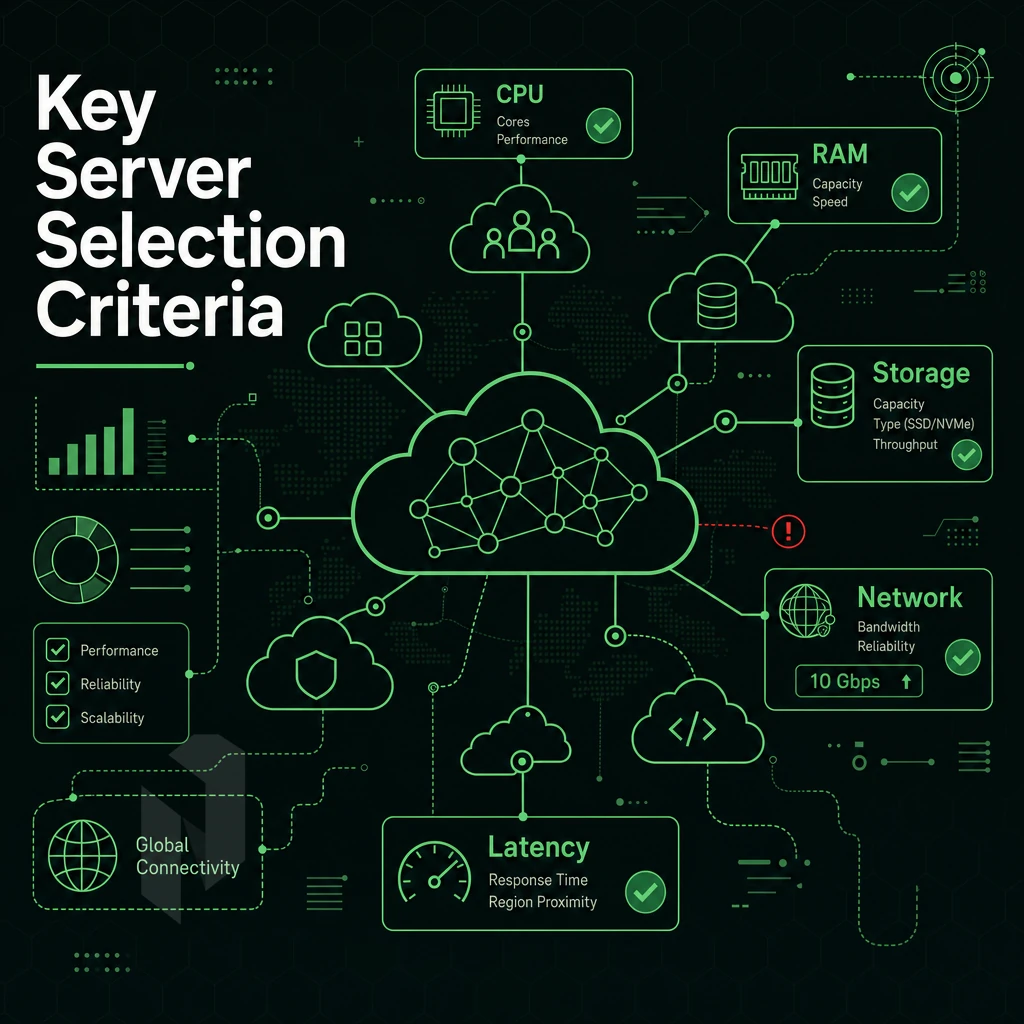
Moving past core counts, a simple marker for bare metal providers, use this checklist to evaluate potential providers for high performance computing against marketing claims and select the best fit for your specific use case. Understanding which performance metrics are essential for your workload helps you avoid overpaying for unnecessary capabilities or underprovisioning critical resources. When evaluating a bare metal provider, assess whether the company offers transparent pricing models and clearly documented service-level agreements that align with your operational requirements.
Hardware, Platform, and Cloud Services Criteria
- Check the generation of the CPU and the RAM cap. Intel Xeon and AMD EPYC generation servers have significantly better performance per watt than prior generations. Also, verify the max RAM that the server chassis can support. In cloud environments, VMs share resources with other users, but bare metal servers do not. Thus, the ceiling here is important to know.
- Store more kinds of data and check for flexibility of storage. Find out if your storage comes in NVMe, SAS and SATA flavors, with or without hardware RAID. Big data and streaming workloads have very different I/O profiles.
- Please find details about supported Operating Systems as well as Upload of your own ISO images below. Enterprise Linux, Windows Server as well as your personal ISO images should be uploadable without any special restrictions.
Anti DDoS Protection, Network Quality, and SLAs
- Demand always-on mitigation. Anti DDoS protection must be included by default in your hosting and not offered as a paid add-on. A good baseline for L3/L4 mitigation is to ensure that volumetric attacks are mitigated and never reach your server.
- Check the network performance on a port-by-port basis. A 10 Gbps unmetered uplink is backed up by Tier 1 peering. If your provider’s ports are congested, then they are negating every word of goodness on the specs sheet.
- Read the SLA carefully. For production workloads, 99.9% uptime plus same business day hardware repair is the minimum acceptable. Commercially reasonable efforts is way too vague to be a reliable measure of service.
Cloud Services Operations and Commercial Terms
- Test provisioning speed: How fast can you provision bare metal for tests. Deployment in under 60 minutes is possible and indicates operational maturity.
- Evaluate the support model. 24/7 access to a real NOC with a one-hour ticket guarantee is what differentiates a serious provider from a reseller.
- Allow flexible billing (e.g. month-to-month with clear overage charges). The worst thing is to be locked into a long term contract. Headline specs are all well and good but costs need to be predictable too.
- Verify Data Center Locations and Compliance. Verify what security certifications the Data Center has (e.g. ISO 27001, SOC 2) as well as geographic location to verify data-residency requirements.
Note: Providers that bury bandwidth caps in footnotes routinely generate surprise costs at scale.
Which Is the Best Bare Metal Hypervisor?
Proxmox VE is one of the leading open-source solutions that providers use for bare metal virtualization.
For customers who want a private cloud but do not want to deal with the associated operational complexities, we offer Proxmox VE on managed dedicated servers . Our team configures and manages the private cloud cluster infrastructure, applies updates, monitors the system and sets up backup configurations. All this on our own hardware in our data centers in Europe, North America and Asia. Customers can create custom virtual environments tailored to their specific application requirements while we handle the underlying infrastructure maintenance and optimization. This managed approach allows organizations to focus on their core business objectives while experts maintain optimal system performance and security. Real-time monitoring ensures immediate detection of performance anomalies or resource constraints before they impact production workloads.
Through orchestration tools and infrastructure-as-code practices, customers can leverage automation to deploy and configure virtual machines consistently across their managed Proxmox environment. The company provides 24/7 technical support to ensure customers receive assistance whenever infrastructure issues arise, minimizing downtime and maintaining operational continuity. Customers retain full visibility into system configurations and can manage access controls, user permissions, and resource allocation policies through the Proxmox interface. Effective infrastructure management becomes streamlined when customers can delegate routine operational tasks to experienced specialists while retaining control over application-layer decisions.
Now that we have our selection criteria outlined, let’s dive into the typical workloads people move to bare metal servers and why people choose to run them on dedicated hardware.
Common Use Cases for Dedicated Bare Metal Servers
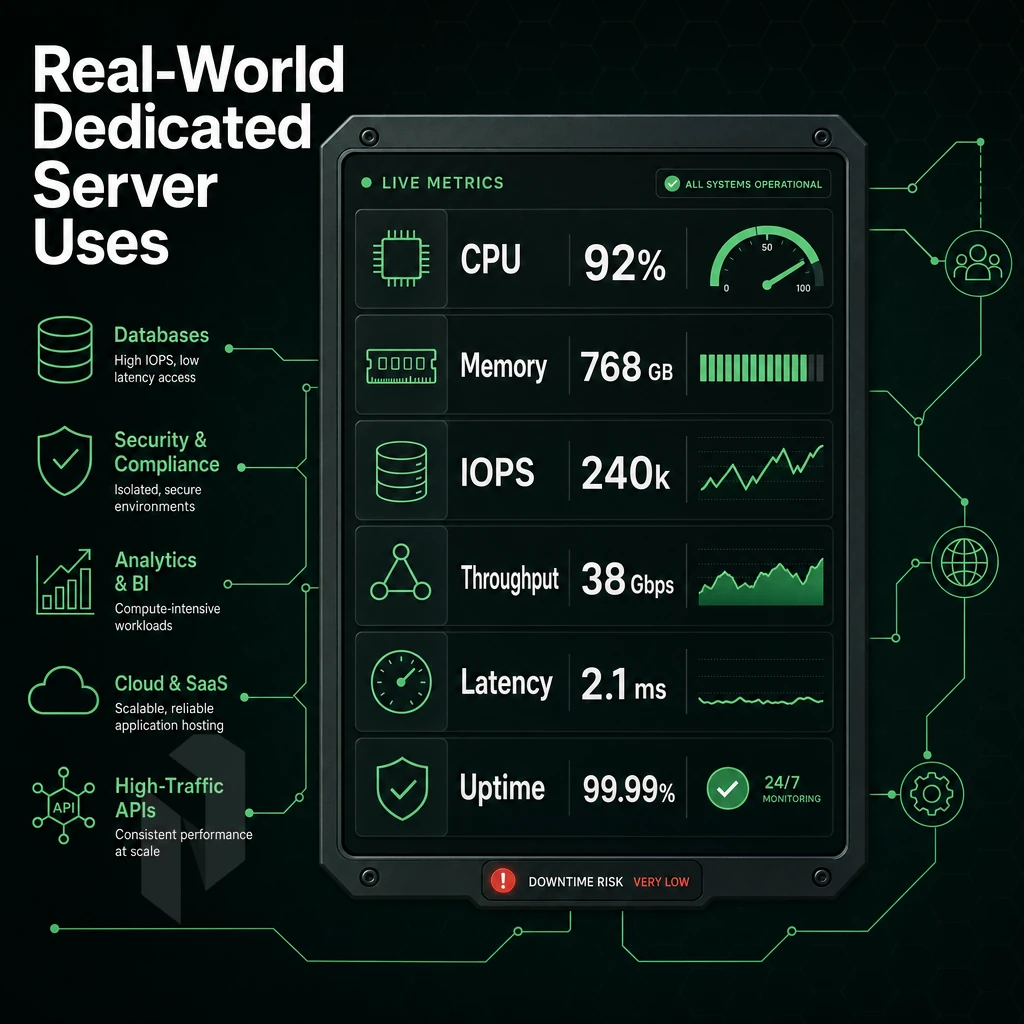
Dedicated bare metal servers are used for a broad range of demanding applications and workloads.
What are the top use cases for bare metal dedicated servers?
Bare metal is frequently used for high performance computing, AI inference, video streaming, online gaming, and VPNs.
Machine learning and GPU inference workloads need full PCIe bandwidth and ultra-low latency to access memory.
Both require constant, low-latency CPU cycles without any jitter caused by other cloud users. This headroom is ensured by dedicated hardware.
Business applications and compliance workloads
Dedicated servers deliver single-tenant environments which are key to regulated industries such as finance, healthcare and law to ensure data sovereignty and audit readiness while meeting all compliance requirements without compromising architecture. Secure hosting on dedicated infrastructure ensures that sensitive data remains isolated from multi-tenant environments, providing organizations with complete control over their security posture and compliance frameworks.
Dedicated NICs with high throughput and deterministic packet processing are needed for VPNs and high-volume business applications.
All Our Servers Include Powerful DDoS Protection
L3/L4 attack mitigation is enabled by default as a security measure for all deployments, hybrid or single site. For bare metal in hybrid deployments across multiple sites, this level of protection is extended to all sites in the deployment, no additional configuration required. Knowing what use cases bare metal serves is one thing, knowing what to ask for from a provider’s lineup of bare metal servers is quite another. We outline what to look for in the following section.
Bare Metal Dedicated Servers Comparison: What All Should Include
Our evaluation of bare metal servers will serve as a benchmark against which all providers can be compared. In the table below we detail the criteria by which shortlists of bare metal servers should be formed. We then show how our dedicated servers meet each of the criteria.
| Criterion | What to Expect | Netrouting |
|---|---|---|
| Hardware specs | Latest-gen CPU, scalable RAM, multiple storage options | Intel Xeon & AMD EPYC; up to 2 TB RAM; up to 24 drives |
| Network speed | 1 Gbps minimum; 10 Gbps preferred | Unmetered 10 Gbps standard; up to 40 Gbps available |
| DDoS protection | Always-on, no extra configuration | Always-on L3/L4 anti-DDoS protection on every service |
| Provisioning | Under 2 hours for standard configs | Bare metal ready in under 60 minutes |
| SLA | 99.9% uptime minimum | 99.9% SLA; same-business-day hardware replacement |
| Support | 24/7 access with fast ticket response | 24/7 NOC; 1-hour ticket guarantee |
| Regions | Multiple continents for latency and redundancy | 10 cities across Europe, North America, and Asia-Pacific |
| Private network | Free inter-server connectivity | Free private network up to 40 Gbps between your resources |
Hardware Resources and Operating Systems
Our Bare Metal Dedicated Servers are delivered with full dedicated resources and without any hypervisor overhead. You can choose from a large variety of secure Linux as well as Windows Operating Systems, with security configurations deployed for you at order time.
Hosted Private Cloud Network Resources and Infrastructure
Many providers will either throttle or meter bandwidth. We do not throttle or meter bandwidth. 10 Gbps unmetered is our standard offering, with additional network resources scaling up to 40 Gbps for high bandwidth workloads.
Cloud Computing Server Administration and Support
Admin complexity varies from team to team. Our managed hosting services include OS updates and security hardening. Our self-managed hosting services are offered with full root access and have 24/7 NOC support. Paper promises only go so far. The real latency is determined by the physical location of the server.
European and APAC Data Centers: Big Data Latency Strategy for Multi-Region Workloads
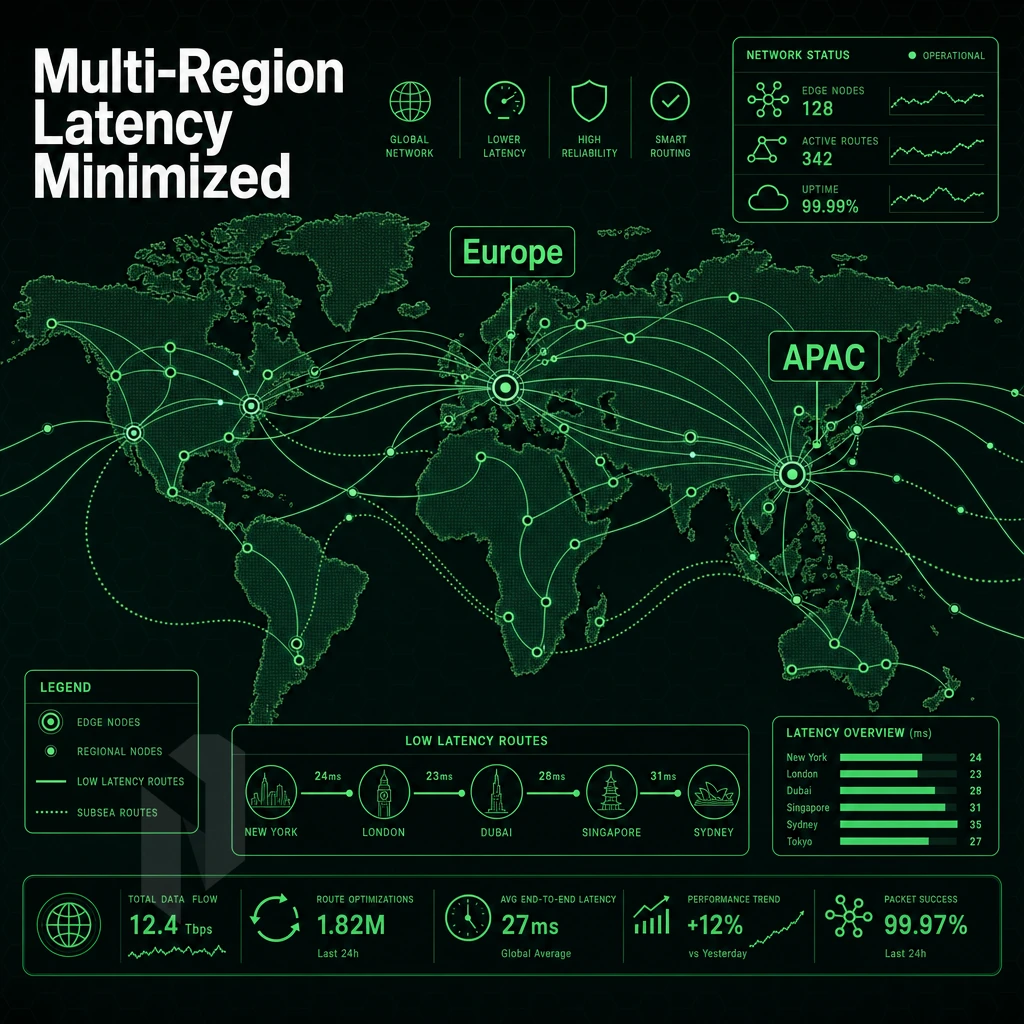
The placement of servers at locations around the world affects latency. Each of the cloud hosting locations has been chosen for carrier-neutral peering, to keep regional traffic on the shortest path. Depending on the nature of the workloads, these locations can be used for global availability.
European Hosting Placement for Consistent Performance
For EU compliance workloads we have The Hague and Amsterdam. For peering in Amsterdam we connect to AMS-IX, LSIX, FRYS-IX and GNM-IX. The Hague is our primary EU location for services, with 215+ sqft of rack space and N+1 power.
From Stockholm we serve our Nordic customers with hosting and DR services. In Rotterdam we added a second location for The Hague to ensure resilience for our customers with sites in multiple carrier-neutral data centers.
APAC and North America
We have two bare metal cloud locations covering APAC: our Hong Kong location is the APAC financial gateway with Equinix HK IX peering and submarine cable connectivity. Our Singapore business hosting location covers Southeast Asia with premium Tier 1 upstreams. Both locations offer sub-20 ms intra-region latency and provide infrastructure suitable for financial services and streaming applications.
Among our global locations, FL-IX connects to Latin America from Miami while our New York location is based in the high performance, premier carrier hotel at 60 Hudson Street. DE-CIX New York peering services at 60 Hudson enable US East Coast business connectivity.
Workload Placement Guide
| Workload | Recommended Site | Key Peering |
|---|---|---|
| EU compliance / GDPR | The Hague / Amsterdam | AMS-IX, GNM-IX |
| DACH / CEE reach | Frankfurt | DE-CIX |
| Nordic DR | Stockholm | NetNod |
| Balkans / Eastern Europe | Bucharest | Regional IXs |
| Latin America gateway | Miami | FL-IX |
| APAC financial | Hong Kong | Equinix HK IX |
| Southeast Asia | Singapore | Tata / local IX |
| US East Coast | New York | DE-CIX New York |
We run our global network on AS6206 with 2.4 Tbps+ capacity. Utilization of ports at all locations of our global data centers is below 40% which leaves sufficient headroom. After choosing the location we recommend building your project on the infrastructure of Netrouting for security and reliability reasons.
Why Choose Netrouting for Bare Metal Dedicated Servers
Netrouting delivers bare metal dedicated servers built for workloads that demand reliable performance, full dedicated hardware control, and zero noisy-neighbor risk. Our bare metal infrastructure is provisioned in under 60 minutes, no queues, no shared cloud overhead.
- Unmetered high-performance networking. All our servers ship with unmetered 10 Gbps, scalable to 40 Gbps. Our own AS6206 backbone carries 2.4 Tbps+ of capacity across global data centers in Amsterdam, Frankfurt, Miami, New York, Hong Kong, Singapore, and more.
- Always-on anti-DDoS protection. Every bare metal dedicated server includes L3/L4 DDoS mitigation at no extra cost. Advanced application-layer protection is available for high-risk workloads.
- Latest-gen dedicated hardware. Dell and Supermicro platforms on Intel Xeon and AMD EPYC, including GPU servers for machine learning and big data workloads.
- Compliance-ready infrastructure. ISO 9001, ISO 27001, and SOC 2 certified. Our 24/7 NOC monitors all servers with a one-hour ticket response guarantee.
- Predictable cost, lower TCO. Transparent monthly billing with no egress surprises, significantly lower total cost of ownership than hyperscaler compute for dedicated workloads.
Explore our bare metal dedicated server configurations or contact our sales team to discuss your specific infrastructure requirements.
Bare metal servers deliver what shared and virtualized environments cannot: guaranteed resources, predictable performance, and full hardware control. For users, the right choice comes down to three factors, raw compute power for your workload, connectivity quality (bandwidth, latency, peering), and a provider that can provision fast and support you around the clock.
Not all bare metal is equal. Hardware generation, uplink speed, and the underlying private network backbone separate a server that handles peak load cleanly from one that buckles under pressure.
Netrouting runs a bare metal cloud across ten locations in Europe, North America, and Asia, all on a 2.4 Tbps+ network with unmetered 10 Gbps uplinks and always-on DDoS protection included. Browse our dedicated server configurations or contact sales to spec a custom deployment.