
Moore’s Law has long been one of the most influential ideas to come out of the tech industry. Gordon Moore, co-founder of Intel, observed in a 1965 paper that the number of transistors on a microchip doubled about every two years, a rate that suggested rapid growth in computing power. Now, one of the industry’s leading players, NVIDIA, is following Moore’s Law, and then some.
The Moore’s Law Conundrum:
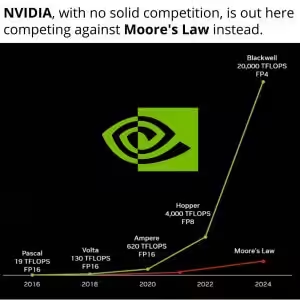
Traditional metrics, like Moore's Law, have traditionally looked at the number of transistors on a die (i.e. the number of computational components) to measure technological progress. But for those who really care about compute-intensive applications, the real metric is how well GPUs perform. Unfortunately, traditional projections of Moore's Law do not do justice to the huge gains that have been made in real GPU performance.
According to data from Jon Peddie Research, the compound annual growth rate (CAGR) of GPU shipments between 2015 and 2020 was 9.8%, outpacing the 7.4% CAGR of Moore’s Law during the same period. This discrepancy underscores the accelerated pace of GPU innovation relative to traditional expectations.
Blog contents
NVIDIA’s Architectural Innovations:
Historically NVIDIA has been focused on architectural innovations and custom designed processing units. This allows NVIDIA to deviate from the typical Moore's Law path to ever greater levels of performance using GPUs.
Case Study: The introduction of NVIDIA’s Turing architecture marked a significant milestone in GPU evolution. With features such as real-time ray tracing and AI-enhanced graphics, Turing-based GPUs deliver unprecedented levels of realism and immersion in gaming and professional visualization applications.
GPU Performance vs. Moore’s Law:
A look at the numbers behind GPU computing performance reveals some very interesting trends. For a long time, the rule of Moore's Law projected CPU performance increases over time. However, NVIDIA's continued improvement in computing power of their GPUs has long since exceeded that of Moore's Law. The many technological improvements to the design and functionality of the GPU in recent years have enabled tremendous increases in parallel processing, improved memory management, and the use of Artificial Intelligence and deep learning technologies for a wide variety of applications.
A collection of new benchmarks posted on TechSpot compares the new NVIDIA Ampere architecture based graphics cards to their previous generation counterparts, and found that there is a huge performance increase of up to 70% in some cases. This increase in processing power far exceeds what is typically predicted by the processing power increase of Moore's Law for this time in history.
Jensen Huang: The Architect of NVIDIA’s Success:
NVIDIA, a leader in innovative initiatives and in the revolutionary field of the GPU, is led by the visionary and innovative CEO Jensen Huang. Always keen to push boundaries, Huang created his own version of the famous Moore's Law, the so-called 'Huang's Law', and he is striving to make this a reality for the company.
Case Study: During his keynote address at NVIDIA’s GPU Technology Conference (GTC), Jensen Huang unveiled the company’s latest breakthroughs in AI and accelerated computing. Demonstrations showcasing real-time AI inference and data analytics underscored NVIDIA’s commitment to driving innovation across diverse industries.
Consumer Adoption and Impact:
NVİDIAS’s recent breakthroughs in GPU technology are already starting to have a dramatic effect on consumers everywhere. Take a look at some of the examples listed below to see how the advancements by NVIDIA are giving consumers a better, all around experience.
- Who benefits from our GPU advancements: While professionals such as scientists, engineers, and video professionals are the main beneficiaries of NVIDIA’s advancements in gaming performance, gaming enthusiasts are second in line. With every new GPU generation, gaming performance, rendering, and features are significantly enhanced, allowing users to enjoy even better, more realistic graphics. NVIDIA’s RTX series features real-time ray tracing, which significantly enhances gaming visuals with realistic, accurate lighting, shading, reflections, and more.
- Productivity in Creative Industries: While video gaming is by far the most well known use for NVIDIA GPUs, the company's cards are becoming essential to many creative professionals as well. Artists in the video, 3D animation, and graphic design industries are seeing incredible productivity increases thanks to NVIDIA's GPUs, in part due to their powerful CUDA cores, and specially designed GPU rendering capabilities.
- Visual tour: Advancements in Scientific Research and Healthcare: NVIDIA GPUs are widely used in scientific research and healthcare to accelerate computation and make new discoveries. Researchers use NVIDIA GPUs to accelerate simulations, run large-scale data analytics, and study complex phenomena.
Leveraging NVIDIA Graphics for Superior Performance:
To complete the latest visual computing tasks, NVIDIA provides a variety of powerful GPUs. The extremely powerful graphics cards of the RTX 6000 series are not only suited for gaming, but are also being used for the processing of data of almost all areas of work and research.
Case Study: In the field of medical imaging, researchers at the Mayo Clinic leveraged NVIDIA’s GPUs to accelerate the processing of MRI scans, reducing analysis time from hours to minutes. This acceleration enabled healthcare professionals to diagnose and treat patients more efficiently, leading to improved patient outcomes.
Unveiling the Potential of GPU Servers:
Discover the capabilities of Netrouting’s GPU servers in the NVIDIA ecosystem. Built with NVIDIA technology, our servers are ideal for demanding applications in artificial intelligence, machine learning, and data analytics. Explore how our scalable, efficient solutions can meet your evolving infrastructure requirements.
Integrating Netrouting’s GPU Servers:
Take your computing to the next level with a Netrouting GPU server.
- Powerful Performance: Our GPU servers offer maximum performance using the massive processing power of graphics computing units (GPUs) to maximize compute performance for highly demanding tasks.
- Scalability and Flexibility: GPU servers from us are highly scalable to accommodate needs of your growing startup or large enterprise requiring to scale out computing resources to handle large batch of computing jobs.
- Accelerated Workloads: Eliminate idle server time. Our GPU servers can complete your accelerated workloads in a fraction of the time it would take on alternative servers allowing you to complete more work in less time.
- We specialise in servers that are optimised for AI / Machine Learning Processing: As more and more users adopt AI / Machine Learning processing for various tasks more and more users are requiring additional servers with more power in order to process larger models. Our GPU servers are perfect for these workloads.
- Reliable infrastructure: Our GPU server hosting services are offered from multiple locations world wide. They have all been set up to provide a stable hosting environment of highest quality. The hosting of our GPU servers takes place in high class data centers. The servers are equipped with features such as multiple power supplies and redundant internet connections to guarantee a stable hosting service.
- Expert Support Our team of experts are on hand to deal with any questions or issues you have; be it helping you deploy and configure PXC, debug issues with PXC, or help you to get the very best out of PXC.
Visit Netrouting to learn more about our Next Generation Data Center.
Market Trends and Future Outlook:
There are many trends today affecting the development of the GPU market. One trend that is currently poised to revolutionize the field of computation in the future is quantum computing. The application of quantum mechanics will be a key development in future GPUs. Also gaining attention in the computing world today is the emerging field of neuromorphic engineering, a field focused on creating a computing system that is modeled after the human brain. Computing systems modeled after the human brain are highly energy efficient and highly parallel. Those companies, such as NVIDIA, today at the front end of the GPU computing market are likely to develop the computing innovations of tomorrow and in the process unlock a multitude of new applications for using artificial intelligence, as well as other fields of scientific computing.
Conclusion:
Beyond current applications, technology will continue along a path which will exceed current definitions of possible. For this to happen, companies like NVIDIA will pave the way for the future of visual computing. By designing revolutionary architectures for GPUs as well as server platforms to further increase computing power, NVIDIA is the epicenter of current technological developments.