Choosing a bare metal server involves finding the right mix of raw power, a good network and competitive pricing for the amount of capacity you need. Otherwise you risk locking yourself into underperforming hardware or being surprised by how much your bill is at the end of the month. For any business evaluating hosting options, understanding these trade-offs upfront prevents costly migrations and ensures infrastructure aligns with growth projections.
Netrouting has been designing dedicated hosting environments for over 10 years and operates AS6206 from 10 locations spread over 3 continents in Europe, North America and Asia, with flexible pricing available at an hourly rate. This extensive knowledge has been used to create this guide to bare metal servers, which outlines all of the key factors that influence the cost of such hosting environments including hardware, network, support.
By the end of this report you’ll know exactly what you’re paying for, where your providers are taking the cheapest option that will cost you later. Additionally, How best to match a server to your workload, whether that’s to deliver high volumes of video, run a number of games servers with very low latency, or run. Comparing multiple hosting providers side-by-side reveals significant differences in how they structure their offerings and where they invest in quality versus cost-cutting measures.
Blog contents
We start with the most fundamental of questions: what does bare metal cost, and why?
What Is the Bare Metal Server Cost Actually?
The cost of bare metal servers can vary widely based on several factors including the hardware tier, the location of the servers, and the amount of bandwidth that your application requires. Basic servers are often very affordably priced. High density servers such as multi-socket 48 core systems are much more expensive. Transparent pricing models help organizations budget accurately by clearly outlining base costs, bandwidth charges, and any additional fees for premium features or support tiers.
Providers often differentiate their offerings through advanced features such as custom BIOS configurations, IPMI access, and automated failover capabilities that justify higher price points. When evaluating different hosting vendors, comparing how each structures their pricing for identical specifications reveals which providers deliver the best value for enterprise workloads.

What Entry Level Servers Cost and Why
Entry-level bare metal servers have one processor, little RAM and local disk space. These configurations are ideal for development environments or small-scale applications where resource demands are limited and predictable. Provisioning these servers typically involves a straightforward setup process that can be completed within hours, allowing teams to deploy applications quickly without complex configuration overhead.
Organizations can streamline their deployment workflows by automating server provisioning through APIs, reducing manual intervention and accelerating time-to-production for new services. Teams can manage provisioning tasks through intuitive control panels or programmatic interfaces, giving administrators flexibility in how they orchestrate deployments.
The cost drivers for this tier are CPU generation, RAM size, disk type (NVMe vs. SATA) and location of data center (premium interconnection hub vs. secondary market). The underlying cost of the physical hardware and real estate to operate servers in a premium interconnection hub is more than in a secondary market.
Bare metal infrastructure is different from shared or virtual infrastructure. A full dedicated server is provided, complete with no noisy neighbors, no hypervisor overhead, and no share of the CPU. Each metal server delivers dedicated resources that remain isolated from other tenants, ensuring predictable performance for mission-critical applications. Organizations seeking the isolation benefits of dedicated hardware often deploy bare metal as the foundation for a private cloud, gaining full control over security policies and resource allocation.
When Does Bare Metal Make More Financial Sense Than a VPS?
Once you need consistent CPU power, high I/O, or low latency, the cost of up-sizing and of using reserved instances can add up quickly.
- Workloads with consistent, high CPU loads (e.g. video encoding, game servers, ML inference).
- High-traffic online store backends requiring low-latency storage I/O.
- Compliance environments where resource isolation is mandatory.
At this price point, a single bare metal server outperforms stacks of virtual machines for dollars spent.
What Are the Cheapest Bare Metal Servers for Hosting?
Our bare metal servers start at a highly competitive entry level, we’d be happy to provide you with the current pricing via our sales department. Amsterdam, Miami and Singapore to name a few, we can offer you a cost effective solution for placing bare metal in close proximity to your users without compromising on network.
The following 6 variables describe why two servers with the same specs have different prices.
The Main Factors That Drive Bare Metal Servers Pricing
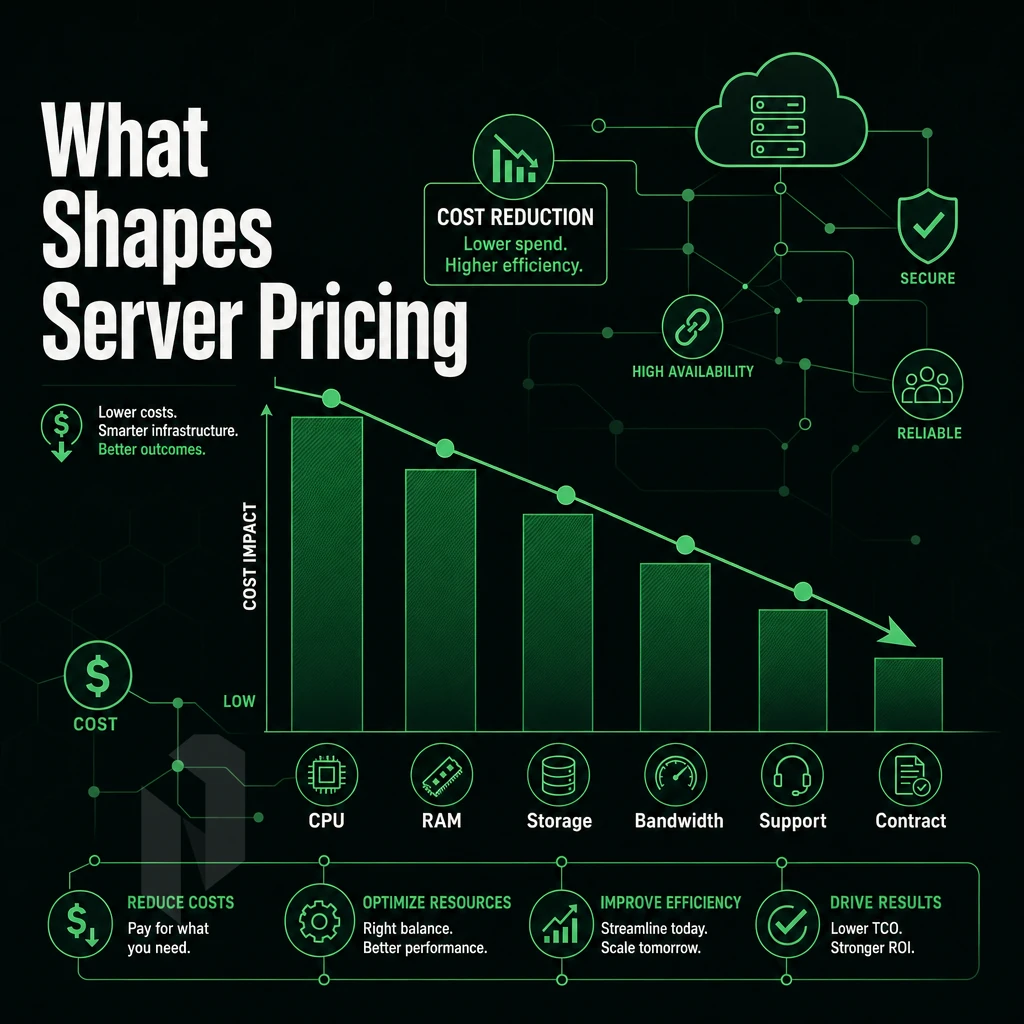
Bare metal server pricing is influenced by six hardware and commercial variables. Understanding these allows you to configure your servers to exactly what you require, paying only for what you need. This flexibility ensures you can tailor configurations to match your specific needs without overpaying for unused capacity or underprovisioning critical resources. Monitoring resource utilization patterns over time helps identify whether your current configuration aligns with actual demand or if adjustments are needed.
Evaluating which features are essential versus optional for your workload prevents unnecessary spending on capabilities that won't improve performance. Organizations that actively manage their server configurations based on evolving workload requirements can optimize costs while maintaining performance standards. Each organization's unique requirements mean that a configuration optimized for one business may be inefficient for another with different workload characteristics.
Hardware and Managed Services for CPU, RAM, and Storage
The biggest cost per component for a CPU generation part is currently the Intel Xeon E5 generation part. This Costs less than the current generation AMD EPYC part but offers fewer cores and less memory bandwidth. Having more cores per server means higher monthly costs but also higher throughput per server. Servers with higher memory capacity allow for larger datasets to be processed in-RAM, reducing disk I/O bottlenecks and improving application responsiveness.
The cost of RAM increases linearly with size, so for web workloads a 64GB configuration is typical. For database and in-memory analytics workloads, however, 256GB or more of RAM is typically required. NVMe storage has I/O latency of less than 0.1ms, compared to 0.1-1ms for SATA SSDs and 1-20ms for HDDs.
Thus, for I/O-bound workloads the cost of such storage is quickly paid for in performance. Workloads that process large datasets entirely in memory benefit significantly from configurations with 512GB or more, reducing reliance on disk I/O.
| Storage Type | Typical Latency | Best For |
|---|---|---|
| NVMe | <0.1 ms | Databases, high-frequency transactions |
| SATA SSD | 0.1-0.5 ms | General workloads, web hosting |
| HDD | 5-10 ms | Bulk storage, backups, archives |
Network Port Speed and Billing Model Well Suited for You
Port speed and bandwidth model also go hand in hand. Most metered plans are charged by the amount of Gigabytes transferred which is fine at low volumes but then becomes extremely costly very fast. The unmetered way fixes your costs regardless of the volume of data being transferred. At Netrouting we provide unmetered 10 Gbps on our dedicated servers. For very high volume servers even up to 40 Gbps is possible.
Hourly billing is great for short-term or burst workloads. Unlike cloud storage, bandwidth is priced simply on the bare metal, no per-GB egress charges.
Is It Cheaper to Build or Buy a Dedicated Server?
While low unit cost for DIY hardware looks good on paper, the real costs of all that power, cooling, security, monitoring, and replacement of failed hardware add up very quickly. Colocation costs less than all that, but a data center slot isn’t free either.
Renting managed bare metal from a provider like Netrouting means you just pay a monthly fee for the hardware, connectivity and support you need. This usually proves to be more cost-effective than buying and managing your own servers, not least because of the value of your time and the need to upgrade the hardware every 3 to 4 years. Providers typically bundle infrastructure management, security patches, and technical support into their monthly fee, ensuring that all essential services remain accessible without separate line items. The initial setup is typically completed within hours, allowing you to deploy applications quickly without the delays associated with procuring and configuring physical servers on-premises.
Streamlined deployment processes enable teams to provision new servers and scale infrastructure on demand without lengthy procurement cycles. Organizations can manage server lifecycles more predictably with fixed monthly costs that eliminate the variability of usage-based billing models. This approach allows business owners to focus capital on growth initiatives rather than tying up funds in depreciating server equipment. Reputable hosting providers also maintain redundant power and cooling systems to ensure uptime, eliminating the single points of failure that plague self-hosted environments.
In the following sections we’ll break down the costs and show you what you get for your money with each of the different configurations available. Transparent pricing structures help you compare configurations side-by-side and select the option that delivers the best value for your specific requirements. Understanding these cost breakdowns enables your business to allocate resources strategically and avoid overspending on unnecessary features.
Entry-Level, Mid-Range, and High-End: Common Bare Metal Configurations
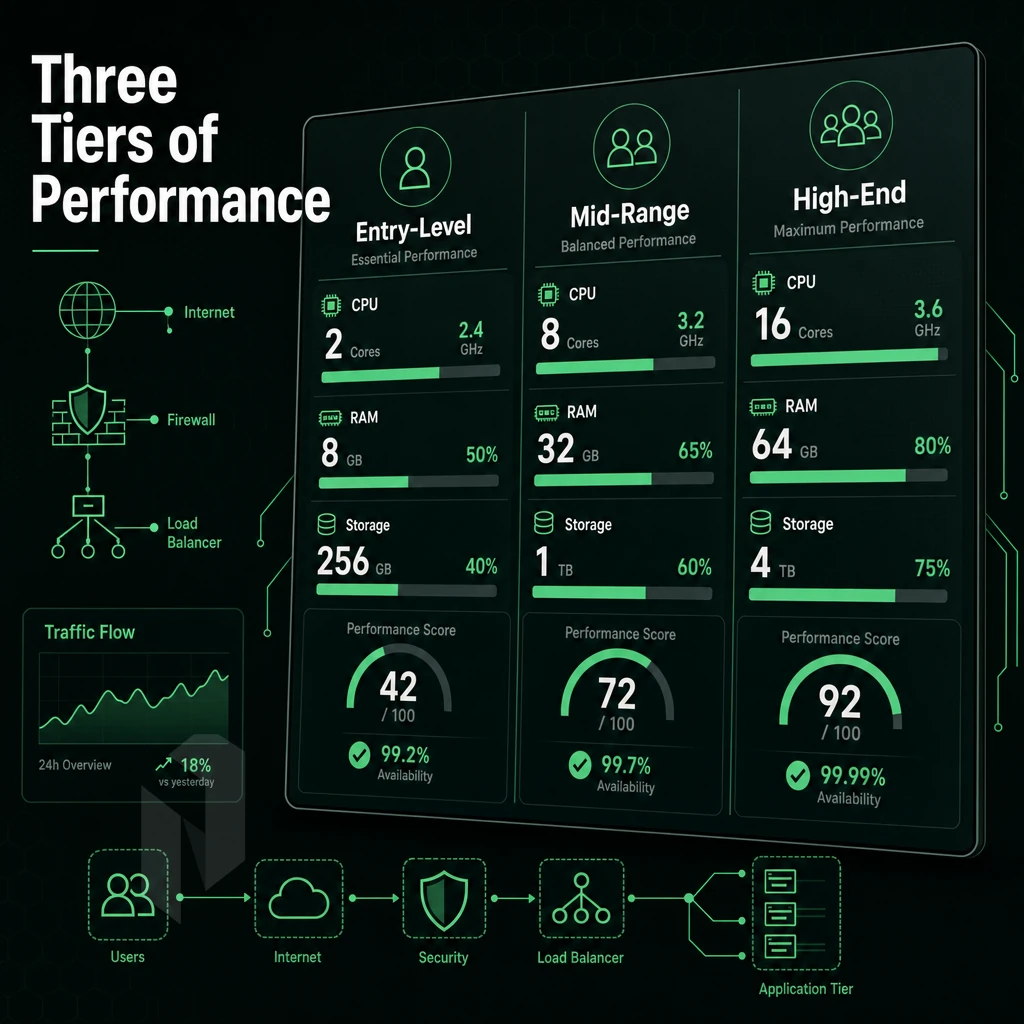
Bare metal configurations generally come in three forms and are optimized for specific types of workloads.
Entry-Level Servers On Demand With Full Control
The typical architecture for this level of server is single CPU, 16-32 GB of RAM and SATA storage. This is the lowest cost offering and is typically used for dev/test environments, staging servers and smaller web sites with low volumes of traffic. These servers are ideal for initial deployment scenarios where teams need to validate configurations before scaling to production environments.
These builds handle light concurrency well but are not suitable for production databases or low latency under high sustained load.
Mid-Range Configurations With Global Reach Available on Demand
Production databases, video streaming and highly loaded web servers are typically run on dual-CPU servers with 128-512GB of RAM and a mix of SSD and regular harddisks. Our 2× Intel Xeon E5-2680v2 (20 cores / 40 threads) and 2× Intel Xeon E5-2690v4 (28 cores / 56 threads) servers are examples of this type of hardware and can be ordered with up to 17 TB+ of bandwidth.
Note: Dual-CPU builds cost significantly more than entry-level. Confirm your workload actually saturates a single CPU before stepping up.
High-End and GPU-Capable Builds
Latest-generation AMD EPYC and Intel Xeon Gold processors are combined with 512 GB+ of RAM, latest-generation NVMe storage, and support for optional GPU cards. The main workloads for this server tier are AI model training, real-time analytics and other large-scale compute workloads.
Netrouting offers dedicated GPU servers (NVIDIA RTX 6000, A10, A40, A100) as Dedicated Servers for Inferencing and self-hosted LLM projects. Please contact our sales team for custom configurations.
How Much Do Servers Usually Cost?
Cost is determined by the CPU generation, number of cores, amount of RAM, and type of storage used. The most cost efficient option would be a basic bare metal server. High-end GPU servers are more expensive, but still very cost efficient compared to other hosting options on the market.
We publish transparent and predictable monthly pricing with no egress surprises. Please contact our sales team for the most up-to-date pricing on any of our servers. For more context, see Bare-metal server .
After picking the right hardware for your case. You also have to decide whether you want to go with bare metal servers or if virtual servers like VMs or cloud servers would do a better job for your application.
Bare Metal Servers vs. Virtual Machines: A Side-by-Side Cost Comparison
The following table provides a side by side comparison of bare metal servers with shared servers and virtual servers. Unlike virtual machines which have many tenants sharing the same physical server and thus subject to performance degradation from noisy neighbors, bare metal servers provide full access to all CPU cores, all RAM slots. Additionally, All NVMe drives, etc. with complete control over the operating system, kernel, and stack. You can order dedicated resources on demand, with no hypervisor overhead.
| Provider / Option | Performance | Support & SLA | Network | Best For |
|---|---|---|---|---|
| Netrouting Bare Metal | Latest Intel Xeon & AMD EPYC; up to 2 TB RAM, 24 drives, hardware RAID | 99.9% SLA; 24/7 NOC; 1-hour ticket guarantee; provisioned in under 60 min | 2.4 Tbps+ backbone; unmetered 10 Gbps; free private network up to 40 Gbps; always-on DDoS protection | High-throughput workloads needing full access across 10 global locations |
| Hyperscaler Bare Metal | Standardised SKUs; limited custom configs; no hardware RAID options | Tiered support plans; SLA varies by service tier; slower provisioning | Large backbone but egress-heavy billing; no unmetered ports | Teams already locked into a hyperscaler ecosystem |
| Virtual Machines (shared cloud) | Shared CPU and RAM; noisy neighbors impact workloads; no complete control over hardware | Best-effort SLA on lower tiers; no hardware replacement guarantee | Shared bandwidth pools; variable latency | Dev/test environments; low-traffic workloads tolerating multiple tenants |
| Colocation (self-owned hardware) | Full hardware control; performance depends on your own equipment | Facility SLA only; hardware support is your responsibility | Carrier-neutral cross-connects on demand; bring your own transit | Enterprises with existing hardware assets |
Most customers who want to run their own OS on their own hardware and not manage physical servers will find bare metal servers outperform virtual servers on all measures. Netrouting offers bare metal servers with custom configurations, a 2.4 Tbps+ network and immediate provisioning.
This is all offered without the negative aspects of sharing physical servers with other users (noisy neighbors) and without any hidden egress fees. Even the best bare metal quote will contain hidden costs which surface on the first invoice.
Bare Metal Servers Cost vs. Owning Your Own Hardware
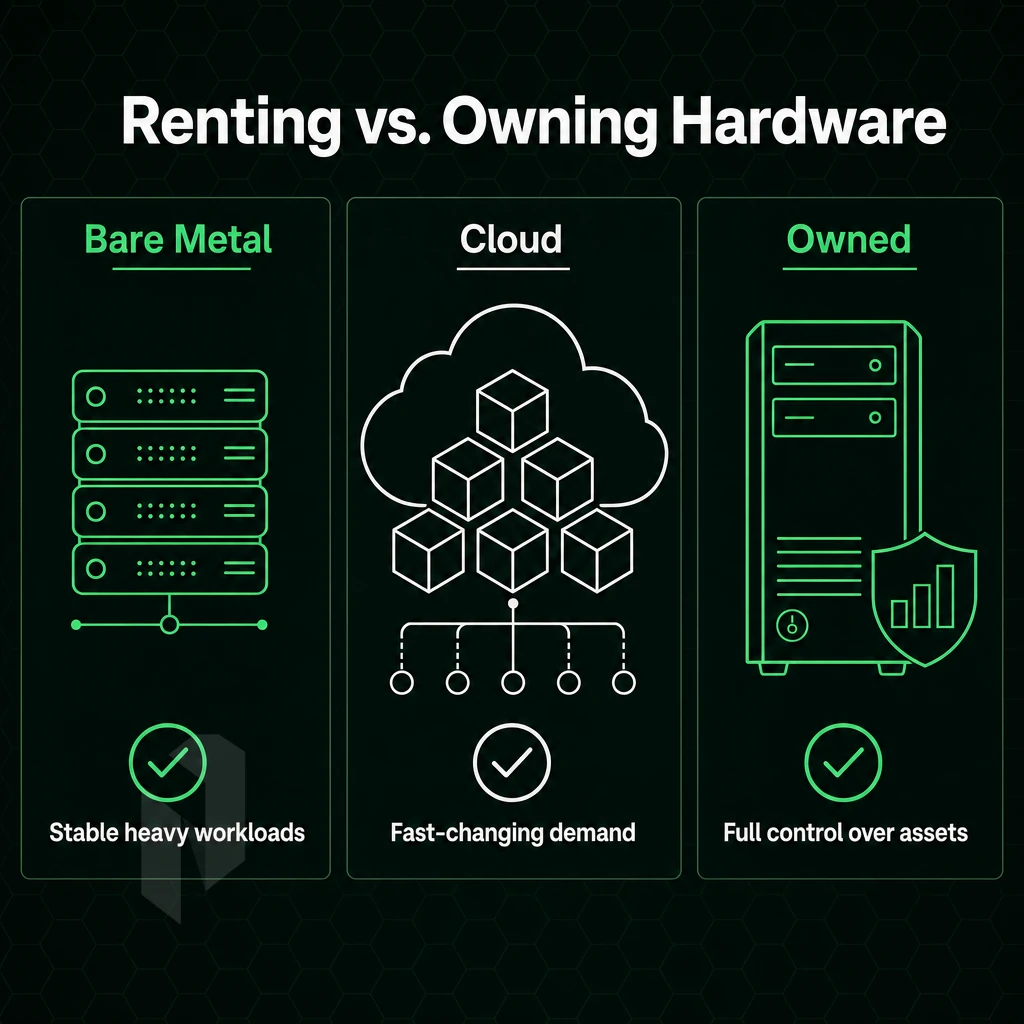
Where do you want to put your capital and operational risk? Rented bare metal, owned servers in your own data center, or colocation all have different cost structures. You need to pick the one that suits your time to deploy and your longer-term capacity plans.
CapEx vs. OpEx: Where the Cost Efficiency Lies
Dedicated servers typically require an up-front capital expenditure to buy the case, servers, memory, storage, networking equipment and rack space before you can start to run any workloads. In addition to this, you will have ongoing costs for the power that the server(s) consume. For the cooling of the server room and for the staff time required to carry out routine maintenance tasks and to replace servers every 3-5 years.
Renting bare metal instead flips your infrastructure cost to OpEx. Meaning you can set a budget for each month and the provider will handle refreshes to new platforms like AMD EPYC based servers, faster NVMe storage, and higher density storage.
Does Bare Metal Dedicated Server Pricing Include Add Ons?
Some include bandwidth in a bundle of features, others charge by the Gigabyte. At Netrouting unmetered 10 Gbps bandwidth is included with all dedicated servers. A free private network is included between all your resources, no surprise overage charges.
| Model | Upfront Commitment | Refresh Risk | High Availability |
|---|---|---|---|
| On-premises ownership | High CapEx | Owner bears it | Self-managed redundancy |
| Colocation | Medium CapEx | Owner bears it | Provider power/cooling SLA |
| Bare metal rental | Zero CapEx | Provider bears it | Provider-managed, 99.9% SLA |
Which Model Delivers Lower Costs With Real Time Analytics?
Colocation is typically suitable for companies that already own enterprise-grade server equipment and require carrier-neutral connectivity without the burden of running a own data center facility. However, bare metal rental is generally more cost efficient once staffing, power contracts and refresh cycles are taken into account. For most users, rented bare metal is cheaper than buying after two years.
Why Choose Netrouting for Bare Metal Server Hosting
Cost-conscious bare metal buyers need predictable infrastructure, no surprise fees, no noisy neighbor effect sharing physical servers, and full control over every resource. Netrouting delivers that across ten data center locations in Europe, North America, and Asia.
- Provisioned in under 60 minutes. Bare metal servers deploy fast. No queuing behind cloud VMs, no hypervisor overhead, your workload runs on dedicated computing infrastructure immediately.
- Unmetered 10 Gbps included. Every bare metal server ships with unmetered 10 Gbps port speed. Up to 40 Gbps is available for high-throughput workloads like AI model training or real-time analytics.
- Always-on DDoS protection at no extra cost. L3/L4 mitigation is included on every server. No add-ons required, no separate service to manage.
- Lower TCO than hyperscaler compute. Predictable monthly pricing with no egress surprises. Bare metal infrastructure costs stay flat, unlike cloud storage and on-demand hyperscaler billing that scales unpredictably under load.
- Intel Xeon and AMD EPYC platforms. Dell and Supermicro physical machines with NVMe SSDs options, high-capacity RAM, and common setups ready to deploy across Amsterdam, Frankfurt, Miami, Singapore, and beyond.
- 24/7 NOC with proactive monitoring. A 1-hour ticket guarantee and round-the-clock support back every deployment. ISO 9001, ISO 27001, and SOC 2 certified for high availability and security compliance.
Explore our bare metal servers or contact sales to compare configurations for your specific workload.
Key Takeaways: Bare Metal Server Pricing at a Glance
Bare metal server cost breaks down to four levers: server infrastructure tier, storage options, memory capacity, and network port speed. Entry-level servers with Intel Xeon processors suit online stores and low-latency applications. Mid-range dedicated server configurations handle real-time analytics and private cloud workloads. High-density dedicated hardware, NVMe drives, high RAM, multi-gigabit ports, serves machine learning workloads and high availability deployments.
virtualized instances carry hidden costs: resource contention from other tenants, shared physical nodes, and unpredictable performance under demand. Bare metal server pricing removes those variables. Watch add-ons, managed support services, Windows Server licensing, and on-demand hourly billing, as they compound fast. Proactive monitoring and full control over your operating system reduce long-term costs. Netrouting's competitive pricing and global reach make dedicated servers the practical choice for workloads that need complete control.
Bare metal server cost isn't a single number, it's a function of computing equipment tier, bandwidth model, and the add-ons your workload actually requires. The biggest pricing mistakes come from underestimating bandwidth needs and overlooking setup fees. Match the configuration to the workload from the start, and the total cost of ownership stays predictable.
Dedicated physical resources consistently delivers lower TCO than equivalent virtual capacity on major cloud platforms, especially for CPU-intensive, high-throughput, or latency-sensitive workloads. The performance-per-dollar gap widens further when you factor in egress charges that hyperscalers apply by default.
If you're ready to spec a configuration, browse Netrouting's bare metal server range, Dell and Supermicro server physical infrastructure on Intel Xeon and AMD EPYC platforms. Contact sales for a configuration matched to your workload.