Managing your own server room is supposed to be more efficient but really it means managing power redundancy, physical security, air conditioning failure and your carrier contracts. And these items cost a lot and increase in complexity very fast. Colocation data center benefits are real and you can put your own hardware in a purpose-built facility and instantly benefit from all the infrastructure that it takes years to build and tens or hundreds of thousands of dollars to acquire.
The operational burden of managing in house servers often diverts IT resources from strategic initiatives to routine maintenance tasks that specialized facilities handle more efficiently. Organizations that attempt to replicate these capabilities internally face substantial ongoing maintenance costs that compound over time as equipment ages and technology standards evolve. For more context, see Are there benefits for a company moving close to a data ....
The calculus for IT departments of all sizes has changed recently.
Blog contents
In this post we take a closer look at the key advantages of colocation, including access to networks, power resilience, physical security, scalability and total cost of ownership. We also take a closer look at what types of workloads are better off in a colocation facility than in the cloud or on premises.
What Are Colocation Data Centers?
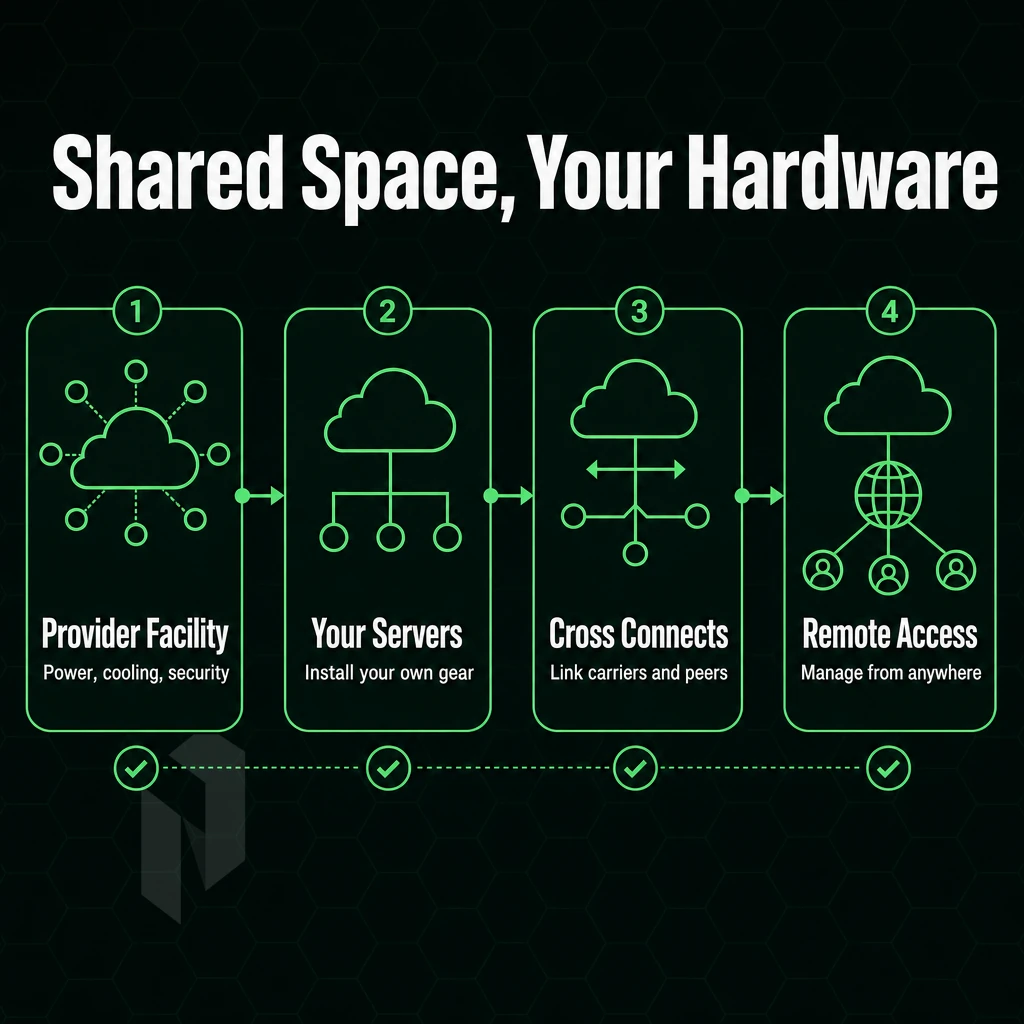
Colocation hosting is a type of hosting where a business rents space in a third-party data center and houses their own servers and other network equipment. The colocation provider handles the power, cooling, and physical security of the facility, but the customer brings their own server hardware.
What a Colocation Data Center Actually Provides
Shared, carrier-neutral space in a top-tier facility is what you get when you rent space in a colocation facility. The data center provider builds the facility, ensures power and cooling, locks up the floor space, and manages access. You manage servers, applications, and configuration.
The split responsibility shown above is the defining characteristic differentiating colocation from on-premises data centers and from cloud computing.
How a Colocation Provider Differs from On-Premises and Cloud
Enterprise data centers in on-premises environments place the full weight of costs and complexity on your shoulders, build it, cool it, power it, staff it. Hyperscalers provide cloud-based data centers where you don’t pay for the hardware but are at the mercy of their complex pricing models and restricted control.
Colocation bridges these extremes by offering the control and performance of owned infrastructure with connectivity options that rival major cloud platforms. Migrating from an on premises data center to colocation eliminates the need for continuous facility upgrades while preserving direct hardware access and customization capabilities.
The colocation facility handles the underlying infrastructure for you.
Retail vs. Wholesale Colocation Data Centers
Retail colocation is typically best for businesses who require individual rack units, half-racks or full cabinets within a shared data center facility. Wholesale colocation on the other hand is for larger scale projects where an entire suite or floor of a data center is required and has its own dedicated power and space.
This includes single U-space as well as private suites with high density.
How Colocation Data Centers Work
A colocation facility is not cloud and is not a managed service.
Shared Infrastructure, Private Hardware
The shared-infrastructure model allows businesses to rent space for their own servers in data centers and thus spread the large capital expenditures for data center facilities among many tenants. Instead of having to build their own data center, companies can now rent enterprise-class infrastructure as simple cabinet space.
Retail colocation is well suited for smaller footprints of one to a few rack units in a shared, secured cabinet.
Redundant Power and Backup Generators
All serious datacenter colocation facilities operate with N+1 redundancy on power. For instance, they have dual feeds from utilities, UPS systems and backup generators to handle power grid failures. Netrouting's The Hague facility delivers N+1 redundancy for power and cooling, supports IT infrastructure across more than 215 racks, and guarantees 99.9% or better uptime under its standard Service Level Agreement (SLA).
Understanding how much power your equipment requires is essential when selecting the appropriate colocation tier and ensuring your infrastructure can scale without exceeding circuit capacity. Implementing comprehensive power redundancy strategies at the facility level protects against both planned maintenance windows and unexpected utility disruptions that could otherwise cause costly downtime. Facilities engineered for reliable power delivery minimize the risk of outages that can disrupt mission-critical applications and result in significant revenue loss.
Advanced Cooling Systems and Fire Suppression Systems
Cooling systems are precision-cooled to maintain the thermal envelope of servers which typically operate within the range of 18-27 °C at the inlet. Fire suppression systems are clean-agent gas fire extinguishers that do not use water to protect your equipment from fire. Modern facilities deploy advanced cooling systems with hot aisle/cold aisle containment and variable-speed fans to optimize energy efficiency while maintaining strict temperature control.
Facilities also implement comprehensive physical security measures including biometric access controls, 24/7 surveillance monitoring, and mantrap entry systems to protect against unauthorized access. These layered defenses create robust security that protects critical infrastructure from both environmental hazards and deliberate intrusion attempts.
The sum of these layers of engineered resilience has value.
Colocation Data Center Benefits for Businesses
Businesses can utilize top-of-the-line enterprise infrastructure and avoid the costly investment of building their own data center by relocating to a colocation.
Cost Efficiency, Power, and Cooling
- Replacing capital expenditure with operational expenditure. While running your own data center(s) can be an interesting investment for your company, it requires an enormous amount of upfront capital and ongoing expenses to maintain and expand. By moving those expenses to the monthly operational spending of a colocation facility, you can keep your money where it belongs: with your core business.
- Rely on redundant power systems. Professional facilities run N+1 uninterruptible power supplies, multiple backup generators, and feeds from multiple power grids. Your hardware stays online even during utility failures. Note: a single-feed office rack cannot replicate this level of redundancy.
- Take advantage of efficient cooling systems in data centers. We design data centers for precise airflow and temperature. This ensures that your hardware is well-protected and runs at full speed without any risk of thermal throttling.
Security and Connectivity
- Robust physical security is enforced at facilities with biometric access controls, 24/7 security personnel on site, and multi-zone entry points. The advanced IT infrastructure is secured 24/7.
- Access to carrier-neutral network connectivity in a carrier-neutral colocation facility. Here you can connect to all providers and thus achieve the best possible latency while at the same time avoiding a lock-in to a single carrier. BGP routing enables the best possible traffic engineering. In our dedicated suites you will find direct cross-connects to our 2.4 Tbps+ backbone.
Scalability and Operational Costs
- Scale without capital expenditure. Add rack space, power or cross-connects as you need them. No construction lead time and none of the associated facility management costs. Scale capacity as you need it.
But the greatest advantage of all is that the colocation facility becomes the platform for your company’s disaster recovery plan, and it is here that the model really comes into its own.
Disaster Recovery and Business Continuity
By placing your primary and backup IT infrastructure in a carrier-neutral colocation facility, such as Equinix. A core component of your disaster recovery and business continuity planning is anchored to protect you against single-site failures that most on-premises DR solutions cannot.
Geographic Redundancy as a DR Foundation
Using a colocation facility in a different city or region as a live DR site means that in the event of a disaster such as a fire.
Duplicating your data storage at a separate geographical location, using near synchronous or asynchronous replication dependent on your RPO, is a strategy data center operators rely on to measure Recovery Point Objectives in seconds rather than hours.
Power Resilience and Continuous Operation
Multiple power grids can be brought online in an enterprise data center. In addition, each power feed is backed up by battery backup systems (UPS) and diesel generators.
At Netrouting's collocation facilities we operate redundant power setups in N+1 configuration to ensure that no single failure will bring services down. The power available scales with the density you require, so a quality data center provider can support very high power consuming equipment without the large upfront capital expenditures needed to build out similar redundancy in your own facilities.
Wholesale Data Center Colocation and Operational Reliability
This allows for redundant power feeds per cabinet rather than shared, providing sufficient operational reliability for enterprise Tier 1 workloads, with SLA-defined uptime and 24/7/365 NOC monitoring.
After determining that DR is a viable solution, most businesses want to know if they can save money by colocating their servers as opposed to building their own facility.
Colocation vs. Cloud: Choosing the Right Model
Decisions made post-decision regarding colocation or cloud affect subsequent infrastructure decisions around cost, compliance and scalability.
Colocation Facilities vs. Public Cloud
Colocation data centers offer dedicated physical hardware, predictable monthly bills and complete control over your environment. While cloud services offer scalable virtual resources on demand, variable egress charges and shared infrastructure can quickly cut into profits for high-volume, high-margin workloads that are largely static, making own data centers a compelling alternative for sustained business growth.
Data can be kept within a physical colocation that is compliant for companies in industries that are subject to various regulations. Most of the major cloud companies can meet many of the compliance requirements but add a layer of complexity to the audit process because of the shared resources that are utilized.
| Dimension | Colocation | Public Cloud |
|---|---|---|
| Hardware control | Full, your own servers | None, shared pool |
| Cost structure | Predictable, lower TCO for stable loads | Variable; egress costs compound |
| Uptime SLA | 99.9% standard | Varies by service tier |
| Data sovereignty | Defined physical location | Region-dependent, shared |
| Network throughput | Up to 40 Gbps dedicated | Shared, throttled at scale |
Cloud Computing Trade-offs at Scale
Hyperscalers offer a broad managed services catalog (databases, serverless functions, AI/ML pipelines, etc.) which is very valuable for variable workloads.
Hybrid Cloud Based Colocation as the Middle Path
Organisations use a combination of both models.
Netrouting has carrier neutral colocation facilities in 10 cities across the world: Amsterdam, Rotterdam, Düsseldorf, New York City, Miami, Berlin, Vienna, Moscow, Kiev and Singapore.
While selecting the right model for your case is important, choosing the right enterprise data center hosting provider whose colocation services, network infrastructure, and support live up to the promises made by the model above is equally important.
Why Choose Netrouting for Colocation
Netrouting operates carrier-neutral colocation data center facilities across 10 cities, Amsterdam, Frankfurt, The Hague, Rotterdam, Stockholm, and Bucharest in Europe; Miami and New York in North America; Hong Kong and Singapore in Asia-Pacific. Businesses rent space in shared cabinets or private cages, keeping full control of their own servers while we handle the physical infrastructure.
- redundant power supplies and cooling. Every colocation facility runs N+1 power and cooling systems, with backup generators and up to 20 kW per footprint, enterprise-grade infrastructure without building your own data center.
- Robust physical security. Biometric access controls, trained security personnel, and 24/7 NOC monitoring protect your hardware around the clock.
- Always-on DDoS protection. L3/L4 mitigation is included on every colocation service, no add-on required.
- Network flexibility. BYOIP and BGP support, plus a free private interconnect between your resources. Dense IX peering across all regions.
- ISO 9001, ISO 27001, and SOC 2 certified. Compliance-ready colocation with a 1-hour ticket guarantee and courtesy remote hands at no extra cost.
Our colocation solutions scale from a single U to a full private suite.
Frequently Asked Questions
How Do Colocation Providers Help Reduce Operational Costs With Their Data Centers?
A colocation data center is a shared facility where businesses house their own servers and networking equipment inside a professionally managed building. The provider supplies the facility space, power, cooling, and network connectivity, you own and control the hardware.
Key benefits of colocation facilities include enterprise-grade redundancy without building your private data center, direct access to high-capacity network infrastructure, and predictable monthly costs far lower than constructing or leasing a private data center. You also gain physical security, carrier-neutral connectivity options, and the ability to scale rack space as your infrastructure grows.
What are the main disadvantages of using colocation providers?
The primary disadvantage is that you remain responsible for procuring, maintaining, and replacing your own hardware, there is no provider-managed compute layer as with cloud hosting.
Colocation is therefore better suited to organizations with in-house hardware expertise than to teams that prefer fully managed infrastructure.
How Do Colocation Services Differ From Cloud Hosting?
In colocation, you own the physical servers and rent space, power, and connectivity inside a data center, the hardware is yours, and so is every core and gigabyte.
Cloud hosting means renting virtualized compute resources from a provider's shared pool of data center space; you never touch physical hardware and can scale instances in minutes, but you share underlying infrastructure with other tenants. Cloud hosting suits variable or unpredictable demand where elasticity matters more than raw cost efficiency.
Who is responsible for hardware in a colocation facility?
The colocation provider is responsible for the physical environment: power feeds, cooling, physical security, and the shared network infrastructure up to the cross-connect point.
Netrouting includes courtesy basic remote hands at no extra cost, with project-based rack-and-stack work available for larger tasks.
What types of colocation are available, retail vs. wholesale?
Retail colocation data centers are sold in small increments, individual rack units, partial cabinets, or full cabinets, and are designed for businesses that need anywhere from a single server to a few racks. bulk colocation covers large, dedicated suites or entire data hall segments, typically measured in hundreds of kilowatts of power capacity, and is aimed at enterprises, cloud providers, or hyperscalers running very large IT infrastructure footprints.
Retail colocation offers more flexibility and lower entry requirements, while wholesale delivers economies of scale and greater customization of power density and cooling.
Colocation providers deliver many things that in-house infrastructure simply cannot, carrier-grade power and cooling, redundant connectivity, and a physical security configuration that scales with your business, without increased capital expenditures. And it becomes with built-in disaster recovery at a colocation data center remote from your primary office.
This also compares well to building your own data center. You get to run on top of the same enterprise grade infrastructure that other large companies run on, without having to build and run the data center itself.
Netrouting operates carrier-neutral colocation facilities across Europe, North America, and Asia, from The Hague and Amsterdam to Miami, New York, Hong Kong. Additionally, Singapore, all backed by a 2.4 Tbps+ network, always-on DDoS protection, and a 24/7 NOC. Explore Netrouting colocation or contact the team to discuss your specific footprint requirements.