As your infrastructure grows beyond the space of your on-premises racks and the cost of maintaining power, cooling, and other overhead becomes uncompetitive, colocating your enterprise with a quality data center provider offering colocation services becomes the obvious step. The real question is, which facility best matches your requirements for power density, connectivity and control of your infrastructure?
Evaluating available data center space early in your planning process helps ensure you can accommodate future expansion without costly migrations or service interruptions. Organizations with massive compute requirements may also evaluate hyperscale data center options that provide the capacity and efficiency needed for large-scale deployments.
The consequences of a wrong choice can be severe.
Blog contents
Forget the hype of the market and read this guide to learn the differences between a serious data center and a simple rental of a rack. We explain the important specifications you should verify before signing with a potential provider. We outline the questions you have to ask a potential provider and compare the data centers of providers from Europe, North America and Asia on the most important criteria for IT decision makers. We start with the basics.
What Are Enterprise Colocation Facilities and Services?
An Enterprise colocation service is where a business puts their own servers and networking equipment into a large data center that is professionally managed. The business owns the servers and other equipment, while the colocation service provider owns the facility and the associated scalable infrastructure, including space, power, cooling, and data exchange connections, needed to run it. This model provides businesses with scalable capacity that can expand or contract based on operational demands without requiring upfront investment in facility construction.
What a Colocation Data Center Actually Provides
Colocation data centers provide the critical components required to run your hardware effectively. This includes air conditioning and heating, power and cooling distribution, network connections, security and a data center space to put your hardware in. All of this is shared with other tenants but completely isolated from them for each individual deployment.
This offering does not include servers, switches or storage arrays. Data storage and compute hardware are your responsibility. You must procure, configure, and maintain all networking devices, servers, and storage systems that will be housed within the colocation facility.
How Colocation Data Center Services Differ From Shared Hosting
Colocation turns the consumer shared hosting model on its head, rather than placing workloads on another consumer's shared server.
A classic example of this is a company moving their own data center to a colocation facility in order to get enterprise-class redundancy without having to build and own the facilities to support it.
The Data Center Colocation Facility Model
The physical data center is operated by the data center operator, and what you do is operate everything above the hardware layer. This is how our various colocation offers at this physical location scale up from the single 1U slot to the private cabinet with high-density power, all protected by N+1 redundancy for all critical data center components. Modern facilities are specifically engineered to support high density computing workloads that demand substantial power per rack and advanced thermal management capabilities.
How Colocation Data Center Services Work
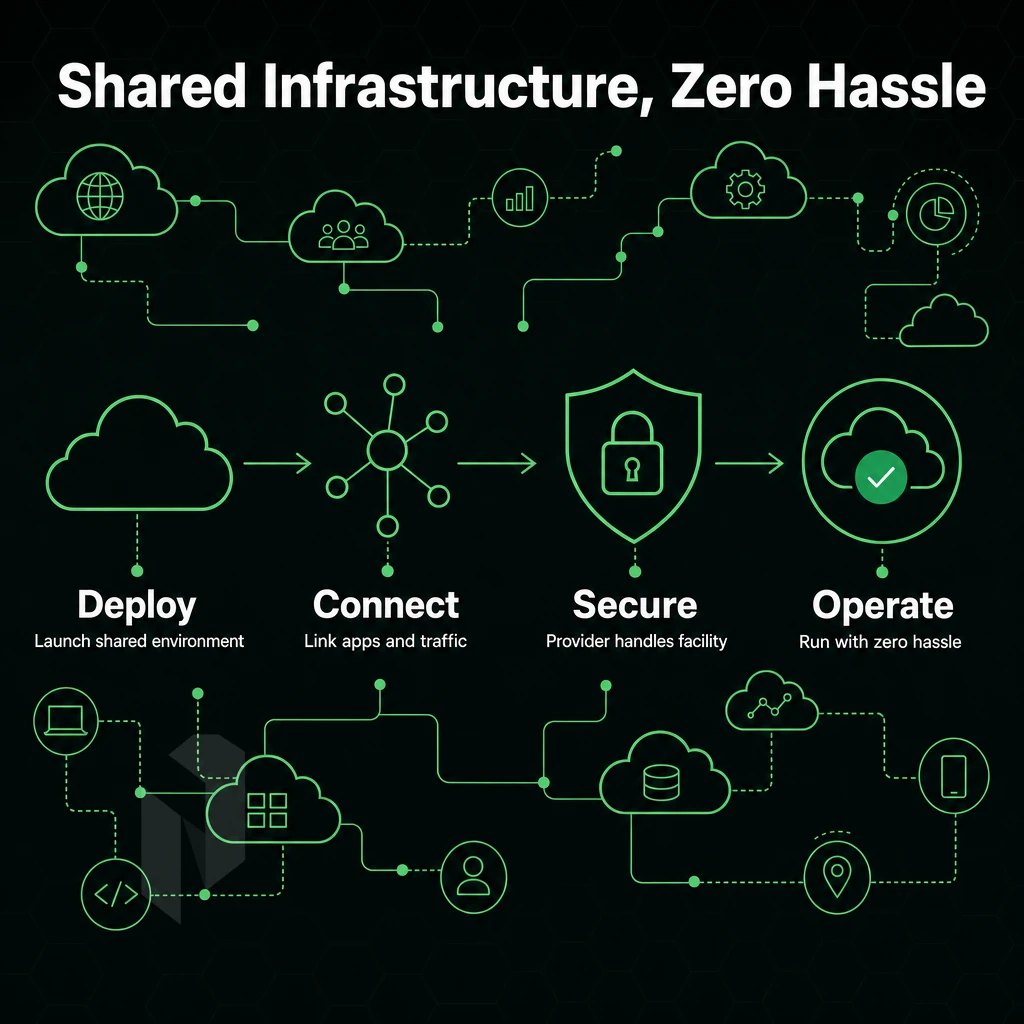
For enterprise colocation services, the division of responsibilities is straightforward.
What the Facility Provides
A colocation data center is physical space for your servers and related equipment, with available power and cooling, plus multiple connections to internet and other networks. All of this is protected by physical security. N+1 power and cooling systems are typical, as well as backup generators, fire suppression systems, video monitoring, and biometric identity verification for access control. Authorized personnel gain access through multiple authentication checkpoints that verify identity before entry to sensitive equipment areas.
Colocation Data Center Capacity Options
From a single 1U machine in a shared cabinet to a full private suite, our range of deployments can be scaled to meet individual needs.
Connectivity and Support in Digital Transformation
A secure data center should provide redundant carrier-neutral network connections.
For most enterprise workloads, choosing between colocation spaces comes down to two things: power density and network reach. Identify your average per-rack power usage and SLA (service level agreement) for uptime, then select a colocation facility with the right redundancy, peering, and on site technical support to meet your needs.
Evaluating space power availability at each candidate facility ensures your racks receive adequate electrical capacity to support current equipment and anticipated growth. Enterprise data centers demand careful evaluation of both current workload requirements and projected scaling needs to avoid capacity constraints that could limit business growth.
Core Data Center Colocation Solutions for Enterprise Workloads
Colocation services for enterprises are not a one-size-fits-all solution. The optimal setup for your IT will depend on the size of your work load, the power density required, and the amount of control your IT department needs over the physical infrastructure. Enterprise data centers typically require customized colocation configurations that align with specific compliance requirements, application architectures, and performance benchmarks unique to large-scale operations.
Assess Your Workload and Choose a Tier
- Begin with shared, secured cabinets, perfect for smaller footprints or for moving the IT hardware of teams out of on-premises closets. In these cabinets you rent dedicated rack space, shared power and network connections, without booking a full cage.
- Move up to private suites for sensitive and regulated workloads. dedicated suites provide your staff with physical separation, controlled access and the isolation required for mission critical workloads. Increasingly, the requirements of compliance demand non-negotiable solutions.
- Use high-density cages for High Performance Computing such as large GPU clusters. These require 10 kW+ per rack. Check power per rack limitation with supplier before signing up as most standard suites have a limit below this.
Note: Underestimating power density is the most common enterprise mistake. Audit your hardware draw before selecting a tier.
Lock In Carrier-Neutral Connectivity
- Please require carrier-neutral colocation solutions. Carrier-neutral facilities enable you to choose your own upstreams and IX peering without any lock-in or forced bundling. Our colocation facilities are fully carrier-neutral in all locations.
- Design scalable datacenter infrastructure from the start. Enterprise IT infrastructure grows. Find a datacenter provider who can scale your infrastructure footprint (e.g. add cabinets, increase power, provide a dedicated suite of cabinets) without moving you to a different facility.
Now that you have matched your work load to the right tier and locked in carrier-neutral connectivity, the next question is can you build a facility that competes with these dimensions.
Key Benefits of Enterprise Data Centers Over Building Your Own Data Center
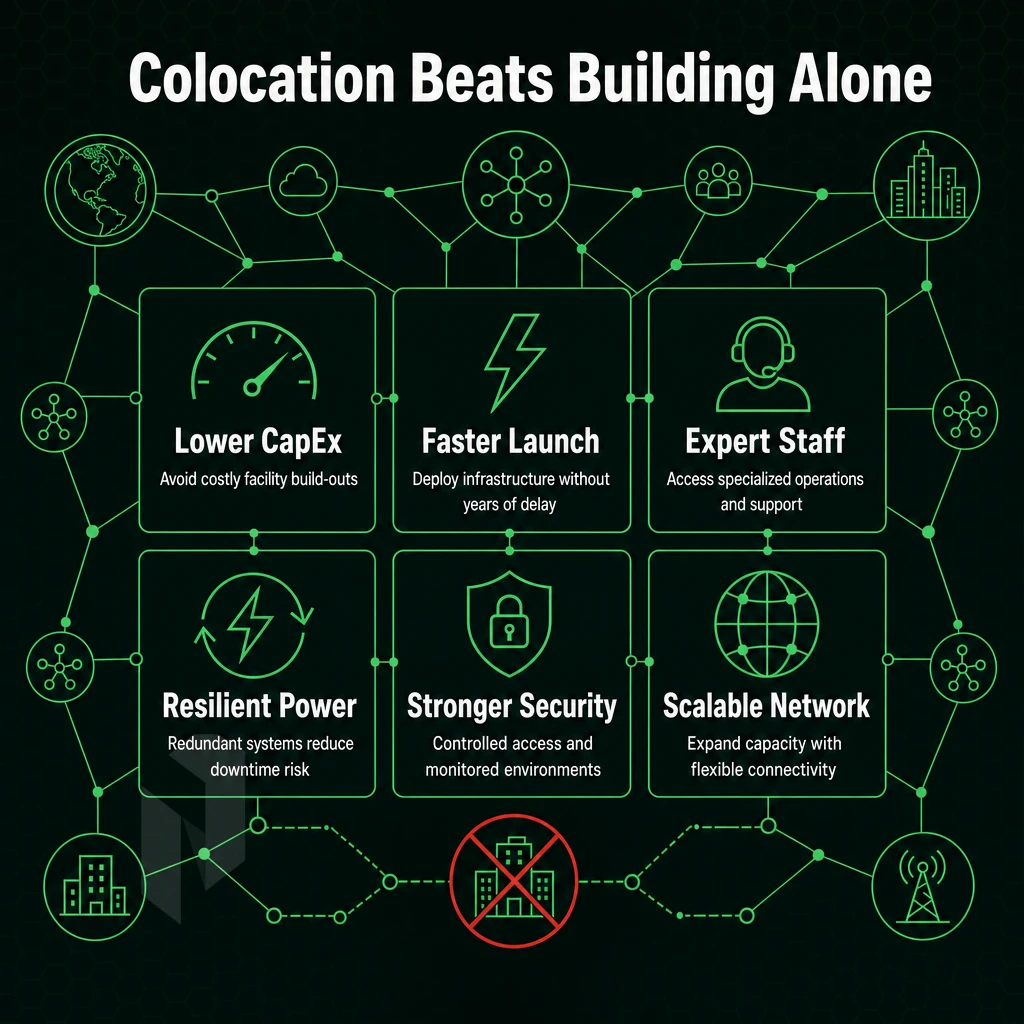
Building and running your private data center requires a large sum of capital and specialized staff which takes years to bring online. An enterprise colocation service delivers top class data center infrastructure on day one, and lets you shift your staff's focus to more strategic work. This approach allows companies to allocate resources toward innovation and business growth rather than facility management overhead. Organizations that leverage colocation gain a competitive advantage by deploying faster and scaling infrastructure without the delays inherent in building proprietary facilities. The cost efficiency of colocation becomes evident when comparing total ownership expenses against the capital investment and operational overhead of maintaining proprietary facilities.
Many providers also include disaster recovery options as part of their service portfolio, enabling businesses to implement comprehensive continuity strategies without additional infrastructure investments. Organizations seeking the control of dedicated infrastructure without capital expenditure often find that colocation bridges the gap between private cloud deployments and traditional on-premises environments. The hyperscale data center model demonstrates how massive economies of scale can be achieved, though most enterprises find colocation offers similar reliability benefits without requiring the enormous footprint or investment that hyperscalers deploy. The shift from enterprise data centers to colocation represents a fundamental change in how organizations approach infrastructure ownership and operational risk management.
Capital Expenditure vs. Operational Costs
Building your on-premises facility means spending lots of capital on a empty room, power distribution, cooling systems and physical security. You only pay for the space, power and connections you actually use and there's no risk of idle capacity or surprise bills for the data center itself.
Enterprise data center space power density is engineered from the outset. That means that N+1 power systems and sophisticated cooling are engineered into the facility from the ground up not as an afterthought. Creating such a specification and getting it implemented independently of existing data center design takes years of advance planning and purchase orders. Facilities with integrated power cooling architectures can deliver up to 30kW per rack while maintaining optimal temperature ranges across all equipment zones.
Physical Security and Compliance
By locating at carrier-neutral facilities and implementing robust security measures such as biometric access control, 24/7 CCTV monitoring and mantrap entry points, most in-house builds can only dream. Ongoing audits and trained personnel are further required to ensure the same level of data security at a self-owned facility.
We hold ISO 27001 and SOC 2 certifications.
Business Continuity and Disaster Recovery
We design our hosting systems with redundant power feeds, multiple fiber paths to your colocation and hosting facilities and distribute nodes across multiple geographic locations. A purpose-built facility for colocation is far more likely to withstand a disaster than your own self-owned data center facility.
Netrouting is operating from ten locations across Europe, North America and Asia. From these locations we can setup active-active and active-passive continuity architectures for our customers, enabling them to complete their digital transformation. Unlike many other companies offering colocation, we also offer cloud services and therefore can give you an impression of the possibilities and drawbacks of both colocation and cloud for your company.
Colocation vs. Cloud: Choosing the Right IT Infrastructure Model
The decision between colocation and cloud isn't simple.
When Colocation Facilities Win
Steady-state, high-performance workloads are typically better suited to a colocation environment. Workloads with predictable compute requirements, such as database clusters, high-end rendering environments and low-latency trading platforms, are better off in dedicated enterprise data centers, with their reliable power cooling infrastructure, as opposed to paying per use for cloud instances.
Data sovereignty matters too.
When Cloud Providers Make Sense
The main strength of cloud is that it deals well with variable demand.
Note that the major platforms offer managed services we don't, such as serverless functions, managed databases, and ML pipelines.
Hybrid Cloud Based Colocation as the Middle Path
Most enterprises fall into this category. The colocation provider hosts the baseline compute resources on dedicated servers while the burst workloads are shifted to the cloud. The integration between the two environments is seamless and is provided with private cross-connects and BGP.
At Netrouting we have multiple carrier neutral locations and a network with 2.4 Tbps+ capacity. As a result setting up a hybrid cloud within our ten data centers across the globe is easy to setup and manage.
Why Choose Netrouting for Enterprise Colocation Services
We operate carrier-neutral colocation facilities across 10 cities, Amsterdam, Frankfurt, Miami, New York, Hong Kong, Singapore, The Hague, Stockholm, Rotterdam, and Bucharest. Enterprises rent space in a professionally managed environment without building or maintaining their in-house data center.
- High-density power and cooling: Up to 20 kW per footprint with N+1 redundant power and advanced cooling infrastructure, ready for mission-critical workloads and high-density computing.
- Carrier-neutral network connectivity: Bring your own upstream or choose ours. Direct access to AMS-IX, DE-CIX, and FL-IX peering with seamless connectivity across our 2.4 Tbps+ backbone.
- Free private interconnect: Up to 40 Gbps private network between your own servers at no extra cost, ideal for hybrid cloud and disaster recovery.
- Always-on DDoS protection: L3/L4 mitigation included on every colocation service. No add-on required.
- 24/7 NOC + remote hands: On-site technical support with a one-hour ticket guarantee. Remote hands services at no extra cost.
- Certified infrastructure: ISO 9001, ISO 27001, and SOC 2, robust physical security, video surveillance, and access control across all colocation data center sites.
Rapid deployment and scalable colocation space mean your IT infrastructure grows with your business needs. Contact our sales team to compare colocation solutions and find the right fit.
Frequently Asked Questions
How Does high performance computing Affect Data Center Power and Cooling for Businesses?
An enterprise data center is a facility purpose-built to host mission-critical infrastructure at scale, think high-density power, redundant cooling, carrier-neutral connectivity, and physical security that meets enterprise compliance requirements.
The goal is predictable, resilient performance for workloads where downtime has a measurable business cost. Facilities like Netrouting's primary EU headquarters in The Hague operate at N+1 power and cooling with 215+ rack capacity to meet exactly these demands.
How Does Data Center Colocation Handle Power Cooling and What Services Does It Offer?
A colocation data center provides the physical space, power, cooling, and network connectivity, you supply and own the hardware. Your servers sit in a shared, secured cabinet or a private cage, connected to the facility's high-capacity network infrastructure. The operator handles the building, power redundancy, physical security, and upstream carrier relationships.
What Are Typical Data Center Colocation Costs for Enterprises?
Enterprise colocation pricing depends on power density, cabinet count, cross-connect requirements, and the specific facility, so a single number doesn't apply. Entry-level single-unit deployments are cost-effective for testing or edge workloads, while multi-cabinet or private-suite deployments through colocation providers, often paired with managed security services, are scoped individually based on power draw and connectivity needs.
The most accurate approach is to contact a provider's sales team with your power, space, and bandwidth requirements.
What is the difference between colocation and cloud services?
Colocation means you own the hardware and lease space, power, and connectivity inside a third-party facility, you control the full stack from the OS down to the firmware. cloud hosting abstract the hardware entirely; you consume compute, storage, and networking as metered, on-demand resources managed by the provider.
Colocation delivers predictable costs, dedicated performance, and no noisy-neighbour risk, critical for high-throughput or latency-sensitive workloads.
Colocation offers the ultimate in physical control of your hardware, without the need to spend millions of dollars to build out a facility. You get seamless integration of carrier-neutral connectivity, charged back to you on a predictable per unit basis, and all the infrastructure of a data center that would take years to replicate at enormous cost. For most organizations, colocation is better than building out their own private data center facilities and offers more control than moving to a cloud-only solution.
Choosing the right colocation partner is almost as important as choosing to colocate in the first place.
Netrouting operates carrier-neutral colocation across Europe, North America, and Asia, backed by a 2.4 Tbps+ network, always-on DDoS protection, and ISO 27001 and SOC 2 certifications. Explore Netrouting's colocation solutions or contact the sales team to discuss your specific requirements.