Selecting the wrong data center colocation services can cost far more than just money. With so many providers in the market, it can be difficult to choose the best colocation services.
The technical specifications of facilities are often convoluted and the sales pitches from data centers are typically similar. However, there are many real differences between data centers and their facilities, including the networks, data storage capacities, power densities, geographic locations, and the service that customers receive from support staff. Evaluating providers requires understanding how they support a broad range of deployment architectures, from single-rack configurations to multi-site hybrid environments. For more context, see contact our team.
Modern colocation providers increasingly position themselves as enablers of digital ecosystems, connecting enterprises to cloud on-ramps, interconnection exchanges, and partner networks within the same facility. As enterprises accelerate their digital transformation initiatives, colocation facilities serve as critical infrastructure hubs that bridge legacy systems with modern cloud-native architectures.
Blog contents

Read about the key selection criteria that IT teams use when evaluating potential data centers, including high density power options, and gain insight into how location, peering, redundancy, and network troubleshooting actually affect your workloads, not just reading through the SLA.
Netrouting operates carrier neutral datacenters in Europe, North America and Asia.
What Is a Colocation Data Center Provider Like Digital Realty?
A colocation data center provider offers rented space, power, cooling, and physical security for servers and networking equipment that companies own themselves. The company brings the hardware. The data center facility provides the rest. For more context, see Colocation centre.
How Colocation Data Centers Power Digital Ecosystems
The server and associated equipment in a colocation data center is housed in a professionally managed facility, the physical building or "white space" used for colocation services, not servers outsourced to a third party.
Managers of data centers are responsible for the building facilities, including redundant power delivery systems, precision cooling plants, fire suppression systems, and access control systems, while the server owner retains complete control and 100% ownership. These facilities also provide secure environments optimized for data storage infrastructure, ensuring active servers and archival systems benefit from environmental controls and physical protection.
Here’s a typical deployment scenario: A company has its own rack of servers, switches and storage within a cabinet which may be shared with other customers, or be a private cabinet within the data center. The colocation data center provides the critical uptime guarantees, cross-connects and access to carriers that would not be possible from a company’s own server room.
Data Center Colocation vs. Other Hosting Models
Data center colocation services sit in the middle ground between on-premises data centers (owned facilities in a building you own) and public cloud services (100% virtualized, where you can own zero servers).
On the one hand, on premises data centers are very capital intensive, but are fully under your control. On the other hand, hyperscale cloud services built on hyperscale data centers offer the advantage of 100% virtualization and no need to own or manage physical infrastructure, but come with very limited control and inherently unpredictable costs. Organizations migrating from colocation to cloud computing often discover that variable egress fees and instance sprawl can exceed the predictable monthly costs of owned hardware in a managed facility.
Such a business case makes sense when predictable costs and control over hardware are important. Maintaining ownership of physical assets while outsourcing facility management represents a strategic middle path for organizations whose data center business requires both cost predictability and infrastructure control.
What Colocation Facilities Supply to Your Business
Colocation providers provide the infrastructure layer your team shouldn’t have to manage.
- Redundant power (N+1 or better).
- Precision cooling.
- Carrier-neutral network access.
- Remote hands and on-site support.
Netrouting’s colocation facilities have space for high density servers and support up to 20 kW per floor in our N+1 powered and cooled environment. All of our locations (Europe, North and South America, Asia) have high density servers supported in their colocation facilities. These high-density configurations are particularly well-suited for compute-intensive ai workloads that demand both substantial power delivery and efficient thermal management at scale. High-density deployments increase the energy required to maintain optimal operating temperatures, making efficient cooling architecture a critical design consideration.
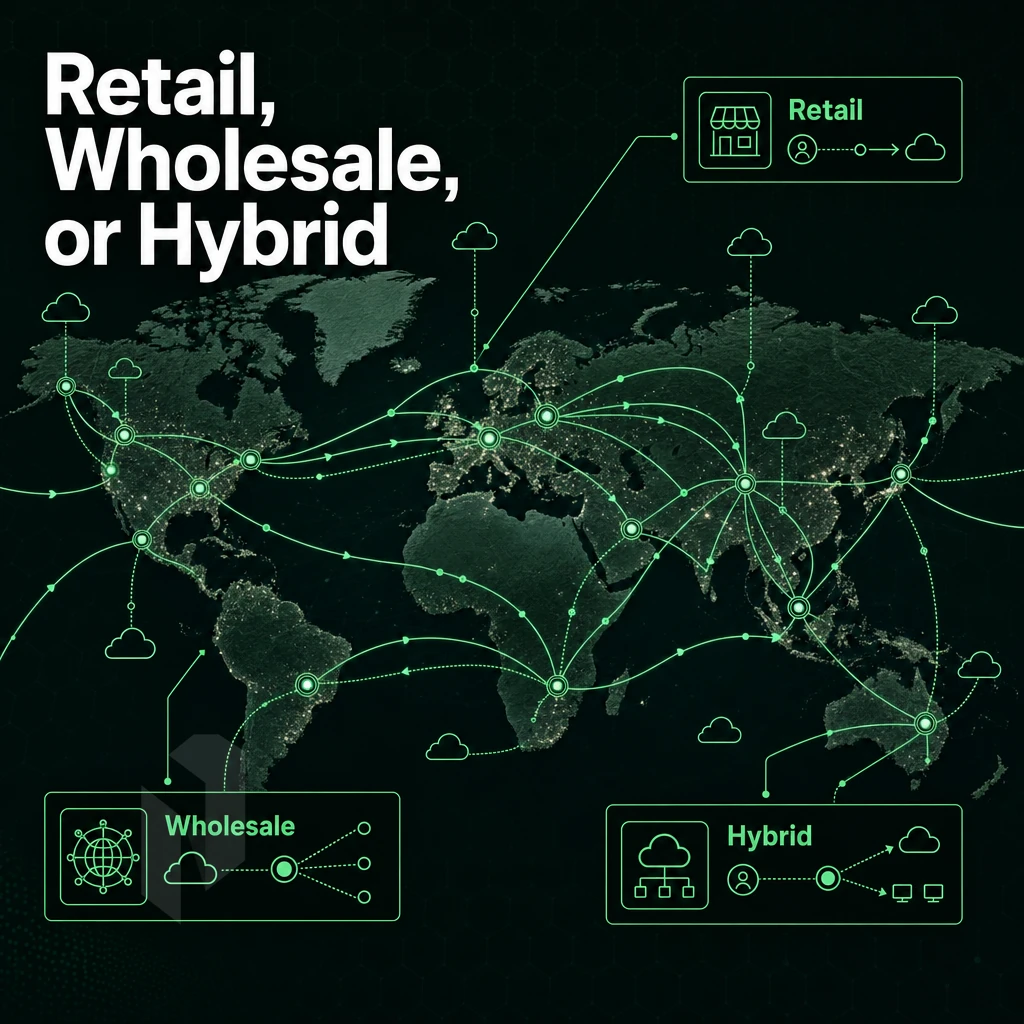
Colocation Data Center Types: Retail, Wholesale, and Hybrid
Not all colocation services are created equal. The type of colocation data center model that you choose will be a determining factor in the actual footprint, flexibility, operational stability, and overall operational overhead that you have for your new infrastructure. This article will introduce the reader to the 3 main types of colocation services available.
Retail and Wholesale Colocation Services for Data Centers
Retail colocation is typically sold in cabinets (cages) within a shared data center. This is ideal for small businesses and medium sized companies that need colocation services for a few servers, requiring physical hardware without the burden of managing a data center facility. Wholesale data centers on the other hand are leased by tenants in large floor areas (halls) within purpose built data centers. Large enterprises and hyperscale operators use this model when the rack density and power commitment makes sense.
Choosing between retail and wholesale colocation fundamentally depends on your organization's business model and whether you prioritize flexibility or economies of scale. Organizations that align their colocation strategy with their growth trajectory and technical requirements gain a competitive edge in both operational efficiency and time to market. Wholesale facilities often serve as the foundation for hyperscale data centers, where tenants deploy thousands of servers across contiguous floor space with dedicated power substations and cooling infrastructure.
A retail data center typically delivers 1-10 Gbps uplinks per cabinet, 99.9% uptime SLAs, and shared support staff. Many providers also offer guaranteed uptime through contractual commitments that include financial credits if availability thresholds are not met.
Hybrid Center Colocation Solutions for Cloud Data
A Hybrid environment typically consists of a tenant running an on-premises colocation data center environment, protected against any power outage through redundant systems, and crossing into shared cloud infrastructure on ramps via direct cross connects.
This environment is ideal for applications that require an in house data center level of business continuity for the latency sensitive tiers of the application, but can burst to cloud compute as required. Optimizing application performance in this architecture requires careful placement of workload components based on their latency requirements and resource consumption patterns.
| Model | Typical Footprint | Uplink | Best For |
|---|---|---|---|
| Retail | 1U-full cabinet | 1-10 Gbps | SMBs, mid-market |
| Wholesale | Suites to full halls | 10-100 Gbps+ | Hyperscale, large enterprise |
| Hybrid | Private suite + cloud | 10 Gbps+, <5 ms cloud | Mixed workloads, burst compute |
Managed High Density Colocation Data Center Services as an Extension
For OS patching, server monitoring, and remote hands services on top of standard hosting, we recommend our managed colocation services. We provide these from our carrier-neutral data centers in Amsterdam, Frankfurt, Miami, and other locations, with rack space for center colocation and 24/7 access to private suites with as many racks as you need.
We also have managed colocation services available to handle all the tasks for you, so you don't need to have your own on site staff.
Colocation Resources and Data Center Frequently Asked Questions
How Do Colocation Data Centers Work and What Do They Offer?
A data center colocation provider rents physical space, power, cooling, and internet connectivity inside a secure facility, you bring your own servers and networking gear. The provider handles the facility infrastructure: redundant power feeds, cooling systems, physical security, and carrier-neutral connectivity. When evaluating a colocation operator, verify their certifications, uptime track record, and whether they own or lease the facility infrastructure. Uptime track records directly reflect data center reliability, which depends on infrastructure design, maintenance protocols, and incident response capabilities.
Who Are the Largest Colocation Providers in the World?
By total raised floor space and global footprint, the largest colocation providers, many of whom also support cloud computing services, are a small group of publicly traded operators with hundreds of facilities across dozens of countries. They serve hyperscalers, enterprises, and network-dense interconnection hubs at massive scale. Smaller, specialist providers like Netrouting compete on network quality, custom configurations, and hands-on support rather than sheer square footage, often delivering better performance and lower total cost of ownership for dedicated and bare-metal workloads. These specialist providers often leverage their agility and technical depth as competitive advantages when serving clients with demanding performance requirements or complex compliance needs. Operators such as digital realty exemplify the hyperscale model, maintaining extensive portfolios of interconnection-rich facilities that anchor global enterprise deployments. Specialist providers often tailor their offerings to ensure enterprises access premium network fabrics and low-latency interconnection without the overhead of navigating massive multi-tenant environments. In contrast to hyperscale operators with global reach, few providers can match the specialized technical expertise and personalized service levels that regional operators deliver for mission-critical deployments. Regional operators frequently differentiate through premium interconnection services that provide direct, low-latency paths to cloud providers and network exchanges within the same facility.
Which companies are the big 5 in colocation data centers?
The commonly cited 'big 5' are the largest publicly traded providers of colocation facilities and interconnection operations, each running multi-continent campus portfolios at hyperscale. They dominate enterprise and cloud on-ramp colocation by volume. Beyond the giants, carrier-neutral colocation data center specialists, including Netrouting, with facilities across Europe, North America, and Asia-Pacific, serve businesses that prioritize network performance, BGP flexibility, and dedicated bare-metal infrastructure over raw facility scale.
Top 10 Data Center Colocation Companies in the World
Rankings shift as capacity expands and M&A activity reshapes the market.
For businesses evaluating colocation, network-centric colocation data center providers are equally worth shortlisting: Netrouting operates ten locations across Stockholm, Amsterdam, Rotterdam, The Hague, Frankfurt, Bucharest, Miami, New York, Hong Kong, and Singapore, delivering carrier-neutral colocation on a 2.4 Tbps+ backbone with ISO 9001, ISO 27001, and SOC 2 certification.
Flexibility of operations.
Colocation services allow you to benefit from not having to spend capital on hardware, whilst allowing you to keep full control of your server stack.
You are held hostage to the pricing and routing of a single provider.
Netrouting operates a carrier-neutral colocation data center presence across ten locations in Europe, North America, and Asia, all running on a 2.4 Tbps+ backbone with always-on DDoS protection included. Explore Netrouting's colocation options or contact the team to discuss your specific rack, power, and connectivity requirements.