The constraint that ends standard colocation is Power density. When your servers are consuming 10 kW per rack, 15 kW per rack or more, most colocation data centers are maxed out in terms of cooling and power to support such high density servers. As a result, you are forced to run your servers in throttled mode.
Facilities engineered to meet these cooling requirements typically deploy in-row cooling units, rear-door heat exchangers, or liquid cooling loops to manage thermal loads efficiently. Deploying in row cooling allows facilities to place cooling units directly adjacent to heat-generating equipment, reducing the distance hot air must travel before being conditioned and returned to the server intake. For more context, see colocation facilities.
Without cloud providers or data center operators, you will be forced to decommission servers periodically and/or pay exorbitant sums of money for a custom buildout to support your server equipment. High density colocation data centers are designed from the ground up to handle high density servers with specialized cooling, power and floor loading to support the highest power density servers.
Blog contents
The wrong data center means that your equipment runs hot.
You fail to meet your service level agreements and your team spends all of their time dealing with power headroom issues, like whether to invest in liquid cooling, instead of building out product.
This guide will take you through the unique aspects of a High Density Colocation environment as opposed to a standard shared data center, review of relevant technical specifications. Additionally, Key criteria to evaluate potential colocation providers before you buy rack space. High Density Colocation environments can offer significant advantages to organizations looking to improve data center efficiency. The first place to start is to define what High Density Colocation environments are, and how they differ from typical shared data centers.
What Is a High Density Colocation Data Center?
In standard colocation data centers, typical power per rack is in the range of 2-5 kW.
However, as the power density per rack increases in facilities handling sensitive data, all other supporting aspects of the data center must also increase in scale to support cooling, power distribution and the physical aspects of the data center. Facilities must also ensure redundant power systems, including backup generators, to maintain uptime for mission-critical workloads operating at elevated density levels.
Robust disaster recovery capabilities become equally critical as density increases, ensuring that data replication and failover mechanisms can sustain operations even during infrastructure failures. Implementing high availability architectures at elevated density requires careful coordination between redundant cooling paths and failover-capable power distribution to prevent single points of failure.
What Sets High Density Colocation Apart in Data Centers
The standard colocation facility is designed around the 1U server and a relatively modest CPU compute load. High density colocation has evolved due to the large AI workloads, large GPU servers, and high performance computing requirements that exceed the power density of legacy facilities. A single GPU chassis can alone draw 10-20 kW of power. Organizations planning large-scale deployments must evaluate whether their chosen facility can scale gpu capacity without hitting thermal or electrical limits that throttle performance.
Changing the way we cool our data centers will require rethinking floor space, cooling, and power delivery. Modern data centers increasingly adopt modular designs that allow incremental capacity expansion as workloads evolve. The transition to a high density data center often means rethinking traditional raised floor layouts to handle heavier equipment and more aggressive airflow strategies. Operators must also manage cable and power distribution pathways that grow increasingly complex in high density environments where space constraints intensify.
High Density Colocation Facilities: Core Characteristics
- Rack power support of 10 kW to 20 kW or higher.
- Precision cooling matched to actual heat load.
- N+1 redundant power feeds per cabinet.
- Cabinet density in square meters is higher than in a standard high density data center.
Choosing the Right Data Center Provider for Your Needs
Not every facility can be retrofitted to support density colocation in large quantities. Support of density colocation is ideal when cloud providers design their underlying network and power infrastructure together from the start, rather than adding components after the fact. Understanding how power density is calculated and why it matters will aid in your assessment of any potential facility.
Organizations deploying ai infrastructure at scale must prioritize facilities where power, cooling, and network architecture are integrated from day one to avoid costly retrofits. Many organizations migrating from cloud platforms to dedicated infrastructure underestimate the complexity of power and cooling integration required for density deployments.
AI Workloads, Machine Learning, and the Demand for High Density Colocation
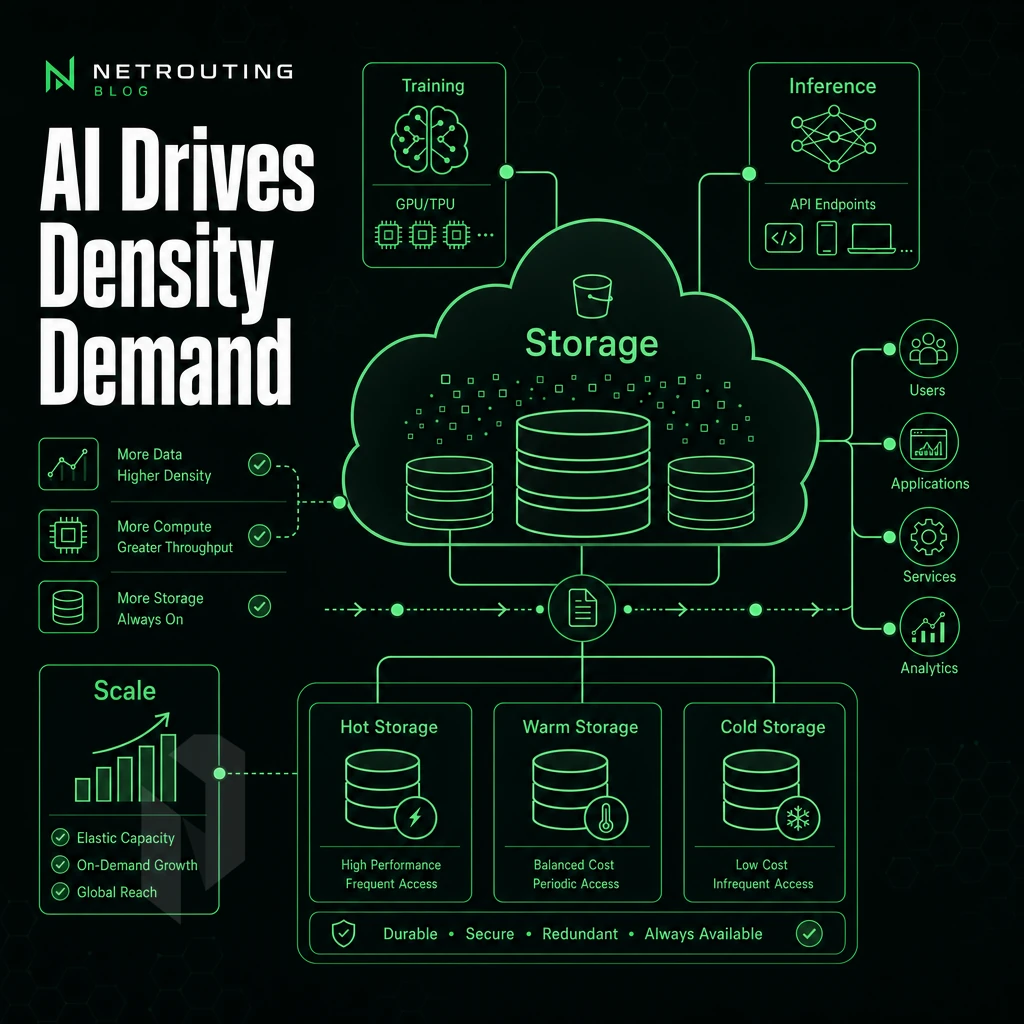
AI and machine learning workloads have fundamentally changed what colocation facilities need to offer. Large-scale model training and high-volume inference require far greater compute density than traditional data centers were designed to support. As a result, the evolving needs of modern AI are driving growth in high-density colocation data center space around the world. The data center industry is responding with purpose-built facilities that integrate advanced cooling architectures and redundant power systems capable of sustaining these demanding workloads.
Why AI Training Breaks Standard Rack Assumptions
Additionally, Structural loading support that typical facilities cannot rapidly retrofit.
In addition to the above mentioned patterns, GPU clusters also generate a huge amount of east-west traffic between the nodes of different workers that are distributed for training. Also, real-time data processing for inference generates latency-sensitive traffic that, in modern data center operations, demands a high bandwidth, low latency fabric to handle effectively. This is quite contra-intuitive to typical north-south traffic in legacy data centers.
GPU Density and Cooling Requirements for Data Center Workload Profiles
While AI training, inference and big data analytics workloads all sit at the edge of the data center, each puts a different set of pressures on the core. Training jobs typically involve distributed compute across multiple nodes, while inference and analytics ai workloads often require sustained throughput with predictable response times under variable load conditions. High performance computing environments running these workloads demand infrastructure that can deliver consistent power and cooling at scale without introducing thermal bottlenecks that degrade model accuracy or processing speed.
Inference workloads are driven by the need for high throughput and low latency.
Key Features of Netrouting's GPU Data Centers Offering
Our digital infrastructure includes high power density GPU servers equipped with the latest NVIDIA models, the RTX 6000, A10, A40, and A100, supporting inference and large-scale training. Our machine learning servers can be deployed across any of our European locations.
EU data sovereignty is guaranteed, particularly for sensitive applications requiring high power density processing within specific jurisdictional boundaries. High compute density and large GPU counts are of no use if server rooms fall short on physical security and network connectivity. Facilities supporting such deployments typically implement biometric access controls and multi-layered authentication to protect critical infrastructure. These environments must also provide direct connectivity to major cloud platforms and network exchanges to minimize latency for distributed workloads.
Frequently Asked Questions About Data Center Space
What Are High power density Data Centers for HPC Colocation?
A dense colocation center is a facility that any serious data center provider engineers to support racks with significantly higher power density than standard deployments, typically 10 kW per rack and above. That threshold is the defining characteristic separating high density facilities from conventional colocation environments. In technical terms, high density colocation refers to environments where power, cooling, and structural systems are purpose-built to sustain elevated loads without performance degradation.
What are the three types of colocation data centers used in high performance computing?
Retail colocation provides shared space sold by the rack or cage, with shared high performance computing infrastructure and flexible contract terms, making it the most common model for enterprises and mid-market businesses. Providers in this segment often balance competitive pricing with service quality to attract organizations seeking cost-effective infrastructure without sacrificing reliability or performance.
What Power Density Is Considered High Density in Data Centers?
Industry consensus places the high density threshold at 10 kW per rack, compared to standard colocation racks that typically run 3, 7 kW. Deployments in the 10, 20 kW range are considered high density, already a major capital investment that high density colocation providers must support; anything above 20 kW per rack, common with GPU clusters and AI inference nodes, is ultra-high density. Facilities must be specifically designed for these loads, retrofitting standard density colocation space is rarely viable above 15 kW per rack.
How do data centers differ in high density versus standard colocation?
High density colocation engineers every layer, power feeds, cooling infrastructure, floor loading, and fire suppression, to handle sustained loads of 10 kW per rack and above.
Power redundancy requirements are stricter, cooling systems are more sophisticated to handle the increased power density, and rack space per rack is often greater to accommodate supplemental cooling hardware. The operational cost per rack is higher, but meeting the evolving demands of AI workloads by spreading them across more standard racks frequently costs more overall and introduces latency between nodes.
What cooling systems are used in high density data centers?
High density facilities deploy several cooling approaches depending on rack density.
For densities above 20 kW, particularly GPU and AI workloads, high density colocation providers deploy direct immersion cooling (DLC) that routes chilled water or dielectric fluid directly to heat-generating components via cold plates. Immersion cooling, where servers are submerged in dielectric fluid, is increasingly used for the highest-density deployments above 50 kW per rack.
What Workloads Require High Density Data Centers Colocation?
GPU-accelerated AI training and inference are the primary drivers of high density demand today. High-performance computing (HPC) clusters, financial trading platforms requiring low-latency parallel processing, video transcoding at scale, and large-scale database servers all regularly exceed standard rack power envelopes, presenting real challenges for data center operations managers.
Any workload that concentrates significant compute into a small physical footprint, rather than distributing it across many low-power nodes, will typically require high density digital infrastructure. Netrouting's colocation facilities support up to 20 kW per footprint with N+1 power and cooling, making them a practical fit for cloud providers and others running these demanding deployments.
Hyperscalers vs Colocation Providers: What Is the Difference?
Hyperscalers own and operate their own data centers as massive shared facilities, selling compute, storage, and platform services as a multi-tenant cloud where you consume their hardware through an abstraction layer and pay per resource consumed. Colocation providers lease data center footprint, power, and connectivity inside their facilities, while data center managers on your side bring and own the hardware, retaining full control over the infrastructure stack.
Hyperscalers offer a broad managed-service catalog but introduce variable billing, data egress costs, and limited hardware customization. Colocation delivers predictable costs, hardware sovereignty, and direct network access, advantages that become significant at scale. Netrouting delivers carrier-neutral network solutions built to meet evolving demands through colocation across ten locations in Europe, North America, and Asia, backed by a 2.4 Tbps+ backbone and always-on DDoS protection included on every deployment.
High density colocation involves three fundamental components: precise power delivery, advanced cooling infrastructure, and low-latency network connectivity. Any one of these can cause the rest to fail. Additionally, as the rack densities of AI and machine learning workloads continue to increase far beyond what typical data centers were designed to support, choosing the right colocation provider has never been more important.
Netrouting’s carrier-neutral data centers have high-density spaces up to 20 kW per 60 sq. ft. of floor space with N+1 power and cooling. 2.4 Tbps+ network and always-on DDoS protection is included with every service. With data center locations in Europe, North America and Asia, we have the right location for your latency-sensitive infrastructure.
If you're evaluating colocation for a GPU cluster, AI inference stack, or any high-density workload, speak with the Netrouting team to discuss your power and connectivity requirements.