
Servers running at high temperatures, draining your on-premises or colocation data center budget at full power, and huge capital expenditure for the next hardware refresh. Colocation at a data center helps to solve all these issues without loosing control of server and applications. Rather than building and running your own data center, server and application are housed in purpose built data center and you only pay for the space, power and bandwidth that you actually require.
Colocation is cost-effective because of the economics of shared infrastructure. In a carrier-neutral data center you have direct access to all network providers. You have multiple power feeds with redundancy. You have precise cooling and you have physical security. All this does not scale cost-effectively in a server room of an enterprise. But in a colocation data center you get enterprise-class availability without the cost of the building.
Modern facilities also deploy uninterruptible power supplies and battery backup systems to ensure continuous operation during grid failures or maintenance windows. These facilities also address environmental issues by optimizing energy consumption through advanced cooling technologies and renewable energy sources that individual enterprises cannot economically deploy.
Blog contents
This redundant architecture ensures high availability for mission-critical applications that cannot tolerate downtime. Precision environmental controls include hot-aisle containment systems and computer room air handlers that maintain optimal temperature ranges, while hvac units are engineered specifically for the thermal loads generated by dense server deployments.
Geographic redundancy across multiple facilities also protects against natural disasters that could compromise a single location. Facilities also provide real-time monitoring dashboards that allow tenants to track resource utilization and optimize performance across their deployed infrastructure.
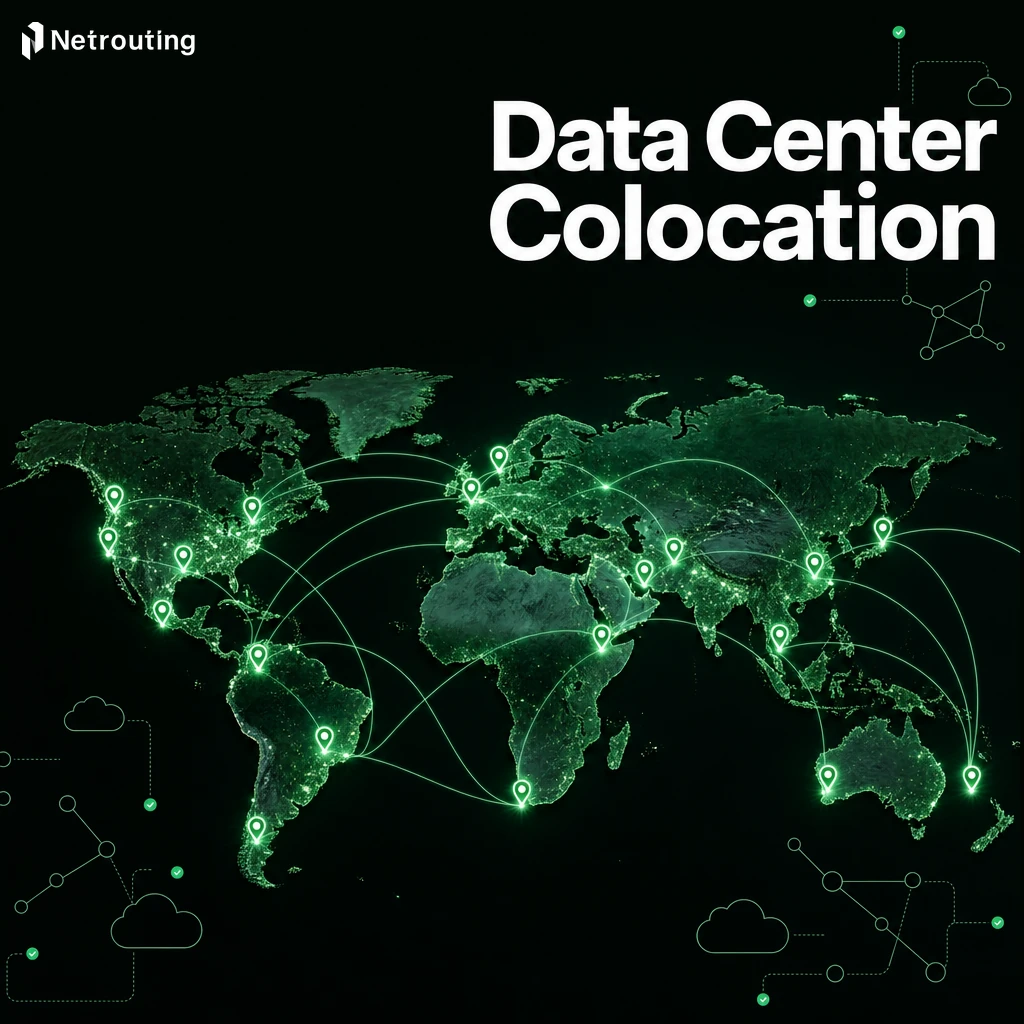
In this in-depth whitepaper we explain what data center colocation is, what you should watch out for when selecting a colocation provider. These workloads are best run in a colocation data center, and Netrouting has colocation locations worldwide (The Hague, Amsterdam, Miami, Frankfurt, Bucharest, Stockholm and Hong Kong). When evaluating colocation providers, it's essential to compare how different colocation companies structure their service offerings, pricing models, and support capabilities.

What Is a Colocation Services Data Center?
Colocation is renting a rack or cabinet space in a third party data center, where you house your own servers and other IT hardware. We handle the data center infrastructure. Depending on your security and isolation requirements, you can choose from shared cabinet arrangements or a fully dedicated caged off room for your infrastructure. This arrangement allows you to deploy routers, switches, storage arrays, and other computing hardware alongside your servers in a secure, professionally managed environment.
What Colocation Solutions the Data Center Provides
A colocation space delivers 4 core resources: power, cooling, network connectivity, and physical security. Many facilities also provide cross connects that enable direct physical links between your equipment and other tenants or network providers within the same building.
These direct connections eliminate the latency and cost overhead of routing traffic through public internet exchanges, making them essential for high-frequency trading platforms and real-time data applications. Facilities with robust interconnection services enable tenants to establish low-latency connections to multiple carriers, cloud on-ramps, and peering exchanges without leaving the building perimeter.
- Power: Redundant feeds with UPS and generator backup.
- Cooling: Precision climate control, N+1 redundancy.
- Connectivity: Multi-carrier access, peering, and transit.
- Security: Biometric access, CCTV, 24/7 on-site staff.
How It Differs from Cloud Providers and Cloud Computing
Cloud resources are provided as virtualized capacity on third-party hardware, while colocation lets you own your computing hardware and take full advantage of the network solutions offered by the facility. This is an important factor for very performant applications, for compliance reasons and for the long-term cost planning.
Organizations that require predictable latency and direct hardware control often find this model provides a competitive edge in industries where milliseconds matter. Companies undergoing digital transformation increasingly rely on this infrastructure model to modernize legacy systems while maintaining direct oversight of critical workloads.
Why Not Build Your Own Facility?
A private data center costs a lot of money to build, not only for the physical space but also for the power supply and for the employees to manage it all. Colocation hosting on the other hand, is very cost-effective. By sharing infrastructure costs across multiple tenants, colocation providers achieve economies of scale that make enterprise-grade facilities accessible and cost effective for organizations of all sizes.
Knowing what the facility can do for you is not enough.
Types of Data Center Colocation Facilities by Colocation Strategy
All colocation facilities are not created equal. There are three main models of colocation that are used today.
Retail and Wholesale Models for Physical Security
- Retail colocation services offer renting of a single rack or even a small cage in a shared data center room, “hall”. Clients share power, cooling, and physical security. This is ideal for small companies and mid-size teams requiring robust infrastructure without the costs of a full data center suite.
- Wholesale colocation, lease your own suite or even data hall of your own and scale up to hundreds of kW in capacity. Ideal for very large enterprises who require very high density of compute and/or have extreme compliance requirements.
Note: Wholesale contracts usually carry multi-year terms. Verify your data center power and cooling projections before signing, because undersizing a suite is costly to correct mid-contract.
Managed Colocation Center Services
- In managed colocation, the provider offers managed services on top of the server in the colocation space. This can include OS updates, security hardening, 24/7 monitoring and (surgeon’s) remote hands service. The customer still has full root access to his server(s), but the provider takes care of all the day-to-day management tasks. Netrouting offers managed hosting on its EU and US-based colocation facility, following this model.
Carrier Hotel Variant
- A carrier hotel or network hotel is a type of datacenter or facility that is a connectivity specialist, a carrier hotel or network hotel. There, Colocation refers to housing of networking equipment and cross-connects rather than servers and storage systems. A number of telecom carriers, ISPs and Content Delivery Networks (CDNs) have peering anchors in these facilities to create very dense peering. It is a specialist type of datacenter, not intended for general colocation.
Once you have worked out which facility model best suits your workload, the next issue to consider is how Colocation compares with Public Cloud and Building your own Data Center.
Data Center Colocation vs. Cloud vs. Private Data Center
Enterprise infrastructure decisions typically come down to colocation, public cloud, or building your own data center.
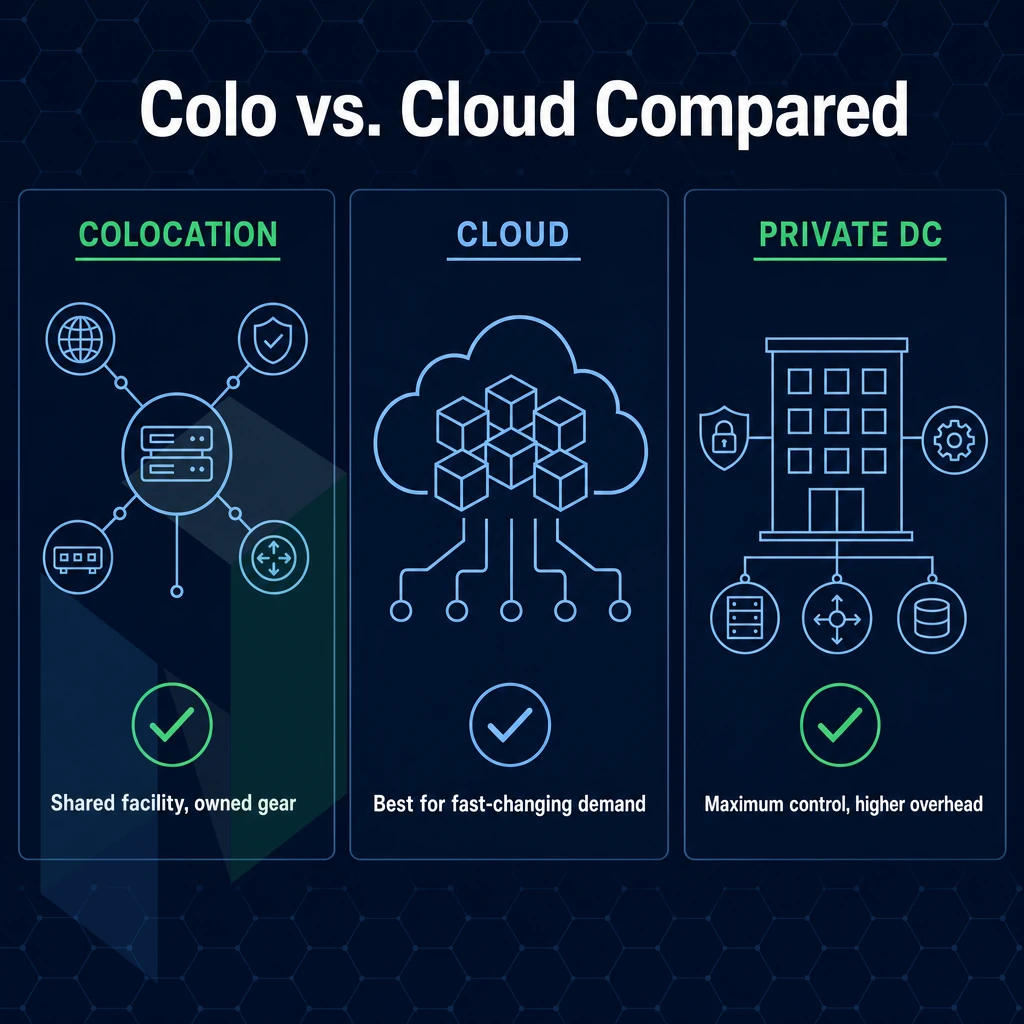
How Data Center Colocation, Cloud, and Own-Facility Models Differ
With Colocation, you own the Servers/Hardware and lease space in a data center. The data center operator supplies power, cooling, and physical access control; you control everything above the rack/floor tile. Typically colocation datacenters are carrier-neutral, implementing biometric scanners, mantrap entries, and 24/7 surveillance for controlled access to customer equipment. Modern colocation facilities also integrate advanced fire suppression systems using clean-agent technologies that protect sensitive equipment without water damage or residue.
That is, all cloud services are provided on shared data center hardware and infrastructure that the cloud provider manages. The key benefit of cloud offerings is elasticity, but the customer is then at the complete mercy of the cloud provider, with no control over the data center hardware, power grids, or infrastructure whatsoever. Many organizations evaluate multiple cloud providers to compare pricing models, service-level agreements, and geographic availability before committing to a virtualized infrastructure strategy.
A fully own data center (owned by you) includes all layers (real estate, power, cooling, personnel).
| Dimension | Colocation | Public Cloud | Own Facility |
|---|---|---|---|
| Hardware ownership | Customer owns own hardware | Provider-owned, shared | Customer-owned, on-premises |
| Capex vs. Opex | Capex (servers) + Opex (space) | Pure Opex | Heavy Capex |
| Control level | Full stack above physical layer | Application layer only | Complete, every layer |
| Scalability | Incremental rack expansion | Near-instant, elastic | Slow; requires construction |
| Regulatory compliance | Known physical jurisdiction | Data residency varies by region | Full jurisdiction control |
| Data loss risk | Low, dedicated hardware, no noisy neighbours | Shared blast radius; provider SLA governs | Low, isolated, but DR burden is yours |
| Typical use case | Latency-sensitive workloads, compliance, dedicated data center performance | Burst capacity, dev/test, SaaS | Regulated industries, ultra-sensitive data |
Where Netrouting Data Center Colocation Fits
Netrouting operates fully carrier-neutral data center s in 7 locations around the globe. At these data center facilities, customers have full control over their own hardware in an ISO 27001 certified environment.
All customer equipment in the data center is connected in a free private network, which means there are no inter-rack transit costs. Unlike cloud services where you pay per use, these costs are fixed for the free private network in the data center facilities of Netrouting. This ISO 27001 certified colocation environment ensures that all physical and logical security controls meet international standards for information security management.
Knowing where colocation fits in the landscape matters.
Why Choose Netrouting for Colocation
Netrouting delivers carrier-neutral, vendor-neutral colocation facilities and network solutions across seven data centers: Amsterdam, Frankfurt, The Hague, Stockholm, Bucharest, Miami, and Hong Kong. Our colocation services scale from shared secured cabinets to private suites, with up to 7 kW per footprint.
Every colocation center runs on a 1 Tbps+ backbone (AS47869) with AMS-IX and NL-ix peering, DDoS protection included as standard, and a free private network between your resources. Major providers like Digital Realty operate facilities in many of these same markets, offering enterprises additional options when comparing global footprints.
- Carrier-neutral colocation, bring your own IP (BYOIP) and run BGP across our Tier 1 network.
- premises security and compliance, ISO 9001, ISO 27001, and SOC 2 (Miami) certified colocation facilities.
- Power and cooling, N+1 redundant power, cooling systems, and multiple backup generators for continuous operation.
- Remote hands included, courtesy remote hands at no extra cost, backed by a 24/7 NOC and 1-hour ticket guarantee.
- Global reach, seven colocation data centers across Europe, North America, and Asia-Pacific.
Speak with our team to find the right colocation solution for your hardware and network requirements.
Frequently Asked Questions
What Colocation Providers Offer Including Interconnection Services
Colocation means renting physical space inside a third-party data center to house your own servers and networking equipment. The facility provides the power, cooling, site security, and network connectivity. You own and manage the hardware; the data center operator manages the building infrastructure. It gives businesses data center-grade reliability without the capital cost of building and running their own facility.
What Are the Three Types of a Colocation Data Center?
The three main types are shared colocation, wholesale colocation, and carrier-neutral colocation. standard colocation sells space in smaller increments, single rack units, partial cabinets, or full cabinets, suited to businesses with moderate computing hardware footprints. Wholesale colocation leases large dedicated suites or entire halls to enterprises needing dense, high-power deployments at scale. Carrier-neutral data center facilities allow customers managing in house servers to connect to multiple ISPs and network providers freely, avoiding lock-in to a single carrier and enabling competitive transit pricing.
How Do Hyperscalers Differ From a Colocation Data Center?
Hyperscalers are the largest public cloud operators, running their own massive, proprietary data center campuses, distinct from the colocation data center model, to deliver on-demand virtualized compute, storage, and services globally. Colocation providers rent space and connectivity inside shared facilities to customers who bring their own hardware.
The key difference is ownership and control: hyperscalers abstract the infrastructure entirely, while colocation keeps you in direct control of your physical servers and their ongoing maintenance costs. Businesses choose a colocation data center when they need predictable performance, data sovereignty, or workloads that are more cost-effective on owned hardware than on metered cloud instances.
How Does a Colocation Data Center Differ From Cloud Infrastructure?
Cloud computing delivers virtualized resources, compute, storage, and networking on demand from shared data center infrastructure managed entirely by the provider. Colocation gives you a physical footprint in a secure facility where your own dedicated hardware runs. Cloud suits variable, unpredictable workloads because you pay only for what you consume. A colocation data center suits steady, high-throughput workloads where dedicated hardware delivers better performance per dollar and where full control over the stack, OS, firmware, and network configuration is a hard requirement.
By setting up colocation within an enterprise data center, customers can gain the density of infrastructure, redundancy of key systems.
The customer has complete control of their server hardware, while power, cooling, physical access control and network uptime are transferred and optimized by the data center facility. In terms of performance, for latency-sensitive, hardware-dependent or high-throughput applications, colocation is far superior to building and managing your own private data center, as well as to hosting in public cloud.
Choosing the right data center colocation provider comes down to network quality, geographic reach, and support responsiveness. Netrouting operates a carrier-neutral colocation data center presence across seven locations, The Hague, Amsterdam, Frankfurt, Bucharest, Stockholm, Miami, and Hong Kong, backed by a Tier 1 backbone, 24/7 NOC, and ISO 9001 + ISO 27001 certification. If you're evaluating colocation for your next deployment, explore Netrouting's colocation options or contact the sales team to discuss your specific requirements.