The data center colocation market solves a problem that every infrastructure engineer ultimately faces with their growth: that their hardware grows beyond the capabilities of their in-house infrastructure. Issues like latency spikes, power limits, and single ISP uplinks that would normally be unacceptable to most companies in the data center colocation market suddenly become major problems when you're running game servers, real-time APIs.
Additionally, Other latency sensitive applications and services at scale. Data center colocation lets you run the physical servers of your choice inside the world's most connected and powerful facilities, with carrier grade power and cooling handled for you. Additionally, Multi-gigabit connectivity that you simply cannot get in any rack in any on-premise data center.
Evaluating facilities and providers is crucial to building scalable and reliable infrastructure to handle peak loads. This guide breaks down the critical factors that determine success in the data center colocation market, including location, network performance, power density per rack, and more importantly, a good operator that can respond to issues at 2 AM.
Blog contents
The purpose of this guide is to equip developers and system administrators that run game servers and other unique workloads with the necessary knowledge to evaluate potential facilities within the data center colocation market.
What Is the Data Center Colocation Services Market?
The data center colocation market is growing faster than most other areas of the global infrastructure market. Rather than hosting servers in their own data centers, companies rent space in third-party facilities and bring their own servers and connectivity. Colocation services are distinct from cloud services and from companies running their own data centers. For community perspectives, see Colocation vs Building Your Own Data Center in India (2026).
What Is the Data Center Colocation Market?
By colocation we mean that your servers and other equipment are housed in a shared data center that you don’t own. The operator of the colocation facility runs the building, the power feeds, the air conditioning etc. and controls access to the space. However, you are still the owner of the servers and can manage them as you see fit. In wholesale multi tenant arrangements, multiple organizations share the same facility infrastructure while maintaining dedicated space and equipment for their specific needs.
Colocation data centers are distinct from cloud services (virtualized compute resources offered on a shared basis) and from private data centers (entire facilities owned by and dedicated to a single organization. Typically a very costly endeavor).
The Two Primary Models in the Data Center Colocation Market
The data center colocation market can be divided into two distinct market segments.
- Retail colocation in single cabinets, half-cabinets or partial cages is typically targeted at the SMB/Mid-market market. Retail colocation services are sold in flexible increments to support the moderate size of the enterprise’s infrastructure footprint.
- Wholesale colocation, entire halls, suites or large areas of dedicated space. Hyperscalers and large enterprises require multiple megawatts of space on a long term basis.
A mid-market enterprise may start with two cages of full height cabinets in one of our data centers and then move to a caged suite as their work load grows. This is one of the main reasons the data center colocation market has grown to the size that it has today. Organizations seeking wholesale multi tenant arrangements can negotiate dedicated cage space with shared facility infrastructure, balancing cost efficiency with the isolation needed for sensitive applications.
Why the Data Center Colocation Market Exists
Three structural forces drive demand in data centers around the world.
Most people don't have hundreds of thousands of dollars lying around to spend outside the data center colocation market, where you'd be covering the facilities, redundant power, cooling, and physical security all on your own. Colocation data centers eliminate this huge upfront cost. Colocation facilities also connect directly to multiple utility feeds and power grids, ensuring redundancy that single-tenant buildings rarely achieve.
Second, carrier-neutral colocation data centers enable you to connect to all network providers from one location. Interconnecting all these networks in a colocation would take years of negotiation in a private facility. Establishing these connections through data center colocation eliminates the need for costly cross-connects and lengthy contract negotiations that would otherwise delay deployment timelines.
Third, operational reliability. The power and cooling infrastructure in our data centers is designed with N+1 capacity and we guarantee an SLA of 99.9% uptime. While in-house server rooms are often not able to match this standard, the center colocation market is continuing to expand.
More than 30 countries are home to enterprises that use the data center colocation infrastructure provided by us in order to close the gap between self-operation and professional operation of data centers. Facilities that meet Uptime Institute Tier III or IV standards provide the redundancy and fault tolerance that mission-critical applications demand.
The data center colocation model thus changes a capital problem into a structured and calculable operational expense. The market for center colocation is not coming to a halt, quite the opposite, and specialized providers are operating the greater part of data centers that are used by enterprises for their IT. Enterprises evaluating the center colocation market benefit from transparent pricing models that convert unpredictable infrastructure expenses into fixed monthly commitments with clearly defined service levels.
Data Center Colocation Market Size and Growth Forecast
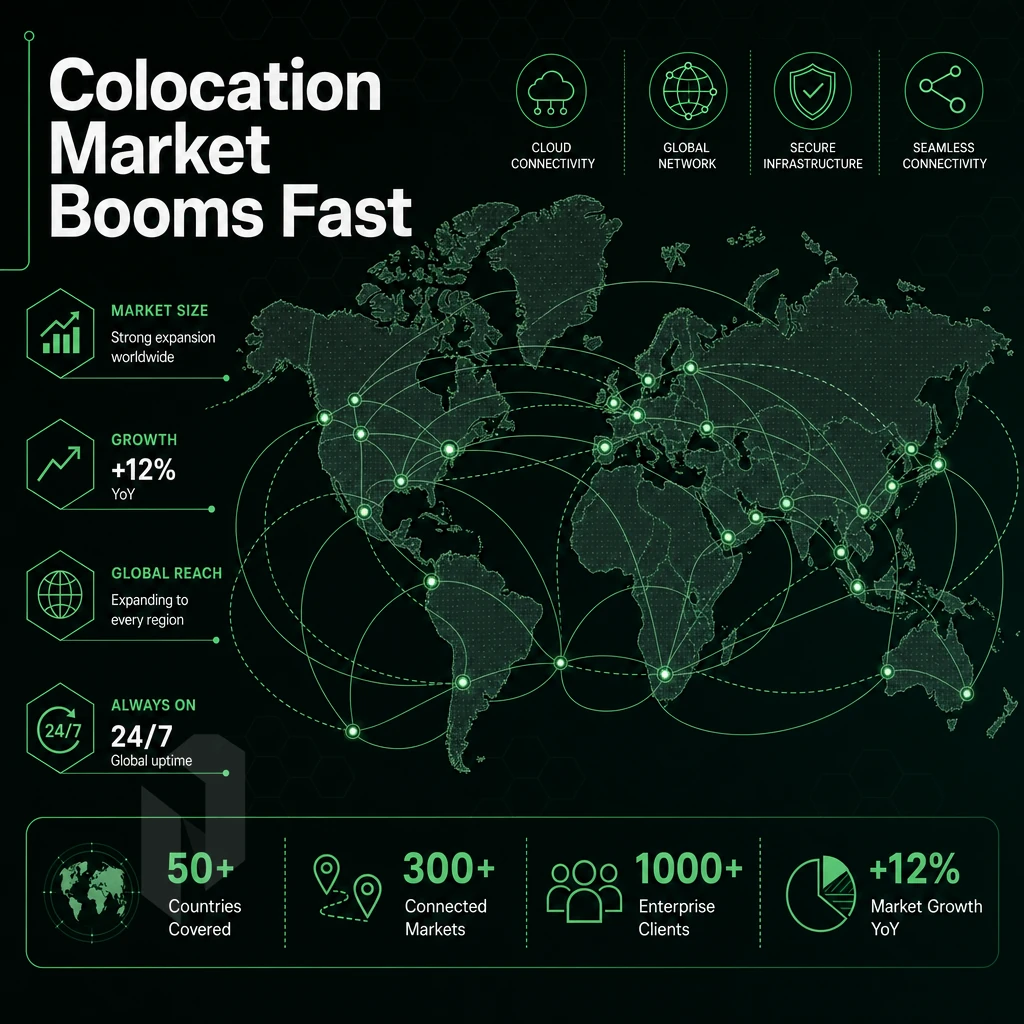
The data center colocation market is a rapidly growing sector within global infrastructure. Market size for the data center colocation market varies widely among current research reports. Forecast growth to 2030-35 is as striking as current market size valuations of $77B to $95B by 2025.
Data Center Colocation Market Size and Revenue Forecast
CAGR estimates for colocation forecasts range in the 11% to 18% range over published timeframes. Using the low-end of these forecasts, the market will reach $256B by 2035 and continue to grow for a decade or more. Higher-growth forecasts, which assume rapid buildout of AI-specific infrastructure, project still-higher values.
The variability in these projections reflects differing assumptions about infrastructure investment cycles and the forecast horizon used by each research firm. Investment patterns in the center colocation market reveal that enterprises are prioritizing facilities with modular power architectures that can scale incrementally as workload density increases.
Growing demand for AI processing requires high density and high power computing. Cloud and hybrid workloads are driving adoption of carrier neutral data centers to support enterprise deployments. Digital transformation of enterprises is driving shift to outsourced physical and automated infrastructure. Growing concerns around data sovereignty are adding a further constraint with governments dictating that data must be stored within their national borders. Compliance with these requirements has accelerated investment in local colocation capacity, with government initiatives in several jurisdictions offering tax incentives for domestic infrastructure buildout.
Recent developments in edge computing architectures are also reshaping colocation strategies as organizations seek to distribute workloads closer to end users. Organizations conducting a restraints impact analysis often discover that sovereignty mandates and edge latency requirements fundamentally reshape their deployment topology and vendor selection criteria. Regulatory frameworks in south america are evolving to mirror European GDPR-style protections, prompting multinational organizations to establish in-region presence for customer data processing.
Regional Data Center Colocation Market Dynamics
Asia Pacific and the Middle East are growing fastest by investment and new capacity added, with demand for colocation solutions, including Digital Realty deployments, driven by hyperscale facilities in Southeast Asia and by sovereign infrastructure programs in the Gulf states. In terms of revenue, North America remains by far the largest market, Northern Virginia is the world’s most densely populated area for colocation.
Additionally, Growing also in South America, especially in Brazil and Chile, where growing numbers of latency-sensitive workloads need to be run from within the region. Colocation demand in South America is also accelerating due to data residency requirements that mandate local processing for financial services and government sectors. Investment in the center colocation market across these regions reflects both the maturation of digital economies and the strategic imperative to reduce cross-border latency for real-time applications.
Top 10 Providers in the Data Center Colocation Market
Colocation services on a global scale are provided by a variety of companies, from NTT Global Data Centers and other large hyperscale-adjacent providers in data park environments to regional specialists and independent carrier-neutral operators. In Europe, established providers of colocation services include Global Switch. Netrouting is an operationally focused alternative for enterprises entering the data center colocation market that require high network quality and a large selection of bare metal servers and are looking for a European data center provider. When selecting among colocation providers, organizations should prioritize those with proven track records in network diversity, redundant power systems, and responsive technical support teams. CoreSite Realty Corporation operates facilities across major U.S. markets with strong interconnection ecosystems that appeal to latency-sensitive deployments.
Digital Realty operates one of the largest global portfolios, with facilities spanning North America, Europe, and Asia that serve both hyperscale and enterprise customers. Digital Realty Trust maintains a strategic focus on platform integration, enabling customers to deploy across multiple metros through a unified interface and consistent service delivery model. Iron Mountain, traditionally known for records management, has also expanded into the colocation space with secure facilities that emphasize physical and digital asset protection for compliance-driven organizations. Many of these providers differentiate themselves through value added services such as remote hands support, hardware procurement assistance, and customized network configurations tailored to specific application requirements.
They offer services in 10 locations worldwide: Stockholm, Amsterdam, Rotterdam, The Hague, Frankfurt, Bucharest, Miami, New York, Hong Kong and Singapore. With a 2.4 Tbps+ backbone, 99.9% uptime SLA and ISO 27001 / SOC 2 certification, they are a great alternative to large-campus providers.
Key Drivers Accelerating Colocation Demand
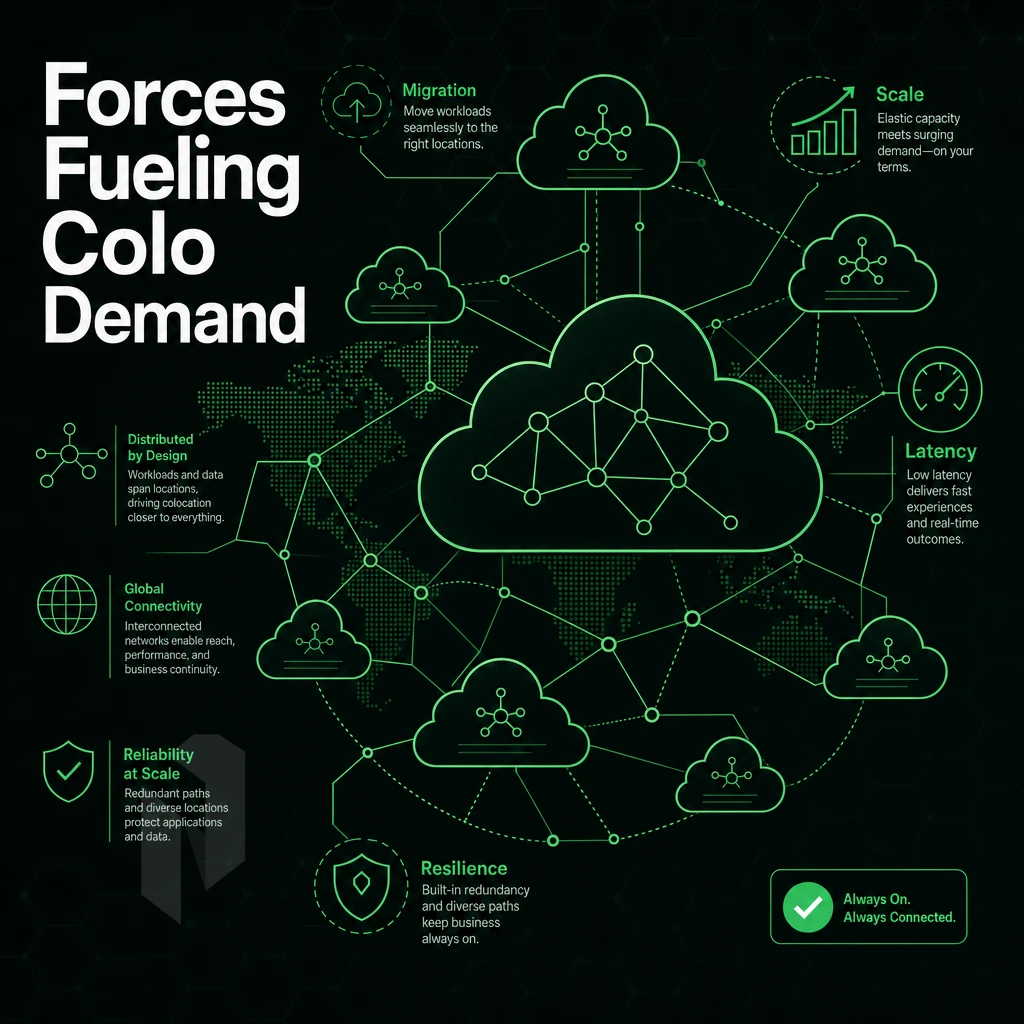
A significant and growing number of enterprises are abandoning their captive server rooms. A number of structural factors are driving this shift, including power physics, regulatory issues and financial discipline, all of which are inter-locking factors in the data center colocation market.
Structural Forces Shaping the Forecast Period
-
AI-ready infrastructure demands.
GPU clusters routinely exceed 30-50 kW per rack. Standard enterprise buildings cannot support that density. Colocation facilities purpose-built with high-density racks and liquid cooling, including rear-door heat exchangers, absorb that load without structural retrofits. Modern facilities with ai ready infrastructure can deliver up to 100 kW per rack, enabling organizations to deploy cutting-edge machine learning models without facility constraints. Facilities equipped with high density racks enable organizations to consolidate GPU infrastructure into smaller footprints while maintaining thermal performance and power delivery standards. Facilities with inadequate electrical infrastructure risk tripping breakers or overloading power grids during peak training runs, which can cascade into multi-hour outages affecting entire racks. Organizations evaluating data center colocation for AI workloads should verify that the facility's electrical distribution system can handle sustained peak loads without voltage sag or thermal throttling.
Note: Deploying GPU hardware into a facility not rated for high-density power is a common and costly mistake. Confirm per-rack kW headroom before signing a lease.
-
Data Sovereignty Mandates in the Data Center Colocation Market
Regulated industries, finance, healthcare, public sector, face hard jurisdictional rules on where data can reside. Local colocation facilities satisfy those requirements without the CapEx of building proprietary data centers from scratch. Selecting the right data center colocation partner in these jurisdictions requires verifying certifications such as ISO 27001, SOC 2, and region-specific compliance attestations that auditors will scrutinize during reviews.
-
Capital costs and financial flexibility.
A purpose-built enterprise data center requires years of planning and significant upfront spend. Colocation converts that into predictable operational expenditure, freeing capital for core business investment.
Cloud Computing and Hybrid Interconnection
-
Hybrid multicloud routing.
Enterprise workloads increasingly move between cloud platforms and on-premises hardware. Carrier-neutral colocation facilities provide the interconnection layer, cross-connects, IX peering, and private circuits, that makes low-latency hybrid architectures viable.
-
Edge computing proximity.
Latency-sensitive applications, gaming, streaming, financial trading, benefit from compute placed closer to end users. Regional colocation sites extend digital infrastructure to the network edge without requiring owned facilities in every market.
Top 5 US Data Center Colocation Market Leaders
Northern Virginia is leading the way in US colocation absorption, fueled by hyperscaler build-outs as well as existing fiber density. Other top data center colocation market hubs include Dallas-Fort Worth, Silicon Valley, Chicago, and the New York-New Jersey metro area, offering carrier-neutral facilities, high-density IX peering, and proven operational track records.
Netrouting's Miami and New York locations sit at the hub of the thriving data center colocation market, with Miami serving as a strategic gateway to Latin America and New York standing as one of the world's most connected carrier hotels.
Retail vs. Wholesale Colocation: How the Models Differ
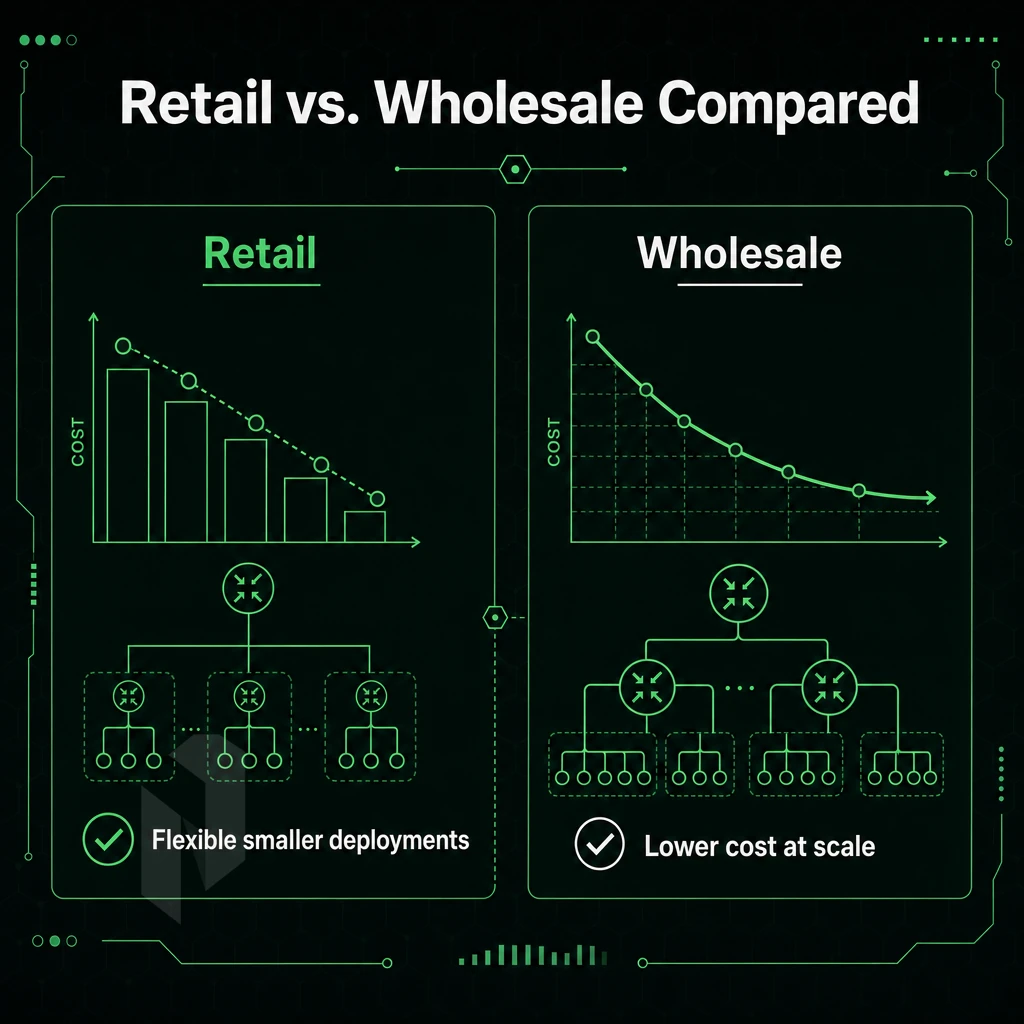
Retail colocation and wholesale colocation are two fundamentally different customer segments. When sizing your data center colocation market strategy, the structural gap between these two models is critical to understand. Colocation is often associated with two different business models, not just with different sizes of floor space.
Retail Multi-Tenant Data Center Colocation Market
Retail colocation is sold in single cabinets, half cabinets or partial cages and many tenants will share the same facility in terms of power, cooling and physical security. Typically offered on a 1-3 year contract across the forecast period, retail colocation is a format favored by colocation companies targeting mid market enterprises and regional specialists, as it has a lower minimum commitment and provides instant access to very dense interconnection fabrics.
Wholesale Multi-Tenant Data Center Colocation Market
Wholesale colocation refers to leasing large power blocks, such as entire halls or even an entire colocation campus. These large tenants such as cloud providers and large enterprises pay a lower per-kilowatt rate and sign to a long term lease of 7 to 15 years.
In wholesale colocation the tenant has full control to design the fit-out, including custom cooling, private machinery rooms and dedicated fiber risers to name a few. Analysis of wholesale colocation is often restricted due to long lead times and high minimum commitments, which creates a barrier to entry for many smaller operators.
Who Are the Big 5 Colocation Data Centers?
The data center colocation market is dominated by a handful of very large global players. When talking about market size and global footprint in colocation solutions, the five most frequently cited companies include Digital Realty and other major US-listed REITs with portfolios spanning North America, Europe, and Asia. A second REIT with a focus on Europe and Latin America.
A carrier-neutral company with a portfolio of data centers in locations with very high concentrations of interconnection opportunities. A hybrid IT and records management company that has grown very quickly into data center colocation (Iron Mountain); and a fifth company focused exclusively on hyperscale wholesale deployments. As a result, companies outside this tier compete on the basis of specialization, geography and depth of service as opposed to simple scale.
Model Comparison
| Dimension | Retail | Wholesale |
|---|---|---|
| Contract length | 1-3 years | 7-15 years |
| Minimum footprint | 1U / single cabinet | 250 kW+ power block |
| Power density | Typically under 20 kW/rack | Custom, 30-50+ kW/rack |
| Pricing model | Per-cabinet or per-U | Per-kW of reserved power |
| Typical customer | Mid-market, regional ISPs | Hyperscalers, large enterprises |
| Interconnection access | Shared meet-me room, IX access | Private MMR, dedicated cross-connects |
Many hybrid models are offered, so that a tenant with Retail Cabinets can easily scale to a private cage or suite. Netrouting’s carrier-neutral colocation facility has locations in 10 cities across Europe, North America and Asia. We can host entry-level as well as very large custom high-density setups up to 20 kW in one rack.
Competitive Landscape: Who Operates in the Data Center Colocation Market
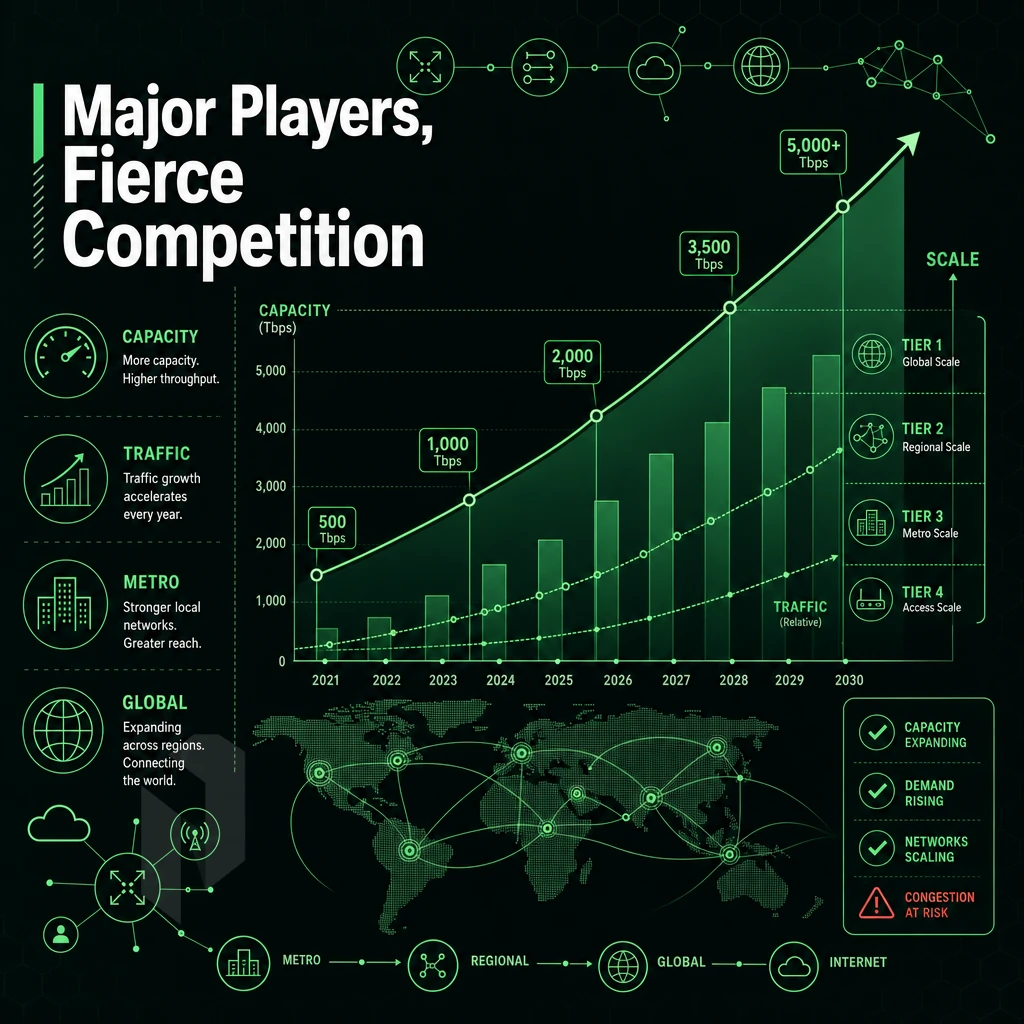
The data center colocation market is not a single competitive tier. It includes a variety of players from campus-sized operators with hundreds of megawatts under management to carriers and carrier-neutral players focused on interconnection. We help you to map your workloads to the right providers.
Three Segments Define the Competitive Landscape
Global Hyperscale Adjacent Operators, a list of Digital Realty and NTT Global Data Centers off the top of the head. Multiple campuses in dozens of metropolitan areas, standardized power and cooling to support Hyperscalers and large enterprises as anchor tenants.
Regional Specialists, These colocation providers compete on interconnection depth, carrier neutrality, and peering density. Unlike facilities based providers, interconnection density, low latency routing, and campus square footage are less important than dense IX presence.
Managed services-focused operators, such as Iron Mountain. Extend beyond the physical space of storage and offer a host of additional value to customers in the data center colocation market around data management throughout its lifecycle, including compliance-focused data storage and management services on top of colocation infrastructure.
China Telecom Corporation Limited represents the fourth force of state-backed large operators in Asia-Pacific, and is a major player for enterprises with cross-border business needs. China Telecom Corporation’s coverage is strongest in mainland China and Southeast Asia.
Aligned Data Centers represents a new entrant model, that of a purpose-built high-density Data Center Campus designed to support AI and HPC workloads with power density per rack being a primary differentiator to floor space.
What Competitive Benchmarking Actually Measures Now
Benchmarking has shifted. Buying based on square footage is outdated. Power density per cabinet, the breadth of services for interconnection, and the capabilities for predictive maintenance are key buying criteria. Can the operator utilize sensor telemetry and corresponding ML-driven alerting to prevent failures rather than respond to failures?
Additionally, across the data center colocation market, sustainability metrics such as PUE, renewable energy commitment, and water usage effectiveness are now commonly included in formal RFP evaluation at enterprise and public sector accounts.
What Is the Difference Between Retail and Wholesale Colocation?
Retail colocation is sold in smaller units of space such as single cabinets, partial cages or a few racks. Customers of retail colocation share the power and cooling of a facility but benefit from greater flexibility than is available with wholesale colocation and typically do not require a dedicated power configuration.
Wholesale colocation is offered in large blocks such as an entire hall or dedicated suite of rooms (sometimes referred to as ‘cages’) of 0.5 MW+ or greater. The lessee is typically responsible for fit-out and for providing cooling to the space leased. Wholesale is suited to large enterprises and cloud operators building out large private datacenter infrastructures.
We run both models, colocation as well as managed hosting. Our colocation suites at DFDC THG1 in The Hague can scale from a single 1U up to private high-density environments of up to 20 kW per suite. Carrier neutral with N+1 power and cooling, free private interconnect between your servers running in our datacenters.
Colocation Use Cases: Who Buys Colocation and Why
From large enterprises with aging server rooms to cutting edge AI companies requiring densities that no office can provide. There are many types of customers that colocate and therefore many types of colocate solutions that will fit particular workloads.
How Fast Is the Global Data Center Colocation Market Growing?
The rapid expansion of the data center colocation market is being driven by government policies supporting the development of digital infrastructure, cloud services and AI, and analyst forecasts of double-digit compound annual growth until 2030. However, by treating data center colocation as a strategic partnership rather than a straightforward way to outsource part of their IT, companies can extract far more value from this growth.
Primary Buyer Archetypes
| Buyer | Core Need | Architecture Pattern | Key Requirement |
|---|---|---|---|
| Enterprise server room exit | N+1 power and cooling without rebuilding | Lift-and-shift existing servers into colocation facilities | Physical security, 99.9% uptime SLA |
| AI / GPU workloads | High-density racks, up to 20 kW per footprint | Dedicated high-power zones with GPU servers and essential computing hardware | Power density, thermal management |
| Regulated industries | Data sovereignty, auditable control | Private caged suites for data storage and regulated workloads | ISO 27001, SOC 2, government agencies compliance |
| Hybrid / multicloud architects | Carrier-neutral interconnection | Colocation hub with cross-connects to cloud providers and private WAN | Dense IX peering, BGP flexibility |
| Disaster recovery | Geographically separate secondary site | Mirrored footprint with other essential computing hardware on standby | Low-latency replication, remote hands |
Where Netrouting Fits
Netrouting's carrier-neutral datacenter colocation is available in 10 locations in Europe, North America and Asia. Each colocation has enough power and cooling to support up to 20 kW per floor, enabling comparison of dense GPU setups with typical office colocated servers.
Workloads in finance, healthcare and government can benefit from ISO 9001, ISO 27001 and SOC 2 certifications in locations across our footprint. In the data center colocation market, DR buyers can have their primary installation at The Hague and secondary installation at Rotterdam, both hosted on our AS6206 backbone, with free private interconnect up to 40Gbps.
Data center colocation is for customers who need on-premises like control, carrier neutral access to cloud providers and very high rack density that their current data center cannot deliver. We match our customers with the right data center for their workload. Contact our sales team.
Architecture Patterns Inside a Modern Colocation Facility
| Component | Minimum | Recommended |
|---|---|---|
| CPU | 4 cores / 8 threads | 16+ cores (AMD EPYC or Intel Xeon) |
| RAM | 16 GB DDR4 | 64 GB DDR4 ECC |
| Storage | 500 GB SSD | 2× NVMe SSD in RAID 1 |
| Bandwidth | 1 Gbps uplink | 10 Gbps unmetered |
| Power | Single PSU, 230W | Redundant PSU, N+1 PDU |
Architecture Overview
Colocating in the data center market means your hardware is located in a physical data center. You own the servers and the colocated facility provides you with power, cooling and connectivity to the servers. Understanding the flow of traffic in this environment is crucial to selecting the proper equipment for your needs before you deploy it.
The connection from your server to the Top of Rack switch in the facility is a 1G or 10G copper or fiber uplink. The ToR then connects to the core routers in the facility, which are connected to the upstream transit providers and Internet Exchanges.
Interconnection services such as cross-connects, IX ports and private networks are provisioned in the meet-me room (MMR). For BGP, you announce your prefixes from the facility's router or from your own edge server in the same cage.
Colocation facilities typically don’t require port forwarding since you’ll have a public IP block assigned directly to the interface of your colocation server(s). Any necessary firewalling is typically managed by your server(s) or by a dedicated firewall appliance located in the same rack as your servers. For multi-server colocation deployments, a private VLAN can be provisioned across a cabinet to isolate all east-west traffic from the public uplink.
Liquid cooling is becoming an increasingly standard offering in modern colocation facilities, often in addition to traditional air cooling methods. If you are deploying very high density GPU nodes or other dense compute infrastructure in the data center colocation market, check whether the colocation facility supports Direct Liquid Cooling (DLC) or rear-door heat exchangers. Standard air cooling in a colocation facility typically has a maximum rack density of around 10-15 kW.
Most colocation facilities offer Managed Services. These can include things like OS patching, Hardware monitoring and Remote hands. Netrouting offers courtesy Remote hands at all of our colocation facilities. In addition to this we also offer project based Rack-and-Stack for larger deployments.
Physical security for a colocation facility includes things like biometric access control, CCTV, and man-trap entry points. Also confirm that adequate audit logs are in place for evidence required under ISO 27001 or SOC 2 compliance.
Quick Setup
- Auditing your power draw to your servers involves actually measuring the real server power in watts (W) when under load. Then just add 20% to cover any “unknowns”. Be sure to confirm the rack’s PDU (Power Distribution Unit) and circuit breaker(s) can handle the power of your servers before you ship the hardware.
- Pre-configure the OS remotely for your servers. Build and test a base image for your servers before they ship. Utilize a KVM-over-IP or IPMI card so you have out-of-band access to your servers once they are racked.
- Please request your IP space allocation and cross-connect details as early as possible as Interconnection services provisioning can take 3-10 business days at very busy facilities. This must be allowed for when setting a go-live date.
- Validate the physical security of the data center. Get a list of who is on the access list for the data center and test their badge or biometric access prior to your first maintenance window.
- Full Load Test before declaring production online. Test upper layers by running a full load test. Saturate uplink, max out CPU and RAM and test all Data Center functions like power failover, cooling and network as contracted.
Common mistake to avoid
Don’t skip the remote hands orientation on day one. Data center operations change quickly during an outage and it’s not the time for your team to physically walk the cage looking for the PDU breaker for the affected row. Take a walkthrough of the cage during normal operations and document the information for future reference (e.g. rack units in the cage, cable labels, breaker IDs).
How to Evaluate a Colocation Provider: Key Selection Criteria
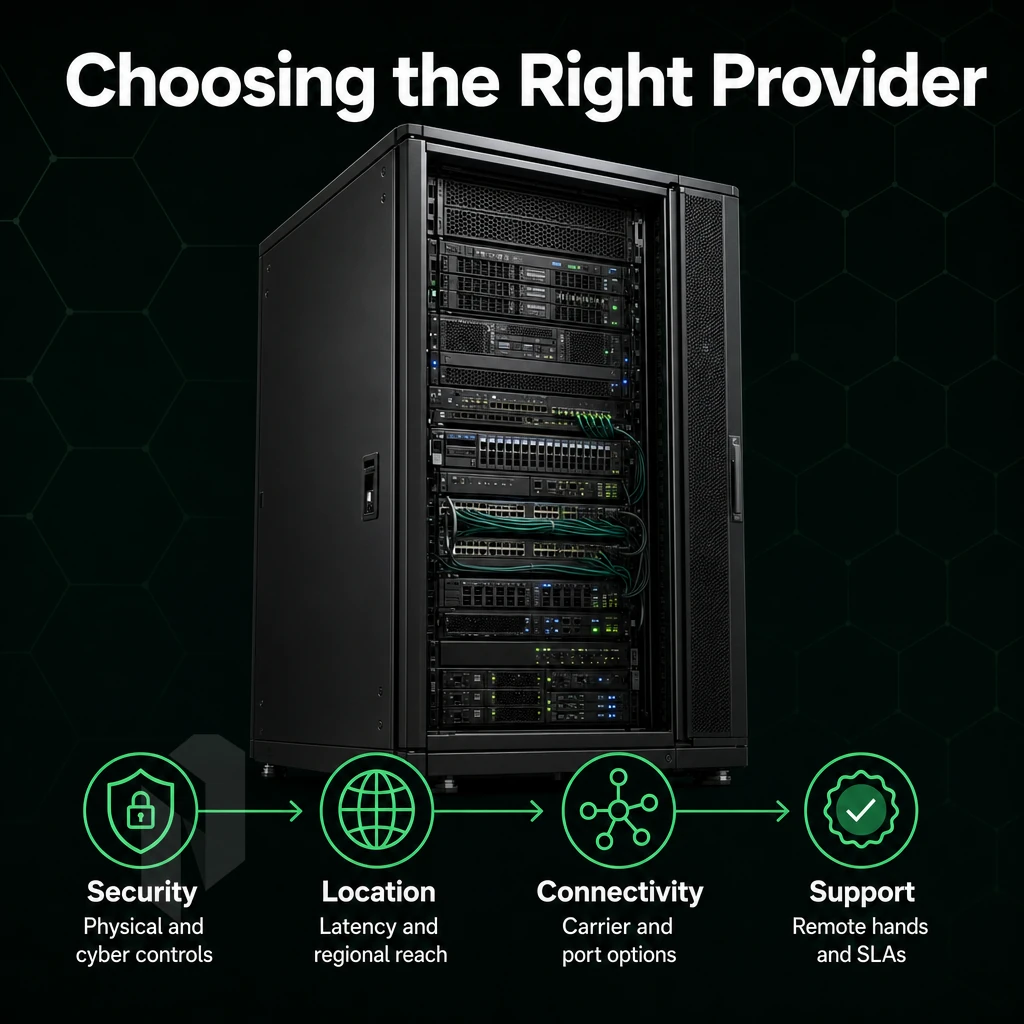
Choosing a colocation provider is one of the most important decisions for any part of your digital transformation program. For years, a suboptimal facility can negatively impact your performance. These seven criteria help you make the right choice quickly.
Location, Network Quality, and Carrier Access
Reducing round-trip latency to your end-users is further helped by being physically close to them. However, carrier neutrality is even more important than geographical location. A single carrier connection to a facility creates a single point of failure and removes the leverages needed to negotiate with carriers.
Look for dense IX peering (access to multiple Internet Exchanges to get the best latency paths and most routes. Ensure the provider is running always-on DDoS protection. Volumetric attacks are network layer in nature and thus require inline (versus reactive) mitigation.
Power Density, Cooling, and Physical Infrastructure
New AI workloads are rewriting new power requirements. A standard rack is 5-10 kW, but a GPU-dense rack often exceeds 30 kW per rack. So, verify the facility's per-rack power ceiling before you sign the lease.
High-density cooling systems today go far beyond simple raised-floor CRAC units. Also ask whether your new facility can be equipped with rear door heat exchangers that can be mounted directly on the rear of racks and dissipate heat right at the source. This is critical for sustaining long periods of high GPU utilization.
Uptime Institute tier ratings help define a standard for data center qualities. For production workloads, Tier III (N+1, concurrent maintainability) is the minimum practical tier to consider. Tier IV adds fault tolerance to enable zero-downtime maintenance windows.
Compliance, SLA, and Scalability
Regulated workloads (including government entities) require proof of certification. For data center providers this typically means ISO 27001 and/or SOC 2 certification(s). Verify that the audit scope includes the specific data center/facility and not only the parent company.
Across the data center colocation market, the key factors that determine your operational risk, whether you are with Digital Realty or a smaller provider, are your SLA uptime guarantee, the remote hands support available to you, and the hours of operation of your NOC. A 99.9% SLA with 24/7 NOC and 1hr ticket response is very different to a 99.9% SLA offered within business hours.
Scalability in space and in commercial model. Retail multi-tenant solutions are perfect for companies starting off with 1-2 racks. Wholesale multi-tenant solutions such as private suites or dedicated space with predictive maintenance built into the contract are suitable for larger footprints. Make sure the provider offers additional value such as managed hands, cross-connects and power monitoring. A stable power grid with redundant utility feeds is the basis of any growth tier.
Regional Spotlight: European and Asia-Pacific Colocation Growth
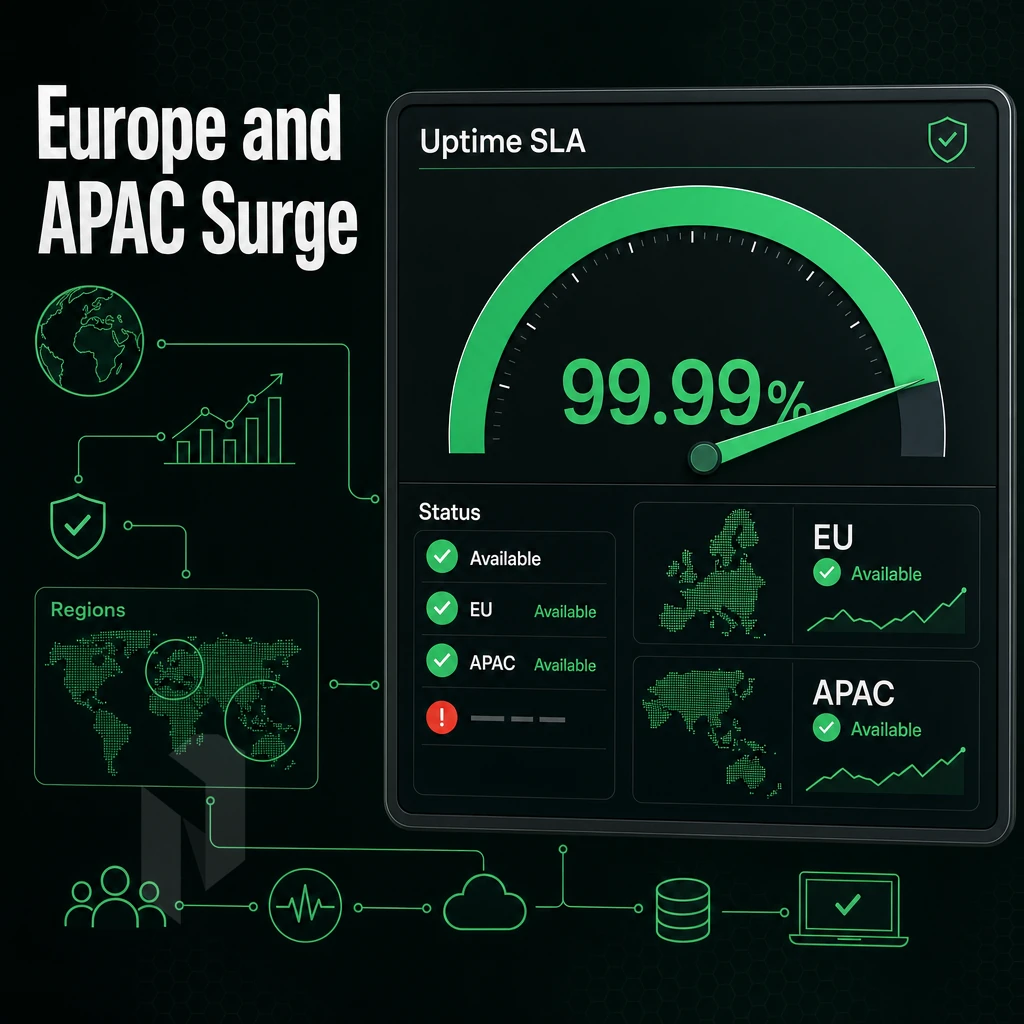
While many parts of the world are growing at a slower pace than the global average for colocation, Europe and Asia Pacific are ahead of the pack. A combination of data sovereignty issues.
Continuing digital transformation spend by enterprises and the recent explosion of submarine cables to the region, including those operated by China Telecom, are creating new opportunities throughout the forecast period for enterprises to colocate their IT within the two regions and ensuring that a new generation of colocation providers are capable of serving them.
Europe: Sovereignty, Connectivity, and Carrier-Neutral Density
Data sovereignty regulations, such as the GDPR and local implementations, are forcing the compliance of EU-based colocation for enterprises processing European personal data. As a result, the routing of workloads via non-EU facilities is increasingly not allowed.
The Netherlands remains the most interconnected region on the continent. Amsterdam is the center, with AMS-IX peering as well as direct access to all major carrier neutral data center exchanges. In the rest of the country, peering facilities are connected to SmartDC peering hubs in carrier neutral data centers such as Greenhouse. Our primary EU headquarters is located in The Hague at DFDC THG1, a carrier neutral data center with 215+ square meters of rack space, N+1 power and cooling.
Our gateway into the DACH and CEE corridor is Frankfurt, DE-CIX peered. Our Nordics presence is in Stockholm, peered at NetNod. This location also serves as a disaster recovery center for The Hague and Miami based services. The southeast European hub of Bucharest extends low latency into the Balkans.
The latest market analysis reports continued European colocation revenue growth as Hybrid Cloud and AI workloads increasingly drive development. Specialist regional operators offering data center colocation, with a physical presence in Europe and highly connected peering locations, are displacing non-regional generic cloud providers from market share.
Asia Pacific: Financial Gateways and Emerging Markets
Singapore and Hong Kong act as twin financial hubs driving the data center colocation market in Asia Pacific and are strategically located at the center of major submarine cable routes connecting to key cities such as Tokyo, Sydney and Mumbai. Our Singapore facility is connected to premium Tier 1 carriers such as Tata Communications at the Digital Realty SIN10 facility. Our Hong Kong facility is strategically located to serve direct connections to traffic flows traveling to and from mainland China via the Equinix HK2 facility.
Investment in digital infrastructure in Southeast Asia is increasing at a pace and scale that will extend beyond the two ‘gateway’ cities as cloud adoption, mobile only economies and government digitization programs create increasing demand.
Similar trends are now emerging in South America where digital transformation is generating a need for colocation in markets where hyperscalers have as yet to establish any credible presence. In both regions, a growing proportion of latency sensitive workloads are being met by local operators rather than global platforms.
The Middle East is growing at a similar rate to both regions. Significant investment in digital infrastructure by sovereign wealth funds, combined with a growing number of data localisation mandates in Gulf countries, is driving demand within the data center colocation market across these regions.
Our AS6206 network, spanning 10 cities worldwide, is well-placed to serve enterprises requiring a bridge between emerging markets in the Middle East and established data centers in the EU and APAC. Indeed, other operators such as Digital Realty Trust are rapidly expanding in both regions.
Why Choose Netrouting for Carrier-Neutral Colocation
The data center colocation market rewards providers that can deliver dense interconnection, proven certifications, and genuine hardware flexibility, not just rack space. Netrouting competes in the data center colocation market as a carrier-neutral, vendor-neutral provider across ten cities: Amsterdam, Frankfurt, The Hague, Rotterdam, Stockholm, Bucharest, Miami, New York, Hong Kong, and Singapore. Every footprint sits on our own AS6206 backbone with 2.4 Tbps+ capacity and dense IX peering at AMS-IX, DE-CIX, NetNod, and FL-IX.
- High-density ready. Colocation facilities support up to 20 kW per footprint with N+1 power and cooling, suited to AI workloads, liquid-cooled hardware, and high-density racks without costly facility upgrades.
- Network built for performance. Unmetered 10 Gbps ports, BYOIP, full BGP support, and a free private interconnect up to 40 Gbps between your own resources. No egress surprises.
- Security and compliance covered. ISO 9001, ISO 27001, and SOC 2 certifications address data sovereignty regulations and enterprise compliance requirements out of the box.
- Always-on DDoS protection. L3/L4 mitigation is included on every colocation service, no add-on required for baseline protection.
- Operational support included. A 24/7 NOC with a one-hour ticket guarantee and courtesy remote hands at no extra cost reduce operational overhead from day one.
Whether you're moving workloads out of captive server rooms, expanding into colocation data centers across Europe or Asia-Pacific, or consolidating under a single colocation provider with global reach, Netrouting scales with you. Explore our colocation solutions or contact sales to discuss your requirements.
Data Center Colocation Market at a Glance: Key Takeaways
The data center colocation market continues its rapid expansion, driven by AI workloads, hybrid cloud adoption, and tightening data residency requirements. Colocation refers to housing servers and other core infrastructure components in third-party colocation facilities, trading capital costs and the burden of operating on-premises server rooms for guaranteed uptime, physical security, and dense connectivity services.
The distinction between retail colocation and wholesale colocation remains central: retail suits mid-market enterprises needing flexible, managed colocation services, while bulk colocation serves large enterprises and hyperscalers requiring dedicated power at scale.
Across the center colocation market, the criteria that matter most are power density, network reach, compliance posture, and the provider's ability to support AI-ready infrastructure and edge computing deployments. The data center colocation market rewards buyers who match workload requirements, regulated workloads, enterprise workloads, or high-throughput AI workloads, to the right colocation data centers before signing. Evaluate carefully; the right colocation provider compounds system uptime for years.
The colocation market is expanding fast, driven by AI workloads, edge computing demand, and enterprises offloading physical infrastructure. Two dynamics stand out: the shift toward higher-density deployments and the growing preference for carrier-neutral facilities that give tenants real network choice. Wholesale contracts are scaling up while retail colo remains the entry point for businesses moving their first racks off-premises.
Network quality separates commodity colo from a strategic asset. A facility connected to multiple Tier 1 carriers and major internet exchanges gives you routing flexibility and redundancy that a single-carrier building simply cannot match. Netrouting's carrier-neutral colocation spans ten locations across Europe, North America, and Asia, all on a 2.4 Tbps+ backbone with always-on DDoS protection included. Explore Netrouting colocation or contact the team to discuss your rack requirements.