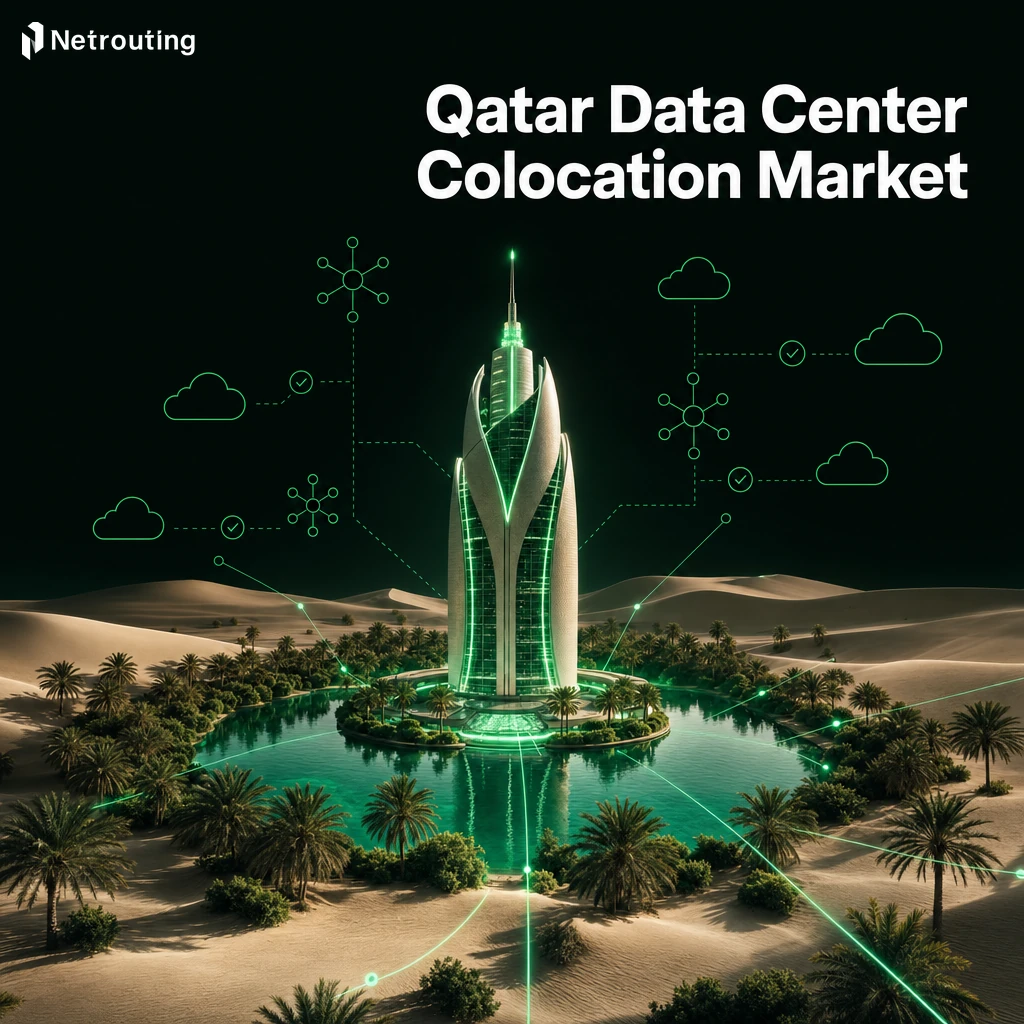
The data center colocation market in Qatar is growing fast. For game server developers and system administrators running data centers who serve a market of Gulf and Middle East players, this is a particularly timely and exciting space.
Colocation in Qatar's data centers can place your gear close to a large population of players who have historically experienced latency of 120ms or more when playing against others on servers based in Europe and Asia, the kind of latency that turns a lobby dead before the game even starts.
For API-centric finance companies, real-time telemetry companies and regional CDN origin servers, having data centers here means a unique opportunity to get a foothold in one of the most connected markets in the region.
Blog contents
Our in-depth guide to selecting a suitable colocation center in Qatar contains essential criteria to evaluate, such as available connectivity, power density and crossconnects. We will also explain how a globally peered backbone (AS6206) can play a role in a multi-region deployment with data centers and edge nodes in the Gulf. We start with the basics to create a solid foundation. This in depth industry analysis examines how Qatar's strategic position enables operators to optimize routing decisions for latency-sensitive applications across three continents.
Qatar Data Center Colocation Market: Size, Growth, and Outlook
The Qatar data center colocation market has grown to $76m in 2024 and is expected to reach $196m in 2030 at 17.1% CAGR. Thus Qatar is one of the fastest growing markets for data center related infrastructure in the Gulf region. This estimated market size reflects strong compound annual growth driven by enterprise digital transformation and regional connectivity investments.
Qatar Center Colocation Market: Key Growth Drivers
Underpinned by government digitisation initiatives, increasing cloud adoption by financial services institutions, and enterprise demand for purpose-built data centers.
The international and regional markets are concentrating on Qatar as a connectivity gateway between Europe, South Asia and Africa. This further cements Qatar’s position as the Gulf data hub for latency-sensitive workloads.

What International Market Research Reports Show on Data Centers
The three most competitive dimensions of the data centers market are power capacity, carrier-neutral interconnection, and sovereign data requirements.
Data Center Colocation: Where Netrouting Fits
Our global network of data centers spans ten cities across Europe, North America and Asia. As a carrier-neutral company, we enable enterprises based in established data centers and hubs such as London, Frankfurt or New York to use our low-latency on-ramp to serve the Middle East while regional capacity scales.
Importantly, many of these growth drivers are inter-related and are being driven by a set of structural trends across industries. Each global hyperscale cloud provider requires low-latency connectivity to regional markets, making our carrier-neutral infrastructure an ideal bridge for enterprises expanding into the Gulf.
Key Drivers Shaping Qatar's Data Center Industry
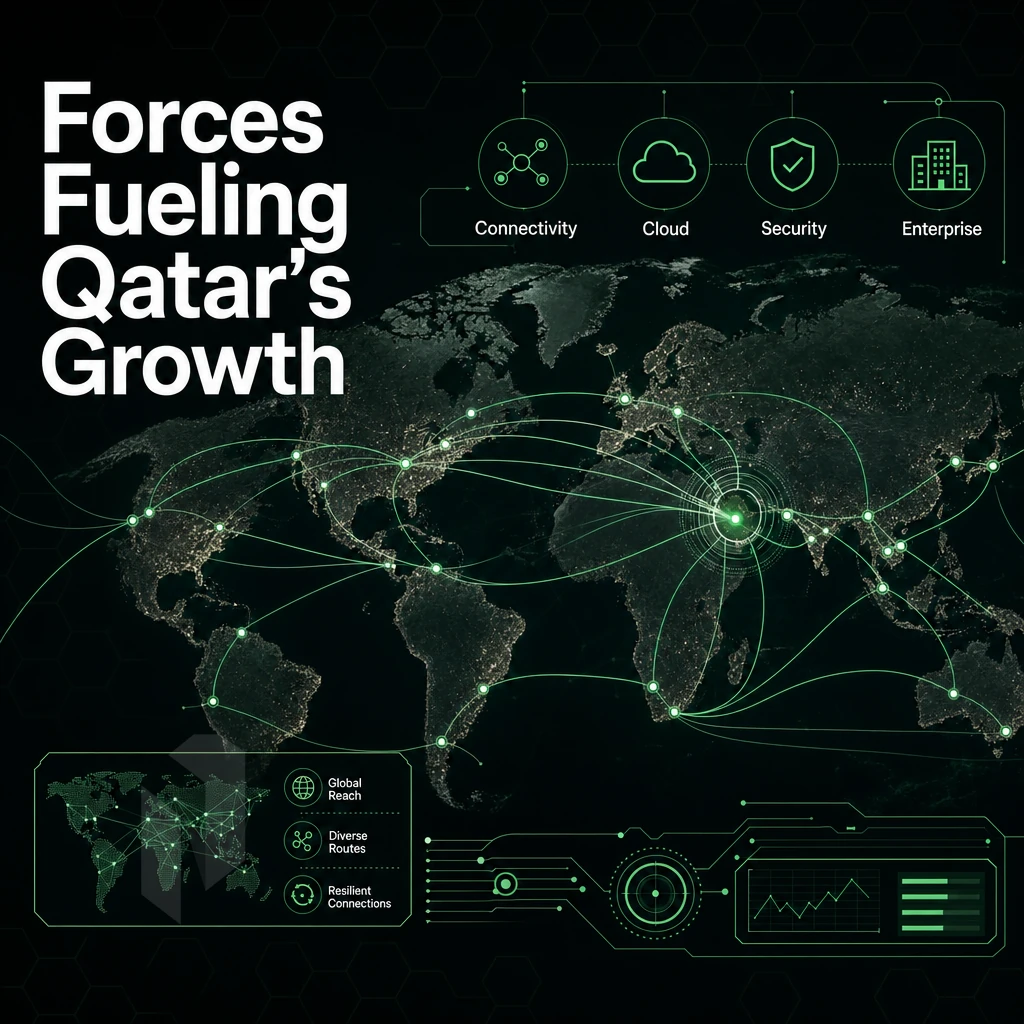
Several structural factors are driving the acceleration of data center development in Qatar. The country's government, corporate digitization, and cloud adoption are driving demand for data centers and transforming the data center industry into one of the fastest growing infrastructure markets in the region. The shift toward cloud computing has accelerated digital transformation across both public and private sectors, requiring localized infrastructure to meet data residency and performance requirements. Regional investments in fiber optic networks and subsea cable landings are further strengthening the data center industry by improving international connectivity and reducing cross-border latency for enterprise workloads. Private equity firms and sovereign wealth funds are increasingly viewing data center investment as a strategic priority to capitalize on Qatar's digital transformation trajectory.
Understanding both demand and supply aspects is essential for operators seeking to capitalize on this infrastructure expansion while maintaining competitive positioning in the market. The growing demand for localized data processing is reshaping infrastructure investment priorities across the Gulf region. Qatar's digital transformation is being propelled by key industries such as energy, finance, and telecommunications, all of which require localized data infrastructure to support mission-critical operations. Beyond these structural trends, macroeconomic factors such as GDP growth, foreign direct investment flows, and regional trade dynamics are also shaping the pace and scale of data center infrastructure development. Investment in new data centers is accelerating as operators race to meet enterprise demand for localized infrastructure that supports both data sovereignty requirements and low-latency application delivery.
Data Center Colocation in Qatar: Demand Signals
National energy companies require robust colocation facilities to store operational data and their SCADA systems.
The smart city initiatives in particular, linked to Qatar's National Vision 2030 goals, are driving demand for edge compute, IoT data processing and high-availability hosting solutions from every gulf data hub across the region, a trend clearly reflected in the latest market data.
These smart city deployments generate massive volumes of sensor data that require big data analytics platforms to extract actionable insights for urban planning and resource optimization. The latest data confirms that IoT deployments in Qatar's smart infrastructure projects are expanding at an unprecedented rate, requiring purpose-built colocation facilities with specialized edge computing capabilities.
Cloud Services and Data Center Investment Trends
Cloud adoption is driving organizations to adopt hybrid architectures in order to maximize control of critical workloads while gaining scalability from the cloud. It is this hybrid model that is driving demand for new Qatar data center space in Doha.
What This Means for the Data Center Competitive Landscape
To serve the data center market in Qatar, providers must deliver highly dense carrier neutral space with direct access to subsea cables and Internet Exchange points.
Data Centers Market Segments: Retail, Wholesale, and Hybrid Models
The colocation data centers market in Qatar consists of three models, catering to different footprints, power requirements and contract structures. Knowing which model to opt for, will determine the type of relation you will have with your potential hosts in the data centers across Qatar.
Retail and Wholesale in the Data Center Colocation Market
- First identify your model. Retail colocation is typically sold by the rack or by the U of space, best suited for small to medium-sized deployments. Wholesale colocation, on the other hand, is contracted based on raw power capacity, in hundreds of kilowatts, as part of very large dedicated spaces that need to be developed by the operator.
- The mechanical and electrical infrastructure of a data center should match the density of the installed racks. High-density equipment requires precision cooling and very solid power distribution. Wholesale customers will typically design and specify the mechanicals from the start. Retail customers will inherit the standard design of the facility.
Note: Misclassifying your power draw as retail when you need wholesale capacity leads to costly mid-contract renegotiations.
Hybrid Models and Colocation Services in Qatar Data Centers
- Layer hybrid contracts thoughtfully. Hybrid approaches are structured as a wholesale anchor with retail overflow capacity, designed for companies that require cloud services integrated with dedicated bare-metal density.
- Get support infrastructure providers on board early. The generators, UPS vendors and cooling specialists that make up the support infrastructure providers can significantly affect the delivery time of a data center. With the Qatar colocation market revenue expected to grow at a 17.1% CAGR through 2030, demand is currently outstripping supply of quality colocation space, so it’s critical to engage with support infrastructure providers early. As the world’s largest producer of liquefied natural gas, on-grid power in Qatar has unusual resilience.
Selecting the right model to consider is only half the story. The competitive landscape of who delivers services from what data centers capacity models and when new capacity will come online is just as important. For community perspectives, see New Upcoming Data Centers in the US (June 2026).
Connecting Qatar Workloads to European and Asian Data Centers
That’s where Netrouting comes in as the international extension to a hybrid architecture based in Qatar.
- Six European locations: Amsterdam, Frankfurt, The Hague, Rotterdam, Stockholm, and Bucharest, dense peering, low-latency onward routing from any gulf data hub.
- Asia-Pacific presence: Singapore and Hong Kong for direct reach into APAC financial and enterprise markets.
- Carrier-neutral colocation: Bring your own IP (BYOIP), full BGP control, and IP transit over AS6206, no vendor lock-in.
- Always-on DDoS protection: L3/L4 mitigation included on every service, across all ten locations.
- Bare metal across all sites: Dedicated servers available in every location, provisioned in under 60 minutes.
Explore our colocation services or contact sales to discuss how Netrouting can extend your Qatar infrastructure internationally. Back in-region, energy efficiency is becoming just as critical a factor as connectivity when evaluating facilities.
Sustainable Data Center Market and Energy Trends in Qatar
Cooling, in terms of the energy it consumes on an ongoing basis, dominates the cost of running data centers and therefore drives a lot of the design decisions around energy efficiency.
For new builds, sustainable data centers are becoming a differentiator. The adoption of renewable energy is gaining speed as companies operating data centers are under pressure from authorities and from customers demanding greener IT infrastructure. For investors of Qatar data centers, energy efficiency is no longer a choice but a condition to compete.
Modern facilities also incorporate advanced building design fire detection systems that integrate with automated suppression technologies to protect critical infrastructure and meet stringent safety compliance standards. Rigorous commissioning services engineering ensures that all mechanical, electrical, and safety systems operate at design specifications before facilities go live. Operators must carefully evaluate both existing and upcoming facilities to ensure their infrastructure investments align with evolving energy standards and regulatory expectations.
The colocation market in Qatar is expanding quickly. A sovereign cloud built on local data centers is being mandated by the government, support for digital infrastructure outlined in Vision 2030 is being put into practice. Additionally, Qatar's position in the middle of Europe and Asia makes it an interesting colocation for networks.
For workloads that require connectivity between Qatar based servers and the rest of the world (e.g. multiple continents), low latency and diverse carriers will be as important as local speeds. Netrouting’s AS6206 network spans 10 data centers in Europe, North America and Asia (Amsterdam, Frankfurt, Singapore. Hong Kong and others) and benefits from 2.4 Tbps+ network, dense peering at all IX locations and 24/7 DDoS protection.
If you're evaluating colocation or IP transit to extend your Qatar footprint into Europe or Asia-Pacific, contact the Netrouting team to discuss your routing and infrastructure requirements.