If your infrastructure costs are rising, your on-premises servers are nearing end of life, and that cloud bill keeps surprising you, server colocation, housing your servers in a data center, is the fix.
By colocating your servers in a high quality data center (server room) such as ours you can continue to manage your servers as you wish without the associated costs of operating your own data center (server room) and avoid the ‘Hyperscaler Tax’ charged by the public cloud providers for every gigabyte of egress. This approach proves cost effective for organizations seeking predictable infrastructure expenses while maintaining full control over their server configurations and deployment timelines.
It is a common misconception that there is one type of colocation. What customers fail to realize when choosing a colocation provider is that there are many differences between a data center’s facility, power density, network connectivity. Additionally, Even the support model a customer will receive from a provider. It is often the case that a customer chooses a colocation provider based on initial features and pricing.
Blog contents
The greatest disparity between a well-connected, redundant data center with properly managed network ports and a poorly peered data center is in latency, uptime. Additionally, In the engineering hours that a customer will have to expend in order to deal with problems that occur at the data center.
Learn everything you need to know to properly evaluate a colocation provider. Find out how Colocation works, what makes a good data center and a bad one. This covers what colocation refers to in terms of ideal workloads and, most importantly, the key questions to ask a provider before signing up. Find out how to match up your specific needs and your data center environment for optimal results. Read on for the basics of Colocation.
What Are Colocation Solutions for Data Center Hosting?
Server colocation involves placing your servers and other network equipment in a data center and renting out space in a room or cabinet (as opposed to renting a server). You bring the hardware and they provide the environment in which to place it.
What Services a Colocation Facility Provides
A colocation facility provides your office or server room with the four essentials that it cannot provide at scale: redundant power, cooling, physical security and high-capacity network connectivity. Because colocation facilities are designed to be energy efficient, they deliver reliable power and cooling far more efficiently than what is typically found in on-premises data center facilities. For more context, see Colocation centre.
Data Center Colocation vs. Dedicated Servers
Colocation space is brought to your data center and you have complete control of your own hardware. With dedicated hardware, the provider owns the hardware and then leases it to you for use. bare-metal servers, often supported by remote hands services, are typically best for organizations that have an existing hardware investment they want to continue to utilize, or for those that require specific hardware the provider does not offer.
Most providers offer a web-based control panel that lets you monitor power usage, request support tickets, and manage billing without needing to contact the data center directly.
How Rack Space Is Allocated via Control Panel
Rack sizes are quoted in U (units), and a single server is usually 1U to 4U in height. Our Colocation starts from a single 1U space, with Private Suites that can support up to 20 kW of power per floor space. Once you understand what a colo provider can offer, it's time to look at the operational structure of a data center.
Key Features of Colocation Space in Data Centers
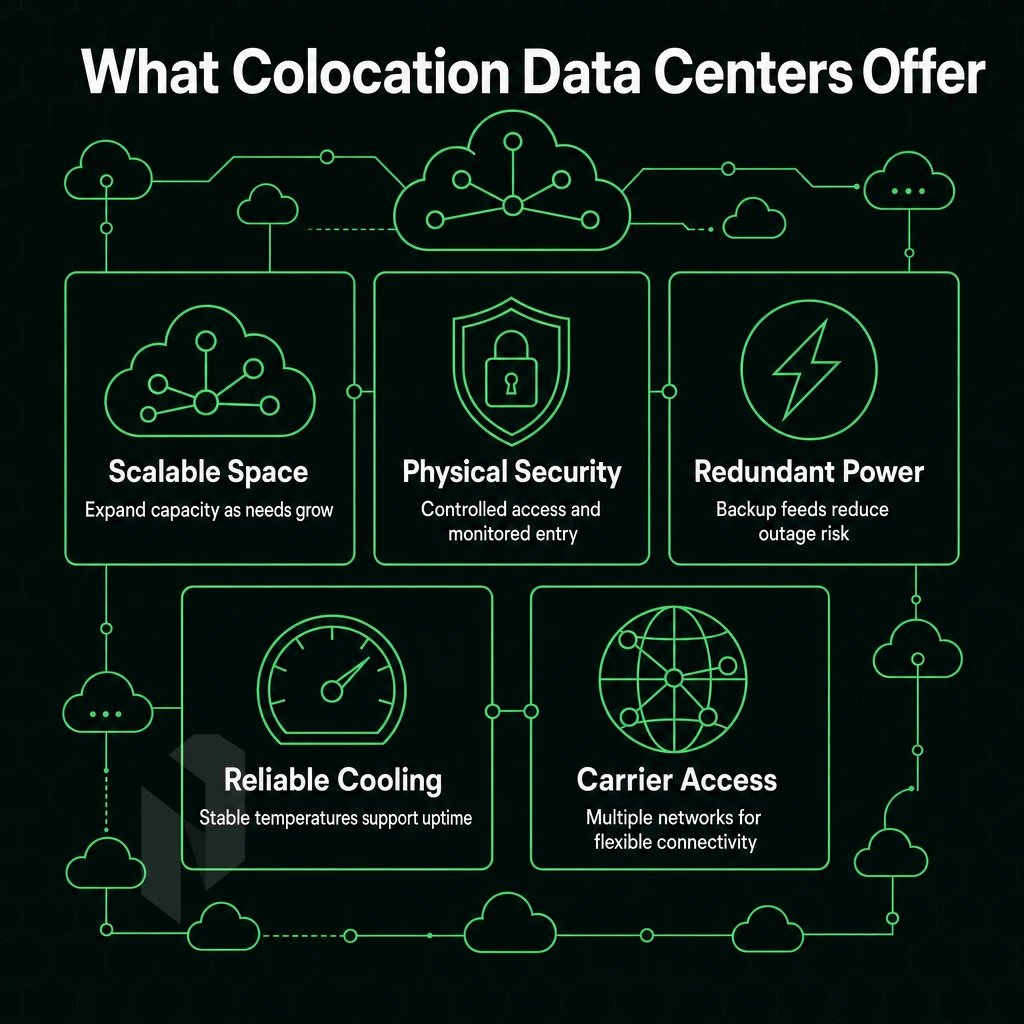
These same core infrastructure components need to be evaluated when making a server colocation decision. These are the key components that will keep your servers up and running when you need them the most. Organizations running mission critical applications depend on these components to deliver consistent uptime and performance under demanding production workloads.
When these components are properly architected and maintained by your provider, you can rest easy knowing your infrastructure will remain available even during unexpected events. Selecting a provider with robust infrastructure ensures that your servers benefit from enterprise-grade systems designed to minimize downtime and support demanding workloads.
Colocation Data Center Power, Cooling, and Data Storage
- Verify the redundant power architecture is functioning properly and confirm that N+1 or greater power configuration is in place at the facility. Also, verify the appropriate battery backup systems are in place to allow for smooth transition from grid power to generator power. Without battery backup, even a 2 second power outage can bring down the unprotected hardware.
- Check the cooling design. Get the cooling redundancy rating and max kW per rack. Under-sized cooling will cause premature wear of hardware and trigger thermal throttling.
Colocation Data Center Security and Fire Safety
- Check physical security layers to be sufficient. A serious data center will employ biometric or badge access, plenty of CCTV cameras on all aisles, and 24/7 on site staff. Physical security failures are almost always irrecoverable.
- Check your fire suppression systems. Clean-agent suppression systems can protect your equipment from damage caused by water. Ensure that these systems are regularly tested to local compliance.
Flexible Colocation Options for Cost, Network, and Remote Hands
- Assess for carrier neutrality. A carrier-neutral facility allows you to connect to as many carriers as you like, preventing you from becoming locked into a single provider. It also allows for the best transit pricing.
- This list includes confirmation of availability of remote hands (on-site technicians for reboot, recabling or replacement of failed hardware). For organizations without local staff remote hands is a key component. At Netrouting basic on-site support is included at all of our datacenter locations.
Note: Flexible colocation options, shared cabinets through private suites, matter as much as raw specs. A facility that cannot scale your footprint forces a disruptive migration later. With the infrastructure criteria clear, it's worth stepping back to compare colocation against the alternative deployment models you may already be running. Businesses that anticipate their server footprint will grow significantly within the next 12 to 24 months should prioritize providers offering incremental expansion without contract renegotiation or relocation penalties.
Providers that accommodate incremental growth from a few rack units to multi-cabinet configurations are particularly valuable for larger deployments that evolve over time. Providers that can allocate more space on demand without forcing you into a new contract or data center migration enable seamless growth as your infrastructure requirements expand. Evaluating total ownership expenses over a three-year horizon often reveals that incremental scaling within a single provider relationship is more cost effective than migrating infrastructure across multiple facilities as requirements change.
Frequently Asked Questions About Virtual Servers
How do colocation providers with direct access to hardware work, and do they charge setup fees?
Server colocation means housing your own physical servers inside a professional data center facility. You own and manage the hardware; the facility provides the space, power, cooling, and network connectivity. This gives you full control over your equipment while benefiting from enterprise-grade infrastructure you couldn't cost-effectively build yourself.
How do setup fees from colocation providers compare to those of dedicated hosting?
With dedicated hosting, the provider owns the server hardware and leases it to you. With colocation, you own the hardware and rent only the physical space, power, and connectivity inside the data center. Colocation gives you greater hardware control and long-term asset ownership. Dedicated hosting offers low latency connectivity, faster deployment, and removes hardware procurement and lifecycle management from your team.
How Cost Effective Is It to Colocate a Server?
Colocation costs vary based on rack space, power draw, bandwidth, and location. Rather than quoting figures for ip addresses that may not reflect your specific requirements, contact a provider directly for an accurate quote. Netrouting offers colocation starting from a single 1U slot, scaling up to private suites with high-density power, contact sales for current pricing tailored to your footprint. Providers typically offer tiered bandwidth packages with burstable options, allowing you to scale transfer capacity as traffic patterns evolve without overprovisioning from day one. Providers typically structure pricing as a monthly fee that bundles rack space, power allocation, and a baseline bandwidth commitment, with usage overages billed separately.
What Data Storage Does a Colocation Data Center Provide?
A colo facility provides physical rack space, redundant power infrastructure supply with N+1 or better resilience, precision cooling, on-site security, and high-capacity network infrastructure. Most enterprise facilities also include 24/7 on-site staff, data center technician support, and cross-connect options to multiple carriers. What it does not provide is the server itself, that remains your hardware, your responsibility. Many facilities also provision cross connects to enable direct interconnection between your equipment and other tenants or carriers within the same building. Redundant power infrastructure typically includes multiple feeds from independent power grids to ensure continuous operation even during utility outages or maintenance windows.
What Is Carrier Neutrality in Data Center Colocation?
A carrier-neutral facility, which often offers private cages alongside shared space, allows you to connect to any network provider in that building without being locked into a single ISP or transit provider. This lets you negotiate competitive rates, build redundant multi-carrier connectivity, and peer directly at internet exchanges using your own ip addresses. multi-carrier access is a critical feature for latency-sensitive or high-availability workloads. Netrouting operates carrier-neutral colocation with access to dense IX peering across its European, North American, and Asia-Pacific locations.
What Are Remote Hands Colocation Services in a Data Center?
smart hands are on-site data center technicians who perform physical tasks on your equipment when you cannot be present. Common tasks include rebooting servers, swapping cables, inserting media, or visually inspecting hardware. Basic smart hands support, power cycles, indicator checks, are often included at no extra cost. More involved work such as rack-and-stack or hardware installation to support growth plans is typically scoped as a separate project. Netrouting includes courtesy on-site technical support at no extra charge, with project-based work available on request.
Is Server Colocation Worth It for a Single Server?
Yes. Colocating one server, typically in a 1U or 2U slot in a shared, secured cabinet, is a practical and cost-effective option for businesses that own their hardware but need professional-grade power, cooling, and connectivity. It makes particular sense when your server handles latency-sensitive traffic, requires multi-gigabit bandwidth, or must meet compliance requirements your own premises cannot satisfy. Netrouting offers single-server colocation slots as an entry point, with a clear upgrade path to larger footprints as your needs grow. Shared cabinets, sometimes called half cabinet arrangements, allow multiple customers to occupy the same enclosure while maintaining logical separation and individual locking mechanisms.
Server colocation services provide data center infrastructure such as power, cooling, premises security and high-bandwidth internet connectivity, without the initial investment and ongoing expenses of building your own data center. You own and manage the server and other hardware in your own cage or rack. Colocation services have a proven track record of delivering the lowest total cost of ownership for predictable and hardware-intensive workloads, whether you are running a single server or a full rack, compared to cloud services.
By avoiding the capital expenditures required to build and maintain your own data center, you can allocate budget to other strategic initiatives while maintaining full control over your server infrastructure. Modern data centers also prioritize energy efficiency through advanced power distribution and thermal management systems that reduce operational costs.
Choosing the right colocation center is as important as choosing to colocate in the first place. A key differentiator between a serious colocation provider and simple rack space is backup power systems, carrier-neutral connectivity and a low-latency network. These are the characteristics that will determine whether your infrastructure can handle a large load of traffic without inflating operational costs.
Netrouting operates carrier-neutral colocation across Europe, North America, and Asia, with N+1 power and cooling, always-on DDoS protection, and a 2.4 Tbps+ backbone on AS6206. Explore Netrouting colocation or contact our team to discuss your rack requirements.