Deciding between colocation versus cloud infrastructure is one of the most significant strategic choices a modern business must make regarding its digital future. This fundamental decision dictates how your company handles massive data workloads, manages ongoing financial expenditures, and secures highly sensitive customer information against evolving cyber threats. Because both solutions offer incredibly powerful but distinctly different approaches to data management, understanding the technical and financial nuances of each is absolutely critical. By carefully evaluating your exact operational requirements, you can build a resilient, high performance IT infrastructure that perfectly aligns with your long term business goals. The debate of cloud versus colocation is not just about technology; it is about finding the most cost effective way to ensure business continuity and uninterrupted service delivery in an increasingly competitive global market.
What Is the Difference Between Colocation and Cloud?
| Category | Cloud | Colocation |
| Cost Structure | 🟡 Variable pay-as-you-go (OpEx) | 🔴 High upfront, predictable monthly (CapEx) |
| Scalability & Flexibility | 🟢 Instant & infinite scaling | 🟡 Manual & hardware-limited scaling |
| Performance & Latency | 🟡 Fast but can vary (shared) | 🟢 Consistent & predictable (dedicated) |
| Security & Compliance | 🟡 Shared responsibility model | 🟢 Full physical & network isolation |
| Control & Ownership | 🔴 Limited to virtual environment | 🟢 Full physical & root access |
| Management Responsibility | 🟢 Provider manages hardware | 🔴 Requires dedicated internal IT staff |
The core difference between these two infrastructure models essentially comes down to the physical ownership of the hardware and exactly who is responsible for maintaining it. While both options involve hosting your critical data in a highly secure, off site facility with enterprise grade power and cooling, the division of labor is entirely different. One model grants you absolute full control over your own servers while renting space within the facility, whereas the other model allows you to completely rent the computing power itself over the internet. Understanding these key differences regarding ownership and responsibility is the very first step in determining which environment will best serve your specific technical requirements. Whether you are dealing with legacy systems or building modern scalable applications, you must know exactly what each of the deployment models entails.
What Is a Colocation Service?
Colocation is an infrastructure strategy where a business physically purchases its own proprietary server hardware and then rents space within a specialized third party data center to house those machines. In this arrangement, the colocation provider supplies the absolute basic necessities for survival, including redundant power grids, industrial climate control, premium internet connection, and physical security. However, your internal IT team retains complete ownership of the servers and remains entirely responsible for configuring the dedicated server hardware, managing the operating systems, and executing all software updates. This model gives enterprises the ultimate level of physical control and customization without the massive capital expense of building their own data centers from the ground up. By utilizing colocation services, a company essentially rents floor space and rack space while retaining the ability to install dedicated hardware tailored to their exact specifications. This is particularly appealing for companies managing sensitive workloads that require strict isolation from external networks.
What Is a Cloud Service?
A cloud service completely removes the burden of purchasing and maintaining physical hardware by allowing you to rent scalable computing resources directly over the internet. In this model, massive infrastructure providers own, maintain, and secure the physical servers, storage arrays, and networking equipment within their own massive data centers. Your business simply logs into a virtualized dashboard and pays a recurring operational fee for the exact amount of processing power, memory, and storage space you actually consume. This incredibly flexible approach allows companies to deploy new applications in a matter of minutes and scale their digital footprint instantly without ever touching a piece of physical silicon. A cloud hosting provider abstracts the complexity of server management, offering cloud resources that can be provisioned on demand. Whether utilizing a public cloud or a highly secure private cloud, tenant administrators have the power to spin up virtual machines rapidly, making cloud platforms incredibly attractive for fast moving software teams.
Blog contents
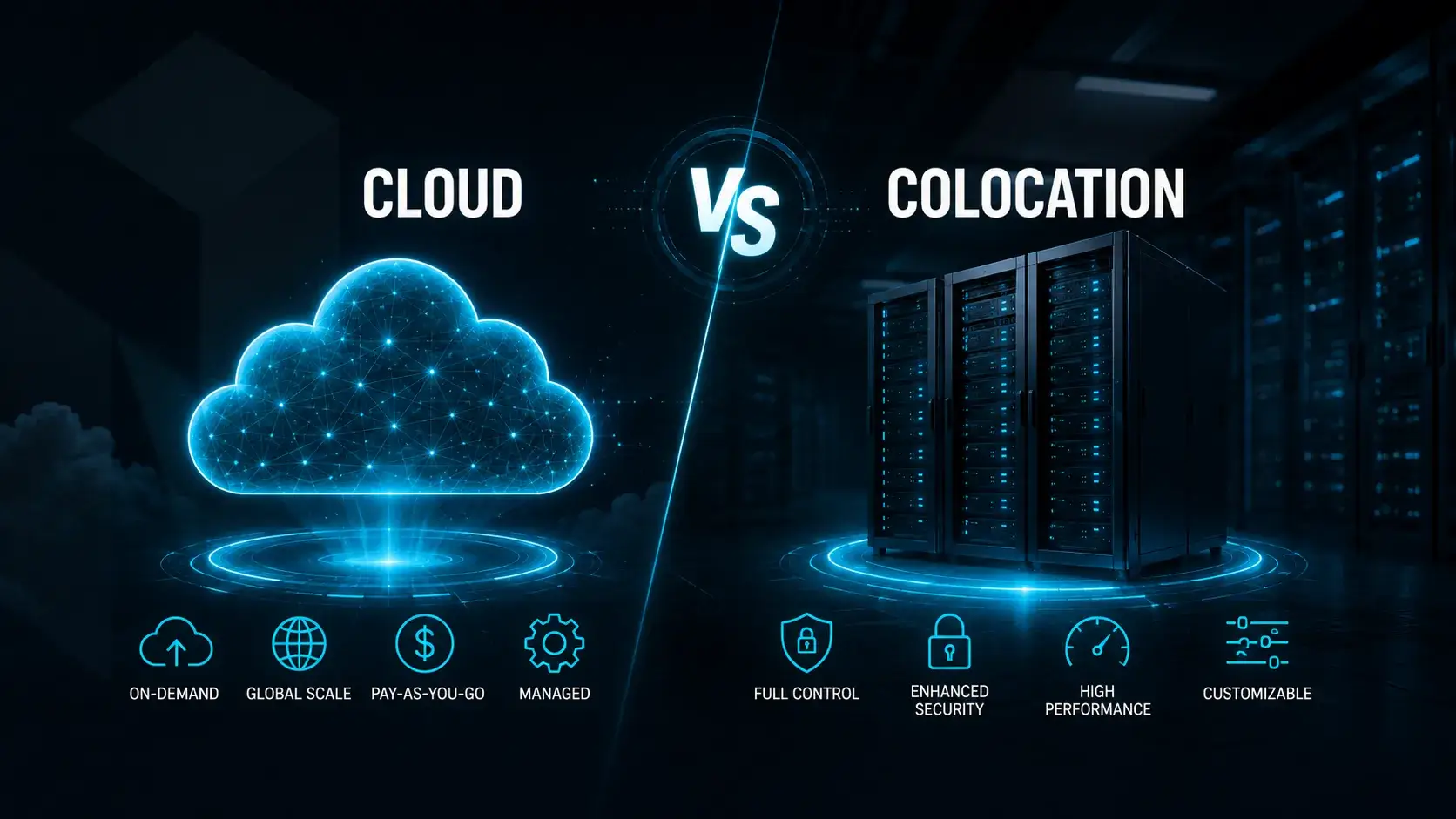
Cloud versus Colocation: Side by Side Comparison
To make an incredibly informed architectural decision, you must directly compare these two highly popular deployment models across several critical operational categories. While marketing brochures often blur the lines between them, a clinical evaluation reveals stark contrasts in how each model handles financial planning, network performance, and daily administrative tasks. By examining the fundamental differences in cost structures, security protocols, and scalability mechanisms, you can clearly identify which platform aligns best with your specific organizational capabilities and future growth projections. The choice between colocation vs cloud requires a deep understanding of how each specific framework will directly impact your daily technical operations and your overall corporate budget.
Cost Structure
The financial models driving these two solutions are fundamentally opposed and require completely different budgeting strategies. Cloud computing typically involves an operating expense (OpEx) model with pay-as-you-go pricing, while colocation involves capital expense (CapEx) for hardware and ongoing leasing fees. Colocation often includes a capital purchase for servers and storage, plus monthly fees for racks, power, and connectivity, which can lead to a stable total cost of ownership for steady workloads. Conversely, a public cloud provider will charge you for every single compute cycle and all data egress, which can lead to surprisingly massive bills if your application goes viral unexpectedly. Public cloud pricing typically combines fixed and variable charges, which can lead to unexpected costs, especially for predictable workloads, making colocation or private cloud potentially more economical in the long run.
Scalability & Flexibility
When it comes to rapidly expanding your digital footprint, the two models offer vastly different timelines and capabilities. Cloud provides nearly instant, infinite scaling, while colocation scalability is limited by the physical hardware installed. With the cloud, you can double your computing resources with a few clicks to handle a massive, unexpected surge in website traffic. Conversely, colocation requires a much slower, deeply manual scaling process because your IT team must physically purchase, ship, and rack brand new server hardware within the colocation facilities before those additional resources become available for centralized use. The true beauty of the cloud lies in this absolute flexibility, allowing businesses to adapt to global market changes in real time. Meanwhile, scaling your own servers in colocation centers demands rigorous capacity planning and substantial lead times to ensure you have enough floor space available for incoming equipment.
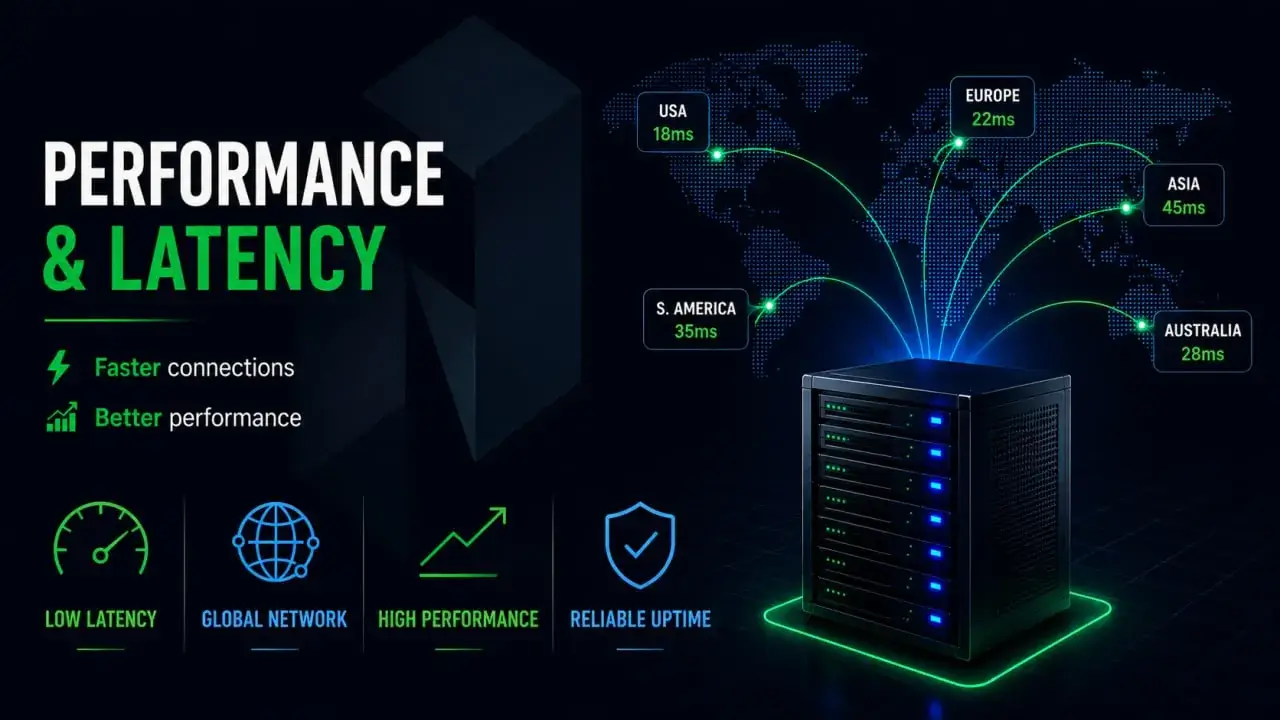
Performance & Latency
Both environments are capable of delivering incredibly fast network speeds, but the way you optimize that performance varies significantly. Colocation allows your network engineers to build highly customized, dedicated network routes and fine tune the physical hardware to squeeze out every single drop of performance for specific, resource intensive applications. Cloud environments rely on massive, shared infrastructure that provides excellent general performance, but heavy virtualization layers can occasionally introduce minor latency variations. Multi-tenant public cloud resources can exhibit variable I/O and network latency during peak periods, which can negatively impact transactional and real-time workloads. Dedicated colocation racks and private cloud clusters provide predictable disk throughput, IOPS, and network latency for applications that are sensitive to latency. If your enterprise absolutely requires consistent, raw computational throughput without the noisy neighbor effect found in multiple tenants sharing a single machine, dedicated hardware housed in colocation data centers remains the gold standard for performance reliability.
Security & Compliance
Protecting your highly sensitive customer data requires a robust defense strategy, and both models approach this critical requirement from different angles. Colocation gives you absolute, uncompromising physical and digital control over your machines, making it the preferred choice for organizations navigating incredibly strict compliance frameworks that mandate dedicated, unshared hardware. Cloud providers invest billions of dollars into elite, enterprise grade security measures and automated threat detection, but the underlying hardware is ultimately shared with other businesses. Furthermore, cloud providers implement a shared responsibility model for security, meaning customers are responsible for configuring their own security measures, such as identity management and encryption, while the provider manages the underlying infrastructure. For handling sensitive data, many businesses prefer colocation because they can install proprietary encryption algorithms and maintain absolute physical custody of their storage hardware, drastically minimizing the potential surface area for external data breaches.
Control & Ownership
The level of absolute authority you wish to retain over your digital ecosystem is a major deciding factor between the two infrastructure paths. With colocation, you physically own the servers and retain total root access, meaning you can install highly specialized legacy operating systems, write custom firewall rules, and audit the exact physical location of your data at any time. Cloud hosting forces you to surrender the underlying hardware control to the provider, requiring you to operate within their specific virtualized ecosystem and adhere to their predefined architectural limitations. If your IT department must maintain ownership of the underlying network switches and routing protocols, colocation allows you to dictate every single technical parameter. When the provider owns the hardware, as seen in cloud services, you are inevitably subject to their ultimate administrative authority.
Management Responsibility
Determining exactly who answers the phone when a server physically breaks is perhaps the most practical difference for your daily operations. A colocation strategy requires you to employ a highly skilled, dedicated team of internal system administrators who are entirely responsible for troubleshooting broken hardware, replacing faulty hard drives, and managing server patches. When you leverage the cloud, the massive provider handles all of the underlying physical hardware maintenance, facility management, and hypervisor patching, freeing your internal engineering team to focus exclusively on developing software and growing the business. While some colocation providers do offer enhanced packages that provide managed services to assist with hardware reboots, managing your own hardware generally requires significant internal it infrastructure expertise compared to the completely hands off approach of managed hosting providers.
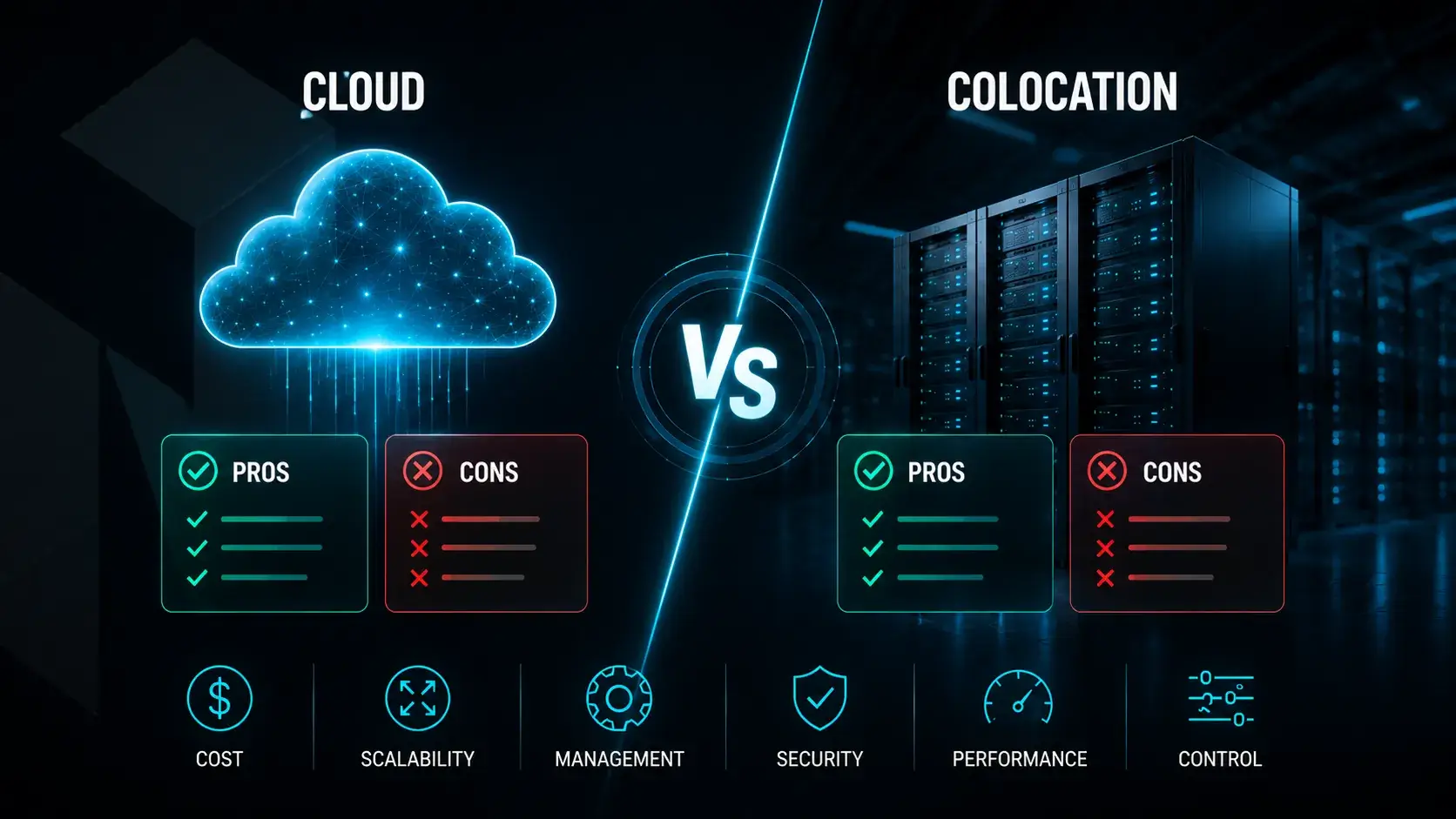
Pros and Cons of Cloud Versus Colocation
Every infrastructure decision involves balancing significant technical advantages against unavoidable operational compromises. Neither the cloud nor colocation is universally perfect for every single scenario, and understanding the inherent strengths and weaknesses of each model is essential for avoiding catastrophic structural mistakes. By honestly evaluating the unique benefits and distinct drawbacks of both pathways, you can safeguard your business against unpredictable costs and crippling technical limitations. This detailed evaluation will illuminate exactly which sacrifices your company is willing to make to achieve its ultimate technological vision.
Cloud Pros and Cons
The cloud offers incredible advantages, including zero upfront hardware costs, rapid global deployment capabilities, and the ability to instantly scale resources to match fluctuating consumer demand without manual intervention. However, these massive benefits are offset by significant disadvantages, such as highly unpredictable monthly billing that can spiral out of control, a potential lack of transparency regarding where your data storage physically resides, and the dangerous risk of becoming permanently locked into a single provider proprietary ecosystem. Furthermore, migrating incredibly large databases into cloud platforms is easy, but migrating that data out often incurs exorbitant data egress fees designed intentionally to penalize you for leaving.
Colocation Pros and Cons
Colocation delivers unparalleled advantages for established enterprises, providing absolute hardware control, highly predictable monthly operational costs, and the superior performance capabilities that come with utilizing entirely dedicated, unshared physical resources. On the downside, this model requires massive upfront capital investments to purchase the initial hardware, demands a highly paid internal IT team to maintain the equipment, and suffers from a notoriously slow scaling process when new physical machines are desperately needed. Colocation provides advantages such as full control and customization, cost predictability, better security and compliance, and consistent performance, but has disadvantages including high upfront costs, a maintenance burden, and limited flexibility.
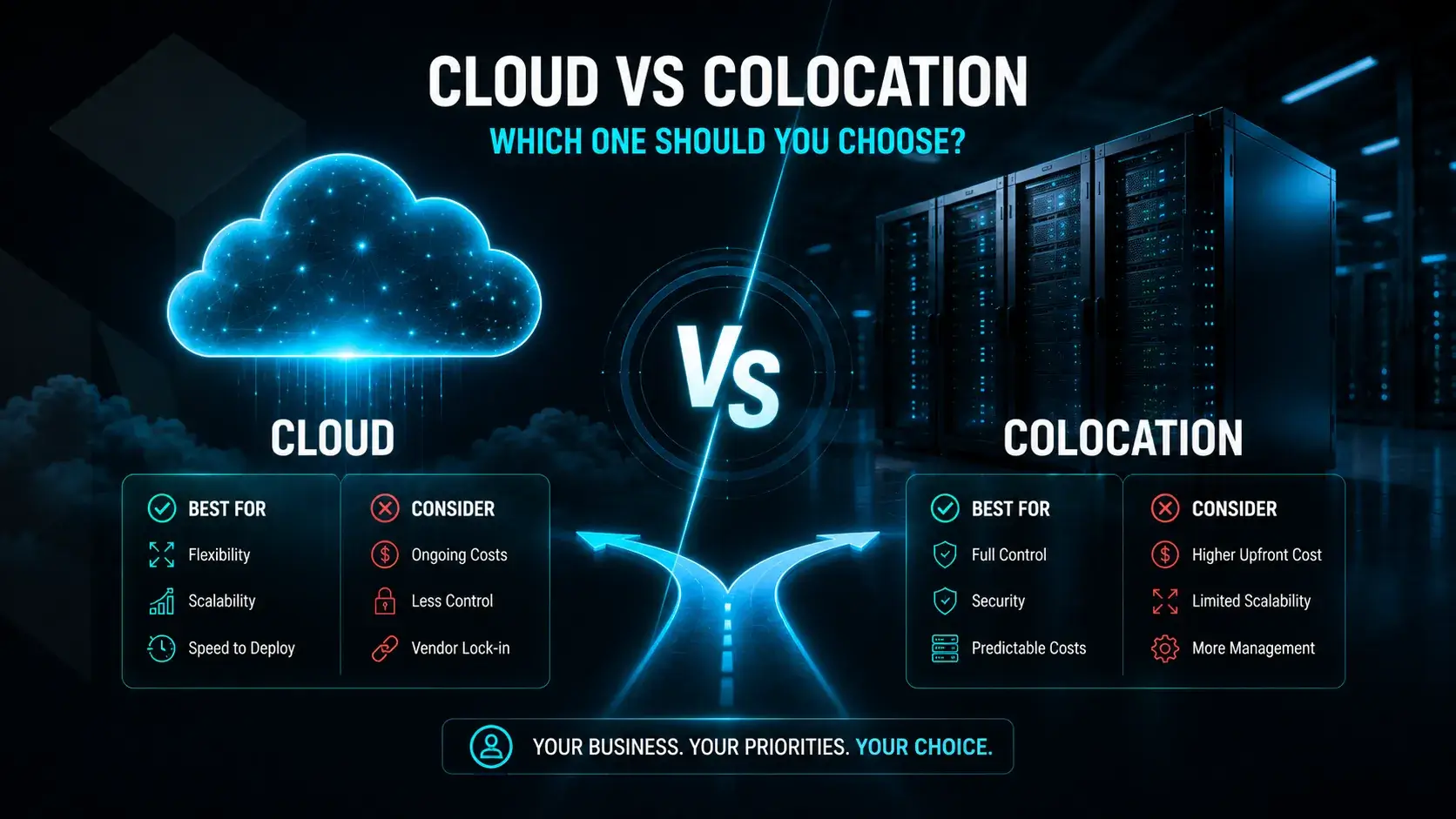
Cloud vs Colocation: Which One Should You Choose?
Making the final infrastructure determination requires a brutally honest assessment of your internal engineering capabilities, your available capital budget, and your long term technological roadmap. You must look beyond the immediate convenience of the deployment and carefully calculate the true total cost of ownership over a five year projection. Selecting the perfect environment ultimately comes down to matching the specific architecture directly to your unique business model, rather than simply following the latest industry trends or generic marketing advice. You must weigh the realities of colocation vs the conveniences of the cloud. Stringent, specialized, or regulatory requirements often favor colocation, while limited staff favors cloud solutions.
When Cloud Is the Right Choice
Migrating to a fully virtualized environment is the absolute best strategy for rapidly growing companies that experience highly unpredictable traffic patterns or massive seasonal spikes in consumer demand. Cloud computing is often better for startups and SMBs, unpredictable workloads, and remote teams. It is the perfect ecosystem for agile development teams that need to instantly spin up testing environments without waiting for hardware procurement, and it is highly recommended for organizations that prefer to preserve their financial capital rather than sinking massive funds into rapidly depreciating physical servers. Choosing public cloud environments allows startups to launch global operations immediately without negotiating long term contracts for renting space inside physical server environments.
When Colocation Is the Better Solution
Relocating your proprietary hardware to a dedicated third party data center is the vastly superior choice for established companies dealing with predictable workloads where continuous cloud resource pricing would become incredibly prohibitive. It is also the mandatory operational path for highly regulated enterprises that require absolute, uncompromised control over data sovereignty and for organizations that have already invested heavily in expensive on prem systems that simply cannot be virtualized easily. If your company relies heavily on customized legacy systems or strictly requires completely dedicated hardware for maximum performance, you should absolutely choose colocation.
When to Use a Hybrid Approach
An increasing number of sophisticated enterprises are realizing that they do not have to choose just one extreme, leading to the massive popularity of the hybrid cloud infrastructure model. By intelligently combining both strategies, a company can house its incredibly sensitive workloads on private collocated hardware while seamlessly bursting its front end web applications into the public cloud during massive promotional events. A well-designed hybrid environment connects colocation infrastructure with cloud platforms through high-performance network connections, ensuring seamless data movement and user experience. A well architected mix of colocation and cloud allows you to optimize your spending perfectly, utilizing physical data centers for steady workloads while leveraging cloud hosting services solely for temporary processing spikes.
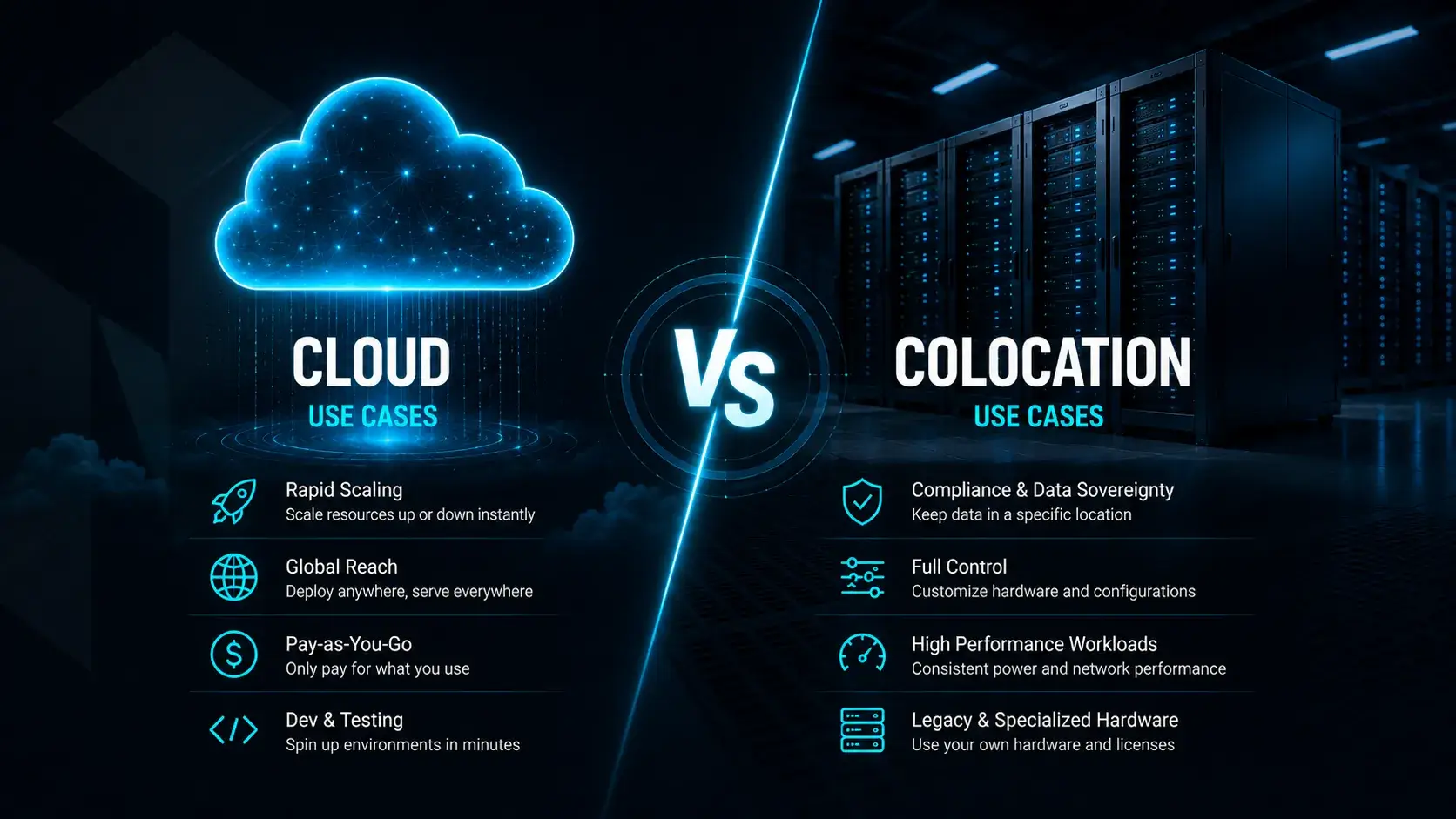
Cloud vs Colocation Use Cases: When Each Makes Sense
Abstract technical features only matter when they are successfully applied to solve real world business challenges. Different industries have completely unique operational demands, and analyzing how similar companies successfully deploy these distinct infrastructures can provide massive clarity for your own strategic planning. By exploring specific, highly targeted use cases, you can immediately see exactly where each architectural model fundamentally shines and where it critically fails under pressure. Real world deployment models prove that context is everything when selecting digital infrastructure.
Startups & SaaS Applications
Modern software startups and rapidly growing software platforms absolutely thrive within the hyper flexible ecosystem of the public cloud. Because these agile companies frequently experience explosive, unpredictable user growth and require the ability to deploy new code globally in a matter of minutes, the massive scalability and zero upfront hardware costs of virtualized environments perfectly match their dynamic, fast paced business models. A young company utilizing cloud hosting can provision infrastructure resources instantly, utilizing platforms like Microsoft Azure or Google Cloud to launch their minimum viable products without worrying about purchasing dedicated server hardware or securing data center space.
Enterprise Workloads
Massive multinational corporations with thousands of employees typically rely on incredibly heavy, steady workloads that run constantly around the clock to support human resources, inventory management, and internal communications. For these established giants, utilizing colocation services for their core operational databases and internal management systems makes perfect financial sense, as the predictable flat monthly fees of owning their hardware are vastly cheaper than paying a premium for continuous, heavy cloud usage over a five year cycle. By utilizing their own servers, enterprises can also fully leverage their existing software licenses without violating strict virtualization terms and conditions.
High Performance Applications
Companies running incredibly complex calculations, such as high frequency financial trading firms, massive genomic sequencing laboratories, or intensive video rendering studios, require absolute, uncompromised raw computational power. Colocation is the absolute best solution for these specific critical workloads because the internal engineering team can custom build incredibly specialized, bare metal servers packed with specific processing units, entirely avoiding the slight latency penalties introduced by virtualized cloud layers. In scenarios where microseconds equal millions of dollars, relying on dedicated hardware housed within secure colocation facilities eliminates the performance degradation commonly associated with multiple tenants fighting for shared network bandwidth.
Data Sensitive Industries
Organizations operating within the healthcare, banking, and government sectors are bound by incredibly strict, unforgiving regulatory frameworks regarding data privacy and dedicated server hardware access. These highly sensitive industries almost universally rely on colocation centers, as this model allows them to maintain absolute physical custody of their storage drives, deploy custom encryption hardware, and legally prove exactly where their proprietary data resides at all times during a strict compliance audit. Unlike a shared infrastructure model where data sits alongside other public cloud workloads, private cloud tenants operating within their own hardware enclaves can guarantee that only explicitly designated users can physically access the machines.
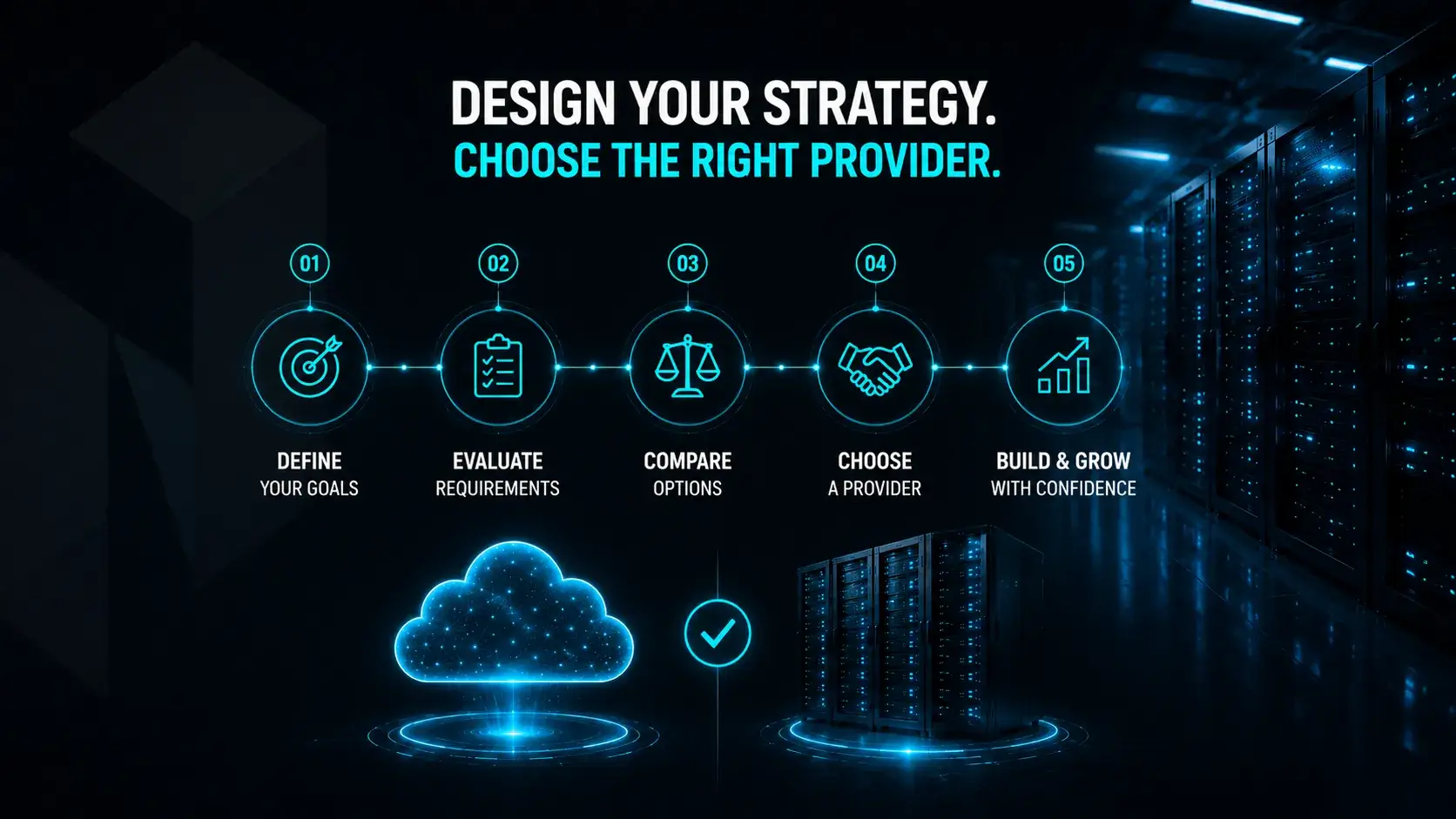
How to Design Your Strategy and Choose a Provider
Once you have firmly decided on your ideal architectural path, you must execute the strategy by selecting a highly reputable, enterprise grade infrastructure partner. The web hosting and data center market is heavily saturated with providers making incredibly bold marketing claims, so you must carefully evaluate their actual capabilities against your specific operational requirements. Finding the perfect provider requires a methodical, deeply analytical approach to ensure your critical digital assets remain secure, online, and incredibly fast. It is absolutely vital that you meticulously investigate the key factors that will ultimately govern your daily technical reality.
Budget & Cost Predictability
Your infrastructure decision must directly align with how your finance department prefers to structure the corporate budget over the next several years. If your organization prefers highly predictable, static monthly operational expenses and possesses the available capital for upfront investments, a colocation facility provides incredible financial stability. Conversely, if your company strictly mandates preserving liquid capital and prefers paying only for the exact computational resources consumed each month, seeking out a flexible cloud hosting provider is the only logical financial path. Understanding your exact budget tolerances prevents you from being shocked by a massive, unexpected invoice derived from unpredictable data egress fees. Businesses should run full total cost of ownership (TCO) models that include reserved commitments, support tiers, monitoring costs, and likely egress over five years to realistically compare colocation and cloud options.
Scalability Needs
You must brutally analyze your company actual growth projections and realistic capacity planning metrics before signing a long term contract. If you expect steady, predictable, and manageable growth over the next five years, purchasing your own hardware and placing it in a colocation facility allows you to scale at a comfortable, highly controlled pace. If your marketing team frequently launches massive viral campaigns that instantly multiply your daily traffic tenfold, you absolutely must partner with a cloud provider capable of providing instantaneous, automated resource elasticity. You cannot afford to wait weeks for new physical servers to arrive during a massive product launch that requires immediate computing resources.
Compliance Requirements
Your legal and compliance obligations dictate a massive portion of your overall infrastructure strategy and simply cannot be ignored or compromised. If your industry requires you to adhere to incredibly strict frameworks for protecting sensitive data, you must rigorously interrogate any potential provider to ensure their physical data centers and network routing protocols are fully certified and actively audited. Choosing a partner that inherently understands and supports your specific regulatory burdens will save your company from devastating legal fines and catastrophic business interruptions. Ensure they offer comprehensive physical security measures, robust disaster recovery protocols, and ironclad business continuity guarantees to satisfy rigorous external auditors.
Internal IT Expertise
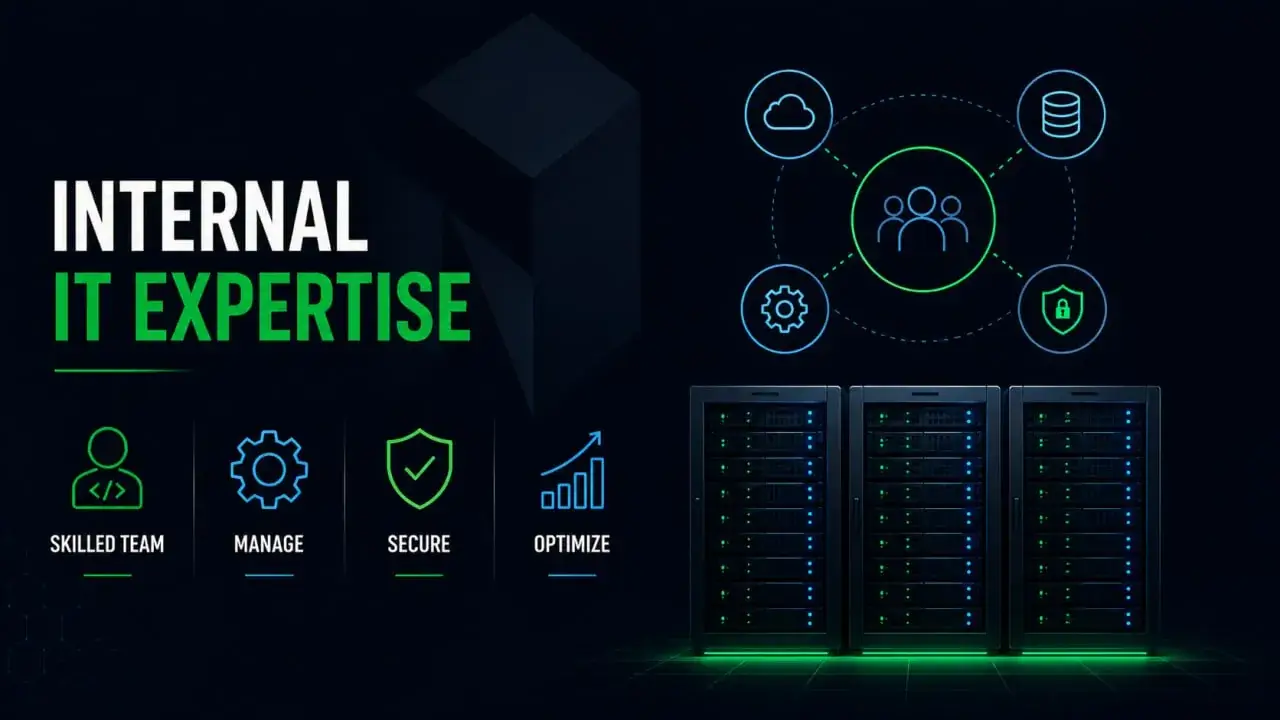
The size, capability, and daily availability of your internal engineering team will heavily influence exactly which model your company can actually survive using. Colocation requires you to employ a dedicated team of highly skilled, expensive system administrators who are fully capable of physically driving to the data center to replace broken motherboards and manually configure complex network switches. If your company prefers to employ a lean team focused entirely on writing software rather than maintaining dedicated server hardware, migrating to a fully managed cloud ecosystem is absolutely essential for your operational survival. You must realistically assess whether your team has the bandwidth to manage basic infrastructure or if you need a partner to provide managed services entirely.
Frequently Asked Questions
What happens if my primary internet connectivity fails?
If you are utilizing colocation services, a premium colocation provider will offer fully redundant internet connection options utilizing multiple diverse fiber optic paths to ensure you remain online even if one carrier experiences an outage. In a cloud scenario, the provider manages massive, multi homed network connections automatically, rendering localized network failures entirely invisible to your end users.
Do I lose my data if the provider goes out of business?
When you maintain ownership of your dedicated server hardware in a colocation model, your data remains entirely yours. You simply drive to the facility, retrieve your servers, and migrate to a new building. If a cloud company were to fail catastrophically, retrieving massive amounts of data from their proprietary cloud platforms could be incredibly challenging, which is why partnering with established giants like Google Cloud or Microsoft Azure is strongly recommended for absolute peace of mind.
Can I move workloads hosted in the cloud back to my own servers? Yes, this process is known as cloud repatriation. Many organizations initially migrate all their workloads to the cloud, only to discover that predictable workloads are vastly more cost effective to run on their own hardware. Moving data storage and applications back to dedicated hardware within colocation facilities is entirely possible, though it requires meticulous planning and a deep understanding of application dependencies to avoid unexpected downtime during the transition.
How do managed hosting providers differ from basic colocation? Basic colocation merely provides floor space, power, and cooling, leaving all server management to your internal staff. Managed hosting providers go a step further by offering hands on technical support, meaning their certified engineers will actively monitor your infrastructure resources, replace failed storage hardware, and troubleshoot operating system errors on your behalf, effectively acting as an extension of your own IT department.
Conclusion
Navigating the complex landscape of colocation vs cloud is not about finding a universally perfect technology, but rather discovering the exact digital infrastructure that perfectly supports your specific business objectives. As we have explored throughout this comprehensive guide, both deployment models offer incredible strengths and present entirely unique operational challenges.
If your enterprise demands absolute full control over dedicated server hardware, requires strict compliance for sensitive data, and operates with highly predictable workloads, partnering with a premium colocation provider remains the most cost effective and secure strategy. It allows you to leverage your existing software licenses, dictate your own security measures, and maintain ownership of your proprietary hardware without building your own data centers from scratch.
Conversely, if your organization prioritizes rapid agility, requires infinite scalability to handle unpredictable traffic spikes, and prefers to avoid massive upfront capital expenditures, migrating to public cloud platforms is the undeniable path forward. The cloud empowers lean development teams to innovate rapidly, deploying new applications instantly without the heavy burden of maintaining basic infrastructure or managing physical storage hardware.
Ultimately, many businesses are discovering that they do not have to restrict themselves to a single path. By actively embracing a hybrid cloud strategy, you can intelligently distribute your resources across multiple environments. You can utilize highly secure colocation facilities for your steady workloads and legacy databases, while seamlessly leveraging cloud services for temporary, on demand computing resources during massive promotional events.
Whichever architectural path you ultimately choose, taking the time to align your decision with your corporate budget, your internal IT expertise, and your long term growth projections will guarantee that your foundational infrastructure remains a powerful, reliable catalyst for your future success.