
Choosing the right hosting plan, whether shared web hosting or something more robust, is a balancing act between the actual resources your applications need, the level of support your staff needs, and the amount you can afford to spend on a monthly basis. If the web hosting cost and plan you choose do not hit all of these marks well, you risk paying for idle resources or panicking when shared servers can't keep up with increased traffic.
We cut through the noise for you. Netrouting has been building out the IT infrastructure for businesses from more than 30 countries for the past 15 years. We run our own AS6206 backbone, operate own data centers on three continents and deliver bare metal servers in 60 minutes or less. Our long-standing infrastructure expertise goes into every single recommendation.
This session will cover all the standard hosting tiers (shared hosting, VPS hosting, cloud compute hosting. Additionally, Dedicated bare metal hosting costs and the key factors that actually affect cost (server resources, bandwidth, service level agreements, and support response times).
Blog contents
You will learn how to select the right web hosting plan for your workloads, avoid typical overcharging pitfalls, and know the right questions to ask, whether you need email marketing tools or raw server performance. For community perspectives, see Cost of hosting a website? (web hosting prices).
How Much Does Website Hosting Cost? A Plain-English Answer
The cost for website hosting can vary from a few dollars per month for a basic shared hosting package to hundreds of dollars per month for an enterprise class bare metal server. Your website hosting costs will depend on 4 variables: the hosting type, the amount of resources required, the contract length and any add-ons such as an SSL certificate, automated backups or DDoS protection. Providers often display attractive introductory rates, but the true hosting monthly expense becomes clear only when you examine what you'll pay after the first billing cycle ends.
Understanding exactly what your hosting plan includes, such as bandwidth limits, storage capacity, and the number of email accounts, helps you avoid surprise charges when scaling your site. Estimating how much website hosting will cost over time requires factoring in both the base subscription fee and potential overages for bandwidth or storage as your site grows. Sites with rich video content or interactive features, essentially any multimedia website, will consume significantly more bandwidth and storage than text-based pages.
How Much Website Hosting Costs per Month
Additionally, start to think about the support that you need.
Here is an example of what the different tiers might look like based on current web hosting prices across the market.
- Shared hosting: Entry-level plans start around two to three dollars a month on introductory offers, renewals typically jump to ten to twenty dollars.
- WordPress hosting: Ranges from three to twenty-five dollars a month. Managed plans cost more but include search engine optimization tools, caching, and staging environments.
- VPS hosting costs: Typically ten to one hundred dollars a month. You get isolated virtual servers with dedicated CPU and RAM, a major step up from shared environments.
- Dedicated / bare metal: Starts higher and scales with hardware. Suitable for workloads that can't share resources across multiple servers.
- Cloud compute: Billed by resource usage. Predictable for steady workloads; can spike under heavy traffic.
The Email Marketing Tools Introductory Pricing Trap
Always check the renewal pricing before you sign up for a plan.
The option to switch month-to-month will incur additional charges upfront. Providers typically bundle annual contracts with discounts, so opting for flexibility means you'll pay an extra cost compared to committing to a longer term. Many hosting providers offer discounts of 30% or more when you commit to annual or multi-year billing cycles instead of paying monthly. When comparing providers, many web hosts structure their pricing tiers to incentivize longer commitments through progressively steeper discounts at two-year and three-year intervals.
Where to Find Hosting Cost FAQs and Deeper Guidance
Hostings costs are explained in more detail for the respective FAQs in the rest of the guide.
The 5 Main Web Hosting Types and Their Hosting Costs
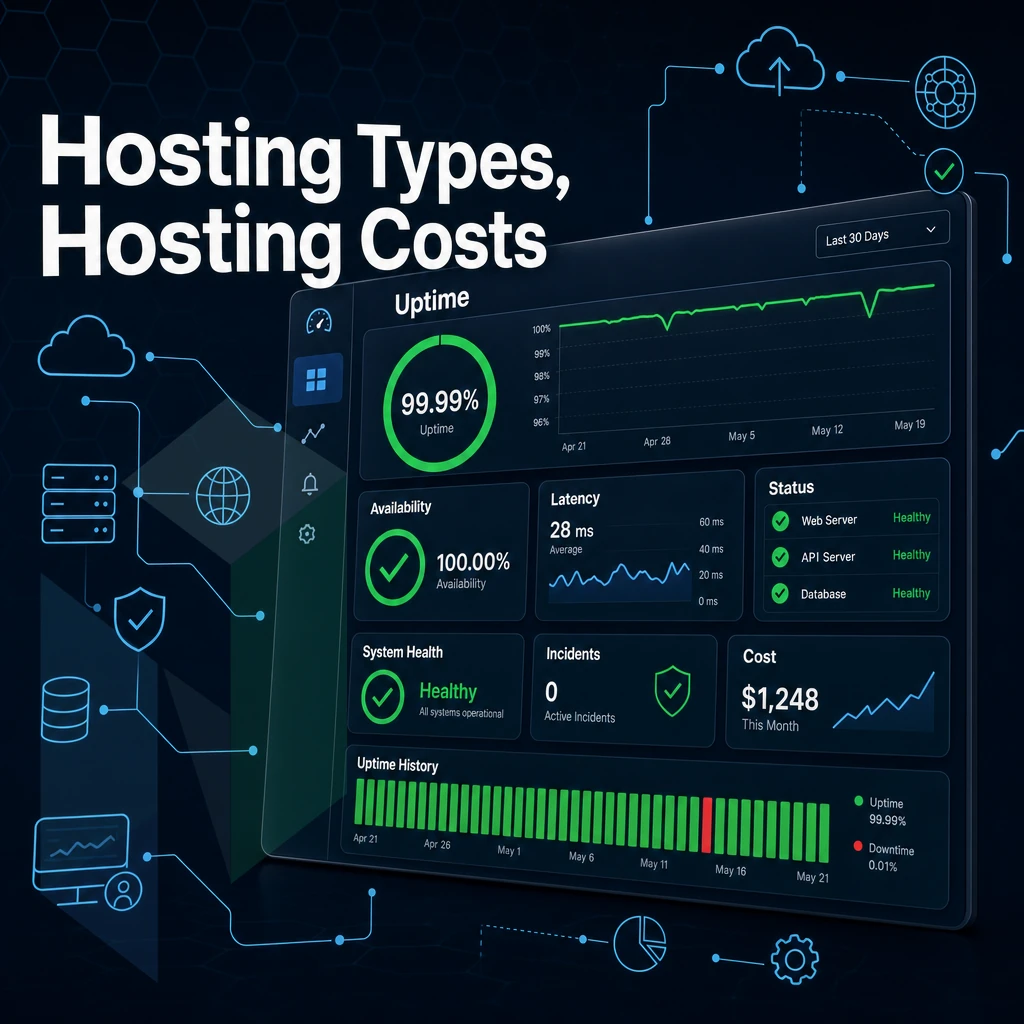
When it comes to web hosting there is a massive variance in cost between the different types. If you have been researching web hosting services, the decision on what type of hosting is best for you will rely heavily on the amount of traffic your site receives. Your need for technical control and your tolerance to being on a shared server with other users. We outline the 5 main types of web hosting below.
What Are the Main Types of Web Hosting and How Do Their Hosting Costs Differ?
From basic shared hosting plans to fully dedicated servers, there are many hosting options available. Performance, server isolation and support overhead increase with price. This guide explains the different types of hosting plans, to help prevent you from paying too much for your web hosting.
Organizations with high-traffic sites or strict compliance requirements often find that dedicated hosting plans offer the performance isolation and control they need without resource contention. For agencies managing client sites or entrepreneurs building a hosting business, reseller hosting packages provide the infrastructure to offer branded hosting services under your own label.
| Hosting Type | Best For | Key Trade-off |
|---|---|---|
| Shared Web Hosting | Personal sites, low-traffic blogs | Noisy-neighbour risk; limited CPU and RAM |
| VPS Hosting | Growing sites, developers, staging environments | Still shares physical hardware; needs OS management |
| Dedicated Hosting | High-traffic sites, gaming, databases | Higher cost; you manage the entire physical server |
| Cloud Hosting | Variable-traffic apps, SaaS, e-commerce | Costs can spike; egress fees add up |
| Managed Hosting | Teams without dedicated sysadmin capacity | Premium over unmanaged; less direct control |
Shared Web Hosting and VPS Hosting Costs
Shared hosting is where many sites are hosted on a single server. Resources are pooled together so a spike in traffic to one of your tenant sites can start to affect other sites. Good for low volume sites but quickly reaches a ceiling. Some providers offer a free website builder or trial period with shared hosting, making it an accessible entry point for new site owners testing the waters.
VPS hosting is a way to carve up a single server into many virtual machines, each having their own dedicated CPU and RAM. A natural upgrade from shared hosting, dedicated hosting provides your site with more isolation, root access, and a more stable, consistent, and scalable environment without committing to a full dedicated server.
This allocation of dedicated resources ensures that CPU-intensive tasks or memory spikes on your VPS won't be throttled by neighboring tenants. Selecting the appropriate hosting environment at this tier depends on whether your workload benefits more from guaranteed resource allocation or from the flexibility to scale vertically as demand grows.
When evaluating options at this tier, most vps hosting providers include root access and the ability to install custom software stacks tailored to your application's requirements. Unlike shared hosting, VPS environments isolate your workload from resource contention, ensuring predictable performance even during traffic spikes on neighboring accounts.
A virtual private server strikes an ideal balance for growing businesses that need more control than shared hosting offers but aren't ready for the capital expense of physical hardware. A virtual private server vps configuration typically includes dedicated RAM, CPU cores, and storage that remain isolated from other tenants on the same physical hardware.
Dedicated vs Cloud Web Hosting Provider
A dedicated server is a complete physical server. You have the entire box to yourself, without any noisy neighbors or worry of resource contention. With a dedicated server you can count on consistent sub-5ms latency and complete control over the hardware. For high-traffic web applications, game servers, and other applications that require a high level of security and compliance, a dedicated server from a reliable hosting provider is the standard.
Cloud web hosting services are typically distributed across a number of servers (typically virtual), which can then be scaled up horizontally as required to handle large numbers of visits. Note that you will typically get charged for egress from hosting, which can make cloud hosting more unpredictable than bare metal.
Managed Hosting and Choosing the Right Plan
Managed hosting typically adds OS patching, monitoring, and security hardening on top of the typical hosting services offered for any given infrastructure tier. For small teams, managed hosting can be a huge force multiplier, eliminating a great deal of overhead as the cost of the hosting plan increases.
For production environments requiring a fixed server configuration to ensure 99.9% uptime, Netrouting can provide dedicated servers, managed web hosting solutions, and reliable technical support. These solutions provide you with a server without shared resources and 24/7 support. The servers are provisioned within 60 minutes. Once you know which tier is suitable for your workload, the question is how your platform of choice will affect your expenses.
Choosing a Website Platform and How It Shapes Your Bill
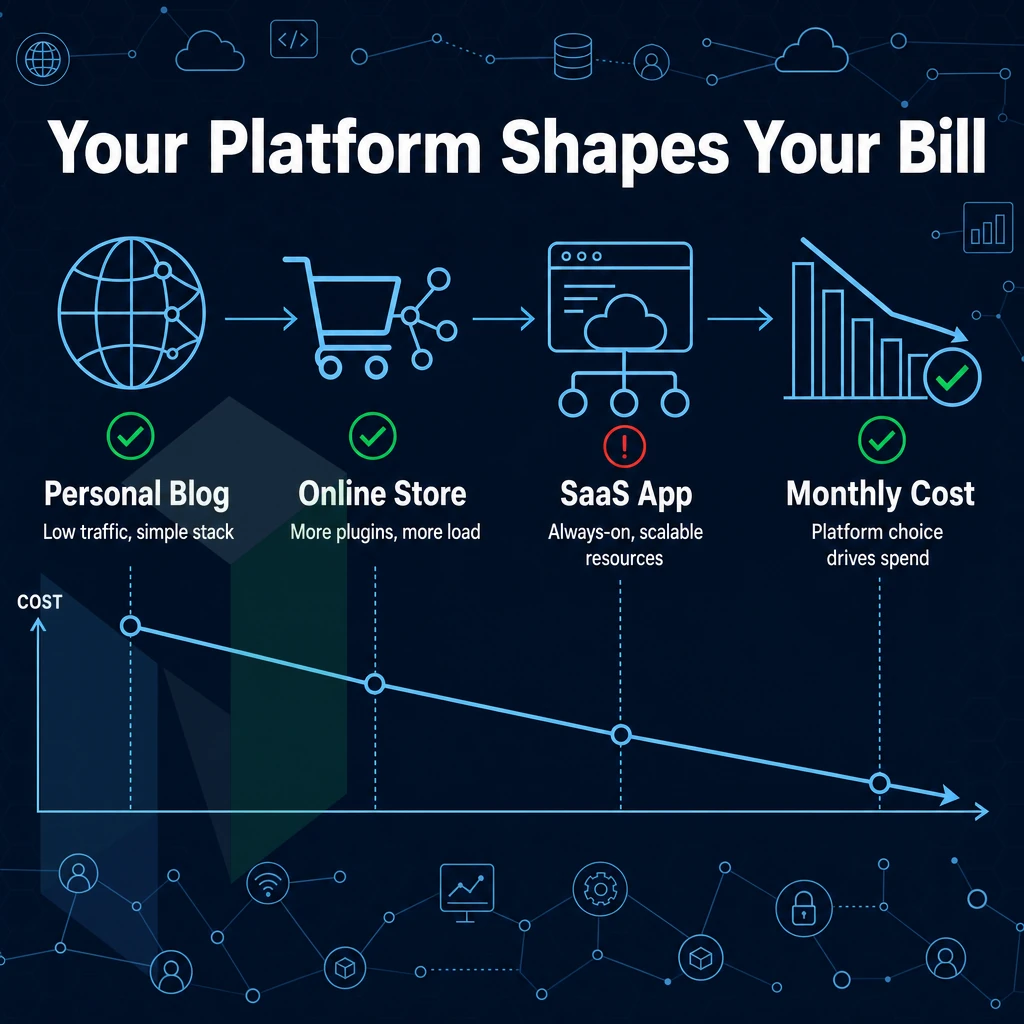
A personal blog requires far less power than a WooCommerce store or a SaaS product.
Assess Your Platform's Resource Footprint
-
Identify your CMS or application type.
That overhead adds up fast under real traffic.
-
Estimate your traffic pattern.
Static sites and personal blogs can start on entry-level plans.
Note: E-commerce platforms also carry PCI compliance requirements. Your host must support the right network isolation and logging, shared environments often fall short.
-
Audit your plugin and extension count.
Each active plugin consumes server resources. Fifty plugins on a shared instance is a recipe for timeouts. Trim ruthlessly before choosing a tier.
Match Platform Complexity to Hosting Tier
-
Static or low-traffic sites.
These need the least. Entry-level cloud compute handles them comfortably with room to grow.
-
WordPress and CMS-based sites.
WordPress hosting works well at the managed tier. Some hosting providers offer managed WordPress hosting with pre-tuned stacks, useful if you want the platform handled for you.
-
Custom Applications on a Virtual Private Server
Custom apps typically need root access, specific runtimes, and dedicated resources isolated from other tenants. Managed hosting on bare metal gives you that control without the operational overhead.
Dedicated Hosting: When You've Outgrown Everything Else
High-traffic e-commerce, extremely resource hungry applications and multi-tenant sites will typically consume all the resources available through shared and cloud hosting services. With a dedicated server you have the complete box, no noisy neighbors and no resource competition.
At Netrouting we offer Dedicated Hosting on the latest servers with Intel Xeon and AMD EPYC Processors. Our Dedicated Servers are equipped with unmetered 10 Gbps Connectivity and 100% DDoS Protection. Activating a server will take less then 60 minutes.
How Much Does It Cost to Have Someone Else Host Your Website?
fully managed hosting typically gets more expensive as the complexity of your sites increase.
This article will go through the various types of hosting and how the cost is structured for some of the website builders too.
Website Builders vs. Traditional Web Hosting: What You Actually Pay
Each web hosting type has its own strengths and weaknesses regarding performance and support. We compared the typical characteristics of the most common hosting types for you in the following table. Please note that the criteria are from the point of view of an IT buyer.
| Hosting Type | Performance | Uptime SLA | Support | Network | Best For |
|---|---|---|---|---|---|
| Free Web Hosting Plans | Low, shared web servers, heavy resource caps | No SLA, best-effort only | Community forums; no ticket SLA | Shared bandwidth; no BGP or transit options | Personal projects, testing only |
| Shared Hosting with Website Builders | Low-to-medium, noisy-neighbour risk on shared web servers | Typically 99.9%, rarely enforced | Email and chat; slow escalation | Shared uplinks; limited to provider's edge | Small sites, website builders, basic SEO tools and email marketing tools |
| VPS / Multiple Virtual Servers | Medium, dedicated vCPU/RAM allocation; hypervisor overhead | 99.9% standard | Ticket-based; response times vary | Shared uplinks; some providers offer 1-10 Gbps ports | Growing apps, dev environments, multiple virtual servers per team |
| Hyperscaler Cloud Compute | High, auto-scaling, global zones; variable latency | 99.9%-99.99% per service | Tiered, premium support costs extra | Global backbone; high egress costs; marketing tools and SEO tools integrations via marketplace | Burst workloads, managed PaaS services |
| Netrouting, Dedicated Bare Metal & Cloud Compute | High, Intel Xeon and AMD EPYC; up to 2 TB RAM; no hypervisor overhead on bare metal | 99.9% SLA; same-business-day hardware replacement | 24/7 NOC; 1-hour ticket guarantee; proactive monitoring | 2.4 Tbps+ backbone (AS6206); unmetered 10 Gbps; always-on DDoS protection; 10 locations across Europe, North America, and Asia | High-traffic sites, video streaming, gaming, VPN, AI/ML workloads needing predictable cost and full hardware control |
Netrouting has the right combination of predictable costs, raw performance and a real SLA with 24/7 NOC support across their hosting plans, which include a free domain and cover both dedicated bare metal hosting and cloud compute hosting.
If you’re just starting out with a project then the free web hosting plans and the website builders that they offer are ideal. However, a basic hosting provider won't have the necessary network capacity or even the correct support response should something go wrong for more developed projects.
For high-traffic web servers. For streaming or any other project where uptime is crucial and being offline could result in serious losses, Netrouting's hosting plans are a far stronger choice than shared hosting in the long run. Knowing which tier to choose is only half the battle, the other half is knowing about the extra charges that aren't included in the headline web hosting cost you're going to pay for your server.
Hidden Hosting Costs That Inflate Your Bill
The advertised price is not the real price. Additional charges, such as add-ons, managed WordPress hosting upgrades, annual renewal fees, and overage costs, can quickly double the price a customer thinks they are paying. Knowing where these extra charges are hidden is key to accurate financial planning.
Introductory Discounts and Renewal Traps
Many web hosting providers will give you an very cheap rate for the first billing term.
They become full retail price domains.
What Hidden Hosting Costs Should I Watch for When Comparing Plans?
Several line items are not included in the “headline price”.
- SSL certificates: Free SSL certificate tiers cover basic domain validation. Extended validation or wildcard certificates typically cost extra.
- Backups: Automated backup services are often an add-on. Verify frequency, retention period, and restore costs.
- DDoS protection: Basic mitigation may be included; advanced scrubbing capacity usually is not. At Netrouting, always-on L3/L4 protection is included on every service by default.
- Control panel licensing: cPanel and DirectAdmin licenses carry a recurring fee that some providers pass through separately.
- Bandwidth and storage overages: Exceeding a plan's allocation triggers per-GB charges. Unmetered plans often cap port speed instead.
- Migration fees: Moving an existing site or server to a new provider can carry a labour charge.
- Technical support: Priority response or phone access may sit behind a paid tier.
The Hidden Cost of Unmanaged Hosting Infrastructure
Free hosting and very cheap unmanaged servers are shifted to the user for server configuration, patching and monitoring. The operational costs for this are staff time, software and risk exposure.
However, unmanaged means that you are fully responsible for all layers above the server’s hardware.
When to Upgrade From Shared Hosting to Dedicated Server Hosting
Every site will eventually outgrow their current tier. There are early warning signs that indicate a slow down in performance such as slow loading pages, throttled CPU. Shared servers, which are often chosen to reduce web hosting cost, place your account alongside hundreds of others on the same server, making it vulnerable to security compromises and unwanted behavior from fellow users on that shared environment.
Additionally, many organizations require a fully isolated and compliant environment to meet the strict guidelines of their industry.
When Should I Upgrade From Shared Hosting to VPS or Dedicated Hosting?
Alternatively, your hosting provider may be throttling your resources, or your current hosting environment is no longer able to meet your security or compliance requirements.
| Tier | Typical specs | Isolation | Control | Best for |
|---|---|---|---|---|
| Shared | Shared CPU/RAM, 99.9% uptime | None | Panel only | Brochure sites, low traffic |
| VPS | 2-8 vCPU, 4-32 GB RAM, 99.9% uptime | Partial (hypervisor) | Root access | Growing apps, dev environments |
| Dedicated | 24-56 cores, up to 512 GB RAM, 10 Gbps unmetered | Full | Full root + hardware | High-traffic, compliance, AI/ML |
Hosting Monthly Costs vs. Responsibility
As opposed to shared hosting, VPS and dedicated servers grant you root access and separate resources. However, the more you go up the server tiers, the more you’ll be responsible for the server’s operation. Most VPS hosting providers offer basic monitoring for their servers, while managed VPS hosting includes monitoring as well as patching and hardening for your server. The highest level of performance for single-tenant servers is offered by dedicated bare metal servers.
Moving from a VPS to a dedicated machine only makes sense if you require guaranteed CPU clock cycles, hardware RAID or physical compliance boundaries. In addition to these requirements. If you require hosting plans that include reseller capacity then scaling up to bare-metal server hardware is also going to scale better than on shared hosting where resources are impacted by noisy-neighbours sharing the same pool of resources.
Cloud and Hybrid as the Next Step
Cloud Hosting Plans and Hosting Costs
On top of our dedicated servers with fixed performance we offer elastic scaling for unpredictable traffic.
We offer unmetered 10 Gbps and free private networking between your resources.
Cloud Hosting Plans: Flexible Pricing vs. Predictable Monthly Cost
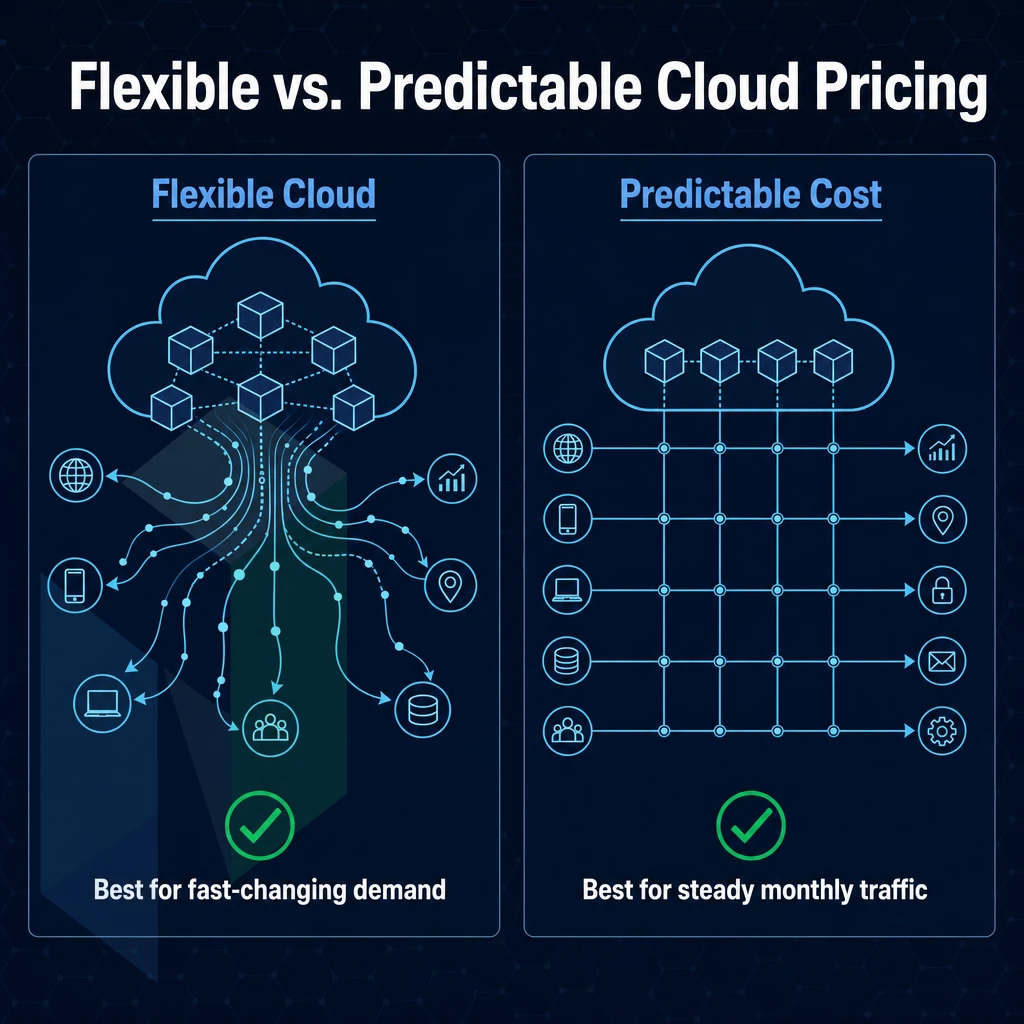
Cloud hosting and flat-rate web hosting plans solve the same problem, but in different ways. By knowing the advantages and disadvantages of both models, you can avoid bill shock and choose a hosting provider and plan that keeps your costs predictable.
Understanding the Two Billing Models
- Understand your traffic patterns and how they map to your cloud hosting. Cloud hosting is designed to scale up and down automatically so is particularly well suited for the spiky or unpredictable workload. You only use what you need.
- See hidden cost layers in your current cloud costs. For example, in addition to the cost of the server instances, there are additional charges for egress, for snapshots, for load balancers, and for higher levels of support. These additional charges can far exceed the cost of the instances themselves. In contrast to cloud hosting, web hosting on dedicated or VPS servers includes all of the costs in one flat fee for hosting.
- Work out your “baselining” consumption i.e. what is the consistent consumption of your workload (e.g. a production site with steady traffic) and therefore a fixed monthly charge is likely to provide a lower Total Cost of Ownership than paying for “as you consume” compute.
Note: Egress fees from major cloud platforms are a common budget surprise. A high-traffic site transferring several terabytes per month can see its effective monthly spend multiply quickly once data-transfer charges apply.
How Does Website Hosting Cost Compare Between Cloud Providers and Dedicated Servers?
Firstly, pay-as-you-go hosting is typically charged out on a per CPU-hour basis, per GB transferred and per API call basis. So costs can very quickly add up. A virtual private server or dedicated host from a specialist web hosting provider will cost you one flat monthly fee. This fee will include the bandwidth for your server, and there will be no nasty egress charges!
Hosting companies with their own network can include transfer costs within the flat rate. Hyperscalers on the other hand monetize every layer and that is more expensive for very bandwidth intensive workloads.
Choosing the Right Web Hosting Plan
- Cloud Compute for the real deal of variability. Short lived environments, dev/test loads, peak loads. Variable and flexible enough to warrant elastic billing. Netrouting Cloud Compute is scalable on the fly in multiple locations across Europe, North America and Asia.
- For steady loads, consider a Dedicated or VPS solution. Such solutions are ideally suited to persistent traffic, latency sensitive applications as well as to those that must comply with various regulations, and billing be flat rate. That is to say that a hosting company bundles bandwidth, thus removing the largest of variable costs.
- Also, make sure you’re getting more than just raw computing power with your web hosting plan. What are you getting for your money in bandwidth, DDoS protection and private networking? Netrouting services include always-on L3/L4 DDoS protection and a free private network on every service with no additional line items.
Once you have established the billing model that suits you best, we would like to know if Netrouting’s infrastructure can handle your workload.
Why Choose Netrouting for Professional Website Hosting
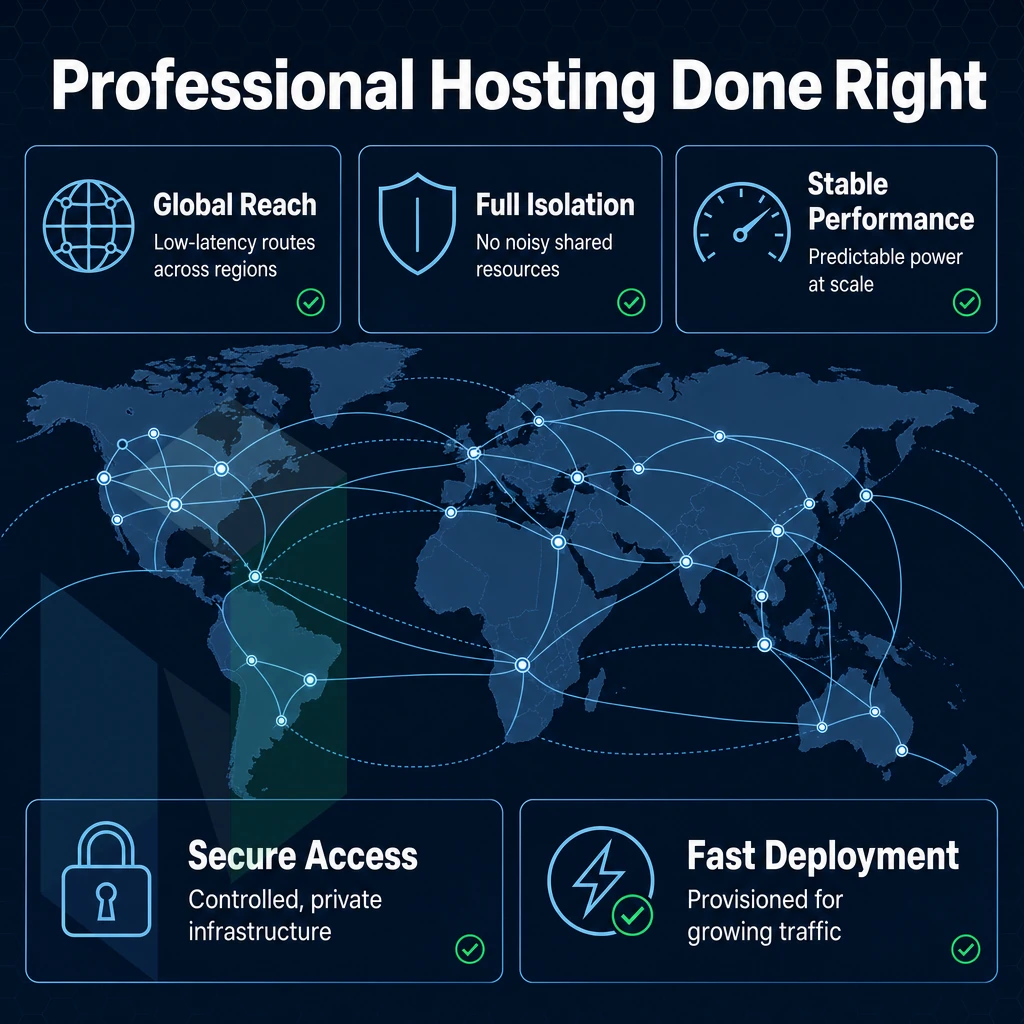
When hosting costs grow alongside your traffic, shared hosting and entry-level VPS hosting plans stop making sense. Dedicated hosting on enterprise hardware delivers the performance, security, and predictability that serious web hosting demands. Netrouting is built for that transition.
Our hosting plans, which include a free domain, cover bare metal dedicated servers and cloud compute across ten data center locations, Amsterdam, Frankfurt, The Hague, Rotterdam, Stockholm, Bucharest, Miami, New York, Hong Kong, and Singapore. Every hosting plan runs on our own AS6206 backbone with 2.4 Tbps+ network capacity.
- Provisioned in under 60 minutes. Bare metal dedicated servers are live fast, no queues, no waiting on hypervisor allocation.
- Unmetered 10 Gbps bandwidth. No egress surprises. Predictable hosting costs, month after month.
- Always-on DDoS protection at no extra cost. L3/L4 mitigation is included on every service by default.
- ISO 9001, ISO 27001, and SOC 2 certified. Enterprise-grade compliance without the hyperscaler price tag.
- 99.9% SLA with 24/7 NOC. Same-business-day hardware replacement and a one-hour ticket response guarantee.
Our managed server hosting options give you full root access with OS-level support handled for you, a practical middle ground between unmanaged dedicated hosting and fully abstracted cloud hosting. Lower TCO than major cloud platforms, with transparent monthly pricing.
Contact our sales team to compare hosting plans and find the right fit for your workload. If you're still narrowing down the decision, the checklist below covers the key variables to confirm before you commit.
How to Pick the Right Hosting Plan for Your Budget

When choosing the right hosting plan for your site, there are four things to keep in mind: the complexity of your site. The amount of traffic you expect, the additional cost of your hosting plan after the first year. Additionally, Your plan for future growth.
It will cost you just as much to under-spec your site and have to scramble for a solution later.
Before you decide to go with a particular hosting provider make sure you know what you're getting for the price quoted (i.e. SSL's, domain(s), level of support, SLA). Many plans look the same but contain surprise charges upon renewal.
We at Netrouting publish all additional web hosting cost fees and back 100% of our services with a 99.9% uptime guarantee as well as 24/7 access to a NOC to handle any issues that may arise to ensure you have a stable platform to host your site on.
Hosting a Website: Key Cost Takeaways
Website hosting cost varies more than most buyers expect. Shared hosting sits at the low end, minimal resources, minimal control. VPS hosting, cloud hosting, and dedicated hosting each step up in power, isolation, and price. Hosting costs also compound: domain name, SSL certificates, managed infrastructure add-ons, and renewal rates all push the real number higher than the introductory offer suggests.
The right web hosting plan depends on your workload, not your launch budget. A personal blog and a high-traffic business website have fundamentally different needs. When hosting a website at scale, total cost of ownership matters far more than the first-term rate. Evaluate what each hosting provider actually delivers at renewal, then decide. Explore all options on our website hosting overview.
Website hosting costs vary wildly, and the sticker price is rarely the full story. Hidden fees, platform lock-in, and bandwidth overages can double what you expected to pay. The hosting type you choose matters most when weighing hosting costs against performance: shared environments trade performance for low entry cost, while dedicated and bare metal infrastructure delivers predictable capacity without resource contention.
Platform choice compounds the decision. A managed CMS or website builder bundles convenience into the bill, much like a free domain or free hosting does early on; traditional hosting gives you control and lower long-term cost if your team has the technical depth to use it.
If your workload has outgrown shared or cloud-platform hosting, dedicated bare metal is worth a serious look. Explore Netrouting's dedicated server options, or contact the sales team to discuss a configuration matched to your traffic, performance, and budget requirements.