The cost of data center infrastructure is increasing, your on-premises IT hardware is reaching end of life and the next refresh cycle looks set to be expensive. Colocation data centers offer a tried and tested middle ground.
By placing your servers in a high quality colocation data center, you can stop paying for the datacenter building, power and cooling and instead concentrate on your core business.
The harder part is execution. For more context, see netrouting.com/colocation.
We dive into the basics of colocation data centers, uncover what truly differentiates a commodity rack from a datacenter infrastructure asset. Outline key datacenter operational considerations and network factors to take into account when selecting your provider. We provide you with a practical guide to matching a datacenter to your actual workload requirements. Understanding how a colo provider structures its service tiers and support offerings is essential to ensuring alignment with your technical and business requirements.
Blog contents
When evaluating colocation companies, it's crucial to assess not only their infrastructure specifications but also their track record in delivering consistent uptime and responsive technical support. Comparing multiple colocation data center providers side-by-side helps reveal differences in SLA guarantees, compliance certifications, and the breadth of connectivity options available at each facility. Leading colocation providers such as digital realty operate facilities that meet stringent industry standards for reliability and interconnection density.
What Are Colocation Companies and Data Centers?
A colocation data center is a physical facility where companies can put their own servers, storage systems and network equipment. The customer brings the servers and other IT equipment into the data center facility, and colocation service providers supply the space, power, cooling and security. In essence, colocation refers to the practice of housing customer-owned hardware within a shared facility that delivers enterprise-grade infrastructure and connectivity.
It is an intermediate solution between the costs of building and managing your own data center and the total dependency of moving your infrastructure to the cloud. Colocation represents a cost effective middle ground that delivers enterprise-grade reliability while avoiding the capital expenditure burden of facility ownership. Organizations that migrate from on-premises facilities to colocation typically realize significant cost savings within the first year of operation.
How Colocation Facilities Work
You ship your servers to a colocation data center. The data center connects them to redundant power feeds, to high-capacity cooling and to a carrier-neutral network.
Colocation data space is charged by the rack unit (RU), so by half-rack (HR), full-rack (FR) or private cage.
Colocation Center vs. Building Your Own Data Center
A private data center costs a lot of money to set up, including the cost of a building, a power infrastructure, air conditioning or a cooling system, as well as 24/7 staff. By colocating your servers, you can avoid these start up costs and use high-end data center infrastructure without having to pay for it.
- No building or land acquisition.
- Shared power and cooling infrastructure.
- Carrier-neutral connectivity from day one.
- Scales from a single rack unit to a full suite.
Colocation Solutions and Data Centers at Netrouting
Our colocation data facilities are located across Europe, North America and Asia (The Hague, Miami and Hong Kong to name a few). All of our data center facilities are built with N+1 power and cooling. In addition to the data center space, you get free private interconnect up to 40 Gbps and always-on DDoS protection. Our data center infrastructure is ISO 27001 and SOC 2 certified.
One must also understand how the various services are provided and how they are shared with other users of the facility. Evaluating the shared infrastructure model in a colocation environment requires careful analysis of service-level agreements and resource allocation policies to ensure your workloads receive adequate capacity during peak demand periods.
How Colocation Data Centers Work
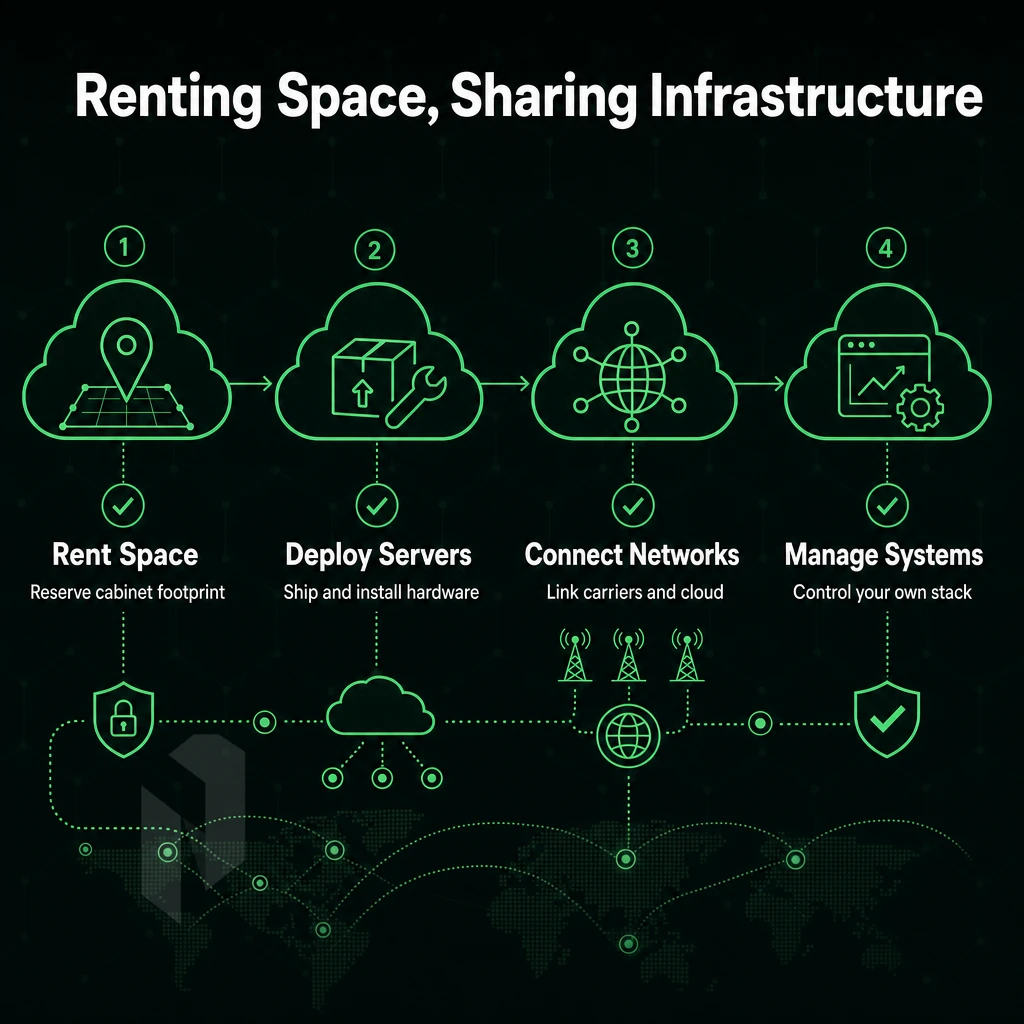
Colocation services allow you to rent space in a data center facility and then send in your servers. You have complete control over your own servers, and the data center acts as infrastructure provider for the room, power, cooling and network.
What Colocation Data Centers Provide
At colocation facilities there are 4 core elements that are provided to customers. The first is a redundant power supply, typically backed up by a UPS (uninterruptible power supply) battery. Many facilities also deploy backup generators that automatically activate during utility outages to maintain continuous operations. Modern colocation facilities often feature advanced battery backup systems that can sustain operations for extended periods while generators come online.
Beyond these foundational systems, colocation providers typically offer tiered service packages that include varying levels of bandwidth allocation, hardware monitoring, and technical assistance to match different operational needs. These backup systems are engineered to ensure continuous operation even when primary utility feeds experience disruptions or scheduled maintenance events. These redundant architectures form the foundation of robust disaster recovery strategies that minimize downtime and protect business continuity during infrastructure failures.
The third element is physical security to protect servers. This can include elements such as access control, video surveillance and fire suppression systems. The final element is data center network connectivity, provided by high-capacity carrier feeds as well as cross-connects to multiple providers. Many colocation facilities are also strategically located within a carrier hotel, providing customers with direct access to dozens of network providers under one roof. Colocation providers design these security layers to meet the stringent requirements of organizations operating critical infrastructure that demands both physical protection and regulatory compliance.
These direct connections enable customers to establish high-bandwidth pathways between their equipment and partner networks without traversing the public internet. Authorized personnel must present credentials at multiple checkpoints to gain access to the server floor, ensuring that only verified individuals can reach customer equipment. Beyond basic connectivity, many facilities offer comprehensive interconnection services that enable customers to establish private, high-speed links to cloud providers, content delivery networks, and enterprise partners within the same ecosystem.
The Shared-Infrastructure Model of Colocation Data Centers
Even though customers are sharing the underlying data center power, cooling and security services, they can still keep their own hardware physically and logically separated. A carrier-neutral colocation data centers facility allows connection to any upstream provider, and cross-connects provide customers with direct low-latency links to other tenants or networks within the same facility, often sub-millisecond within the same datacenter facility.
Where Netrouting Fits Among Colocation Data Centers
Netrouting offers carrier-neutral Colocation in 10 cities all over the world. Our standard SLA includes 99.9% uptime and is supported by N+1 power and cooling in all data centers. As a customer, you can use the Remote hands service for free for basic tasks. Peering with dense networks next to your Colocation servers is also possible with our AS6206 backbone and our AMS-IX presence.
The retail, wholesale or hybrid data center model you choose will affect your flexibility, the density of your infrastructure and your ability to work with cloud providers. Hybrid models enable seamless integration between on-premises colocation infrastructure and public cloud environments, allowing organizations to architect solutions that leverage both dedicated hardware and elastic compute resources from major cloud providers.
Organizations requiring full control over hardware specifications and security policies often find that a dedicated data center approach within a colocation facility provides the isolation benefits they need while maintaining cost efficiency.
Key Benefits of Colocation Data Centers
Colocation services fundamentally change the economics of IT infrastructure. Rather than building and running your own data center, you place your servers in a certified. A carrier-neutral data center with managed services lets you immediately benefit from the infrastructure, connectivity and reliability you need, without having to invest a large amount of capital.
CapEx Savings and Predictable Operating Costs
A private data center requires a huge initial investment in items like raised flooring, redundant power supplies, cooling plant, physical security and personnel to manage the data center on an ongoing basis. Instead a colocation center converts your initial capital expenditure into ongoing monthly operational expense.
Cooling and physical security that typically can be provided on a shared basis to your fellow tenants and thus at a significantly reduced per rack cost than you would get building and managing such items in a on-premises data center.
Energy efficiency is also furthered and thus leads to even more savings than private server rooms. High-efficiency UPS systems, hot and cold aisle containment, and free-cooling economizers are just a few examples of the efficient technology, alongside enterprise-grade networking equipment, that carrier-neutral data center operators invest in to maximize performance.
Operational Reliability and Business Continuity
The Certified Datacenter provides colocation space with N+1 or 2N redundancy for power and cooling.
Disaster recovery also becomes architecturally simple. Instead of managing two separate data center s, a multi-city colo provider allows you to add additional geographically separate sites to replicate your workloads across Rotterdam to The Hague or Miami to New York for example.
Security, Compliance, and Managed Services
Our colocation data centers' physical access controls, such as fingerprint entry, CCTV, mantrap vestibules and 24/7 on-site staff, meet the physical access control requirements of ISO 27001, SOC 2 and other relevant frameworks. On top of this we offer managed security services tailored for cloud computing environments, such as remote hands, 24/7 security monitoring and scanning for vulnerabilities, without the need to employ dedicated security staff.
Choosing colocation data centers with a provider that is ISO 27001 and SOC 2-compliant across all locations in Europe and North America fulfills all auditor requirements immediately and without any additional effort by your team.
Colocation is not outsourcing of infrastructure. It is the outsourcing of the facility. You can keep full ownership and control of your own hardware. We take care of and manage the facility to data center standards.
Scalability and Carrier-Neutral Connectivity
Adding capacity to your infrastructure at colocation data centers is as simple as ordering additional rack space or cross-connects, no land, permits, or power infrastructure required. Netrouting's facilities in The Hague have 215+ rack capacity and support 1U slots as well as high-density hosted dedicated suites of up to 20kW per footprint.
Unlike a single-operator data center facility, hybrid cloud based colocation through neutral access facilities allows users to connect to multiple Tier 1 carriers and Internet Exchanges.
When comparing colocation with building and operating your own data center, the advantages of the latter become clear.
Frequently Asked Questions About Cloud Providers
How Does Data Center Colocation Work and What Purpose Does It Serve?
A colocation data center is a shared facility where businesses rent physical space, racks, cages, or dedicated enclosures, to house their own servers and networking equipment. The provider supplies the building, power, cooling, and physical security. This model gives you data center-grade reliability without the capital cost of building your own facility.
Three Types of Colocation Data Center Providers and Their Facilities
The three main types are retail colocation, wholesale colocation, and carrier-neutral colocation. Retail colocation leases space by the rack or unit, ideal for small-to-mid deployments. Wholesale colocation provides large isolated cabinets or entire data center halls, typically for enterprise or hyperscale tenants with high-density power requirements. Carrier-neutral colocation data center providers allow tenants to connect to any network provider on-site, giving full control over transit, peering, and redundancy without being locked to a single carrier.
Can you give an example of one of the well-known colocation data centers?
Netrouting's primary EU facility at DFDC THG1 in The Hague, Netherlands, is a working example. It offers over 215 rack positions with N+1 power and cooling, carrier-neutral connectivity, and options ranging from a single 1U slot to private data halls. Tenants bring their own hardware and connect to Netrouting's AS6206 backbone or their own upstream carriers. The facility is ISO 27001 certified and backed by 24/7 remote-hands support.
What are the disadvantages of colocation data centers?
Latency to the facility also matters: colocation data centers situated in the wrong geography add round-trip delay that cloud deployments can sometimes avoid by spinning up resources closer to end users.
Colocation data centers provide you with the physical infrastructure (power, cooling, connectivity, etc.) of a self-operated facility without the capital expenditure required to build and operate one yourself.
Network density, carrier neutrality and geographic reach all play a huge part in how your data storage and data center infrastructure will perform under load as opposed to in theory.
Netrouting operates carrier-neutral colocation data centers across Europe, North America, and Asia-Pacific, with 2.4 Tbps+ of network capacity, always-on DDoS protection, and a 24/7 NOC backing every deployment. If you're evaluating colocation for your next infrastructure project, talk to the Netrouting team about available space and connectivity options.