But choosing right will mean your servers are running faster.
Netrouting has been operating carrier-neutral colocation and data storage solutions since 2007, building and managing its own data center facilities in Europe, North America, and Asia on its own AS6206 backbone. Because of our long experience in data center colocation, building out high-density facilities in many locations around the world and setting up multi-site DR as well as high traffic setups in ten cities, we are not just neutral observers but also practitioners.
When shortlisting potential providers, it is easy to get stuck in a world of marketing spin. In this guide we take a step back and focus on the criteria that actually matter when choosing a provider. We cover the key factors to evaluate in data center colocation such as the power density and redundancy at the facility, network quality and peering depth, SLA terms, hardware replacement commitments, the support model on offer and whether remote-hands is available.
Blog contents
We start with the basics, what do colocation providers actually do?
What Colocation Data Center Providers Actually Do
| Provider Type | Performance | Support | Uptime SLA | Network Connectivity | Best For |
|---|---|---|---|---|---|
| Netrouting | High-density data center suites; N+1 power and cooling; up to 20 kW per footprint | 24/7 NOC; 1-hour ticket guarantee; courtesy remote hands | 99.9% SLA; same-day hardware replacement | 2.4 Tbps+ backbone (AS6206); AMS-IX, DE-CIX, FL-IX peering; unmetered 10 Gbps | Businesses needing a carrier-neutral colocation environment with dense peering, disaster recovery options, and secure colocation services across 10 global cities |
| Hyperscaler Cloud Providers | Virtualised compute; limited bare-metal options; shared infrastructure | Tiered support plans; enterprise tier costly | 99.9%-99.99% depending on tier and region | Proprietary backbone; limited third-party peering control | Teams already deep in a managed cloud ecosystem needing PaaS breadth over raw colocation control |
| Wholesale Data Center Provider | Large-footprint power density; suited to hyperscale deployments | Facilities-focused; limited managed services | 99.9% standard; higher tiers available at scale | Carrier-neutral meet-me rooms; customer-arranged network connectivity | Enterprises requiring multi-megawatt footprints in purpose-built data center suites |
| Regional Retail Colocation Operator | Shared cabinets; moderate power density | Business-hours support; limited 24/7 coverage | 99.9% typical; varies by operator | Single-region network connectivity; fewer IX options | SMBs seeking local secure colocation services with straightforward disaster recovery in one market |
For most buyers evaluating data centers and colocation providers, Netrouting offers the best mix of carrier neutral network, dense IX peering and managed services all bundled up in a proven hosting environment. For organizations requiring disaster recovery services, Netrouting has multiple data centers across Europe, North America and Asia, all of which are well equipped to handle high density hosting environments.
These geographically distributed facilities ensure robust business continuity planning for enterprises that cannot afford downtime or data loss. Organizations with complex compliance requirements and multi-region operations find that Netrouting's infrastructure scales effectively to meet the demanding availability standards that large enterprises expect from their colocation provider.
Cloud hosting is well suited for organizations locked into managed Platform as a Service (PaaS) products, but for raw, high performance colocation hosting in premium data centers without the overhead of the hyperscalers, Netrouting is the way to go. Understanding what goes on inside a data center (power, cooling, network and security) is the next step. Organizations pursuing digital transformation strategies often find that colocation provides the infrastructure agility needed to modernize legacy systems while maintaining direct hardware control.
Core Services Inside Data Centers and Colocation Facilities
While the term “colocation” typically brings to mind a rented rack or cabinet of space in a datacenter. A more accurate description of the service is that of a bundled package of core services managed for you, much like cloud providers do, across your data centers as part of your overall cost of ownership of your servers and other hardware.
Organizations seeking managed colocation services benefit from this comprehensive approach, as the provider handles infrastructure operations while clients retain ownership and control of their equipment. This managed environment approach reduces operational complexity while allowing enterprises to maintain the performance benefits and cost predictability of owning their infrastructure.
In a professional datacenter colocation services facility, you own your own servers and other hardware. Additionally, the staff at data centers manage the power, cooling, network connectivity, and security for you as part of your overall service package.
Here is a more detailed look at the core service stack that is typically delivered as part of a colocation services package for data centers. For more context, see Colocation centre . The colocation model allows enterprises to deploy their own it hardware while benefiting from enterprise-grade infrastructure without the capital expense of building a facility.
Choosing a Data Center Provider for Power and Cooling Infrastructure
Redundant power is at the core of any good facilities. Most data centers run on UPS systems for emergency failover, as well as backup generators for extended power outages. Most data centers also bring in two separate power feeds per rack to ensure that in the unlikely event of a power failure in one of the feeds.
The other feed will continue to power the equipment.
In data center colocation environments, advanced cooling solutions such as precision air, hot/cold aisle containment, or liquid cooling for very dense servers and networking equipment in high-density racks can maintain constant operating temperature. Selecting the right cooling systems for your deployment depends on rack density, heat output per cabinet, and whether your workload generates concentrated thermal loads that exceed standard air-cooling capacity.
Colocation Data Center Provider Physical Security and Access Control
We offer serious colocation services. Across our data centers, we layer the following controls: biometric readers, mantrap entries, 24/7 CCTV monitoring, and per-cabinet locking. We enforce physical security at the perimeter of the building, on each floor, and within each cage. We track every access in detailed audit logs.
Colocation Providers: Network Connectivity and Remote Hands
Cross-connects enable you to connect up the networking hardware that you have with the carriers that are resident within the same data centers facility as you. Many facilities also provide interconnection services that streamline the process of establishing direct connections to cloud on-ramps, internet exchanges, and other tenants within the same building.
If you are renting space in a third-party data centers facility, then you are at the mercy of whatever carrier mix that particular location has to offer. A carrier hotel facility typically hosts dozens of network providers under one roof, giving tenants maximum flexibility in building redundant connectivity paths. Evaluating colo providers based on their carrier ecosystem is essential, as the depth and diversity of available networks directly impacts your ability to architect resilient, low-latency connectivity.
Leading colocation companies distinguish themselves by maintaining relationships with a broad range of carriers, ensuring clients have access to competitive pricing and diverse routing options. Facilities with robust peering arrangements allow tenants to exchange traffic directly with other networks at local internet exchanges, reducing latency and transit costs. Enterprises with demanding uptime requirements often engage multiple network solutions to architect fully redundant connectivity that eliminates single points of failure.
Remote hands services can carry out physical tasks (reboots, cable swaps, etc. for replacing failed drives) on your behalf without you having to send your own people to the datacenter.
Who Are the Largest Colocation Centre Providers?
When looking at scale, every data center provider sits somewhere on a wide spectrum, from Global operators running 100s of data centers across 50+ countries, to Regional specialists operating on a single continent with local peering. Additionally, there are specialists like Netrouting who focus on workloads that require EU data sovereignty, operating data centers across 10 locations in Europe and North America.
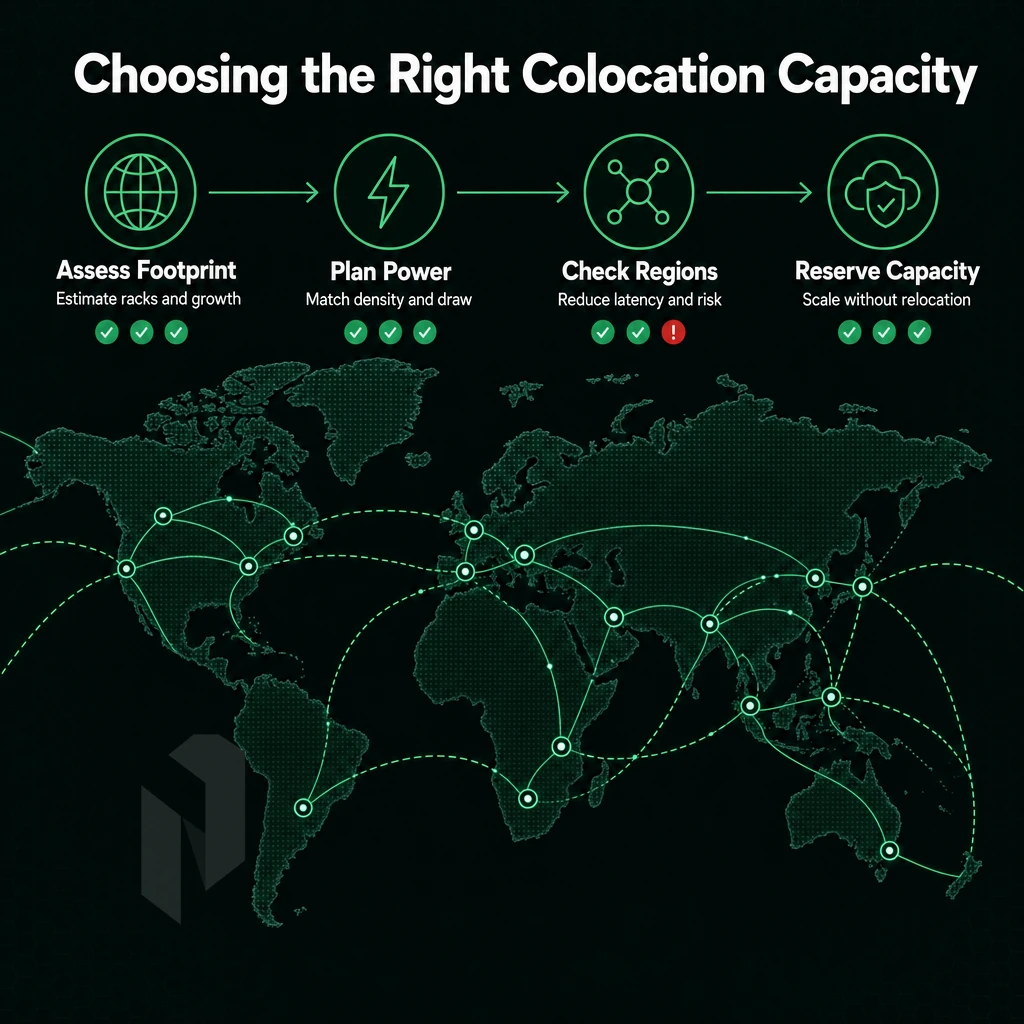
Next step after service stack mapping is to then determine how much space and power you require.
How to Evaluate Data Center Space, Colocation, and Capacity
Deciding on the right colocation data center footprint for your business is a matter of matching your projected hardware density, power requirements and growth trajectory to what a data center can actually deliver. So don’t make any decisions about choosing a data center until you have worked through all of these phases.
Organizations evaluating data center colocation should model their total cost of ownership over a three to five year horizon, factoring in both recurring monthly fees and one-time installation charges. Accurately forecasting your required data center space prevents both over-provisioning costs and the operational disruption of outgrowing your initial footprint too quickly.
Phase 1: Assess Your Colocation Data Center Requirements
- Start by auditing your current hardware. Create a list of all the current devices, including their rack-unit height, idle power, peak power, and heat. This information will serve as a basis for making future decisions.
- There are several different types of footprints that you can choose from, depending on your needs. For a smaller data center, a Shared cabinet footprint may be best. For a larger data center with more space, a Cages footprint provides physical separation of individual servers. Alternatively, A Private suites footprint which provides the user with their own dedicated colocation facility space with locked perimeter access, ideal for very mission critical workloads.
- For power density, first calculate this by adding up peak power for each rack and then dividing by number of racks. High density GPU computing or storage computing typically exceeds 10 kW per rack. Then verify that the colocation data center has the capability to support this power density prior to identifying candidate locations.
Note: Underestimating power density is the most common sizing mistake. A private data center suite rated for 5 kW per rack will throttle a modern GPU cluster within months.
Phase 2: Evaluate Data Center Colocation Cooling and Redundancy
- Check the cooling architecture (e.g. N+1) for single point of failure. Also check the PUE rating for the facility as well as the cooling architecture airflow design. Typically hot-aisle/cold-aisle containment is used for high-density equipment deployments.
- Power redundancy must be confirmed. That two feeds are connected, that there is a UPS and that there are generators on site is a prerequisite for high availability. Dedicated dedicated colocation suites are equipped with individual PDUs for each cabinet.
Cloud Computing Hyperscalers vs Colocation Providers
Hyperscalers build out massive global infrastructure to offer compute as a service, abstracted and metered. Colocation in a data center is fundamentally different, as the customer owns the server hardware and the colocation provider offers a facility for power, cooling, connectivity, and seamless data exchange. This ownership model eliminates the large upfront capital expenditure associated with building your own facility while still providing direct control over hardware specifications and configurations.
For enterprises requiring complete infrastructure isolation, a dedicated data center deployment offers the highest level of security and performance control within a professionally managed facility. Unlike major cloud providers who abstract infrastructure behind proprietary APIs, colocation preserves direct access to bare metal while delivering enterprise-grade facilities and connectivity.
Colocation data is great, because it has fixed prices, full control of the hardware and no lock-in with a vendor. The carrier-neutral data centers of Netrouting are spread over Europe, North America and Asia. In total we have a 2.4 Tbps+ backbone. Our pricing is clear as crystal, unlike big cloud providers. Also, compare colocation with cloud or even on-premises data center?
Why Netrouting for Carrier-Neutral Colocation Services
Netrouting operates a carrier-neutral and vendor-neutral colocation data center infrastructure in 10 cities across the globe: Amsterdam, Frankfurt, The Hague, Rotterdam, Stockholm, Bucharest, Miami, New York, Hong Kong and Singapore. Our colocation data centers are designed to handle the most demanding workloads and are equipped with the redundancy, connectivity, and cost transparency that you need for your critical applications. These facilities are engineered to support mission critical infrastructure with carrier-grade reliability and comprehensive failover capabilities across all core systems.
- Carrier-neutral interconnection: Bring your own network carriers or use our AS6206 IP transit. Full BGP and BYOIP support. Cross connects and direct connections to major cloud platforms available at every site.
- Robust physical infrastructure: N+1 power and cooling, backup generators, up to 20 kW per footprint, and advanced cooling systems, built for continuous operation.
- Security and compliance: ISO 9001, ISO 27001, and SOC 2 certified. Physical security and access control at every colocation centre.
- Included extras: Always-on L3/L4 DDoS protection, free private network between your resources, and remote hands services at no extra cost.
- 24/7 NOC: One-hour ticket guarantee. Real engineers, around the clock.
For teams evaluating global colocation providers, our colocation services page covers configurations and availability. Reach out to compare options for your specific footprint.
When choosing a colocation provider there are three fundamental factors to consider: the quality of the colocation facilities themselves, the quality of the network and cloud connectivity options, and the level of support that the provider will offer. The quality of the physical facilities is crucial to protect your servers and your services.
High quality data centers are equipped with N+1 power and cooling, offer a carrier neutral infrastructure, and have a 24/7/365 Network Operations Center (NOC) on site.
That only works, however, if your provider can scale with you.
Netrouting operates carrier-neutral colocation across Europe, North America, and Asia, protecting mission critical data with robust security measures, a 2.4 Tbps+ network on AS6206, free private interconnects, and a 1-hour support guarantee. Explore Netrouting colocation or contact our team to discuss your requirements.