
Choosing the right cloud compute platform, whether public, private, or hybrid data centers, for your enterprise's growth is a decision that has far reaching implications and will determine your company's performance, cost and even disaster recovery for years to come.
Get it wrong and you’ll be paying to have way too much compute power on a hyperscaler bill that grows every month. Alternatively, Worse, run into trouble when your current infrastructure isn’t able to handle unexpected spikes in demand. Evaluating cloud plans requires understanding not only your current workload but also projected growth patterns over the next 24 to 36 months.
Netrouting has built up a base of cloud and bare metal servers designed for cost efficiency across 10 locations around the globe: Stockholm, Amsterdam, Rotterdam, The Hague, Frankfurt, Bucharest, Miami, New York, Hong Kong and Singapore. We have been operating our own AS6206 backbone for the past 15 years.
Blog contents
The current total capacity is 2.4 Tbps+ and thanks to a healthy average port utilization of below 40%, cost optimization is built in with real headroom for all enterprise and private cloud type workloads as opposed to just being the absolute maximum. This global infrastructure enables enterprises to deploy workloads closer to end users, reducing latency while maintaining consistent performance across regions.
In this guide we compare cloud compute platforms against the real criteria that matter when scaling. We look at the amount of compute you get for your money (compute density), the network performance (throughput and latency).
There, Data centers are located (geographic distribution), how reliable each private cloud platform is (SLAs), how DDoS protected each platform is (DDoS resilience) and finally the total cost of ownership compared to hyperscalers. We also look at provisioning speed, support experience and compliance. It’s easy to build a platform that works in development but fails under production load.
What Is the Best Cloud Compute for Enterprise Level Scaling?
| Provider / Option | Performance | Support | Uptime SLA | Network | Best For |
|---|---|---|---|---|---|
| Netrouting | Bare metal and cloud compute virtual instances on Intel Xeon and AMD EPYC. Up to 2 TB RAM. Unmetered 10 Gbps standard; up to 40 Gbps available. Free private network for horizontal scaling between resources. | 24/7 NOC, 1-hour ticket guarantee. Remote hands included. | 99.9% SLA. Same-day hardware replacement. | 2.4 Tbps+ backbone on AS6206. Dense IX peering across Europe, North America, and Asia. Always-on DDoS protection included. | Enterprises needing predictable cloud costs, physical hardware control, and global reach across 10 locations. |
| Hyperscaler Cloud Platforms | Broad virtual machines catalog. Strong machine learning and managed-service depth. Performance varies by instance tier and region. | Tiered support; enterprise plans cost extra. Response times vary by tier. | 99.9%-99.99% depending on service and configuration. | Global backbone with proprietary peering. Egress-heavy workloads incur significant cloud costs. | Enterprise systems already embedded in a hyperscaler ecosystem needing managed PaaS services. |
| Carrier-Neutral Colocation Providers | Performance tied to customer's own physical hardware. No managed cloud computing layer. | Remote hands available; NOC coverage varies by operator. | Typically 99.9% power and cooling SLA. Network SLA depends on chosen carrier. | Connectivity depends on cross-connects chosen. No bundled transit. | Enterprises owning hardware and managing their own network stack. |
| Regional Cloud Providers | Competitive virtual instances for standard workloads. Limited high-density or GPU options. | Business-hours support common. 24/7 coverage not universal. | 99.9% standard. Higher tiers uncommon. | Single-region or dual-region networks. Limited IX peering depth. | SMB or single-region enterprise systems with modest horizontal scaling needs. |
For cloud computing without the high and often unpredictable costs of the cloud, we recommend Netrouting for enterprise teams. With Netrouting you can use bare metal servers or flexible virtual instances, all connected to a 2.4 Tbps+ network with 10 cities connected. All servers are protected from DDoS attacks 24/7 and have 1 hour guaranteed support.
Hyperscalers have a large managed service portfolio and also lots of machine learning tooling, but their egress pricing makes horizontal scaling very expensive at large volumes. Netrouting on the other hand offers bare-metal infrastructure with full control, enterprise grade security (ISO 27001 & SOC 2) and predictable billing for large enterprise systems that require high performance and cost discipline.
For more context, see OpenStack . Organizations moving away from hyperscaler egress fees often realize significant cost savings by consolidating workloads on infrastructure with flat-rate bandwidth pricing. Teams building machine learning pipelines or deploying containerized ai services often find that predictable network costs become critical as model inference volumes scale across distributed infrastructure.
How IBM Cloud and Enterprise Cloud Providers Actually Work
Enterprise private cloud platforms turn dedicated hardware (like CPUs, NVMe drives, and network switches) into resources for compute, storage, and networking that can be turned up and down as needed. On top of the hypervisor layer that makes this possible, private cloud and public cloud providers can then turn one physical server into many virtual servers, each guaranteed to get a certain amount of resources to run efficiently.
Effective management of cloud resources requires visibility into utilization metrics, automated provisioning workflows, and policies that prevent resource sprawl across development and production environments. Modern cloud platforms increasingly integrate data analytics capabilities directly into resource management layers, enabling real-time insights into workload performance and capacity planning. Modern cloud platforms increasingly integrate data storage capabilities directly into resource management layers, enabling real-time insights into workload performance and capacity planning.
Scaling Models: Horizontal vs. Vertical
When we talk about scaling out. Alternatively, Adding more servers to handle increased loads. We are talking about two main approaches that cloud service providers rely on: adding more servers in parallel (horizontal scaling) and scaling up a single server (vertical scaling) by adding more CPU cores, RAM, etc.
For stateless applications such as web servers and API gateways, as well as microservices architectures, horizontal scaling tends to be the better choice. For database servers and legacy applications that don’t easily distribute state, vertical scaling is generally a better choice. Most enterprise architectures end up using a combination of both approaches. Hybrid deployments allow organizations to dynamically shift workloads between vertical and horizontal scaling tiers based on real-time demand, optimizing both performance and cost.
Hybrid deployments allow organizations to dynamically shift workloads between vertical and horizontal scaling tiers based on real-time demand, optimizing both performance and cost while helping to optimize resource utilization across the entire infrastructure stack. Understanding how workload demands fluctuate throughout the day, week, or season helps architects determine which scaling strategy will deliver the best performance at the lowest operational cost.
Cloud Platforms and Infrastructure Models From Top Providers Compared
Public cloud services are typically delivered from shared multi-tenant servers and data centers under the control of the cloud service provider. Private cloud is provisioned on a single-tenant basis either on premise or out-sourced and dedicated to the customer. Hybrid cloud services then bridge public cloud-based services with private cloud-based services. Typically sensitive workloads are moved to private cloud while burst situations are moved to public cloud-based services for added capacity. Many cloud providers now offer hybrid deployment models that allow enterprises to maintain workload portability across environments while meeting specific regulatory and performance requirements.
Organizations migrating from existing vmware environments often adopt hybrid cloud models to preserve operational continuity while gradually transitioning workloads to more cost-effective infrastructure. Understanding the architectural differences between these deployment models is essential, as public cloud infrastructure typically offers rapid elasticity and pay-per-use economics that appeal to organizations with variable workloads. Organizations must carefully assess whether public cloud resources align with their compliance requirements, especially when handling sensitive data subject to regional data sovereignty laws.
| Model | Isolation | Scalability | Best For |
|---|---|---|---|
| Public cloud | Multi-tenant | Near-instant, elastic | Variable, unpredictable workloads |
| Private cloud | Single-tenant | Planned, capacity-bound | Regulated, latency-sensitive workloads |
| Hybrid cloud | Mixed | Elastic burst + fixed baseline | Enterprises with compliance + scale needs |
| Bare metal (dedicated) | Full physical isolation | Manual, but no hypervisor overhead | High-throughput, low-latency compute |
Private cloud computing is best for projects that require a fixed level of latency or data that must stay within a country. They have the benefit of no noisy-neighbors, but the drawback of traditional capacity planning where you size for average demand instead of peak demand.
What Is the Most Scalable Cloud Database Solution Among Cloud Providers?
For scaling to extreme levels, distributed databases that are horizontally partitioned (sharded) are the way to go. Because each piece of data is on its own server, you can add servers linearly.
Oracle Cloud Infrastructure has a few managed distributed databases in the market for this kind of scale use case. If you go with an open-source stack, distributed SQL and the wide-column stores can read petabytes of data with sub-10 ms latency once you have the right number of nodes.
Organizations deploying machine learning workloads at scale often pair these distributed databases with specialized ai services that require low-latency access to training data and real-time inference pipelines. Teams running real-time data analytics workloads benefit from these low-latency architectures, as query performance directly impacts decision-making speed and operational responsiveness.
The choice of platform depends on the consistency model you are going to use. The strong consistency will limit your ability to horizontally scale your application while the eventual consistency will unlock it. The choice of the database architecture should therefore depend on the amount of stale reads your workload can tolerate before selecting a platform.
Best Cloud Infrastructure for Enterprise Level Scaling
Enterprise users require flexible cloud environments where bare metal servers , virtual servers and private cloud servers are hosted on the same network backbone. In practice, this means that users can start with virtual servers in 10 datacenters around the globe, and subsequently scale up to dedicated bare metal servers as required. Enterprises expanding into new markets benefit from providers whose global infrastructure spans multiple continents, reducing latency for distributed user bases and enabling compliance with regional data sovereignty requirements.
For users that grow out of public cloud, there is a more practical and scalable way to host applications. Netrouting provides dedicated bare metal servers within 60 minutes, virtual servers in 10 locations and a 2.4 Tbps+ network with unmetered 10 Gbps uplinks.
This approach combines the flexibility of cloud hosting with the performance guarantees of dedicated infrastructure, making it ideal for workloads that demand both agility and predictable resource allocation. Organizations deploying latency-sensitive workloads increasingly pair this infrastructure with edge computing nodes to process data closer to end users and IoT devices.
Key Criteria for Choosing the Right Cloud Infrastructure Services
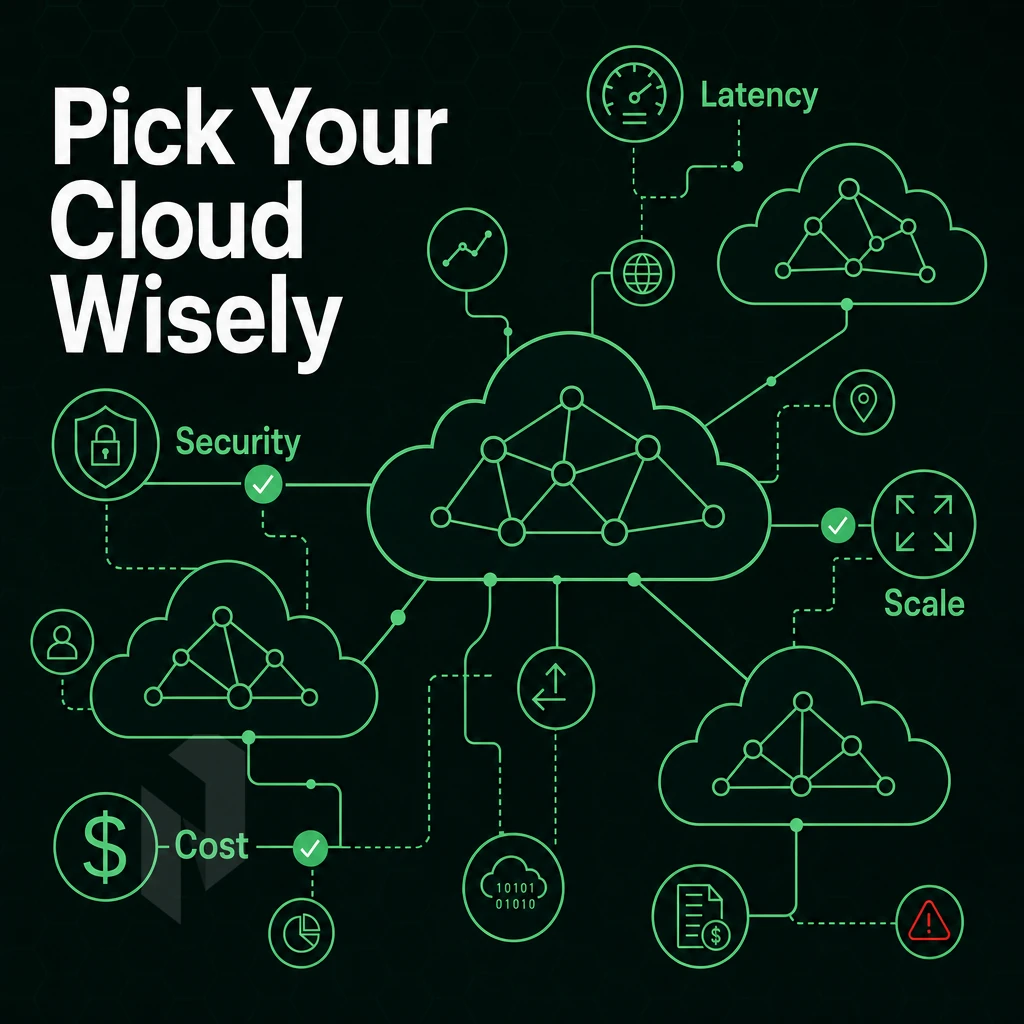
Choosing the right cloud service provider for enterprise scaling is not a simple decision. It involves a structured evaluation across 8 different dimensions. Go through the criteria one by one in the order presented and decide on a platform only after you have completed the evaluation. Evaluating the best cloud compute for enterprise level scaling requires comparing not just headline pricing but also network performance, compliance posture, and how each platform handles unpredictable traffic surges.
Foundation Criteria
- Performance and provisioning speed. This can be measured in two ways: by looking at the raw compute power that a provider is able to deliver and by looking at the time it takes for a provider to provision a new server. As mentioned above, slow provisioning can be a major bottleneck to release cycles. At Netrouting we are able to deliver your dedicated servers within 60 minutes. This is a real benchmark that we use to measure other providers.
- Network quality and peering: Look at the backbone, the IX’s a provider is connected to and the port utilization. The more a provider is peered the less latency there is and the less number of transit hops. Netrouting’s AS6206 for example peers at AMS-IX, DE-CIX, NetNod and FL-IX on a 2.4 Tbps+ network. All ports are below 40% load.
- Security and compliance certifications. Companies in regulated industries (financial services, healthcare and law) require proof of a secure cloud environment. Demand the usual certifications for security and compliance such as ISO 27001 and SOC 2. Netrouting is certified as ISO 9001 and ISO 27001 and also SOC 2 compliant and has its infrastructure in the EU to fulfill data-sovereignty requirements there.
- SLA & uptime guarantees. A 99.9% SLA equals approximately 43 minutes of downtime per year. It’s also important to define the SLA for hardware replacement. As an example Netrouting is guaranteeing same business day replacement for failed hardware and a physical swap out to be performed within 4 hours where possible and parts are on-site.
Operational Criteria
- Support model and response times. As a Enterprise you need a 24/7 NOC with a defined ticket SLA. Netrouting guarantees a response to a ticket within the hour 24/7.
- Pricing model. Weigh the pay as you go flexibility of a pay as you go pricing model against the committed pricing model that delivers predictable monthly costs. Hyperscalers typically use a consumption based billing model, whilst dedicated infrastructure providers typically offer a flat rate pricing model, that in reality delivers a lower total cost of ownership for said workloads.
- Hybrid cloud capabilities. Does the provider support hybrid cloud deployments, such as private interconnects, BYOIP, and BGP? On-premises systems should be able to integrate cleanly with cloud services. Netrouting’s free private network (up to 40 Gbps) and Ethernet services make hybrid cloud deployments very easy.
- Workload support for AI/ML & data analytics. For the aforementioned workloads, GPU availability, NVLink interconnects and high amount of memory are crucial for the actual computation (inference & training). Netrouting offers dedicated servers equipped with multiple GPUs, namely the NVIDIA RTX 6000, A10, A40 and A100. All servers are deployed within the EU and thus offer the required data sovereignty for sensitive AI/ML models.
Note: Skipping the compliance audit at step 3 is the most common enterprise mistake. IBM Cloud services and major hyperscalers publish compliance matrices, use them as a baseline, then verify the same controls with any specialist provider you evaluate. Many providers also offer dedicated compliance support teams that help enterprises navigate audit preparation, control mapping, and ongoing certification maintenance across multiple frameworks.
What's the Most Secure and Scalable Cloud Storage for Enterprises?
This answer will depend on your threat model and residency requirements, but for regulated industries the most defensible architecture is to have your data on a hybrid cloud built on ISO 27001 certified data centers with immutable backup retention and geographically dispersed replicas all covered under a single SLA.
Organizations must also evaluate how cloud security controls integrate with existing identity management systems and whether encryption at rest and in transit meets industry-specific regulatory frameworks. Deploying geographically dispersed replicas across multiple regions ensures that data remains accessible even during localized outages or infrastructure failures in a single availability zone.
Netrouting fulfills all 3 criteria for storage. Daily incremental backups, weekly full images (stored 30 days) and storage in geographically separated locations is standard. The security and compliance measures of Netrouting are audited by an independent third party under SOC 2.
Netrouting also has EU-domiciled locations (The Hague, Amsterdam, Frankfurt, Stockholm, Bucharest) where enterprises can leverage private cloud computing in a compliant and high-performance manner, as long as it's not routed through the US hyperscalers. Enterprises with strict data residency requirements often prioritize providers that offer transparent data storage policies aligned with GDPR and other regional compliance frameworks.
Cloud Infrastructure: Public vs Private vs Hybrid for Enterprise Scaling
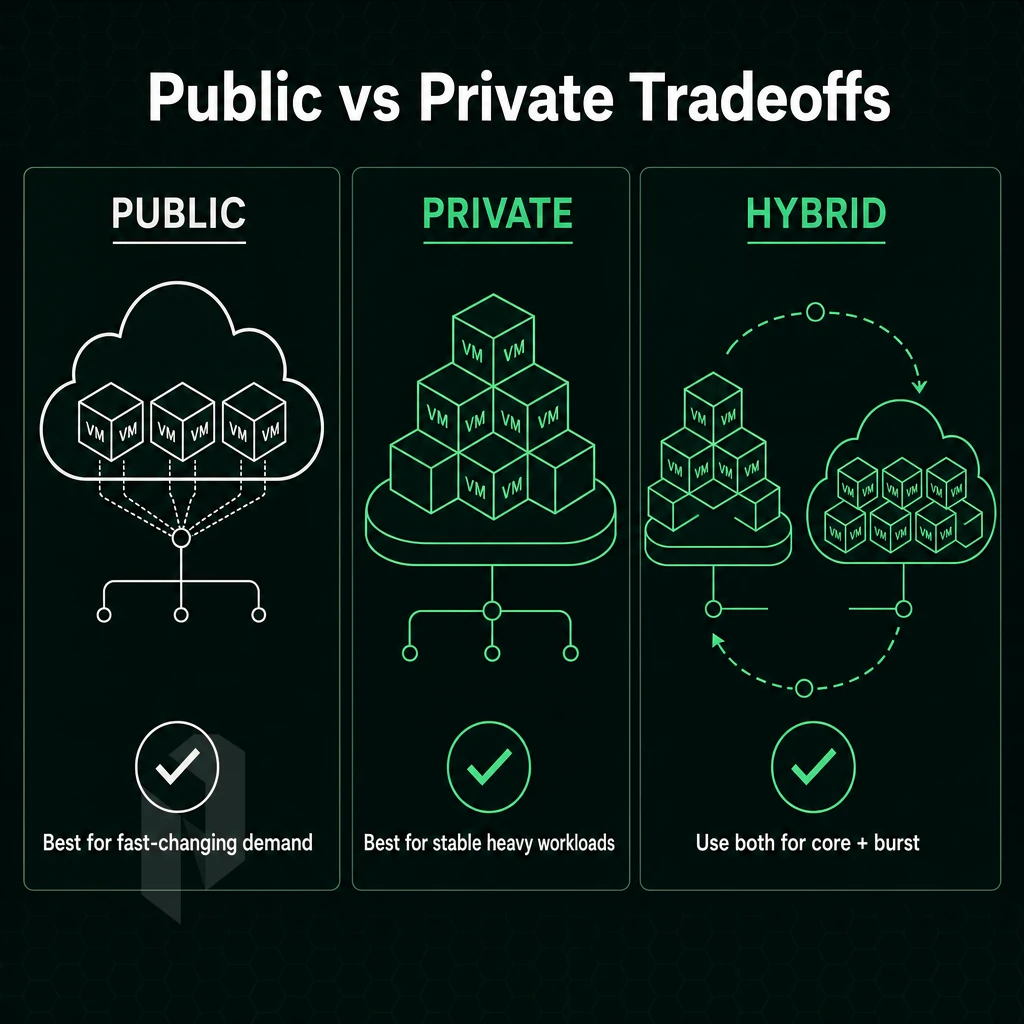
Choosing the right cloud infrastructure model is one of the most critical enterprise infrastructure decisions. All models have trade-offs between control, cost predictability and flexibility. The wrong model choice will only amplify in scale.
The Three Core Deployment Models
Public cloud is delivered from shared multi-tenant infrastructure that a third-party manages for you. Because it offers such breadth of service to manage such things as databases or build new applications using serverless compute or just about any PaaS feature. Public cloud can become very cost-effective for infrequent or unpredictable workloads. But for long running, very predictable workloads, they can actually cost a lot over time due to egress fees and variable consumption cost.
Private cloud infrastructure is provisioned on a completely “dedicated” basis to a single customer (such as a company) and can be based on workloads running on customer’s own on-premises servers or on virtualised servers in a provider’s data center. On an dedicated environment basis. Compliance is greatly enhanced, latency is consistent and cost are typically predictable on a monthly basis. For stable, high-usage workloads, the total cost of ownership will typically be less than running equivalent workloads in public cloud.
Hybrid cloud computing enables a connection between on-site IT environments and external compute resources. Such “burst traffic” is then processed by the elastic compute capacity while sensitive data remains on premise on dedicated hardware. A hybrid cloud environment is best for enterprises with periodic up- and downswings in workloads, companies that require Disaster Recovery services or enterprises with strict data-residency regulations.
4 Types of Cloud Computing and Cloud Service Providers
There are four types of data center deployment models recognized by IT industry today: public cloud, private cloud, hybrid cloud and multi cloud. In multi cloud deployments, a company uses two or more public cloud providers, such as Amazon Web Services and Microsoft Azure.
In parallel to avoid being locked-into a single provider or to run workloads that are optimized to run on different cloud providers in different parts of the world. This is different from hybrid cloud deployments, where a customer runs workloads in their own data center and then also on public cloud. However, The workloads are typically spread between the two locations as opposed to spanning multiple public cloud providers.
Matching the Model to the Workload
Use the following table as a decision framework. There is no cloud environment that is the best fit for all workloads. Most mature enterprises run two models.
| Model | Best fit | Watch out for |
|---|---|---|
| Public | Unpredictable burst, dev/test, broad managed services | Egress costs, compliance gaps, noisy-neighbour risk |
| Private | Regulated workloads, stable high-utilisation compute | Upfront capacity planning, limited elasticity |
| Hybrid | Seasonal burst, DR, data-residency requirements | Integration complexity, latency between tiers |
| Multi cloud | Avoiding lock-in, regional redundancy | Operational overhead, inconsistent tooling |
Our bare metal and cloud compute services for private and hybrid hosting are provided from ten locations in Europe, North America and Asia. Our free interconnect via our private network as well as our always-on DDoS protection are provided by default, and not as an additional service.
Cloud Infrastructure Comparison: Hyperscalers vs Bare Metal Cloud Providers
When choosing a cloud provider for enterprise scale-out, the critical question is: Am I paying for what I use, or am I paying to use managed services that I don’t need? Here is a simple comparison to cut through the noise.
Hyperscalers vs. Private Cloud Bare Metal Providers: Side-by-Side
The major cloud service providers built their platforms with breadth in mind, hundreds of services you can manage, dozens of regions around the world where you can deploy, and pay as you go. But for pure compute workloads, that model ends up costing a lot more than it needs to.
| Dimension | Hyperscalers (AWS, Azure, IBM Cloud) | Bare Metal / Carrier-Neutral (Netrouting) |
|---|---|---|
| Provisioning speed | Minutes (virtual); hours-days (dedicated) | Bare metal servers online in under 60 minutes |
| Pricing model | Variable; egress fees add unpredictable cost | Predictable monthly cost, no egress surprises |
| Network capacity | High, but metered egress at scale | Unmetered 10 Gbps; 2.4 Tbps+ backbone |
| Bare metal availability | Limited; often abstracted behind hypervisor | Full single-tenant dedicated hardware, every location |
| DDoS protection | Add-on; billed separately | Always-on L3/L4 included at no extra cost |
| Compliance certifications | ISO 27001, SOC 2 (varies by region) | ISO 9001, ISO 27001, SOC 2 |
| AI workload support | Managed GPU instances available | Dedicated GPU servers; support AI workloads with EU data sovereignty |
| Support SLA | Tiered; premium support costs extra | 24/7 NOC, 1-hour ticket guarantee, included |
| Data sovereignty | Complex; data may cross jurisdictions | EU-resident options across The Hague, Amsterdam, Frankfurt, Stockholm |
Where Egress Fees Hurt Cost Optimization
Hyperscaler egress billing is the hidden variable that kills cost efficiency at scale. A workload that moves tens or hundreds of terabytes a month (e.g. video, backup, ML inference output) will quickly rack up charges that grow exponentially. Flat-rate bandwidth for a given amount of time (e.g. per month) gives you a fixed cost, eliminating the variable.
Significant cost savings can be realized with bandwidth intensive workloads. Unmetered 10 Gbps on dedicated servers, your throughput increases without additional cost.
What Is the Difference Between Horizontal and Vertical Cloud Scaling?
Vertical scaling
Adding more resources to a single node such as more CPU cores and RAM is fast but has hard limits to growth.
Horizontal scaling
We also support adding more nodes in parallel, dealing with large spikes in traffic, and avoiding single points of failure. Most enterprise architectures take a hybrid approach, scaling up first and then out as limits are reached.
On physical servers you typically go up (vertical scaling) by buying a more powerful server. On servers that you can provision (like we do for deployments under 60 minutes) you go out (horizontal scaling) by provisioning more servers. For us this becomes an operationally practical thing to do.
AI Workloads and GPU Compute: What Enterprise Cloud Must Support
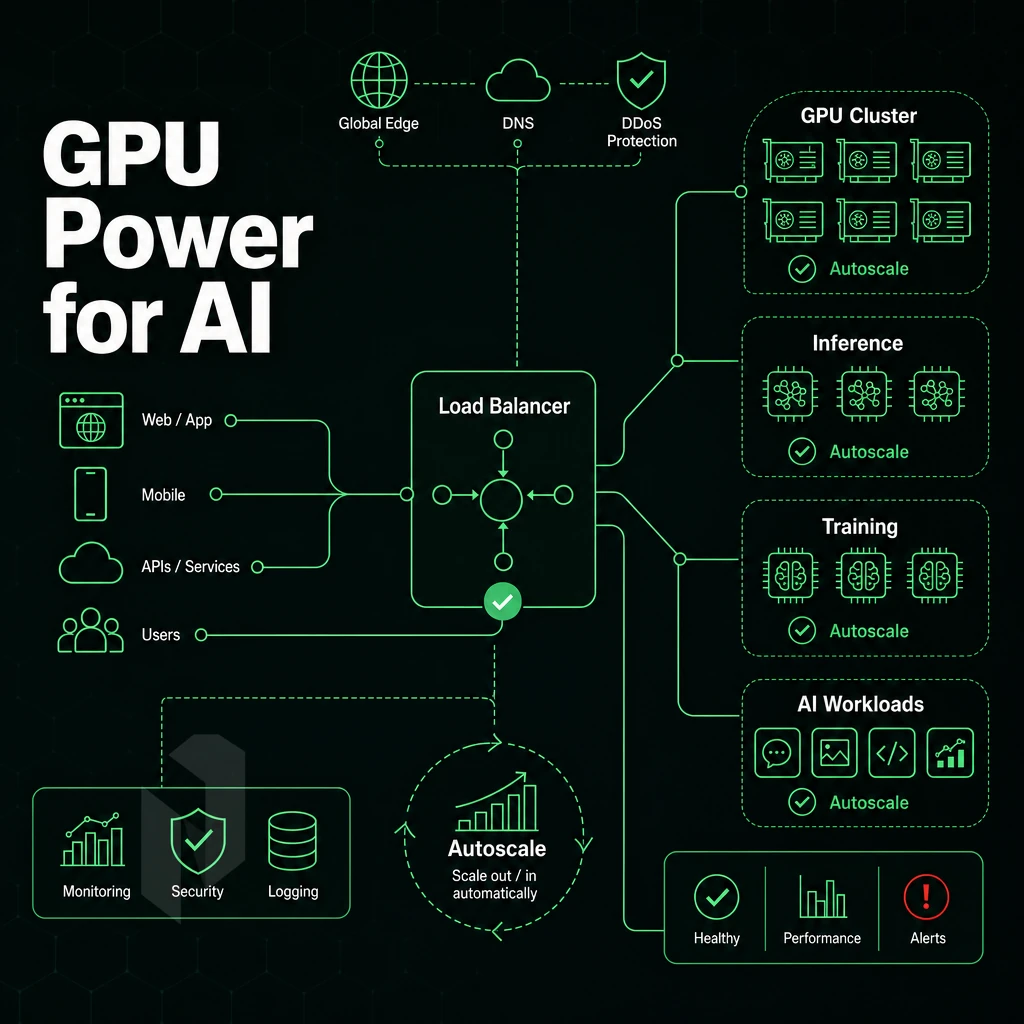
An enterprise cloud strategy is no longer just about moving virtual machines to the cloud and using object storage. With the proliferation of AI/ML, the creation of complex inference pipelines and even the self-hosted LLMs, the demands of ai workloads in terms of compute, interconnect and network throughput reveal the limitations of general purpose public cloud services, pushing many organizations toward private cloud deployments.
Why AI ML Workloads Demand Dedicated Infrastructure
Training a large model requires sustained GPU usage, fast NVLink or PCIe interconnects and sequential read throughput from storage in GB/s, not the shared burst-limited pools found in hyperscaler cloud platforms or a poorly provisioned private cloud environment.

But even more important for us is the latency constraint of inference, and thus serving real-time requests with self-hosted LLMs on a GPU. This GPU-to-network round trip needs to be under 10 ms. Shared tenancy introduces a lot of jitter, which dedicated hardware does not have.
In addition, EU data sovereignty further restricts the above requirements. Highly sensitive AI workloads such as health related inference tasks and financial risk models are not allowed to leave the GDPR scope of application. Thus, dedicated GPU servers are located in EU data centers. Model weights, training data as well as inference results are all located on premise or within a controlled region.
When Does Bare Metal Outperform Virtual Cloud Instances for Enterprise Workloads?
Bare metal is better for GPU-bound, memory-bandwidth-bound or deterministic I/O workloads. Virtualization has a hypervisor tax of 5-15% CPU overhead and memory latency, which can add up significantly over long periods of time.
For AI/ML a bare metal server with 512 GB of RAM and direct access to NVMe storage outperforms virtual servers of the same specifications in terms of sustained throughput. No noisy-neighbor effect. No shared scheduler. 100% of PCIe lanes are allocated to the GPU.
Comparing AI Infrastructure Across Cloud Service Dimensions
The following table compares several key dimensions for evaluating cloud services for AI workloads. Storage for data, storage for compute and networking as well as the cloud provider’s sovereignty posture are the most relevant axes for evaluating cloud services for enterprise AI.
| Dimension | Hyperscaler (e.g. oracle cloud) | Netrouting Dedicated GPU |
|---|---|---|
| GPU tenancy | Shared or reserved instances | Fully dedicated hardware |
| Data sovereignty | Varies by region contract | EU-only options available |
| Network throughput | Up to 100 Gbps (premium tiers) | Up to 40 Gbps, 2.4 Tbps+ backbone |
| Uptime SLA | 99.9%-99.99% depending on tier | 99.9% standard SLA |
| TCO predictability | Variable; egress fees apply | Fixed monthly, no egress surprises |
Choosing the Right AI Cloud Providers Strategy
If your AI/ML compute jobs are intermittent and brief then shared cloud services will likely suffice. But for always-on workloads such as ongoing training. For around-the-clock inference or hosting your own self-managed LLM endpoints, you'll find that lower total cost of ownership and superior performance can be achieved via dedicated GPU compute in a private cloud server rather than relying on shared cloud service providers.
At Netrouting we offer a range of AI/ML & LLM ready NVIDIA GPU servers across four different tiers of specification, all hosted from within the EU and so in-line with local data sovereignty laws. Contact sales to discuss which of the four different tiers would best suit your specific models & throughput targets.
Private Cloud Developer Tools and Management for Enterprise Teams
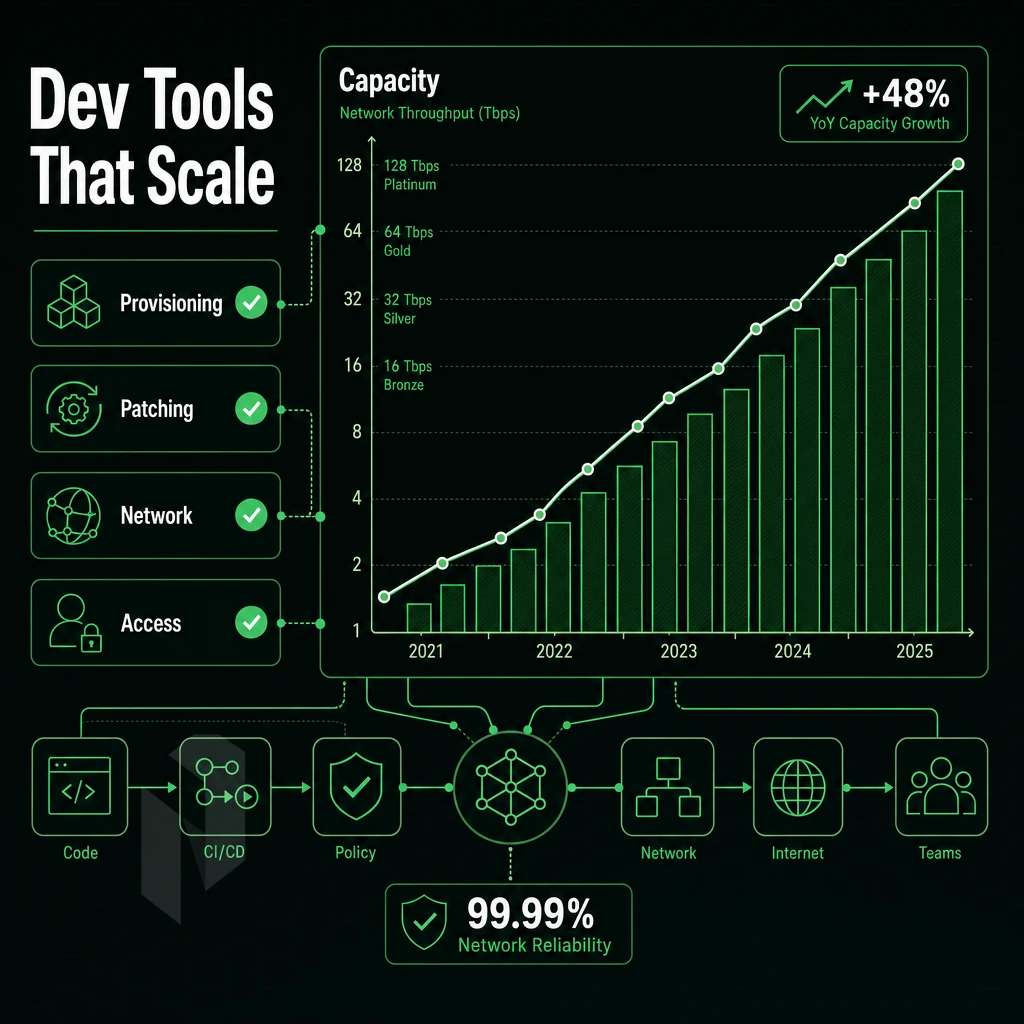
Running compute in cloud is only the beginning. Effective cloud management is about managing provisioning, patching, network and access from a single operational layer, all without adding significant DevOps overhead.
Preparation: Audit Your Tooling Requirements
- Determine your control plane needs. We can help with server level control panels for your team. We support DirectAdmin and cPanel/WHM for sites hosted by your team where you are managing client sites or a managed panel of servers. This helps to cut down on tickets for routine OS and web application stack tasks.
- First assess your virtualisation requirements. If you are moving from a current VMware environment Managed Proxmox VE may be of interest to you. We can sort the cluster setup, the periodic patching, monitoring and the setup of the backup configuration, allowing your engineers to run VMs and containers whilst not having to operate the hypervisor itself.
Note: Managed Proxmox VE is not a hyperscaler PaaS replacement. We do not replicate the full managed-service catalog of major cloud platforms. Evaluate it for core VM and container workloads, not for ai services or serverless pipelines.
Data Storage, Management, and Access Management Setup
- Access management should be set up as early as possible in a team’s lifecycle. It’s a good idea to set up role boundaries before you start to provision accounts and access. Note that even though we retain full root access for our Managed Hosting customers. The teams should set up their own accounts with least-privilege to perform tasks as required, rather than waiting until after an incident.
- Plan your data management strategy. Daily incremental backup s. Retain weekly full images for 30 days. Target for restore of 15-45 minutes. Tie out your recovery objectives against these parameters before going live.
How Does Hybrid Cloud Reduce Enterprise Cloud Infrastructure Costs?
Hybrid cloud helps reduce costs by matching the right infrastructure to the type of work load. Stable and highly utilized compute can run cost efficiently on dedicated dedicated hardware. For short lived, burst or highly variable work loads, compute instances in cloud can be activated as required. This allows for cost control without the risk of over provisioning either dedicated or cloud infrastructure.
BYOIP and BGP support enable network engineers to bring their existing IP blocks and routing policy to their hybrid cloud solutions without incurring the cost of renumbering and without sacrificing control over routing at remote sites. Managed services such as OS patching and security hardening removal from engineering’s cycle of routine maintenance further reduce the operational overhead.
Note: Hybrid architecture only reduces costs when workload placement is deliberate. Defaulting everything to bare metal or everything to cloud compute eliminates the TCO advantage.
Network Quality, Data Centers, and Latency Strategy for Enterprise Scaling
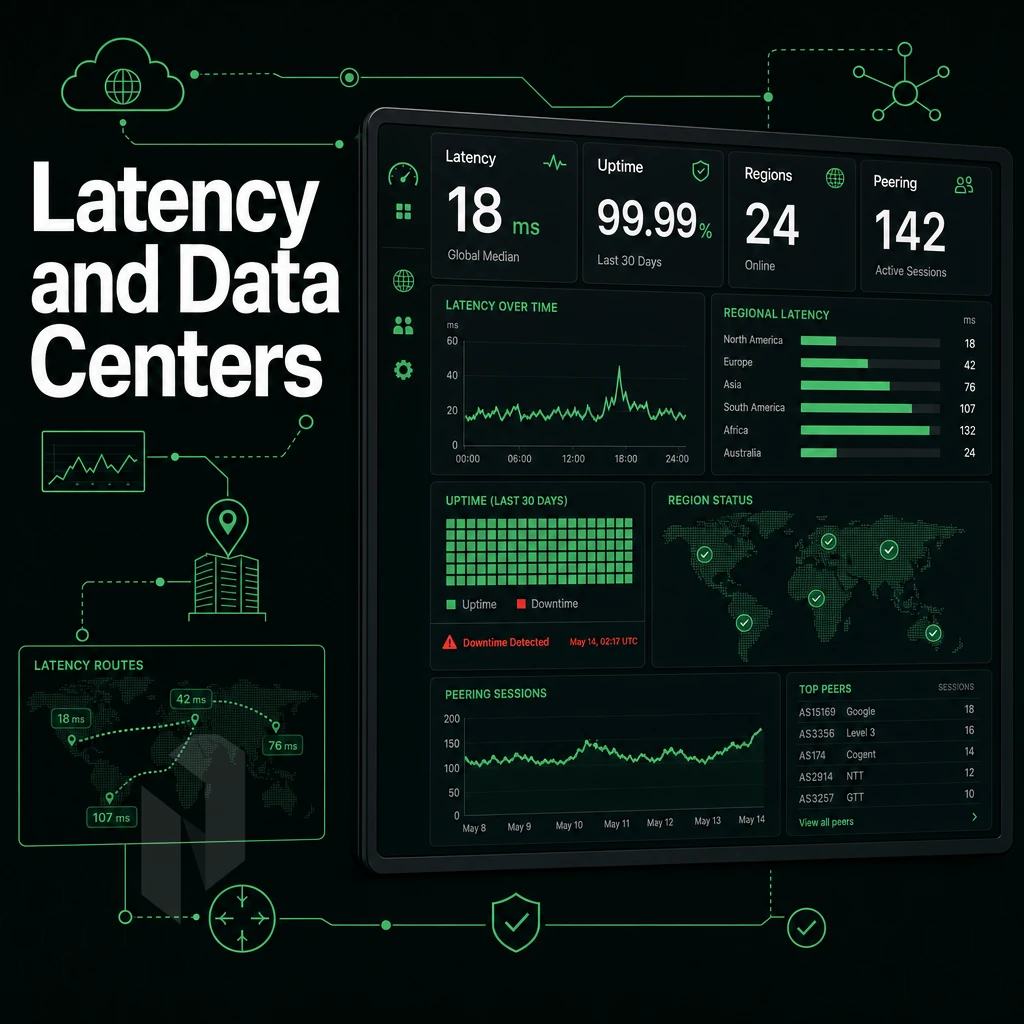
While raw compute is a critical component for scaling in the enterprise, network quality is just as important. The topology, peering density, and port headroom all play a significant role in determining whether your private cloud compute resources can support ai workloads under real-world burst conditions or whether they will fail at the worst possible time.
Backbone Architecture and Peering Depth
Netrouting operates AS6206, a Tier 1-connected backbone with more than 2.4 Tbps of total capacity. The majority of our connections are already scaled to 100 Gbps and up. We maintain a healthy port utilization of below 40%, so even during heavy load, there is real burst capacity available, not just theoretical headroom.
Being carrier-neutral is important. We peer with AMS-IX, DE-CIX, NetNod, FL-IX, LSIX, FRYS-IX and GNM-IX. The large amount of interconnections reduces the AS-path length to major networks, thereby reducing round-trip times. This is very important for cloud hosting type of workloads that require low and very predictable latency. In these scenarios, a large peering network is more important than a single-transit connection.
Global Data Centers and Multi-Region Strategy
Our global footprint, a key pillar of any serious cloud strategy whether public or private cloud, spans 3 continents in 10 cities: Europe (Amsterdam, Frankfurt, The Hague, Rotterdam, Stockholm, Bucharest), North and South America (Miami, New York) and Asia-Pacific (Hong Kong, Singapore). With such a large footprint, cloud service providers can place private cloud compute close to your end users and use resources more efficiently by spreading them across regions rather than over provisioning a single site.
Our spread of edge computing deployments around the world are serviced by the following locations. In the Nordics, we are anchored in Stockholm via NetNod. In Germany, Frankfurt-based DE-CIX is used to service customers in DACH and CEE. In Asia, Singapore-based premium Tier 1 connectivity is used to service customers in Southeast Asia, while Miami is used as our primary point of entry to Latin America.
Network specs: 2.4 Tbps+ capacity, sub-40% average port utilization, Always-On L3/L4 DDoS protection for all customers and services, 1 Tbps+ of mitigation capacity.
Disaster Recovery and Hybrid Deployments
Having resources in multiple regions enables a real disaster recovery architecture. Rotterdam can be used for DR for The Hague. Stockholm can be used for DR for both The Hague and Miami. Free private interconnect up to 40 Gbps connects resources across regions. No egress charges, no metered replication traffic.
Connect your hybrid deployment of on-premises infrastructure, cloud storage and object storage over your Ethernet services. We provide point-to-point Layer 2 connections to keep replication latency low and keep the traffic off the public Internet. As with all locations, our DDoS protection is always-on so failover paths have same security baseline as primary site.
Why Choose Netrouting for Enterprise Cloud Compute and Scaling
Enterprise scaling demands more than elastic quotas and pay-as-you-go billing. It demands flexible cloud infrastructure built on physical servers you can trust, a network that won't buckle under load, and responsive customer service that answers in minutes, not days. That's where Netrouting stands apart from the typical field of cloud service providers.
Our cloud compute and bare metal platforms run across ten cities, Stockholm, Amsterdam, Rotterdam, The Hague, Frankfurt, Bucharest, Miami, New York, Hong Kong. Additionally, Singapore, giving enterprise teams genuine global infrastructure without forcing a single-vendor lock-in. Virtual instances provision rapidly alongside dedicated hardware, so you scale the right resource for each workload.
- Rapid bare metal deployment: dedicated servers provisioned in under 60 minutes, with unmetered 10 Gbps bandwidth and up to 40 Gbps available for high-throughput workloads.
- 2.4 Tbps+ backbone: our own AS6206 network with AMS-IX peering since 2009 and consistently sub-40% port utilization, headroom when traffic spikes.
- Always-on DDoS protection: L3/L4 mitigation included on every service at no extra cost, with advanced L7 options for regulated industries.
- AI/ML-ready GPU servers: NVIDIA-powered instances for AI workloads, machine learning pipelines, and self-hosted LLM inference, with EU data sovereignty.
- Managed Proxmox VE: run your own hybrid cloud environment without operating the hypervisor layer yourself.
- Security and compliance: ISO 9001, ISO 27001, and SOC 2 certified, essential for enterprise systems in regulated industries.
Predictable pricing
and a 24/7 NOC with a one-hour ticket guarantee round out the picture. If you're evaluating the right cloud service provider for enterprise-level scaling, explore our cloud compute options or contact our sales team to discuss your workload requirements.
The Core Cloud Services Every Enterprise Scaling Strategy Needs
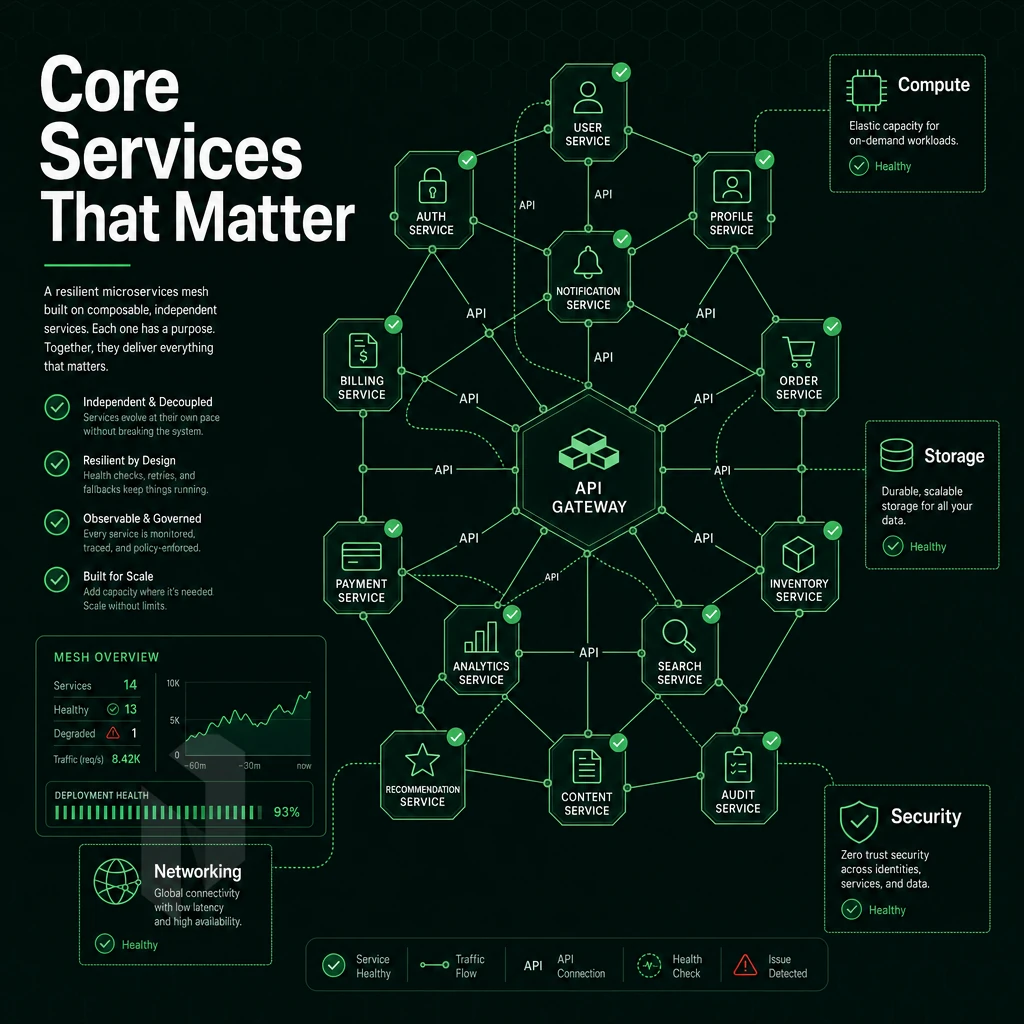
When we talk about Enterprise cloud services we are talking about a number of dimensions. Compute, storage, networking, security & compliance and last but not least support.
None of these elements can function in isolation and therefore the right cloud infrastructure is critical to tying all of these elements together whether that be running hybrid cloud solutions from on premise environments through to scaling AI workloads across regions or indeed running cloud based services for regulated industries where strict compliance is required. Cloud can only deliver value when ALL components are engineered to work as one.
Choosing the ideal cloud hosting partner comes down to three factors: workload type, compliance requirements, and total cost of ownership. Flexible cloud infrastructure with predictable pricing and strong managed services reduces operational overhead without sacrificing control. For bare metal performance, private cloud isolation, or hybrid deployments that span cloud and dedicated resources, Netrouting delivers compute, storage. Additionally, Networking across ten global data centers, backed by 24/7 support and a 99.9% uptime SLA.
Choosing the Best Cloud Compute for Enterprise-Level Scaling: Final Checklist
Choosing the best cloud compute for your enterprise needs can be based on a few simple criteria. The cloud must be able to provide consistent performance under heavy load, provide adequate security and related compliance certificates. Additionally, Also provide flexible hybrid cloud options to allow interaction between on premise servers and public cloud servers.
In addition to these basic requirements, it is also very important to be able to choose between bare-metal hardware and virtual servers in a private cloud, support for AI workloads without being locked into proprietary solutions. Additionally, Cost effective, predictable pricing with real cost control as opposed to pay as you go pricing that skyrockets under heavy load. Global reach and responsive customer service with a Service Level Agreement (SLA) that has been clearly documented also needs to be considered.
Netrouting checks every box: ISO 9001, ISO 27001, and SOC 2 certified cloud hosting across ten locations, a 2.4 Tbps+ network, and a 1-hour support guarantee. Explore Netrouting Cloud Compute or contact our team to discuss your enterprise cloud strategy.
When it comes to enterprise cloud scaling there are three key decisions that you have to make: which workloads to run on cloud, how to get cost predictability. Additionally, How to get performance from the network.
Hyperscalers offer great breadth of services, but their billing is often variable and the egress costs compound quickly as you add more regions and services. Instead, using Bare metal cloud or private infrastructure means you have dedicated resources for your workloads, consistent performance. Additionally, A total cost of ownership that is easier to forecast and therefore to defend to your stakeholders.
Hybrid architectures are winning for most enterprises, which deploy a private cloud to run latency-sensitive or compliance-bound workloads on dedicated hardware and burst to cloud service providers for flexible virtual compute capacity. The right provider can make this seamless.
Netrouting runs bare metal, cloud compute, and colocation across ten locations in Europe, North America, and Asia, all on a single 2.4 Tbps+ backbone with unmetered 10 Gbps and always-on DDoS protection included. Talk to the team about building an architecture that scales without surprises.