Game servers have huge spikes in traffic.
This is NOT commodity cloud.
Providers like Netrouting for instance.
Blog contents
When it comes down to brass tacks for us, the following are far more important than managed AI services built on cloud computing that never see the light of day: deployment speed. Network capacity, DDoS protection and response times for support. For latency-critical game workloads, edge computing architectures can reduce round-trip times by positioning compute resources closer to end users.
When running game servers, latency sensitive applications, or building out cloud services infrastructure to handle real traffic, having the proper compute makes all the difference before you even launch and get your first player. The fundamentals of cloud compute for a startup at your stage is a good place to start.
Whether deploying containerized microservices, web apps, or real-time multiplayer backends, selecting the right compute tier ensures your infrastructure can handle both baseline load and unexpected traffic surges. Beyond game servers and real-time applications, cloud compute also powers traditional web hosting scenarios where consistent uptime and rapid scaling matter just as much. Modern application development relies on flexible compute resources that can adapt to changing requirements throughout the software lifecycle.
What Are the Leading Cloud Solutions for Startups?
Cloud compute has flipped infrastructure for startups on its head. Instead of buying servers and other hardware to get up and running, teams can provision their own virtual compute resources through a cloud service provider as and when they need them, only paying for what they actually use. This brings serious infrastructure within the financial reach of even the youngest startups. For more context, see Amazon Web Services.
What Cloud Migration Means for Startups
A cloud platform delivers compute, storage and network services over the Internet using shared multi-tenant infrastructure. This is in contrast to shared hosting, where resources are fixed and non-transparent, or physical servers in a datacenter, where scaling up quickly means buying more hardware weeks in advance, neither of which a cloud service provider requires. Cloud platforms eliminate the operational overhead of maintaining servers, allowing startups to focus engineering resources on product development rather than infrastructure management. Cloud platforms abstract away the complexity of managing servers, enabling teams to deploy applications without worrying about hardware provisioning, operating system patches, or capacity planning.
Cloud platforms eliminate upfront costs associated with purchasing and maintaining on-premises equipment, allowing startups to convert capital expenses into predictable operational expenses. Cloud platforms also accelerate application development by providing pre-configured runtime environments, managed databases, and integrated deployment pipelines that eliminate weeks of infrastructure setup. Cloud infrastructure provides the foundational layer of compute, storage, and networking that enables startups to build and scale applications without managing physical datacenters.
We utilize virtual machines at the core of our infrastructure. Virtual Machines run their own isolated Operating Systems on the shared physical hardware. Each VM has its own dedicated performance without the cost of having to purchase separate hardware for each Operating System. We can then resize or replicate individual cloud servers in a matter of minutes. This is critical as the amount of traffic a product launch receives can increase from 50 users to 50,000 in overnight.
What Cloud Service Provider Is Best for Early-Stage Startups?
The leading cloud compute services for startups are ones that provide fixed cost, instant provision and true scalability. By paying as you go for your compute you eliminate the risk of over provisioning. With cloud computing, a staging environment for a startup can be provisioned and then scaled down to near zero between test cycles for the production environment. Transparent pricing structures allow startups to forecast monthly cloud expenses accurately and avoid unexpected bills that can derail early-stage budgets.
Leading Cloud Computing Services Providers
Network depth and support are key areas in which our solutions vary greatly. Our cloud services run on servers spread over 10 locations worldwide, including Amsterdam, Frankfurt, London, Paris, Berlin, Hamburg, Munich, Warsaw, Prague and Singapore. We guarantee solution of tickets within 1 hour and operate with a 2.4 Tbps+ backbone on our own AS6206.
This combination of global reach and rapid response times directly contributes to customer satisfaction for startups running mission-critical applications. This global infrastructure ensures that startups can deliver consistent performance to users regardless of their geographic location. Our infrastructure's robust networking capabilities enable seamless data transfer and low-latency communication between distributed cloud resources across all deployment regions.
How Do Hybrid Cloud Services Help Startups Manage Rapid Growth?
Hybrid cloud is a combination of a cloud platform and dedicated bare metal servers. A database workload running on dedicated servers provides consistent low latency for a startup. Application tier workloads can then be 'burst' out to cloud computing servers as necessary to ensure that costs are kept under control and headroom is maintained.
However, the flexibility to switch between these two environments is only as good as the reliability of the provider delivering the hybrid cloud services and environment. Startups that architect hybrid deployments strategically can optimize cloud costs by reserving predictable baseline capacity on dedicated infrastructure while leveraging elastic compute only for variable demand. Implementing effective cost control measures across hybrid environments requires continuous monitoring of resource utilization and automated policies that prevent runaway spending on elastic infrastructure.
Core Cloud Platform Services Every Startup Should Understand
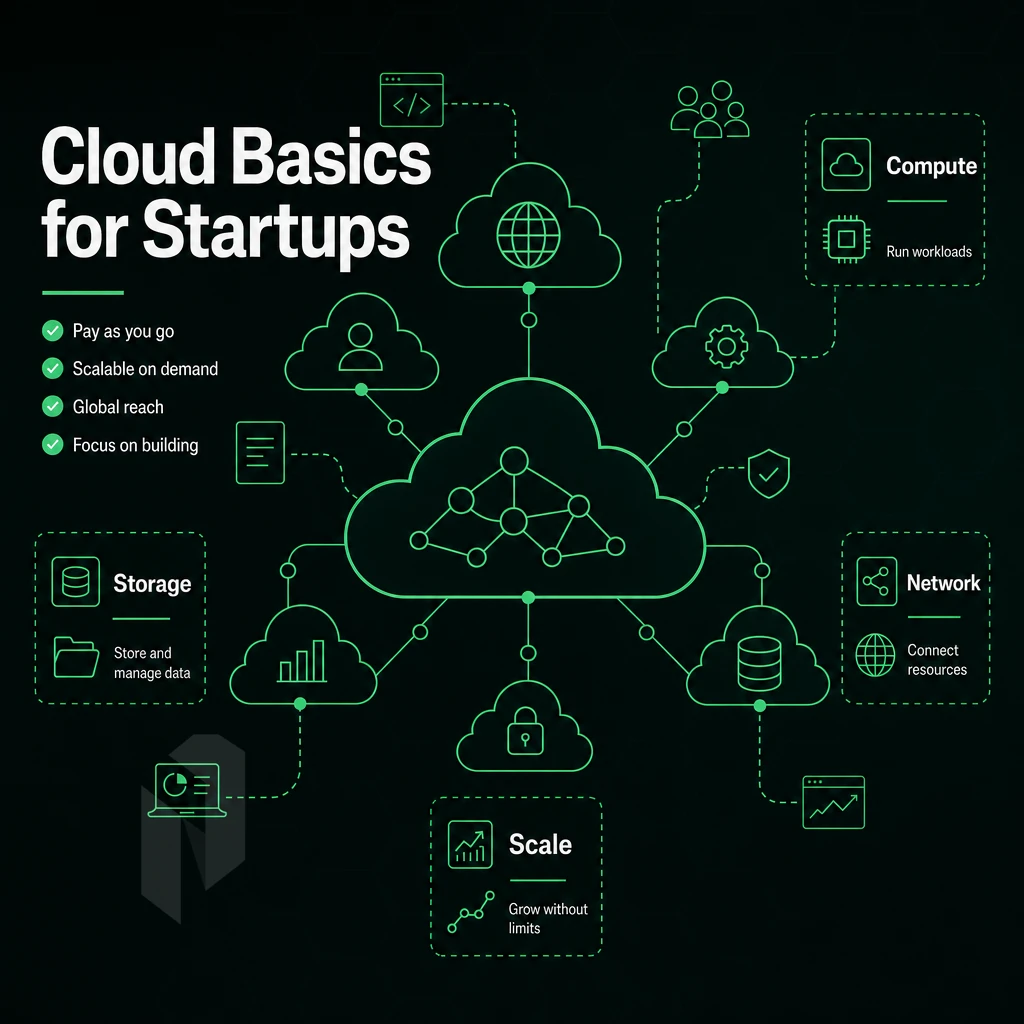
Cloud infrastructure is the backbone of any modern startup. It is very important to understand the core components early on to avoid costly rearchitecting in the future. In this walkthrough we will cover the fundamental building blocks and the different deployment models of cloud infrastructure.
Foundation: Core Cloud Services Components and Cloud Costs
- Cloud servers (compute), Virtual instances running your applications on shared or dedicated physical servers. Start small and scale up as required with most platforms able to provision new instances within minutes.
-
Cloud storage and object storage. Block storage attaches directly to your instances. Object storage holds unstructured data, backups, media, logs, at scale. Use object storage for anything you don't need to mount as a filesystem.
Note: Mixing block and object storage correctly cuts costs significantly. Don't store large static files on block volumes. - Private network. Our private interconnect keeps all your resources connected, and all internal traffic on your own private network, and off the public internet. Free private networking up to 40 Gbps between all your resources. Lowest latency and highest security.
- Data centers in regions that lower latency for end users. Primary data center in core of main user base, and a second data center for DR in a separate region.
Public vs Private Cloud Services: What's the Difference for Startups?
Public cloud solutions are built on shared, multi-tenant infrastructure that is managed by a service provider. Private cloud solutions, on the other hand, are dedicated to a single organization and can be provisioned on either physically isolated hardware or logically isolated virtual servers. Many startups begin by deploying in public cloud to quickly scale up, but later migrate the most sensitive workloads to private cloud infrastructure as compliance requirements mature.
Understanding the security and isolation trade-offs between public and private cloud environments helps startups make informed decisions about where to place different application tiers. Effective cloud migration planning ensures that startups can transition workloads between public and private environments with minimal downtime and data loss. Isolating sensitive workloads also reduces exposure to data breaches that can occur when multiple tenants share the same underlying infrastructure. Startups evaluating major public clouds should assess each provider's compliance certifications, regional availability, and support for hybrid architectures before committing to a single vendor.
Choosing the Right Cloud Provider and Services Model
There are three models for deployment of a cloud platform. Evaluate the deployment models and determine which best fits your workload and then deploy that model. Selecting the right deployment model for your cloud infrastructure directly impacts both operational flexibility and long-term cost efficiency as your startup scales.
- Public cloud: very fast to provision, very low upfront financial commitment which is ideal for the early stages when traffic is highly unpredictable.
- Private cloud. We define private cloud as dedicated resources, fully isolated from other customers. At scale, private cloud has better unit economics than public cloud and stronger data sovereignty. We offer managed private cloud, and see bare metal dedicated servers as the same thing but with more control for customers. We view Oracle Cloud Infrastructure as a provider that offers managed private cloud.
-
Hybrid cloud. Combines both models. Run latency-sensitive or regulated workloads on private infrastructure; burst overflow to shared capacity. Hybrid cloud solutions suit startups crossing from growth stage into enterprise compliance territory.
Note: Hybrid cloud adds operational complexity. Only adopt it when a clear workload boundary justifies the overhead.
Once the basic infrastructure is set up, the next challenge for startups is powering their AI and machine learning workloads. This requires a different conversation around compute.
AI Tools and Machine Learning Workloads on Cloud Services
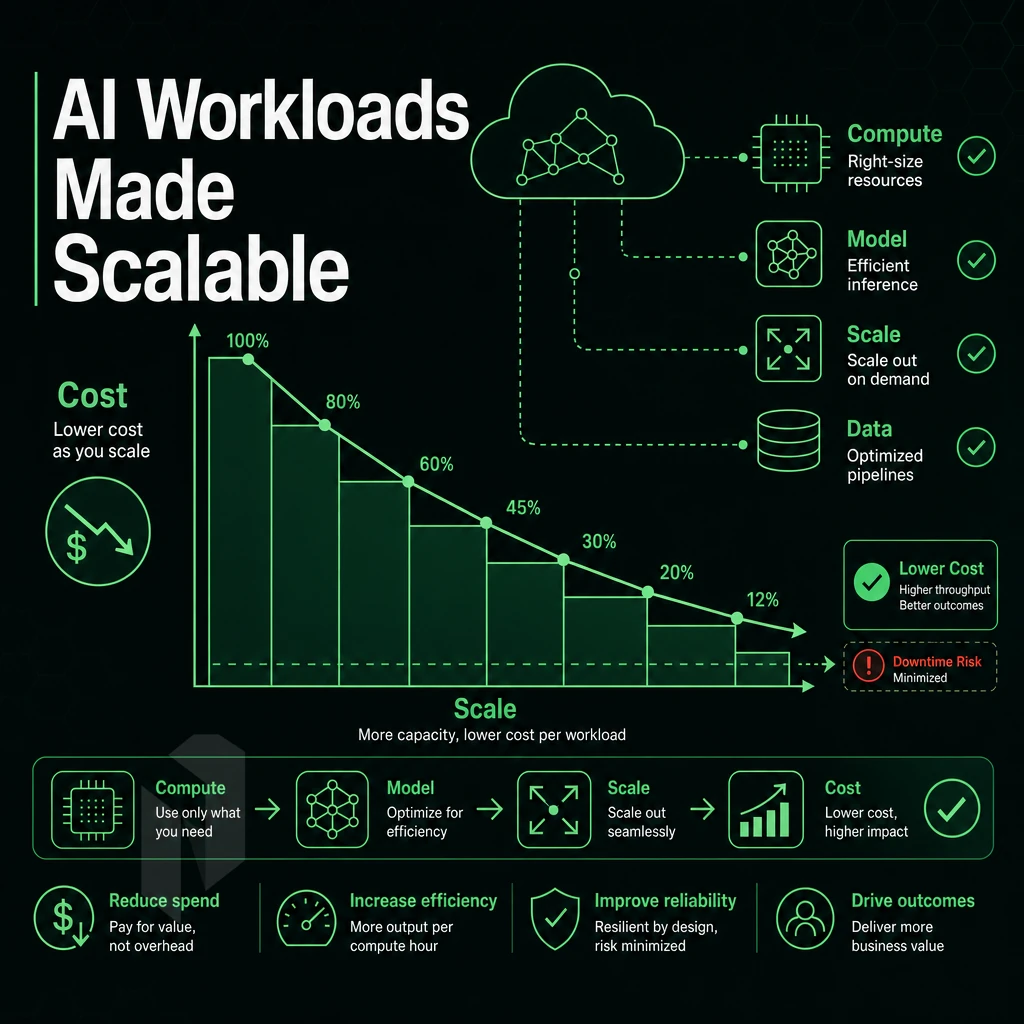
Startups are moving their AI workloads to cloud platforms at a rate unmatched by previous technology waves. Because in cloud environments, the compute resources needed to run AI workloads, including access management controls, can be provisioned in minutes on a pay-as-you-go basis without the need for upfront capital expenditure. The traditional biggest barrier to running AI and big data analytics workloads, infrastructure, now scales with usage rather than requiring a funding event to bring more servers online.
How Startups Use Cloud Services for Machine Learning and AI Tools
Additionally, cloud services let you release the instance after the job is complete, meaning you only pay for the actual compute time used, as opposed to reserving physical hardware.
In addition to raw compute, cloud computing platforms offer a multitude of AI services that can be leveraged, such as inference APIs, vector databases, and model registries. Startups can ‘compose’ these services to create their own AI solutions, rather than having to build from scratch. This ‘composability’ greatly reduces the time-to-prototype, from weeks to days.
Leading Cloud Compute Services for Startups With GPU and Big Data Needs
GPU compute is the primary function required for tasks such as model training and large scale data analytics.
Storage and data management for AI are fundamental components of every pipeline.
For serious training workloads, NVIDIA’s A100 and A40 GPUs are the new normal. Inference workloads on the other hand can run on much lighter GPUs like the RTX 6000 or A10, matching the right GPU to the right workload type is a huge waste reducer.
Why Netrouting Fits AI-Driven Startup Infrastructure
Servers are located in Europe, North America and Asia.
Our 2.4 Tbps+ network is designed to handle large amounts of data movement across heavy AI workloads, rivaling leading cloud providers, while our bare metal is provisioned in under 60 minutes. This Means your teams won’t get stuck waiting for infrastructure to be provisioned when you’re ready to start running your next experiment.
This rapid provisioning empowers cloud engineers to iterate quickly on infrastructure configurations and respond to changing workload demands without operational delays. Our support team combines deep technical expertise with hands-on experience in AI infrastructure, ensuring that startups receive guidance tailored to their specific workload requirements.
As you mature through your AI workloads, you'll find that in most cases, a single deployment method just won't be enough, and so you'll need to make decisions around hybrid and multi-cloud strategies across more than one cloud service provider.
Why Netrouting for Startup Cloud Compute
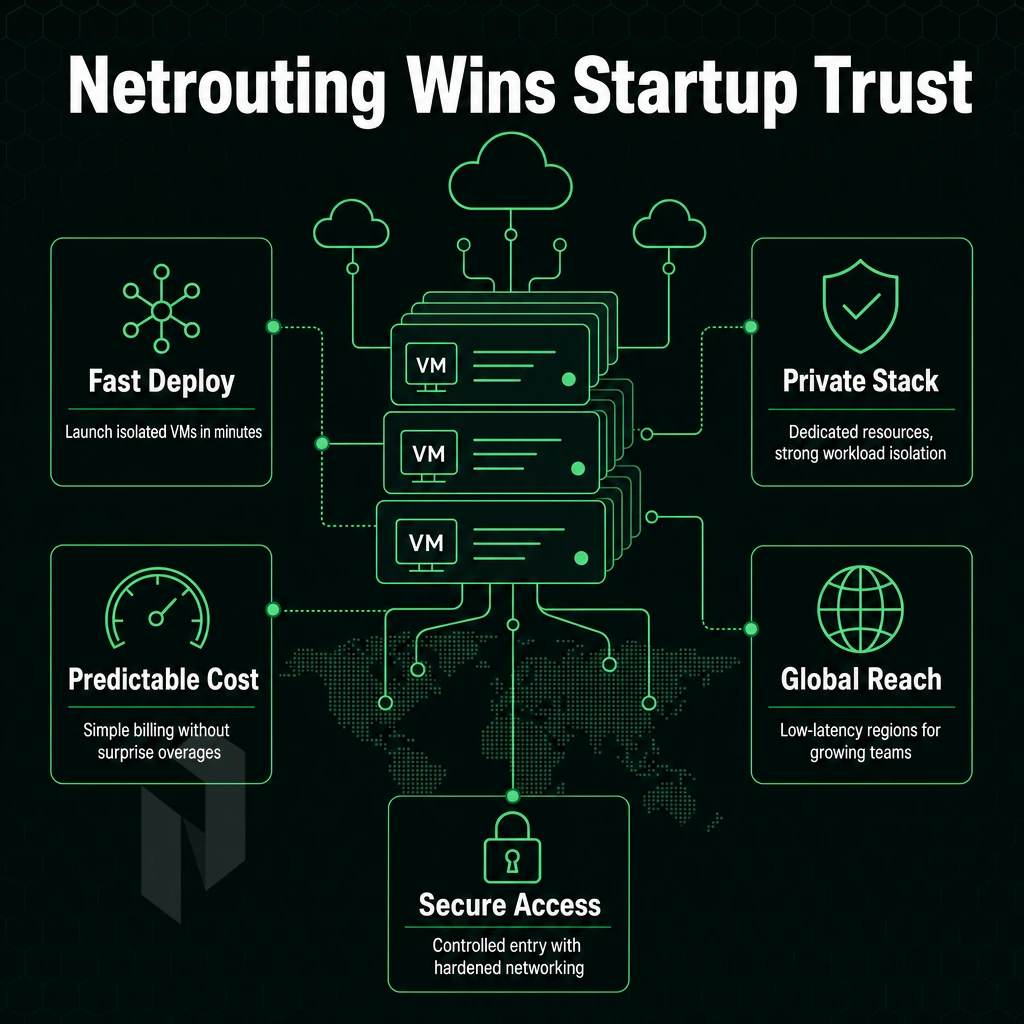
Many startups start off on the major public cloud providers to utilize the free services offered as well as to utilize up the cloud credits provided to them. However, as cloud computing costs begin to scale, many realize that the costs can be unpredictable and far exceed what they had initially planned.
Netrouting is a cost effective alternative to building out your very own cloud infrastructure, that provides its users with the control they desire without the Hyperscaler pricing structures that they don’t.
We run cloud servers as well as bare metal dedicated servers from ten data centers spread across Europe, North America and Asia-Pacific. Unlike big enterprises, our infrastructure is set up for the rapid growth of a startup, not for lock-in.
- Predictable cloud compute: Flexible virtual machines with transparent, competitive pricing. No surprise egress fees. Lower TCO than AWS, Azure, or IBM Cloud for comparable computing power.
- Bare metal when you need it: Physical servers provisioned in under 60 minutes. Full hardware control, no noisy neighbours, no underlying infrastructure shared with strangers.
- Always-on DDoS protection: L3/L4 mitigation included on every cloud service. No add-on required.
- Free internal network: Up to 40 Gbps private interconnect between your resources. Secure data management without extra cloud networking costs.
- Certified and compliant: ISO 27001 and SOC 2 certified. Sensitive data stays protected, critical for startups handling regulated workloads.
- 24/7 NOC with 1-hour ticket SLA: Real engineers, real service level agreements, not a chatbot queue.
Startups evaluating cloud services infrastructure options and providers and interested in a fixed cost as you grow, talk to our sales team and we will provide you with a comparison of the options.
Key Takeaways: Choosing the Right Cloud Services for Your Startup
Choosing the right cloud services comes down to three decisions: matching cloud platform capabilities to your current stage, understanding pricing structures before you scale, and evaluating service provider reliability against real SLAs. Startups begin on pay-as-you-go public cloud services, that flexibility is genuine. But as resource usage grows, so do cloud costs.
Cost management and cost optimization become non-negotiable once free tiers run out. The right cloud solutions reduce infrastructure costs without forcing a startup hire just for cloud management. Netrouting's bare metal and cloud services spanning ten global data centers deliver predictable billing and 99.9% uptime, making it a cost-effective alternative when hyperscaler complexity outpaces your actual needs. Match the platform to the workload, not the other way around.
Choosing the right cloud infrastructure shapes how fast your startup can move. Prioritize cloud computing providers that offer predictable costs, genuine scalability, and a network built for low-latency workloads, not just the biggest brand name. A hybrid or multi-cloud approach gives growing teams flexibility without vendor lock-in.
AI and machine learning workloads demand more than basic compute. Dedicated GPU resources, high-throughput networking, and data sovereignty matter from day one, not as an afterthought.
Netrouting delivers bare metal, cloud services, cloud compute, and GPU servers across ten locations in Europe, North America, and Asia, all on a 2.4 Tbps+ backbone with always-on DDoS protection and a 24/7 NOC. If you're scoping infrastructure for your next stage of growth, talk to the Netrouting team about a configuration built around your workload.