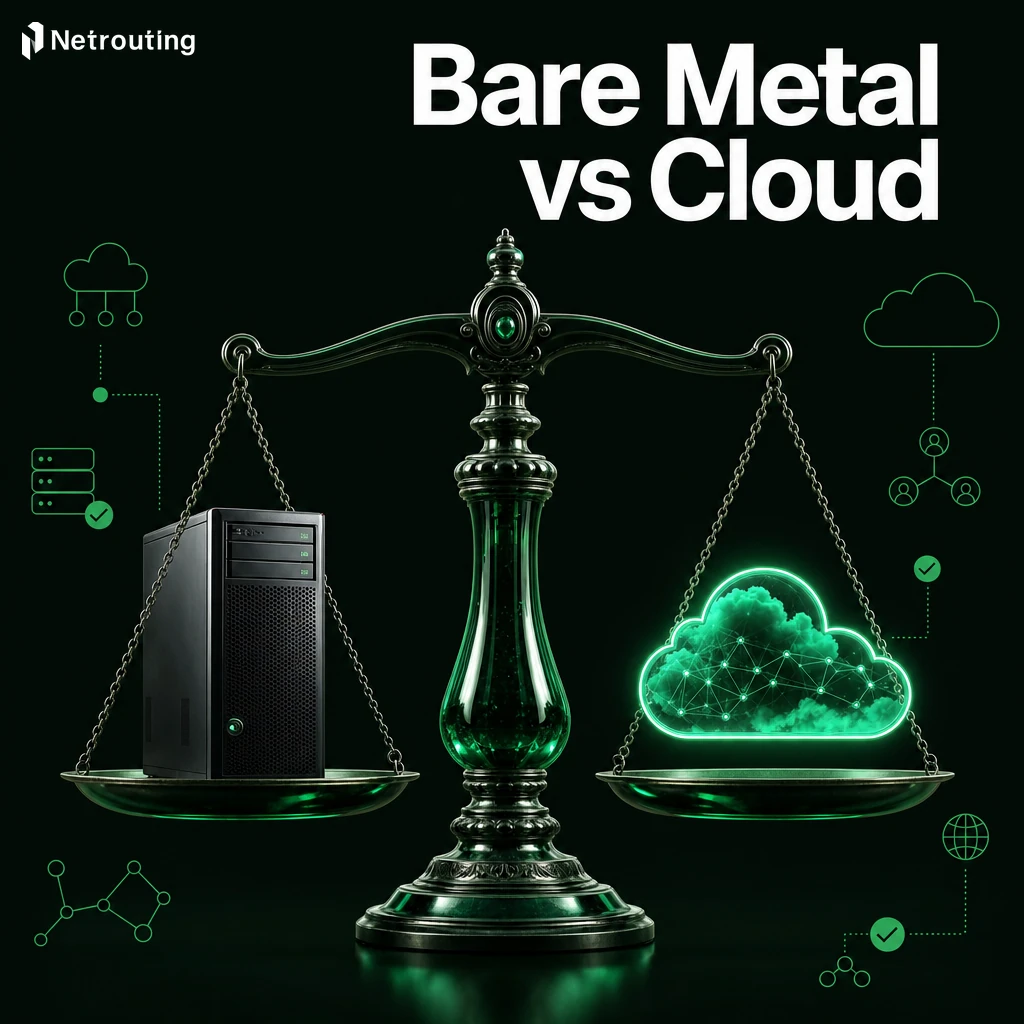
Deciding between bare metal and cloud-based infrastructure is one of the most important decisions you can make for your stack.
Netrouting is a dedicated and cloud hosting company, with infrastructure in 10 locations worldwide: Stockholm, Amsterdam, Frankfurt, Miami, New York, and others. Our network is powered by AS6206 with 2.4 Tbps+ capacity, and we offer unmetered 10 Gbps on bare metal servers. With over a decade of experience hosting all kinds of workloads and automation tools, we bring that technical expertise to everything we recommend.
In this post we evaluate two popular options for IT workloads (bare metal servers vs. cloud servers) across several key dimensions that actually matter to IT decision makers (performance / isolation, scalability / provisioning time, cost, security / compliance, administration). Additionally, establish a high performance framework that will help you navigate the bare metal market and pick the best spot to run your particular application or service. We start with the basics of bare metal servers and how they perform under load.
Blog contents
What Are Bare Metal Dedicated Servers and How Do They Work?
A bare metal server is a dedicated physical server, reserved for a single customer. There is no hypervisor, the server is run directly on the physical hardware. This means that one server is allocated exclusively to your workload, eliminating resource contention entirely.

Single-Tenant Dedicated Physical Servers, No Sharing
A dedicated physical server delivers a high performance environment where your workload won't compete with other customers for resources.
Dedicated Servers Have No Virtualization Layer
Cloud VMs are run on top of a hypervisor that multiplexes your physical server with other tenants on the same server. In contrast, Bare Metal servers are run on dedicated servers with no hypervisor overhead, no noisy-neighbor CPUMAX utilization and no memory ballooning due to adjacent VMs running.
What Full Hardware Control Means in Practice
You have full control of the server including the BIOS / RAID / network stack / kernel parameters. You have dedicated resources that do not change under load. This is different from bare metal cloud infrastructure where model choice is just as important as the choice of the platform to run on.
This level of complete control makes bare metal the preferred choice for workloads requiring precise tuning and deterministic behavior. Selecting the right computing environment means weighing these control benefits against your team's operational requirements and budget constraints.
How Cloud and Dedicated Servers Work
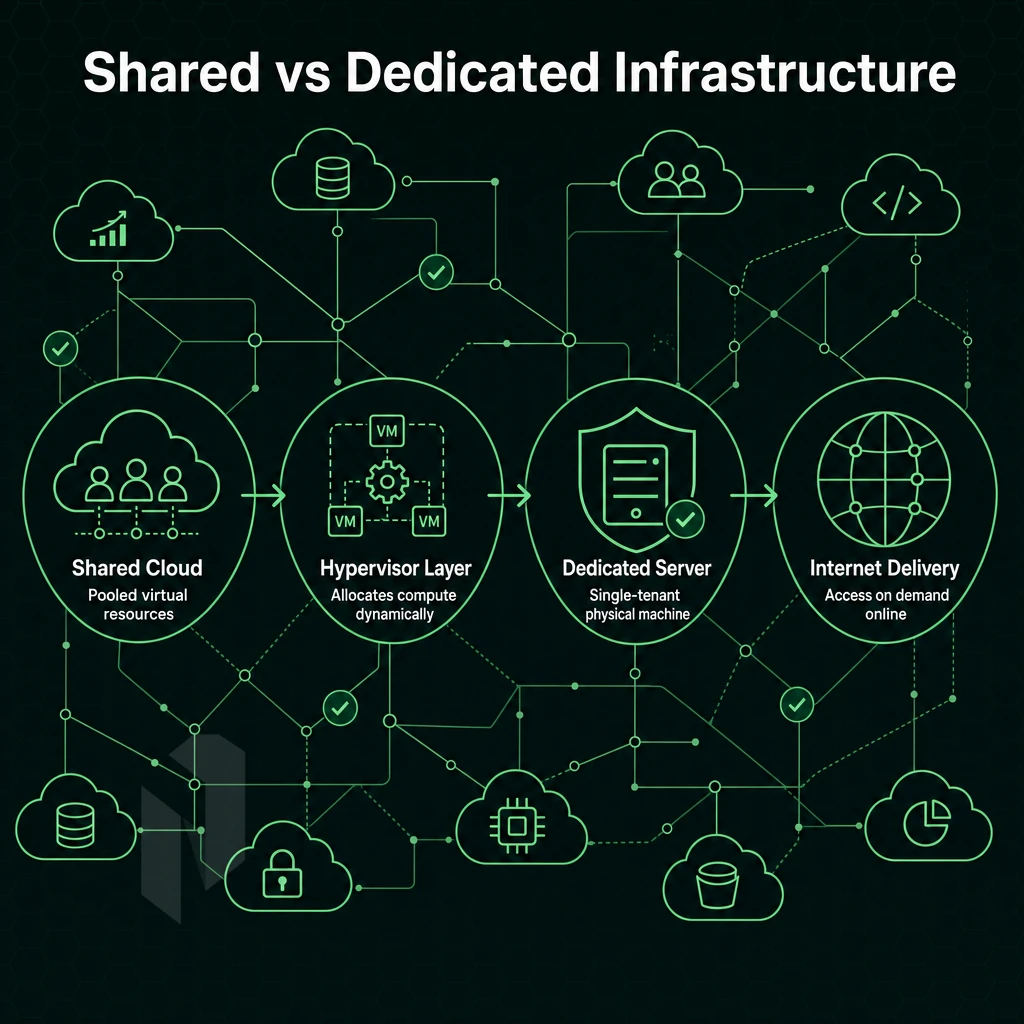
Cloud computing enables server resources to be delivered as a service over the Internet. Unlike dedicated hosting, resources such as physical servers are virtualized into software-defined layers on top of the physical hardware. A hypervisor layer is seated between the server’s Operating System and the physical server. The hypervisor virtualizes the physical server into virtual servers, which can draw from a shared pool of resources. Organizations migrating from on-premises infrastructure often find that understanding these virtualization layers is critical when transitioning to a cloud environment.
How a Cloud Server Works Unlike Traditional Cloud Services
Many tenants run on the same server. A hypervisor dynamically allocates CPU, RAM and storage to tenants. The available capacity of your servers can therefore be reduced in the event of high demand by other tenants, in contrast to dedicated hardware. This shared-tenancy model means that resource contention from multiple tenants can introduce unpredictable latency spikes during peak usage periods.
Cloud Server and Computing Models
Public cloud shares the infrastructure with other customers and users. Private cloud dedicates all resources to a single customer or organization and thus mitigates the risk of noisy neighbors.
| Model | Isolation | Scalability | Best For |
|---|---|---|---|
| Public cloud | Low, shared tenancy | Instant, elastic | Variable, unpredictable workloads |
| Private cloud | High, dedicated resources | Planned capacity | Regulated, sensitive data |
| Bare metal | Complete, no hypervisor | Fixed, predictable | High-performance, consistent workloads |
By removing the virtualization overhead that cloud providers rely on, bare metal can deliver consistent performance and is often the better choice when performance matters more than scalability. With bare metal cloud hosting, we can have servers provisioned within less than 60 minutes and still get the isolation of a hosted environment. The provisioning speed advantage means teams no longer face the traditional trade-off between dedicated hardware isolation and rapid deployment timelines.
Common Use Cases: When to Choose Bare Metal Cloud vs Standard Cloud Server
When selecting the right infrastructure for your needs, it is essential to differentiate between a dedicated physical machine and cloud hosting and choose the most cost-effective solution for your use case to avoid over-engineering. Bare metal hosting provides a raw, unadulterated allocation of dedicated resources, whereas cloud hosting provides greater flexibility and configurability.
Understanding the trade-offs in your digital infrastructure strategy ensures you allocate budget toward the architecture that best supports your application's performance profile and growth trajectory. Recognizing the key differences between these deployment models helps technical teams align infrastructure choices with application requirements and long-term operational goals.
Workloads That Demand Bare Metal
Bare metal is ideal for high performance computing, scientific simulations and big data processing. Such workloads benefit from consistent CPU and memory resources in cloud computing environments, are disturbed by 'noisy neighbors' only, require minimal latency and are not affected by any shared resources. Organizations running machine learning training pipelines or real-time analytics workloads benefit greatly from the dedicated resource allocation that bare metal provides. Teams evaluating infrastructure options should choose bare metal when workload consistency and resource isolation outweigh the need for rapid elastic scaling.
The gaming industry also relies heavily on bare metal infrastructure to deliver low-latency multiplayer experiences and handle compute-intensive rendering tasks without performance degradation. Enterprises managing large databases also prefer bare metal to avoid the I/O throttling and storage contention common in multi-tenant virtualized environments. Bare metal infrastructure proves especially valuable when processing large volumes of transactional records or streaming telemetry that would otherwise saturate shared network paths in virtualized environments. Financial services firms and healthcare providers also deploy bare metal for mission critical applications where uptime guarantees and regulatory compliance cannot tolerate the unpredictability of shared virtualization layers.
- Dedicated Hardware for Gaming Servers, Removes Jitter at Peak Player Loads.
- High-traffic websites, getting sustained throughput without your cloud provider throttling you because you’re sharing servers.
- Mission-critical applications, predictable performance with no virtualization overhead.
- Large datasets, local NVMe storage avoids network I/O bottlenecks.
Bare metal avoids vendor lock-in.
Workloads Suited to a Cloud Server
The public cloud is great for variable workloads such as test environments and development environments that need to scale quickly.
A private cloud model suits teams that need isolation from other departments but don't want to manage bare metal servers themselves.
Where Netrouting Fits With Dedicated Servers
Provision bare metal in less than 60 minutes across 10+ server facility locations around the globe. Our backbone provides the low-latency, high-performance networking that applications relying on virtualized resources require. 10 Gbps of unmetered bandwidth is included with every dedicated server. Below is an overview of our dedicated server hosting and associated infrastructure.
Why Choose Netrouting for Bare Metal Servers and Cloud Compute?
Netrouting runs both bare metal servers and cloud compute across 10 locations, Amsterdam, Frankfurt, Miami, Singapore, Hong Kong, New York, The Hague, Stockholm, Rotterdam, and Bucharest.
- Sub-60-minute provisioning. Dedicated physical servers on Dell and Supermicro hardware, Intel Xeon and AMD EPYC, deployed in under an hour.
- Unmetered 10 Gbps bandwidth. Consistent high performance for bare metal cloud workloads, high traffic websites, and resource-intensive computing environments.
- Always-on DDoS protection. L3/L4 mitigation included on every service, bare metal and cloud server alike, at no extra cost.
- Free private network. Up to 40 Gbps between your dedicated resources, with no surprise fees.
- Certified and audited. ISO 9001, ISO 27001, and SOC 2, covering confidential data and mission-critical applications.
Lower TCO than hyperscaler compute, with 24/7 NOC support and a one-hour ticket guarantee. Talk to our team to compare bare metal vs cloud options for your workload.
High Performance Computing Frequently Asked Questions
In cloud computing, does bare metal mean you get a dedicated physical server without sharing?
Bare metal refers to a physical server dedicated entirely to one tenant, no hypervisor, no shared resources, no noisy neighbors. You get direct access to every CPU core, every gigabyte of RAM, and every I/O channel the hardware offers. This architecture also delivers enhanced security by eliminating the hypervisor attack surface and ensuring complete isolation from other tenants. One of the primary benefits of this model is the elimination of virtualization overhead, which translates to lower latency and higher throughput for latency-sensitive applications.
Providers like Netrouting deliver bare metal with cloud-like provisioning speeds, including your choice of operating system, in under 60 minutes from order to live server, so you don't sacrifice agility for performance. The term "bare metal cloud" simply means that single-tenant bare-metal hardware is provisioned and managed through the same kind of self-service interface you'd expect from a virtual environment. This eliminates the complexity of manual setup while preserving the performance advantages of dedicated hardware.
How do bare metal disadvantages compare to cloud computing server drawbacks?
Bare metal servers cannot scale in seconds the way virtual machines can, adding capacity means provisioning new hardware, which takes minutes rather than milliseconds.
Finally, bare metal cloud demands more operational discipline: OS patching, security hardening, and monitoring are your responsibility unless you add a managed hosting layer.
What are 5 disadvantages of using a cloud server for storage?
First, egress fees built into traditional cloud services turn high-throughput workloads into unpredictable monthly bills, as every gigabyte leaving the platform costs you. Third, storing private data off-premises on shared hardware resources such as virtual machines introduces compliance complexity, particularly under GDPR, HIPAA, or financial-sector regulations that restrict where data can physically reside.
Fourth, cloud storage creates a hard dependency on internet connectivity, and any network disruption between your application and the entire server storage layer causes latency spikes or outages. Fifth, long-term retention at scale is deceptively expensive in cloud computing; archival tiers carry retrieval fees that only surface when you actually need the data.
Is a Cloud Server Really Just a Big Data Center?
At the physical machine level, yes, cloud infrastructure runs on servers, switches, and power systems inside real data centers, the same as any dedicated or colocation deployment. The difference is the cloud computing abstraction layer on top: virtualization, orchestration, and self-service APIs that let thousands of tenants share the same pool of server resources dynamically.
What the major bare metal cloud and virtualized platforms sell is not the hardware itself but the convenience of on-demand provisioning, elastic scaling, and a broad managed-service catalog. When you colocate or deploy bare metal with a provider like Netrouting instead of a cloud server, you're working closer to that physical layer, trading some of the abstraction for predictable performance, lower total cost of ownership, and full control over your environment.
Bare metal and cloud are not competing philosophies, they are different tools to reach different goals. Bare metal has better performance, better throughput, better isolation between workloads. Cloud has better scaling, better speed of provisioning and more features.
In practice, most production environments are somewhere in between: latency-sensitive or heavily loaded applications claiming an entire server of dedicated resources, with some burst capacity handled by cloud instances.
Netrouting offers both, bare metal servers provisioned in under 60 minutes and flexible cloud compute, all running on a 2.4 Tbps+ backbone across ten locations in Europe, North America, and Asia. Explore Netrouting's dedicated servers or talk to the team about the right fit for your workload.