The performance bottlenecks, the surprise latency, the shared resource contention that come with any cloud service's virtualized systems all scale with your workloads. With rental of a bare metal server you get a dedicated physical server, rented month by month, without the purchase costs of such a server.
Renting instead of buying hardware transfers the risk of hardware failures to the provider. However, you maintain full control of the Operating System, the network stack and all the software you need to run. This bare metal cloud solution is ideal for many applications requiring object storage or dedicated resources: High throughput databases, Latency sensitive trading applications, GPU enabled AI applications and Game Servers that require a constant CPU clock speed under load.
This guide explains bare metal rental, what to look for in a provider, and how it compares to cloud compute and colocation.
Blog contents
What Is Bare Metal Server Rental?
Bare metal server rental refers to renting out physical servers for a monthly fee. You pay for the physical server and get to use it as you see fit, no hypervisor, no shared hardware, no other customers’ workloads competing with your for CPU time and memory bandwidth. Providers typically offer several hardware tiers, allowing you to select a base configuration that matches your workload requirements and scale up as needed.
How Bare Metal Servers Work
Bare metal servers are physical machines running entirely as your own server. You rent a physical server from a provider who manages the real metal for you. Additionally, You get root access to your server and dedicated resources without having to pay the upfront costs of purchasing servers for yourself.
The web hosting rental model as practiced by us: Monthly bills, no hardware expenses upfront, and no maintenance (hardware, power, air conditioning) of any kind. Some providers also support hourly billing for short-term projects or testing environments, though monthly contracts remain the standard for production workloads. This rental approach allows a business to scale infrastructure investments incrementally without tying up capital in depreciating hardware assets.
Bare Metal vs. Shared and Virtual Hosting
Both Shared hosting and VPS hosting have multiple tenants on the same server.
With dedicated servers, your workloads run directly on your server hardware, no virtualization overhead, no resource contention, no shared kernel. High performance workloads benefit most from this architecture, as eliminating the hypervisor layer removes CPU scheduling delays and memory translation overhead that degrade application responsiveness.
Bare Metal Dedicated Servers and Hybrid Infrastructure
Bare metal dedicated servers are being used as part of a bespoke cloud infrastructure. Physical servers are paired with cloud-based compute for burst capacity. This bespoke hybrid infrastructure delivers the very best performance where it is needed most, and then flexibility and elasticity where required but not necessary.
Organizations seeking tailored performance profiles often design custom cloud infrastructure that combines bare metal servers with virtualized components to optimize both cost and latency. Some enterprises architect their private cloud entirely on bare metal infrastructure to maintain strict data sovereignty and eliminate hypervisor attack surfaces. Enterprise architects frequently deploy bare metal nodes at the edge of their networks to reduce latency for regional users while maintaining centralized orchestration. Some organizations deploy a hosted private cloud architecture on bare metal infrastructure to combine single-tenant isolation with rapid provisioning capabilities.
A typical private cloud usage example is the database tier running on bare metal to guarantee lowest latency, while the application-tier VMs scale horizontally as needed. Subsequent sections will outline key differences between running on bare metal versus virtualized systems, including private cloud environments, and compare trade-offs to select the best approach for a specific use case.
Bare Metal vs. Virtual Machines: How the Hardware Differs
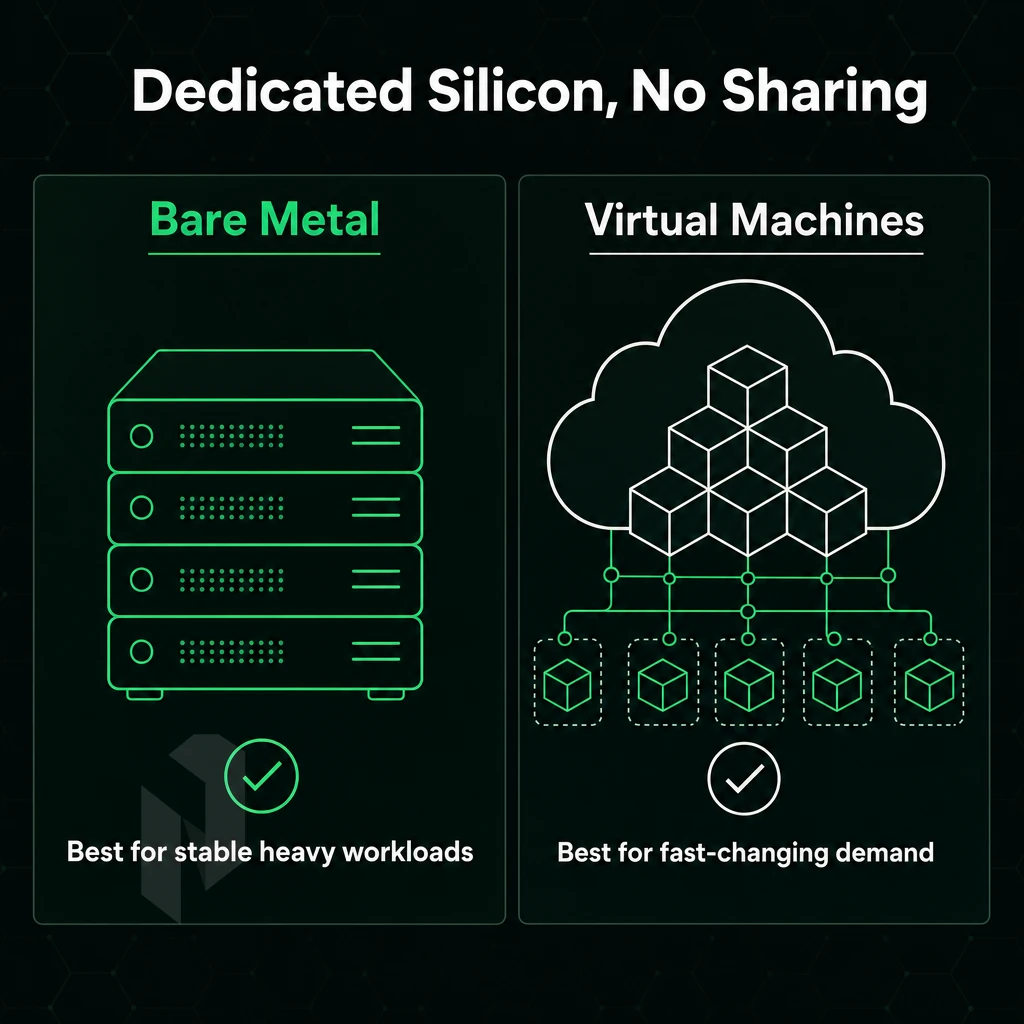
Bare metal and virtual machines are deployed on the same physical hardware but provide different experiences. The key experience differentiator is whether the physical hardware is shared or not.
Hypervisor Overhead and Resource Contention on Dedicated Servers
A virtual server in a cloud service typically runs on top of a hypervisor layer, which uses CPU cycles and memory to isolate the tenants on the server.
Our bare metal cloud servers are offered without a hypervisor. This means that all the cores, all the RAM and all I/O operations to storage are all dedicated to your workload. Database workloads with high random read workloads benefit most from running on a bare metal server.
Enterprises running analytics pipelines, real-time data processing, or machine learning inference find that demanding workloads achieve predictable throughput when the hypervisor layer is removed entirely. Applications demanding high performance throughput, such as video encoding clusters or scientific simulations, eliminate virtualization bottlenecks by running directly on bare metal infrastructure.
Bare Metal Cloud: Performance Isolation
With a dedicated metal server you don’t have to worry about this variable. With a bare metal cloud solution, you get the same performance you would expect from a dedicated physical machine in a datacenter, because no other tenants share or compete for the same physical resources.
Workloads such as financial modeling, real-time analytics and ML inference are high-frequency compute jobs that require consistent CPU and memory performance across global data centers.
When to Choose Each Data Center Option
| Dimension | Bare Metal | Virtual Machine |
|---|---|---|
| CPU access | Direct, no overhead | Shared via hypervisor |
| Network throughput | Up to 10-40 Gbps dedicated | Shared, capped by host |
| Cloud storage I/O | Local NVMe or SAS, low latency | Network-attached, variable |
| Best for | Databases, HPC, gaming, streaming | Dev/test, burstable web apps |
VMs are suitable for elastic low load servers. Private clouds on dedicated bare metal servers are best suited for latency critical and compliance bound applications. Netrouting offers bare metal servers in 10 locations worldwide. All servers are unloaded and come with 10 Gbps ports. And an SLA of 99.9%. We’ll have a look at how the bare metal cloud model is organized and what you should watch out for when picking a provider in this article.
Netrouting's infrastructure spans global locations to ensure low-latency connectivity for workloads requiring geographic distribution and regional compliance. Organizations with distributed teams often select providers with multiple global locations to ensure low-latency access for users across different geographic regions.
Bare Metal Cloud: On-Demand Dedicated Servers Without the Lock-In
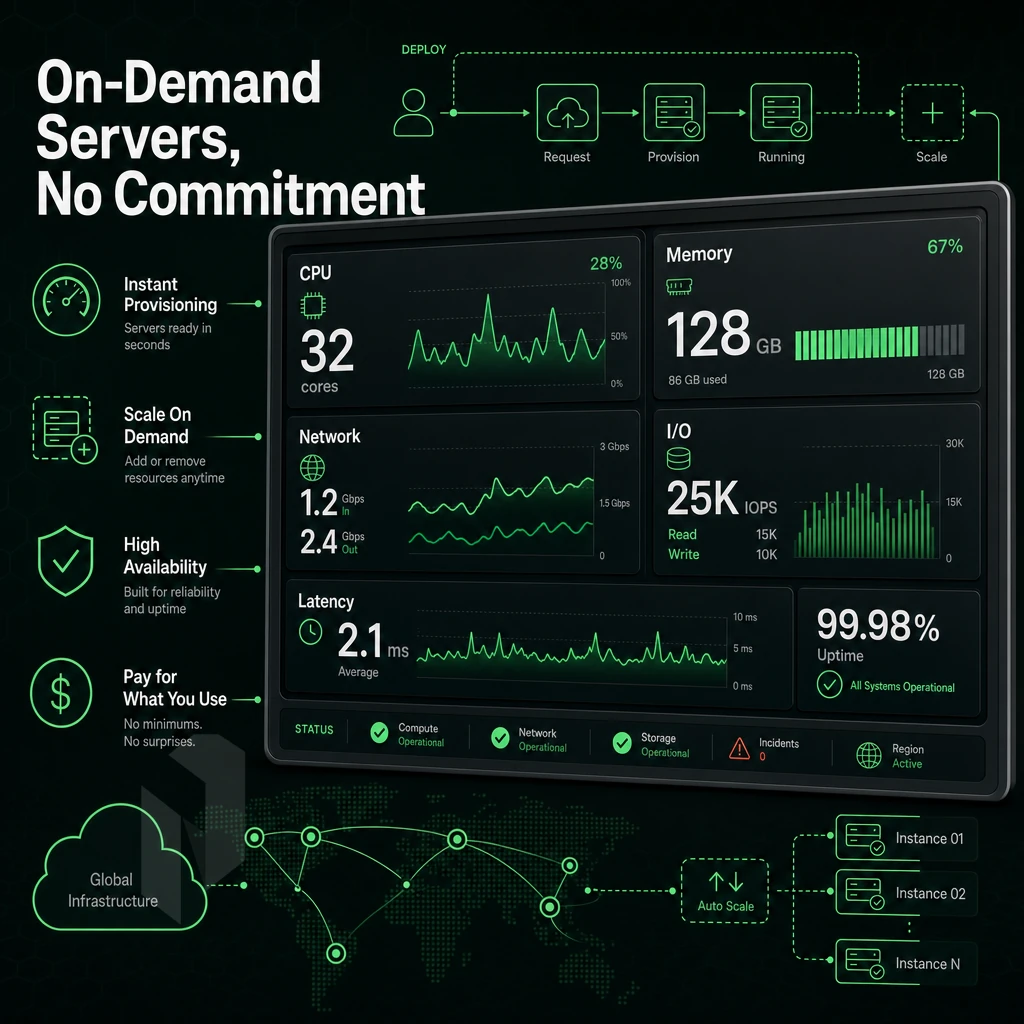
Bare metal cloud is a combination of the ultimate in dedicated servers (bare metal) and the speed and flexible billing models of cloud services. That means one physical server, no virtual machines and no noisy neighbors, up in minutes, not weeks.
Understanding the Dedicated Servers Model Across Global Locations
Bare metal cloud solutions are often offered between the traditional colocation model and the more traditional hyperscaler compute models. In colocation, customers provision and manage their own hardware in a datacenter. In hyperscaler-based compute models, users provision virtual instances to run applications on shared hardware. Bare metal cloud offerings are dedicated hardware provisioned on demand, billed on a monthly basis, without the need to purchase the hardware upfront.
A bare metal cloud server bridges this gap by offering single-tenant hardware with the provisioning speed of virtualized infrastructure. Some providers also offer hourly billing options for short-term workloads or testing environments, though monthly commitments remain the standard pricing model. Bare metal cloud offerings appeal to users who need the performance isolation of physical hardware but want to avoid the capital expenditure and lead times associated with traditional colocation deployments.
A hosted private cloud is related to bare metal cloud computing but differs from it as a hosted solution where a provider virtualizes a private and isolated computing environment for a single customer. In contrast, bare metal cloud computing does not use any virtualisation and the customer’s application is running directly on the physical server’s metal.
Organizations requiring isolation without virtualization overhead often compare hosted private cloud architectures against bare metal deployments to determine which model best satisfies their security and performance requirements. Bare metal deployments offer enhanced security postures by eliminating the hypervisor attack surface that exists in virtualized environments, making them attractive for organizations with stringent compliance mandates.
Evaluating Dedicated Servers Provisioning Speed
- Verify the deployment SLA of your provider before signing off on it. The provisioning time can vary greatly between hosts. For example, at Netrouting, we provision bare metal servers within 60 minutes or less. This is crucial in situations such as unexpected traffic surges or fast moving projects.
- Billing granularity should also be checked. Most providers charge on a monthly basis. However, certain workloads might benefit from even shorter timeframes and thus you should check if the respective provider also offers corresponding flexible terms for his complete infrastructure and not only for new additions.
- Don’t compare prices on headline rates. Most of the major cloud providers offer bare metal, but their real costs are hidden in egress fees and per resource charges. Our pricing is transparent with no surprise egress charges.
Making the Right Choice for Dedicated Servers
- Select a model to match your workload. Latency sensitive applications, high throughput databases and GPU compute are best run as bare metal. Workloads that require rapid horizontal scaling across many nodes (dozens or more) are better suited with a hybrid approach.
- Check the network capacity. Even the best bare metal servers are useless if the uplink is too slow. Verify the port speed, peering and DDoS protection before you cut it loose.
Note: Don't conflate bare metal cloud with managed dedicated servers.
With our model and procurement criteria now defined, we can start to assign the right bare metal to the right workloads. Aligning server specifications with business requirements ensures that infrastructure investments directly support operational goals and revenue-generating activities.
What to Look for When Renting a Bare Metal Server
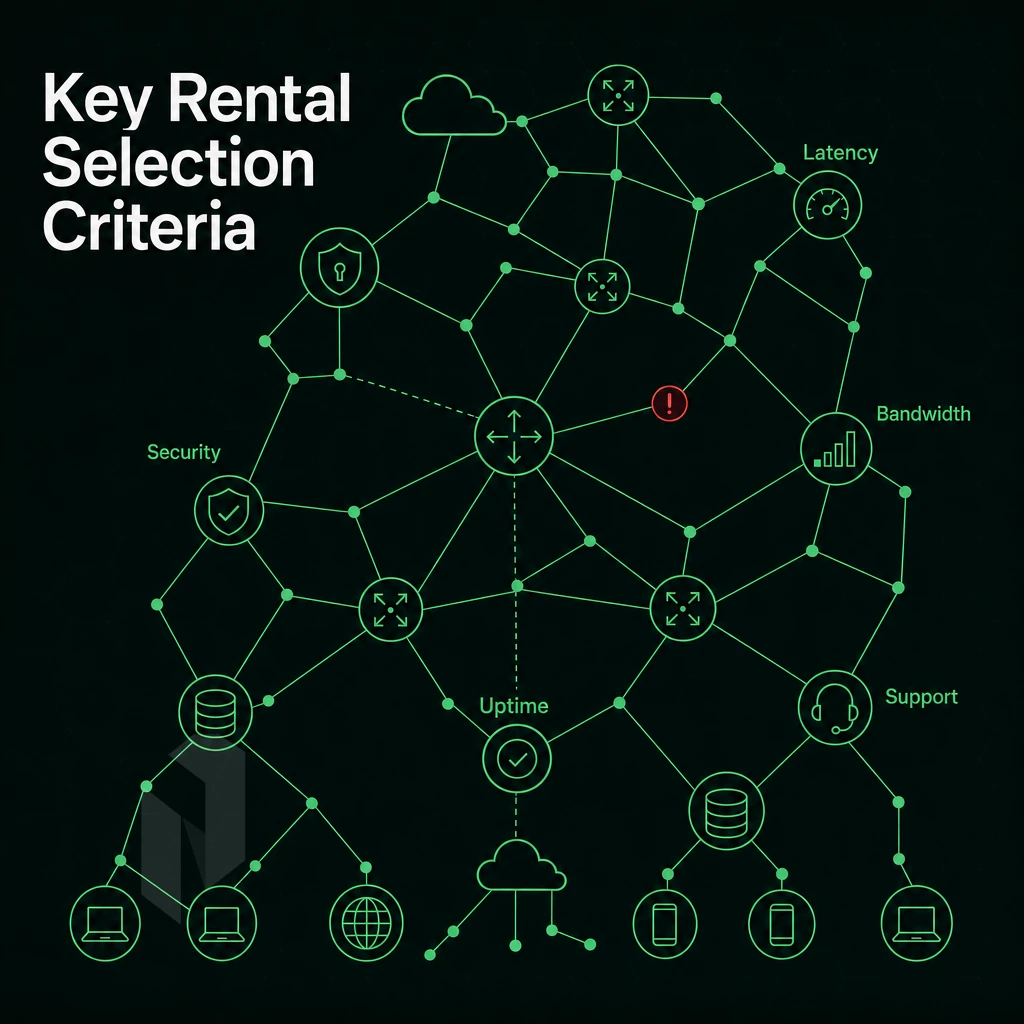
Bare metal rentals are not created equal.
Hardware and Storage for Dedicated Performance Servers
We start with the CPU platform: The Intel Xeon and AMD EPYC architectures, both staples of the modern data center, serve different purposes: High core count + high memory bandwidth vs. high single thread performance. We run on Dell and Supermicro hardware and use the latest generations of Intel Xeon and AMD EPYC CPUs. High performance workloads such as real-time analytics or computational simulations benefit significantly from selecting the appropriate CPU architecture based on thread parallelism requirements.
Check base specs for RAM limits, drive bay count, and storage types. Some platforms offer object storage alongside local NVMe or SAS drives and may support custom configurations for unusual workloads.
Network Quality and Control With Dedicated Servers
For example, we offer our dedicated servers with unmetered 10 Gbps bandwidth, and up to 40 Gbps on select servers. Look for DDoS protection to be included by default, not something you have to pay for as an add-on.
Full IPMI access is non-negotiable. It allows for out-of-band access to your servers to perform full OS reinstalls, and even change the BIOS, all without having to wait for your support team. Be sure to ensure that no one else is using your hardware or management interface. For community perspectives, see Reliable Bare Metal Providers : r/sysadmin.
Network-aware buyers should also ask about a provider’s BYOIP and BGP capabilities. These will influence performance at multiple sites or ones that need low latency.
Dedicated Servers for Big Data SLA and Support
Instead of targeting uptime percentages, a Service Level Agreement should outline the expected hardware replacement timeframes. Our standard SLA ensures same-business-day hardware repair or replacement. In addition to hardware, the provisioning time to deploy bare metal servers in under 60 minutes should also be a consideration. In addition, verify the network service level performance metrics outlined below.
Network Quality, DDoS Protection, and Private Network Options
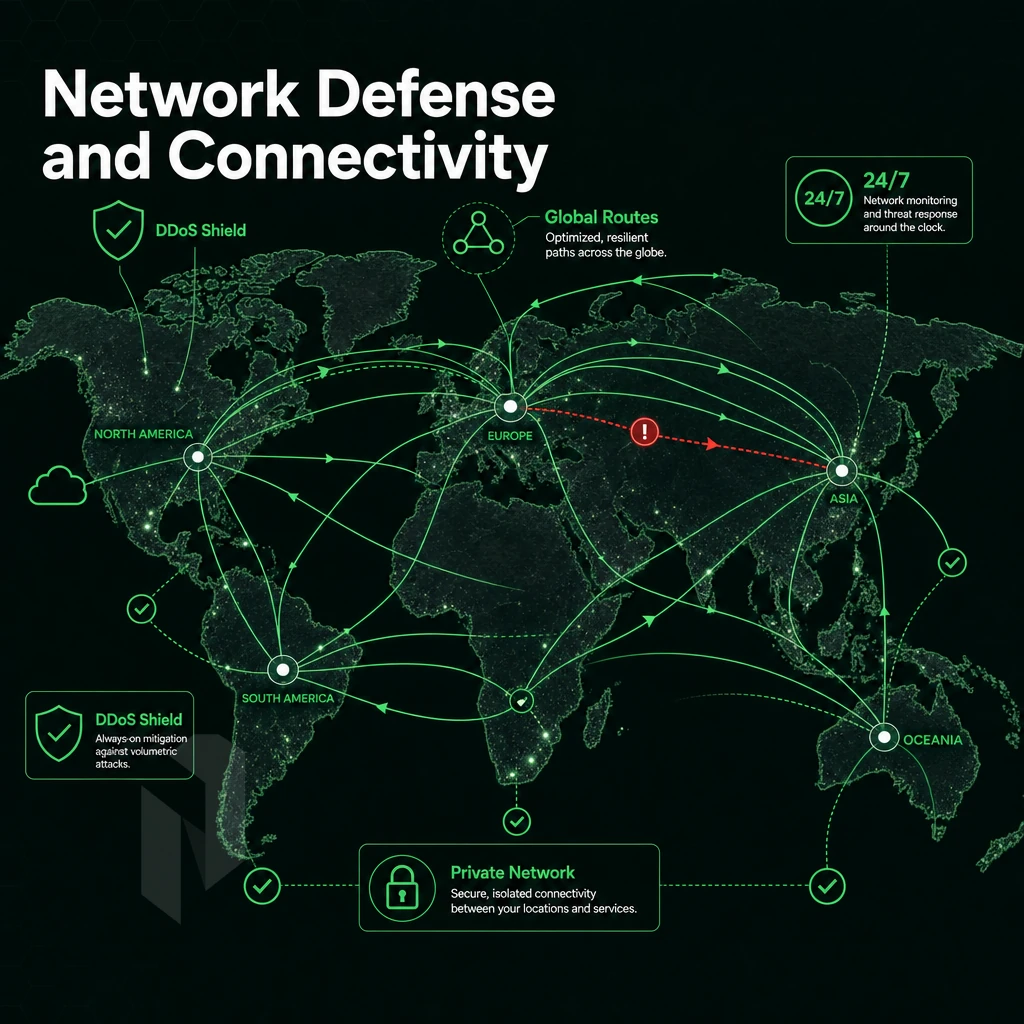
When renting a bare metal server, the raw hardware specs typically are only half the story. The network to the physical hardware (the “Metal”) is almost as important as the number of CPU cores and amount of RAM for real world performance. A poor network can cause all sorts of problems including latency spikes, congestion, and outages, even when you have direct access to robust underlying physical hardware resources.
Tier 1 Backbone, IX Peering, and Low Latency
Rather than relying on reseller transit, providers running their own Tier 1 backbone deliver traffic directly.
With a global network that carries more than 2.4 Tbps of bandwidth, and average port utilization of below 40%, there is always considerable headroom to grow.
Anti DDoS Protection and Traffic Scrubbing
All Netrouting services come with Anti DDoS protection (L3/L4) as basic service.
Private Network, Bandwidth, and Network Resources
Metered bandwidth can incur bills by Gigabytes transferred. Unmetered bandwidth on the other hand grants you a fixed port speed without any overage charges. It is particularly suitable for large, constant volumes of data. We offer unmetered 10 Gbps on all our dedicated servers. On special request even up to 40 Gbps.
Private networking between servers ensures all communication within your set of servers is 100% isolated from the public internet. The free private interconnect offered by Netrouting carries up to 40 Gbps and is highly suitable for replication, clustering as well as IPMI access. The full extent of our network resources are included by default and not offered as an optional add-on.
Low latency, DDoS resilience, and high-throughput private connectivity are all critical to optimal performance, and these factors must be considered when choosing a provider for your servers.
Then make sure DDoS protection and private networking are included by default and not sold as an extra. The location of your servers will have a huge impact on your latency and also on your compliance issues.
Managed vs. Unmanaged Bare Metal: Which Model Fits Your Team?
bare-metal hosting exists on a spectrum between the two extremes of offering customers full root access to a private network and completely managing the operational layer of a server for them.
Unmanaged: Full Control, Full Responsibility
Unmanaged bare metal servers are sold from first boot up to you to configure. You select the OS(s) to install, configure your web, application, database, etc. stack and are fully responsible for security. This is in contrast to shared hosting or vps hosting where much is pre-configured for you.
This model is ideal for development teams who have strong DevOps practices in place and experienced sysadmins. They get to directly access all of the hardware-level tuning options, such as CPU governors, NUMA topology and interrupt affinity.
Managed: Operational Overhead Offloaded
Managed services cover OS patching, security hardening, and proactive monitoring, so lean teams without dedicated server administration staff can run large-scale enterprise infrastructure without hiring a full team of administrators.
The managed hosting at Netrouting patches, hardens and monitors your bare metal and cloud servers for you. The Managed Proxmox VE services even go one step further and set up a cluster, patches the hypervisor, and configures backups for you.
Control Panel Options for Dedicated Servers
For client sites and reseller accounts, our managed plans support multiple operating systems and include cPanel/WHM or DirectAdmin to manage day-to-day tasks, with root access when needed.
Full root access is retained on all Netrouting managed plans. You control what you want to run on the server, we control what you need to keep your servers healthy.
With the appropriate web hosting management model identified, here's a comprehensive view of what Netrouting's data center expertise can bring to these respective deployment scenarios.
Why Choose Netrouting for Bare Metal Server Rental
Netrouting delivers bare metal servers provisioned in under 60 minutes, on dedicated hardware with no shared resources, no noisy neighbors, and consistent performance under every workload. Our dedicated servers run enterprise Dell and Supermicro hardware on Intel Xeon and AMD EPYC platforms, giving engineering teams and enterprise operations full control over their physical server environment.
- 2.4 Tbps+ global network, AS6206 backbone with AMS-IX peering since 2009; unmetered 10 Gbps standard, up to 40 Gbps available.
- Always-on DDoS protection, L3/L4 mitigation included on every bare metal service, no configuration required.
- Free private network, up to 40 Gbps between your resources across our data center locations.
- 10 locations, Stockholm, Amsterdam, Frankfurt, The Hague, Rotterdam, Bucharest, Miami, New York, Hong Kong, and Singapore.
- ISO 9001, ISO 27001, SOC 2 certified; 24/7 NOC with a one-hour ticket guarantee.
GPU servers for machine learning and AI workloads, managed solutions, and custom configurations are available across all regions. Compare configurations or contact our sales team to find the right fit for your workload.
The Core Advantages of Bare Metal Server Rental
Bare metal servers offer the unique combination of dedicated hardware, no hypervisor overhead and predictable performance under load. Resource isolation ensures that your workloads will never be competing against other users for CPU, storage and network resources. For critical workloads such as high-performance databases, AI and ML, and big data processing on a private network, the variance in performance caused by shared or virtualized environments translates directly into dollars lost.
Bare metal dedicated servers also give you full control over operating systems, tailored setups, and private network topology. Flexible billing keeps costs predictable. When performance predictability and security outweigh elasticity, bare metal server rental is the straightforward choice.
Frequently Asked Questions About Dedicated Servers
What is the typical cost of a custom bare metal private cloud server with dedicated resources?
Bare metal server costs vary widely based on CPU generation, RAM, storage, and bandwidth. Entry-level single-processor servers are cost-effective for small workloads.
How much would it cost to rent a server?
The cost depends on hardware tier, bandwidth allocation, and any fully managed offerings layered on top. Bare metal web hosting consistently delivers lower total cost of ownership than equivalent hyperscaler compute, especially for sustained, high-throughput workloads.
Where can I find a cheap bare metal server?
Look for web hosting providers that own their network backbone and operate carrier-neutral facilities, they cut out reseller margins and pass savings on to you. Netrouting offers bare metal across ten locations in Europe, North America, and Asia-Pacific, with unmetered 10 Gbps included and always-on DDoS protection at no extra charge.
What is the cheapest server for home use?
For home use, a cloud compute instance is typically the most cost-effective starting point, you pay only for what you provision and can scale down when idle. If you need dedicated resources without shared-tenancy risk, an entry-level bare metal server is the next step up. Home lab enthusiasts who need full hardware control and consistent performance often find bare metal worth the modest premium over a VPS.
What is the difference between bare metal and a VPS?
A bare metal server gives you exclusive access to a physical machine, no hypervisor overhead, no noisy neighbours, and full control over the hardware. A VPS shares underlying physical resources with other tenants via a hypervisor, which introduces variable performance and limits low-level hardware access.
Bare metal is the right choice when cpu usage is intensive, covering high-frequency databases, gaming servers, and any application where consistent, predictable performance is non-negotiable.
How fast can a bare metal server be provisioned?
Netrouting provisions bare metal servers in under 60 minutes through its Rapid Deployment programme. Custom hardware builds or high-density configurations spanning your entire infrastructure may require additional lead time, so confirm availability with sales before ordering if your deadline is tight.
Renting a bare metal server means you get to use dedicated hardware to get the best performance possible, all while avoiding the costs of purchasing and the commitment of owning servers. Choosing the right provider for your needs is just as important as choosing the right servers. Look for a provider with a strong core network, quick provisioning, and fair SLAs before agreeing to anything.
We deploy bare metal servers in 10 locations in Europe, North America and Asia on our own AS6206 backbone with 2.4 Tbps+ and unmetered 10 Gbps connectivity. All servers are protected by always-on DDoS protection and come with 24/7 NOC support. Most servers are online within 60 minutes.
Ready to spec your server? Browse Netrouting's dedicated server configurations or contact our team for a custom build.