As your workloads grow, they inevitably outgrow shared infrastructure.
The differentiation between virtualized and non-virtualized environments matters more than you think. But removing them allows for deterministic performance, direct access to hardware features (e.g. Bare metal eliminates the hypervisor layer entirely, giving applications direct CPU instruction access and removing unpredictable scheduling delays that plague multi-tenant systems. This architecture delivers high performance by eliminating context switches and allowing applications to leverage specialized CPU instructions without virtualization penalties.
Applications requiring maximum performance benefit most from this direct hardware access, as they can fully utilize CPU capabilities without interference from virtualization layers. Organizations seeking optimal performance choose this architecture specifically because it eliminates the unpredictability inherent in virtualized systems where resource contention can degrade application responsiveness.
Blog contents
In this article we explore what bare metal servers are like, how they differ from virtual machines and cloud instances, where bare metal servers sit in the modern stack of infrastructure. Additionally, Lastly which workloads will actually benefit from a dedicated server.
By the end of this piece you will have a clear way of thinking about whether or not to use bare metal servers in your next architecture.
What Do Bare Metal Servers Mean?
The terms bare metal server, dedicated server and physical server are generally used interchangeably and refer to the same basic model of server provision. Understanding the key differences between bare metal servers and virtualized servers will help you choose the correct platform for your workloads. For more context, see Bare-metal server.
Bare Metal Server Meaning: The Core Definition
A bare metal server is a physical server dedicated to a single customer. Unlike a typical cloud environment that relies on virtualization software like a Hypervisor, there is no layer of software sitting between your applications and the physical server's hardware. Also, there are no other customers sharing the server’s CPU, RAM or storage. The server's compute capacity, memory bandwidth, and storage throughput remain exclusively available to a single organization rather than being divided among multiple users.
Direct hardware access is the defining characteristic of your server.
Bare Metal vs. Virtual Machines by Operating System
Virtual machines divide up a physical server into individual instances, or Virtual Machines, which run independently on top of the same physical servers. This sharing of servers results in additional overhead and problems caused by so called “noisy neighbors”.
Bare metal servers remove a layer of abstraction from your servers. Instead of the varied performance that can fluctuate on shared setups, a metal server gives you full control over consistent, predictable, and fully isolated resources without sharing them with other users.
Dedicated Server Use Cases by Operating System
Bare metal servers provide a very practical example of high frequency databases running on a dedicated server. There, they have complete control over the hardware their hosting provider dedicates solely to them, and are unaffected by latency spikes from shared infrastructure that could corrupt timing-sensitive transactions. Enterprise customer relationship management platforms running on these servers benefit from the same predictable performance characteristics, ensuring consistent response times during peak transaction volumes. The isolation inherent in dedicated resources ensures that database queries execute with microsecond-level precision, unaffected by workload fluctuations from neighboring tenants.
Organizations running enterprise resource planning systems on dedicated infrastructure experience similar advantages, with transaction processing speeds that remain stable regardless of external load conditions. Financial institutions deploying high frequency trading platforms on these servers achieve the sub-millisecond execution speeds required for algorithmic strategies that depend on nanosecond-level timing precision. Organizations deploying mission critical applications on these servers require the guaranteed performance and isolation that only non-virtualized infrastructure can provide.
- Latency-sensitive databases and trading platforms.
- High-throughput video encoding and streaming.
- Compliance workloads requiring physical isolation.
- AI/ML training on GPU hardware.
We deploy bare metal servers within 60 minutes or less at 10 data centers worldwide.
Bare Metal vs Virtual Machines: Key Differences
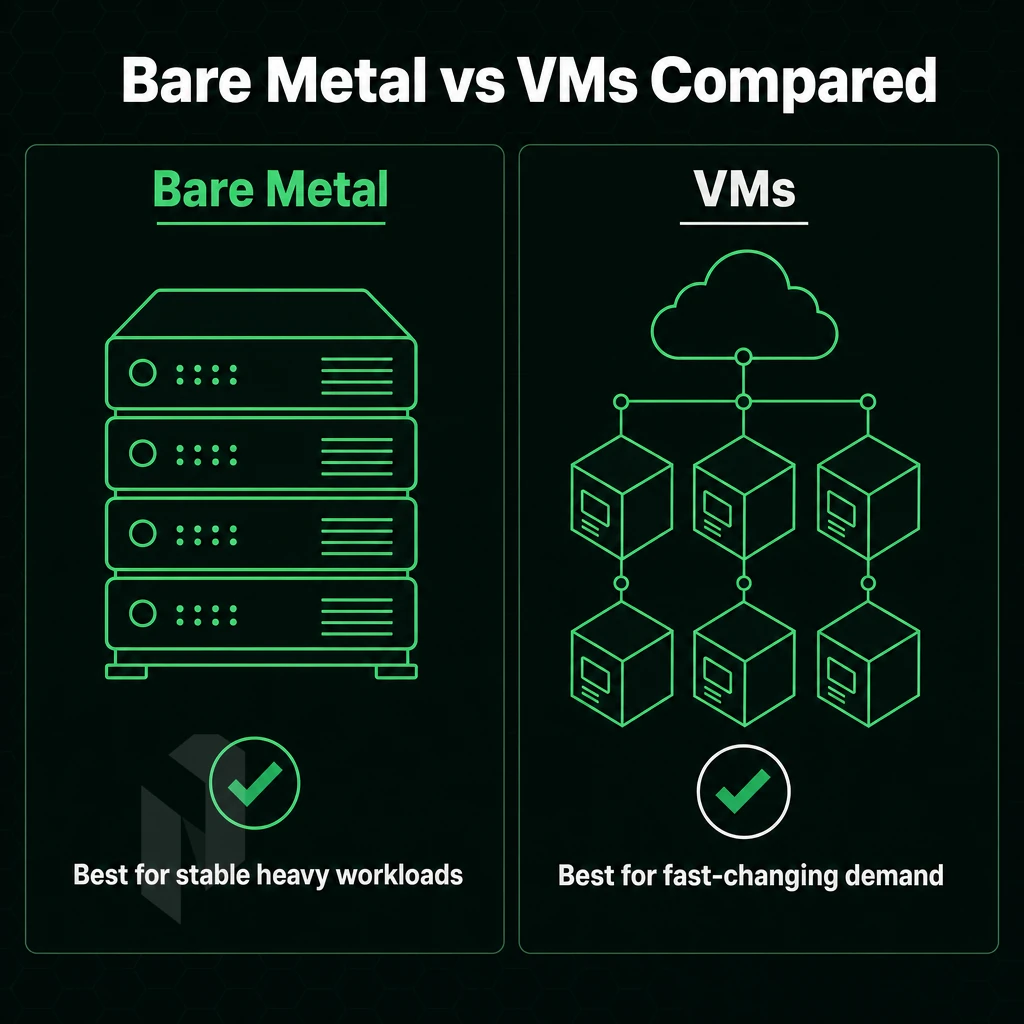
When choosing between bare metal servers and virtual machines the main deciding factor is whether you need guaranteed resources or if shared resources are acceptable. From there performance, cost, and architecture follow.
Understanding the Managed Services Operating System Resource Model
Bare metal servers are dedicated physical server s for a single customer. They are not virtualized, i.e. there is no hypervisor and no sharing of hardware resources with other customers. In contrast to that, virtual servers are run by a hypervisor which slices up a dedicated server into virtual servers. Each virtual server then runs on the same CPU, RAM and storage as the bare-metal host.
Note: The noisy neighbor problem occurs when another VM on the same host consumes a disproportionate share of resources, degrading your performance without warning.
Bare Metal Servers vs. Cloud Hosting by Operating System
Bare metal servers offer physical isolation and guaranteed throughput. Cloud servers trade off isolation against flexibility and faster setup. The virtualization overhead (the amount of CPU time consumed by the hypervisor) is non-existent on bare metal servers, and can be a critical factor for very low latency applications and other very compute intensive workloads.
Bare Metal Cloud: When to Use Each
The Bare metal cloud combines the power of dedicated servers with the flexibility of cloud hosting. We recommend to use bare metal servers for dedicated hardware like databases, high-frequency trading or AI-inference, whereas VMs are perfect for fast scaling and slightly varying server performance. We can provision bare metal servers within 60 minutes or less, all on dedicated hardware, no virtualization in between, and all come with unmetered 10 Gbps network connectivity.
Network architects often deploy load balancers in front of these servers to distribute incoming traffic across multiple instances while maintaining the performance benefits of the underlying infrastructure. Organizations requiring high availability often configure multiple servers in active-passive or active-active clusters to ensure continuous operation during hardware failures or maintenance windows. These servers typically include enterprise-grade network interface cards that support advanced features like SR-IOV and RDMA for maximum throughput in data-intensive applications.
| Factor | Bare Metal | Virtual Machine |
|---|---|---|
| Resource model | Dedicated | Shared |
| Performance | Consistent | Variable |
| Isolation | Physical | Logical only |
| Provisioning speed | Under 60 min | Seconds to minutes |
| Use case fit | Databases, AI, gaming | Dev/test, burstable apps |
While it’s clear that VMs differ from bare metal in terms of functionality, less obvious is the difference between bare metal and dedicated server as marketing terms.
Bare Metal Server vs Dedicated Server: Is There a Difference?
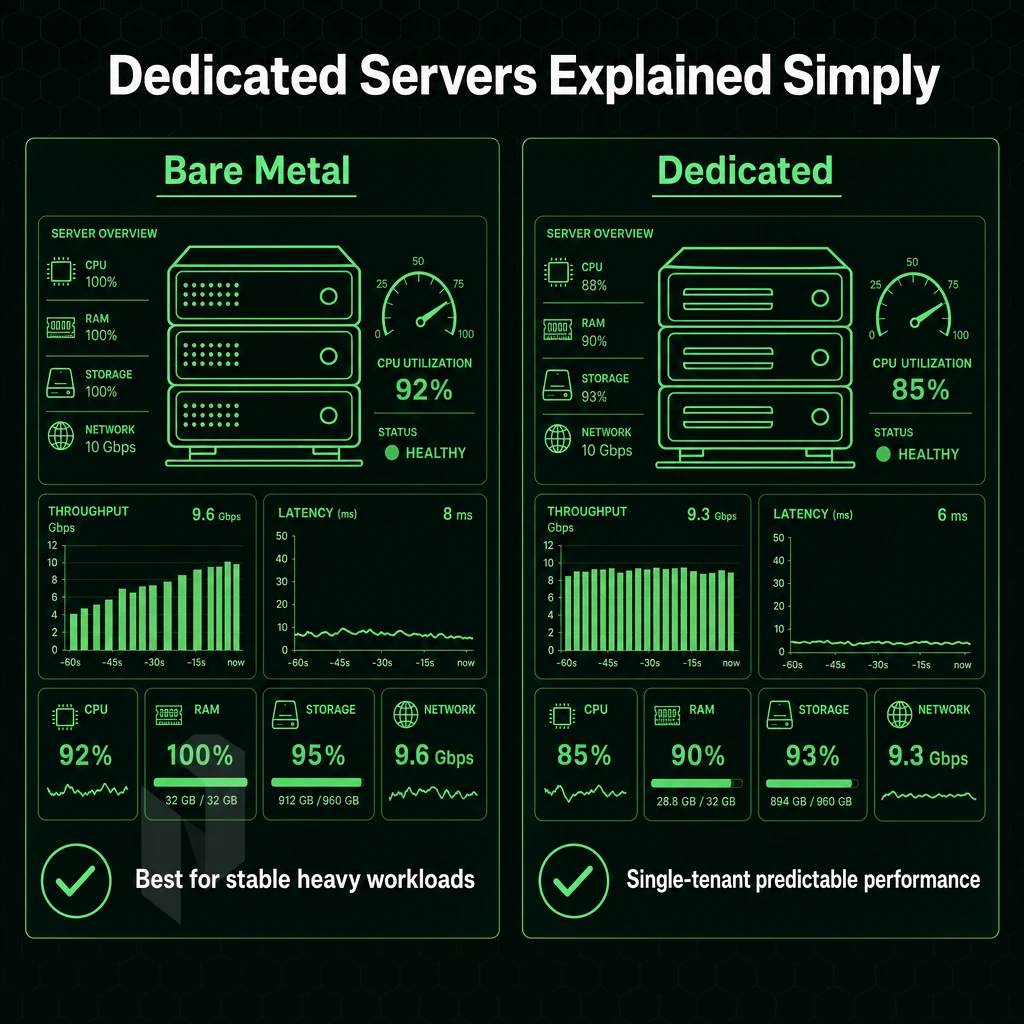
A single-tenant hardware server with no shared resources is often all that's needed for high performance computing, but there are some subtle differences worth explaining.
What the Labels Actually Mean for Complete Control
"bare metal" emphasizes that no virtualization layer sits between you and the servers.
Bare metal server hosting is usually understood to mean unmanaged server hardware. Even if a provider calls their offering of dedicated resources bare metal, it is still a dedicated server. Customers remain responsible for operating system updates, security patches, and hardware maintenance unless they purchase managed services separately from their provider. Customers should carefully evaluate service agreements to understand hidden costs that may arise from support tickets, bandwidth overages, or emergency hardware replacements not covered in base pricing.
Bare Metal Servers vs. Traditional Dedicated Cloud
As part of the move to cloud computing, some cloud providers started to offer “bare metal cloud”. This means that instead of virtual servers, customers can get physical machines provisioned on demand, using cloud APIs.
As opposed to bare metal hosting offered by traditional hosting providers which typically offers the same hardware but for longer periods of time and with different terms. The key distinction lies in provisioning speed and billing models, where a traditional hosting provider typically requires longer contract commitments while bare metal cloud platforms enable hourly or monthly billing with API-driven automation.
Cloud hosting on the other hand runs your workloads on shared hypervisors.
Which High Performance Term Should You Use?
Get a clear answer from your hosting provider.
It solves performance and resource contention problems.
Enhanced Security and Physical Isolation Benefits
Bare metal is defined by physical isolation of your workload running on dedicated hardware. As no other tenant shares the same CPU, memory, and storage on your entire physical machine with you, entire classes of attack are prevented that cloud servers and shared hosting environments cannot guarantee to fully mitigate.
Enhanced Security Through Physical Isolation
Virtualized environments run on shared kernels and shared hypervisor layers for multiple tenants. In contrast, bare metal deployments run unvirtualized and thus have no VM escape risk, no risk of hypervisor rootkits, and no shared kernels to scan for rogue processes from another tenant.
Physical hardware resources such as CPU caches, memory buses and network interfaces are allocated entirely to a guest. Side-channel attacks such as Spectre and Meltdown rely on shared hardware components with other guests and the host.
Compliance-Ready Operating System Infrastructure
Bare metal's hard tenant boundary pairs naturally with our ISO 27001 and SOC 2 certified infrastructure, unlike shared cloud servers, for isolating regulated workloads like healthcare records, payment data, and financial systems.
Verifying that no other customer has direct access to your environment is trivial on bare-metal infrastructure, but extremely difficult in a shared cloud computing hypervisor environment.
Machine Learning Mission-Critical Application Fit
For mission-critical applications, predictability of security is as important as performance.
Once you determine bare metal is the best architecture for your needs rather than a cloud environment, you need to pick a provider for that hardware and figure out how a capable operator differs from commodity providers.
Why Choose Netrouting for Bare Metal Server Hosting
Netrouting delivers bare metal servers on latest-gen Dell and Supermicro hardware, Intel Xeon and AMD EPYC platforms, giving you exclusive access to underlying hardware resources with zero virtualization overhead. No shared resources, no noisy neighbor, no virtual machines slowing you down.
- Provisioned in under 60 minutes. Bare metal provisioning that moves at cloud speed, without the virtualization layer.
- Unmetered 10 Gbps standard; up to 40 Gbps available. Our 2.4 Tbps+ backbone on AS6206 keeps latency low and throughput consistent.
- 10 locations across three continents. Amsterdam, Frankfurt, The Hague, Stockholm, Rotterdam, Bucharest, Miami, New York, Hong Kong, and Singapore.
- Always-on L3/L4 DDoS protection included on every bare metal deployment, no add-on required.
- ISO 9001, ISO 27001, and SOC 2 certified. Audited security and quality management for mission-critical applications.
- Free private network between your resources, plus a 24/7 NOC with a one-hour ticket guarantee.
Whether you're running high performance computing , machine learning workloads, or latency-sensitive platforms, our dedicated hardware delivers consistent performance with full control over your software stack.
Frequently Asked Questions About Operating System
What does a bare metal server mean for HPC hardware access without a shared OS?
A bare metal server is a physical machine dedicated entirely to one tenant. That unmediated hardware access eliminates the performance overhead and "noisy neighbor" interference that shared or shared virtual infrastructure introduce.
How does a metal server differ from a VM when accessing the underlying hardware?
A virtual machine runs on top of a hypervisor that carves one physical host into multiple isolated instances. Bare metal removes that layer entirely, your OS runs directly on the hardware. Bare metal wins on raw throughput, consistent latency, and workloads that cannot tolerate CPU or I/O contention from neighboring tenants.
What Are Bare Metal Servers vs Dedicated Servers?
Both describe a physical machine assigned exclusively to one customer with no shared resources. "Bare metal" emphasises the absence of a hypervisor layer and is commonly used in cloud-adjacent contexts where API-driven provisioning is expected. "Dedicated server" is the older hosting industry term for the same concept. At Netrouting, bare metal servers are provisioned in under 60 minutes and run on enterprise Dell and Supermicro hardware with Intel Xeon and AMD EPYC processors.
How much does a bare metal server cost?
Bare metal pricing varies by processor generation, RAM, storage configuration, and bandwidth requirements. Bare metal hosting eliminates the unpredictable costs of equivalent capacity on major cloud platforms, consistently delivering a lower total cost of ownership with no surprise egress fees and predictable monthly billing.
Bare Metal Servers for High Performance Computing in the Cloud
Bare metal cloud combines the single-tenant, no-hypervisor performance of a dedicated server with the on-demand provisioning model of cloud infrastructure. Netrouting delivers dedicated server deployment in under 60 minutes across locations in Europe, North America, and Asia-Pacific.
When should I use a bare metal server instead of a virtual server?
Choose bare metal infrastructure when your workload is sensitive to latency, CPU contention, or I/O throughput, databases, high-frequency trading, video transcoding, online gaming, and AI/ML inference are clear examples.
If your application requires a specific kernel configuration, custom networking stack, or direct hardware access for workloads like machine learning (such as GPU passthrough), bare metal is the only practical option. Virtual servers remain the better fit for lightweight, variable, or short-lived workloads where flexibility outweighs raw performance.
Bare metal servers offer the unique ability to provision dedicated physical servers in the datacenter without virtualization overhead. As opposed to hypervisor-based environments that host many noisy neighbors, bare metal servers offer consistent and predictable performance for applications such as databases, high-volume sites, and low-latency applications. In terms of security, bare metal servers offer a completely isolated physical environment which does not have a shared attack surface at the hardware level.
As opposed to virtual machines, the difference with bare metal is fundamental. Bare metal is a completely different tool than cloud computing and should not be viewed as a simple upgrade from cloud.
Netrouting provisions bare metal servers across ten locations in Europe, North America, and Asia, all on a 2.4 Tbps+ network with unmetered 10 Gbps connectivity and always-on DDoS protection included. Explore Netrouting's dedicated server configurations to find the right hardware for your workload.