Unlimited bandwidth dedicated servers look great on paper. However, when you drill into the terms of service for apparently unmetered dedicated hosting connectivity, you'll discover that there's a world of difference between 'unlimited' and 'throttled ports/burst allowances/fair use policy'. Mis Choosing a server leads to unexpected overage charges, slower than optimal performance at peak hours and servers which cannot sustain the true traffic you move.
Netrouting has been operating dedicated servers since 2007.
Read on for the key things to look out for when evaluating cheap dedicated server s with unmetered bandwidth: how to read a bandwidth policy, what your port speed actually gets you, what you get for your money with regards to hardware, where location matters (and why).
Blog contents
Additionally, Lastly, how soon your support team will respond in the event of a sudden traffic spike.
What Cheap Dedicated Servers With Unlimited Bandwidth Actually Means
"Unlimited bandwidth" is arguably one of the most commonly abused words in the dedicated server hosting industry today.
Dedicated Hosting vs. Shared Infrastructure
Dedicated servers are isolated, i.e. they don’t share any resources such as CPU, RAM or storage. Every workload running on a dedicated server gets 100% of the resources allocated to it. Organizations requiring complete resource isolation often choose dedicated servers to ensure their applications receive consistent computational power without interference from other tenants.
Servers with higher ram capacity enable more simultaneous processes and larger datasets to be held in memory, reducing disk I/O bottlenecks for memory-intensive applications. Many administrators prefer linux distributions for dedicated servers due to their stability, security, and lower resource overhead compared to proprietary operating systems. This isolation architecture enhances reliability by preventing resource contention and ensuring that performance degradation in one application cannot cascade to affect others.
This is different from VPS or shared hosting in that with dedicated hosting you don’t have to worry about noisy neighbors, and you can expect consistent and predictable performance. This isolation architecture enhances reliability by eliminating the risk of resource contention that can cause unexpected downtime or performance degradation in multi-tenant environments.
Is Cheap Dedicated Server Unlimited Bandwidth Really Unlimited?
No. "Unlimited bandwidth" in provider marketing almost always means unmetered bandwidth at a fixed port speed. The port is the real ceiling.
A 1 Gbps unmetered port can support up to approximately 10.8 TB of theoretical throughput on a 24 hour basis (should you manage to sustain 100% utilization throughout the day and night). Note that this is not infinite, but rather is constrained by the laws of physics.
Three bandwidth models exist on cheap dedicated servers:
- Unmetered bandwidth (no data limits) but restricted by port speed (1 Gbps / 10 Gbps).
- Guaranteed bandwidth, a fixed bandwidth guaranteed 24/7/365.
- Burstable bandwidth, a minimum bandwidth which can transiently go above that minimum before returning to that minimum.
Just because something is described as 'unmetered' on a cheap dedicated server offer doesn't mean it's guaranteed.
Our dedicated servers include unmetered 10 Gbps bandwidth as standard.
What Hidden Costs Should I Watch for When Buying a Cheap Dedicated Server?
Don't get caught out, advertised rates from your server rarely cover everything, so know about these common add-ons.
- Setup fees charged at provisioning.
- Overage charges once a "soft" data cap is hit.
- Port upgrade fees to reach 10 Gbps.
- Charges for additional IPv4 addresses.
- Remote hands billed per incident.
Free private networking on your resources, no setup fees for standard configurations and courtesy remote hands are included in your bill with Netrouting. Once you understand the terms, storage limits, and other hidden costs, you can start to compare the value in the variables of the different plans each provider offers. Regular security reviews and compliance checks help ensure your server infrastructure remains protected against emerging threats and vulnerabilities through systematic audit processes.
What to Look for in Cheap Dedicated Servers Plans
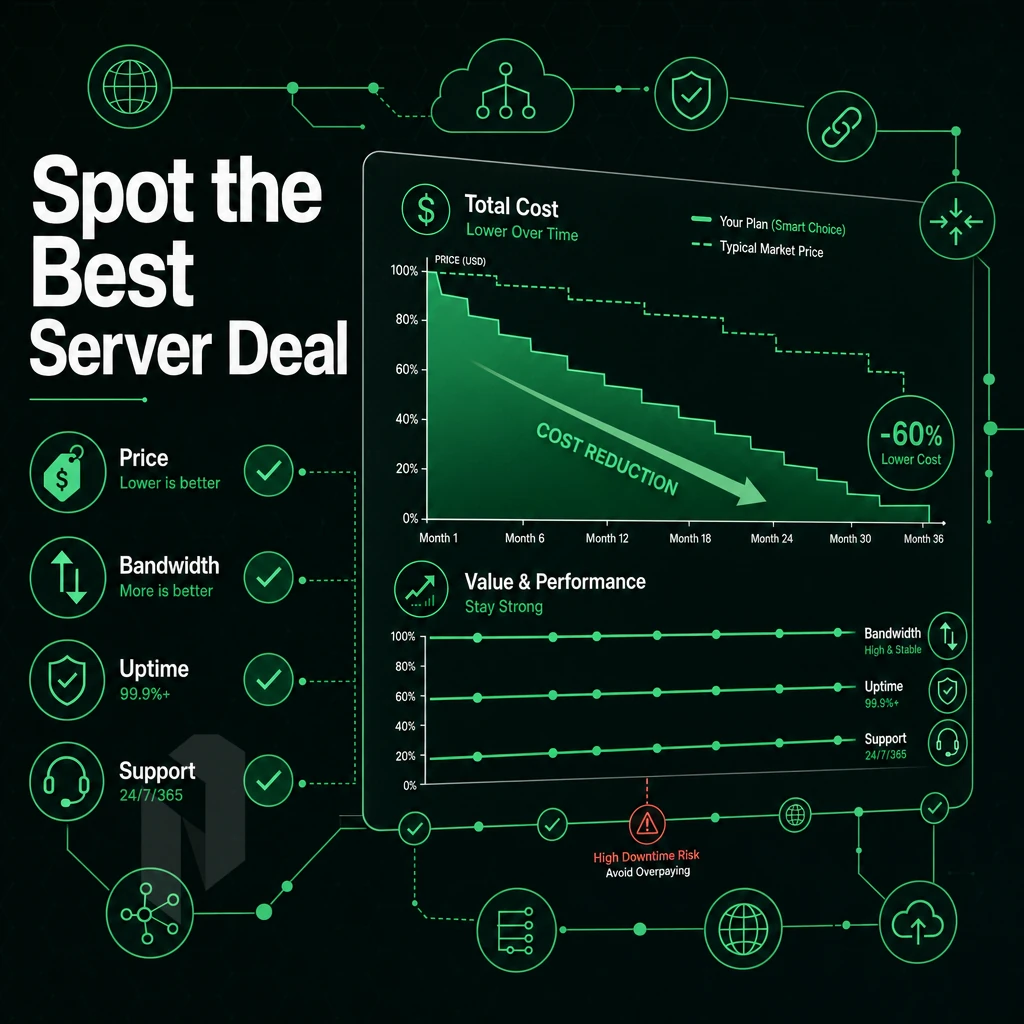
While a cheap dedicated server offer may have a low headline price, the true value or costs hidden until later can depend on many factors.
Performance: CPU Cores, RAM, and Storage
The number of CPU cores and the generation of a CPU matters far more than the clock speed of older generations.
The type of storage is as important as total amount of storage space.
What Port Speed Do High Traffic Websites Actually Need?
For most medium-sized websites a 1 Gbps port is more than enough.
For dedicated servers, Netrouting includes unmetered 10 Gbps bandwidth (up to 40 Gbps for high volume sites). High-traffic projects benefit from this infrastructure, as each site receives consistent throughput without competing for network resources during peak usage periods.
Control Panel, Root Access, and Setup Fees
Full root access and a usable control panel are minimum requirements. You should also confirm which operating systems the provider offers and whether licensing for the control panel is included in the price or not. The ability to configure server settings, install custom software, and modify system parameters ensures you maintain complete operational flexibility for your specific use case. Some providers also offer free domain registration or transfer services as part of their hosting packages, simplifying the process of getting your server online. Many hosting providers offer cpanel as a popular option for server management, though licensing costs and feature sets can vary significantly between plans.
Evaluating which features are included versus those requiring additional fees helps you understand the total cost of ownership before committing to a provider. Most providers support both linux and Windows Server distributions, though some specialized configurations may require specific OS versions for compatibility. Some providers also offer free domain registration or transfer services as part of their hosting packages, simplifying the process of getting your site online. Experienced administrators often prefer platforms that allow them to manage multiple servers from a unified interface, streamlining routine maintenance tasks across their infrastructure.
One of the most common hidden costs of budget dedicated servers is the setup fee. Some providers charge extra for a static IP, IPMI access or for a re-install of the OS. Make sure you get a full cost breakdown before committing to a server. Verify whether your provider includes a free domain registration or transfer service, as some hosts bundle this with server packages while others charge separately for domain management tools. Comparing the total cost of ownership helps you determine whether an advertised lowest price truly represents value or simply masks additional fees that accumulate over time.
Some hosts also charge for installing cPanel or other management software, so confirm whether your preferred server includes cPanel licenses or if you need to budget separately for them. Review which management features are included by default versus those requiring paid add-ons, as some hosts bundle monitoring tools and backup utilities while others itemize each component separately. Clarifying which administrative tasks you can perform independently versus those requiring paid support helps you manage ongoing operational expenses more effectively.
For public internet-facing servers, DDoS protection is a must.
| Variable | Minimum Acceptable | What to Aim For |
|---|---|---|
| CPU generation | Xeon E5 v3/v4 | EPYC or Xeon Scalable |
| Storage | SATA SSD | NVMe SSD |
| Port speed | 1 Gbps unmetered | 10 Gbps unmetered |
| DDoS protection | Basic L3/L4 included | Always-on, no config needed |
| Setup fees | None | None, with transparent billing |
When evaluating the cost of a hosting plan, even one that scores well across the five critical variables of recent processor generation. Adequate storage, adequate and unmetered bandwidth in real terms (and not just in labeling), no hidden fees. Additionally, attack mitigation included, look closely at the terminology used to define “unmetered bandwidth” as it can cost you a lot of money if you don’t understand what you’re reading.
Unmetered vs Unlimited Bandwidth: The Difference That Costs You Money
| Provider / Option | Performance | Bandwidth Options | Uptime SLA | Support | Best For |
|---|---|---|---|---|---|
| Netrouting | Latest-gen Intel Xeon and AMD EPYC. Up to 2 TB RAM. Hardware RAID standard. | Unmetered 10 Gbps port speed included. Up to 40 Gbps available. Free private network up to 40 Gbps. Guaranteed bandwidth with no overage surprises. | 99.9% SLA. Same-day hardware replacement. | 24/7 NOC. 1-hour ticket guarantee. Rapid deployment under 60 minutes. | High-traffic workloads needing guaranteed bandwidth, global reach, and always-on DDoS protection. |
| Budget bare-metal providers | Older-generation hardware common at entry tier. Limited custom configurations. | Unmetered plans available but port speed often capped at 1 Gbps. Traffic spikes may trigger fair-use limits. | 99.9% typical. Hardware replacement SLAs vary. | Ticket-only. Response times vary. No guaranteed SLA. | Cost-sensitive buyers with predictable, low-volume traffic and no strict SLA needs. |
| Hyperscaler compute (on-demand) | Flexible instance sizes. Shared tenancy common at lower tiers. | Metered egress. Bandwidth options expand with spend, but great deals on sustained throughput are rare. High-traffic workloads get expensive fast. | 99.9%-99.99% depending on tier and region. | Tiered support. Priority response requires paid plans. | Variable workloads with unpredictable scale and tolerance for egress billing complexity. |
For users running high traffic websites, game servers, or live streams, Netrouting offers the best balance of high port speeds, guaranteed bandwidth, and a 99.9% SLA. All this without hiding behind metered egress bandwidth. Affordable web hosts can advertise low prices but are often restricted by hidden fair use terms tied to hdd storage and data centers that kick in under load.
With a 2.4 Tbps+ backbone and volumetric attack protection enabled 24/7/365, Netrouting is by far the best option for users who require large amounts of bandwidth and 100% uptime. Only after you have settled on the bandwidth policy of choice, the question remains whether you really need dedicated hardware for your specific use case, or if a VPS wouldn’t be more than sufficient.
Dedicated Server vs VPS: When Cheap Shared Resources Aren't Enough
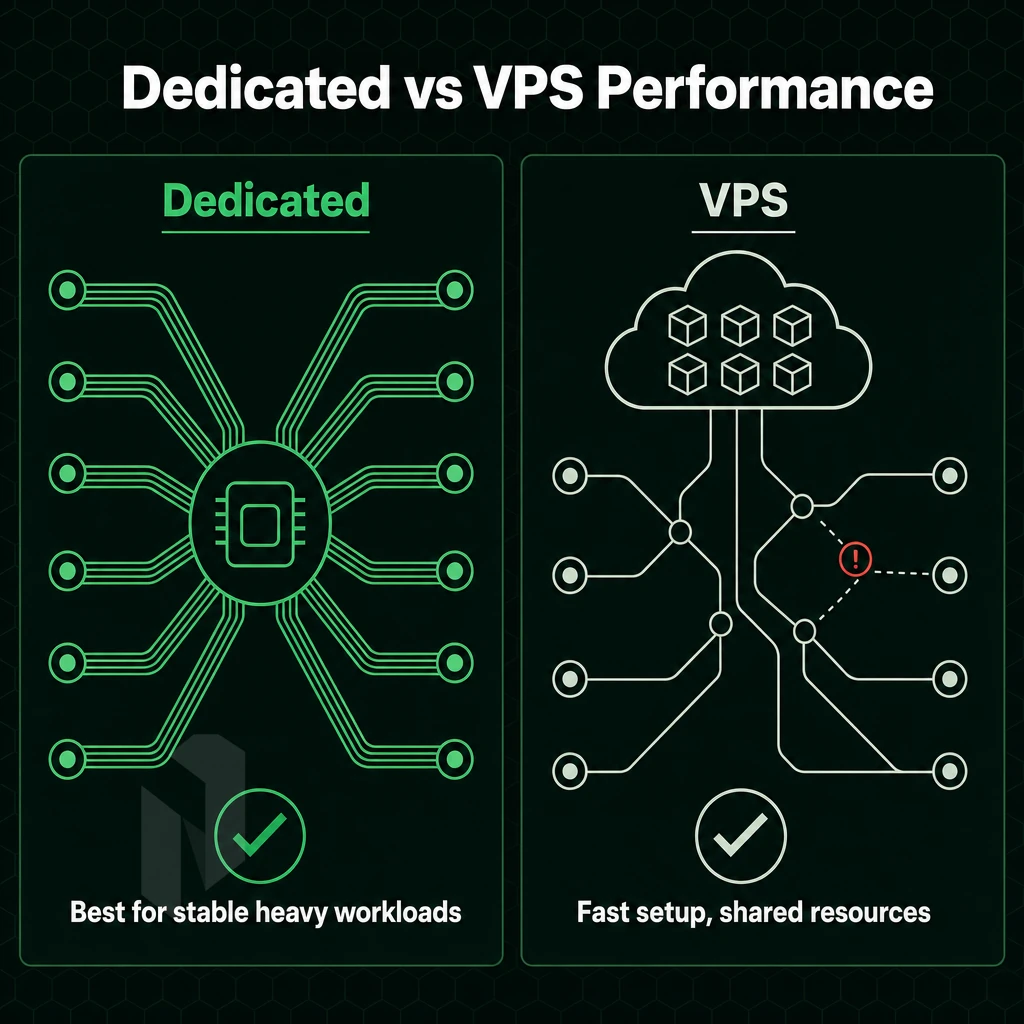
VPS hosting often looks very attractive (low cost, instant set up, familiar control panel). However, shared virtualisation brings its own set of hidden dangers that only surface under load. Learning about these dangers helps you to select the correct ‘tier’ of hosting from the off.
Predictable Performance vs. Noisy-Neighbour Risk
On a VPS, CPU cycles, memory bandwidth and disk I/O are shared with other tenants. A neighbor spike will impact your response time. This problem is typically invisible in a benchmark but is very real in production. We call this the "noisy neighbor" problem.
With dedicated hardware you eliminate the variable. Every core, every MB of RAM and every I/O path is dedicated to your sole use. It’s this that allows sustained high levels of traffic, video streaming and online gaming to be delivered with consistent and predictable performance.
Root Access Depth and OS Control
While root access is provided for both VPSes and dedicated servers, the level of access can vary greatly. On dedicated servers (or ‘iron’) you have complete control of the bootloader, kernel options, network driver tuning and even storage controller firmware. You can install Windows Server, custom kernels and even bare metal hypervisors. The only restriction would be that imposed by the underlying hypervisor and not the server itself.
The VPS guests run as normal guests inside the kernel of the host. This makes low-level tuning difficult to achieve, especially for databases that need to use huge pages, for VPN servers that need to control the routing, and for other workloads that stress the kernel networking.
When a VPS Is Enough, and When It Isn't
VPS is ideal for low-traffic websites, staging servers, and development sandboxes.
What works for production databases, game servers, and streaming apps at scale with a large provider differs greatly from smaller apps.
How Quickly Can Dedicated Servers Be Provisioned?
Provisioning speed is no longer a VPS advantage.
Netrouting’s Rapid Deployment target for bare metal online is 60 minutes or less, and is monitored 24/7 by the NOC from the time the server goes online.
Cheap Dedicated Servers Now Offer Competitive Pricing Against High-End VPS
Entry-level dedicated servers are now priced competitively with the premium end of VPS. The performance differential is large, but the cost differential has decreased significantly. Upgrading from shared servers to dedicated servers for workloads that require more than shared servers can provide is now easier than ever. Next, one must investigate the modern hardware provided for the price at each tier and where the greatest differential in hardware will occur.
Dedicated Server Specs Comparison: What You Get at Each Price Tier
Cheap dedicated servers are not created equal.
| Tier | CPU | RAM | Storage | Port Speed | Bandwidth | Example Config |
|---|---|---|---|---|---|---|
| Entry | Dual-core to quad-core | Up to 64 GB DDR3 | HDD or SSD storage | 1 Gbps | Unmetered | Contact sales |
| Mid-Range | 20-28 cores (dual Xeon) | Up to 512 GB DDR4 | SSD or mixed HDD/SSD | 1-10 Gbps | Unmetered | 2× E5-2690v4, 28C/56T |
| Performance | AMD EPYC / latest Xeon | Up to 2 TB RAM | NVMe SSD, up to 24 drives | 10-40 Gbps | Unmetered | Contact sales |
Avoiding Expensive Mistakes When Choosing a Tier
For static sites, development environments, and low load servers, the entry-level server configuration is sufficient. A mid-range server such as our 2× E5-2680v2 server is required for core count and RAM for databases and game servers.
The Performance tier is built with the latest generation of hardware, including AMD EPYC processors, NVMe storage, and ports delivering up to 40 Gbps. It’s ideal for workloads such as AI inference, high-frequency trading, and video transcoding that require low latency.
What Is the Difference Between Unmetered and Guaranteed Bandwidth?
Unmetered Bandwidth Across Every Operating System
no data limits, all traffic sent over the port speed is processed freely. Guaranteed bandwidth, we guarantee a minimum amount of bandwidth at all times, and never have our network loaded to affect this guaranteed speed.
All our servers are supplied with unlimited bandwidth over a 10 Gbps port. Servers that require extra high amounts of throughput can be supplied with 40 Gbps ports. Neither model charges overages per gigabyte.
DDoS Protection Across Every Server Tier
All Server tiers include always-on L3/L4 distributed denial-of-service protection as standard, and additional application-layer protection for high-criticality applications is available as a paid service with no setup fees beyond the recurring cost.
Even the most impressive hardware specs and bandwidth policies are irrelevant if the underlying network is not up to snuff. Here’s the metric that most providers prefer to gloss over: network quality and the related latency numbers.
Network Quality and Latency: Why Bandwidth Numbers Alone Don't Tell the Whole Story
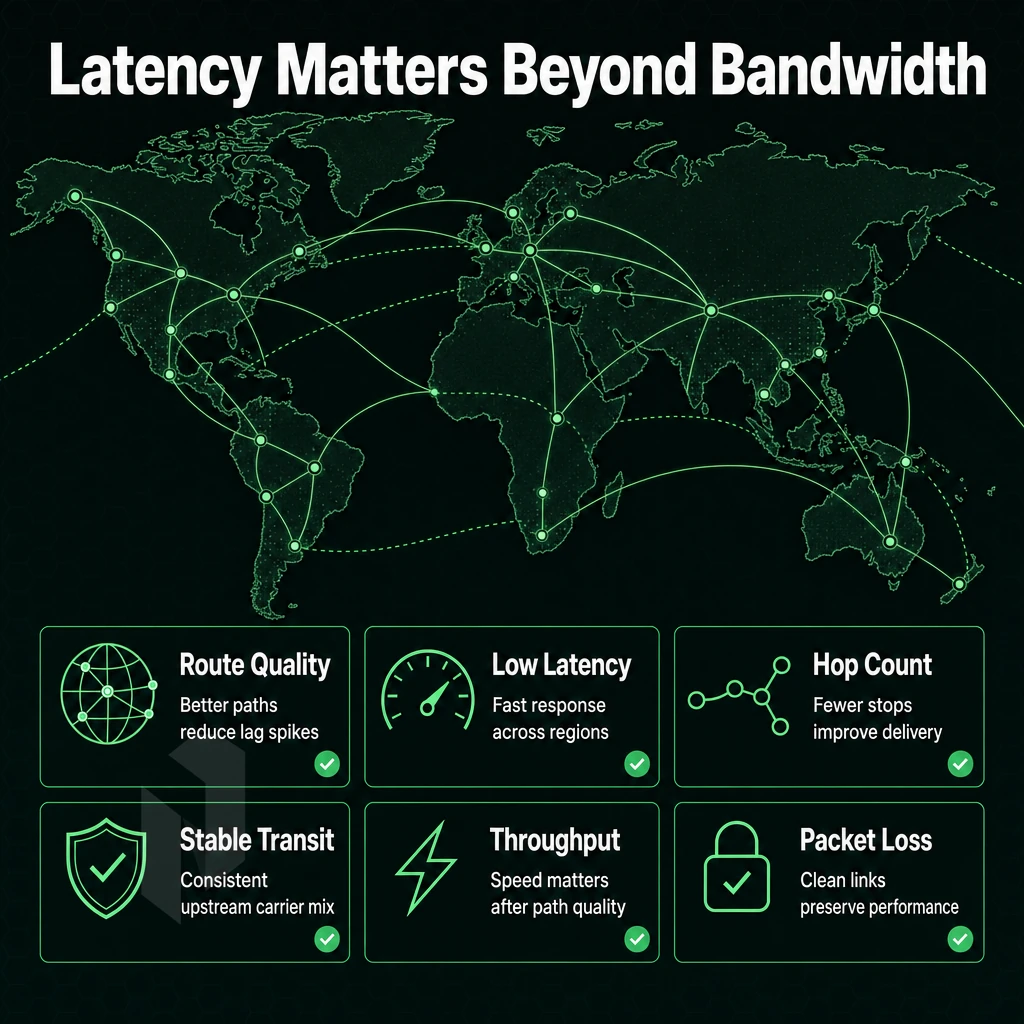
Dedicated server marketing tends to focus on raw bandwidth numbers. But raw numbers don’t tell the whole story. In reality, the performance that your users experience is determined by a variety of factors including peering, routing, and port utilization.
Peering, Routing, and Network Quality
IX membership cuts the cost of per-bit transmission and extra hops that a provider without it has to pay, enabling more competitive pricing across their network. As a hosting provider with AS 6206, you can peer directly with the major Internet Exchanges like AMS-IX, DE-CIX, NetNod, FL-IX and others.
Port utilization is just as important as raw power. Netrouting's server network operates below 40% average utilization on 100G+ connections, on a 2.4 Tbps+ backbone. This vast margin of capacity is what prevents packet loss during peak usage, the unnoticed destroyer of streaming, online gaming and VPN services.
Carrier-Neutral Data Centers and Routing Flexibility
Netrouting's server and data center locations are carrier-neutral and allow for free selection of your upstream provider. Netrouting's European hosting locations, offering precise routing control, are based in the heart of the European peering area in Amsterdam, Frankfurt and The Hague. The location in Miami serves as the primary entry point for Latin America. The location in New York is the primary entry point for the East Coast of the US. Netrouting is also present in Singapore and Hong Kong to serve customers in Asia-Pacific.
The geographic distribution of regions supports low latency for workloads focused on major regions, all served directly and without the need for a single hub to route traffic through.
Is Cheap Dedicated Server Hosting Better Than a VPS for High-Traffic Workloads?
A dedicated server is far better suited for sustained high-traffic workloads than a VPS, on all fronts: no CPU contention with other shared users, no memory pressure from ‘noisy-neighbor’ processes. Additionally, No contention with shared networking queues. Low-to-moderate traffic with fluctuating demand is better served by a VPS, once sustained at high levels, though, dedicated hardware delivers consistently superior performance to a VPS.
| Dimension | Dedicated Server | VPS |
|---|---|---|
| CPU isolation | Full, no contention | Shared host cores |
| Network throughput | Up to 10-40 Gbps unmetered | Typically capped, shared |
| Uptime SLA | 99.9% | Varies by platform |
| Best for | Gaming, streaming, VPN at scale | Dev environments, low-traffic sites |
This table provides a clear overview for high-traffic workloads. We compare the offers of dedicated servers by Netrouting with the required features in practice.
Why Choose Netrouting for Cheap Dedicated Servers with Unmetered Bandwidth
Netrouting's cheap dedicated servers are built for high traffic workloads that demand unmetered bandwidth and consistent performance, no throttling, no surprise fees.
- Unmetered 10 Gbps included, up to 40 Gbps available. Every dedicated server ships with unmetered bandwidth at 1 Gbps port speed as standard. Need more throughput? Upgrade to 10 Gbps or 40 Gbps without renegotiating your plan.
- Always-on network attack mitigation. L3/L4 mitigation is included on every server at no extra cost. Traffic spikes and volumetric attacks are scrubbed before they reach your hardware.
- Latest-gen dedicated hardware. We deploy Dell and Supermicro servers on Intel Xeon and AMD EPYC platforms, with full superuser access and custom configurations available.
- 10 global data centers. Amsterdam, Frankfurt, The Hague, Rotterdam, Stockholm, Bucharest, Miami, New York, Hong Kong, and Singapore. Low latency to Europe, North America, and Asia-Pacific.
- Bare metal in under 60 minutes. No setup fees, 99.9% SLA, and 24/7 NOC support with a 1-hour ticket guarantee. ISO 27001 and SOC 2 certified.
Compare our cheap dedicated server plans or contact sales to discuss custom configurations for your workload.
Key Takeaways: Getting Real Value from a Cheap Dedicated Server Offer
A cheap dedicated server with unlimited bandwidth is only as good as the port speed backing it and the network carrying your traffic. Unmetered bandwidth means no overage bill, it does not mean uncongested, low-latency delivery. Evaluate network quality: peering coverage, packet loss rates, and port utilization matter more than the headline spec. Factor in setup fees and DDoS add-ons before comparing plans. bare-metal hardware delivers reliable performance under load that VPS simply cannot match at scale.
Netrouting's dedicated server hosting combines unmetered bandwidth on a 2.4 Tbps+ backbone with always-on DDoS defense, no surprise fees. Additionally, Bare metal with HDD storage is provisioned in under 60 minutes, across ten data centers in Europe, North America, and Asia. That is what a cheap dedicated server offer should actually look like.
Cheap dedicated servers with unmetered bandwidth exist, but the spec sheet tells the real story. Prioritize network architecture over headline pricing. A low monthly cost means nothing if port speeds are throttled, oversold, or buried in fair-use clauses.
Know the difference between unmetered and unlimited before you commit. Unmetered at a guaranteed port speed is a real, measurable commitment. "Unlimited" without a port rate is marketing.
When shared resources can no longer handle your workload, traffic spikes, latency requirements, or raw compute demand, dedicated server is the only honest answer. The question is whether your provider's network can back it up.
Netrouting's dedicated servers ship with unmetered 10 Gbps connectivity on AS6206, always-on traffic scrubbing, and provisioning in under 60 minutes. Browse configurations or contact sales to spec a server against your actual workload requirements.