When committing real budget to dedicated server hosting, the choice of host is critical. The worst host can leave you with no complete control over slow (and painful) hardware upgrade cycles, congested (and underpowered) networks, and non-existent support post-purchase. But choose the right server hosting provider and your applications run faster, your team can get on with their jobs (as opposed to firefighting), and the total cost of ownership is exactly what you expect.
Netrouting has been a dedicated server provider for over 10 years, operating its own AS6206 Internet backbone with over 2.4 Tbps of network capacity in 10 data centers spread across Europe, North America and Asia-Pacific. This wealth of experience has been used to build this guide.
The real evaluation criteria that tell apart good hosts from great hosts: generation and configurations of hardware, network quality and peering, provision time, DDoS protection, support, and data center certifications. A dedicated server evaluation should also consider whether the provider owns its network infrastructure or resells capacity from third parties, as this directly impacts latency and troubleshooting speed. Understanding these key factors allows technical teams to benchmark providers objectively rather than relying on marketing claims or surface-level feature lists.
Blog contents
Whether that be high volume video hosting, very low latency game hosting with optimal server location, or high powered enterprise hosting that requires ISO 27001 and SOC 2 compliance. We start with a comparison of web hosts below.
What Makes the Best Dedicated Hosting Providers Stand Out
| Provider | Performance | Support | Uptime SLA | Network | Best For |
|---|---|---|---|---|---|
| Netrouting | Latest-gen Intel Xeon & AMD EPYC. Up to 2 TB RAM, 24 drives. Bare metal provisioned in under 60 minutes. Dedicated resources, no noisy neighbours. | 24/7 NOC. 1-hour ticket guarantee. Remote hands included. | 99.9% SLA. Same-day hardware replacement. | 2.4 Tbps+ backbone (AS6206). Unmetered 10 Gbps. Dense IX peering across 10 cities. Always-on DDoS protection. | Teams needing fast deployment, high-throughput dedicated server hosting, and global reach. |
| Large hyperscaler platforms | Shared server resources on virtualised infrastructure. Dedicated bare metal options available but limited configs. | Tiered support, faster response behind paid plans. | 99.9% on most dedicated tiers. | Massive global footprint. High egress costs. | Organisations already deep in a single-cloud ecosystem. |
| Budget dedicated server hosts | Older-generation hardware. Limited RAM and storage options. Shared server resources on entry configs. | Ticket-only. Response times vary. | 99.9% stated; enforcement varies. | Single-region. Limited peering. Basic DDoS mitigation. | Low-traffic sites with minimal performance requirements. |
| Carrier-neutral colocation providers | Customer-owned hardware. Full dedicated resources, performance depends on your gear. | Remote hands available; varies by provider. | Power and cooling SLAs only. | Dense cross-connect options. Bring-your-own transit. | Enterprises with existing hardware investments. |
When evaluating the best dedicated server options, Netrouting delivers peak performance combined with immense network potential.
As dedicated server hosting providers, we've equipped the countless servers at our multiple locations with the necessary resources to enable our customers to reach users everywhere around the globe. Next up: we’ll outline the most important features that you should pay close attention to when choosing a dedicated server.
Key Features to Evaluate in a Dedicated Server Hosting Provider
Dedicated hosting providers differ significantly in hardware generation, network quality, management level, and competitive pricing.
Hardware Configurations From the Best Dedicated Server Hosts
For a more modern server, look for current generation Intel Xeon or AMD EPYC processors, upgradable DDR4/DDR5 memory up to 512GB and NVMe storage for low-latency I/O. Root access is non-negotiable as it is the only way to have full control of the OS, kernel and software stack, as opposed to shared servers. This level of access provides maximum control over security policies, performance tuning, and application-level optimizations that shared environments cannot accommodate.
Network Quality and Security From a Dedicated Hosting Provider
All web hosting tiers include a 99.9% SLA as a minimum, unmetered 10 Gbps ports, and DDoS protection. Providers committed to high uptime typically back their infrastructure with redundant network paths and proactive monitoring to detect issues before they impact production workloads.
How to Compare Dedicated Server Hosting Providers
Look for a service provider that offers managed and unmanaged services, a range of operating systems, and daily automated backups. While price is important for any web hosting plan, make sure the terms are transparent and there are no surprises such as overage charges or hidden fees.
Providers with advanced features such as API provisioning, IPMI access, and hardware RAID configurations give technical teams greater flexibility without requiring constant vendor intervention. Reliable disaster recovery depends on automatic backups being configured correctly from day one, ensuring your data remains protected without manual intervention.
The key is to find a web hosting combination of appropriate hardware for your application and the right level of support for your team. Aligning hardware specifications with your business needs ensures you're not overpaying for unused capacity or underprovisioning critical workloads. Scalability should also factor into your decision, as evolving business requirements may demand more compute power, storage, or bandwidth over time.
A well-matched hosting plan becomes cost effective when it eliminates waste while maintaining the performance headroom needed for peak traffic periods. Evaluating cost efficiency means comparing not just the monthly rate but also the operational overhead, support costs, and potential downtime expenses across different hosting tiers. For large enterprises, this evaluation becomes even more critical as infrastructure decisions impact multiple departments and long-term operational budgets.
Managed vs Unmanaged Dedicated Hosting: Which Is Right for You
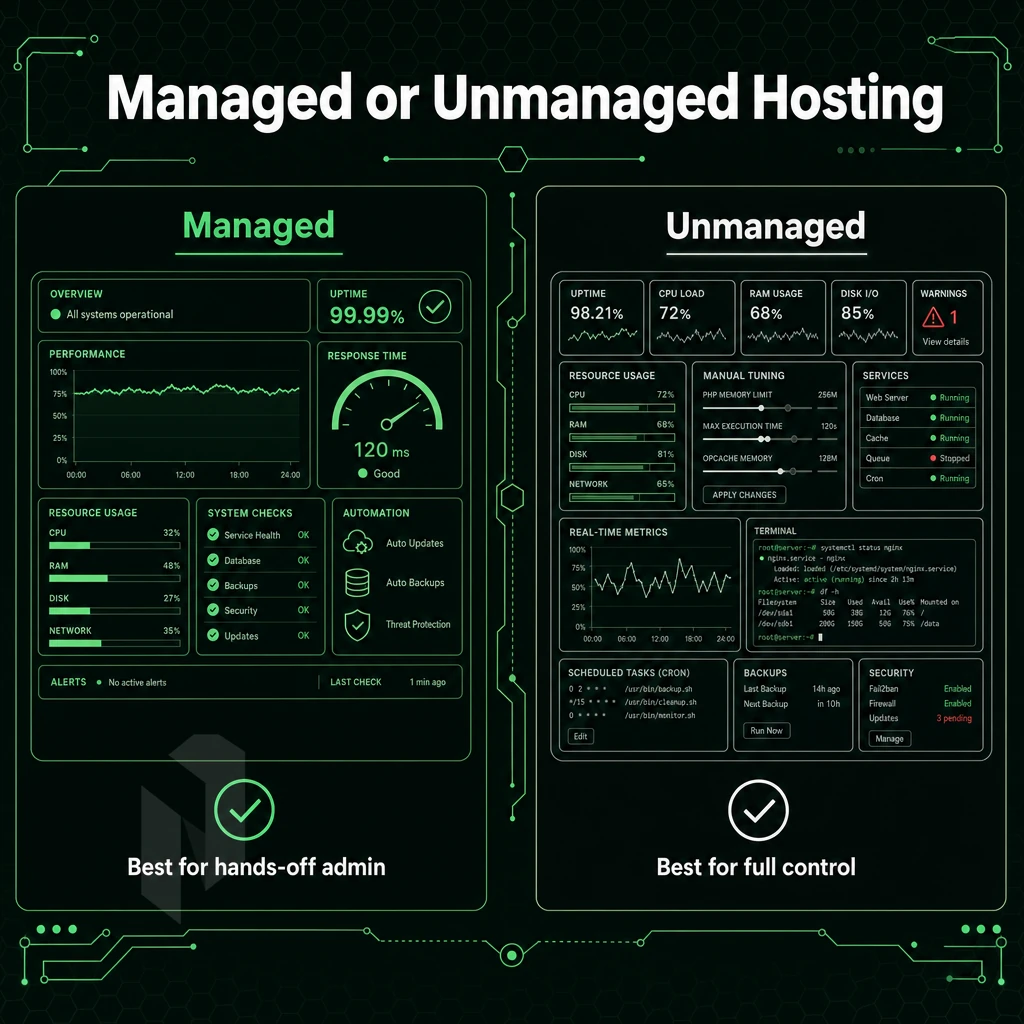
Deciding between managed and unmanaged hosting, regardless of server location, comes down to one thing: how much server administration your in-house team can handle. The decision depends on the technical ability your team already possesses and how much load they are going to put on the entire server infrastructure. Selecting a dedicated hosting provider that offers both tiers allows you to start unmanaged and migrate to managed support as your infrastructure scales or team priorities shift.
Assess Your Technical Capacity for Dedicated Resources
- Audit your team’s Linux or Windows admin skills. Running an unmanaged dedicated server means that you are responsible for the operating system layer and above and therefore are not reliant on a vendor for things like security hardening and troubleshooting.
- Also take into account the location of the servers and compliance requirements. For example, for regulated workloads like those required for healthcare organizations, it is often necessary to document patch cycles as well as have audit trails for security incidents. Managed servers include OS patching as well as proactive monitoring for servers to aid in compliance reporting.
Note: Choosing unmanaged to cut costs only saves money if your team has genuine sysadmin depth. Gaps in coverage create risk.
Match the Bare Metal Model and Hosting Provider to Your Workload
- As a lean team, you should pick managed options. Managed Services cover things like OS patching, security hardening and monitoring for you. You still get root access, but the operational overhead is offloaded. A dedicated server on the other hand is a fully managed server environment, so you only get to deal with the application, not the server itself.
- Pick unmanaged for full engineering control. Unmanaged servers are generally best for development teams and infrastructure engineers who want to fully configure every layer of their stack. Servers can be provisioned very quickly and the operational model is very simple.
We offer managed hosting, updated with the latest patches and security hardening, and 24/7 monitoring of all our physical server and cloud servers, and respond to all tickets within 1 hour. Unmanaged bare metal servers are delivered within 60 minutes and you can start building on top of them immediately. See below for a comparison to shared hosting and VPS and find out for yourself whether dedicated servers are the right tier for you.
Our managed tier includes proactive operating system updates to keep your infrastructure secure and stable without requiring manual intervention from your team. Our support team is available via live chat, email, and phone support to ensure you can reach us through your preferred communication channel. Our support team prioritizes quick response times to minimize downtime and keep your infrastructure running smoothly during critical incidents.
Dedicated Hosting vs Shared Hosting vs VPS: A Side-by-Side Comparison
Not all hosting tiers are made equal. The server hosting architecture underpinning your application will determine the extent to which resources are isolated, the security posture and how performance will fare under load. Here we outline the three primary models and outline the key differences.
Best Dedicated Server Side-by-Side Comparison
| Factor | Shared Hosting | VPS | Dedicated Server |
|---|---|---|---|
| Resource isolation | None, shared pool | Soft limits via hypervisor | Complete, single tenant |
| Performance consistency | Noisy-neighbour risk | Moderate | Consistent performance guaranteed |
| Security | Shared kernel exposure | Isolated but shared host | Dedicated hardware, no shared attack surface |
| Scalability | Very limited | Vertical within host limits | Full hardware control |
| Ideal use case | Low-traffic sites, free ssl certificates bundled | Dev, staging, small apps | High-traffic, compliance, latency-sensitive workloads |
Why Single-Tenant Hardware Delivers Enhanced Performance
On a dedicated server you have 100% of the CPU power, RAM and I/O for your own use. There's no noisy-neighbour impact to high performance, and that's important for any hosting provider serving high-demand e-commerce, online gaming and financial services applications that need to perform consistently under sustained load.
This isolation makes dedicated servers ideal when you need guaranteed resources for one website handling millions of monthly visitors or complex database operations. Resource isolation at the hardware level ensures predictable performance even during traffic spikes or compute-intensive batch processing jobs. Applications such as machine learning model training, real-time video transcoding, and large-scale data analytics are particularly resource intensive and benefit from this dedicated allocation.
You also get exclusive access to control the Operating System and kernel configuration from day one. Controlling this is impossible in a shared server environment where the host will lock down the stack for all other tenants.
Where Netrouting Fits as a Hosting Provider for Customer Support
Our Enterprise hardware offering includes the best available on the market, such as Intel Xeon and AMD EPYC processors, all with unmetered 10 Gbps connections and DDoS protection enabled by default. As a dedicated hosting provider for high traffic or business critical servers, we offer dedicated servers on our AS6206 nodes, which provide the isolation and required throughput that virtual servers just can't deliver. And, choosing the right web hosting hardware is only half the story, the support model behind it is just as important.
Why Choose Netrouting for Dedicated Server Hosting
Netrouting delivers dedicated server hosting built for IT teams that need performance, security, and control, without compromise. Our bare metal servers run on enterprise-grade Dell and Supermicro hardware with Intel Xeon and AMD EPYC processors, provisioned in under 60 minutes.
- Always-on DDoS protection, L3/L4 mitigation included on every server, with advanced options for high-risk workloads.
- Unmetered 10 Gbps bandwidth, backed by our Tier 1 AS6206 backbone and 2.4 Tbps+ network capacity.
- 10 global data center locations, Amsterdam, Frankfurt, The Hague, Rotterdam, Stockholm, Bucharest, Miami, New York, Hong Kong, and Singapore.
- Custom configurations, non-standard server environments, high-density deployments, and resource-intensive workloads handled to spec.
- Certified and compliant, ISO 9001, ISO 27001, and SOC 2, supporting your compliance requirements out of the box.
- 24/7 NOC with a 1-hour ticket guarantee, expert support whenever your critical applications need it.
Whether you're running high-traffic applications or evaluating different providers for business continuity, our team is ready to help you find the right dedicated hosting fit. Compare configurations or contact sales to discuss your requirements. If you're comparing providers like inmotion hosting against enterprise infrastructure, our team can walk you through the differences in network architecture, provisioning speed, and hardware specifications.
Choosing a dedicated server host comes down to three things: network quality, hardware reliability, and support you can actually count on. Managed or unmanaged, your web hosting provider's infrastructure determines your uptime ceiling, not just their SLA paperwork.
Hardware specs matter, but they're table stakes. What separates the best dedicated hosting providers is what surrounds the server: carrier-grade connectivity, always-on DDoS protection, and a support team that responds in minutes, not hours.
Netrouting delivers dedicated hardware with technical support across ten locations in Europe, North America. Additionally, Asia, all delivered by a dedicated hosting provider on a 2.4 Tbps+ backbone with unmetered 10 Gbps ports, free private networking, and a 24/7 NOC backed by a one-hour ticket guarantee. If you're ready to move past shared infrastructure, explore Netrouting's dedicated server configurations or contact sales to spec a custom deployment.