Game servers are no-latency applications. They are best run on bare metal cloud servers, which make up the bare metal cloud market. These applications have unique requirements. In shared environments, such applications would get disrupted by noisy neighbors (people running applications in hypervisor environments).
For such applications, every millisecond counts and hence can make huge differences in revenues. The ideal solution for such applications would be dedicated hardware, which can be provisioned very fast (cloud like). Such applications require full CPU cycles without any virtualization overhead. Additionally, they require large network throughput to handle large number of concurrent sessions.
For game server developers and system administrators running special server setups, the choice of provider determines important aspects such as the game’s tick rate. DDoS protection, geographic distribution of players and rapid scalability before a launch. Achieving low latency connections between players and servers requires strategic placement of infrastructure in regions with robust network peering and minimal routing hops. Selecting data centers with low-latency network paths and redundant connectivity ensures that game servers maintain stable performance even during traffic spikes or regional network disruptions.
Blog contents
In this guide, we compare various capable bare metal cloud market providers, discussing generations of hardware, network setups, deployment times, support and locations around the world that are relevant to players of a game. By the end of this article, readers will know what to look for when selecting a hosting provider and what to demand from them in terms of a hosting contract.
What Is the Bare Metal Cloud Servers Market?
The bare metal cloud market refers to the commercial ecosystem around single-tenant physical servers, provisioned, billed and flexibly scaled in a similar fashion as cloud-based services. Bare metal cloud services blend raw, single-tenant dedicated hardware with modern cloud services’ operational efficiency and are used by hyperscale companies and smaller businesses and service providers alike.
They all are attracted to the same thing: dedicated computing power, without the typical overhead of shared tenancy. This model represents a modern evolution of infrastructure as a service, delivering physical compute resources through automated provisioning and flexible consumption models. Each cloud service provider in this ecosystem differentiates through automation capabilities, geographic reach, and hardware refresh cycles that determine performance consistency.
What Is the Bare Metal Cloud Market and How Is It Different from Traditional Cloud Hosting?
Unlike the traditional dedicated hosting which used to take long to provision and locked you into a contract and charged you even when the server was idle. Bare metal cloud can provision servers in under an hour and can be provisioned on a monthly or pay as you go basis.
Providers now compete on flexible pricing models that align infrastructure costs directly with actual usage patterns and business cycles. This shift enables organizations to treat bare metal like a true cloud service, scaling capacity up or down based on real-time demand without the financial penalties of traditional hosting.
Virtualized public cloud offers agility but also introduces noisy-neighbor contention. Workloads run on shared CPUs, memory buses and network fabric, but competing with unknown tenants. Bare metal cloud eliminates all of these issues as workloads run on full servers with no hypervisor tax and no shared resources. Organizations seeking bare metal's control gain direct access to CPU instruction sets, memory channels, and PCIe lanes without abstraction layers.
When you provision bare metal cloud, you control the entire server from firmware to application stack, enabling precise tuning for your workload's specific requirements. This level of control extends to the operating system layer, where administrators can select custom kernels, security modules, and runtime configurations optimized for their specific performance targets.

The distinction matters most for latency-sensitive and compute-intensive workloads: Applications requiring low latency execution depend on bare metal's ability to eliminate virtualization overhead and provide direct hardware access for time-critical operations.
- HPC and AI/ML: Bare metal cloud services deliver consistent, unthrottled throughput that shared virtual instances cannot guarantee.
- Gaming and media streaming: Low, predictable latency requires dedicated hardware, not a slice of it.
- Regulated industries: Single-tenant isolation simplifies compliance with data-residency and audit requirements.
Bare Metal Cloud Market: Key Infrastructure Segments
We are tracking 3 buyer segments for the bare metal cloud market. Enterprise accounts represent the largest spend in the bare metal cloud market, deploying bare metal cloud solutions for database workloads, private cloud builds, and high-frequency trading environments.
SMBs are deploying bare metal for game servers, video encoding, and SaaS backends where predictable performance is worth the step up from virtual instances. High frequency trading platforms depend on bare metal's microsecond-level execution precision to capitalize on fleeting market opportunities that would be impossible in shared infrastructure. Large enterprises often deploy bare metal infrastructure to support mission-critical applications where performance consistency and security isolation are non-negotiable operational requirements.
The third segment of users consists of service providers, including resellers and MSPs that white-label bare metal cloud instances and offer them to their end customers. They require rapid provisioning APIs and flexible bandwidth options. These providers benefit from flexible pricing models that allow them to scale their offerings dynamically based on customer demand and usage patterns.
Many of these service providers also bundle managed services with their bare metal offerings, handling server monitoring, security patching, and performance optimization on behalf of their clients. Integrating bare metal infrastructure with a robust cloud service layer enables these providers to offer hybrid solutions that combine physical performance with flexible orchestration tools.
Bare Metal Cloud Market Outlook and Server Trends
Demand for metal cloud is increasing in a number of markets including enterprise, SMB and service providers. In particular AI/ML inference and real-time analytics workloads are moving off of shared virtual environments to take advantage of metal cloud. In addition, edge computing workloads are also an area where metal cloud is being used. Demand across the bare metal cloud market is increasing in regulated industries including finance, healthcare, and government, where enhanced security through single-tenant isolation is a firm requirement and not merely a preference. Organizations leverage advanced analytics on bare metal infrastructure to process large datasets with minimal latency, ensuring compliance requirements are met without performance degradation.
Organizations implementing multi cloud strategies increasingly rely on bare metal deployments to maintain consistent performance baselines across different provider ecosystems while avoiding vendor lock-in. Large enterprises increasingly adopt bare metal solutions to support mission-critical applications where predictable performance and regulatory compliance cannot be compromised by shared infrastructure models. Analysts project these trends will continue to accelerate throughout the forecast period as organizations prioritize infrastructure that delivers both compliance and performance.
Netrouting offers bare metal cloud servers in 10 locations across Europe, North America and Asia-Pacific. Our network is running on AS6206 with 2.4 Tbps+ and is unmetered with 10 Gbps per server. This is a specialized setup, tailored to specific workloads that require dedicated performance and cloud like speed and control. We are expanding our footprint to include strategic locations in the Middle East to serve growing demand from financial services and government sectors in that region.
Bare Metal Cloud Market Size, Growth, and Forecast
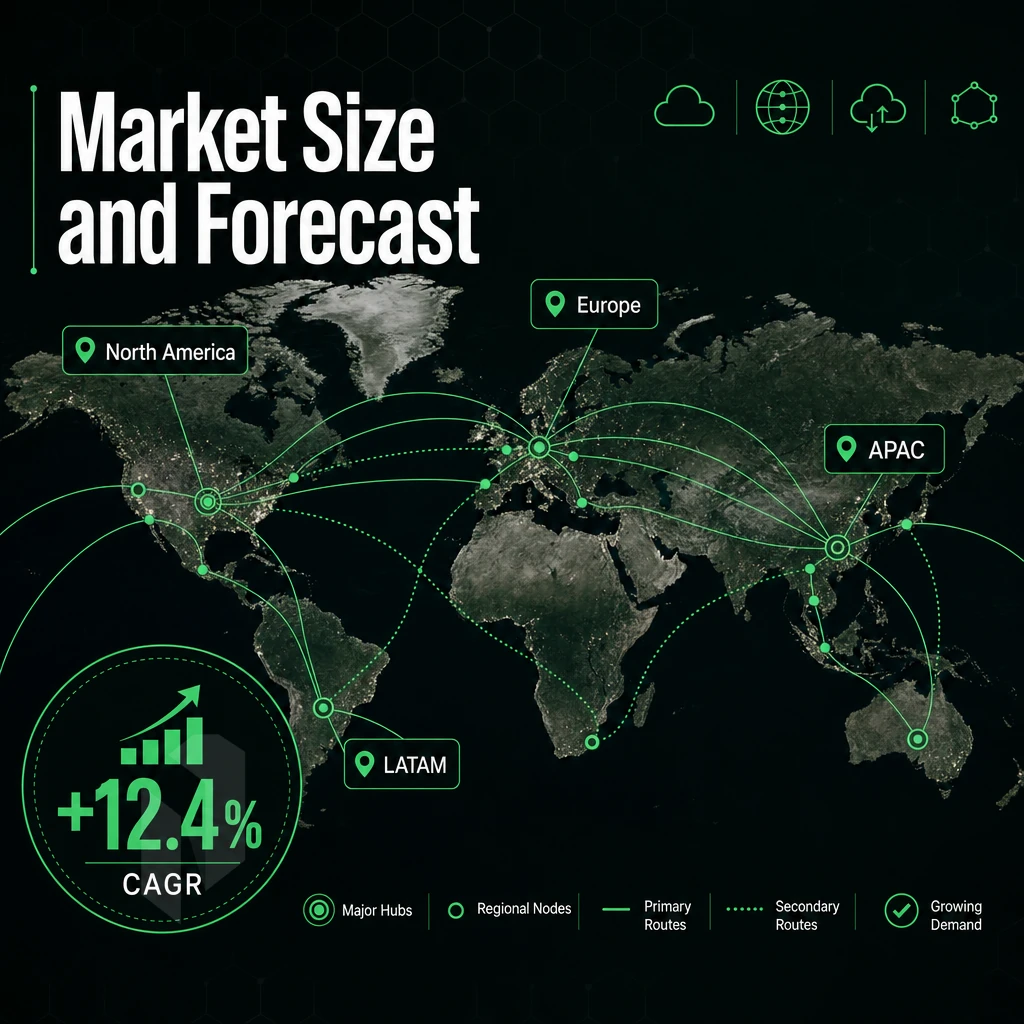
Analyst estimates for bare metal cloud vary somewhat depending on the baseline used, but there is general agreement that the market is growing rapidly. Forecasts for 2025-2026 put the bare metal cloud market at $11-17 billion, and forecasts for 2030-2033 converge at $36-58 billion. The corresponding CAGRs for the forecast period are 17-22%.
Multiple research firms have published comprehensive studies, and each report coverage revenue forecast reflects slightly different assumptions about enterprise adoption rates and regional expansion timelines. Growth drivers during the forecast period include accelerating enterprise adoption of AI workloads, expanding edge computing deployments, and stricter data sovereignty regulations across multiple jurisdictions.
How Large Is the Bare Metal Cloud Market and What Is Its Projected Growth Rate?
Bare metal cloud computing is a rapidly growing market of approximately $11-17 billion today, which will more than triple by the early 2030s. Analysts’ respective calculations of the Compound Annual Growth Rate (CAGR) have resulted in corresponding figures of 17% to more than 22% for this market.
This Represents extremely rapid development in the respective fields of infrastructure and market analysis. Industry projections indicate that the bare metal cloud market will sustain this momentum throughout the forecast period, driven by enterprise adoption of AI workloads and regulatory compliance requirements.
The growth in our dedicated servers is largely due to demand from large enterprises that require dedicated hardware to perform at the required level without sacrificing cloud agility. Single-tenant bare metal servers are increasingly being chosen over virtualized environments for a variety of workloads including AI inference, real-time financial processing and high-throughput media delivery.
Regional Breakdown: Where the Cloud Market Is Growing Fastest
North America currently leads the global bare metal cloud market. With the majority of enterprise customers based in the region, it also boasts the greatest density of data center infrastructure, established cloud technology ecosystems, and relevant regulatory frameworks that promote predictable, auditable compute. Organizations selecting providers in this region benefit from proximity to Tier 3 and Tier 4 data centers that offer carrier-neutral connectivity and redundant power systems essential for mission-critical deployments.
The Asia-Pacific region is growing fastest of all. Here, industrialization is taking off at a great pace, and the growing digital economies are driving demand for large volumes of data. And, not least importantly, there is increasing pressure for data sovereignty. Governments and enterprises across the region are investing heavily in localized data centers to comply with regulatory frameworks while supporting digital transformation initiatives. Analysts expect this regional expansion to accelerate throughout the forecast period as local enterprises prioritize infrastructure sovereignty alongside performance requirements.
Emerging technologies such as 5G edge computing, and AI-based manufacturing require large volumes of data to be processed. All of this requires the type of bare metal-class isolation and throughput that can currently only be offered by small number of providers. Bare metal infrastructure delivers the consistent, low-latency performance these compute intensive workloads demand at scale.
Deploying these applications on robust infrastructure ensures organizations can meet strict service-level agreements while maintaining operational resilience across distributed computing environments. Industry analysts project that edge computing deployments will triple during the forecast period as organizations race to build distributed infrastructure capable of supporting latency-sensitive AI workloads.
The Middle East is emerging as a region of growing influence. Sovereign cloud mandates and large-scale smart-city programs are driving demand for dedicated metal cloud market infrastructure across the region's financial services and government sectors. Organizations across the Middle East increasingly prioritize low-latency infrastructure to support real-time applications in sectors ranging from oil and gas operations to rapidly expanding e-commerce platforms.
What This Means for Infrastructure Buyers
Bare metal's rapid growth means it is no longer a specialized alternative to VMs for a limited set of use cases, it has become a primary way to deploy performance-sensitive workloads in every region.
Netrouting is a bare metal infrastructure provider with 10 locations all over the world: Stockholm, Amsterdam, Rotterdam, The Hague, Frankfurt, Bucharest, Miami, New York, Hong Kong and Singapore. Netrouting’s provisional time for a deployment is under 60 minutes and has a 99.9% uptime SLA. 24/7 NOC support is included.
Organizations can also leverage optional managed services to offload routine infrastructure maintenance, monitoring, and security patching while retaining full control over application-layer configurations. Customers seeking a cloud service with predictable performance characteristics benefit from Netrouting's direct hardware access model, which eliminates the variability introduced by multi-tenant virtualization layers.
When evaluating forecast periods, buyers navigating the bare metal cloud market will likely choose providers that have genuine global reach, own and manage network infrastructure and deliver scalable hardware to meet demand, rather than simply re-selling capacity out of single geographies.
Key Drivers Fueling Bare Metal Cloud Market Demand
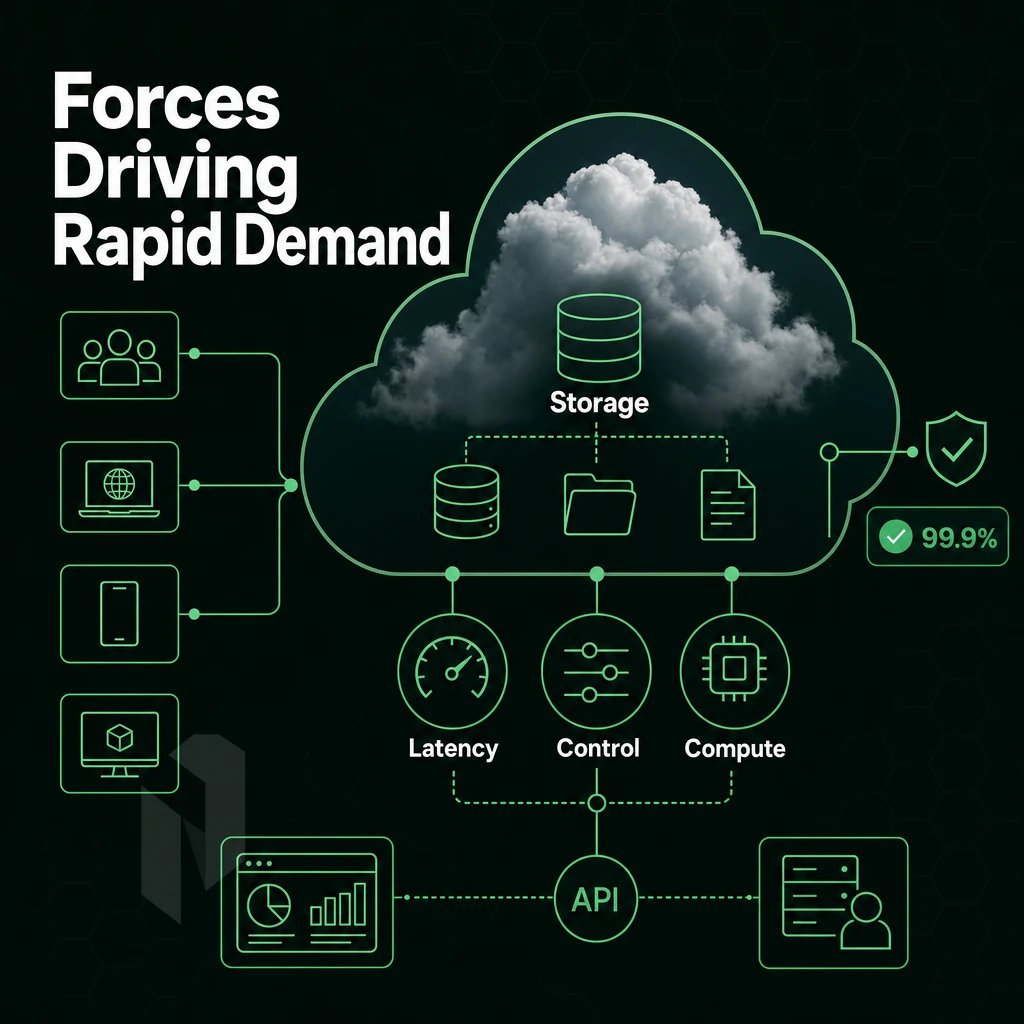
The demand for Bare Metal Cloud services is growing in all markets depending on raw compute power, deterministic latency, and full control of all hardware and software components. 5 Forces that are changing the assessment of cloud computing infrastructure are driving demand for dedicated physical servers as an alternative to shared, virtualized servers.
Performance-Driven Workloads Pushing Beyond Cloud Computing Limits
-
AI/ML and big data analytics
Training large models and running real-time inference require direct, uncontested access to GPU resources. Virtualization layers introduce latency and memory overhead that degrade throughput on data intensive workloads. Netrouting's GPU server lineup, spanning NVIDIA RTX 6000, A10, A40, and A100 options, is purpose-built for exactly this demand.
-
High performance computing and high-frequency trading
HPC simulations and algorithmic trading platforms cannot tolerate noisy-neighbor interference. High performance computing clusters need cycle-accurate timing and deterministic I/O. Bare metal eliminates the hypervisor layer entirely, delivering predictable performance that shared virtual machines structurally cannot match.
Note: Even a single shared tenant consuming burst CPU on the same host can introduce microsecond jitter, enough to invalidate a trading strategy or corrupt a simulation checkpoint.
-
Media streaming and online gaming
Sustained multi-gigabit throughput is non-negotiable for high-definition media streaming and low-latency gaming. Virtualization overhead compounds under concurrent session loads, causing frame drops and buffering. dedicated servers with unmetered 10 Gbps connectivity removes that ceiling entirely.
What Workloads Thrive in the Bare Metal Cloud Market?
To identify candidates, look for services that are running 24/7 at high utilization. The services listed below all immediately punish latency or contend for resources. This list includes: AI inference services, HPC batch jobs, video transcode services, real-time online gaming services, and high frequency trading services.
-
Data sovereignty and compliance requirements
Regulatory frameworks, GDPR, HIPAA, PCI-DSS, demand provable tenant isolation and auditable data protection controls. Multi-tenant clouds make that audit trail difficult. Single-tenant bare metal, deployed in a jurisdiction you control, closes that gap cleanly.
Note: Choosing a provider with ISO 27001 certification and SOC 2 compliance is a baseline requirement for regulated workloads, not a differentiator.
-
Cost optimization for steady-state compute
Hyperscaler pricing scales poorly for workloads running at consistent, high utilization. Reserved instances help, but the total cost of ownership still exceeds physical server at sustained load. Enterprises migrating predictable workloads to bare metal routinely cut compute spend significantly, without sacrificing reliability or control.
Netrouting's always-on L3/L4 DDoS protection is included at no extra cost across every service. For gaming, streaming, and trading platforms, all high-value attack targets in the metal cloud market, that baseline coverage removes a line item that hyperscalers typically charge separately.
Matching Driver to Deployment
While not every workload can or should be running on bare metal, workloads that run at sustained high utilization, require hardware-level isolation. Alternatively, Have compliance obligations are best served in the bare metal tier using a decision framework for selecting workloads for bare metal.
With bare metal servers in Stockholm, Amsterdam, Rotterdam, The Hague, Frankfurt, Bucharest, Miami, New York, Hong Kong and Singapore. Netrouting’s teams can provide all of the geographic flexibility that bare metal provides to your servers, your users, your. data residency requirements, or all of the above.
Market Segmentation: Service Models, Applications, and Deployment Types
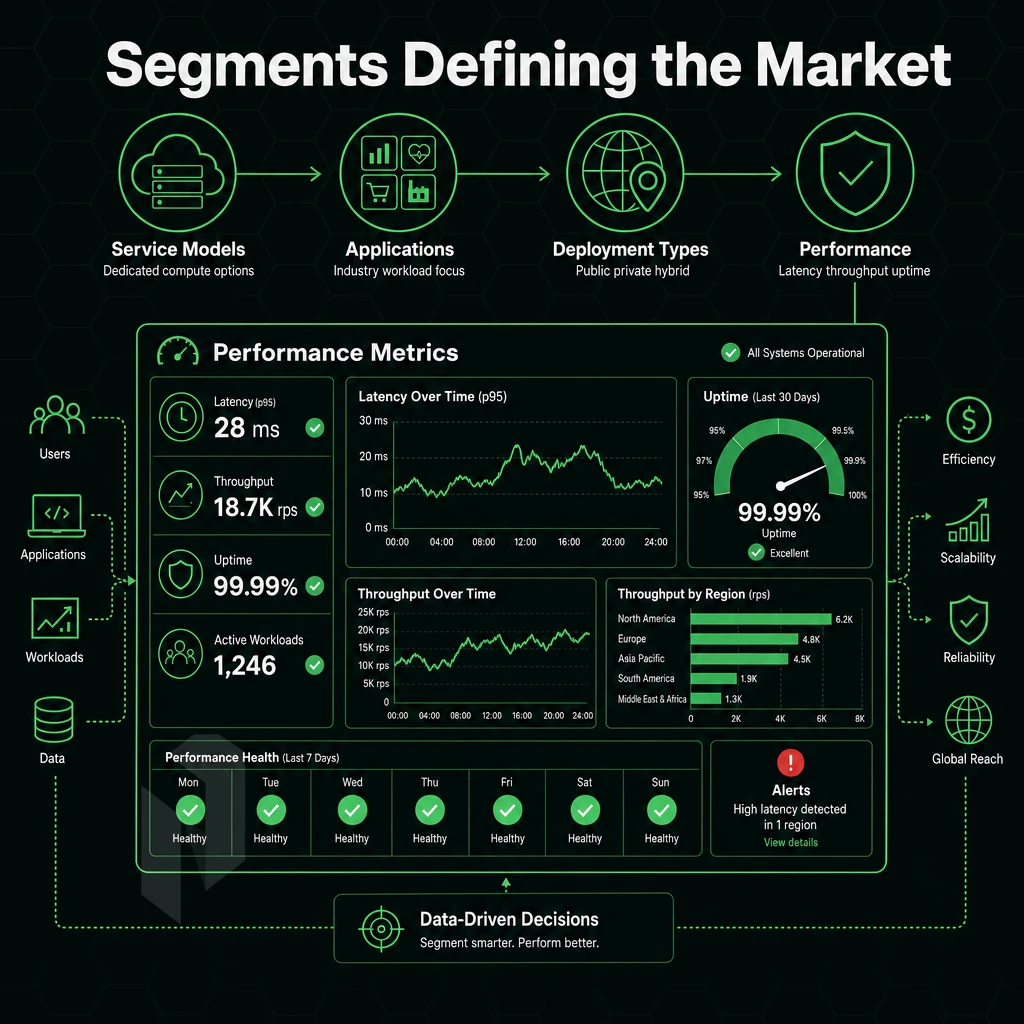
Bare metal cloud is typically segmented in research by service model, by application vertical, and by deployment type. Here’s how to break it down to reveal the buyer profiles that drive demand to dedicated cloud infrastructure over virtualized and to where specific advantage is delivered.
Service Model: From Bare Metal Instances to Managed Configurations
Service Delivery (1st axis): The first layer covers Service Delivery. Within the bare metal cloud market, a difference can be made between bare metal server instances (delivering raw hardware, single-tenant instances, fully controllable by customers) and managed bare metal services (delivering same hardware.
However, With customers’ OSes patched and monitored by provider and supported by provider). In addition to these two primary offerings, Hybrid and Customized configurations are offered to customers whose workloads benefit from managing physical servers alongside virtual instances for the best of both worlds.
We can describe profiles of buyers across the bare metal cloud market for self-managed instances (DevOps, platform engineers etc., root access / zero abstraction), for managed instances (mid-market IT departments without dedicated operations staff etc.). Additionally, For custom configurations (enterprises using bare metal cloud as part of a larger on-premises / multi-cloud strategy).
Application Vertical: Where Bare Metal Wins
HPC workloads that drive the bare metal cloud market require raw hardware access, i.e., MPI programs, tightly-coupled computational simulations, and risk engines written in finance for instance, can't afford to live in a hypervisor and suffer the additional latency thus. AI/ML and data analytics workloads need consistent memory bandwidth and GPU throughput which tenanted shares can’t deliver.
Gaming and media streaming need low latency, in the single digit millisecond range to be precise. General-purpose compute workloads complete the segment for those that are migrating from major cloud platforms in search of lower cost of ownership.
Verticals map to buyers. HPC/AI, high compute density in dedicated environments. Gaming, very low latency in particular locations. General-purpose buyers, predictable monthly cost, easy provisioning in a variety of locations. We serve all four verticals with purpose-matched hardware deployed in bare metal environments across locations such as Stockholm, Frankfurt, Miami, New York, Hong Kong and Singapore.
How the Bare Metal Cloud Market Eliminates Virtualization Overhead
Virtualization includes a hypervisor below the OS. The layer for the hypervisor consumes CPU time for scheduling, memory for isolation of guests and I/O bandwidth for emulated device drivers. Unlike with bare metal, the OS does not run directly on the processor here. Thus there is no hypervisor tax.
On bare metal you run your workloads directly on the physical CPUs (including their cache hierarchies). On the NUMA nodes and directly on the NVMe queues (without a hypervisor introducing any kind of performance overhead to expose these to you).
Dedicated bare metal servers result in deterministic latency, i.e. it is always the same, as opposed to other forms of cloud deployment. As there are no noisy neighbors, the typical causes of variable latency, i.e. the others, are completely absent. So each tenant has his own server, and thus there is no competition for CPU ready time or memory balloon drivers etc.
Deployment Type: Public, Private, and Hybrid
Public bare metal servers are run on public provider-owned hardware in a public facility and are Single Tenant per Server but Multi Customer per Rack. Private bare metal servers are run on customer-owned hardware either On-Premises or in a Dedicated Cage provided by a Provider. Hybrid scenarios mix Bare Metal with Virtualized Cloud and route latency sensitive workloads on Bare Metal and burstable workloads on Cloud.
The metal cloud market can be split in between the more regulated industries (finance, healthcare, government) who prefer private or hybrid models in order to be able to exercise data sovereignty. High growth SaaS and gaming companies are being served by public metal cloud providers, offering fast provisioning and global reach without incurring any capital expenditures. In multi-cloud scenarios the bare metal servers are used as the performance anchors, with virtualized capacity used for burst purposes.
Bare Metal Cloud Market vs. Virtualized Cloud: The Performance Case
NEEDS REVIEW: density over: 'bare-metal infrastructure' used 2x in section, max 1
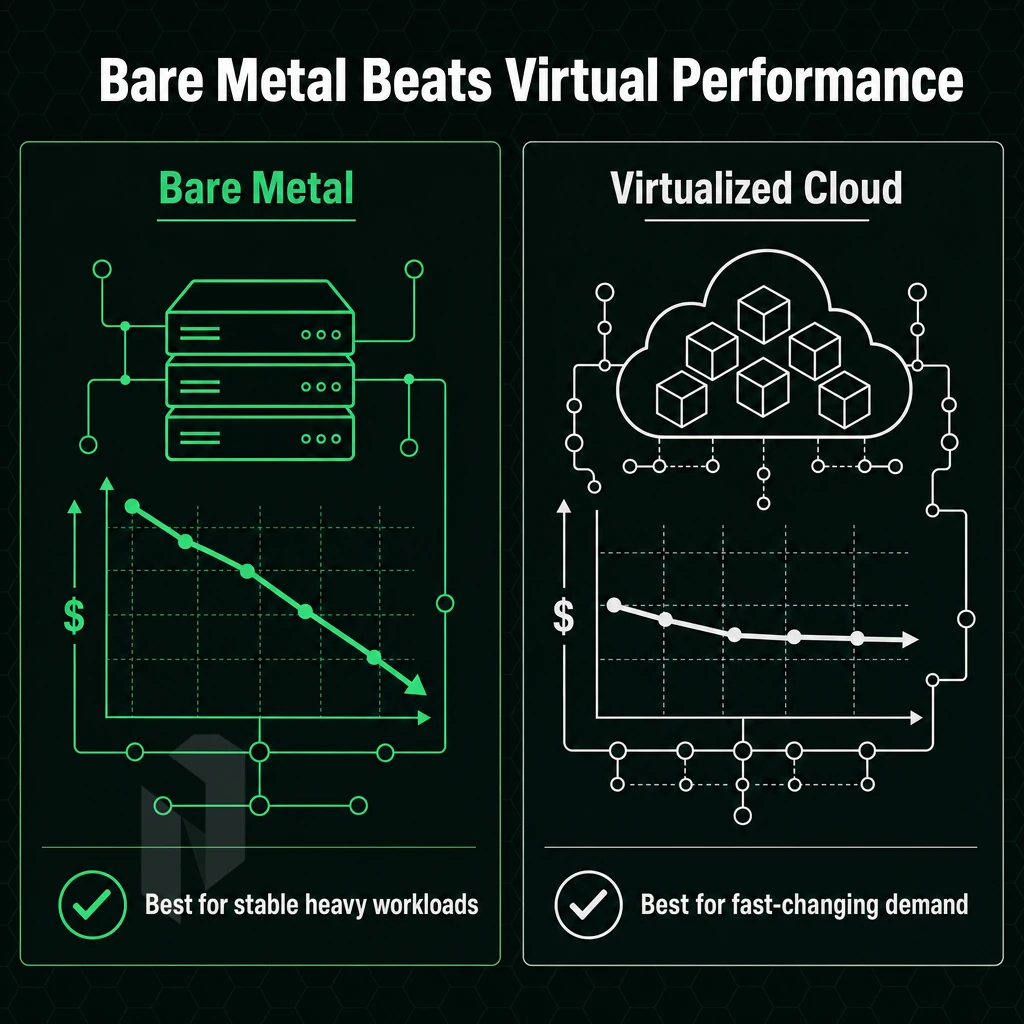
Every layer of virtualization incurs a performance cost. Workload are run in bare metal mode, i.e. directly on the physical hardware (no hypervisor) with no noisy-neighbor contention and no shared CPU scheduler fighting for cycles.
Why the Bare Metal Cloud Market Outperforms Virtualized Infrastructure
A hypervisor can introduce a lot of overhead in a virtualized environment. The amount of latency in system calls, memory, I/O etc can be measured. In the bare metal cloud market, workloads that introduce latency can affect performance quite a bit, with examples including NVMe storage, high frequency database queries and real-time analytics.
Bare metal enables applications to directly read hardware performance counters, which results in Bare metal’s raw power. The NUMA topology of a bare metal server is visible and can even be exploited by applications. CPU pinning, which enables specific CPU cores to be assigned to virtual servers, is real and not emulated as with host processing.
The performance gap is sharpest in three areas:
- Storage IOPS: No virtualization layer means no I/O translation overhead. NVMe drives deliver their rated throughput to the application, not to a virtual disk abstraction.
- Network throughput: Single-tenant physical servers eliminate the bandwidth contention that degrades cloud servers under multi-tenant load spikes.
- Memory latency: Direct NUMA access and no memory ballooning means consistent, predictable latency, critical for in-memory databases and ML training jobs.
Use Cases Where Dedicated Hardware Decides the Outcome
While not every workload can benefit from bare metal workloads do exist for which bare metal is the only acceptable model.
GPU-based ML training jobs are very bandwidth-intensive, in a way that can saturate the available bandwidth of the available PCIe connectivity. Additionally, a hypervisor can introduce sufficient latency for tensor-based operations. Bare metal servers, however, provide sufficient connectivity between GPUs and CPUs: they talk directly over the physical bus, without any translation or other overhead.
For game servers running game engines, sub-10ms tick rates are a hard requirement for performance. We deliver enhanced performance for game servers as a product requirement. On bare metal dedicated servers, running game engines outperforms virtualized alternatives under concurrent player loads.
In the bare metal cloud market, latency sensitive databases such as PostgreSQL with high-concurrency OLTP workloads and Redis at scale demand predictable CPU scheduling that shared virtual environments simply cannot provide.
What Is the Difference Between Public Bare Metal and Private Bare Metal Deployment?
Public Bare Metal Cloud Servers Market Overview
dedicated server is provisioned through a shared management plane. A single-tenant physical server is provided, with provisioning API, billing and orchestration provided as shared services for all customers. Cloud-like agility is provided in conjunction with bare metal isolation.
Private Bare Metal Servers
All physical and management tools are for the sole use of a single organization. This is ideal for heavily regulated industries and high security workloads. Also very important for customers who require complete control over firmware as well as physical and network topology of servers and related switches.
We support both the bare metal model as well as the cloud servers at Netrouting. The bare metal cloud servers at Netrouting can be provisioned in under 60 minutes and come with a 2.4 Tbps+ network. We offer 10 locations in Europe, North America and Asia-Pacific. For community perspectives, see BareMetal & Cloud : r/ExperiencedDevs.
Architecture Patterns in the Bare Metal Cloud Market
| Component | Minimum | Recommended |
|---|---|---|
| CPU | 8 cores | 16+ cores (AMD EPYC or Intel Xeon) |
| RAM | 32 GB | 64-128 GB |
| Storage | 500 GB NVMe SSD | 2× NVMe in RAID 1 for redundancy |
| Bandwidth | 1 Gbps unmetered | 10 Gbps unmetered |
| OS | Ubuntu 22.04 LTS | Ubuntu 22.04 LTS or Debian 12 |
Architecture Overview
Bare metal platforms are at the core of every cloud market today. They are more efficient than a virtualized stack running on top of servers. Given that they are running on physical machines with direct hardware access, no hypervisor tax, no noisy neighbors and no CPU steal due to sharing. This is the control advantage of bare metal in practice.
Here is the simple architecture to get started with your API gateway/marketplace frontend. Clients connect to your service over HTTPS (port 443). The services that perform the following functions are running on dedicated servers in a private network: inventory, pricing, transaction processing. The database tier should not be exposed to the public interface.
For edge computing nodes serving local traffic, deploy lightweight API replicas close to your user clusters. This reduces latency for round-trip operations, without the overhead of a full application stack. Note that managing physical servers at the edge of the network is easier than it sounds, provided you have configuration management set up from the start.
Port requirements for your application reflect rising demand for secure connectivity across the bare metal cloud market: 443 for HTTPS, 80 for HTTP redirecting to HTTPS, and all ports required for your internal service mesh (typically 8080 through 8090). Lock down the rest of the ports at the firewall before you go into production.
Quick Setup
- Provision dedicated infrastructure. Provision a bare metal node for dedicated use based on your forecast period traffic projections. Over-provisioning for the initial period will be cheaper than having to go into emergency scaling mode later.
- Harden the OS first. Disable root SSH access. Force key based authentication. Set up UFW or iptables before trying to modify application configurations.
- Use Deploy automation tools, such as Ansible, Terraform, etc., to Codify your Server Stack (Automation of physical servers reproducibility and configuration drift elimination between all nodes of a server stack).
- Set up your own private network. Isolate database and cache layers to a private VLAN. Never connect Redis or Postgres to a public interface.
- Running a load test before launch is key. Doing a load test against your stack before it launches can allow for tuning of kernel parameters (as available with bare metal) but only after you have located the bottleneck.
Performance Tip
The most common configuration mistake on dedicated physical servers is leaving the Linux CPU governor set to powersave. Switch it to performance immediately after provisioning.
Run: cpupower frequency-set -g performance
On high-throughput market workloads, this alone can reduce API tail latency by 15-30%. Don’t leave cycles on the table.
Use Cases Driving Bare Metal Cloud Market Adoption
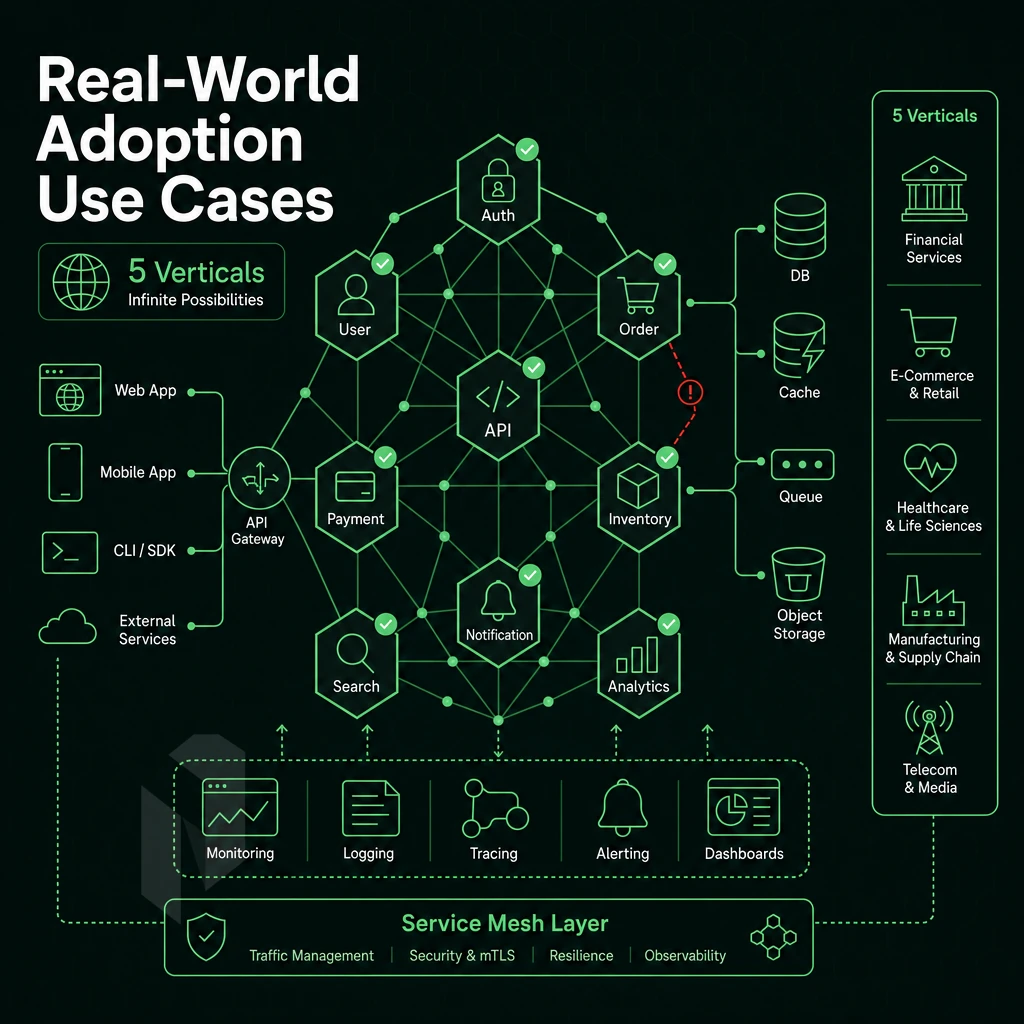
Bare metal cloud is experiencing rapid adoption in 5 distinct verticals. Each type of workload requires a different set of characteristics from the underlying infrastructure. In order to select the right bare metal cloud offering, it’s essential to first understand the architecture required to support a given use case. Additionally, Then select the right cloud offering that supports the operational requirements of that workload.
Compute-Heavy and Latency-Critical Workloads
-
AI/ML Training and Inference
AI and ML pipelines are among the most compute intensive workloads in modern infrastructure. GPU servers with large RAM configurations and NVMe storage eliminate the hypervisor overhead that throttles throughput on virtual servers. The result is faster epoch times and lower inference latency.
Architecture note: deploy GPU-equipped bare metal nodes with a high-speed private interconnect between training and storage nodes. Netrouting's GPU server options, including NVIDIA A100 configurations, pair naturally with a free private network up to 40 Gbps between customer resources.
Note: Shared GPU instances on multi-tenant platforms introduce unpredictable "noisy neighbour" effects. Single tenant physical servers eliminate that risk entirely.
-
High-Frequency Trading and Fintech
Low latency is non-negotiable for HFT systems. Direct hardware access removes the scheduling jitter introduced by hypervisors. Placement near major internet exchange points shortens the path to counterparty systems.
Architecture note: co-locate bare metal nodes at IX-dense facilities. Netrouting's New York presence at 60 Hudson Street and Amsterdam nodes with AMS-IX peering serve this requirement directly.
Bandwidth-Intensive and Media Workloads
-
Game Server Hosting
Online gaming demands dedicated CPU cores, consistent frame-tick scheduling, and unmetered high-bandwidth ports. Player experience degrades the moment a shared tenant spikes CPU on the same host. Bare metal removes that variable.
Architecture note: deploy servers geographically close to your player base. Netrouting competes in the bare metal cloud market across ten cities, Stockholm, Amsterdam, Frankfurt, Miami, New York, Hong Kong, and Singapore among them, giving game studios genuine edge reach without multi cloud strategies complexity.
-
Video Streaming and CDN Origin
Media streaming at scale requires sustained multi-Gbps throughput without burst penalties. Unmetered 10 Gbps ports in bare metal environments handle live and on-demand origin traffic without the surprise overage charges that software as a service platforms routinely impose.
Architecture note: anchor origin servers at high-peering locations. Netrouting's Amsterdam and Miami nodes connect directly to dense IX fabrics, reducing round-trip time to CDN edge nodes globally.
Enterprise DR and Hybrid Extension
-
Enterprise DR and Colocation Extension
Bare metal cloud solutions serve as clean DR targets for on-premises workloads. Private Ethernet circuits between primary and secondary sites keep replication traffic off the public internet. Big data analytics clusters benefit from the same model, replicate data to a bare metal DR node and run analytical queries without touching production.
Architecture note: Netrouting's Ethernet services provide point-to-point Layer 2 circuits linking colocation footprints across Europe, North America, and Asia. Pair with daily incremental backups and a 99.9% uptime SLA for a credible recovery posture.
Note: DR plans that rely solely on object storage often miss RTO targets. A warm bare metal standby with a private circuit consistently outperforms cold-restore approaches.
What Buyers Should Evaluate in the Bare Metal Cloud Market
Here are 5 criteria that separate capable providers from commodity providers. The first criterion is network quality, i.e. IX peering density and backbone ownership. The rest are hardware generation, provisioning speed, support responsiveness, and geographic coverage, etc. to match your workload’s distribution.
So not only can you use bare metal cloud effectively by checking if DDoS protection is included as standard (as opposed to an add-on) and if adequate is put in place for L7 traffic. Netrouting includes as standard L3/L4 protection on all of our services.
This can then be enhanced for higher risk services as required. So not only do bare metal platforms satisfy the provider checklist for high performance infrastructure, a 1-hour ticket guarantee, 24/7 NOC, and ISO 27001 / SOC 2 certification also satisfy said checklist.
Regional Landscape: Where the Bare Metal Cloud Market Is Growing Fastest
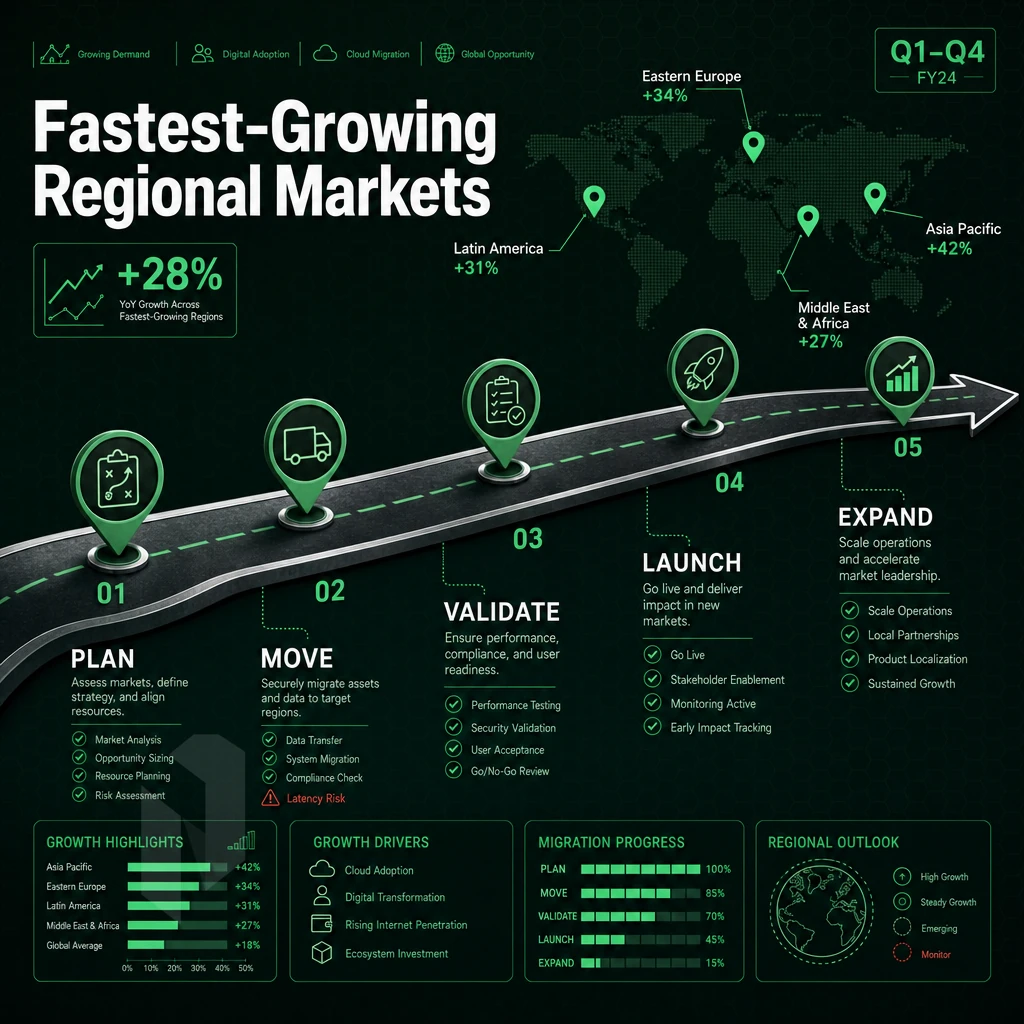
Bare metal cloud server demand does not form a complete and even distribution across the globe. The primary economic drivers are services that are very dense, subject to specific regulations and experience a high transformation pace. The exact location of infrastructure footprint versus just raw capacity in demand of bare metal cloud servers is most relevant in these economic drivers.
North America: Enterprise HPC and Fintech Anchor Demand
North America has the largest revenue share of bare metal cloud workloads, driven by Enterprise adoption of High Performance Computing (HPC) workloads. Algorithmic Trading platforms and large datasets of analytics workloads that require single-tenant hardware with deterministic latency, i.e. the core value proposition of public bare metal.
Fintech clusters in New York and Miami are sustaining steady demand for low-latency and compliant infrastructure. These are not spike workloads; rather, they are always-on workloads that drive demand in the bare metal cloud market for dedicated resources, and cannot tolerate the noisy-neighbor problem that afflicts shared virtualisation environments. Bare metal IaaS is the direct answer to this kind of demand.
Netrouting has a presence at 60 Hudson Street in New York (one of the premier carrier hotels on the East Coast) as well as their SOC 2-compliant Miami facility. As such, they are located at the heart of North American enterprise demand.
Europe: Big Data Sovereignty and Carrier-Neutral Colocation
Europe is the second largest region by revenue and by influence, as the necessary Data Centers have to be located in the relevant countries within the EU. Additionally, As far as necessary are required to be equipped with documented Chain-of-Custody and Auditable Access Control. Influencing are here the structural aspects of the GDPR as well as sector-specific stipulations of law for financial services and for healthcare.
In another parallel to key market trends, demand for carrier-neutral data center space is also rising rapidly. Enterprises are increasingly looking to select their own upstreams to avoid being locked into a single cloud service provider’s network. As a result, demand for public bare metal solutions is increasing at the expense of managed hyperscaler offerings.
Our European Presence covers six cities. We have a strong presence of Western, Central, Nordic and of late even Southeast European demand zones. All locations are Carrier Neutral and hold ISO 27001 certification. Netrouting connects to Major Internet Exchanges such as AMS-IX and DE-CIX.
The breadth of our solution is not about flags. It's where the workloads for the GDPR actually reside within the metal cloud market, distributed across geographic regions, with requirements for DR that also require geographically separate nodes.
Asia-Pacific and Emerging Markets: Velocity and Vertical Depth
The Asia-Pacific region is growing fastest in the bare metal cloud market, driven by investment in digital transformation and by demand for mobile-first financial services and online gaming, among other factors. Singapore and Hong Kong serve as financial and connectivity hubs for the region.
Growth rates for APAC exceed the global average, according to report coverage, revenue forecast and data. Growth in gaming, streaming and real-time payments workloads is driving latency-sensitive workloads. To serve APAC markets, cloud providers must deliver sub-millisecond intra-region latency and high-throughput uplinks to submarine cable infrastructure.
We have points of presence in Hong Kong at Equinix HK2 and in Singapore at Digital Realty SIN10. From these points, our platform as a service layers can reach end-users in Southeast Asia as well as in the Pacific Rim region with minimal hop count. This is because We connect directly to submarine cable systems and to regional IXs.
Emerging market in the space of the Middle East, with Sovereign cloud mandates, fast construction of data centers and a growing number of Fintech startups. The demand for bare metal is expected to rise strongly in the next few years. An area that will be worth watching with the further expansion of bare metal cloud infrastructure all over the world.
Competitive Landscape and What Buyers Should Evaluate
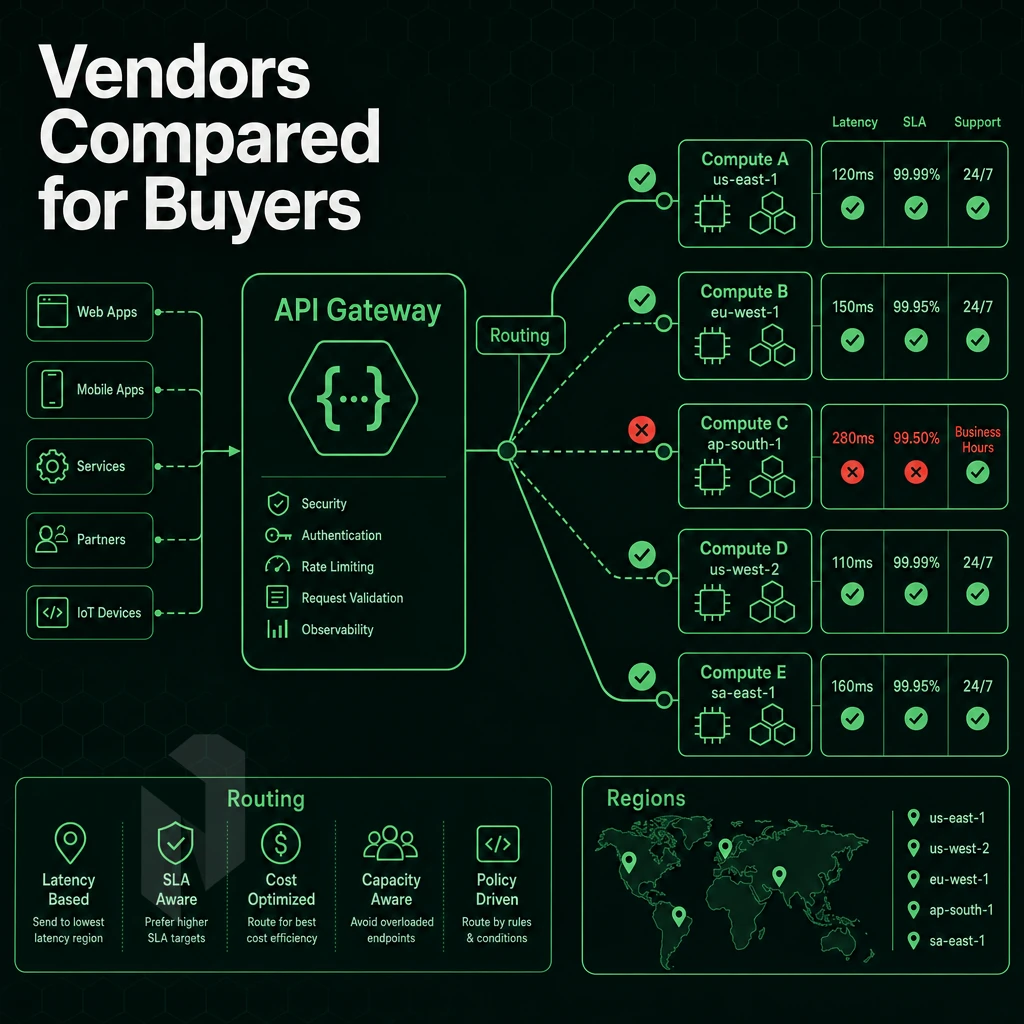
The bare metal cloud market is expected to grow rapidly and reach over $36 billion by 2030 with a CAGR above 20%. Three tiers of providers have entered the market, each with their own strengths and trade-offs. This overview will help cloud buyers and architects to understand where each tier is competing and find the right partner for their workloads.
How the Competitive Tiers Break Down
Bare metal is typically offered by hyperscalers as an add-on to their core platform. While it offers great ecosystem integration, its flexible but opaque pricing, per-GB egress charges, and consumption-based billing make it generally unsuitable for large enterprises in the bare metal cloud market that have already committed to a platform. Greenfield deployments are rarely the best way to go.
Large specialist providers operate from multiple locations across the globe, in dozens of cities around the world. They compete on the basis of geographical coverage and robust physical and / or technical infrastructure to support their operations.
Their metal cloud market offering is based upon standardized configurations, fixed in nature, which are updated on a slow cycle to take into account individual custom hardware requests. Additionally, their support is offered within a number of tiers and costs are linked to the specific spend of a customer.
Regional and carrier-neutral providers compete in different ways, i.e. based on network quality, peering density, provisioning speed and price transparency. For latency-sensitive or for bandwidth-heavy workloads proximity to an IX fabric is more important than the hyperscalers’ brand name.
Bare Metal Offerings: What Buyers Should Actually Evaluate
Network quality is the first filter. Request for the Autonomous System Number (AS Number) and the IX fabrics the provider peers on as well as the upstream carriers that back the network. We are operating on AS 6206 with dense peering on the IXs AMS-IX, DE-CIX, FL-IX and more.
The speed at which you can provision servers will definitely differentiate operators. We can provision bare metal in under 60 minutes, which sets us apart in the metal cloud market and is critical for a variety of scenarios including incident response, unexpected capacity growth, and DR failover.
A DDoS protection baseline is non-negotiable and is always enabled for L3/L4 mitigation for all services offered. This is included as standard on all services, with advanced L7 filtering offered for high-risk workloads that require additional security.
The Certification signals data security discipline. There are three benchmarks ISO 9001, ISO 27001 and SOC 2. We are certified for all three of them.
Where Cost Savings Actually Come From
By enabling predictable billing, we can drive real cost savings for our buyers. No egress charges. No per-request fees. Our unmetered 10 Gbps connectivity on dedicated servers, combined with a free private network between customer resources, ensures that buyers get the real cost of hyperscaler services. Buyers should ask for a full breakdown of what is included and what is not included before committing to any service.
Why Choose Netrouting for Bare Metal Cloud Infrastructure
The bare metal cloud market rewards providers that combine raw network muscle with operational simplicity. Netrouting delivers both. We operate dedicated bare metal servers across ten data center locations, Amsterdam, Frankfurt, The Hague, Rotterdam, Stockholm, Bucharest, Miami, New York, Hong Kong, and Singapore, giving you dedicated cloud infrastructure with genuine global reach.
Our own backbone, AS6206, carries 2.4 Tbps+ of capacity. Dense IX peering at AMS-IX, DE-CIX, NetNod, and FL-IX means your bare metal cloud servers reach end users with low latency, not just on paper. Port utilization stays consistently below 40%, so headroom is real.
- Rapid provisioning. Bare metal cloud infrastructure goes live in under 60 minutes. No queue, no manual ticket escalation.
- High-throughput networking. Unmetered 10 Gbps is standard on dedicated servers. Up to 40 Gbps is available for compute-intensive workloads and media streaming pipelines.
- Free private interconnect. Connect your resources across our data centers with a private network up to 40 Gbps, no egress surprises, predictable performance at every scale.
- Always-on DDoS protection. L3/L4 mitigation is included on every service by default. Advanced L7 filtering is available for high-risk, data-intensive workloads.
- Managed Proxmox VE and GPU servers. Leverage bare metal's raw power without operating the hypervisor yourself, or deploy NVIDIA GPU nodes for AI/ML and big data analytics workloads.
- Certified and audited. ISO 9001, ISO 27001, and SOC 2 compliance covers data protection and cloud infrastructure security across our facilities.
Leveraging bare metal cloud at this level means lower total cost of ownership than hyperscaler compute, with no opaque billing and dedicated resources you never share. Explore our bare metal offerings or contact our sales team to discuss a configuration matched to your workload.
The Core Trends Shaping the Bare Metal Cloud Market
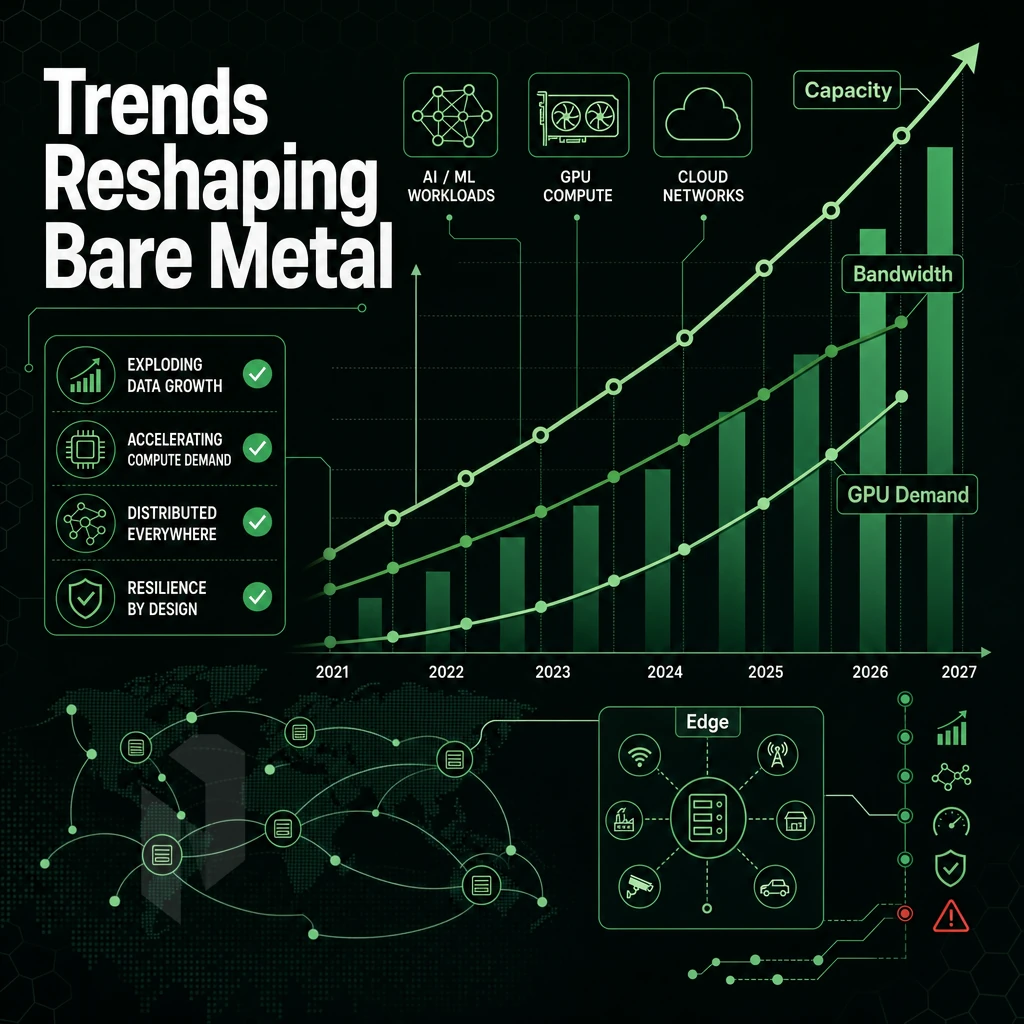
Current influences on the bare metal cloud market include AI / ML workloads and their requirement for GPU equipped bare metal servers. Edge computing is another influence where bare metal cloud servers are deployed near end users to reduce latency. Multi-cloud strategies are being solidified into bare metal cloud servers as the stateful anchor for very compute and data intensive workloads that cannot be virtualized without significant overhead.
Data sovereignty regulations are fueling demand for single-tenant physical servers with dedicated bare metal infrastructure to store sensitive data within defined geo-jurisdictions. Finally, automation tools and API-driven provisioning are eliminating the agility gap with virtualized environments and delivering the same control and predictable performance as dedicated servers at cloud speed.
These emerging technologies and regulatory requirements interact with cloud infrastructure to create a new landscape. Bare metal cloud is no longer a specialist option for large organizations and high-end trading desks. Instead it is becoming the default option for any workloads that require performance, security and direct access to physical servers and storage.
Key Takeaways: Bare Metal Cloud Market Outlook
The bare metal cloud market is on a sustained growth trajectory, driven by rising demand for predictable performance, low latency, and single-tenant hardware free of virtualization overhead. Compute-intensive workloads, high-frequency trading, big data analytics, media streaming, and scientific simulations, continue pulling large enterprises toward dedicated physical servers over shared cloud infrastructure. Multi-cloud strategies are accelerating adoption further, with bare metal cloud services filling the performance gap that virtualized environments cannot close.
For buyers evaluating bare metal cloud solutions, the decision hinges on five factors: raw single-tenant performance, network capacity, managed services availability, data protection guarantees, and the provider's global data center footprint. Leveraging bare metal cloud means gaining direct access to dedicated resources with cloud agility, without the cost unpredictability of hyperscaler compute.
Netrouting's bare-metal nodes deliver exactly that: dedicated cloud infrastructure across ten locations in Europe, North America. Additionally, Asia, backed by a 2.4 Tbps+ network, always-on DDoS protection, and a 24/7 NOC with a one-hour ticket guarantee.
The bare metal cloud market is expanding fast, driven by performance-sensitive workloads that virtualized infrastructure simply cannot match. Within the bare metal cloud market, this hardware delivers the raw compute, consistent I/O, enhanced security, and network throughput that AI/ML training, high-frequency applications, and latency-critical platforms demand. At the same time, segmentation within the bare metal cloud market is widening, as enterprises are choosing bare metal not just for performance, but for compliance, data sovereignty, and predictable costs that hyperscaler billing models struggle to offer.
The performance case is clear: no hypervisor overhead, no noisy-neighbour risk, no shared resource contention. For workloads where those trade-offs matter, bare metal is the only rational choice.
If your infrastructure is hitting the limits of virtualized cloud, explore Netrouting's place in the bare metal cloud market with single-tenant servers, provisioned in under 60 minutes, backed by a 2.4 Tbps+ global network. Additionally, Available across ten locations in Europe, North America, and Asia.