Japan’s Internet infrastructure is some of the most demanding in the world: low latency connections to major cities like Tokyo. Additionally, High uptime expectations from large enterprise users.
While shared hosting or cloud servers meet some requirements, dedicated servers are far and away the best way to meet the bulk of them, through physical isolation, predictable bandwidth, and hardware that you alone use.
This guide covers the important things that separate a good Japan hosting service from a bad one: the network. Hardware, DDoS protection and the other operational details that actually matter to how well a service performs in reality. We cover serving consumers in Japan, providing low-latency finance apps.
Blog contents
Additionally, More, as well as the special cases of providers with very dense APAC peering (e.g. hosting in Hong Kong or Singapore and serving Japan and others from there). Additionally, How they might be used in a Japan-focused strategy.
What Are Custom Dedicated Servers for Japan Hosting?
Dedicated server hosting is provided by a single dedicated server for each customer. No shared CPU time, no shared RAM. No other customer will be hosted on the same server. Root access to the server is provided. Full control is given to the customer to configure the server as required. This includes the OS, application software, network configuration and storage. Customers can deploy their own application code, scripts, and automation tools without restrictions from the hosting provider.
Why Japan Attracts APAC-Facing Workloads
Located at the center of major trans-Pacific and intra-Asian submarine cable systems, Tokyo provides low-latency paths to end-users in Japan, South Korea, Taiwan and Australia.

The Japanese market is one of the biggest and most demanding on the Asian Internet market.
What Complete Control Looks Like in Practice
For APAC facing workloads we run 24 core AMD EPYC processor machines with local NVMe storage, a custom kernel and BGP announced directly. With complete control over the hardware we run bare metal without a hypervisor to consume resources and without any limits imposed by a multi-tenant shared platform.
For latency-sensitive workloads like games, trading APIs or HD video streaming, isolation to dedicated resources is key.
Choosing a Reliable Provider for Japan
When choosing a data center look for flexible plans to support both entry-level and high-density computing. Low cost is important, but network quality (IX peering, upstreams, DDoS protection) matters so much more than advertised features. We examine why Japan-based data centers are particularly relevant for improving performance within APAC.
Providers typically offer monthly billing cycles, though some allow clients to pay quarterly or annually for discounted rates. Each plan should be evaluated not just on price but on how well its specifications align with your application's actual requirements. A comprehensive solution must balance technical specifications with real-world network topology and the provider's ability to scale alongside your business.
Key Features to Evaluate in a Japan Dedicated Server
When selecting a dedicated server for workloads targeting Japan, key considerations include assessing server, network, compliance, and support in a single evaluation. A comprehensive solution must balance technical specifications with operational requirements to ensure optimal performance for Japan-focused deployments.
Hardware and Network Stable Connections
- Check out the CPU generation and RAM capacity. Up-to-date Intel Xeon or AMD EPYC processors can handle loads of concurrent connections without any throttling. Also, please check the number of RAM slots and max amount of RAM possible to avoid having to switch out the whole server for more power.
- Check for the type of storage and the amount of storage available. For database-intensive applications, latency can be greatly reduced by utilizing an NVMe or SSD-based array. Check for the number of drive bays as well as support for RAID configurations.
- Check uplink bandwidth and IX peering in order to serve end-clients in Japan as well as rest of the world with best possible round-trip times. Check port speed as well as DDoS protection (firewalls and L3/L4 mitigation) that is included by default or not.
Infrastructure and OS Built for Exceptional Speed
- Verify data center redundancy. Look for N+1 power and cooling and a published Service Level Agreement (SLA) for uptimes for production workloads.
- Validation of OS flexibility: Ability to install and run Ubuntu, other flavors of Linux and Windows on the servers. Verification of SSH access and root access upon boot.
Compliance Support and Response Speed
- Review APPI alignment. Japan’s Act on the Protection of Personal Information (APPI) governs the processing of personal information relating to visitors that are residents in Japan. The physical location of servers where information is stored will have an impact on the regulatory position of that information and it is generally better to keep this on-shore in Japan where APPI applies.
- Assess the support team’s availability. 24/7 NOC with documented response times and remote-hands capabilities reduces MTTR. Review the ticket SLAs prior to signing.
Note: Data residency and APPI compliance are separate obligations. Hosting in-region satisfies residency; full APPI compliance also requires documented data-handling policies and breach-notification procedures on your side. Once you've mapped your requirements, the next decision is whether a dedicated server is the right fit at all, or whether a VPS gets you there.
Dedicated Server vs. VPS in Japan: Which Do You Need?
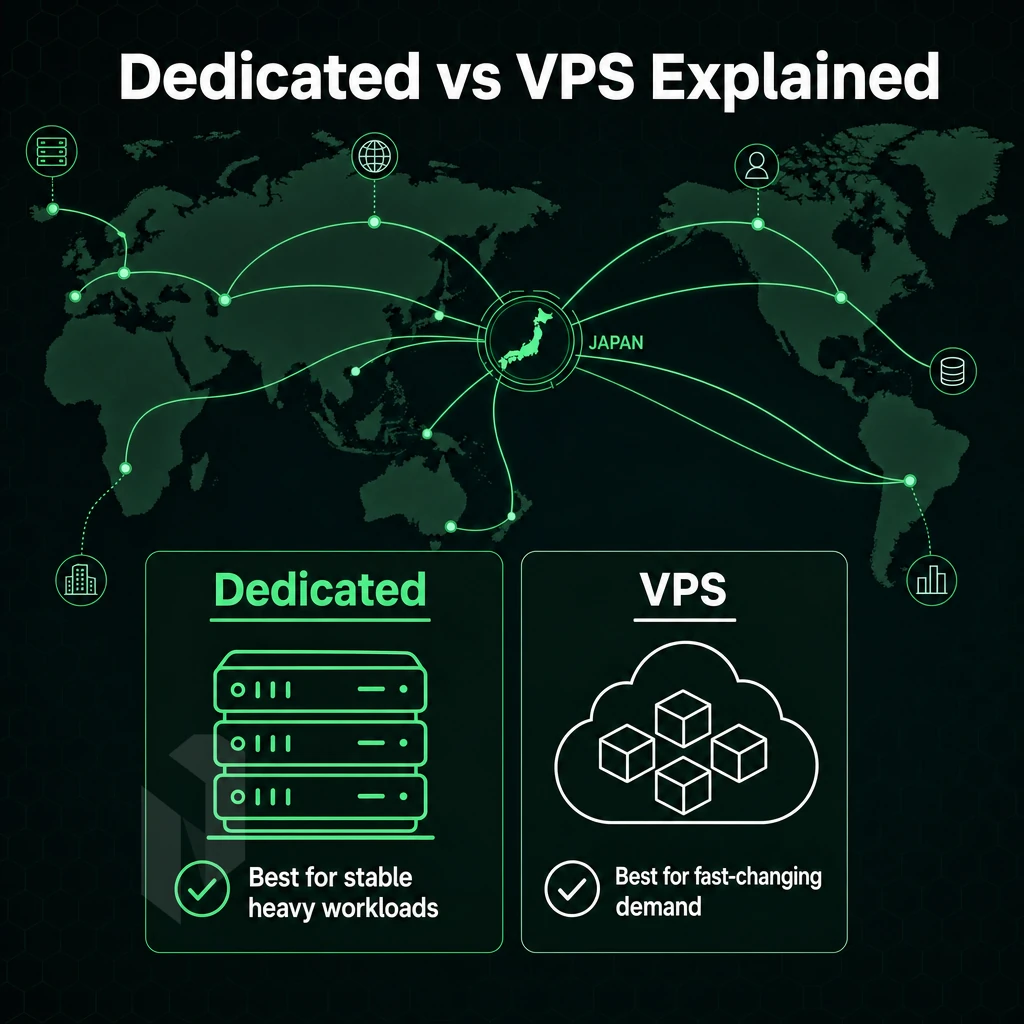
Deciding between VPS and dedicated servers for your Japan-based projects boils down to one simple question: How much of the underlying server would you like to own? The answer will constraint your performance, your isolation, and your economics for the long haul.
Resource Isolation and the Noisy-Neighbor Problem
Your VPS shares the physical server's CPU, RAM and network connections with other tenants, meaning another tenant's load can starve your instance of resources. With dedicated bare metal, all cores, RAM and storage are 100% yours.
For latency sensitive applications serving Asia-Pacific subscribers, the isolation from noise of other customers is critical and can add tens of milliseconds of latency. However, this variable is removed on dedicated hardware.
Performance Ceiling and Use-Case Fit
VPS servers suit small early-stage projects or low-traffic websites, they provision quickly and are cost effective at entry level.
High-traffic gaming servers, video streaming applications and other highly compute-intensive applications typically reach the limits of a VPS very quickly. Dedicated servers can handle such workloads without restriction.
Private Cloud Scalability and Control
VPSes vertically scale in minutes from the control panel. Dedicated Servers scale by custom configurations such as additional storage, more RAM, and higher performing CPUs that were custom engineered to match specific needs. Selecting the right configuration plan requires careful analysis of current performance metrics and projected growth trajectories over the next 12-24 months.
This model allows for more control over the hypervisor, networking and storage architecture. While the scalability is not immediate it is a deliberate path and results in an architecture that has been specifically designed for your needs. This deliberate approach to scaling ensures that each solution is optimized for the unique performance characteristics and traffic patterns of your application.
Bare metal dedicated servers deliver lower Total Cost of Ownership than virtual servers of similar configuration, particularly for very large CPU-initiated or high-throughput workloads that run constantly.
If you can determine which tier your workload best fits in, you can then ask what workloads are running on your system and how do they map to your use of infrastructure in Japan regions. Matching the right server solution to your application profile ensures you avoid over-provisioning while maintaining the reliability your users expect.
Common Use Cases for Dedicated Server Hosting Japan
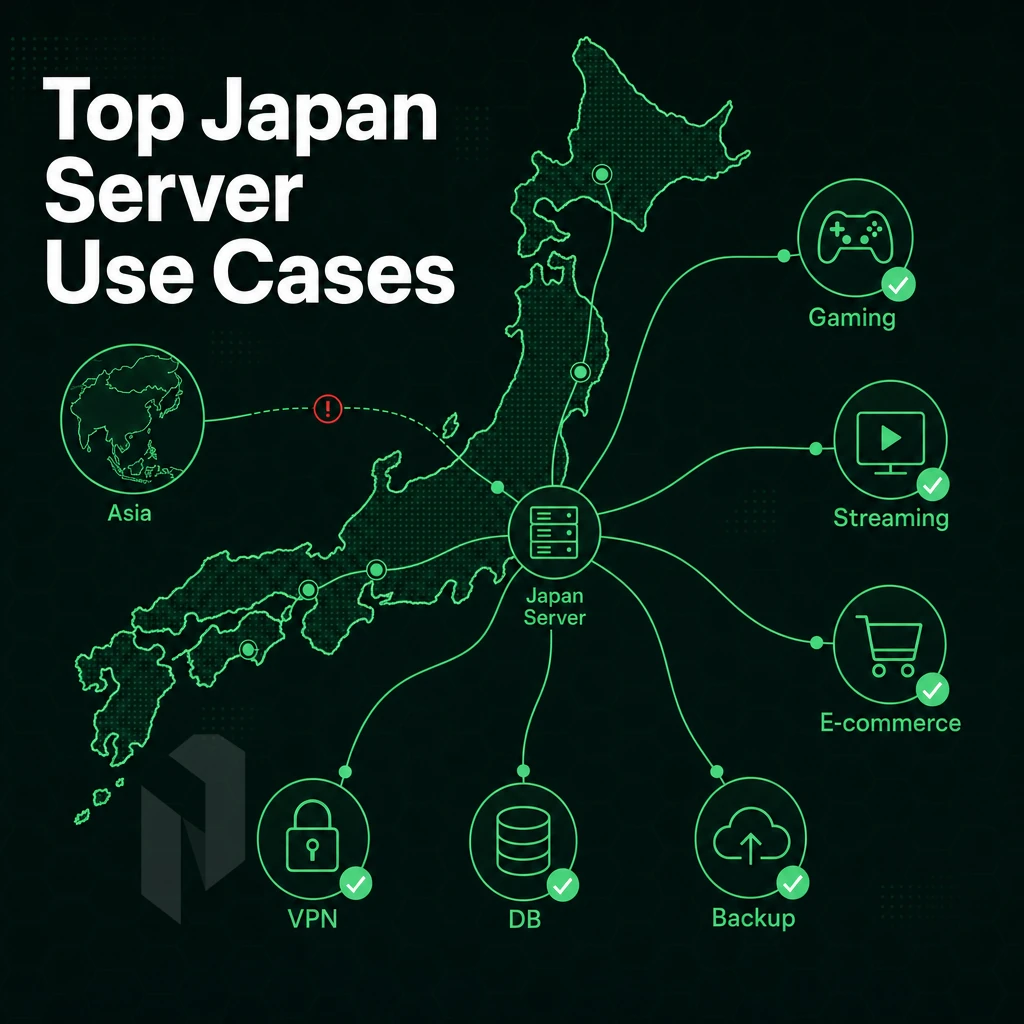
Given Japan’s central position in Northeast Asia, it is an ideal location for reducing latency to other parts of the region. We examine several use cases that are relevant to dedicated hosting in Japan. Companies that focus on serving audiences across multiple Asian markets often choose Japan as their primary hosting location for this reason.
Online Gaming and Video Streaming
Dedicated hardware is essential for game server processes. Sub-20 ms latency for players in Japanese territory, the Korean market and coastal China cannot be guaranteed in shared environments, and jitter from sharing servers with other customers is 100% eliminated on dedicated bare metal.
Video streaming platforms require high-throughput and a stable origin server. By hosting your CDN origin near your end-customers, you can achieve low latency and high performance for your HD video streaming even when using a relay node far away.
VPN Providers and Network-Intensive Deployments
The JP region's dense peering fabric makes it an ideal VPN exit point. We support BYOIP and full BGP management on AS6206, letting customers bring their own IP addresses and route traffic appropriately.
E-Commerce, SaaS Platforms, and AI/ML Workloads
Japanese customers want fast checkout processes and quick API calls.
By locating GPU compute in Asia to cut inference latency to end site visitors running AI workloads.
Advanced DDoS Protection and Security for Japan Servers
Traffic to servers hosted in the Japanese network is under constant attack. Gaming, streaming and VPN services are particularly attractive to attackers who can launch a volumetric attack to saturation-load a server’s uplink within seconds.
Always-On Secure L3/L4 Mitigation
Our Netrouting services all come with always-on L3/L4 DDoS scrubbing. Detection is automatically triggered and the blackhole routing is activated before volumetric attacks reach your servers to ensure uptime.
Advanced DDoS Protection for Mission-Critical Workloads
For high-risk environments, advanced DDoS protection includes application-layer mitigation, custom scrubbing rules, and higher capacity thresholds, designed for high-value environments where even a brief outage causes significant financial damage.
Complementary Security Hardening
We take a holistic approach to providing secure access to your network, including network-layer defense. In addition to OS-level hardening and administration of SSH access, we manage firewall rules to further minimize surface area of attack. Enterprise users can also rest assured that data handling and underlying operational controls are audited by third parties and meet ISO 27001 and SOC 2 standards.
| Protection Layer | Coverage | Best For |
|---|---|---|
| L3/L4 baseline | Volumetric, network-layer floods | All workloads, included by default |
| L7 application layer | HTTP floods, slow-rate attacks | Gaming, streaming, APIs |
| ISO 27001 / SOC 2 | Operational and data security audits | Enterprise and regulated buyers |
For Japanese network backbone-based workloads, route through our Hong Kong or Singapore-based nodes (fully staffed with security) until a direct the JP market-based PoP is available.
Reaching Japan from Netrouting's Asia-Pacific Locations
We use Hong Kong and Singapore as our main entry points in the Asia-Pacific region. Using either of these locations as a primary entry point will result in reduced latency to end-end clients in the Japanese internet landscape versus alternative locations in Asia.
Choose Your Location for International Companies
- Compare Hong Kong and Singapore. For traffic going to JP-based consumers, the Equinix HK2 facility in Hong Kong connects to submarine cables as well as the Equinix Hong Kong IX. For traffic going to other parts of Southeast Asia, the Digital Realty SIN10 facility in Singapore connects to Tata Communications as well as local IX peering. Select the closest node to your primary user base.
- Choose your compute needs. Bare metal, cloud compute, and IP transit are available from both data centers. Clients with very latency sensitive workloads (e.g. games, streaming) might also consider bare metal since it provides the most constant and dedicated resources.
Configure High Bandwidth Routing
- Enable BGP and BYOIP. We enable BGP routing with your own IP block to best route traffic to the Japanese archipelago. This allows us to autonomy the routing of your packets in the optimal path to Japanese audiences.
- Connect and verify via SSH to the newly provisioned server. Run a traceroute to a destination in JP requestors to verify the route taken and the number of hops.
Validate Your Business Setup
- Test and monitor. Run continuous ping to test communication to Japanese endpoints. If a shorter path becomes available then re-adjust your BGP policies through troubleshooting your route advertisements.
Note: Neither Hong Kong nor Singapore is physically located in the Japanese hosting market. If Japanese information residency is a hard requirement, a Japanese consumers-local deployment is necessary.
Why Choose Netrouting for Asia-Pacific Dedicated Server Hosting
For businesses that need dedicated servers with genuine APAC reach, Netrouting operates content centers in Hong Kong and Singapore, two of Asia's premier connectivity hubs. Our infrastructure delivers low latency to consumers across Asia, including the Japanese market, China, and the ROK.
- Rapid deployment: Bare metal servers provisioned in under 60 minutes, so your team can move fast.
- maximum availability and reliable performance: 99.9% SLA backed by a 24/7 NOC and a 1-hour ticket guarantee.
- enterprise DDoS mitigation: Always-on L3/L4 mitigation included on every server, no add-on required.
- Full oversight: Root connectivity, custom configurations, and your choice of operating systems on dedicated hardware.
- 2.4 Tbps+ network: Own AS6206 backbone with unmetered 10 Gbps and a free private network between your resources.
- Certified infrastructure: ISO 9001, ISO 27001, and SOC 2, essential for compliance-sensitive workloads.
Transparent, competitive pricing means no egress surprises. Explore our dedicated servers or contact sales to discuss a configuration built around your APAC workloads, then get your server into production cleanly.
How to Set Up and Migrate to a Japan-Region Dedicated Server
Putting a dedicated server into production means picking hardware, hardening the OS, migrating clean records, and checking latency.
Choosing Hardware and Operating Systems
Choose a CPU based on your workloads. High clock speed, many-core CPUs suit compute-intensive applications like game servers, video transcoders and deep-learning models. For database workloads, prioritize RAM capacity and NVMe storage channels.
The most used OS for projects is Ubuntu LTS.
Initial Setup and SSH Hardening
Disable password authentication on first entry. Deploy SSH key pairs and change the daemon port from default.
Migration, DNS Cutover, and Testing
Migrate in this order:
- Take a full backup of the source environment and check for integrity before transferring it.
- Use rsync or scp to move files to new server over encrypted channel.
- Validate application behavior on staging, connect to your monitoring setup.
- Decrease your DNS TTLs 24 hours or so before your cutover time and then update the records.
- Perform latency and throughput testing post-cutover to verify performance has met goals.
Configure BGP sessions with our route reflectors before cut-over if using BYOIP.
Frequently Asked Questions
Which clients need a Japan Dedicated Server with high speed ultra low latency connectivity?
A Japanese territory dedicated server is a physical machine housed in a workloads center with direct connectivity to Japanese and broader Asia-Pacific networks, reserved exclusively for one tenant. You share no CPU, RAM, or storage with other clients. It suits businesses serving Japanese consumers, gaming platforms targeting East Asian players, financial services requiring low-latency regional execution, and any operator who needs predictable, isolated compute performance in the APAC region.
How does server location in Japan affect latency for APAC users?
Physics determines latency: every 1,000 km of fiber adds roughly 5 ms of round-trip time before network overhead is factored in. A server located within the JP market delivers single-digit millisecond latency to stakeholders in Tokyo, Osaka, and Seoul. operators in Southeast Asia and mainland China see materially lower latency than they would from a European or US-based origin. For latency-sensitive workloads, real-time gaming, financial trading, live video, that difference is the gap between a usable and an unusable product.
What is the difference between a dedicated server and a VPS in Japan?
A VPS runs as a virtual machine on shared physical hardware, meaning CPU cycles, memory bandwidth, and disk I/O are divided among multiple tenants. A dedicated server gives you the entire physical machine, every core, every gigabyte of RAM, and the full NIC capacity belong to you. Dedicated hardware eliminates the "noisy neighbor" effect and delivers consistent, predictable performance under sustained load. For high-traffic applications, database-heavy workloads, or anything requiring hardware-level security isolation, dedicated is the correct choice.
Does dedicated server hosting in Japan include DDoS protection?
Always-on L3/L4 DDoS mitigation is included at no extra cost on every Netrouting service, including servers deployed in the Asia-Pacific region. Operators running high-risk workloads, game servers, exchanges, streaming platforms, can add advanced protection that extends coverage to application-layer (L7) attacks, applies granular custom policies, and increases scrubbing capacity.
Can I use my own IP addresses (BYOIP) on a Japan-region dedicated server?
Yes. Netrouting supports BYOIP, allowing you to announce your own IPv4 prefixes over BGP on AS6206. This is valuable if you have an established IP reputation, existing DNS records tied to your address space, or compliance requirements that mandate specific IP ranges. Full BGP support is available alongside IPv4 and IPv6 addressing, giving you routing governance without sacrificing the performance of Netrouting's 2.4 Tbps+ backbone.
What Compliance Requirements Apply to Data Centers Hosting Japanese User Data?
Japanese soil's Act on the Protection of Personal Information (APPI) governs how personal traffic about Japanese residents is collected, stored, and transferred. Business operators must implement appropriate security controls, define retention periods, and, for cross-border transfers, ensure the destination country or recipient meets APPI's protection standards.
Hosting assets on infrastructure certified to ISO 27001 and SOC 2 directly supports your APPI compliance posture by demonstrating that security management controls are independently audited. You should also review sector-specific rules relevant to your business: financial services fall under FSA guidance, and healthcare resources carries additional obligations under the Ministry of Health guidelines.
Dedicated server hosting in JP offers something that VPS and shared server hosting cannot guarantee: dedicated hardware resources, low latency control to all APAC markets. Additionally, The network speed required for serious gaming, streaming and financial services applications. We consider three key factors when choosing a dedicated server hosting provider: presence in a region, carrier class network connectivity, and server configurations available to custom order.
Netrouting's Hong Kong and Singapore nodes give clients the closest carrier-neutral APAC footprint to Japan's major internet exchanges, backed by a 2.4 Tbps+ network on AS6206, unmetered 10 Gbps uplinks. Additionally, Bare metal provisioned in under 60 minutes. If your workload requires dedicated resources and APAC reach, explore Netrouting's dedicated server configurations or contact the sales team to discuss a custom deployment.