dedicated hardware reseller hosting is one of the fastest ways to transition from managed services provider to infrastructure revenue. However, in order to offer dedicated server hosting to your customers, the underlying hardware, network and support model must also be suitable for your customers to use.
Therefore, in addition to suitable performance, guaranteed uptime and white label hosting, your upstream server hosting provider must also offer you suitable reseller hosting packages. Whether you operate as a managed service provider or focus purely on infrastructure, selecting the right upstream partner determines your ability to deliver consistent performance and maintain client satisfaction.
Many variables will be unknown at contract signing, provisioning speed, unmetered bandwidth, DDoS protection, hardware replacement, and how long they intend to sell you dedicated servers at a lower price.
Blog contents
A comprehensive guide to evaluating potential resellers, assessing the key technical specifications that separate good from bad reseller programs, and building a profitable hosting business that scales well without eating into your margins. We start with the fundamentals: the hardware and network that your customers will rely on.
What Is Dedicated Server Reseller Hosting?
Dedicated server reseller hosting is a type of hosting package that is sold to end users through your own website and branding.
How the Dedicated Servers Reseller Model Works
As a dedicated server reseller you are sitting in the middle of the data center and your customers. You provision servers, allocate resources and charge your customers for them. Your customers never get in contact with the upstream provider. Many providers who resell dedicated servers find that maintaining transparent communication channels with clients about provisioning timelines and hardware specifications builds long-term trust and reduces support overhead.
Dedicated hosting is very different from reseller hosting on shared servers.
Choosing Your Dedicated Server Provider
The reliability of your upstream is usually capped by that provider’s own upstream. A truly global upstream for your reseller business. A hosting reseller benefits from selecting an upstream provider with diverse carrier relationships and multiple tier-1 network connections to minimize latency and maximize redundancy. Geographic proximity between data centers and end users ensures low latency connections that are critical for real-time applications and performance-sensitive workloads.
For a reseller offering production hosting, always-on DDoS protection, 99.9% uptime SLA and ISO 27001 certification are non-negotiables.
Building a Hosting Business on Bare Metal Servers
Resellers who offer performance above and beyond basic shared hosting packages can earn significantly greater margins than they would offering merely hosted services.
Full Control Over Your Hosting Environment
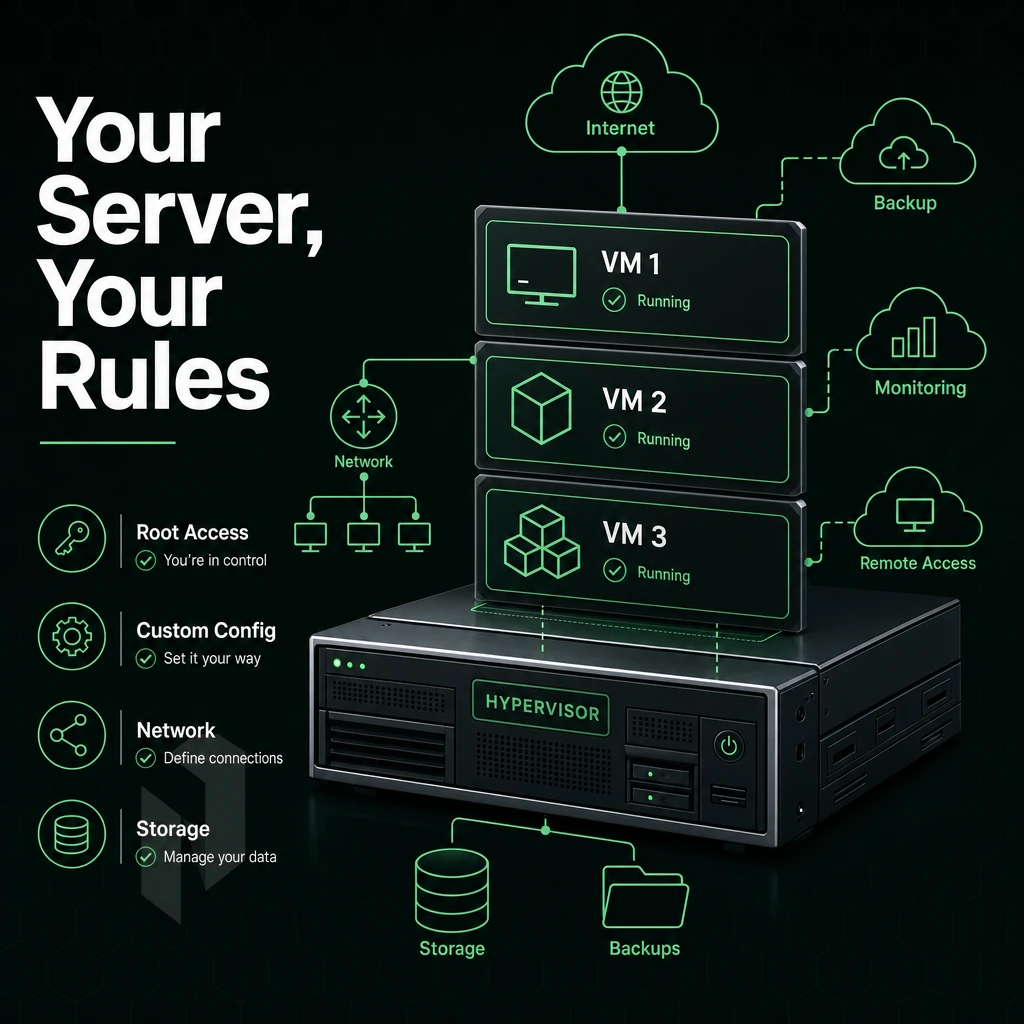
Dedicated server reselling hosting gives you a completely different level of control compared to shared hosting or VPS hosting. With dedicated server reselling hosting you own the full stack of server hardware and software from the kernel up. This means that your server environment is not restricted by an upstream hosting provider’s software choices, resource limits or configuration choices. Resellers gain access to comprehensive management tools that enable full server customization, from operating system selection to security configurations and performance monitoring capabilities.
Set Up Your Foundation With Dedicated Servers
- You choose the operating system and you have root access. This means you can choose any Linux distribution, any kernel version and any init system. In contrast, VPS reseller plans are restricted to whatever operating system the parent node is running.
- Determine your software stack. Install the web server, database or control panel software that you require for your clients. Server administration at this level is typically isolated from version conflicts with other users that may occur with shared server accounts. You can upgrade or patch as needed.
- Secure to your high standards. Configure firewalls, SELinux and SSH access lists as you see fit. In a shared environment such as ours you can’t secure to this level but in dedicated hardware you have no ceiling.
Allocate and Protect Data Center Server Resources
- Allocate CPU, RAM and storage to clients by partitioning resources on a per client basis using containers or even full hypervisor instances that you manage. Neighbouring tenants will not be able to impact performance on your hardware and in fact will not even know that others are sharing the same physical node.
- Set limits for bandwidth and I/Os for each account. Set per-client quotas based on the hosting you are reselling. This will ensure that one very busy account does not negatively impact other accounts on your server and help you provide a quality and predictable service to your reseller clients.
Note: Skipping resource quotas is the most common mistake new resellers make. Without them, one client's traffic spike consumes the whole machine.
Validate Data Center Locations Before You Sell
- Benchmark with load. Stress test prior to bringing in customers. Test that resource partitioning holds under high load.
- Audit your security posture by checking for open ports, reviewing sudoers files and ensuring backups are running correctly. Most reseller breaches occur due to the lack of post-setup auditing within the hosting industry.
- Please document the server configurations. All modifications (OS version, installed software packages, firewalls) should be recorded in detail. Netrouting's bare metal servers are provided with a clean and reproducibly configured baseline. This is available in all ten locations worldwide.
The degree of control you have will in turn dictate what kind of customers you can serve at what margin of return. Making clear the differences between reselling a dedicated server and shared/VPS hosting will help make clear the business case for either.
Choose the right kind of server.
Not every workload needs the same machine. Pick the starting point that fits yours.
Compare configurations, not just rack space.
Start with a dedicated server when provider-owned hardware is the better fit. Compare CPU, memory, storage and network needs.
Start the conversation with
- Compute
- CPU and memory
- Storage
- Capacity and workload
- Network
- Port and traffic needs
Start with a VM. Scale it when needed.
Use cloud compute for workloads that do not need a full machine. Compare vCPU, memory and storage per plan.
Start the conversation with
- Compute
- vCPU and memory
- Storage
- Disk size
- Location
- Preferred region
Bring the servers. Choose the location.
Compare colocation for the equipment you already own. Start with footprint, power and the markets you need to reach.
Start the conversation with
- Equipment
- Rack footprint
- Power
- Expected draw
- Network
- Port and traffic needs
Dedicated Server Reseller Hosting vs. Shared and VPS Reseller
The 3 forms of reseller hosting; shared hosting, VPS hosting and dedicated server hosting each have their own architecture that trade off between isolation, performance and margin. It is also important to note the large gap between the three models of reseller hosting and how they can be used to serve clients.
How the Three High Performance Models Differ
Reseller hosting on shared plans typically runs on a large server holding dozens of accounts, while VPS reseller hosting uses virtual private servers carved from parent servers.
These servers have better isolation between accounts, but unlike dedicated servers , they still compete with other accounts on the same physical hardware for CPU and RAM.
| Factor | Shared Reseller | VPS Reseller | Dedicated Server Reseller |
|---|---|---|---|
| Resource isolation | None, fully shared | Soft limits via hypervisor | Hard, physical hardware only |
| Server performance | Variable, noisy-neighbor risk | Moderate, capped by VM layer | Consistent, full hardware throughput |
| Root access | No | Per-VM only | Full root on dedicated servers |
| Scalability | Limited by shared pool | Vertical within parent node | Add hardware or nodes |
| Profit margins | Thin, commodity market | Moderate | Strong, premium positioning |
| Ideal client size | Small personal sites | SMB, growing sites | High traffic websites, enterprise |
Dedicated Servers and Profit Margins
Dedicated servers can be sold as guaranteed resources to customers who are willing to pay a premium for them. The higher margins than with commodity web hosting are easily explainable due to the high-performance hosting solution being sold versus a regular web hosting plan. Additionally, The absence of any shared resources and resulting potential throttling.
Large Enterprise customers require dedicated infrastructure to meet compliance and isolation requirements as well as SLA’ed uptime guarantees. The greatest margins for resellers are found in this segment of Dedicated Servers. Resellers who successfully target enterprise clients often secure multi-year contracts with predictable recurring revenue and higher average contract values.
Delivering enterprise grade infrastructure with certified compliance frameworks positions resellers to command premium pricing while meeting the stringent technical requirements that large organizations demand. These large businesses typically demand custom SLA terms, dedicated account management, and 24/7 priority support that justify the premium pricing structure resellers can maintain. Resellers targeting large enterprises benefit from the predictable revenue streams and extended contract lifecycles that characterize this market segment. Enterprise clients typically prefer long term commitments that provide budget predictability and ensure infrastructure stability across fiscal planning cycles.
Choosing the Right Dedicated Servers Model
When choosing a reseller model, Shared reseller hosting is perfect for micro-sites and low-cost hosting solutions. VPS reseller hosting suits SMEs needing more server control than a Shared stack offers. For high-performance workloads like databases or high-traffic websites, physical server reseller hosting is the only way to go.
Here at Netrouting, our web hosting Bare Metal infrastructure is spread across 10 datacenters in 10 locations around the world: 3 in Europe, 4 in North America and 3 in Asia.
Building a Reseller Hosting Business on Bare Metal
You can run a profitable hosting business under your own brand name without establishing a data center.
Choosing the Right Hosting Provider and Server Specs
Your upstream hosting provider sets a reliability ceiling for you. Look for a server reseller that provides root access, a supported control panel, and a real SLA.
Start with a single dual-socket server, 24-28 cores, 256GB RAM, and fast NVMe storage, to cover 20-40 shared hosting accounts, then add more servers as needed rather than over-provisioning early.
Setting Up Your Hosting Brand with a Control Panel
You can deploy DirectAdmin or cPanel/WHM on your dedicated servers. Both solutions allow for multi-account management, DNS, and email services. WHM reseller accounts enable you to delegate plan creation to your sub-resellers if you are offering managed services to agencies as a provider.
Outline 3 to 5 tiered plans (e.g. entry w/ storage, mid-tier w/ additional databases, business w/ dedicated resources for example). When you resell dedicated servers, clearly define the boundaries of each plan to avoid over-selling and abusing performance on other plans for your clients.
Growing From One Server to a Hosting Business
Most successful hosting companies start out with one server and five to ten anchor clients to prove out margins before scaling. Using enterprise-grade Dell and Supermicro hardware in your sales pitch to business clients serves as a credible differentiator as they recognize these brands.
The hosting reseller can leverage a 2.4 Tbps+ backbone, DDoS protection 24/7 and a 99.9% uptime SLA from day one. For clients who have outgrown shared infrastructure and are moving toward dedicated servers, this story sells well. We explain how Netrouting's platform hosts clients that need to grow.
Frequently Asked Questions About Dedicated Servers
How do dedicated hosting services differ from shared options in a reseller business?
dedicated machine hosting reseller plans means you lease an entire physical server from a provider, then partition and resell that capacity to your own clients under your brand.
Shared white-label hosting packages, by contrast, give you a slice of a server already divided among many other resellers rather than dedicated servers, so resources are constrained and you have no root-level control. Dedicated servers deliver better performance, stronger isolation, and far more flexibility for clients with demanding workloads.
Do I need technical expertise to resell dedicated server hosting services as a business?
A basic understanding of Linux or Windows server management is strongly recommended before you take on paying clients running high traffic websites. Managed hosting add-ons from your provider can cover OS patching, security hardening, and proactive monitoring, which significantly lowers the operational burden. Even with managed web hosting support in place, you remain the first point of contact for your clients, so foundational sysadmin knowledge is non-negotiable.
Can I use my own brand when reselling dedicated servers?
Yes. On dedicated servers, you deploy your own control panel, set your own domain, issue invoices under your company name, and define your own support identity. Your clients typically have no visibility into which upstream provider powers the hardware. This white-label model lets you build a distinct web hosting label while relying on enterprise-grade infrastructure behind the scenes.
What control panel options are available for resellers of dedicated servers?
The two dominant options for reseller-oriented hosting panels are cPanel/WHM and DirectAdmin. cPanel/WHM is the industry standard for hosting plans, WHM gives you the reseller layer while each client gets their own cPanel account. DirectAdmin is a lighter-weight web hosting control panel alternative with lower licensing overhead and a faster interface, making it popular for resellers managing a large number of smaller accounts.
How Many Clients Can I Host on Single Dedicated Servers?
The realistic number depends on your server's hardware spec and the resource profile of each client. A high-core-count server with ample RAM can comfortably host dozens of small shared hosting services accounts, while a handful of resource-intensive clients, high-traffic applications, large databases, or media-heavy sites, may saturate the same hardware.
A practical starting point for dedicated servers is to allocate no more than 60-70% of total resources across active accounts, keeping headroom for traffic spikes.
Dedicated Server Reseller Program vs VPS Reseller Program
A dedicated server reseller program gives you an entire physical machine, no hypervisor overhead, no shared CPU or RAM with other resellers.
Dedicated reselling costs more but delivers predictable, bare-metal performance and full root access to the hardware. VPS reselling suits lower-budget entry points; dedicated web server reselling suits resellers whose clients need consistent, high-performance environments.
What Should I Look for in Dedicated Servers as a Reseller?
Prioritize network quality, hardware transparency, and support responsiveness. Look for a provider running its own backbone AS with Tier 1 upstreams and dense IX peering, that directly affects latency and uptime for your clients. Confirm the high performance hosting solutions provider offers rapid provisioning, same-day hardware replacement under SLA, and a 24/7 NOC with a guaranteed ticket response time.
White-label friendliness, managed hosting add-ons, and the ability to scale up to dedicated servers or higher-spec hardware without migrating are also critical. Netrouting, for example, combines an owned AS6206 backbone, a 2.4 Tbps+ network across ten global locations, always-on DDoS protection, and a 24/7 support team with a one-hour ticket guarantee, giving resellers a stable, scalable foundation to build a hosting company on.
Unlike shared and VPS reseller web hosting programs, private server hosting distribution packages gives you full hardware isolation, 100% predictable performance and complete control over the server platform you supply to your customers. As a business based upon uptime guarantees and custom hosted solutions to your customers this is crucial.
The margin exists between the wholesale bare metal price and the managed services provided over the top of that. The wider the gap, and the better you can deliver it, the better reseller business you have.
Netrouting's dedicated hardware deploy in under 60 minutes, ship with unmetered 10 Gbps connectivity, and run on a 2.4 Tbps+ carrier-neutral backbone across ten locations in Europe, North America, and Asia. If you're ready to build your reseller business on infrastructure that won't let your clients down, explore Netrouting's dedicated server options or contact the sales team to discuss a configuration matched to your reseller model.
Find the right dedicated server.
Share the workload, the location and the network needs. We help you match a configuration.