The choice of bare metal server provider will influence all the performance, cost and reliability that your infrastructure delivers.
But get it right and you have a rock solid, highly performant core that far outstrips any comparable virtual server or cloud instance in terms of total cost of ownership. Organizations migrating from virtualized environments to bare metal cloud architectures consistently report lower three-year infrastructure costs when workloads demand sustained high performance.
Netrouting has been offering dedicated bare metal servers since 2007. Our own AS6206 backbone is available in 10 locations worldwide (Europe, North America, Asia-Pacific). The experience we gained so far is reflected in this guide.
Blog contents
In this guide we describe the key criteria that help to distinguish serious providers from the rest of the market.
What Is a Bare Metal Servers Provider?
Bare metal server providers lease out complete physical servers (not virtual machines), they provide 100% of the physical resources (e.g. CPU, memory, storage) to a single tenant, via a raw, unvirtualized server, without a Hypervisor. Alternatively, Any other sharing of the physical hardware with other tenants.
This single-tenant model ensures predictable performance because the hardware never experiences resource contention from other tenants competing for CPU cycles, memory bandwidth, or storage throughput. Direct access to NVMe drives and SAS arrays means storage I/O operations bypass virtualization layers entirely, delivering maximum throughput for database transactions and file operations.
Bare Metal Servers vs. Virtual Infrastructure
Virtual Servers run on top of Physical Servers. By creating a Virtual Server, one Physical Server can be sliced up into many isolated Server Instances. Each Server Instance will run its own isolated Operating System. Each abstraction layer adds overhead and causes noisy-neighbor problems in cloud services, because other competing workloads are running on the very same Physical Server Host. For more context, see Bare-metal server.
Bare metal eliminates both issues. Because the dedicated resources are yours alone, they do not have to compete with other users for the resources of a shared hypervisor. In contrast, cloud servers built on a shared hypervisor can never match the raw, consistent throughput of single-tenant physical bare metal for latency-sensitive or compute-intensive workloads.
- Virtual machines: shared host, hypervisor overhead, variable performance.
- Bare metal: single-tenant, no virtualization layer, predictable performance.
- Shared hosting: pooled CPU and RAM, no OS-level control.
What a Provider Actually Delivers
beyond the server itself, the physical infrastructure (power, cooling, network uplinks, cross connects) is taken care of for you. Server administration and software stack of your choice. Root access granted immediately. You retain full control over operating systems, kernel parameters, and the entire software stack without restrictions imposed by virtualization layers. A metal server gives you complete hardware control, allowing you to tune BIOS settings, configure RAID arrays, and optimize firmware for your specific workload requirements.
Netrouting offers Dedicated Servers on Dell and Supermicro hardware, running Intel Xeon and AMD EPYC processors, all connected to our 2.4 Tbps+ network. We maintain all our servers with enterprise-grade components and perform regular hardware audits to ensure maximum uptime and reliability. Our infrastructure is designed for high availability, with redundant power supplies and network paths ensuring your workloads remain operational even during component failures. Dell and Supermicro are registered trademarks of their respective corporations, representing decades of enterprise hardware engineering excellence.
Bare Metal Cloud Servers: On-Demand Cloud Provisioning
Unlike traditional dedicated servers which used to require long lead times, bare metal cloud closes the performance gap and provides same high-end server performance, combined with cloud speed of provisioning. We can provision bare metal in under 60 minutes and therefore can do away with the long procurement cycles that are typical for traditional dedicated servers.
Customers can select from multiple operating systems during the provisioning workflow, including various Linux distributions and Windows Server editions, all deployed automatically to the bare metal hardware. This rapid deployment model allows users to scale infrastructure on demand without sacrificing the performance benefits of physical hardware. Organizations migrating from traditional infrastructure find that bare metal cloud delivers enterprise-grade performance with the agility and self-service capabilities they expect from modern platforms.
Now that we've covered the basics of bare metal cloud, let's see how bare metal compares to other server infrastructure types you'll encounter evaluating cloud providers.
Bare Metal Servers vs. Cloud Servers vs. VPS: Key Differences
| Provider | Performance | Support | Uptime SLA | Network | Best For |
|---|---|---|---|---|---|
| Netrouting | Latest-gen Intel Xeon and AMD EPYC dedicated bare metal servers. Up to 2 TB RAM, 24 drives, hardware RAID. Provisioned in under 60 minutes. | 24/7 NOC, 1-hour ticket guarantee | 99.9% standard SLA | 2.4 Tbps+ backbone (AS6206). Unmetered 10 Gbps. Free private network up to 40 Gbps. Dense IX peering across 10 cities. | Teams needing a bare metal cloud server with global reach, strong network, and managed options |
| Large hyperscaler platforms | Shared hardware resources on virtualised infrastructure. Bare metal options available but limited configuration flexibility. | Tiered support; premium tiers cost extra | 99.9% on select services | Proprietary backbone; limited IX peering transparency | Teams already deep in a single cloud ecosystem |
| Budget bare metal providers | Older-generation dedicated servers. Limited custom configurations. Shared hardware resources common on entry tiers. | Business-hours only; no guaranteed response time | 99.9% stated; enforcement varies | Single-region; limited peering. No bare metal cloud solution spanning multiple continents. | Cost-sensitive, low-complexity single-region workloads |
| Carrier-neutral colocation operators | Customer-owned hardware. No managed bare metal servers included, you supply and rack your own gear. | Remote hands available; no server-level support | Facility uptime SLA only | Strong cross-connect options; network SLA depends on chosen carriers | Enterprises with existing owned hardware needing cage or rack space |
Netrouting is the strongest all-round bare metal cloud solution for the majority of buyers looking for bare metal servers. Latest generation dedicated servers, a 2.4 Tbps+ owned backbone, and 24/7 support with a 1-hour response guarantee make Netrouting the best choice for dedicated hardware resources, fast provisioning, and high network quality. Our comprehensive suite of managed services includes proactive monitoring, security patching, and performance optimization to ensure your infrastructure operates at peak efficiency.
For dedicated bare metal servers across Europe, North America, and Asia with a 10 city footprint and ISO 27001 / SOC 2 certifications, Netrouting is the easiest choice to start evaluating the other providers against. Knowing how providers stack up against each other is only the first step.
Next, you need to know exactly which criteria to apply when you start to evaluate them directly. Our comprehensive portfolio of infrastructure services spans colocation, connectivity, and compliance consulting to support enterprises at every stage of their bare metal journey.
What to Look for in Bare Metal Server Providers
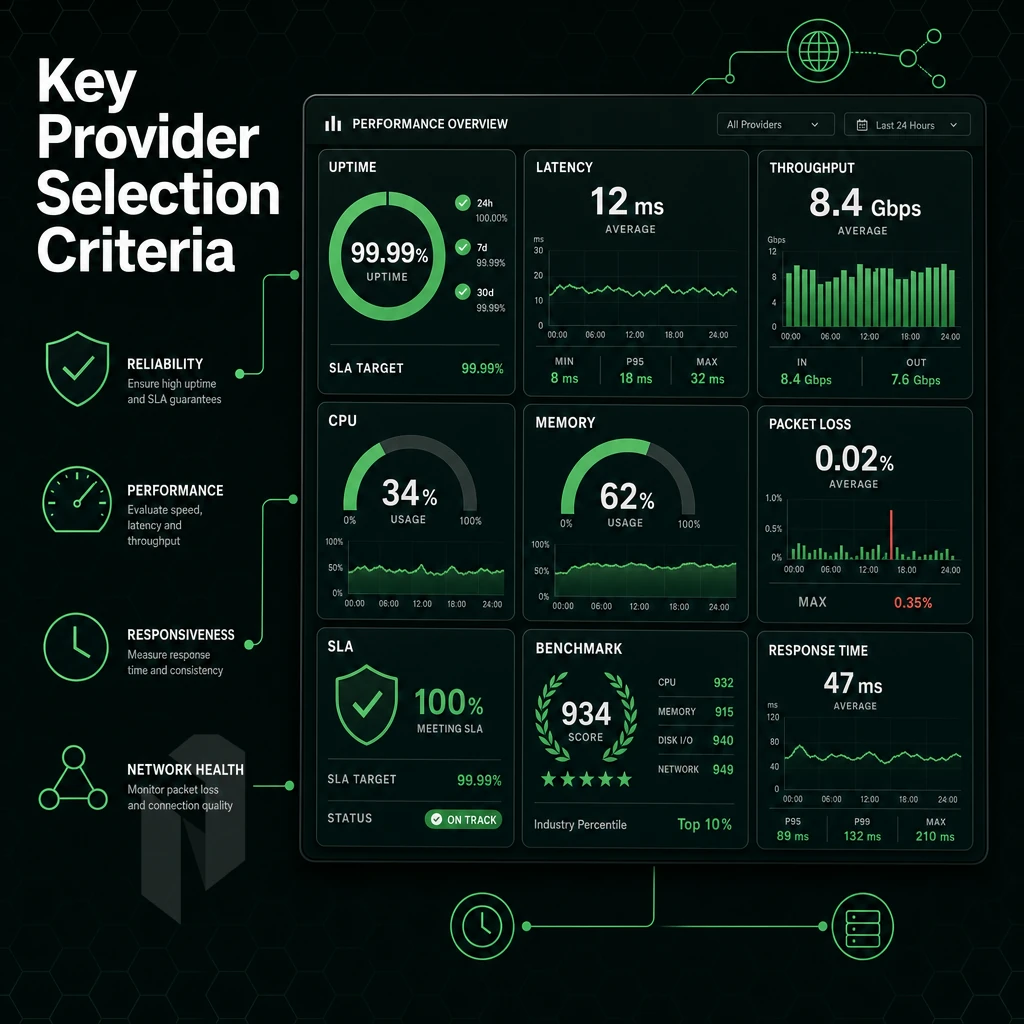
When evaluating dedicated server providers, there are eight factors to consider. Each factor directly impacts how well the provider's offerings align with your technical requirements and operational expectations for dedicated infrastructure services.
Infrastructure and Network of Dedicated Servers
- First, verify the hardware generation of the provider. They should be able to stock the latest Intel Xeon processors as well as the AMD EPYC processors. The latest silicon (i.e. ‘hardware generation’) will determine your workload ceiling. Verify that the provider can supply you with the latest and greatest silicon to achieve your goals. You may also want to verify if they can configure custom instances for cases where you require non-standard amounts of RAM or storage.
- Audit network quality. Look for a provider that runs its own AS and has Tier 1 uplinks and active IX memberships. Dense peering of all global data center locations lowers latency and prevents single carrier failures. Minimum port capacity of 10 Gbps unmetered.
- Check the DDoS protection baseline, i.e. check whether the provider bundles always-on L3/L4 mitigation for you (for free or for a separate charge) or not at all (and you have to set it up yourself). Netrouting includes always-on DDoS protection for every service.
Dedicated Servers Operations and Support
- Test provisioning speed. Bare metal should come up in under 60 minutes to allow development teams to test quickly.
- Read your Service Level Agreement (SLA) carefully. A minimum of a 99.9% uptime is required with clear definitions for hardware-replacement times. Vague wording such as “commercially reasonable efforts” is not sufficient.
- Support Model, Review their 24/7 NOC coverage along with their 1 hour ticket response guarantee (as opposed to only business hours support).
Anti DDoS Protection Flexibility and Pricing
- BYOIP, IPMI access and support for operating systems. You need out-of-band IPMI access for remote recovery, portable IP space for migration and a broad list of supported OS’s. Providers that restrict these often force you into considering vps hosting or even shared hosting “solutions” which are not really suitable for production bare metal hosting.
- Demand for pricing transparency, whilst competitive pricing is great, hidden egress charges and private network charges can render such pricing competitive in name only. Clearly document up front what bandwidth is provided and what inter-server connectivity is offered.
Note: Private networking is often the hidden cost. Some providers charge per GB for traffic between your own servers. Netrouting includes free private interconnect up to 40 Gbps between customer resources.
After establishing your evaluation criteria, identify the key workloads that would greatly benefit from dedicated hardware and explain the reasoning behind your decisions. Organizations should map their performance requirements, compliance needs, and budget constraints to determine which applications justify the investment in dedicated servers versus virtualized alternatives.
Technical teams should involve end users early in the evaluation process to capture real-world performance expectations and workflow requirements that influence infrastructure decisions. Evaluate how provider capabilities align with your operational requirements, including support responsiveness, monitoring tools, and the breadth of ancillary services available for backup, security, and compliance.
Common Use Cases for Bare Metal Servers
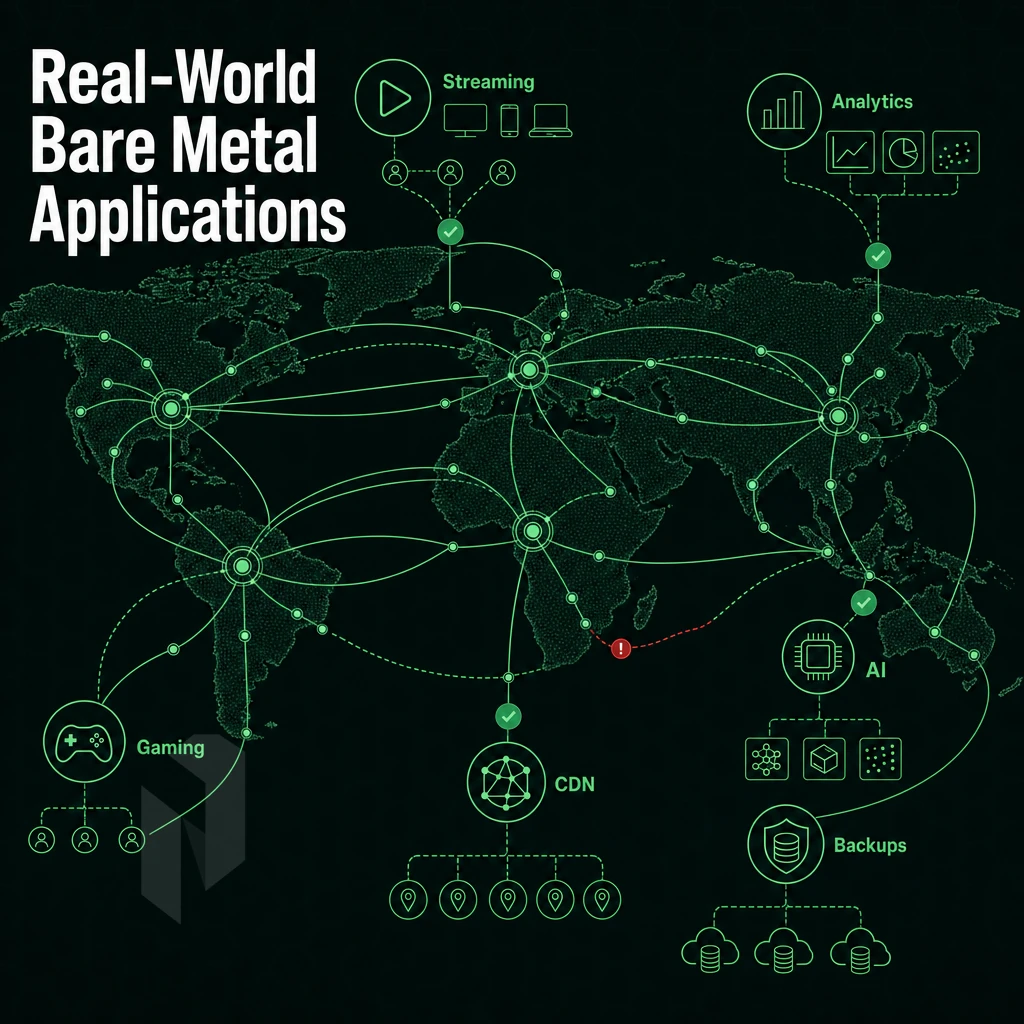
Bare metal dedicated servers suit a wide variety of demanding workloads that share one trait: they require raw, unshared resources that cloud computing cannot guarantee at scale.
Performance-Critical and Big Data-Intensive Workloads
High performance computing (HPC) workloads (scientific simulations, financial modeling, large 3D rendering etc) need fixed CPU and memory throughput. Shared cloud environments cause random latency spikes which then can cause corruption for timing critical work. On bare metal the NUMA topology is fully exposed and memory bandwidth is not shared with other systems.
Dedicated servers with direct hardware access ensure that HPC applications can leverage full processor cache hierarchies and memory controllers without interference from virtualization layers. Each metal server deployed for HPC eliminates virtualization overhead entirely, allowing compute-intensive applications to access raw silicon without abstraction layers that introduce unpredictable jitter.
For both inference and training of machine learning models, dedicated VRAM on GPU servers leads to consistent throughput for inference pipelines.
Big data workloads, such as Hadoop, Spark, and Kafka, are I/O bound and memory intensive. They are best run on bare metal with NVMe arrays and high core count CPUs to process large amounts of data without the latency penalty of virtual storage.
Direct-attached NVMe storage eliminates the network hop inherent in SAN architectures, delivering sub-millisecond latency for distributed file systems that underpin analytics clusters. Organizations migrating from traditional SAN environments to bare metal cloud architectures often see 3-5x improvements in query performance for data warehouse operations that depend on sustained sequential read throughput.
Network-Dependent Business Applications
A gaming server requires online connectivity with a round-trip time of less than 20ms and a dedicated CPU thread per game instance, neither can be guaranteed on a shared node.
Without limits to your bandwidth on your dedicated server, there’s no chance of your stream being throttled in mid-transfer.
Bare metal servers with BYOIP support and BGP routing are the only option for VPN infrastructure operators requiring static IP blocks, full BGP control, and high packet-per-second performance, needs that cloud infrastructure's routing abstraction layers cannot meet.
All Our Servers Support Containerised and Hybrid Workloads
Kubernetes clusters on bare metal servers outperform virtualized environments for latency-critical microservices.
Bare metal nodes for disaster recovery or hybrid environments mean you can run dedicated nodes on guaranteed minimum resources. Ideal for building out a bare metal DR target with dedicated network resources that provide exactly the kind of performance your production systems run on and then fail over to, rather than some best effort shared environment. Organizations migrating from virtualized infrastructure to bare metal cloud can replicate their production topology exactly, ensuring failover testing accurately reflects real-world performance characteristics.
As with any feature, knowing when to use it is half the battle.
Bare Metal Servers Provider Comparison: How the Market Stacks Up
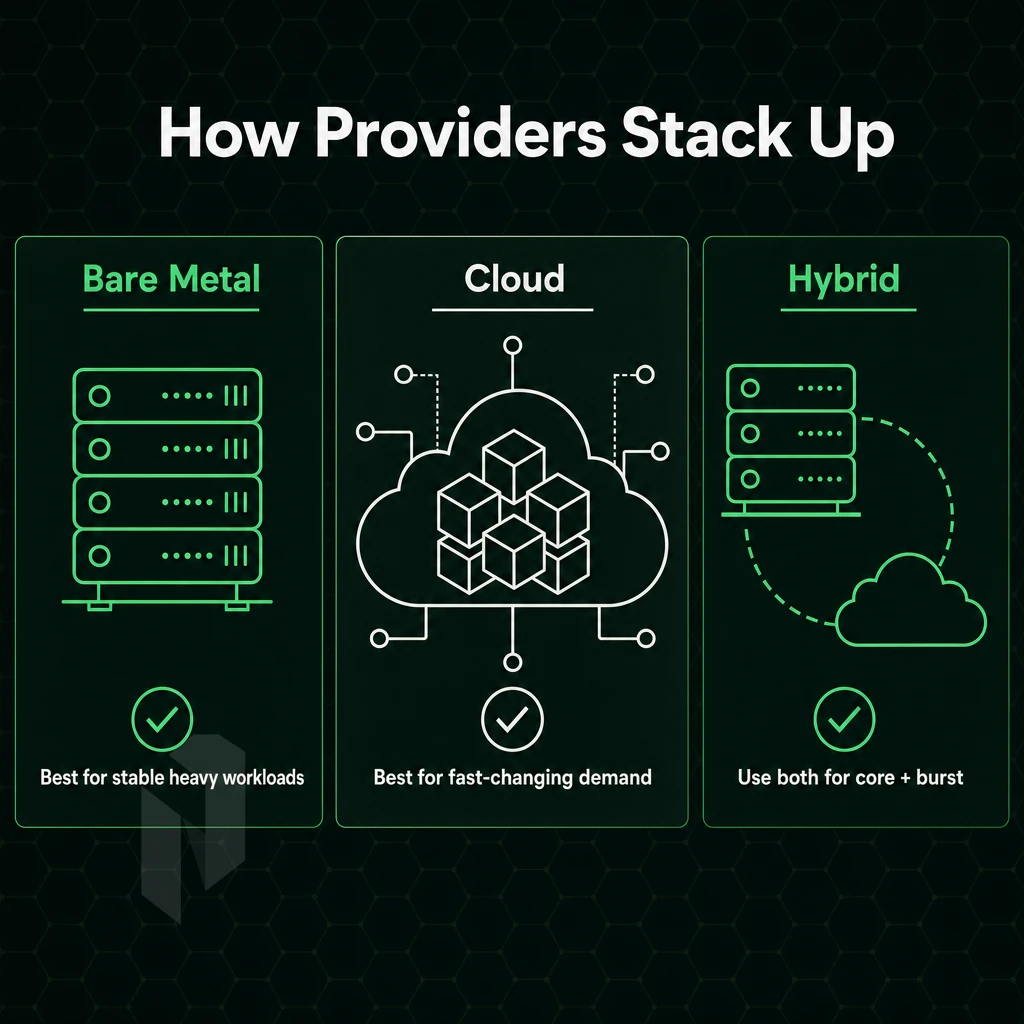
physical server hosts are not all created equal. Each of these types of providers in a hybrid infrastructure has their strengths and weaknesses with regard to the key variables of control, cost, and network quality.
Hyperscaler Cloud Services: Power With a Premium
Bare metal from hyperscalers is part of a wider ecosystem of managed services, databases, and serverless compute. For example, IBM Cloud positions bare metal as a way into its wider cloud services portfolio.
The breadth of service offered by hyperscalers comes at a cost, including egress charges, setup fees and consumption-based charges. In reality, a 24/7 workload on hyperscaler bare metal is likely to cost more in TCO than the same hardware offered by a specialist provider of dedicated servers.
Large Commodity Providers: Scale, Less Flexibility
Hardware generations take a long time to emerge, and private cloud deployments typically require additional licenses and/or managed add-ons.
Rarely included by default in DDoS protection as it’s an upsell. Network pricing varies by region and flexible billing options are typically only available for pre-committed terms.
Specialist Carriers: Where Netrouting Fits
DDoS protection is always enabled across all services.
| Dimension | Hyperscaler | Large Commodity | Specialist / Carrier-Neutral |
|---|---|---|---|
| Hardware control | Limited | Moderate | Full custom configs |
| Network model | Proprietary, metered egress | Shared backbone | Carrier-neutral, Tier 1 peering |
| Pricing transparency | Complex, variable | Moderate | Flat-rate, predictable |
| DDoS included | Rarely | Rarely | Always-on (Netrouting) |
| Provisioning speed | Minutes (virtualised) | Hours to days | Under 60 minutes |
| Global locations | Broad, region-locked | Selective | 10 cities, 3 continents |
What provider tier really means to you is what network is behind that tier and how your end users will really experience it.
Network Quality and Data Center Locations: Why They Matter
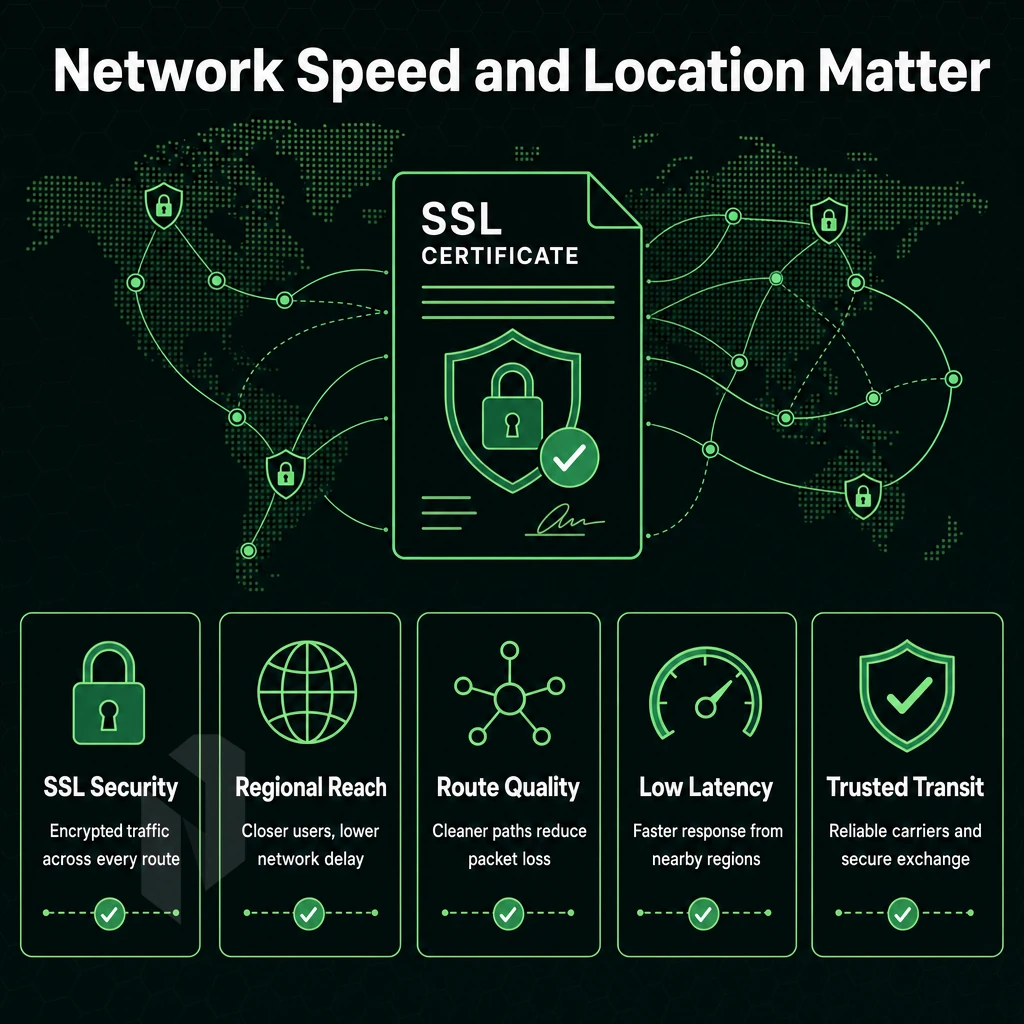
For bare metal hosting companies, the Server specs tell only half the story. The real key to excellent application performance is the quality of the Network.
Carrier-Neutral Architecture and IX Peering
By offering carrier-neutral colocation and bare metal cloud resources across global data centers, we route traffic via the shortest, lowest-latency path rather than a single upstream provider.
Dense IX peering helps to keep the number of hops down and reduces latency, and as a result of this, traffic is kept separate from other users’ traffic, on heavily congested transit paths.
This buffer capacity is being to keep full performance under peak traffic, not only in the lab.
Data Center Coverage Across Three Regions
Global availability requires real geographic distribution. For a genuine multi region cloud services deployment, Netrouting offers dedicated servers available from ten locations around the world: Amsterdam, Rotterdam, The Hague and Frankfurt in Europe, as well as Stockholm and Bucharest. In the Americas Netrouting has locations in Miami and New York, while Asia/Pacific is covered from Hong Kong and Singapore. This allows for very low latency connectivity to DACH, CEE, the Nordics, Latin America and Southeast Asia from a single provider.
This replication spread can also be used for disaster recovery without having to depend on third parties. Replication between dedicated servers in locations like The Hague and Rotterdam and also between locations like Miami and New York is possible via our free private cloud network at up to 40 Gbps.
What to Verify Before Committing
Management access is required to get any value out of high performance bare metal servers. This includes full IPMI access (out of band management) to the servers even when the Operating System has crashed. Also check the uptime SLA (Netrouting offers a 99.9% uptime SLA for cloud computing), peering at IX's and whether private inter-server bandwidth is metered or free.
Before you choose, find out which private cloud providers run their own dedicated servers and backbone infrastructure, are multi-regional, and most importantly clearly state their network specifications. As network fundamentals have been covered for you, we explain why Netrouting's bare metal cloud solutions can fulfill all of your requirements in all of the locations that we serve.
Why Choose Netrouting for Bare Metal Dedicated Servers
Netrouting is purpose-built for teams that need dedicated bare metal servers without the noise of shared infrastructure. We operate 10 global data centers housing dedicated servers across Europe, North America, and Asia-Pacific, each connected via our own AS6206 backbone with 2.4 Tbps+ capacity.
- Fast provisioning. Bare metal dedicated servers go live in under 60 minutes. No queues, no delays.
- Serious bandwidth. Every dedicated server ships with unmetered 10 Gbps. Up to 40 Gbps available for high-throughput workloads.
- Always-on DDoS protection. L3/L4 anti-DDoS protection is included on every service, no add-on required. Advanced L7 mitigation available for mission-critical deployments.
- Enterprise hardware. Latest-gen Dell and Supermicro on Intel Xeon and AMD EPYC. GPU servers available for machine learning and AI workloads.
- Free private network. Connect your dedicated resources across locations at no extra cost, up to 40 Gbps private network between your servers.
- Certified and compliant. ISO 9001, ISO 27001, and SOC 2 certified. 24/7 NOC with a one-hour ticket guarantee backs every service level agreement.
Whether you're running high performance computing, big data pipelines, or latency-sensitive business applications, our bare metal server infrastructure is engineered to perform. Explore our dedicated servers or contact sales to discuss custom configurations. If you're ready to make a final decision, the section below turns everything covered so far into a practical selection framework.
How to Choose the Right Bare Metal Servers Provider for Your Workload
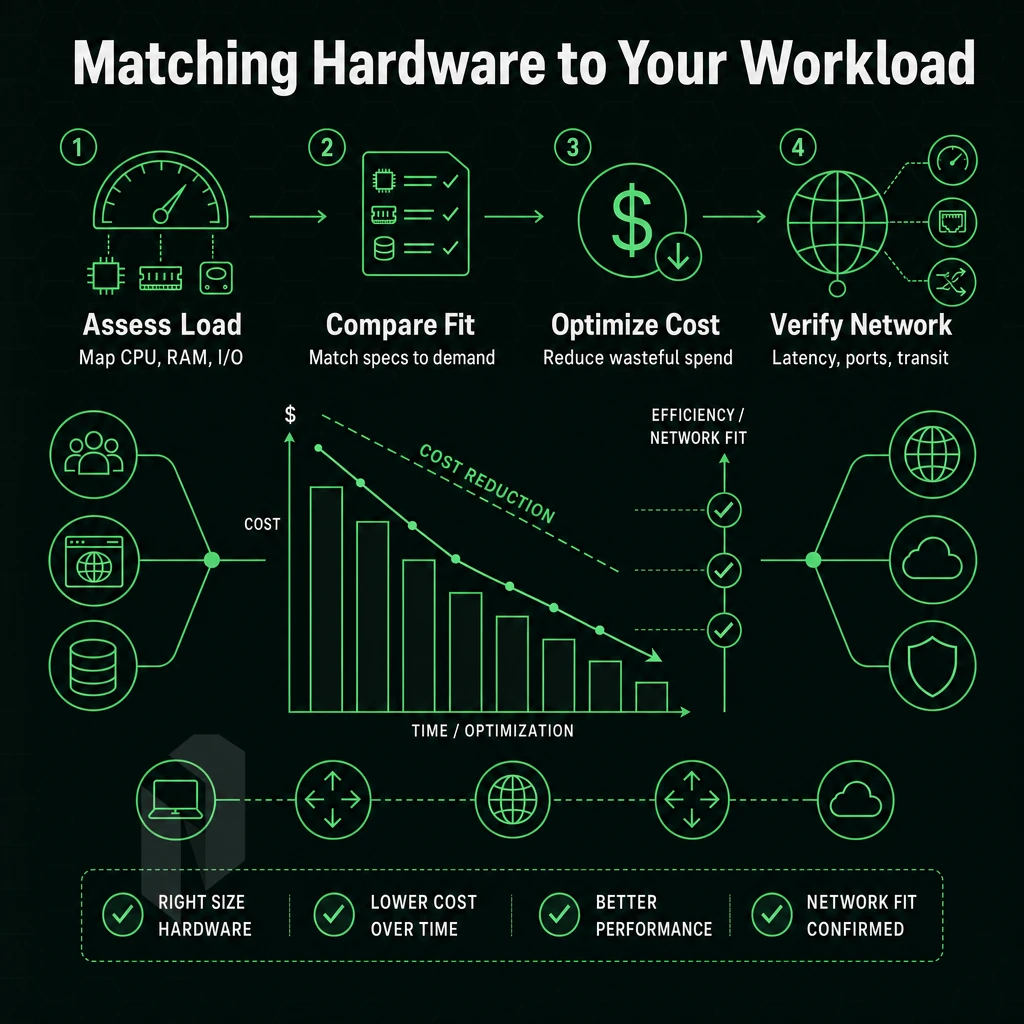
Choosing a bare metal server provider requires more than just comparing specifications.
Match Hardware to Workload Type
Memory-intense workloads (e.g. in-memory databases) are served best by physical servers equipped with large amounts of RAM (up to 2 TB on current platforms).
Storage-intense workflows (e.g. image processing, video rendering) require high NVMe density and hardware RAID. For AI/ML inference workloads GPU computing with dedicated NVIDIA hardware is required, shared cloud storage for GPUs does not cut it.
The rest of your software stack is also decided by these factors. However, a large metal server with predictable and uncontested resources is typically required to run monolithic business applications.
Assess Network and Security Requirements
There are many factors that determine performance, not just CPU. Identifying required latency and mapping it to locations of data centers is required. Dense IX peering reduces number of hops. Unmetered multi-gigabit uplinks for own nodes prevent burst costs. A free private network between own nodes enables required inter-service latency without using public networks.
Gaming, streaming, financial APIs etc. require application-layer scrubbing and most importantly granular access management policies on top of the above L3/L4 mitigation.
Compliance, Management, and TCO
For highly regulated industries, ISO 27001 and SOC 2 certification are important. Data residency requirements will also limit your location options. Do you need unmanaged root access or a fully managed hosted private cloud (with OS patching and monitoring, for example)?
The TCO for dedicated hardware always ends up below that for equivalent workloads in the hyperscalers, particularly for sustained and predictable workloads: no per core licensing, no egress charges.
Quick Selection Checklist
- Define workload type: CPU-bound, memory-bound, storage-heavy, or GPU.
- Set latency targets and map to available locations.
- Confirm unmetered bandwidth and private network availability.
- Verify DDoS protection tier matches your risk profile.
- Verify certifications for ISO 9001, ISO 27001 and SOC 2.
- Confirm data residency region.
- Managed vs Unmanaged: choose based on your development teams' capacity.
Whether you need a dedicated or virtual server, our infrastructure covers all 10 checkpoints in 10 locations worldwide with a 2.4 Tbps+ backbone, always-on DDoS protection, and certifications such as ISO 27001 / SOC 2.
Key Takeaways: Picking the Best Bare Metal Servers Provider
Bare metal dedicated servers deliver what shared cloud environments cannot: exclusive hardware resources, no noisy neighbors, and consistent performance under load. network performance matters as much as raw specs, dense peering, a private network, and always-on DDoS protection should be standard, not upsells. Provisioning speed and a clear service level agreement separate production-ready providers from the rest.
Certifications like ISO 27001 and SOC 2 signal genuine operational maturity. Hyperscaler bare metal carries a significantly higher total cost of ownership than specialist dedicated hardware vendors. For high performance computing, machine learning, or latency-sensitive business applications, the best bare metal deployments combine dedicated hardware, global locations, and a backbone built for scale.
Bare metal delivers what shared and virtualized infrastructure cannot: dedicated hardware, predictable performance, and full control over your environment. For workloads where latency, throughput, or compliance matter, the choice between bare metal and cloud isn't close.
Hardware flexibility determines whether you can scale without migrating.
Netrouting operates hosted private cloud bare metal across ten locations, Stockholm, Amsterdam, Frankfurt, Miami, New York, Hong Kong, and more, on a 2.4 Tbps+ backbone with unmetered 10 Gbps and always-on DDoS protection included. If you're ready to spec a server, explore Netrouting's dedicated server options or contact the sales team for a custom configuration.