
Reviews for Managed Dedicated Server Hosting tell you what the vendor’s spec sheet cannot: Will they answer your call at 2 AM? How long will it take for them to replace a failed hard drive?
Does their advertising of “ unmetered bandwidth ” mean anything when put to the test with high volume traffic. Most reviews of Managed Dedicated Server Hosting are horribly inaccurate because they mistake Managed Shared Hosting with Managed Bare Metal and the two are entirely different for entirely different purposes.
Our Guide to Managed Dedicated Servers cuts through the marketing fluff and helps you understand what really matters: network quality, SLA, support. Additionally, The operational overhead that you can avoid when having your provider handle OS patching, security hardening and monitoring proactively.
Blog contents
We highlight the key criteria for your stress test before signing up with a provider. The questions most people fail to ask and where we position our managed bare metal dedicated hosting plans and server solutions at Netrouting within the market for single servers up to larger multi-site setups in Europe, North America and Asia. Evaluating dedicated server hosting solutions requires understanding how different providers structure their support tiers and whether their infrastructure can accommodate your specific compliance and performance requirements.
What Is Managed Dedicated Hosting for Servers?
Managed dedicated server hosting is the combination of a powerful physical bare metal server with the management of a dedicated server hosting provider. You get to use the servers’ full potential on entirely your own hardware, without any shared usage by others.
The operating of the servers and their environment is then taken care of by your hosting provider’s operations team. Running your own server means you control every aspect of the hardware configuration and resource allocation without competing for CPU cycles or memory with other tenants.
What Managed Dedicated Server Hosting Actually Covers
We manage the dedicated servers for you. This means the usual operational work that consumes lots of engineering time on a dedicated server is done by us: OS patching, security hardening, monitoring, and your control panel management. Our infrastructure also includes automated backups that run daily to ensure your data remains protected and recoverable in case of any unexpected failures.
In practice, managed dedicated hosting typically includes:
- Automated and scheduled OS updates and kernel patches.
- Security hardening, firewall rules, intrusion detection, vulnerability scanning.
- 24/7 proactive monitoring with alerting before issues escalate.
- Gestione del pannello di controllo, ad esempio DirectAdmin o cPanel/WHM.
- Daily backups with off-site retention.
You can still deploy applications, configure services and modify the server environment as required because root access is retained throughout the Managed Dedicated plans. Note that the operational burden of the server(s) is transferred to you, not the control.
Managed vs. Unmanaged Dedicated Server Hosting
Unmanaged dedicated servers are sold as raw hardware plus a network port. All the other important things like patches, security hardening, monitoring and backup/restore are up to you. This model is suited best for very large DevOps teams that already have plenty of experience with Linux.
Managed dedicated servers are for organizations with enterprise-class hardware requirements but without a dedicated sysadmin to run a server under. A good example of such organization would be a SaaS provider using dedicated hosting plans to run a database-intensive application on a dedicated server and requiring high uptime but not having sufficient resources to run a full team of internal ops people. Evaluating the best dedicated hosting options requires comparing not just hardware specifications but also the depth of operational support each provider delivers for database workloads and high-availability requirements.
When evaluating the best dedicated hosting providers, focus on their track record with similar workloads and their ability to scale infrastructure as your application demands grow. Organizations running online stores with high transaction volumes often find that ecommerce hosting on bare metal infrastructure delivers the consistent performance and security their payment processing systems require. Comparing managed dedicated server plans across providers reveals significant differences in how they handle database optimization, backup retention policies, and the level of customization permitted within their management frameworks.
The Hardware Layer: Bare Metal, Exclusively Yours
Dedicated hosting is based on bare metal, meaning all our dedicated hosting servers run without a hypervisor and without any virtualisation tax. All CPU cycles and all RAM is dedicated to one tenant only: you.
Our managed dedicated servers are hosted on high end Dell and Supermicro servers equipped with the latest Intel Xeon and AMD EPYC processors. Our ten data centers around the globe are connected with a 2.4 Tbps+ network. Our 24/7 NOC is ready to support you 24/7/365. We explain you how we divide tasks between you and us for managed and unmanaged server hosting. Each server configuration includes unlimited bandwidth to ensure your applications can handle traffic spikes without throttling or overage charges.
Managed vs Unmanaged Dedicated Server: Key Differences
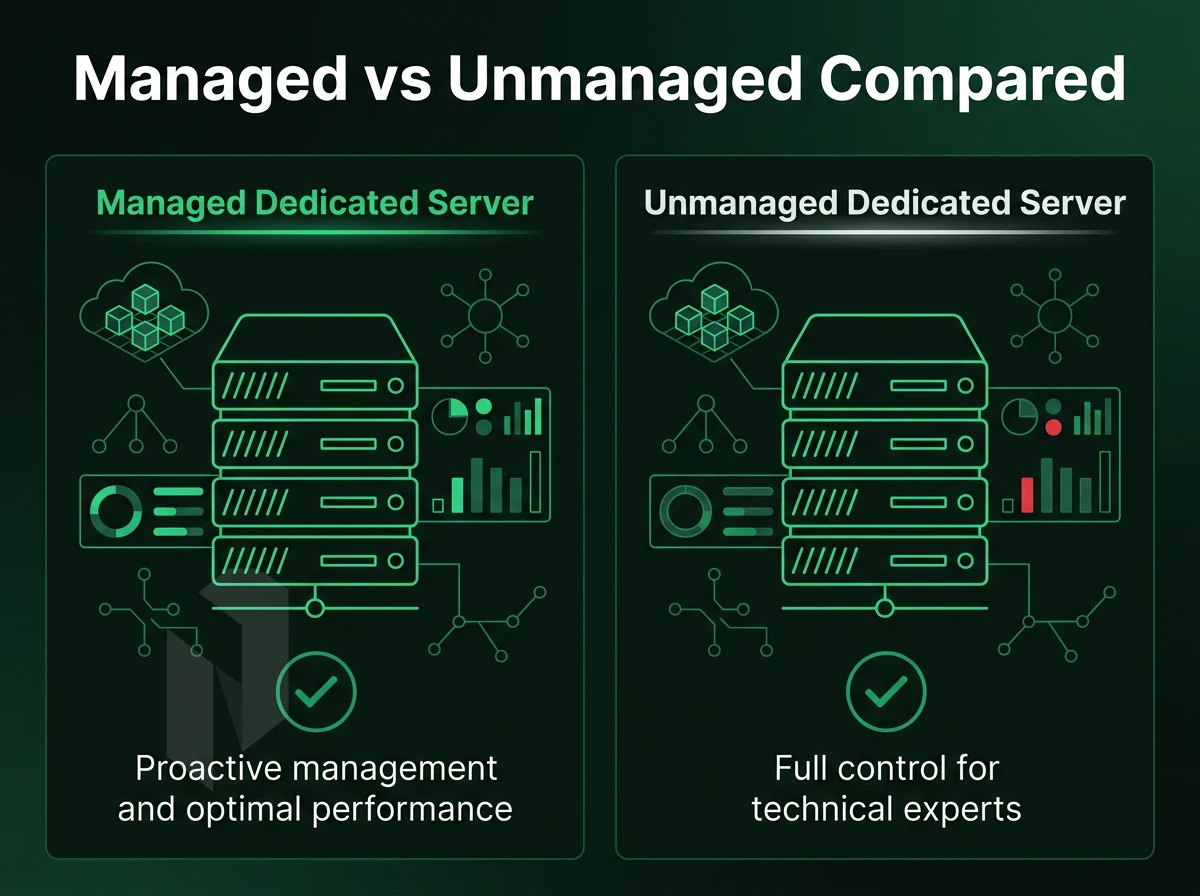
When choosing between managed dedicated servers and unmanaged dedicated servers, the key question is: who is going to handle the operational problems of the server? Both options are offering you dedicated hardware only, but the way both options are handling the problems is totally different. That’s why you need to know about the problems of dedicated server hosting services first.
What Each Model Covers
The hardware and the connection to your network are provided by the server hoster with unmanaged dedicated servers. Everything above that has to be set up by you (OS, security updates, monitoring, incidents etc.). Your company needs in-house sysadmins (with Linux/Windows Server expertise).
Organizations without experienced system administrators often underestimate the complexity of initial server setup, which includes partitioning schemes, firewall rules, and baseline security configurations that require specialized knowledge. Building this level of technical knowledge internally typically requires years of hands-on experience across multiple production environments and failure scenarios.
As opposed to unmanaged hosting, managed hosting is set up and managed by the provider. The OS is updated, security is harden, and plenty of monitoring is done. However, root access is granted to the customer, and they hand off the operations to the host, which is the core of managed services. Effective server administration requires expertise in both operating system maintenance and security protocols, which managed providers deliver through their specialized operations teams.
Side-by-Side Comparison for Complete Control
| Dimension | Unmanaged | Managed |
|---|---|---|
| Server setup | Your team | Provider |
| OS & security patches | Your team | Provider |
| 24/7 monitoring | Your team | Provider NOC |
| Technical support | Self-serve | 1-hour response SLA |
| Uptime SLA | Network only | 99.9% full-stack |
| Staff requirement | Dedicated ops team | Minimal |
Cost and Staffing Trade-offs
The premium that managed dedicated hosting services cost over unmanaged hosting is to cover the cost of your staff. The cost of hiring and retaining good sysadmins is extremely high for most businesses. As a result, It’s often more cost effective to pay a premium to outsource the operation of your servers to a managed hosting provider. Selecting the right hosting provider requires evaluating not only their pricing structure but also their ability to deliver consistent uptime and responsive technical support when critical issues arise.
Businesses seeking reliable dedicated hosting should evaluate providers based on their incident response times, hardware replacement policies, and the technical depth of their support staff. Many providers waive setup fees entirely for managed plans to make the transition from unmanaged infrastructure more attractive to businesses evaluating their total cost of ownership.
Below that are the shared or VPS hosting services, which operate from beneath these two tiers and use the host’s resources. The only other alternative is a dedicated server, which does not have to share any resources with neighboring workloads and thus delivers a consistent supply of CPU power, RAM and network throughput.
Organizations requiring predictable performance for mission-critical applications often migrate from virtualized environments to bare metal servers to eliminate the overhead introduced by hypervisor layers. Choosing dedicated web hosting ensures that your applications receive guaranteed resources without the performance variability inherent in multi-tenant architectures.
Which Model Fits Your Team
Unmanaged servers are typically best suited for very engineering-heavy teams that have their own full ops department and already manage most of their infrastructure. Managed servers on the other hand are best for companies that have no ops department at all or want to move part of their current engineering resources to product development instead of spending it on their current shared/VPS hosting environment that has reached its limits.
Teams that choose managed dedicated servers gain immediate access to enterprise-grade infrastructure without the months-long hiring cycle required to build an internal operations team.
Our Managed Dedicated Hosting solution features Intel Xeon and AMD EPYC servers and is backed by our 24/7 NOC team. We guarantee a response to any ticket within 1 hour. Once you have decided on managed dedicated hosting, it is time to assess your current environment.
Selecting the best dedicated server hosting involves evaluating not only hardware specifications and network infrastructure but also the provider's commitment to proactive monitoring and rapid incident response times. Our team combines technical expertise with helpful customer service to ensure your migration and ongoing operations proceed smoothly without unexpected downtime.
Shared Web Hosting vs Dedicated Server: Why the Upgrade Matters
For most businesses, the first step to hosting a website is to start on a shared web hosting account. It’s easy to use, low-cost and does not require any knowledge of building out infrastructure. However, shared hosting has many hard limits. Knowing what these limits are and what you can expect on outside of them will help you pick the right hosting service for your needs.
Understanding the Shared Hosting Ceiling
-
Recognize the resource contention problem.
On a shared server, dozens or hundreds of tenants compete for the same CPU, RAM, and disk I/O. One noisy neighbor can spike latency for everyone else. This isn't a configuration issue, it's structural.
-
Identify your security exposure.
Shared environments mean a single operating system instance serves multiple customers. A compromised account on the same host can threaten yours. For businesses handling payment data, health records, or regulated workloads, this risk is unacceptable.
Note: Reseller hosting improves account isolation slightly but still runs on shared physical infrastructure. It does not eliminate the underlying risk.
-
Map your compliance requirements.
PCI DSS, HIPAA, and ISO 27001 frameworks all require demonstrable control over your environment. Shared infrastructure makes that audit trail nearly impossible to produce cleanly.
Making the Case for Dedicated Server Web Hosting
-
Claim the hardware outright.
Dedicated hardware means no contention. Every CPU core, every gigabyte of RAM, and every I/O operation belongs to your workload alone. Performance becomes predictable, not subject to what your neighbors are running at 2 a.m.
-
Enforce true isolation.
Your server, your network segment, your firewall rules. Security posture is no longer a shared responsibility with strangers. Incident response is faster because the blast radius is contained to your environment.
-
Scale without architectural rework.
Traffic spikes, database growth, and application complexity all hit a wall on shared tiers. Dedicated infrastructure absorbs that growth without forcing a re-platform.
Why a Managed Dedicated Server Is the Logical Next Step
-
Separate hardware ownership from operational burden.
Most teams that outgrow shared hosting don't have the staff for full server administration. Fully managed hosting closes that gap, you get the isolation and performance of dedicated infrastructure without running the OS, patches, and monitoring yourself.
-
Align support with business hours and risk tolerance.
Netrouting's managed dedicated offering pairs enterprise hardware with 24/7 NOC monitoring and a one-hour ticket response guarantee. The hardware is yours. The operational overhead isn't.
Note: Evaluate managed tiers carefully. "Managed" means different things across providers, confirm exactly what is included before committing to a contract.
What to Look for in the Best Dedicated Hosting Services

While recognizing the need for managed dedicated hosting is half the battle, choosing the right host for your specific needs the other half. Choosing the right host among hundreds of dedicated hosting services requires a solid evaluation criteria. There are huge differences between low-cost dedicated hosting and premium dedicated hosting services.
While low-cost hosts offer cheap hardware and a basic network infrastructure, enterprises require top-of-the-line hardware as well as a robust and failsafe infrastructure. In addition, response times of several hosts differ greatly. This article will help you to find the right host for your needs.
Hardware, Storage, and Compute Capacity
Enterprise platforms are powered by the latest Intel Xeon and AMD EPYC processors, as opposed to outdated consumer grade processors. The memory ceiling is important to note as well, as high traffic databases and virtualization platforms can consume hundreds of GB of RAM. In terms of storage, Enterprise dedicated server platforms offer multiple RAID options (RAID 1, 5, 10) to protect against a single drive failure, without requiring manual intervention from system administrators.
Dedicated Server vs VPS (Virtual Private Server): A VPS is basically a shared server with dedicated physical resources, but with variable performance under load. A Dedicated Server is a full machine, all to yourself, with predictable performance.
Network Quality and DDoS Resilience
When evaluating the bandwidth of an upsream provider, examine the actual upload speed as well as the peering density at Internet Exchanges. Look for providers with Tier 1 peering at major exchanges and multiple upstreams. “Unlimited” bandwidth often contains hidden fair-use caps discovered in the contract’s fine print.
Always-on L3/L4 DDoS protection should be included by default, not a paid add-on. For workloads that are very sensitive to network performance, dedicated IP addresses and BGP support are non-negotiable. BGP allows you to announce your own prefixes and thereby control how your traffic routes across various upstream providers.
Dedicated Server Setup, SLA, and Support Speed
A credible Service Level Agreement (SLA) should specify uptime in terms of a percentage and associated Service Level Remedies. While 99.9% is generally an acceptable service, determine if 24/7 support is offered or not and the guaranteed response time for logged issues. A 1-hour response time with 24/7 NOC is the minimum that should be considered.
Be aware of any setup fees charged by hosts, these can significantly inflate your first-month spend. Reviewers also frequently highlight how fast a host can provision a managed dedicated server, with the best of the managed dedicated server hosting reviews listing time to provision bare-metal servers within 60 minutes or so.
The security options available such as automated backup s, OS hardening and firewalls are also very important for a managed hosting service and should be activated as standard on all managed hosting tiers.
Also the options for control panels like cPanel/WHM or DirectAdmin are important on a dedicated server as they reduce the amount of technical knowledge needed to manage individual websites as well as client accounts. Note that Windows servers incur additional licensing fees, so it’s worth checking which OS options are available before signing up.
Dedicated hosting services are characterized by top-quality servers, responsive support and fair SLAs. We offer current models from Dell and Supermicro as well as 24/7 support from our NOC with a 1h ticket guarantee. Our SLA contains a 99.9% uptime guarantee and we operate ten data centers in Europe, North America and Asia.
Decide who runs the servers.
Hand over the operations, run a dedicated server yourself, or start with a virtual one.
We run it. You ship product.
Choose managed hosting when your team should focus on the application. Agree on what we manage and what stays with you.
Start the conversation with
- Servers
- Number and roles
- Scope
- What we manage
- Access
- What stays with you
Compare configurations, not just rack space.
Start with a dedicated server when provider-owned hardware is the better fit. Compare CPU, memory, storage and network needs.
Start the conversation with
- Compute
- CPU and memory
- Storage
- Capacity and workload
- Network
- Port and traffic needs
Start with a VM. Scale it when needed.
Use cloud compute for workloads that do not need a full machine. Compare vCPU, memory and storage per plan.
Start the conversation with
- Compute
- vCPU and memory
- Storage
- Disk size
- Location
- Preferred region
How to Evaluate Dedicated Server Hosting Providers: A Review Framework
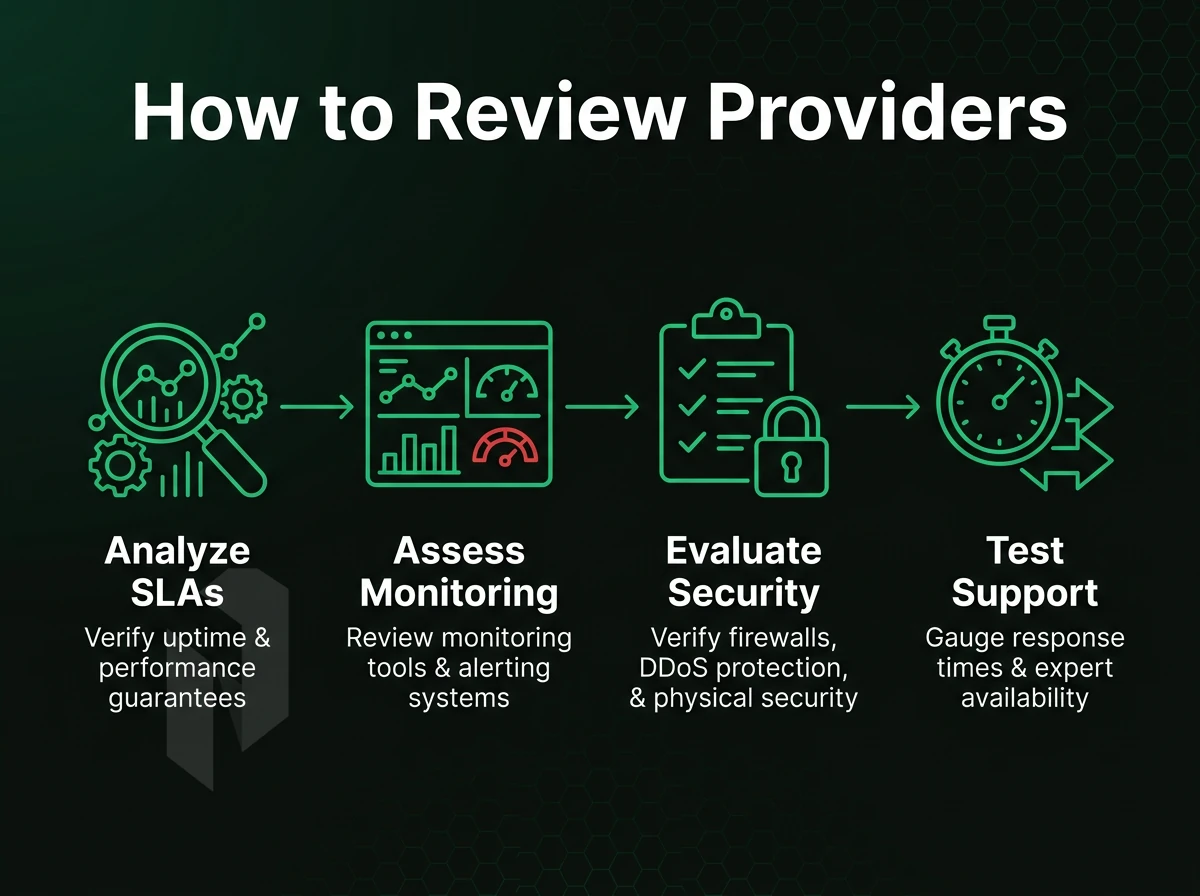
The criteria matter little unless you can verify them. Most reviews of managed dedicated server solutions hide the signal in loads of marketing hype. Check reviews critically and check the provider’s technical documentation to verify the claims made in the review. There’s a world of difference between a good managed hosting provider and one that looks good in comparisons.
Review Criteria That Actually Matter
When evaluating managed dedicated infrastructure, there are 4 key metrics to assess: performance benchmarks, support response time, hardware refresh cycles, and network uptime service level agreements (published SLAs).
- Performance benchmarks: Look for real throughput figures, disk I/O, CPU compute scores, and network latency measurements. Unverified claims mean nothing.
- Support responsiveness: A stated response time is only credible when it appears in the SLA. We publish a 1-hour ticket guarantee and back it contractually.
- Hardware generations: Confirm which CPU platform is in use. Intel Xeon and AMD EPYC generations vary significantly in per-core throughput.
- Network uptime: 99.9% is the minimum acceptable standard. Anything unquantified should be treated as unguaranteed.
How to Assess a Hosting Provider's Network Infrastructure
Check the AS number against public routing registries. A dedicated server provider with their own autonomous system (AS) and IX peering at major Internet Exchanges (IX) is likely to be a technically advanced company and not just reselling a transit provider’s services.
Carrier-neutral colocation is key for enterprise buyers with multiple upstreams that they want to keep independent. We are AS6206 and peer AMS-IX, DE-CIX, NetNod and FL-IX, with a public network capacity of 2.4 Tbps+ and more, all publicly verifiable.
What to Ignore in Managed Hosting Reviews
Don’t believe any claim which is not supported by the web hosting company’s published Service Level Agreement (SLA) or specifications. For example, managed dedicated servers advertised with 'enterprise-grade' hardware will typically fail to reveal the actual model generation, while hollow claims of 'unlimited' bandwidth will fail to name the port speed(s) concerned.
Test a managed hosting offer before you lock yourself into a contract for it. Set up a server, open a support ticket and measure the time it takes for them to respond to it. That one test is worth more than all review aggregators put together.
Cross-check the hosting company’s technical documentation with what other reviewers write about the same offer. Large discrepancies between the two a red flag. Once you have a good framework for comparing hosting providers, it’s also interesting to see how the market looks like when you break it down into tiers.
InMotion Hosting and Other Popular Managed Dedicated Server Plans: What Competitors Offer

Managed dedicated servers are offered by a wide range of providers in the market. Including several providers that cater to the needs of SMBs and offer control panels, as well as large operators that offer bare metal dedicated server hardware for enterprise customers. Knowing what kind of support each tier of providers offers to manage servers for their customers helps choosing the right one for your workloads.
InMotion Hosting and the SMB Tier
InMotion Hosting is a typical managed dedicated server for the SMB market. All plans include cPanel/WHM, backups, 24/7/365 support and more. The hardware is generally dual-socket based and can be equipped with up to 256 GB RAM. InMotion Hosting guarantees an uptime of 99.9%.
For small to medium sized operations running WordPress hosting, reseller accounts and small e-commerce sites, the lowest tier is usually sufficient. While the network infrastructure is typically not carrier-neutral, peering is usually limited and custom setups not typically available. You’ll find bandwidth caps and shared uplinks in this tier.
Best Dedicated Hosting Providers for Enterprise Tier
When it comes to network quality, large Enterprise-grade operators compete with each other. High-end dedicated server deployments include features such as unmetered multi-gigabit uplink connectivity, carrier-neutral locations, BGP and DDoS protection, 24/7. Such functionality is not available from most dedicated hosting providers aimed at end-consumers.
| Dimension | SMB Tier | Enterprise Tier (Netrouting) |
|---|---|---|
| Network | Shared uplinks, limited peering | 2.4 Tbps+ backbone, AS6206, dense IX peering |
| Uptime SLA | 99.9% | 99.9% standard |
| DDoS protection | Add-on or basic | Always-on L3/L4, 1 Tbps+ mitigation |
| Provisioning | Hours to days | Under 60 minutes |
| Locations | 1-3 data centers | 10 cities across EU, NA, APAC |
Choosing the Right Hosting Service
The SMB tier is suitable for a managed control-panel for standard web workloads, providing reliable dedicated hosting for the price. However, for high-volume, latency-critical and multi-region deployments, this tier very quickly runs out of headroom.
When it comes to a more powerful server, you are better off opting for Netrouting’s dedicated server offers. These have been tuned for maximum performance with custom hardware and 10 Gbps uplinks, which remain unmetered. By comparing the features of the different tiers you will also get a better idea for when it is time to switch from hosted to fully managed dedicated servers and for which services you may need additional management in order to be properly operated.
Running Your Own Dedicated Server: When Full Management Makes Sense
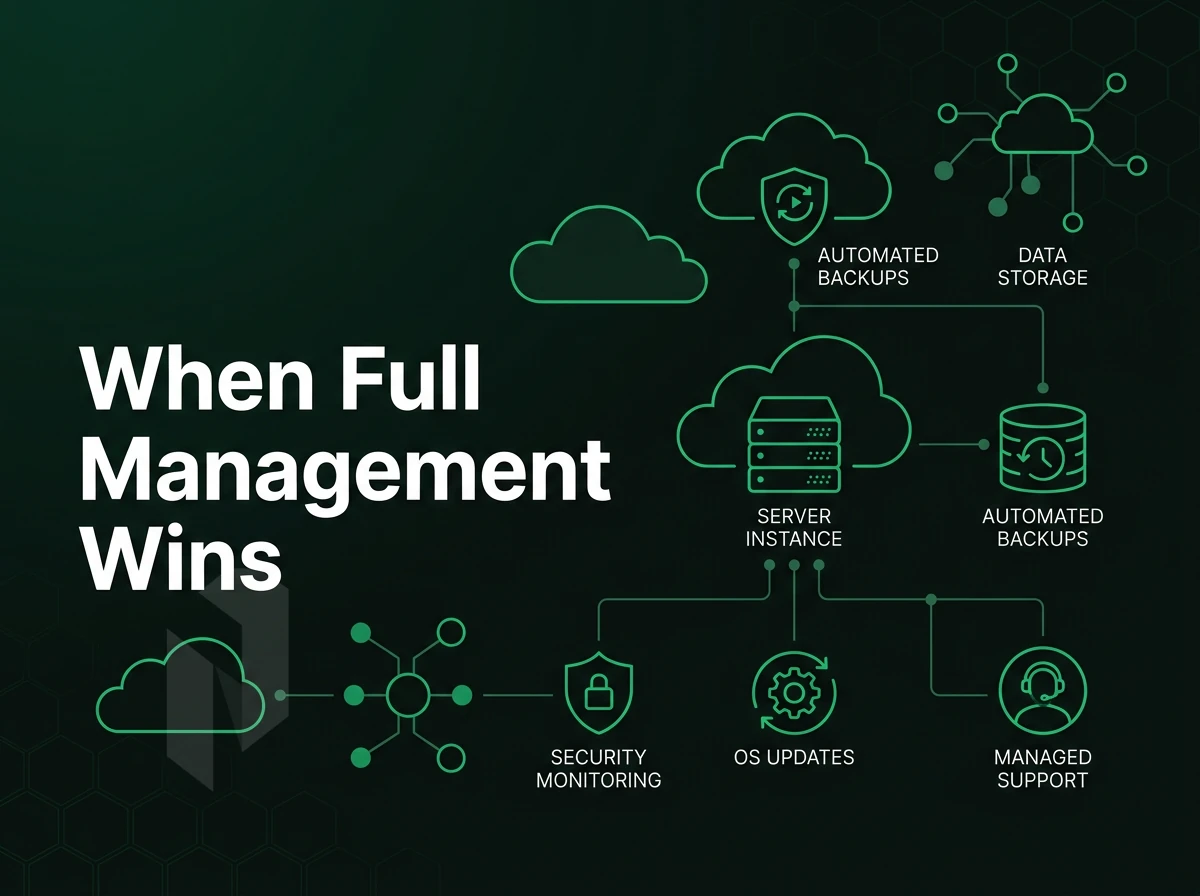
Most teams today who run their own servers want to have full root access to their server or even want to run their hosting environment themselves. At the same time they want someone to take care of the operational layer underneath. This is where managed services can add value without taking away control.
Own Server: Knowing When to Add Management
Managed dedicated servers come down to one question: where do you want your engineers to spend their time? With managed dedicated servers, your engineers aren’t spending their time patching kernels and troubleshooting issues at 2am.
- Identify your operational gaps. Document what you are currently managing with your team (OS updates, security config, server monitoring, hardware upgrades). All of these items create risk. Managed hosting covers all of these gaps without affecting your application.
- You still have root access. We manage the OS but you manage everything above that as you would with self-hosted servers.
- Dive into our Service Tiers, and we’ll match you with the perfect package for your infrastructure stack. A collection of running VMs and containers? Our Managed Proxmox VE offering runs cluster, patch, and backup configurations on your hardware of choice. Client accounts? We provide fully-managed control-panel servers, running cPanel/WHM or DirectAdmin (fully-licensed, of course) so you never have to run a control-panel for your client sites.
Best Dedicated Server Hosting Services: Provisioning and SLA
Deployment speed is important. Netrouting deploys bare metal servers within 60 minutes. We also guarantee 99.9% uptime and same business day hardware replacement for all managed deployments.
- Request your desired server configuration and we will get the server up and running with your choice of OS, RAID and network settings etc. All of this is done on our online order system and is done at the time of provisioning so there is no waiting for a manual build to come to the front of a queue.
- Check your SLA and state the hardware replacement terms and the schedule for the backups (daily increments, weekly fulls kept for 30 days as standard).
Note: The physical server's computing resources are dedicated entirely to your workload. No noisy neighbours, no shared contention, but that also means capacity planning is your responsibility. Size correctly from the start.
Why Choose Netrouting for Managed Dedicated Server Hosting
Netrouting is built for teams that have outgrown consumer-focused managed hosting providers and need enterprise-grade dedicated server hosting with real infrastructure behind it. Our managed dedicated servers run on Dell and Supermicro hardware, Intel Xeon and AMD EPYC platforms, provisioned in under 60 minutes. We handle OS patching, security hardening, and proactive monitoring while you retain full root access. That's not a compromise; it's the point.
- Managed hosting that doesn't limit you. Choose managed dedicated servers with cPanel/WHM, DirectAdmin, or managed Proxmox VE. We operate the hypervisor and control panel layers, you run your workloads with complete control.
- Always-on DDoS protection. Every dedicated server hosting plan includes L3/L4 DDoS protection at no extra cost. Advanced L7 mitigation is available for high-risk deployments.
- 2.4 Tbps+ network on AS6206. Dense IX peering across Amsterdam, Frankfurt, Miami, New York, Hong Kong, and Singapore. Tier 1 upstreams. Unmetered 10 Gbps standard on dedicated hardware.
- 24/7 NOC with a 1-hour ticket guarantee. Our support team monitors your server environment around the clock, not just during business hours.
- ISO 9001, ISO 27001, and SOC 2 certified. Compliance-ready managed dedicated infrastructure across 10 locations in Europe, North America, and Asia-Pacific.
If you're evaluating fully managed dedicated hosting options and want a hosting provider built on bare metal servers rather than oversold shared infrastructure. Explore our managed hosting plans or contact our sales team to discuss your requirements.
The Core Criteria for Choosing a Managed Dedicated Server
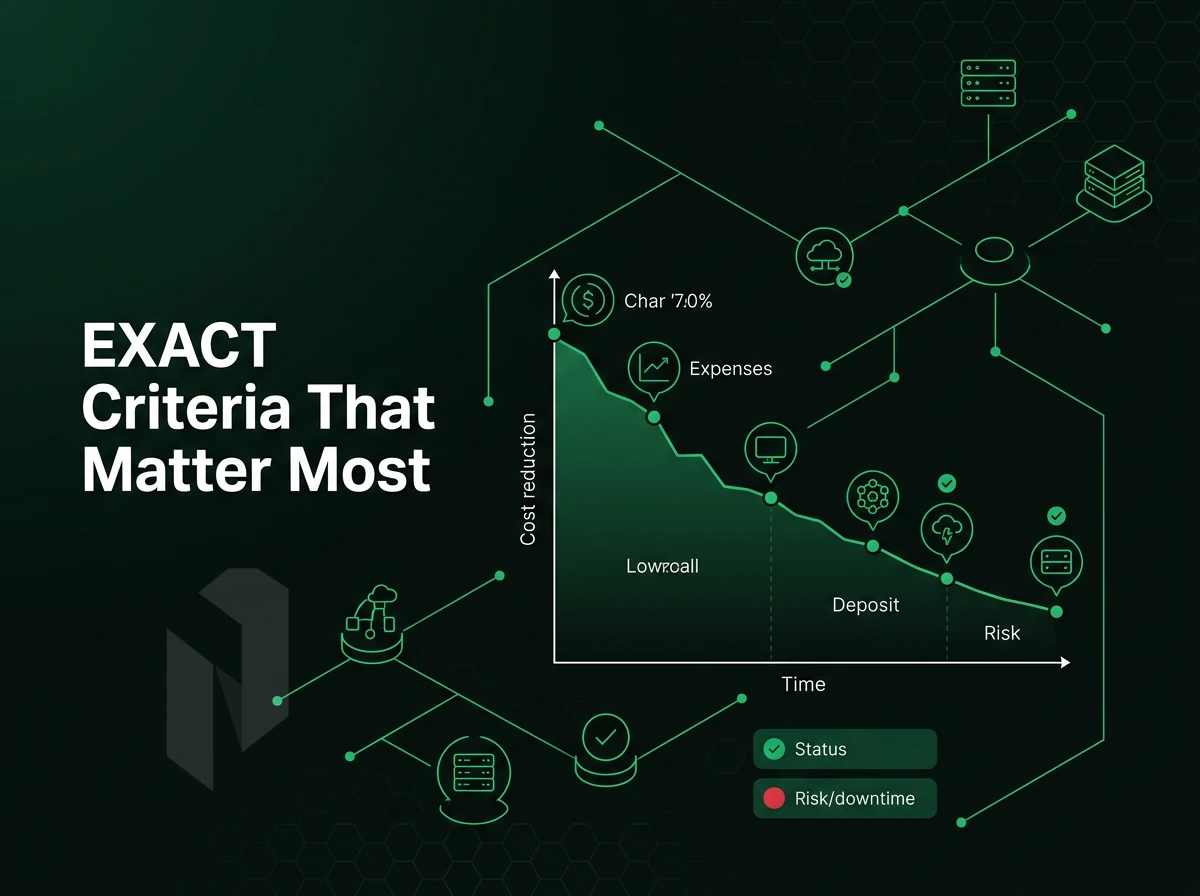
Each managed bare-metal server hosting review worth reading to look at looks at 8 key variables: the hardware generation in question, the network provided. The DDoS protection in place, the SLA and server uptime guarantee, the support model in place, the security offered, the control panel provided and the provisioning time. You don’t want to host mission-critical applications on a provider that only scores half of these well.
Dedicated hosting services should be weighed against the actual needs of your workloads. For very high traffic sites, for example, you will need to dig deep into a hosting company’s network and look for DDoS protection that is left on 24/7.
For a compliance-driven hosting solution, you will care most about the host’s security features and the ability to provide auditability for all actions on your server. Look for managed dedicated hosting from a dedicated server hosting company that can back up performance claims across all of the above criteria, and not just marketing bluster. Managed dedicated servers perform better than shared or VPS hosting for real workloads.
Key Advantages of Managed Dedicated Infrastructure Over Shared and VPS Hosting
Managed dedicated infrastructure provides the single-tenant server environment, dedicated IP address and complete control of the hardware that Managed Shared Web Hosting and Managed VPS Hosting cannot provide. With a dedicated hosting plan on bare metal servers you can set up the operating system and install all the software you require. On top of that, you can implement whatever security measures are required to ensure complete isolation of your applications on a dedicated server, running on dedicated hardware that you lease exclusively.
Our managed services offer the same flexibility as our un-managed hosting services, but we take care of the day to day management of your servers. This allows your system administrators to go back to adding value to your organization instead of being bogged down with dedicated server day to day operations such as patching, backups and more.
Root access is still granted to your administrators. DDoS protection is included. If performance, security and a reliable hosting environment are key to your organization’s operations then managed dedicated hosting is your best choice. The following are typical questions that organizations have regarding our managed dedicated hosting services.
Frequently Asked Questions
How do managed dedicated servers differ from unmanaged dedicated server hosting?
With unmanaged hosting, you get the hardware and a network connection, OS installation, patching, security hardening, and monitoring are entirely your responsibility. managed server hosting means the provider handles those operational layers on your behalf. You focus on your application; they keep the underlying server secure, updated, and running. The hardware is dedicated to you in both cases, the difference is who operates it.
Do managed dedicated servers still allow me to keep root access?
Yes. managed server hosting does not mean the provider locks you out. You retain full root access to install software, configure services, and manage your environment exactly as you would on an unmanaged server. The provider's management layer sits alongside your access, not in place of it.
What do providers handle day-to-day with managed dedicated servers?
Day-to-day management typically covers OS patching, security hardening, proactive monitoring, and alerting on hardware or service anomalies. Providers also handle control panel updates, firewall rule maintenance, and initial incident response. At Netrouting, managed services extend across bare metal, dedicated server, cloud, and colocation environments, including fully managed Proxmox VE clusters and managed cPanel/DirectAdmin servers where the provider owns the entire stack below your sites. Remote hands for physical tasks are included at no extra cost.
Are managed dedicated servers worth the extra cost compared to VPS hosting?
For most production workloads, yes. A dedicated server gives you guaranteed CPU, RAM, and storage, no noisy-neighbour contention that VPS environments inherit by design. Add managed operations and you eliminate the staffing cost of a sysadmin handling routine maintenance. The total cost of ownership is often lower than it appears once you factor in the engineering hours a VPS still demands.
What security features should a top dedicated server hosting service provide?
Expect always-on DDoS protection at minimum, L3/L4 mitigation should be included on every service without extra configuration. Beyond that, look for OS-level security hardening, proactive vulnerability patching, and firewall management as part of the managed layer. Advanced providers offer application-layer (L7) mitigation and custom scrubbing policies for high-risk workloads. Certifications like ISO 27001 and SOC 2 signal that security controls are independently audited, not just claimed.
How fast should a managed dedicated server be provisioned?
Best-in-class providers deploy bare metal in under 60 minutes for in-stock configurations. Anything beyond a few hours for a standard server suggests manual provisioning bottlenecks you will encounter again during incidents. Custom configurations, non-standard RAM, additional drives, and specific RAID layouts are all part of dedicated server management that reasonably takes longer, but your provider should give a firm timeline upfront, not an open-ended estimate.
What certifications should a dedicated server hosting provider hold?
ISO 27001 is the baseline for information security management, it means controls are documented, tested, and independently audited. ISO 9001 covers quality management processes, relevant when you need consistent service delivery. SOC 2 certification matters most if you handle customer data on a dedicated server where server management is subject to compliance requirements, as it independently verifies security, availability, and confidentiality controls. Netrouting holds ISO 9001, ISO 27001, and SOC 2, with SOC 2 compliance in place since 2016.
When choosing dedicated server management services, there are three key factors to consider: the quality of the management layer provided, the power of the underlying network, and the clarity of a provider’s SLA. A fast dedicated server on a congested or poorly connected network is of little use, and obscure phrasing in server management contracts around hardware replacement or response times for support queries can often cost more than the quoted monthly charge.
This review framework can be used to cut through the marketing blurbs of individual cloud providers. Use this to compare providers on network, support, and real hardware configurations listed, not just a list of feature announcements.
Netrouting offers managed dedicated servers across ten locations in Europe, North America, and Asia, backed by a 2.4 Tbps+ network, a 1-hour ticket guarantee, and always-on DDoS protection. Explore the configurations or contact the sales team to spec a deployment for your workload.
Hand over the day-to-day.
Tell us what runs on the servers and what your team keeps. We propose the managed scope.