Locking your company into latency, redundancy, and even operational expenditure for years to come, choosing the wrong colocation data centers can prove to be a real headache for future IT generations.
In this guide we set out the key factors to consider when shopping for a colocation provider. Additionally, Set them out in the clear, structured order in which IT decision-makers would reckon them when deliberating over a contract.
Netrouting is a carrier-neutral hosting company providing colocation services from data centers in Europe, North America and Asia-Pacific since 2007. We operate our own AS6206 Internet backbone with 2.4 Tbps+ of network capacity. The extensive knowledge we gained from operating such a large and distributed infrastructure is reflected in this guide.
Blog contents
To judge a data center colocation facility as good or bad, we examine several key factors, including the physical infrastructure (space and power), the network (quality and peering), and proximity to major cloud providers.
Finally, we outline the various questions you can pose to evaluate data centers and their operations in advance, helping you to create a scorecard and narrow down your options based on more than marketing blather.
What Are Colocation Companies and Data Centers?
When we speak of colocation, you own the servers (the hardware) and the facility owns the rest (physical space, power, cooling, connectivity, etc). Data center colocation allows you to put your hardware into an enterprise class physical space without having to build and maintain your own facility. For community perspectives, see Leading Colocation Data Center Companies.
How Colocation Data Centers Work
Your servers will be housed in shared or private colocation spaces, and you'll be responsible for racking them out.
In stark contrast to cloud computing, where you own nothing but rent capacity, with data center colocation you own the hardware and have complete control over it, costs are always predictable and never spike due to traffic surges.
Colocation Data Centers vs. Private or Cloud Infrastructure
A private data center demands large upfront investment plus ongoing facilities expenses on top of typical single-tenant overhead.
Data center colocation is somewhere in between.
- Own hardware: full control over specs and configuration.
- Shared facility: N+1 power, cooling, and physical security.
- Carrier-neutral data center space: choose your upstreams.
Who Are the Top Colocation Data Centers Providers?
Major global operators operate colocation facilities in dozens of cities all over the world. One of them is NTT Global Data Centers. Also carrier-neutral providers have the advantage of better connection options compared to single-carrier data centers. These operators typically maintain a broad portfolio of facilities with varying specifications, allowing customers to match their technical requirements to the most appropriate location. Carrier-neutral facilities enable direct connections to multiple network providers, giving customers the flexibility to optimize routing and redundancy without vendor lock-in.
Enterprises with distributed workforces and international customer bases rely on these providers to support their global operations through strategically positioned facilities. Leading colocation facilities also provide robust interconnection services that enable low-latency, high-bandwidth connections between customer equipment and cloud platforms or partner networks. Enterprises with distributed workforces and international customer bases rely on these providers to support their global operations through strategically positioned facilities across multiple regions.
Our 10 data centers are spread across the globe in locations such as Stockholm, Amsterdam, Rotterdam, The Hague, Frankfurt, Bucharest, Miami, New York, Hong Kong and Singapore. All of our locations offer N+1 power and cooling, 24/7 DDoS protection and unmetered 10 Gbps uplinks. We offer colocation services starting from a single 1U rack and scaling up to private suites and custom designed environments. We would like to explain how we run our data centers.
How Colocation Data Centers Work
Colocation is when you place your servers and networking equipment in a data center.
Retail vs. Wholesale Colocation Services
Retail colocation is sold in Rack Units or by Cage size and suits most businesses.
| Model | Footprint | Best For |
|---|---|---|
| Retail colo | 1U to full cabinet | SMB to mid-market |
| Cage / suite | Multiple cabinets | Compliance-sensitive workloads |
| Wholesale | Half-floor+ | Carriers, hyperscalers |
Remote Hands and Colocation Facilities
Our remote hands services, available across wholesale data centers and standard colocation facilities, enable physical work, reboots, cable changes, disk swaps, without an engineer traveling on-site.
What Should I Look for in the Best Colocation Data Centers?
N+1 or better power and cooling, proper fire suppression, biometric access control, and dense carrier-neutral networking hardware are all key criteria to prioritize. We verify that proper controls are in place with independent audits of the security and operational controls via certifications such as ISO 27001 and SOC 2. Modern colocation facilities increasingly provision specialized infrastructure optimized for ai workloads, including high-density GPU clusters and low-latency interconnects between compute nodes. Enterprises deploying mission critical applications require infrastructure that guarantees consistent uptime through redundant power paths, diverse network connectivity, and real-time monitoring capabilities.
Colocation facilities supporting mission critical infrastructure must demonstrate proven track records of maintaining five-nines availability through comprehensive redundancy and proactive maintenance protocols. Enterprises deploying mission critical applications require infrastructure that guarantees consistent uptime and operational reliability through redundant power paths, diverse network connectivity, and real-time monitoring capabilities. Rigorous testing protocols and continuous infrastructure monitoring ensure operational stability across all critical systems, from power distribution to environmental controls.
We review Netrouting's colocation offering at the DFDC THG1 facility in The Hague.
Key Criteria for Choosing the Best Colocation Data Center
| Provider Type | Performance | Support | Uptime SLA | Network | Best For |
|---|---|---|---|---|---|
| Netrouting | N+1 power and cooling; advanced cooling systems; high-density up to 20 kW per footprint; hardware RAID and storage systems on bare metal | 24/7 NOC; 1-hour ticket guarantee; courtesy remote hands; managed colocation services available | 99.9% SLA | AS6206 backbone; 2.4 Tbps+ capacity; AMS-IX, DE-CIX, FL-IX peering; unmetered 10 Gbps | Carrier-neutral colo with dense IX peering across Europe, North America, and Asia |
| Hyperscaler-adjacent colo | High-density power; advanced cooling systems; fire suppression systems to Tier III/IV standard | Enterprise NOC; tiered SLA packages; remote hands at cost | 99.999% (Tier IV claims) | Dense carrier ecosystem; cross-connects to major clouds; limited third party data center neutrality | Enterprises needing direct cloud on-ramps in a single data center campus |
| Regional carrier-neutral colo | Standard power densities; basic fire suppression systems; limited storage systems options | Business-hours support; managed colocation services vary by site | 99.9% | Local IX access; fewer upstream options; relies on third party data center agreements for redundancy | SMBs needing local presence in a single data center market |
For customers requiring a carrier-neutral environment with robust network connectivity (cooling, fire suppression, managed services, storage for high-density servers) across multiple locations instead of a single facility, Netrouting is the obvious choice. AS6206, 10+ locations, 99.9% SLA. Latency-sensitive and third-party datacenter-dependent projects benefit from dense IX peering and free private interconnects.
After rating potential colocation providers, the question remains whether or not to colocate in the first place, or to build your own facility. When evaluating colo providers, examine their network architecture, peering relationships, and ability to deliver consistent performance across their entire footprint.
Colocation vs. Building Your Own Data Centers
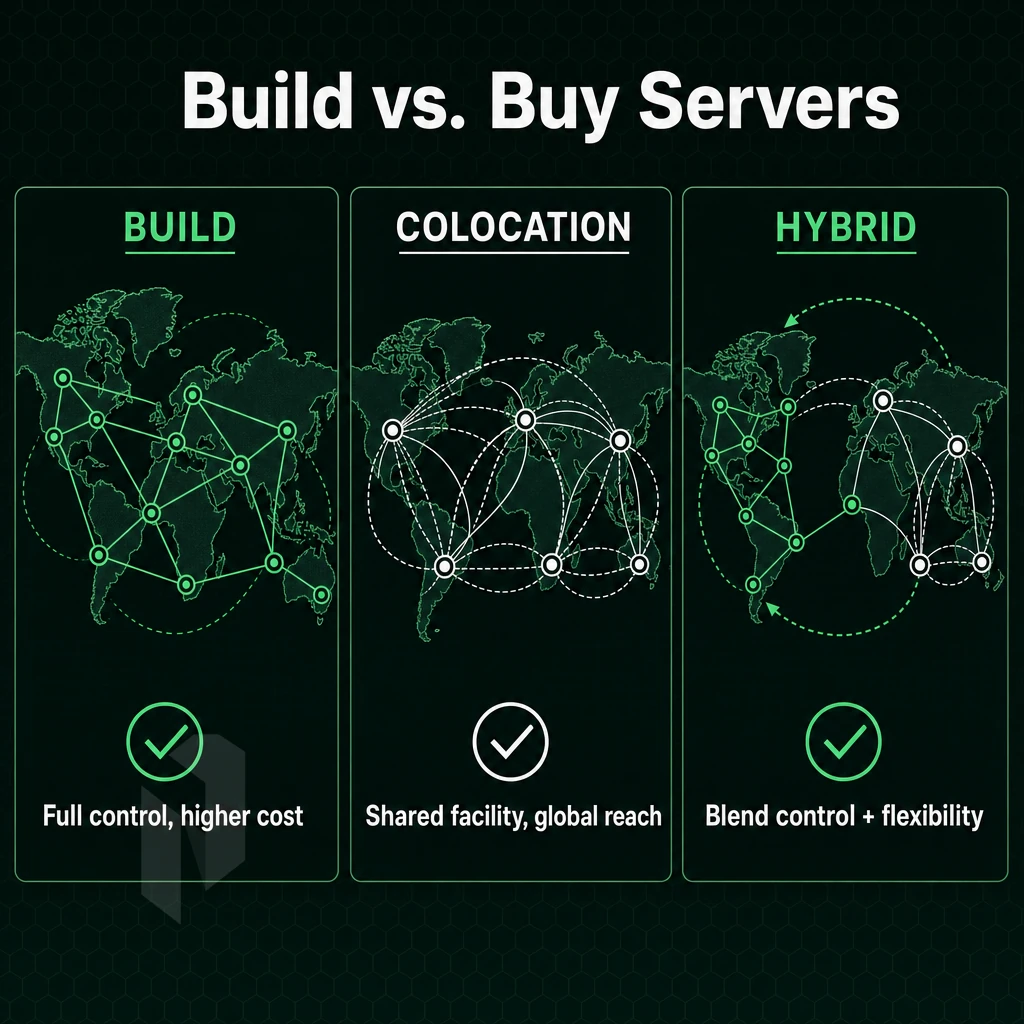
The dream of building your own data center may seem affordable at first. However, the initial investment, ongoing personnel costs, and the corresponding time frame only make running data centers feasible for very large environments with strict compliance requirements. A colocation center provides the physical infrastructure that data centers require, power, cooling, and safe harbors, as an operational expense, eliminating any construction risk.
Organizations operating critical infrastructure often choose colocation to meet stringent uptime and security requirements without the burden of facility ownership. For most organizations, the data center business model of colocation delivers enterprise-grade infrastructure without the capital intensity of facility ownership.
CapEx vs. OpEx: Where the Decision Really Lives
A private data center requires a multi-million-dollar investment in a facility for land, a building, power, cooling, and redundant networks. Once you’ve spent that money, colocation converts it into very predictable monthly expenses. That can make a huge difference for most companies. Enabling them to shift from a capital expenditure model to an operational expenditure model through colocation data centers solutions, thereby improving their cash flow and enabling them to get up and running in days as opposed to years.
Operating at scale requires 24/7 NOC support, physical security, and enterprise level engineers on call 24/7. Colocation providers absorb these costs, so you never have to hire enterprise level staffing. Experienced colocation providers bring specialized expertise in data center operations that would take years for an internal team to develop independently.
Scalability, Risk, and Business Continuity
In contrast, colocation scales quickly. Add a rack, fill an additional cabinet, or even move to a second city, all without building out new space. An own data center, on the other hand, grows in large steps and at expensive costs.
For disaster recovery, the geographic distribution of colocation facilities is a structural advantage over self-built sites. While replicating across different carrier-neutral data centers in cities all over the globe is easy, replicating across two self-built sites is a completely different business, and typically only justifiable at hyperscaler volumes.
A hybrid cloud architecture serves two purposes. It enables companies to collocate mission critical equipment in order to benefit from lower latencies and better control. Additionally, it enables bursting of variable work loads on cloud compute services. Data center operators that support BGP, cross connects and large IXs make hybrid cloud architectures very easy to use.
Netrouting has carrier neutral locations in 10 cities around the world. This includes data centers in Europe such as Amsterdam and Frankfurt, as well as locations in North America (Miami, New York) and Asia (Hong Kong, Singapore), to name a few.
What Certifications Should Colocation Data Centers Have?
Certifications indicate the maturity of a company’s operations and also prove that they have been audited. A serious provider must have at least these certifications:
- ISO 27001, information security management. Describes physical and social controls for protecting information, the management of incidents, and associated risk management.
- ,.
- SOC 2 Type II, an independent audit of security, availability and confidentiality controls over a period of time and not a single point in time audit.
Their facilities are audited for ISO 9001, ISO 27001, and SOC 2 compliance.
Colocation vs. Cloud: When Each Makes Sense
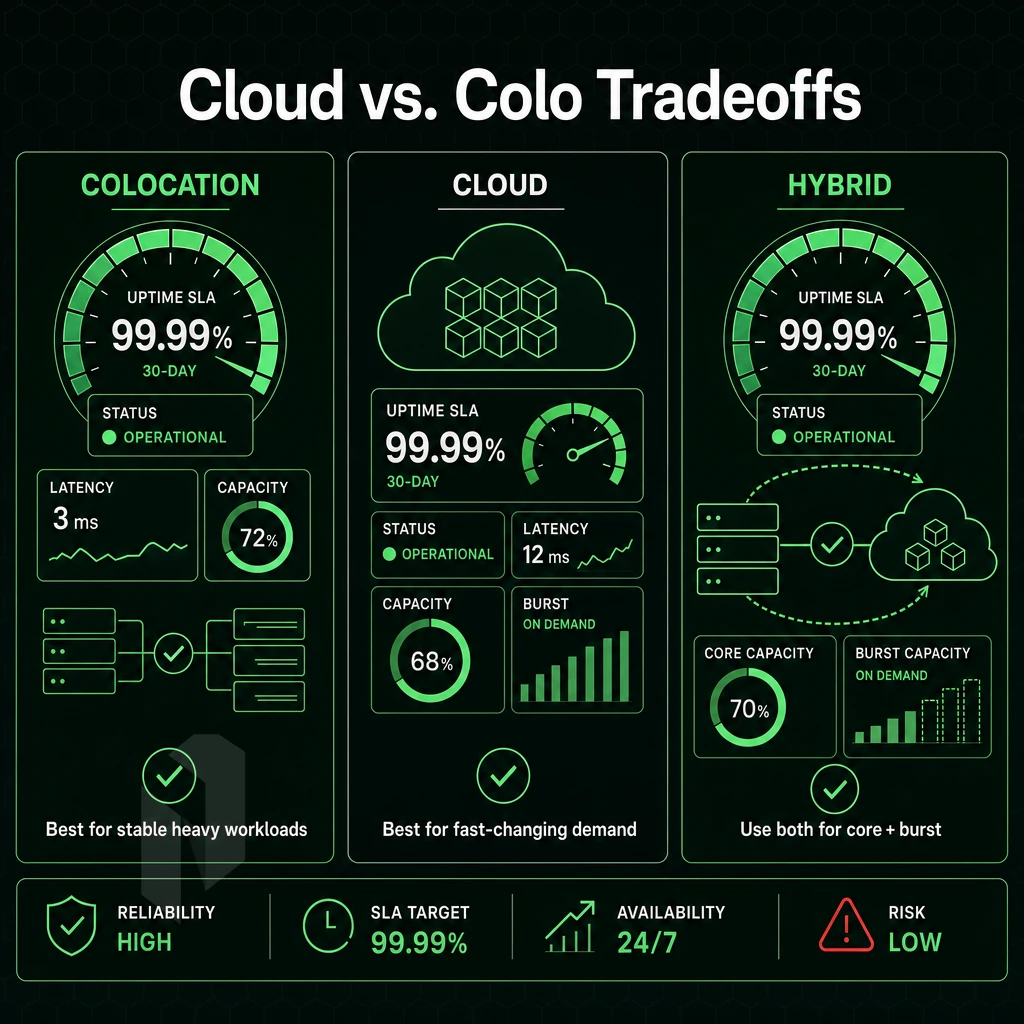
Colocation and cloud are not opposing philosophies. Each has its own strengths, and businesses can use them based on their workloads, data, and long-term cost structure.
Colocation Hosting Services vs. Cloud Computing: The Core Trade-off
Cloud computing delivers elastic, on-demand resources suited to unpredictable traffic spikes or rapid prototyping. At sustained, steady-state scale, however, egress fees and per-hour billing rapidly compound.
Most cloud providers charge by the gigabyte for data egressing from their cloud. For high-throughput workloads like video distribution, AI inference, and financial data feeds, egress costs can exceed the cost of processing the data.
You own the server hardware.
When Colocation Data Centers Win
Many regulated industries with mission critical data, healthcare, financial services, government, require physical control of data center infrastructure to meet audit requirements that shared multi-tenant cloud services cannot.
Colocation also excels for:
- For workloads which require dense GPU clusters and high-memory bare metal servers.
- Mission critical workloads with strict latency SLAs.
- High-throughput compute that costs linearly with cloud bandwidth.
Our data center facilities are designed to support up to 20 kW per footprint making them suitable for high density deployments of AI/Deep Learning infrastructure.
What Are Remote Hands Services in a Colocation Facility?
Our on-site remote hands are the local data center colocation technicians who can perform physical work with your networking equipment, re-booting servers, swapping hard drives, relocating cables, and more.
Hybrid Cloud Architectures: The Practical Middle Ground
For most applications, a combination of both colocation and cloud makes sense. hybrid cloud deployments are now common and run the core of an application in colocation data centers and burst it in the cloud as needed to ensure that it remains scalable, yet predictable and compliant. While neither of these models are mutually exclusive, understanding the different providers across colocation and cloud data centers infrastructure markets is key to ensuring that you select the right solution to run your workload.
Colocation Provider Comparison: What the Market Looks Like
Colocation facilities can vary dramatically. The physical footprint, power density, carrier neutrality, and quality of support offered can differ dramatically between provider archetypes. Reviewing these key differences enables you to create a short list of potential facilities.
Colocation Providers at a Glance
| Provider Type | Typical Footprint | Carrier-Neutral | Power Density | Certifications | Remote Hands | Best For |
|---|---|---|---|---|---|---|
| Hyperscale campus operators | Single data center campus, 100 MW+ | Rarely | Standard (≤10 kW/rack) | SOC 2, ISO 27001 | Billable, SLA-governed | Wholesale, large-block data center capacity |
| Global carrier-neutral providers | 50+ cities worldwide | Yes | Standard-high (up to 20 kW/rack) | SOC 2, ISO 27001, PCI DSS | Billable per task | Dense interconnection, cloud providers, financial trading |
| Regional carrier-neutral providers (Netrouting) | 10 cities, Europe, North America, Asia | Yes | High (up to 20 kW/rack) | ISO 9001, ISO 27001, SOC 2 | Courtesy basic remote hands included | Dedicated data center footprint with managed options and direct NOC access |
What Is the Difference Between Retail and Wholesale Colocation?
Retail Colocation Data Centers
Shared facility colocation means leasing specific cabinets or U-slots within a shared facility. This type of colocation provides the user with the greatest control and flexibility while allowing for direct access to data centers and the services provided by the facility operator. It is the most common form of colocation for businesses.
Wholesale Colocation Data Centers
Leasing of halls or pods on a large scale, for a long period of time and with specific demands for power and cooling. Often used by companies that require large amounts of contiguous data center space.
How to Choose the Right Colocation Data Center Provider
Use the right kind of provider for the size of your workload. Wholesale is for hyperscale builds, while global neutral hubs are ideal for dense interconnection. For businesses that need carrier-neutral connectivity, high-density power and personal support in Europe, North America and Asia, regional data centers from a provider like Netrouting can be a suitable alternative to campus-sized facilities. Here's what I mean.
Why Choose Netrouting for Colocation
Netrouting operates carrier-neutral colocation data centers across ten cities, Amsterdam, Frankfurt, The Hague, Rotterdam, Stockholm, Bucharest, Miami, New York, Hong Kong, and Singapore. Whether you need a single 1U slot in a shared, secured cabinet or a private suite with high-density power, our colocation facilities scale to fit.
- High-density power: Up to 20 kW per footprint with N+1 power and cooling systems, ready for AI workloads and mission-critical infrastructure.
- Network built for performance: 2.4 Tbps+ backbone on AS6206, dense IX peering at AMS-IX, DE-CIX, NetNod, and FL-IX, plus free private interconnect up to 40 Gbps between your resources.
- Always-on DDoS protection: L3/L4 mitigation included on every service, no add-on required.
- Certified and compliant: ISO 9001, ISO 27001, and SOC 2 across our colocation environment.
- Courtesy remote hands: Basic remote hands services at no extra cost, with 24/7 NOC and a one-hour ticket guarantee.
BYOIP and BGP are fully supported, giving you direct control over your network connectivity and routing.
Colocation Locations: European, US, and Asia-Pacific Coverage
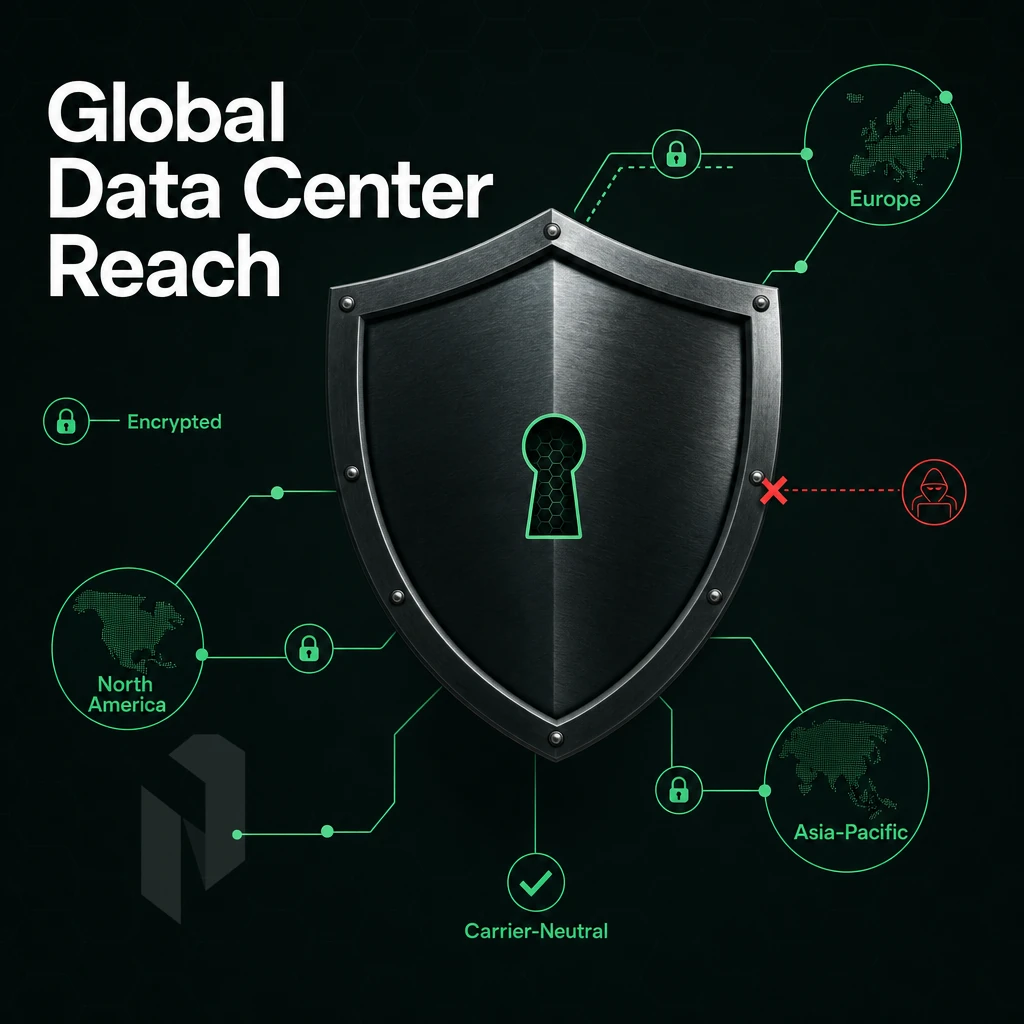
Netrouting's colocation facilities are set up in carrier-neutral locations at the interconnection hubs of Europe, North America and Asia-Pacific. We do not have many locations distributed over the globe for the sake of coverage. However, we chose the spots where there is a lot of fiber, good exchange peering and a large number of network providers.
European Colocation Hubs for AI Workloads
Our primary EU HQ is The Hague (DFDC THG1), a 215+ rack datacenter with N+1 power and cooling designed for enterprise colocation.
We are also located at Nikhef.
North America and Asia-Pacific Colocation Solutions
Our global SOC 2-compliant headquarters in Miami sits atop FL-IX peering with direct routes to Latin America.
In Asia-Pacific, our Hong Kong facility connects via submarine cable to provide low-latency services to the region. Our Singapore facility is located at Digital Realty SIN10 with cloud connectivity provided by Tata Communications and peering on the local IXs.
How Does Carrier-Neutral Colocation Benefit My Business?
You choose your upstream carriers and negotiate the rates and services you require.
Our private suites and network solutions support BGP multihoming, BYOIP and direct cross-connects. This means you have full control over your routing and don’t have to rely on a single provider’s network configuration.
All Netrouting colocation facilities are carrier-neutral and are connected to all local Exchanges. Bring your own IP addresses, upstreams and define your own routing.
Key Takeaways: Picking the Right Colocation Data Centers
The top-tier colocation facility for your workload checks five boxes: sufficient power density, carrier-neutral network connectivity, verified certifications (ISO 27001, SOC 2), clear SLA terms with remote hands services. Additionally, A location that meets your latency and compliance requirements. Miss any one of them and the colocation environment will constrain your operations rather than enable them.
Data center colocation lets you run your own hardware inside enterprise-grade colocation facilities, without the capital cost of building a on-premises data center. Evaluate colocation providers on those five criteria, confirm they support your cloud connectivity and disaster recovery needs, and the decision becomes straightforward.
Choosing the right colocation space in today's data centers comes down to three factors: physical location and network reach, power density and redundancy, and the quality of support behind the infrastructure. Get those right, and colocation delivers the control of owned hardware with none of the capital burden of building your own facility.
Colocation consistently outperforms cloud for predictable, high-throughput workloads where cost visibility and hardware control matter. It outperforms self-built facilities for every organization that doesn't want data center operations as a core competency.
Netrouting operates carrier-neutral colocation data centers across ten cities, Stockholm, Amsterdam, Rotterdam, The Hague, Frankfurt, Bucharest, Miami, New York, Hong Kong. Additionally, Singapore, with a 2.4 Tbps+ backbone, always-on DDoS protection, and ISO 27001 and SOC 2 certification. Explore Netrouting colocation or contact the team to discuss your specific power, space, and connectivity requirements.