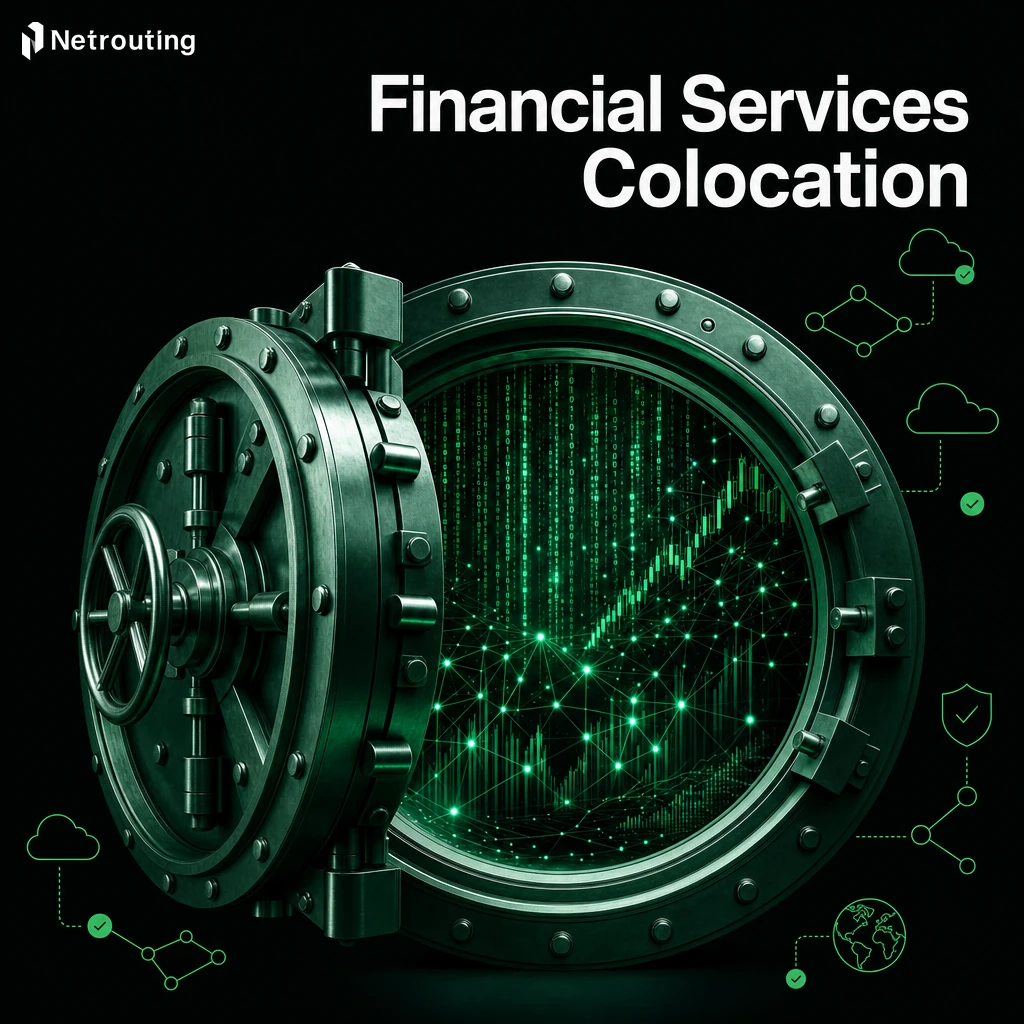
Decisions around colocation of financial services carry far greater consequences than other infrastructure choices. Misconfigured network paths, unexpected outages, and regulatory non-compliance, risks that grow more complex with colocation solutions, can trigger regulatory scrutiny, lost customer confidence, and mandatory incident reports. Financial organizations treat colocation facility selection as a strategic issue, not a commodity IT purchase.
There are specific requirements that need to be met by a carrier-neutral facility with dense peering, and specific certifications such as ISO 27001 / SOC 2 to name a couple.
This guide outlines what a colocation provider must deliver to the financial services sector, covering network architecture, compliance, redundancy, and geography, the factors that separate purpose-built infrastructure from merely workable. We start with the fundamentals.
Blog contents
What Are Financial Services Colocation Solutions?
Financial services colocation is the installation of servers at a bank, payment processor, online trading company or insurer in a third-party data center facility that they rent. The colocation provider supplies space, power, cooling and connectivity while the customer retains full ownership and control of their hardware.
How It Differs from Cloud and On-Premises
The on-premises model structures all costs as those of the single company, be they for hardware or for facilities.

Why Financial Institutions Choose It
Financial services organizations require deterministic latency, data to reside within a country’s boundaries and to meet physical security and audit requirements. None of the Shared Cloud environments currently on the market can deliver all three of these requirements. Colocation provides Financial Organizations with dedicated Servers in a Data Center Facility that they lease on an ongoing basis rather than having to spend millions of dollars and years planning and building out a facility.
- Full hardware control for compliance and performance tuning.
- Carrier-neutral connectivity for low-latency trading and payment rails.
- ISO 27001 and SOC 2 environments for regulated workloads.
Colocation Solutions: The Core Model in Practice
A payment processor may choose to run their own servers in a Financial Services-grade data center, and we supply them with redundant power, N+1 air conditioning, and 2.4 Tbps+ network capacity. The payment processor runs their own software stack. We explain below why running this type of workloads in a dedicated data center as opposed to the cloud is superior from a business perspective.
Why Financial Institutions Choose Colocation Solutions Over the Cloud
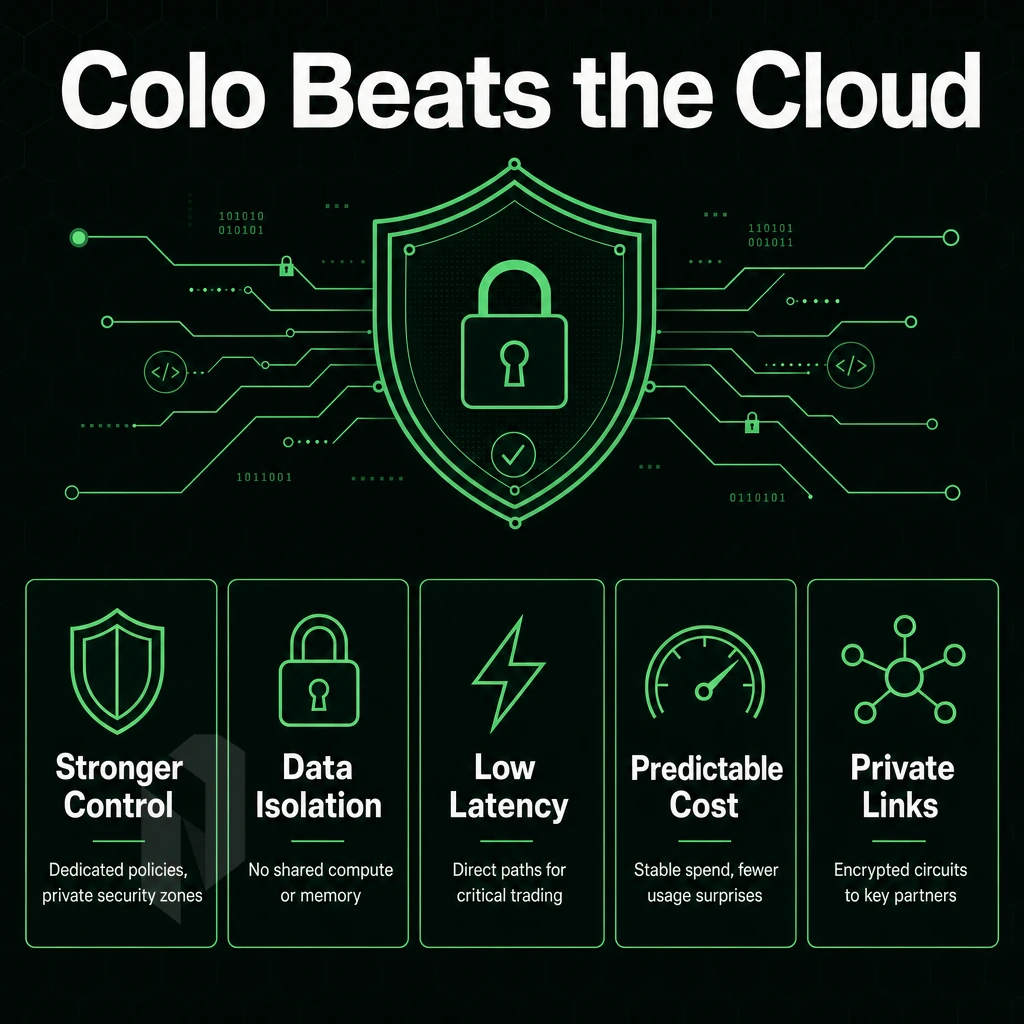
Financial services organizations have a choice when it comes to their IT infrastructure: running on the hyperscale cloud of companies like Amazon, Google, or Microsoft, or in dedicated colocation facilities. Colocation is generally the best choice for financial services organizations, for three key reasons.
Cost Predictability Under Regulatory Requirements
Hyperscaler egress fees are notoriously difficult to predict on a per terabyte basis. The cost of egress from colocation is a fixed monthly charge for your footprint. For core compute workloads, TCO is consistently lower than equivalent capacity on cloud providers, without surprise billing cycles.
Compliance and Data Sovereignty With Colocation Solutions
Financial services companies with operations in many geographies have to comply with local regulations around data residency and audit access. Colocation puts your hardware in a single, auditable location. You own the compute layer. This makes a big difference to how you report compliance to regulators as opposed to in a shared cloud tenancy.
Latency-Sensitive Workloads and Colocation Solutions
Sub-millisecond execution is required for trading systems and payment processors. Colocation in a carrier-neutral facility with cross-connects to exchanges and networks ensures consistent and deterministic latency. Cloud routing has variable hops of latency compared to dedicated hardware.
| Dimension | Hyperscaler Cloud | Colocation (Netrouting) |
|---|---|---|
| TCO predictability | Variable egress costs | Fixed monthly footprint |
| Hardware control | Shared, abstracted | Dedicated, customer-owned |
| Latency | Variable, multi-hop | Deterministic, direct cross-connect |
| Uptime SLA | Varies by region | 99.9% with N+1 power and cooling |
Colocation suits workloads needing physical servers, auditable data locations, and low latency networks. Pick a carrier-neutral facility on a Tier 1 network and scale from there. Once the infrastructure model is sorted, you still have to satisfy the regulators.
Network Performance and Low-Latency Connectivity for Financial Workloads
For trading platforms, payment services and real-time risk systems, network quality is critical. The difference in execution quality is measured in milliseconds. As such, poor infrastructure that is unable to provide consistent low latency connectivity is a liability.
Carrier-Neutral Facilities and IX Peering
Our carrier-neutral colocation lets financial sector customers choose their own upstream providers and peers, avoiding lock-in. Our data centers connect to AMS-IX, DE-CIX, and FL-IX, the major European and North American exchange points for financial traffic.
Dense IX peering enables shorter paths between counterparties. This results in lower jitter and more deterministic latency for all rounds trips associated with order routing and settlement. For community perspectives, see Colocation vs Building Your Own Data Center in India (2026).
Network Capacity and Port Utilization
The 2.4 Tbps+ core provisions 100 Gbps+ connections by default, with average port utilization under 40%, giving it ample headroom to absorb transient spikes during peak trading windows when low latency is critical.
Port utilization remains below 40% on average, thus financial workloads will not have to fight for bandwidth during peak market times.
BGP and BYOIP for Address Portability
Our network model allows companies with their own address space to bring their existing IPv4 address space to the network.
Colocation Solutions for European and US Financial Firm Locations
Location affects issues such as jurisdiction, proximity to exchanges, and latency. For financial services companies location is key when choosing a colocation facility.
The EU Financial Corridor
Our primary facilities for European financial services are located in Amsterdam, Frankfurt, The Hague and Rotterdam.
New York and Miami for US and LatAm Reach
Our New York operations are located at 60 Hudson Street, one of the premier carrier hotels on the East Coast.
APAC Financial Gateways
Our coverage of Hong Kong and Singapore into the Asia-Pacific financial markets includes submarine cable and local IX peering for these time zones. Financial institutions can now benefit from a single provider’s global coverage of three continents, and associated single point of contact, to meet their regulatory requirements.
Why Choose Netrouting for Financial Services Colocation
Netrouting delivers colocation solutions built for the compliance, connectivity, and uptime demands of financial services organizations. Our infrastructure spans 10 data centers across Europe, North America, and Asia, giving financial institutions the geographic reach their regulatory requirements demand.
- Certified and audit-ready: ISO 27001 and SOC 2 certifications satisfy the core compliance obligations financial institutions face.
- Dense IX peering: Our 2.4 Tbps+ network with AMS-IX, DE-CIX, and FL-IX peering delivers the low latency that trading and payments workloads require.
- Always-on DDoS protection: L3/L4 mitigation is included on every colocation service, no add-on required.
- Full routing control: BYOIP and BGP support let banks and brokerages maintain address portability and traffic policy.
- 24/7 NOC, 1-hour ticket guarantee: Around-the-clock monitoring with a committed response time.
Contact our sales team to discuss colocation solutions tailored to your compliance and connectivity requirements.
Frequently Asked Questions
What Do Colocation Solutions Actually Do?
A colocation data center provides physical space, power, cooling, and network connectivity for servers and infrastructure you own. You bring your own hardware; the facility handles the building, redundant power feeds, and physical security.
How do financial cloud services differ from colocation solutions?
Financial cloud services are compute, storage, and networking resources consumed on demand by banks, trading firms, insurers, and fintech companies. They cover everything from core banking workloads and risk analytics to payment processing and regulatory reporting. Delivery models range from colocation and dedicated bare metal to virtual instances and hybrid architectures. The defining requirement is that every layer must meet strict compliance, latency, and data-sovereignty standards that general-purpose cloud offerings often cannot satisfy out of the box.
Hyperscalers vs Colocation Solutions: What Is the Difference?
Hyperscalers offer shared, multi-tenant infrastructure billed on consumption, with pricing that scales unpredictably under sustained or data-intensive workloads.
For financial workloads, colocation also means lower latency to exchanges and counterparties, no noisy-neighbor risk, and clearer data-residency guarantees.
What regulatory requirements apply to financial services colocation solutions data centers?
Key frameworks include DORA (EU Digital Operational Resilience Act), PCI DSS for card data, GDPR for personal data processed in Europe, and sector-specific rules such as MiFID II for trading firms and Basel III operational-risk standards for banks.
Facilities must hold relevant certifications, ISO 27001 for information security management and SOC 2 for operational controls are the baseline expectations.
The core requirements for financial services colocation are; compliance, low-latency and proximity to markets and counterparties. None of the cloud platforms can guarantee all of these requirements on a reliable basis. Dedicated, carrier-neutral colocation facilities can.
Location is not a secondary consideration.
Netrouting operates carrier-neutral colocation across ten cities, including Amsterdam, Frankfurt, New York, and Miami, on a 2.4 Tbps+ backbone with dense IX peering, always-on DDoS protection, and ISO 27001 and SOC 2 certification. If you're evaluating colocation for a regulated financial workload, speak with our infrastructure team to discuss your compliance requirements and connectivity needs.