Selecting the right IoT connectivity provider has significant impacts to factors down stream such as the reliability of your devices, latency, scalability and cost to operate your deployment as it grows. Get this wrong and you’ll be looking to re-architect under pressure. Get it right and the underlying infrastructure will largely disappear from sight.
Providers must demonstrate proven capabilities in scaling iot deployments from pilot projects to production environments without requiring infrastructure redesign or service interruptions. The internet of things demands connectivity architectures that can adapt to diverse device types, communication protocols, and geographic constraints without compromising security or performance.
This guide is a no-nonsense manual to building the best possible network, based on Netrouting's 10 years of experience with carrier-grade infrastructure.
Blog contents
When selecting a provider for IoT at scale, key evaluation criteria include network coverage and peering, and latency and reliability guarantees.
Who Offers the Best IoT Connectivity Services in 2026
| Provider / Option | Performance | Support | Uptime SLA | Network | Best For |
|---|---|---|---|---|---|
| Netrouting | Bare metal provisioned in under 60 minutes. Unmetered 10 Gbps per server. Up to 40 Gbps available. | 24/7 NOC, 1-hour ticket guarantee | 99.9% standard SLA | 2.4 Tbps+ backbone (AS6206). Dense IX peering across 10 cities. Always-on L3/L4 DDoS protection included. | IoT back-end infrastructure, high-throughput ingestion, low-latency processing, EU data sovereignty |
| Hyperscaler cloud platforms | Broad managed-service catalog; shared infrastructure with variable latency under load | Tiered support plans; enterprise SLAs require premium contracts | 99.9% on core compute; varies by service | Global regions; egress-heavy billing model | Teams already deep in a single cloud ecosystem |
| Cellular IoT connectivity providers (MNO / MVNO) | LTE-M, NB-IoT, 5G depending on carrier; SIM lifecycle management handled end-to-end | Varies; enterprise tiers offer dedicated account management | Carrier-dependent; typically 99.5-99.9% | Licensed spectrum; roaming agreements for global IoT connectivity | Device-side managed connectivity, SIM provisioning, roaming, MVNO aggregation |
| Carrier-neutral colocation operators | Facility-level power and cooling; connectivity depends on tenants' own transit choices | Remote hands; on-site NOC varies by operator | Typically 99.9% power SLA | Meet-me room access; cross-connects to multiple connectivity providers | Hardware-owning enterprises needing physical colocation only |
When selecting an IoT back-end infrastructure, a global IoT connectivity provider with large volumes of data from devices and low latency is typically required. Built on a core network infrastructure spanning 10 cities across Europe, North America and Asia, Netrouting's 2.4 Tbps+ network delivers iot services and enterprise clients always-on DDoS protection and a 99.9% uptime SLA. Enterprises deploying IoT solutions across continents depend on global networks that maintain consistent performance and security standards regardless of geographic location.
Compare this with dedicated cellular IoT connectivity providers that offer managed connectivity on a device-side as well as SIM lifecycle management. Compare services by first establishing what each layer does for your IoT connectivity service. Enterprises evaluating managed iot connectivity services must distinguish between providers that merely resell SIM cards and those that deliver end-to-end network orchestration with integrated device control.

What IoT Connectivity Services Actually Cover
IoT connectivity services cover a wide spectrum of functionalities, from basic SIM setup over to full-fledged network control. When selecting connectivity services for IoT applications. Enterprises managing iot devices need to get a good grasp of the various layers of service in order to avoid unnecessary expenditure resulting from service gaps as well as avoiding redundant functionalities that they may already own.
Evaluating connectivity solutions requires understanding how each service tier integrates with existing infrastructure and whether the provider can deliver both device-level control and network-layer performance guarantees. Selecting the right iot connectivity solutions means balancing technical requirements like latency and throughput with operational needs such as billing transparency and vendor lock-in risk. The internet of things ecosystem demands connectivity architectures that can accommodate diverse device types, from low-power sensors to bandwidth-intensive edge gateways, each with distinct performance profiles.
What the Network Layer Actually Delivers
The foundation of IoT connectivity is routing of data from field devices to a destination endpoint in a reliable and secure manner. This includes cellular access technologies (2G to 5G), private APNs, IP transit and routing. The latency for different use cases ranges from less than 50ms for industrial control systems up to 200-500ms for asset tracking.
Devices must transmit data efficiently across these networks while maintaining security through encryption protocols that protect payloads from interception during transit. As the internet of things expands into sectors like healthcare and manufacturing, these foundational routing requirements become even more critical for ensuring real-time data delivery.
To ensure adequate coverage, multiple networks (cellular, fixed line, WANs/LANs) are often provisioned. A single SIM on a single carrier is not suitable for large roaming deployments. Multi-IMSI and eSIM profile support is provided at the iot platform level, but only if the underlying cellular networks support smooth handoff without inducing significant re-authentication delays.
Managed IoT Devices vs. Basic SIM Reselling
A bare-bones SIM reseller will set you up with a data plan and a portal to manage it. Managed IoT connectivity services on the other hand offer private routing, traffic steering, anomaly detection and a host of other features to ensure end-to-end communication with guaranteed uptime all covered by a Service Level Agreement. At scale, managing thousands of individual devices across multiple carriers would be an impossible task to manage manually without automation.
A connectivity management platform includes a control layer, such as policy management, usage tracking, alerts, and API-based configuration. Device management includes firmware management, remote monitoring and diagnostics, and device life cycle management. These are different functions, which a managed IoT connectivity platform should integrate rather than add as an afterthought. Operators should verify that the platform's key features include real-time visibility into device health, automated policy enforcement, and seamless integration with existing enterprise systems. Operators deploying at scale need the ability to monitor devices in real time, correlating connectivity metrics with application-layer performance to isolate issues before they cascade. Effective network management requires centralized visibility across all connectivity layers, enabling operators to troubleshoot routing issues, optimize traffic paths, and enforce security policies without touching individual devices.
Monitoring network performance in real time allows operators to detect degradation patterns, such as increased retransmissions or jitter, that signal underlying infrastructure problems before end users experience service disruption. Operators must ensure the platform provides granular access controls to network resources, preventing unauthorized devices from consuming bandwidth or accessing sensitive endpoints. Platforms that lack centralized control force operators to manage connectivity policies across fragmented interfaces, increasing operational overhead and the risk of configuration drift. Platforms offering centralized management enable operators to apply consistent policies across thousands of devices simultaneously, reducing the risk of misconfiguration and streamlining troubleshooting workflows.
What Enterprise Buyers Should Demand
We expect 99.9% uptime or better, with detailed SLAs measuring latency and packet loss.
| Capability | SIM Reseller | Managed IoT Provider | Network Infrastructure Provider |
|---|---|---|---|
| Private APN / routing | Rarely | Standard | Standard |
| Uptime SLA | None | 99.9% | 99.9%+ |
| BGP / IP transit control | No | Limited | Full |
| DDoS protection | No | Optional | Always-on L3/L4 |
| Carrier diversity | Single carrier | Multi-carrier | Multi-carrier + own backbone |
For critical applications where uptime is non-negotiable, a provider with a 100% owned network is your best bet.
This quality of transit is far superior to what managed IoT connectivity services built on third-party infrastructure can offer.
Key Features to Evaluate in an IoT Connectivity Platform
The IoT connectivity platform is the foundation of all your operational decisions.
Connectivity Management and Network Fundamentals
-
Evaluate multi network access support.
A platform that can switch between multiple carrier networks, without manual SIM swaps, keeps devices online across geographies. Permanent roaming restrictions affect many standard SIMs; confirm the provider addresses these through local breakout options or a local core network presence in your target markets. Operators must address permanent roaming restrictions proactively by deploying local network infrastructure or negotiating bilateral agreements that allow sustained connectivity without forced disconnections. Providers with presence across global networks ensure that devices maintain consistent performance and security postures regardless of deployment geography.
Providers that rely on a single carrier agreement expose your deployment to regional outages with no failover path.
-
Assess remote provisioning capabilities.
The ability to update network profiles over the air eliminates costly field visits. Remote provisioning is non-negotiable for deployments spanning multiple countries or hard-to-reach installations.
-
Review data usage controls.
Granular policies, per-device caps, alerts, and automatic suspension, prevent bill shock and catch malfunctioning devices early. Confirm these controls apply at the individual SIM level, not just the account aggregate. Real-time data usage monitoring paired with threshold alerts enables operators to identify anomalies before they escalate into costly overages or security incidents. Enterprises evaluating managed iot connectivity services should prioritize platforms that expose usage analytics through RESTful APIs, enabling integration with existing billing and operational support systems.
Platform Connectivity Management and Automation
-
Test SIM lifecycle management workflows.
Activation, suspension, and decommissioning should be executable in bulk via a dashboard or API.
-
Verify automation capabilities.
Rule-based triggers, such as suspending a SIM when it crosses a data threshold, reduce human intervention. Look for webhook support and API depth; a platform like wireless logic demonstrates how policy automation can replace repetitive manual tasks at enterprise scale. Platforms offering centralized control through unified policy engines allow operators to enforce consistent security postures and compliance rules across heterogeneous device fleets without fragmenting administrative overhead.
-
Demand centralized visibility and control.
A single pane of glass covering all devices, networks, and usage patterns is the primary driver behind operational complexity reduction in large IoT deployments.
Note: If a vendor cannot demonstrate real-time device status and network diagnostics in one interface, escalate that as a disqualifying gap during evaluation.
Security and Data Integrity
-
Confirm secure data transmission standards.
End-to-end encryption, private APNs, and VPN tunnel support protect traffic from interception.
-
Audit the device management platform's security posture.
Role-based access control, audit logs, and multi-factor authentication are baseline requirements.
These platform criteria apply to all provider categories.
Cellular IoT Connectivity Providers: How the Market Breaks Down
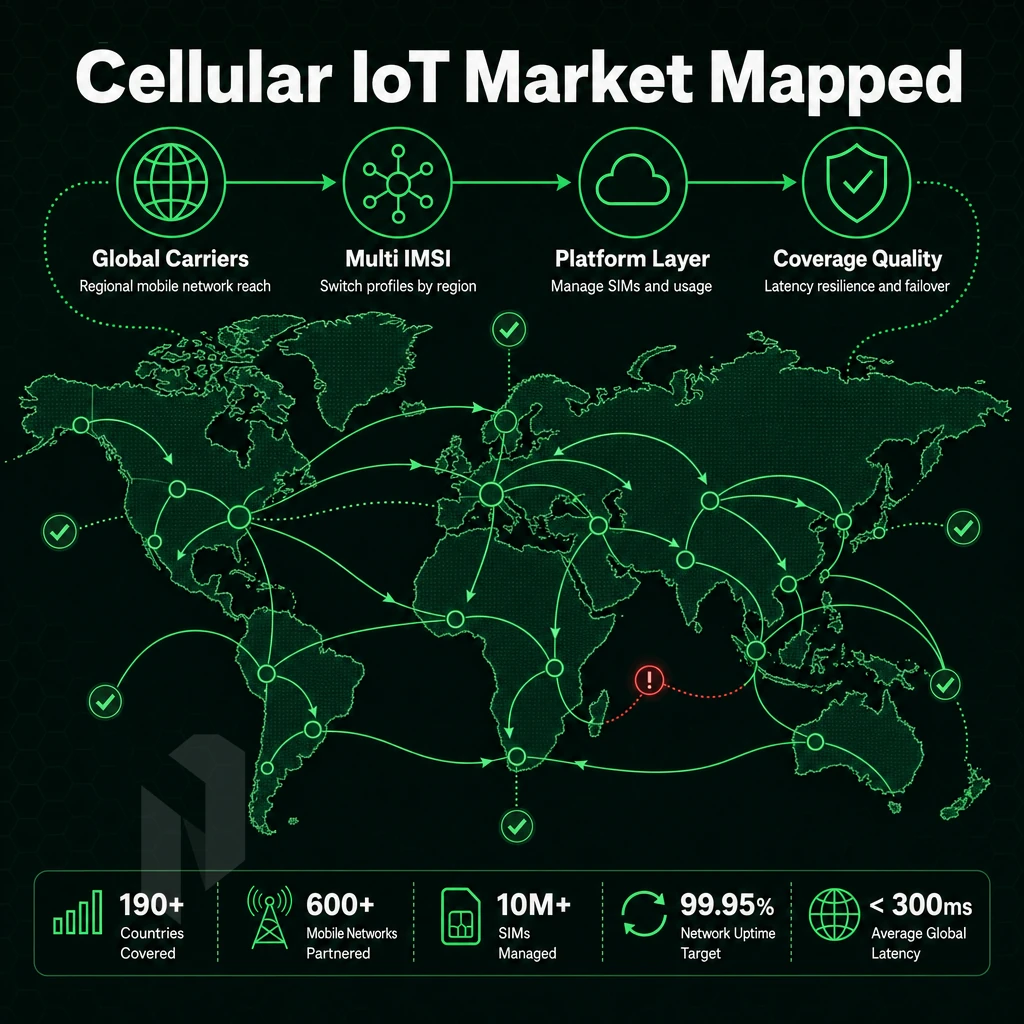
The IoT connectivity market is more complex than it appears.
How the IoT Connectivity Market Segments IoT Devices
Mobile network operators (MNOs) form the base of the mobile telecommunications market. They own licensed spectrum and operate the Radio Access Network (RAN) as well as the Core Network (CN) of all providers. Their coverage is excellent but their commercial offers are geared towards massive consumer volumes whereas enterprises require specific IoT applications and features.
Mobile virtual network operators (MVNOs) rent capacity from MNOs and resell it under their own terms.
IoT Connectivity Solutions: Platform vs. Network Layer
Above the radio layer are the connectivity management platforms. These manage the SIMs (of devices), data sessions of connected devices, as well as their usage. An IoT connectivity platform typically offers a set of REST APIs to automate the provisioning of SIMs, to set data limits and to trigger actions on the network.
The operations teams of companies can use these APIs to control the connectivity of their IoT devices. They do not have to deal with the back-office systems of the carriers.
Enterprise cloud platforms offer a variety of combinations of IoT solutions and broader compute and storage solutions. There are also pure network-layer providers that focus on device connectivity and try to deliver the most reliable communications. It’s impossible to say whether one model is better than the others. Ultimately, whether your team needs a single vendor to provide a complete solution or can select the best solution for each function is key.
IoT Connectivity Platform: Infrastructure Providers in the Stack
The infrastructure-layer is composed of IP transit carriers and colocation providers. As traffic flows from the SIM session to the application servers, it must travel through the backbone of the termination provider. A robust and low-latency network is needed to ensure deterministic and high-performance IoT connectivity. In this section we will map out the different types of provider in detail, side by side with the key trade-offs between them in subsequent sections.
Comparing IoT Connectivity Providers: Side-by-Side
Note that not all IoT connectivity providers are created equal, and in particular key differentiators are depth of coverage, level of routing control and scalability of the platform as your device fleet grows. The following table outlines key archetypes in the market against the key differentiators for production usage.
Provider Archetypes at a Glance
| Provider Type | Coverage | SIM Management | Device Management | Private Routing | DDoS / Security | Scalability | Best For |
|---|---|---|---|---|---|---|---|
| Major cellular carrier | Strong domestic; limited abroad | Basic portal | Limited | Rare; add-on cost | Minimal | Moderate | Single-country deployments |
| Managed IoT MVNO | Global via roaming agreements | Full sim management platform | Strong | Available | Basic filtering | High | Fleet-scale device connectivity across multiple regions |
| Infrastructure + IP transit specialist | Global PoPs; carrier-neutral | Via partner integration | Moderate | Private routing native | Always-on L3/L4; advanced L7 available | Very high, scalable connectivity to 40 Gbps+ | Global IoT deployments needing low-latency, secure backhaul |
| Hyperscaler IoT add-on | Tied to cloud regions | Platform-native | Deep within ecosystem | Within cloud VPC only | Platform-level | High within ecosystem | Teams already locked into a single cloud platform |
Communications Service Providers and the Control Trade-Off
Communications service providers such as Verizon, AT&T, T-Mobile and others offer bundles of communications services with management tools for customers. The convenience of bundling communications services with management tools for a customer such as a fleet may mean less control over routing and data usage and higher cost as the customer scales.
Managed MVNOs provide good global coverage for IoT through robust SIMs and tools. However, the coverage is dependent on roaming agreements in place which can vary in terms of latency and quality in different regions.
Where Infrastructure Specialists Fit
As an infrastructure provider, we offer a different value proposition to teams running latency sensitive / security focused IoT workloads. Our network reaches 10+ cities in Europe, North America and Asia. DDoS Mitigation is included in all services as standard, no add-ons required.
Combining carrier-neutral peering with dedicated hardware and protection is what makes Netrouting an ideal choice for your connectivity platform and network requirements. Once you scale globally to several locations around the world however, the specific pressures on the underlying infrastructure are a different story altogether.
Global IoT Deployments: Network Infrastructure That Scales

IoT deployments around the world fail at the network level before they fail at the device level. Problems with scale such as increased latency, high data usage costs, patchy geographic coverage, and clustering of resources on the backend all affect the IoT at the connectivity level, and none of these problems are fixed by a SIM swap. The failure point for IoT connectivity is at the infrastructure level below your connectivity stack.
What Scaling IoT Actually Demands
The industrial IoT and the management of fleets have one thing in common: the need for reliable connectivity to distant endpoints. The low latency of real-time telemetry is crucial, since control loops and anomaly detection both rapidly decrease in value when latency exceeds 50 ms. Routing redundancy, local breakout and sub-second failover are non-negotiable when scaling.
Last mile connectivity is typically provided by cellular networks but the backhaul and core routing has a much greater impact on end-to-end performance. A cross continental deployment such as Europe, North America and Asia will require managed iot connectivity services with regional points of presence to handle data usage efficiently, as opposed to a single point of transit in one continent.
Remote Diagnostics and Device Visibility
Visibility into the status of your devices and remote diagnostics of those devices hinges on reliable device connectivity, specifically a persistent, low-jitter connection between the endpoints and your management platform. The quality of your network (not the number of SIMs) determines your reliability. Packets lost in excess of 0.1% will result in corrupted telemetry and resulting false alerts.
Cloud platforms for IoT data ingestion require backbone infrastructure capable of handling peak loads without queuing delays.
Infrastructure Comparison: Key Features at the Network Layer
| Dimension | Minimum viable | Netrouting AS6206 |
|---|---|---|
| Network capacity | 100 Gbps regional | 2.4 Tbps+ global |
| PoP coverage | 1-2 regions | 10 cities across EU, NA, APAC |
| Uptime SLA | 99.5% | 99.9% |
| DDoS protection | Optional add-on | Always-on L3/L4, included |
| Private network | Rarely included | Free, up to 40 Gbps |
Select an IoT backend data center with very dense peering at Internet Exchanges and with PoPs in regions where your device’s are located. Netrouting's IoT platform and global infrastructure backbone provides network access across locations in Amsterdam, Frankfurt, The Hague, Stockholm, Rotterdam, Bucharest, Miami, New York, Hong Kong and Singapore.
Data Security and Private Routing in Managed IoT Connectivity
Standard cellular connectivity was not designed for enterprise-class security. As enterprises utilize Industrial IoT, remote monitoring and fleet management solutions, they require private networking with access controls and network isolation at the IP layer, not just data services.
Data Security Foundations for Connected Devices
-
Enforce secure data transmission at the network layer.
Require all device traffic to traverse encrypted tunnels, IPsec or WireGuard, before it touches any application endpoint. This eliminates exposure on shared public internet paths.
-
Isolate traffic with private APNs or VPN breakout.
Route device traffic directly into your private network, bypassing the public internet entirely. Local breakout keeps sensitive telemetry off shared infrastructure.
Note: Skipping private APN configuration is the most common mistake in enterprise IoT deployments. Traffic routed over public internet is exposed to interception and policy gaps.
-
Apply Centralized Multi Network Access Policies
Define which devices can reach which endpoints and enforce those rules at the network layer, not just the application layer, so you can monitor devices and revoke access instantly.
Backhaul and Interconnect Architecture
-
Anchor your IoT backhaul to a private interconnect.
Connectivity solutions built on BGP and BYOIP let you terminate device traffic directly into your own address space.
-
Use multiple carriers for resilience, not just coverage.
Multi-carrier SIM strategies reduce single-point failure risk. Pair this with a provider whose backbone has redundant paths across regions.
-
Extend private routing to your compute layer.
Netrouting's free private interconnect and IP transit capabilities let you terminate IoT backhaul directly into bare metal or cloud compute, keeping the full data path off public infrastructure.
Verification of Connected Devices
-
Audit traffic paths before production rollout.
Confirm that no device traffic egresses to the public internet unencrypted. Use flow logs and BGP route verification to validate the full path.
-
Test failover under real conditions.
Simulate carrier outages and verify that connectivity solutions fail over without exposing traffic to unprotected routes.
Building out a secure architecture for iot devices is one thing, but then the real question becomes what is the best infrastructure provider to use as the foundation of your entire data stack, private backhaul to high-throughput ingestion.
Why Choose Netrouting for IoT Connectivity Infrastructure
IoT connectivity providers and enterprise IoT teams need more than SIM cards, they need a network infrastructure layer that keeps connected devices online at scale. Netrouting provides exactly that: a carrier-neutral backbone purpose-built for demanding IoT deployments.
- Global reach across 10 locations. Our network spans Amsterdam, Frankfurt, The Hague, Stockholm, Rotterdam, Bucharest, Miami, New York, Hong Kong, and Singapore, delivering low latency and reliable connectivity across multiple regions for global IoT workloads.
- AS6206 IP transit with dense IX peering. We peer at AMS-IX, DE-CIX, NetNod, and FL-IX, giving IoT connectivity solutions direct, low-hop paths to global networks and Tier 1 upstreams.
- Always-on DDoS protection. L3/L4 mitigation is included on every service, no add-on required. Critical for IoT devices that are frequent attack targets.
- BYOIP and full BGP control. Bring your own IP space and manage private routing and local breakout to match your IoT connectivity platform architecture.
- Bare metal provisioned in under 60 minutes. Unmetered 10 Gbps on dedicated servers handles high-volume IoT data ingestion without operational complexity.
- ISO 27001 and SOC 2 certified. Data security and secure data transmission compliance built into the infrastructure layer, not bolted on.
Our 99.9% SLA, 24/7 NOC, and one-hour ticket guarantee keep managed IoT connectivity services built on Netrouting online when it matters.
Choosing the Right IoT Platform and Infrastructure Stack
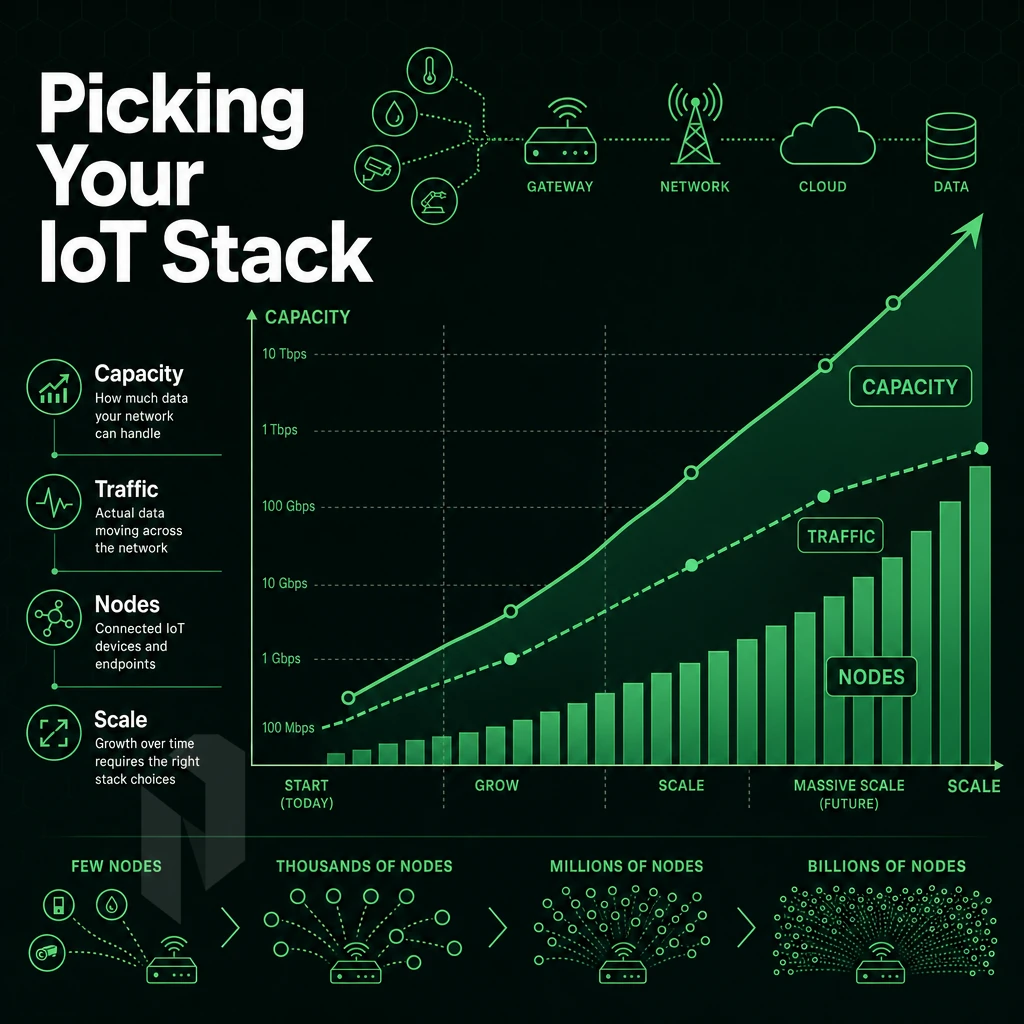
When deploying IoT at scale, there are two key decisions that need to be made. First, there is the choice of connectivity platform to manage the SIMs, manage the devices and provide a single view. The second is the underlying network that will deliver reliable communications between the device and application.
The IoT Platform Layer for IoT Devices
A capable IoT platform enables provisioning, policy management and real-time diagnostics of thousands of endpoints. It abstracts the complexities of the carrier and enables operations teams to work with a single portal.
Key capabilities to require:
- Automated SIM provisioning and remote profile switching.
- Per-device data policies and usage alerts.
- API-driven integration with upstream applications.
- Multi-carrier fallback for resilience in remote deployments.
For Industrial IoT applications like monitoring oil pipelines or automating a factory, all four measures of downtime apply. Production is lost during each instance of downtime.
The Device and Connectivity Management Platform Layer
The device management platform includes functions for firmware updates, health checks and remote diagnostics. In cases of Fleet Management or Remote Monitoring it helps to reduce truck rolls and to keep endpoints up to date remotely.
Applications that require very low latency such as autonomous cars, edge inference and others require device management to be co-located with compute resources. Each hop introduces additional latency.
Why Connectivity Infrastructure Decides the Outcome
The platform on top of it all is only as strong as the network underneath it. You need to control private routing, BGP and low-latency IP transit in order to ensure your IoT services scale or don’t die under sudden spikes of traffic.
Our backbone operates from 10 locations worldwide including Stockholm, Amsterdam, Frankfurt, Miami and Hong Kong, with the necessary private routing and transit capacity to service large-scale IoT deployments. DDoS protection is active by default and all services benefit from a 99.9% uptime SLA. Importantly, six key differentiators will distinguish worthy short-listers from also-rans as you scale your deployments.
The Core Criteria for Managed IoT Connectivity Services
When evaluating an IoT connectivity provider, there are 6 non-negotiables: global reach across multiple networks, deep SIM management and SIM provisioning and lifecycle control, robust device management, private routing with secure data transfer, high network reliability. Additionally, The ability to scale quickly and efficiently without added complexity. A mature connectivity management platform is the glue that ties all of these together and provides a single, centralized view of all connected devices.
Managed IoT Devices Connectivity Services
These managed IoT connectivity platforms exist to offload the related infrastructure for you. Managing cellular connectivity, connecting your devices, and scaling to support your application, all of this should be handled by your chosen platform. As a result, You can focus on your actual application, on top of this new layer of infrastructure. If it meets six simple criteria, then it should be gone from your notice.
The Key Advantages of Reliable IoT Connectivity Infrastructure
The quality of your network infrastructure will determine your success with IoT connectivity at scale. Low latency, highly scalable connectivity and secure data transmission are the fundamentals of managed IoT connectivity solutions. Without them, connected devices will drop packets, your IoT deployment will stall and complexity will quickly reach explosive levels.
Global IoT Connectivity Management
demands infrastructure that spans multiple regions
In addition to good network coverage, a reliable IoT provider also needs a strong backend and must be able to scale. A platform that performs well in a test environment but then fails in real life due to a lack of compute power or data throughput, is useless in the long run.
Cellular connectivity enables devices to get online. However, keeping them online and enabling reliable data transfer requires much more than a simple SIM and the connectivity provided by it.
Low-latency routing, redundant power supply and a constantly available high-throughput network during peak usage are a few basic requirements. If you need dedicated servers with plenty of compute power, private networks or even colocation next to your edge devices.
Our bare metal servers, 2.4 Tbps+ Backbone and locations in Europe, North America and Asia could be a great starting point for your IoT-Project. We’d be happy to explain how your infrastructure needs can be mapped to our connectivity platform. Get in touch with the Netrouting team.