Downtime is far more than an inconvenience to keep your employees productive.
What many organizations describe as managed connectivity solutions often amounts to little more than basic monitoring of circuits and managed services tied to the underlying transit circuit.
This guide sorts through the marketing hype for managed connectivity services to explain what’s actually included, which workloads will benefit most. Additionally, What you need to ask a potential provider for before you sign a contract.
Blog contents
Whether you’re looking at IP transit, private interconnects or a fully managed network for a multi-regional, multi-datacenter deployment.
What Are Managed Services for Connectivity?
Managed connectivity services are provided as a network service offer and operated by a third party for your benefit. The provider is responsible for the design and implementation of the services and for the monitoring and troubleshooting of the services. You simply use a reliable connection without managing the corresponding infrastructure yourself. Managed connectivity services are core component of modern managed network services.
What a Provider Actually Owns
The Managed Network Services Provider takes complete control of your network infrastructure and manages it on an ongoing basis. This includes proactive monitoring, fault detection, 24/7 incident management and ongoing network performance tuning. For community perspectives, see Managed Network options for smaller clients : r/msp.
This contrasts with unmanaged network services, where you configure, monitor, and repair everything yourself.
Network Services vs. Self-Managed Networks
There is a key accountability shift here. Self-managed connectivity has your team responding to outages. Managed connectivity services turn your team’s reactive work into the provider’s proactive work under contract with associated Service Level Agreements.
Managed services help reduce mean time to resolution. A good provider has a 24/7 NOC with proper tools to catch issues before they affect users. Proactive detection and remediation of network issues significantly reduces the operational burden on internal IT teams while maintaining service continuity.
This proactive approach strengthens operational resilience by ensuring network infrastructure remains stable and responsive even during unexpected traffic spikes or component failures. Maintaining operational stability requires consistent network performance metrics and automated failover mechanisms that prevent service degradation during peak demand periods.
Where Netrouting Fits in Continuous Optimization
Our network spans ten locations across Europe, North America and Asia, offering IP transit, DDoS protection and Ethernet services as fully managed services.
How Managed Connectivity Services Convert Networks Into Solutions
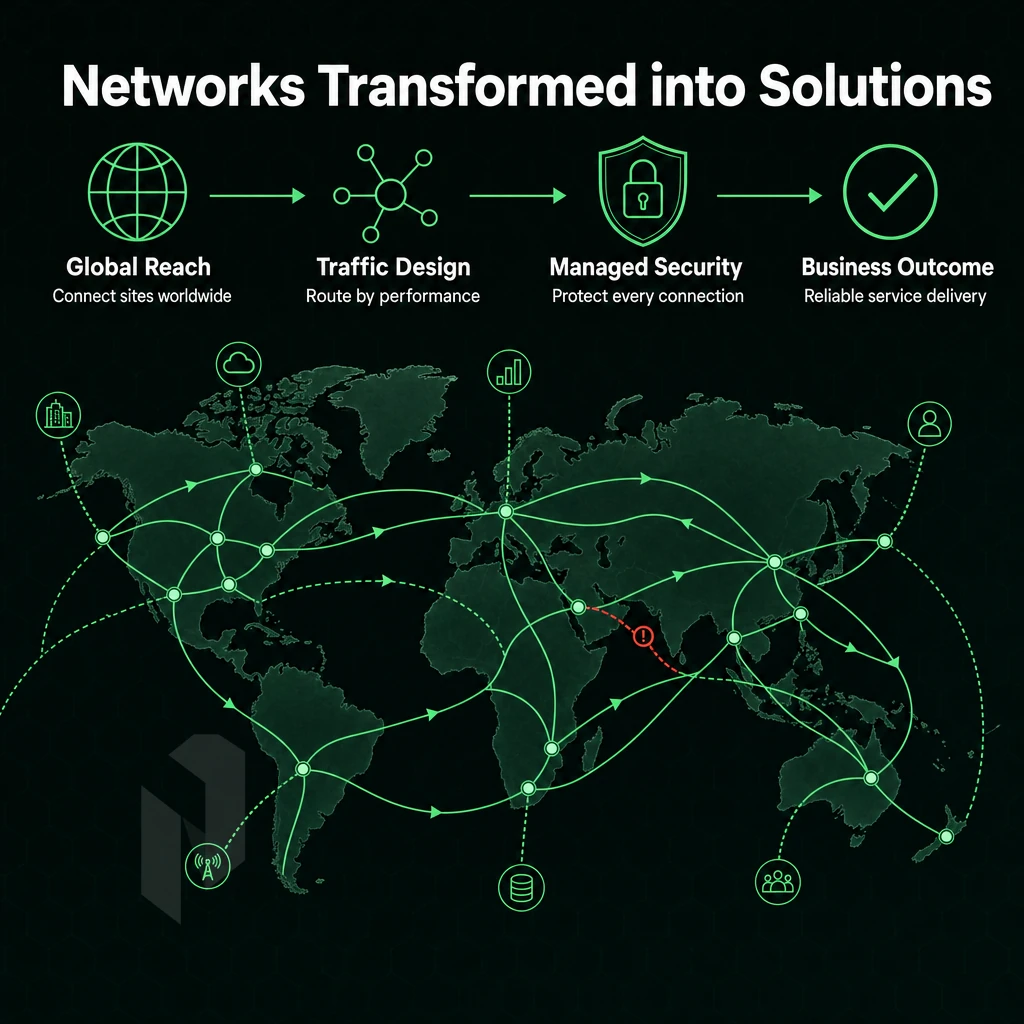
Managed connectivity services are typically offered on a delegation model.
What the Provider Takes On
Our Provider manages the 24×7 monitoring and management of all your network devices, routers, switches, firewalls and edge appliances. The Provider owns the configuration, patching and lifecycle of the underlying network hardware. Telemetry is ongoing and feeds into a NOC where the Provider’s engineers identify anomalies before they become outages.
This model relies on proactive maintenance to keep the network running at optimal performance. Effective managed connectivity relies on continuous optimization of routing policies, capacity planning, and performance metrics to adapt to evolving traffic patterns. Regular analysis of traffic patterns and latency metrics plays a crucial role in optimizing performance across distributed network environments. Providers leverage advanced analytics and real-time telemetry to enable performance optimization that maintains consistent throughput and minimizes packet loss across all network segments.
SLAs as the Contractual Backbone
A Service Level Agreement (SLA) clearly outlines what a service provider guarantees for reliable internet connectivity, covering network management operations such as uptime availability (99.9% and higher), time to restore service from failure, and the corresponding escalation processes. SLAs form the basis of customer’s expectations of service performance and guarantee the corresponding service levels.
By missing a service level, a provider incurs credits or other forms of remediation towards its customers. Meeting these contractual commitments directly translates to higher customer satisfaction and strengthens the trust relationship between provider and client. Compliance with industry regulations often dictates specific SLA requirements, particularly for organizations in healthcare, finance, or government sectors where connectivity standards are legally mandated.
Where Netrouting Fits
Our managed connectivity offering is a secure IT services connection to 10 data centers around the world, with 24/7 NOC and a 1 hour ticket response time. The full network management is handled for you on our AS6206 managed network backbone. We have 2.4 Tbps+ capacity available, with most of our connections running at 100 Gbps or above.
DDoS protection is included on all services and we’d be happy to scope out the correct managed connectivity solution for you.
Core Network Infrastructure Components of Managed Network Services
When evaluating managed connectivity services, it is important to recognize that managed connectivity services are not a single product but rather a layered set of services and value.
Connectivity and Routing Foundations
- Your IP transit provider secures your Internet connectivity by sourcing upstream capacity from Tier 1 Internet Service Providers and peers major Internet Exchanges. Your latency, redundancy and bandwidth ceiling are all influenced by this.
- BGP routing and BYOIP. We fully support BGP for all our customers, enabling you to control traffic flow over multiple upstreams. We also support Bring Your Own IP (BYOIP), meaning you can take your existing address space with you when you move to a new connectivity provider.
Connectivity Providers and Carrier Flexibility
- Many connectivity providers are carrier-agnostic and offer their customers carrier-neutral connectivity. A carrier-neutral operator can route traffic over multiple upstream carriers and thus prevents his customers from locking into a single carrier. Always check whether the AS number of your provider is owned by him or if he is just reselling a connectivity service from a single upstream carrier.
Note: Providers that resell a single carrier's capacity cannot offer true path diversity. Verify AS ownership before signing. A carrier agnostic provider maintains direct relationships with multiple upstream networks, ensuring true redundancy and competitive pricing across transit options. Organizations should verify that service providers maintain direct peering relationships rather than relying solely on resold capacity to ensure genuine network redundancy.
Network Security, Cloud, and Recovery
- Network security and DDoS protection. Thorough security measures include always-on L3/L4 mitigation as a default and optional application-layer filtering for high risk services. At Netrouting these measures are enabled by default for all services.
- Include cloud connectivity and disaster recovery in your RFP. For connectivity, require private Layer 2 circuits for hybrid solutions as well as detailed documentation of DR failover paths. Without these requirements a single site outage becomes a total service disruption.
The cost implications of a managed approach are detailed below.
Advanced Technologies Powering Modern Connectivity Services

The managed connectivity services are built on top of a complex technology stack of advanced network solutions. The architecture of the underlying infrastructure is critical to delivering network reliability, performance, and secure connectivity under scale, geographically distributed and under cyber attack. Robust connectivity infrastructure requires redundant peering arrangements, diverse fiber paths, and strategically positioned points of presence to minimize latency and eliminate single points of failure.
Organizations should conduct thorough assessments of their current connectivity infrastructure to identify gaps in redundancy, capacity, and geographic coverage before migrating to a managed model. Strong security architecture also mitigates the risk of data breaches by implementing encryption, access controls, and threat detection across all network segments.
Advanced Network Hardware Technologies Driving Performance
Our network runs on AS6206 with over 2.4 Tbps of capacity.
BGP routing allows fine-grained traffic control, unlike the shared upstream paths of most providers.
Always-On Protection and Ongoing Monitoring
Network-layer security incidents (such as volumetric floods or reflection attacks) require mitigation that is already active before troubleshooting network issues under high-traffic conditions becomes necessary. All managed network solutions include always-on L3/L4 DDoS protection with 1 Tbps+ scrubbing capacity and ongoing monitoring by the 24/7 NOC for anomalies that could escalate into outages.
Emerging Technologies and What to Look For in Potential Providers
100G+ port infrastructure and SD-WAN overlays are transforming how companies connect remote offices.
Carrier-neutral facilities and high-end Tier 1 upstreams are also critical.
The connectivity infrastructure underlying our online platform provides concrete advantages tailored to your business needs, both for day-to-day operations and when things are not working properly.
Key Benefits of Business Continuity for Operations
Managed connectivity services are designed to take the weight of connectivity off your shoulders and put it in the very capable hands of a managed service provider. Your internal teams can now get on with more productive work, whilst your networks are managed through reliable IT services that significantly reduce network downtime and complexity. Here’s how it translates.
Impact on Business Operations
When a provider owns monitoring, patching and troubleshooting of end-to-end security issues across the customer's network, IT teams can stop spending hours in fire-fighting mode and start to use that time for strategic projects in the organization. As a result, productivity of employees increases since connectivity problems are detected and resolved before they even affect users.
Scaling Across Multiple Locations
New sites can be added to your existing infrastructure without going through separate procurement processes. A managed provider can extend your current architecture to new sites, providing same routing, monitoring and cloud connectivity. Centralized network operations continue to function as before, even with hundreds of additional sites.
Compliance and Continuity for Operational Efficiency
In highly regulated industries it is beneficial to work with suppliers who hold certifications like ISO 27001 / SOC 2. Their audit processes will extend to your network, saving you a lot of compliance work. As managed service providers, we hold both of these certifications at Netrouting and can be a strong addition to your IT suppliers where strict rules and regulations apply.
| Dimension | Self-managed | Managed connectivity |
|---|---|---|
| Uptime assurance | Best-effort | SLA-backed (99.9%) |
| New-site deployment | Weeks | Under 60 minutes |
| Compliance coverage | Internal effort | Provider-maintained certifications |
However, the key benefits can only be realized if you choose the right provider. The following checklist can help you organize your evaluation of potential providers.
How to Choose the Right Managed Services Connectivity Provider
Picking the right managed connectivity services provider to work with requires more than simply comparing features and services against a list. Use this checklist to evaluate providers against your real business needs.
Preparation: Define Your Core Business Requirements
- Document your current traffic and coverage needs for all sites, cloud endpoints, and user regions. Check each potential provider’s data center footprint to ensure there are no geographic gaps that would translate into outages.
- Set your SLA floor. Define the minimum levels of uptime and your ticket response time that your Business Continuity Plan requires. In reality, a 1-hour response time guarantee is so much more meaningful than any marketing rhetoric.
Execution: Evaluate Network Hardware and Security Posture
- Check peering density and capacity. Ask for AS numbers, IX memberships and check for good upstream diversity. Carrier-neutral providers give you more routing flexibility than single-carrier operators.
- Verify that robust security measures are in place. Always-on DDoS mitigation (not a bolt-on) should be the minimum requirement. Also, verify that the provider is able to defend against current security threats at layers 3, 4 and 7.
Note: Providers that bundle related services, managed hosting, colocation, and IP transit under one roof, reduce handoff complexity and simplify fault resolution.
Verification: Confirm Scalability Aligns With Growth Plans
- Test the technology roadmap. Find out how a provider plans to scale for additional capacity at more locations. Misalignment with your business objectives will necessitate renegotiation of the contracts as you scale.
- Validate the depth of support offered. 24/7 NOC with proactive monitoring is the minimum requirement. Netrouting pairs a 24/7 NOC with a 1-hour ticket guarantee. Their level of accountability is critical in protecting your business to allow for growth, without having to have your team manage the network.
Here’s the full lowdown.
Why Choose Netrouting for Managed Connectivity Services
Netrouting delivers managed connectivity services on infrastructure we own and operate, not resold capacity. Our AS6206 backbone carries 2.4 Tbps+ across 10 carrier-neutral locations, with ports consistently below 40% utilization. That headroom matters when burst traffic hits.
- Owned backbone, not resale. Full BGP support, BYOIP, and IPv4 and IPv6 transit over AS6206, the same network we've operated since joining AMS-IX in 2009.
- Always-on DDoS protection. L3/L4 mitigation is included on every service. No add-on required, no configuration needed.
- Global reach across 10 cities. Amsterdam, Frankfurt, Miami, Singapore, Hong Kong, New York, The Hague, Stockholm, Rotterdam, and Bucharest, consistent network performance at every node.
- 24/7 NOC with a 1-hour ticket guarantee. Our team handles ongoing monitoring, troubleshooting network issues, and proactive maintenance around the clock.
- Certified and compliant. ISO 9001, ISO 27001, and SOC 2, the compliance frameworks your business continuity and security audits require.
If your managed network services provider should be running the infrastructure, not just managing someone else's, talk to our team. We're straightforward about what fits your connectivity requirements and what doesn't.
Frequently Asked Questions
How do providers differ in satisfaction, cost savings, and handling network complexity?
Managed connectivity services focus specifically on the physical and logical links that connect your sites, users, or infrastructure to the internet and to each other, circuits, IP transit, peering, and last-mile access. Managed network services is a broader term that also covers internal LAN/WAN infrastructure, routing, switching, firewalls, and SD-WAN. Think of managed connectivity as the on-ramp; managed network services covers the full road system. In practice, many providers bundle both, but the distinction matters when scoping a contract.
What does a managed connectivity services provider actually manage?
Incident response, SLA reporting, and capacity planning are included in a full-service engagement.
How Do Managed Connectivity Services Offer Lower Connectivity Costs?
Eliminating in-house network engineering removes a significant fixed cost.
What Are Examples of Managed Internet Service Providers in Connectivity?
Providers range from large carrier-neutral colocation operators to specialist IaaS companies with their own autonomous systems. Netrouting, for example, operates AS6206 with a 2.4 Tbps+ backbone built on existing network infrastructure, peering at AMS-IX, DE-CIX, NetNod, and FL-IX across ten locations in Europe, North America, and Asia, delivering managed IP transit, DDoS protection, and Ethernet services under a single contract.
Carrier-neutral providers generally offer better multi-homing options than single-carrier solutions.
What should I look for in a managed network services provider?
Verify peering density, geographic coverage, and whether DDoS mitigation is included or sold separately.
How do service level agreements work for managed connectivity services?
Better contracts for connectivity infrastructure also specify mean-time-to-repair, network operations escalation procedures, and hardware replacement windows (for example, same business day or a four-hour physical replacement target).
Can managed connectivity services support multiple locations and disaster recovery?
Yes, multi-site support is one of the core use cases. A provider with a broad footprint can deliver network security and connectivity solutions like private Layer 2 Ethernet circuits between your locations, ensuring low-latency inter-site replication without traffic traversing the public internet.
For disaster recovery , geographically distributed presence means a secondary site can take over if a primary facility goes offline. Netrouting, for instance, is among the service providers offering DR-oriented connectivity from Rotterdam that backs up primary deployments at The Hague, with private interconnects up to 40 Gbps between customer resources at no extra cost.
Managed connectivity services simplify operations by offloading network management to experts of the trade and deliver consistent performance across dispersed systems. The value in such purpose-built network services is clear: managed connectivity service providers use redundant network paths, smart routing and continuous monitoring to ensure that traffic flows without consuming precious resources on an ongoing basis.
The other side of the equation is cost control. Instead of tying up large amounts of capital in unpredictable expenditure, managed connectivity solutions give you control over fixed costs and remove the hidden costs of providing your own network management.
Netrouting is one of the service providers delivering managed connectivity over its own AS6206 backbone, 2.4 Tbps+ capacity, dense IX peering across Europe, North America, and Asia, and always-on DDoS protection included on every service. If you're evaluating providers or planning a network refresh, contact the Netrouting team to discuss your requirements.