Choosing a 10 Gbps dedicated server is choosing a performance tier. If you make the wrong choice, it will cost you in terms of latency, in terms of reliability, in terms of unnecessary capacity. There’s a large gap between the different providers and their offers of 10 Gbps dedicated servers.
Selecting the right provider and configuration represents a strategic decision that will impact your infrastructure's ability to scale and perform under demanding conditions. For enterprise business deployments, the right server configuration directly influences operational continuity and the ability to respond to market demands without infrastructure constraints.
Unmetered 10 Gbps on a true dedicated uplink is a different animal from a shared 10 Gbps uplink that’s been throttled at burst. It quickly becomes apparent just how wrong a choice has been when put under real traffic load. For workloads that depend on consistent throughput, having a truly unmetered connection can be a game changer in operational stability.
Blog contents
Netrouting has been operating dedicated servers on its own AS6206 backbone since 2007. Our network has a capacity of 2.4 Tbps+ and most of our connections are already running at 100 Gbps or even larger. This is why we have written this guide that lists the criteria that are actually important when running at this bandwidth. First of all, we look at how ports are allocated and whether a 10 Gbps connection is really uncontended.
We also evaluate the available hardware and its CPU-to-bandwidth ratio, then test the private network throughput between individual servers.
Last but not least, we check the geographic allocation of the servers in relation to the users.
What Are 10Gbps Dedicated Gaming Servers?
A 10Gbps dedicated server is a single-tenant bare metal server. The uplink is a 10Gbps network connection dedicated to your server and your workloads without sacrificing performance by sharing a tenant pool with other tenants. There is more to a 10Gbps server than most buyers initially realize. This architecture gives you full control over resource allocation, security policies, and software stack configuration without interference from co-tenants.
This level of control extends to your choice of operating systems, allowing you to deploy Linux distributions, Windows Server editions, or specialized hypervisors tailored to your application requirements. Organizations with unique requirements can further customize their server environment by implementing custom kernel modules, specialized networking stacks, or proprietary security frameworks that would be impossible in shared hosting scenarios.
What Unmetered Dedicated Server 10Gbps Plans Actually Deliver
Dedicated servers offer you physical hardware of your very own, not shared with anyone else. Adding a 10Gbps port to that dedicated server equates to a high speed data connection that can sustain the transfer of around 1.25 GB/s of data. Note, this is a sustained transfer rate, as per standard industry practice, not some sort of theoretical figure. For more context, see Small Form-factor Pluggable.
Uplink speed operates independently of CPU and RAM.
AMD EPYC Dedicated Servers: Dedicated Port vs. Shared or Burstable Uplinks
Burstable or shared uplinks in hosting infrastructure, on the other hand, share the available capacity in up to 10Gbps in bursts, but for optimal performance they typically deliver less sustainable throughput, often dropping significantly under contention.
The difference for high network throughput workloads such as video streaming or large-file distribution can easily mean the difference between meeting your SLA and failing to do so. Content delivery networks and high-traffic websites particularly benefit from dedicated uplinks, as they require consistent throughput to serve assets without degradation during simultaneous user requests.
Our 10Gbps dedicated connections are unmetered and port-exclusive, so your traffic never competes with traffic from neighboring customers. This port-exclusive architecture keeps your server's full 10 Gbps capacity available at all times, unaffected by the usage patterns of other customers on the same infrastructure. By isolating your traffic from other users, it prevents the performance degradation common in shared environments during concurrent load spikes.
It also enables real time monitoring of throughput utilization, letting administrators track port saturation and catch bottlenecks before they impact service. This isolation model directly enhances reliability by eliminating cross-tenant interference that could otherwise introduce unpredictable latency or packet loss during critical operations.
Unmetered vs. Metered 10 Gbps Dedicated Server
Metered plans are charged by the number of gigabytes you transfer, an unmetered dedicated server on the other hand is charged by a flat rate regardless of how much you use. This predictable pricing model helps business operations budget infrastructure costs accurately without worrying about unexpected overages from traffic spikes.
Unmetered bandwidth is for variable or spiky traffic such as for example live streaming, game servers, backup replication or even for example Windows Server environments that do frequent large transfers. High-traffic websites that serve dynamic content or large media files particularly benefit from unmetered connections, as they can handle sudden visitor surges without throttling. For business applications requiring predictable data transfer costs, unmetered plans eliminate the financial uncertainty of overage charges during seasonal demand fluctuations.
On the other hand, Metered bandwidth is suitable for low volume, latency sensitive environments like gaming servers that for normal operation don't require high speed bulk transfers to saturate the bandwidth in the first place.
For applications that do require consistent throughput at scale, dedicated servers with unmetered 10 Gbps uplinks eliminate the guesswork around capacity planning and monthly cost forecasting. Enterprises evaluating hosting options for their business should assess whether their traffic patterns justify flat-rate pricing or if usage-based billing aligns better with their operational model.
Unmetered 10Gbps vs. Metered Bandwidth: What the Difference Costs You
| Provider / Option | Performance | Network | Uptime SLA | Support | Best For |
|---|---|---|---|---|---|
| Netrouting | Latest Intel Xeon and AMD EPYC; up to 2 TB RAM; up to 24 drives; hardware RAID | Unmetered 10 Gbps dedicated port; no bandwidth caps or bandwidth restrictions; 2.4 Tbps+ backbone; free private network up to 40 Gbps; always-on DDoS protection | 99.9% SLA; same-business-day hardware replacement; provisioned in under 60 minutes | 24/7 NOC; 1-hour ticket guarantee; courtesy remote hands | High traffic platforms, video streaming, gaming, disaster recovery, and workloads needing unrestricted data transfer across 10 global data center locations |
| Budget bare-metal providers | Older-gen CPUs; limited RAM options; basic storage configs | 1 Gbps shared or metered ports; bandwidth caps apply; limited IX peering; data transfer overages common | 99.9% SLA typical; slower hardware replacement windows | Ticket-only; business-hours response; no dedicated NOC | Low-volume sites with predictable, low data transfer needs |
| Hyperscaler bare-metal (cloud-native) | Current-gen hardware; strong vertical integration with managed services | High-throughput within ecosystem; egress fees and bandwidth restrictions apply outside it; no dedicated port model | 99.9%-99.99% depending on tier; complex SLA structure | 24/7 tiered support; competitive pricing on entry tiers but escalates quickly | Teams already invested in a hyperscaler ecosystem; less suited to high traffic platforms with heavy outbound data transfer |
| Regional colocation + leased bare metal | Hardware varies by operator; custom configs possible but slow to provision | Dedicated port available; bandwidth caps and data transfer limits vary widely by operator | 99.9% standard; disaster recovery options depend on operator footprint | Business-hours on-site; remote hands billed separately | Enterprises needing physical access to their own hardware in a single data center |
The majority of customers that operate high-demand workloads (e.g. streaming, gaming. VPNs and disaster recovery services) will find the 10 Gbps exclusive port with unmetered bandwidth (no data transfer limits / restrictions) offered by Netrouting to be the decisive factor. The combination of unrestricted data transfer on a 2.4 Tbps+ backbone. Organizations running mission-critical business operations depend on this infrastructure to maintain service continuity without unexpected overage charges or throttling during revenue-generating events.
Fair pricing and a 1-hour response time guarantee make our 10gbps dedicated server an ideal starting point for teams requiring rapid global infrastructure setup with predictable costs and no egress surprises. Whether your workload actually needs this much bandwidth depends on what you're running. Our transparent pricing model ensures customers can scale their infrastructure without worrying about overage fees or complex billing.
Organizations evaluating hosting solutions for mission-critical applications should prioritize providers offering infrastructure transparency and contractual uptime backed by measurable SLAs. Proven infrastructure reliability ensures your deployment handles sustained workloads without compromises that only surface under production load. For business deployments requiring predictable expenses, unmetered 10 gbps servers eliminate the financial uncertainty of usage-based billing.
Use Cases That Demand 10Gbps Throughput
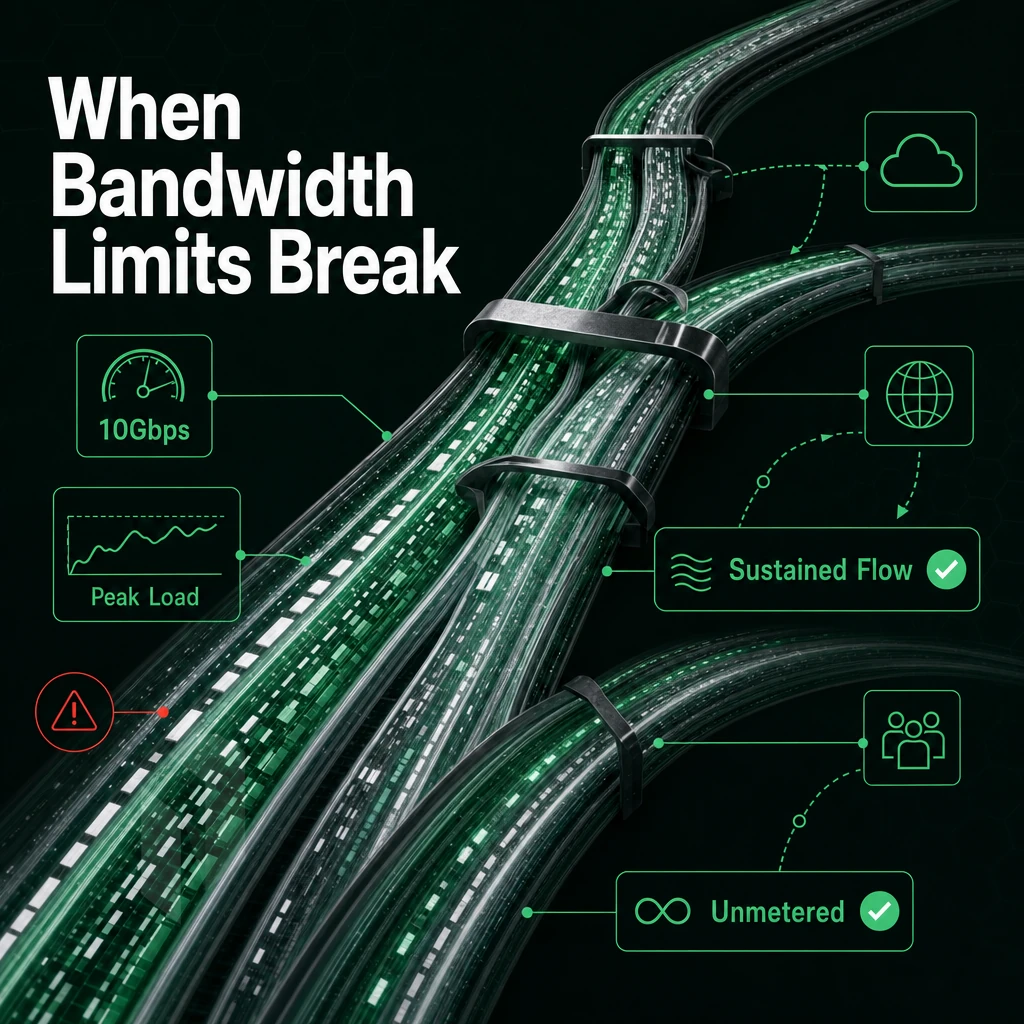
The following examples all share a common theme of sustained, high volume data transfer, and for each an unmetered dedicated server's bandwidth headroom translates directly into user experience and business continuity. Platforms delivering video content at scale benefit directly from unmetered 10 Gbps uplinks, as consistent throughput prevents buffering and maintains quality during simultaneous viewer sessions.
Content delivery networks and large-scale websites rely on this architecture to serve global audiences without degradation during traffic surges. For enterprise deployments, unmetered 10 Gbps infrastructure directly supports business continuity by eliminating transfer quotas that could otherwise interrupt critical operations during unexpected demand spikes.
Content Delivery Networks and Bandwidth-Hungry Dedicated Server Workloads
- Video streaming and large file distribution. While 4K or 8K streaming to thousands of users can soon fill a 1 Gbps connection, in the meantime, streaming and distribution can be supported with high stability using a 10 Gbps uplink. Here too, large software distributions and high volumes of large files are supported at scale.
- Content delivery networks. Edge nodes for CDN’s must handle sudden spikes of requests and then serve up the cached assets at line rate speed. Running a CDN on 10 Gbps hardware will keep the cache-hit latency to a minimum and prevent requests from having to go up to the origin server under load.
- Large scale online commerce e.g. E-commerce during peak traffic. Flash sales and seasonal events can shrink months of steady traffic to just hours. 10 Gbps dedicated servers are able to handle all that peak traffic without reducing e.g. checkout processes and general page load times.
Dedicated Servers for Latency-Sensitive and Other Demanding Workloads
- Online gaming servers. These servers can handle hundreds of players at the same time. They generate constant streams of state update packets. Thus low latency and high throughput are required. Packet queuing due to 1 Gbps link congestion even introduces additional latency (jitter) which is instantly eliminated by 10 Gbps connectivity.
- VPN providers. VPN providers run thousands of encrypted tunnels on a single host. Even though there’s real overhead from encryption, a 10 Gbps connection is enough to ensure that the density of tunnels never impacts the throughput of any given user.
Data-Intensive Back-End Workloads on Data Center Dedicated Servers
- Big data pipelines and backup replication. Data intensive applications such as ETL jobs, log aggregation and cross-site replication move large amounts of data in terabytes. Replication jobs are kept within maintenance windows by reducing transfer times from hours to minutes using a 10 Gbps link.
Note: Provisioning 10 Gbps without confirming the switch port and uplink path is a common mistake. Netrouting provisions unmetered 10 Gbps as standard on dedicated servers, with the full path engineered on our own AS6206 backbone, so the port speed you order is the speed you get. But raw port speed is only part of the equation: delivering a true high speed connection requires server hardware capable of sustaining line-rate throughput under real workload conditions.
Hardware Specs That Keep Up With a 10Gbps Uplink
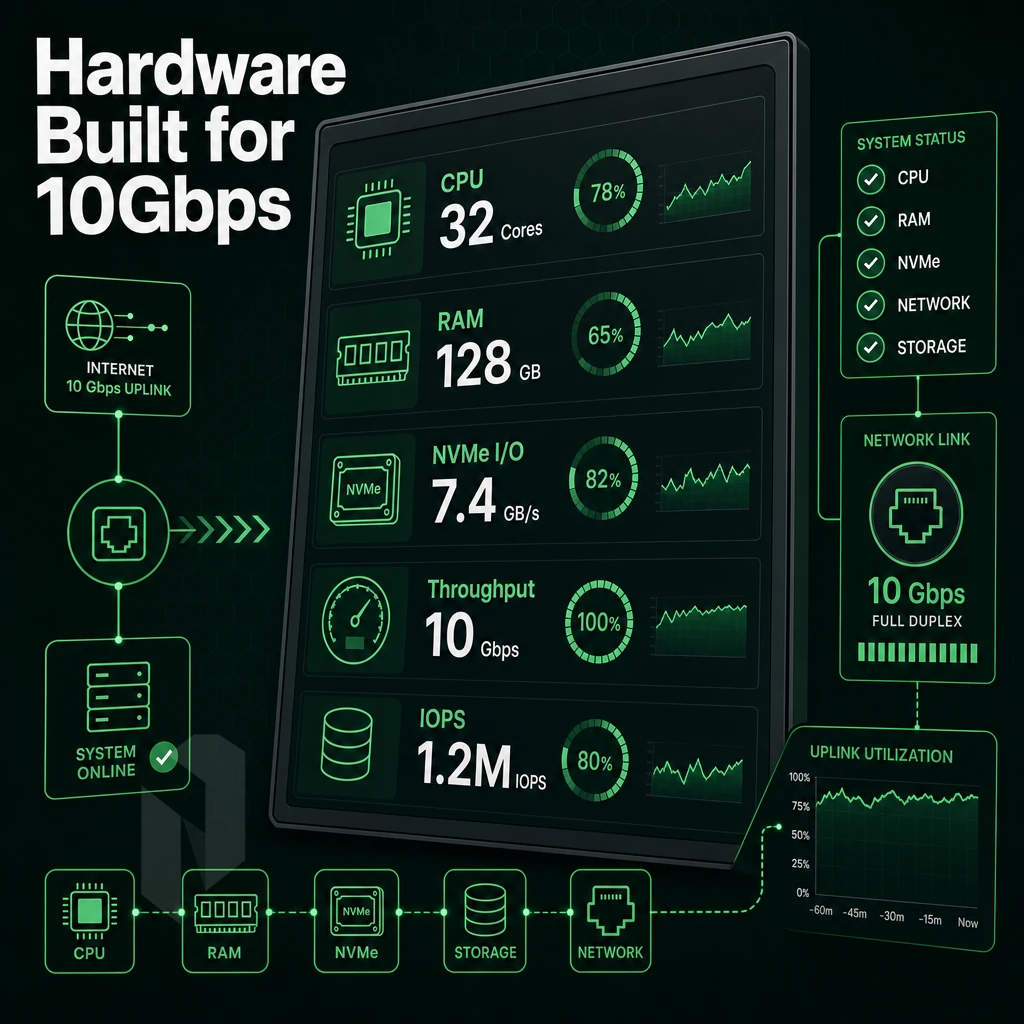
That means there’s a need for CPU headroom, sufficient RAM, and sufficient I/O on storage. Modern NVMe storage arrays can deliver the IOPS necessary to prevent disk bottlenecks when serving content at line rate across multiple concurrent sessions.
High Performance Dedicated Servers CPU and Memory Requirements
10Gbps links require substantial computing power to process packets, encrypt data, and manage connections. Even a large core count on an unmetered dedicated server is not enough to handle the high-concurrency workloads that mission critical applications demand at connection speed before the NIC reaches saturation. Processors such as Intel Xeon or AMD EPYC with high core counts and robust instruction sets are essential for wire-speed packet processing without CPU-bound bottlenecks.
Our 2× Intel Xeon E5-2680v2 test configuration delivers 20 CPU cores / 40 CPU threads at 2.80 GHz, well suited for demanding network workloads.
Finally, for single-socket tests, we chose the AMD EPYC 7402p processor, with 24 cores / 48 threads, and up to 512 GB of RAM. This is really top-of-the-line, enterprise-grade hardware, and is optimized for very memory-intense workloads of high-concurrency traffic. For workloads requiring dual-socket configurations, the intel xeon platform offers scalable processing power that complements the EPYC architecture in multi-tenant data center deployments.
Storage I/O: Matching Disk to Network Capacity
On enterprise grade hardware, NVMe SSDs deliver consistent performance with sequential reads above 3,000 MB/s, while SATA SSDs top out near 550 MB/s, roughly the 10Gbps (1,250 MB/s) interface rate for disk-bound work. With a sufficient interface, NVMe SSDs remove storage from the critical path entirely.
Hardware RAID, when implemented correctly, adds fault tolerance without any loss of performance.
High Performance Solutions Built Around the Uplink
High performance end to end requires matching the hardware to the corresponding network tier. Our high performance EPYC 7402p configuration, 24 cores, 512 GB RAM, 4 x 4 TB NVMe storage, and up to 20 Gbps network connectivity, is one of our high performance solutions where every layer is sized for the uplink, not the NIC.
In addition to the high performance hardware, each 10gbps dedicated server comes with predictable costs and a provisioning window of less than 60 minutes, so you can start using your infrastructure in no time. Of course, high performance hardware only has value if the network in the background is equally well engineered. This rapid deployment model allows your business to scale infrastructure on demand without lengthy provisioning delays that could impact project timelines.
Network Quality Beyond Raw Speed: Peering, Latency, and DDoS Protection
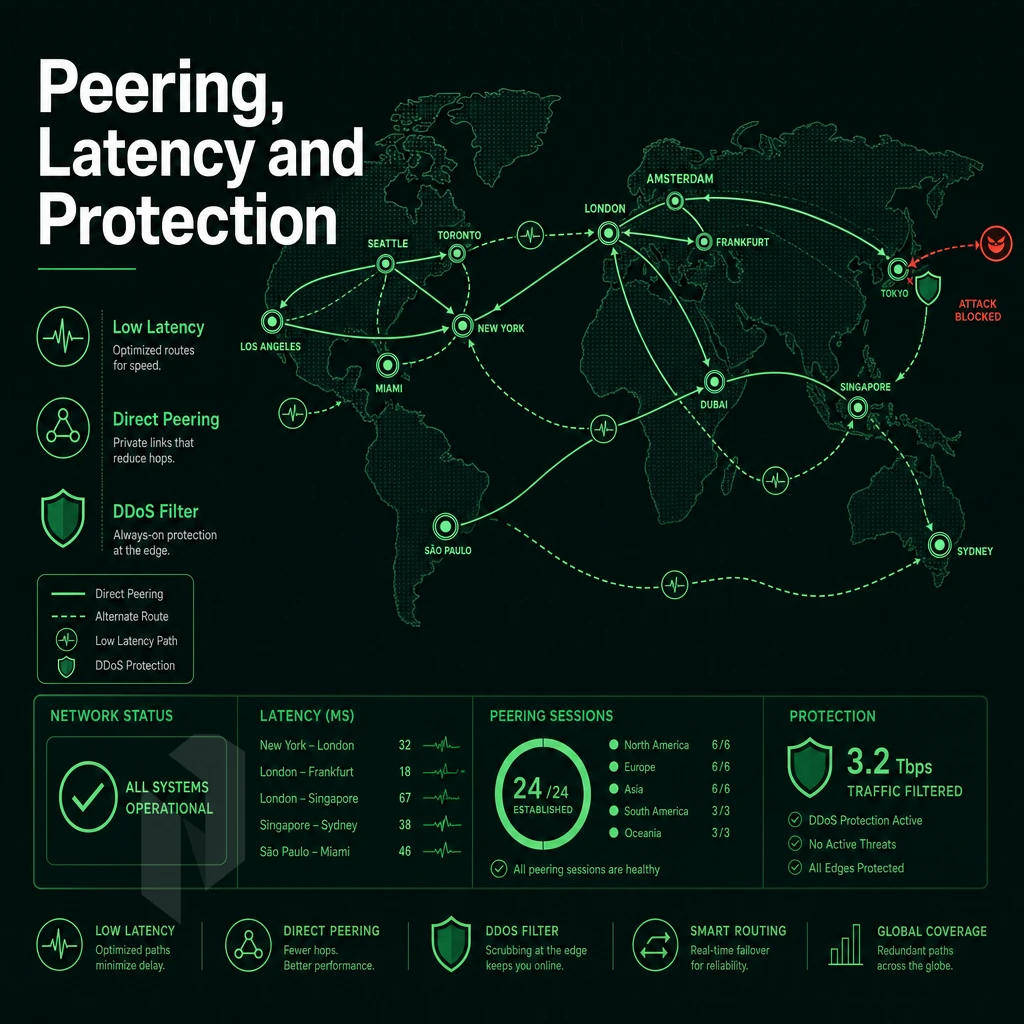
10Gbps ports are only as good as the network behind them. Raw link speed doesn’t count for much if the upstream network is congested, poorly peered or unprotected. What really matters are the quality of the backbone, the peering and how a network handles adversarial traffic.
Tier 1 Backbone, IX Peering, and Low Latency Connectivity
This results in lower latency connectivity for end users based in Europe, North America and Asia-Pacific.
Transit-only providers send all of your network traffic up to a few upstream carriers. IX peering eliminates these extra hops and sends traffic on the shortest path possible.
This headroom between the current utilization and the maximum possible utilization ensures consistent performance and prevents performance fluctuations during peak hours. High speed connectivity (10Gbps) requires sufficient upstream fabric headroom to be reliable.
DDoS Protection Included on Every Dedicated Servers Service
Our DDoS Protection Service is enabled for all services by default. This Layer 3/4 protection service detects and blocks volumetric based attacks automatically without the need for configuration. Applications such as online gaming, video delivery, etc. will greatly benefit from our always on service to ensure maximum up-time.
Advanced protection for the most sensitive environments adds application-layer protection, custom scrubbing rules, and increased network bandwidth throughput for highest risk operating systems and mission critical users.
BGP and BYOIP for Dedicated Servers Network-Level Control
We offer Full BGP support and bring-your-own-IP (BYOIP) which means you can manage routing at a network level. This means that as you add more servers in our datacenters around the world, you can announce your own prefixes. With these hosting solutions, you can set up failover and manage your IP reputation, all without having to re-IP your servers and change out your networking backbones.
Why Choose Netrouting for 10Gbps Dedicated Servers
Netrouting's dedicated servers ship with unmetered 10 Gbps as standard, no traffic quotas, no shared uplinks, no performance fluctuations during peak traffic. Every port connects to our own AS6206 backbone, a 2.4 Tbps+ network running consistently below 40% utilization. That headroom matters for data-intensive applications and bandwidth-intensive platforms that cannot tolerate congestion.
- Genuine unmetered bandwidth. Unmetered 10 Gbps dedicated network port on every server, scalable to 40 Gbps for demanding workloads, no data transfer limits or surprise overages.
- High-performance, enterprise-grade hardware. Dell and Supermicro chassis on Intel Xeon and AMD EPYC platforms. Custom builds available for specific requirements.
- Global low-latency footprint. Ten data center locations across Europe (Amsterdam, Frankfurt, The Hague, Rotterdam, Stockholm, Bucharest), North America (Miami, New York), and Asia-Pacific (Hong Kong, Singapore) for low latency connectivity wherever your users are.
- Always-on volumetric attack protection. L3/L4 mitigation included on every service at no extra cost, critical for gaming servers, live video broadcasting, VPN providers, and mission-critical applications.
- Rapid provisioning and 24/7 support. Bare metal online in under 60 minutes. Our NOC monitors infrastructure around the clock with a one-hour ticket guarantee.
We're ISO 9001, ISO 27001, and SOC 2 certified, the reliability baseline that e-commerce stores, streaming services, and high-performance solutions demand. If you need tailored solutions or want to compare configurations, contact our sales team to discuss your specific needs.
Key Takeaways: Choosing 10Gbps Dedicated Servers
A 10Gbps dedicated server delivers what shared and cloud environments cannot: a full-duplex reserved uplink, unmetered bandwidth, and consistent throughput under high traffic loads. When choosing between dedicated servers, the decision comes down to five factors: dedicated versus shared uplink, unmetered versus metered billing, backbone quality, built-in distributed denial-of-service mitigation, provisioning speed, and hardware generation.
Netrouting's 10Gbps dedicated servers check every box. Every 10gbps dedicated server runs on enterprise-grade Intel Xeon or AMD EPYC hardware with unmetered bandwidth, always-on network attack defense, and bare metal provisioned in under 60 minutes across ten locations in Europe, North America, and Asia. Explore Netrouting dedicated servers and find the right configuration for your workload.
A 10Gbps dedicated server is only as good as the network behind it. Raw port speed matters, but for e commerce stores and similar high-traffic platforms, unmetered bandwidth, low-latency peering, and always-on traffic scrubbing determine whether that throughput translates into real-world performance or just a number on a spec sheet.
Match the uplink to hardware that can actually saturate it. High-core-count processors, NVMe storage, and sufficient RAM prevent the server itself from becoming the bottleneck.
Netrouting delivers unmetered 10Gbps as standard on dedicated servers, backed by a 2.4Tbps+ backbone on AS6206 with dense IX peering across Europe, North America, and Asia. Every server includes always-on L3/L4 DDoS defense at no extra cost. If your workload demands sustai ned throughput without surprise fees, explore Netrouting's dedicated server configurations or contact the sales team for a custom build.