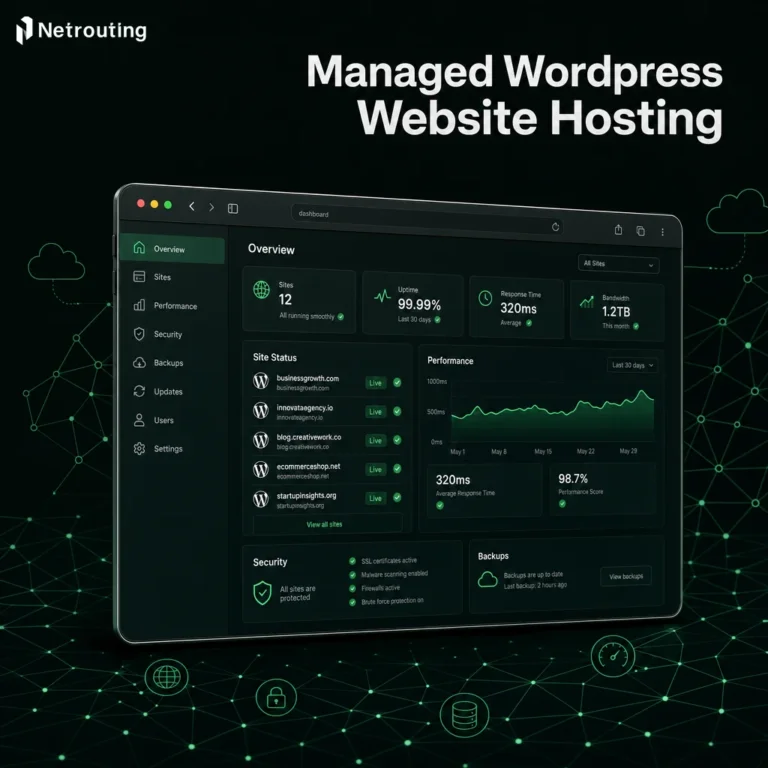


Picking the right website hosting for a small business is a balance between getting good performance from your site, good reliability and cost. Because you don’t have a dedicated IT department to sort things out for you when things go wrong with your site’s hosting. Whether you run an online business or maintain a local storefront with digital reach, downtime translates directly into lost revenue and customer trust.
The wrong hosting can quickly cost you in terms of time when your site is down, slow to load or when you get held in limbo by unhelpful support tickets. The good hosting service on the other hand will be almost invisible, just as you want.
Reputable providers mitigate this risk by offering a money back guarantee that lets you test performance and support responsiveness before locking into a long-term contract. Evaluating a hosting provider on uptime guarantees and ticket response times before committing ensures your infrastructure aligns with business continuity requirements.
Blog contents
We cut through the noise and provide business and companies from Europe, North America and Asia with infrastructure in the data centers of Netrouting since 2007. From lean startups to very large websites that need dedicated servers and enterprise level uptime, our many years of experience as infrastructure engineers is reflected in all that we do.
We'll cover the criteria that actually matter when evaluating web hosting services for small businesses: server types and when each makes sense, network quality and what "uptime" really means in practice, support responsiveness, scalability as your traffic grows. Additionally, Security fundamentals including DDoS protection. By the end, you'll have a clear framework for matching your workload to the right hosting environment, and the right provider. For community perspectives, see Best web hosting for small business owners who are not ....
What Is Website Hosting for Small Business, and Why It Matters
For businesses with an online presence, web hosting is a crucial component to running a successful website. For many small business owners, however, web hosting is a mystery. Understanding the basics of web hosting will help you pick the best web hosting service for your needs and avoid getting ripped off by unnecessary expenses. Most importantly, it will keep your website up and running 24/7. Many providers at this tier also bundle email hosting with domain registration, centralizing communication infrastructure under a single vendor.
What Web Hosting Services Actually Do
A web hosting service like us stores all your website’s files on a server in a data center connected to the Internet. All the files for your website, HTML, images, databases, code, etc. When someone accesses your website by typing in your website’s address in a web browser, we serve up all the relevant files in a matter of milliseconds.
The domain name for your website (yourbusiness.com) is separate from your website hosting. It is the signpost and the web hosting is the building behind the signpost. You can register the domain name through a domain name registrar and then point it to your hosting account. You can buy a domain name and hosting account from two different companies. Many providers bundle email hosting with domain registration, allowing businesses to create professional addresses that match their domain without purchasing separate services.
For a small business website, reliable hosting means:
- Fast page loads that keep visitors from bouncing.
- Enough storage and bandwidth to serve your content.
- Security and uptime for around the clock customer support.
The Four Main Types of Web Hosting Services
Not all web hosting is created equal. There are four basic types of web hosting that cover the needs of most small businesses.
- Shared hosting, where multiple websites are hosted from the one server. Very low cost, but little control over the server. Best used by very early websites with minimal traffic.
- VPS hosting (Virtual Private Server), Virtual Private Server (VPS) Hosting, Your VPS is a virtual private server, which is allocated a fixed set of resources on a shared server. This type of hosting offers more room for growth than shared hosting and includes root access.
- Dedicated hosting: It’s a whole physical server dedicated to your needs. The ultimate in performance and control. Best for sites with huge traffic volumes, or for companies who need to comply with specific rules and have full control of their server.
- Cloud hosting, which provides access to resources of a distributed infrastructure pool. It is very suitable for peak traffic and for companies in growth phase, because it can scale on demand.
Each section of this guide to technical analysis models is a detailed guide to one of the models.
What Are the Best Web Hosting Services for Small Business?
There is no single ‘right’ answer here as it very much depends on factors such as current traffic, technical requirements of the site and business growth plans. However, generally early-stage websites are typically deployed on shared hosting and then migrate up through the hosting tiers as required. Businesses with sensitive data or very high levels of consistent traffic tend to want to migrate to a VPS or dedicated server very quickly.
Migrating an existing website from shared infrastructure to a VPS typically involves minimal downtime when planned correctly, with DNS propagation being the longest step in most transitions. Businesses seeking hands-off infrastructure often choose managed hosting to offload server maintenance, security patching, and performance tuning to the provider's operations team. Providers at this tier often include a money back guarantee period, typically ranging from 14 to 30 days, allowing businesses to validate performance benchmarks before finalizing their infrastructure commitment.
We offer bare metal servers and cloud servers across 10 locations around the world: in Europe, in North and South America, and in Asia. Our network is based on our own AS6206 IP range. With 2.4 Tbps+ of dedicated infrastructure we can help companies that have long since left the regular webhosting out of their growth plans. We provide them with the hosting infrastructure that they can grow with, without any unpleasant surprises along the way.
The 4 Types of Web Hosting Services Explained
There are many types of web hosting plans, not all of which are created equal. When choosing web hosting for small sites or larger ones, one must take into consideration the amount of traffic a site receives, the amount of money one is willing to spend on a hosting plan. Additionally, The level of control that one needs to have access to in order to configure the server environment. Below is a comparison of the four main types of web hosting plans.
Shared Web Hosting
Multiple sites share one server's CPU, RAM, and disk. Resource usage is capped per account Many entry-level plans also advertise unlimited bandwidth to accommodate traffic spikes without overage fees, though fair-use policies typically apply at extreme consumption levels.
How to Choose the Best Web Hosting Services for Your Small Business
| Provider / Option | Performance | Support | Uptime Guarantee | Network | Best For |
|---|---|---|---|---|---|
| Shared Hosting Platforms | Shared CPU and RAM, performance varies with neighbor load | Phone support and live chat; bundled control panel and free domain on most plans | 99.9% uptime guarantee typical | Single datacenter; limited routing control | Brand-new company website with minimal traffic |
| Managed WordPress / CMS Platforms | Optimized stack for one content management system; poor fit outside that CMS | CMS-specialist support; no phone support on entry tiers | 99.9% uptime guarantee; auto-scaling on higher tiers | CDN included; no BGP or transit control | Content-heavy site hosted on WordPress with minimal DevOps |
| Cloud VPS (major platforms) | Burstable vCPU; consistent for moderate workloads | Ticket-based; phone support on paid tiers; full site management left to the user | 99.9% uptime guarantee; no hardware SLA | Proprietary backbone; egress fees apply | Growing business needing flexible compute without dedicated hardware |
| Netrouting Dedicated / Managed Hosting | Dedicated Intel Xeon or AMD EPYC hardware, no shared resources; bare metal provisioned in under 60 minutes | 24/7 NOC, 1-hour ticket guarantee; managed control panel (cPanel or DirectAdmin) with full site management handled on request; phone support via EU and US lines | 99.9% uptime guarantee; same-business-day hardware replacement | 2.4 Tbps+ network on AS6206; unmetered 10 Gbps; always-on DDoS protection; 10 locations across Europe, North America, and Asia | Business needing a company website with room to scale, site hosted on dedicated hardware, free domain not bundled but full infrastructure control included |
For a straightforward company website with light traffic, a shared hosting platform with a bundled free domain and basic control panel covers the basics. Businesses that expect growth, or run a WordPress site alongside e-commerce or custom applications, benefit from a managed VPS or dedicated server for stronger site management and uptime guarantees.
Specialized wordpress hosting plans deliver optimized caching layers and automatic plugin updates that keep content-driven sites secure and fast. Some providers bundle a drag-and-drop website builder into entry-level plans, which can accelerate launch timelines for teams without in-house design resources. Professional email hosting with custom domain addresses reinforces brand identity and ensures reliable communication channels for customer inquiries and internal collaboration.
Additionally, Network quality are not shared with thousands of other tenants. Netrouting stands apart from most web hosting companies when your site on shared infrastructure has hit its ceiling, offering dedicated hardware, a managed control panel, and 24/7 phone support on both continents. Additionally, A 2.4 Tbps+ backbone deliver the performance and reliability a scaling business demands. Clients who test our infrastructure can do so risk-free under our 30 day money back guarantee, ensuring compatibility with their workloads before committing long-term.
Best Web Hosting Services: What the Top Providers Actually Offer

The best web hosting services for small businesses bundle far more than raw server space. Understanding what each tier actually delivers, and where the trade-offs live, helps you match infrastructure to workload before you sign a contract. Evaluating web hosting for small operations requires clarity on uptime SLAs, backup retention policies, and whether the plan includes SSL certificates or charges them separately.
Look for providers that offer a 30 day money back guarantee so you can test performance and support quality without long-term commitment risk. Evaluating whether free ssl certificates are included or billed as add-ons can save recurring costs and simplify certificate renewal workflows. Compare how each hosting provider structures its SLA terms, because uptime percentages alone do not reveal compensation thresholds or incident response windows.
What Are the 4 Types of Web Hosting?
Most web hosting companies organize their catalog around four core models.
- Shared hosting. Multiple sites share a single server's CPU, RAM, and storage. Low cost, low control. Suited to low-traffic brochure sites.
- VPS hosting. A physical server is partitioned into isolated virtual machines. You get dedicated resources and root access at a mid-range commitment level.
- Dedicated / bare metal hosting. One server, one tenant. Full hardware access, predictable performance, no noisy-neighbour risk.
- Cloud hosting. Workloads run across a distributed pool of nodes. Resources scale horizontally on demand, and billing tracks actual consumption.
What Consumer-Grade Providers Typically Bundle
Entry-level plans from other hosting companies commonly include a free domain name for the first year, a drag-and-drop website builder, and one-click CMS installers. Managed WordPress hosting, where the provider handles core updates, caching, and staging environments for a WordPress website, sits at the premium end of this tier. A robust content management system simplifies editorial workflows and allows non-technical staff to publish updates without touching code or server configurations.
Many providers integrate a drag-and-drop website builder directly into the dashboard, enabling rapid prototyping without requiring design or coding skills. Plans at this tier frequently bundle email hosting with the domain registration, allowing businesses to create professional addresses that match their brand without purchasing separate services.
WordPress hosting at this level abstracts away server management entirely. That convenience comes with constrained resource ceilings, limited BGP or network control, and shared infrastructure that can bottleneck under traffic spikes. Businesses that lack in-house DevOps expertise often accept these trade-offs because the provider manages all the technical aspects behind the scenes.
The provider typically maintains the underlying operating system patches and security updates, shielding users from low-level server administration tasks. Businesses evaluating managed hosting should confirm whether the plan includes proactive security monitoring and whether migration assistance is provided when onboarding from another provider. Providers at this tier often include baseline security features such as malware scanning and DDoS mitigation to protect sites from common threats.
Most consumer plans also advertise unmetered bandwidth, but fair-use clauses in the terms of service cap sustained throughput, read the acceptable-use policy, not just the headline.
Automatic backups and a day money back guarantee are now near-universal at this tier. Backup schedules vary: daily snapshots are standard, but retention windows and restore granularity differ significantly between providers. Most providers at this tier also bundle free SSL certificates through Let's Encrypt, automating renewal cycles to maintain encrypted connections without manual intervention.
Plans at this tier typically include unlimited bandwidth to accommodate traffic growth without overage fees, though fair-use policies may still apply during sustained abuse or attack scenarios. Providers at this level often layer in additional security features such as malware scanning, DDoS mitigation, and web application firewalls to protect against common threats.
Where Netrouting Fits
Netrouting does not offer shared hosting, website builders, or managed WordPress, and that is deliberate. Our catalog targets businesses that have outgrown consumer-grade infrastructure, offering web hosting providers and enterprises dedicated bare metal servers, cloud compute, colocation, and managed hosting across ten locations in Europe, North America, and Asia. Teams that have scaled past the constraints of a website builder gain full root access, custom kernel configurations, and the ability to deploy containerized workloads across our global footprint.
For small businesses running resource-intensive applications, high-traffic e-commerce, or latency-sensitive workloads, that separation matters. You get dedicated hardware, unmetered 10 Gbps connectivity, always-on DDoS protection, and a 99.9% uptime SLA, not a shared pool with a polished admin panel bolted on top.
Clients requiring hands-off server administration can layer managed hosting on top of bare metal or cloud instances, delegating patching, monitoring, and incident response to our engineering team. Enterprise-grade security features include hardware firewalls, intrusion detection systems, and encrypted storage volumes that protect sensitive business data at rest and in transit. Selecting the right hosting provider at this tier requires evaluating not just hardware specifications but also network architecture, incident response protocols, and geographic distribution of infrastructure.
Shared vs Dedicated Web Hosting Services: Which Is Right for You?
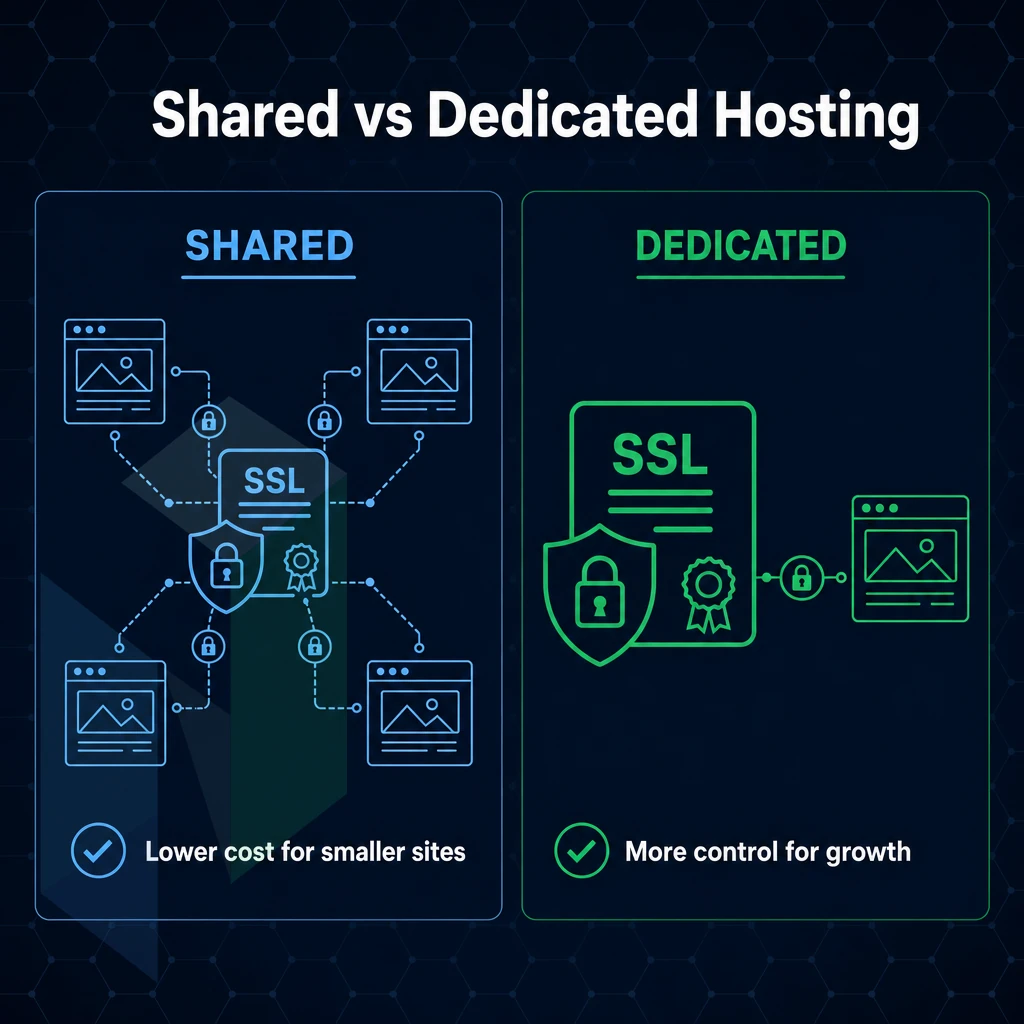
The right hosting type depends on your traffic, compliance requirements, and growth trajectory. Shared plans and dedicated servers sit at opposite ends of the spectrum, understanding where each fits helps you avoid overpaying or underbuilding. Evaluating your hosting provider against these criteria ensures that infrastructure scales in step with business demands rather than becoming a constraint.
When Cheap Hosting Makes Sense
Shared hosting puts multiple sites on a single physical server. Costs stay low because resources are divided across tenants. Most hosting providers offer shared plans as their entry-level tier, often bundled with a website builder and basic email.
It suits a personal website, a local service page, or an early-stage business with modest traffic. If your site rarely exceeds a few hundred daily visitors, shared infrastructure handles the load without complexity.
The trade-off is real, though. You inherit limited features around performance tuning, custom firewall rules, and resource guarantees. A traffic spike from a neighbouring tenant can degrade your response times with no recourse.
When Dedicated Hosting Is the Better Call
A dedicated server gives you an entire physical server, no shared tenants, no noisy-neighbour risk. Every CPU cycle and gigabyte of RAM belongs to your workload.
This matters most for:
- E-commerce sites handling payment data under PCI DSS.
- Healthcare or legal platforms with strict data-residency rules.
- High-traffic business website deployments where latency directly affects revenue.
- Applications requiring custom kernel modules or specific security features.
Netrouting's bare metal servers provision in under 60 minutes and ship with always-on DDoS protection. That combination of speed and security is difficult to match on shared infrastructure.
Do Small Businesses Need Dedicated Hosting?
Not always, but more do than expect it. The turning point is usually compliance, consistent performance, or rapid growth. VPS and cloud compute sit between shared and bare metal: more isolation than shared website hosting, lower commitment than a full dedicated server. They work well as a stepping stone while traffic scales.
When your workload outgrows that middle ground, dedicated hardware becomes the rational next move, not a luxury.
Cheap Hosting and Free Plan Options: What You Get (and What You Sacrifice)

Budget hosting options attract small businesses with low entry costs and zero-commitment trials. But the gap between advertised unmetered bandwidth and what's actually delivered in cheap hosting plans is significant, and the long-term cost is rarely as low as the headline suggests.
What a Free Plan Actually Gives You
A free plan typically bundles a subdomain address, capped storage (often under 1 GB), and forced platform ads on your pages. You won't get a custom domain. Performance is throttled, shared CPU and RAM limits mean slow load times under any real traffic. Uptime guarantees are absent or unenforceable.
Some providers bundle plans free domain registration as a first-year incentive, then charge renewal fees that erode the initial saving. Read the fine print before committing.
What Cheap Hosting Plans Include, and What They Don't
Entry-level paid plans improve on the free tier but still cut corners. The table below maps what you typically get versus what's commonly omitted.
| Feature | Cheap Shared Hosting | Netrouting Cloud / Bare Metal |
|---|---|---|
| SSL certificate | Free SSL on most plans | Included; full certificate control |
| Automatic backups | Often a paid add-on | Daily + incremental; 30-day retention |
| Uptime SLA | 99.9% claimed; rarely guaranteed | 99.9% contractual SLA |
| Support | Ticket-only or chatbot | Round the clock support, 1-hour response guarantee |
| Resources | Shared CPU/RAM, hard caps | Dedicated cores, up to 2 TB RAM |
What is the Difference Between Shared Hosting and VPS Hosting?
Shared hosting places your site on a server alongside hundreds of others. Everyone competes for the same CPU, RAM, and disk I/O. One busy neighbour degrades performance for all. It's cost-effective for minimal traffic but collapses under load.
VPS hosting carves out a guaranteed slice of a physical server. Your CPU and RAM allocation is reserved, other tenants can't consume it. You get root access, a choice of OS, and predictable performance. Latency and throughput stay consistent even during peak traffic.
The practical difference: shared hosting is a starting point. VPS is where businesses move when reliability and performance actually matter.
Total Cost of Ownership: The Hidden Upgrade Path
Cheap hosting plans rarely stay cheap. Automatic backups, staging environments, and priority support are frequently sold as add-ons. Migration fees apply when you outgrow the tier. Unplanned downtime carries its own cost, lost transactions, damaged search rankings, and customer churn.
Businesses that have moved past the early-stage threshold, consistent traffic, revenue-generating sites, compliance requirements. Find that the total cost of ownership on budget tiers exceeds what a properly specified dedicated or cloud environment would have cost from the start. Netrouting is built for that next stage: dedicated hardware, a 2.4 Tbps+ network, and infrastructure that scales without surprise fees.
WordPress Site Hosting: What Small Businesses Need to Know
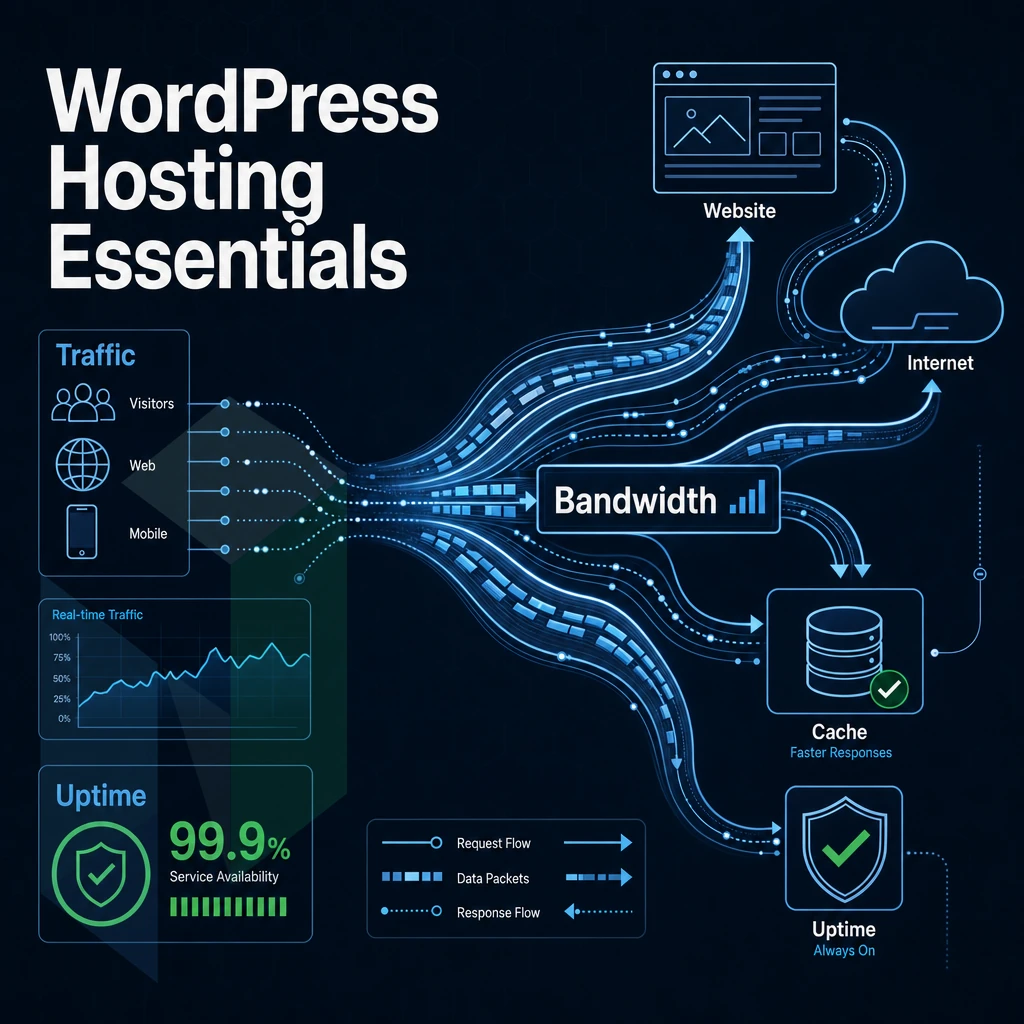
WordPress powers a significant share of the web. For small business owners, choosing the right hosting environment for a WordPress site determines speed, security, and how easily the site scales. Here's what to evaluate before you commit.
WordPress Web Hosting Requirements
WordPress runs on PHP and MySQL. Any host must support a compatible operating system stack, typically Linux with Apache or Nginx, PHP 8.1+, and MySQL 8.0 or MariaDB 10.6+. Confirm these before signing up.
Storage and bandwidth matter too. A lean business site with a few pages needs far less than a media-heavy store. Plan for growth: image libraries and plugin overhead add up quickly.
Managed WordPress Web Hosting vs. Self-Managed
Consumer managed WordPress services handle updates, caching, and backups automatically. They suit owners who want zero server involvement. The trade-off is limited control, you can't always install arbitrary plugins or run multiple sites under one account.
Self-managed WordPress on a VPS or dedicated server gives full control. You choose the stack, configure caching, and own the environment. It requires more technical comfort, but the flexibility is significant.
Note: Netrouting's Managed Control-Panel Servers, running cPanel/WHM or DirectAdmin, are built for agencies and resellers who want to host their own website alongside client accounts. This is not consumer managed WordPress hosting. It's infrastructure with a managed control panel on top.
When Should a Small Business Upgrade from Shared to Dedicated Hosting?
Upgrade when shared resources become a bottleneck. Slow page loads, frequent downtime during traffic spikes, or a security incident caused by a neighbor on the same server are clear signals.
Dedicated hosting also makes sense when compliance or data isolation is required. Site setup on a dedicated server gives you full root access, a clean environment, and no noisy neighbors. Site building at scale, whether running WooCommerce, membership plugins, or high-traffic blogs, benefits from dedicated CPU and RAM that shared plans, even those bundled with a free domain, simply can't guarantee.
Netrouting's bare metal servers provision in under 60 minutes and support DirectAdmin or cPanel out of the box, making them one of the best web hosting services to consider as a practical step up from VPS hosting when your WordPress workload outgrows shared infrastructure.
Best Web Hosting Comparison Table for Small Businesses
Not all hosting plans suit every stage of growth. The table below maps each hosting type, including vps hosting, to the workloads and team sizes where it performs best, helping you identify the best web hosting services for your current needs and match the right infrastructure without over-spending or under-provisioning.
Small Business Web Hosting Services Comparison
| Hosting Type | Best For | Key Features | Scalability | Typical Support |
|---|---|---|---|---|
| Shared Hosting | Early-stage sites, low traffic | Shared resources, control panel included | Low, resource ceiling hit quickly | Ticket and email |
| VPS Hosting | Growing sites needing isolation | Dedicated vCPU and RAM, root access | Medium, vertical scaling within host limits | Ticket, some live chat |
| Cloud Hosting | Variable or spiky traffic loads | Elastic resources, pay-as-you-scale model | High, horizontal and vertical | 24/7 ticket and chat |
| Dedicated Hosting | High-traffic or resource-intensive apps | Full hardware tenancy, custom configs | High, hardware upgrade or add nodes | 24/7 NOC, priority response |
| Managed Hosting | Teams without in-house sysadmin capacity | OS patching, monitoring, security hardening | Depends on underlying tier | Proactive, 24/7 NOC |
Matching Hosting Plans to Growth Stage
Shared Web Hosting Plans
suit pre-revenue or low-traffic sites where cost control matters most. Opening a hosting plan on shared infrastructure is fast, but resource contention limits headroom.
As traffic grows, VPS or cloud hosting plans deliver the isolation and elasticity that small business sites need without the overhead of managing physical hardware.
When Managed Hosting Makes Sense
Managed Web Hosting
removes the operational burden entirely. It suits any hosting for small business teams that lack dedicated sysadmin staff, the provider handles patching, monitoring, and hardening while you retain root access.
At enterprise scale, dedicated or colocation infrastructure, delivered by specialist web hosting providers like Netrouting, gives full hardware control, predictable performance. Additionally, Small business web hosting economics that scale without the cost surprises common on hyperscaler platforms.
Key Features Every Small Business Web Hosting Plan Should Include
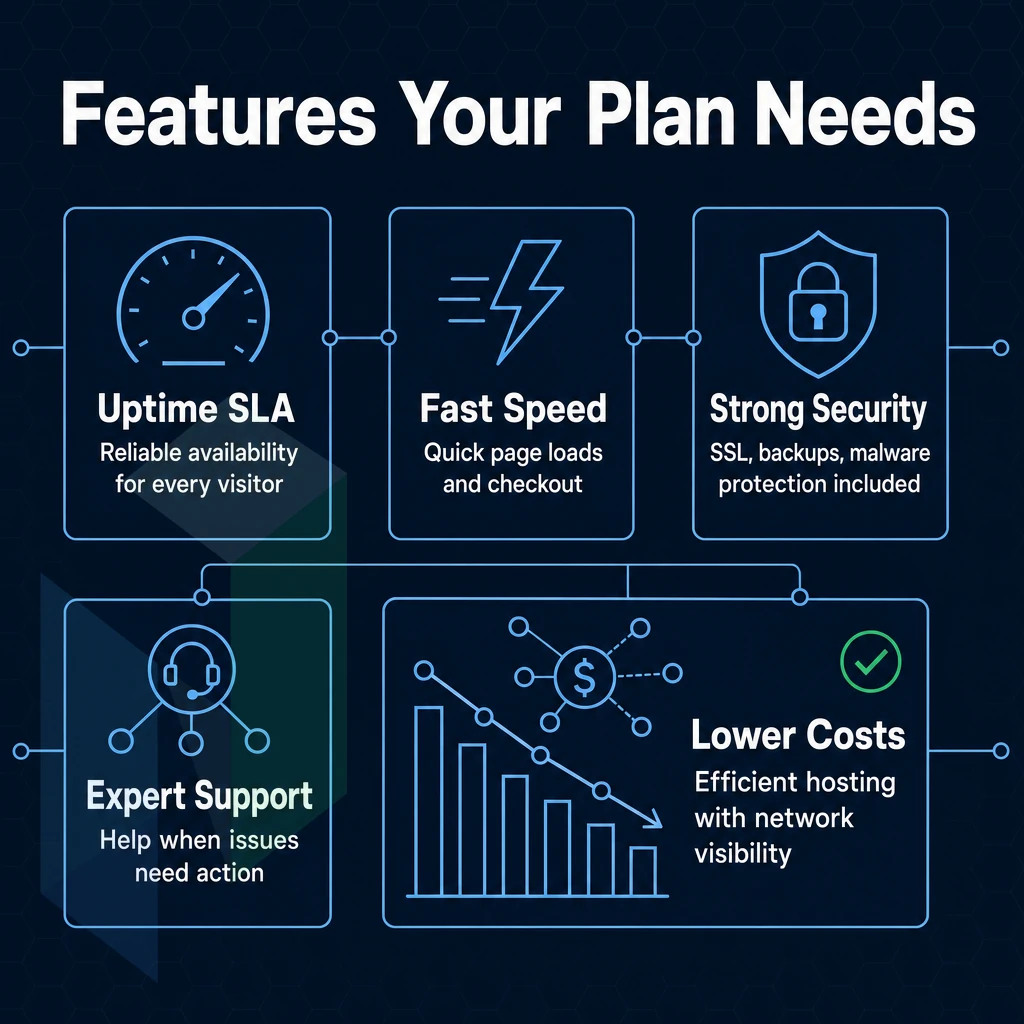
Not every web hosting plan is built equal. Small businesses need a specific combination of reliability, security, and support to stay competitive online. Here's what to look for before you commit.
Uptime, Reliability, and Site Speed
Downtime costs revenue. Look for a provider with a documented uptime guarantee, the industry baseline is 99.9%, which limits unplanned outages to under 45 minutes per year.
Page load performance matters just as much. Slow servers hurt search rankings and push visitors away. Prioritize providers running modern hardware with low-latency network connections and consistently uncongested ports.
Security Features and DDoS Protection
Security is non-negotiable. A solid plan includes free SSL certificates, which encrypt data in transit and are now a baseline requirement for browser trust and search visibility.
Beyond SSL, look for these security tools in any plan you evaluate:
- Always-on DDoS protection at the network layer.
- Firewall rules and traffic filtering.
- Malware scanning and intrusion detection.
At Netrouting, always-on L3/L4 DDoS protection is included with every service, no add-on required, no configuration needed.
Backups, Bandwidth, and Support
Automatic backups protect you when things go wrong. Look for daily incremental backups with a fast restore capability, ideally under an hour for typical site data.
On bandwidth, the terms unmetered bandwidth and unlimited bandwidth appear frequently in hosting marketing. Read the fine print. Unmetered means no cap on data volume; unlimited often carries fair-use clauses. Confirm what applies before signing.
Email hosting is a common requirement for small businesses, verify your provider supports it or integrates cleanly with a dedicated mail service.
Finally, responsive customer support is essential. Look for 24/7 availability, a staffed NOC, and a guaranteed ticket response time, not just a chatbot.
When Small Businesses Outgrow Shared Hosting

Growth is the goal, but shared hosting wasn't built for it. When traffic climbs, resource caps bite, and a single slow page can cost a sale. Recognising the warning signs early makes the upgrade path far less painful.
Signs You've Outgrown Shared Web Hosting
Shared environments pool CPU, RAM, and I/O across dozens of tenants. Hit your allocation and site speed drops, often past the 3-second threshold where most visitors abandon. Security incidents are another red flag: shared infrastructure means one compromised neighbour can affect yours.
Custom software requirements accelerate the problem. PHP version locks, restricted ports, and no root access block the tools modern applications need. When your stack outgrows the platform, the platform is the bottleneck.
The Upgrade Path: From VPS to Dedicated
Most small businesses follow a predictable progression. A VPS isolates your resources without the cost of a full machine. Cloud hosting adds elastic scaling for variable traffic. A dedicated server delivers maximum performance, dedicated cores, dedicated RAM, no noisy neighbours, for high-traffic or compliance-sensitive workloads.
| Tier | Typical RAM | Uptime SLA | Best For |
|---|---|---|---|
| VPS | 2-16 GB | 99.9% | Growing sites, dev environments |
| Cloud Compute | 4-64 GB | 99.9% | Variable traffic, rapid scaling |
| Bare Metal | 64-512 GB | 99.9% | High traffic, custom stacks, compliance |
Managed Hosting and Multiple Websites
No in-house sysadmin? Managed VPS hosting closes that gap. The provider handles OS patching, security hardening, and monitoring. You retain root access and focus on the business.
Agencies and growing teams often need to manage multiple websites under one roof. Managed control-panel servers, running DirectAdmin or cPanel, centralise that without adding headcount.
Other web hosting companies bundle management as an upsell with opaque terms. Netrouting includes proactive monitoring and a 1-hour ticket guarantee as standard, so you know exactly what you're getting before you sign.
Decision guide
If you're hitting speed or resource walls, move to cloud compute. If you need custom software or compliance controls, go bare metal. If you lack the team to manage it, add managed hosting, don't let operational overhead slow the business down.
Why Choose Netrouting for Small Business Website Hosting
Most web hosting providers push small businesses toward shared hosting plans with limited features, oversold resources, and little room to grow. Netrouting's hosting services are built differently, infrastructure-grade performance without the hyperscaler complexity or unpredictable billing.
Here's why small business owners running serious business websites choose us over other web hosting companies:
- Dedicated servers and cloud compute on demand. Start with flexible cloud hosting instances and scale to a dedicated server, a real physical server with no noisy neighbours, without migrating your stack. Rapid provisioning means your server is live in under 60 minutes.
- Managed hosting with full root access. We handle OS patching, security hardening, and proactive monitoring. You keep complete control. Managed Control-Panel Servers running cPanel/WHM or DirectAdmin let you manage multiple websites and client accounts without touching the underlying infrastructure.
- Always-on DDoS protection at no extra cost. Every service includes L3/L4 mitigation. Your business site stays online during volumetric attacks, no add-on required, no configuration needed.
- 99.9% uptime SLA with 24/7 support. Our uptime guarantee is backed by a 1-hour ticket response commitment and a round-the-clock NOC. Customer support is available around the clock via ticket and live chat.
- Global network, local performance. Ten data center locations across Europe (Amsterdam, Frankfurt, The Hague, Rotterdam, Stockholm, Bucharest), North America (Miami, New York), and Asia-Pacific (Hong Kong, Singapore) on our own 2.4 Tbps+ AS6206 backbone. Low latency wherever your customers are.
- Certified and audited. ISO 9001, ISO 27001, and SOC 2, the security features and compliance standards enterprise clients demand, available to growing businesses from day one.
If your small business web hosting needs have outgrown generic shared hosting, speak with our team. We'll match the right hosting plan to your workload, no overselling, no guesswork.
The Core Hosting Types for Small Business: A Quick Recap
Four hosting types cover almost every small business scenario. Shared hosting suits early-stage sites with tight budgets, resources are pooled, and most shared hosting plans include a free domain and free SSL certificates.
VPS hosting steps in when a growing business site needs dedicated resources without the cost of a full bare-metal server. Cloud hosting fits businesses that need elastic scaling across multiple websites or unpredictable traffic spikes. Dedicated hosting is the right web hosting plan for high-traffic, resource-intensive workloads that demand maximum performance and isolation.
The right hosting for small business comes down to where you are now and where you're headed. Start with the hosting service that matches today's traffic, then scale your web hosting as the business grows. Managed hosting options exist at every tier for owners who'd rather not handle the technical side.
How Cloud Hosting Works for Small Business Websites
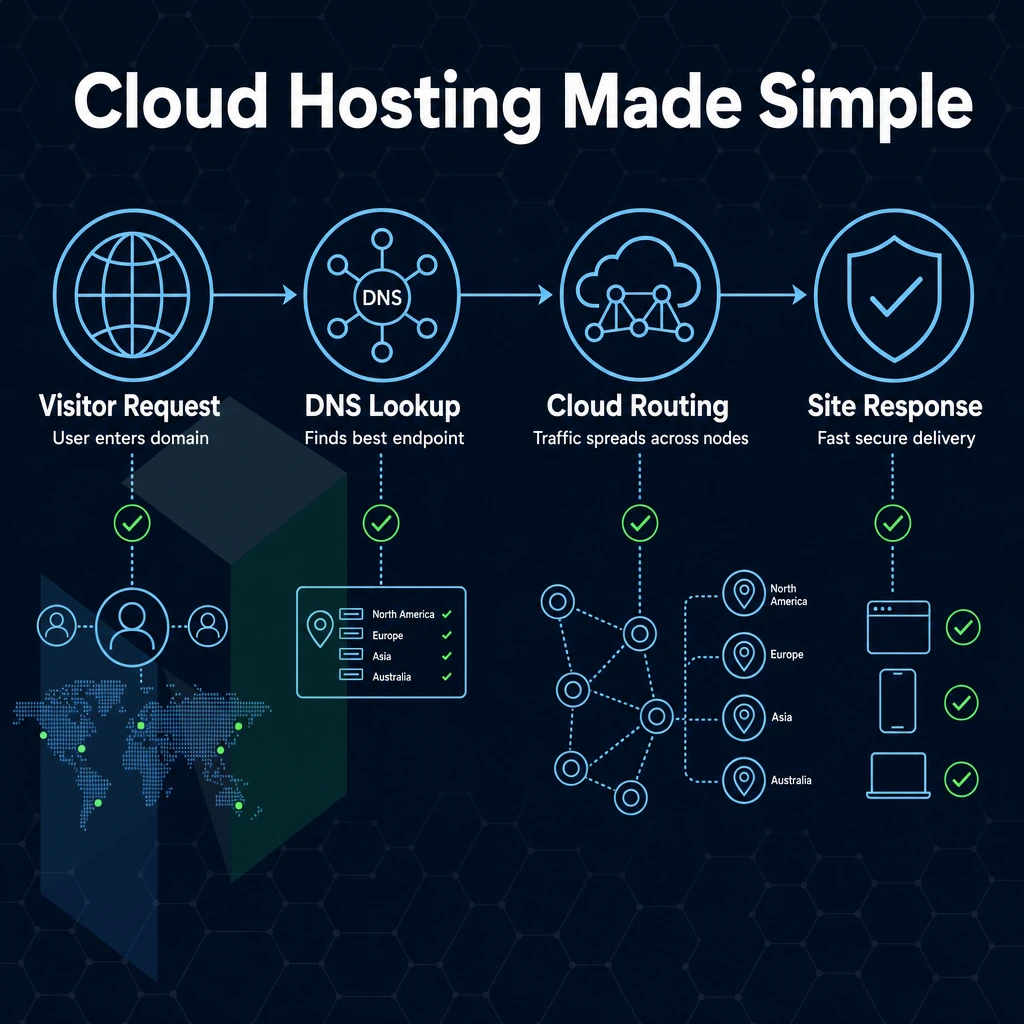
Cloud hosting is different from other types of hosting in that your site is never actually hosted on a single server. Instead, your site is hosted across a network of servers. So, for example, if one server in a network of servers were to develop a hardware problem, the load would simply be shifted to another server.
For a small business, this type of web hosting is very appealing since a single server failure would typically result in hours of downtime and degraded site speed while the server is repaired or replaced, a situation most small businesses cannot afford. In contrast, a cloud hosting configuration provides a very safe environment for your site, far safer than a single-server shared hosting environment.
Resources in a cloud are typically provisioned on the fly as needed. For example, when a product launch or a seasonal shopping event in the free domain of e-commerce generates a huge traffic volume, a cloud platform used as web hosting for small businesses can automatically pull in more CPU and RAM as needed.
With WordPress or cloud hosting plans, you only pay for the resources you actually use on an as-needed basis and can scale back down once the high-traffic period is over. This is the opposite of traditional shared hosting and VPS hosting plans where your resources are fixed at the time you sign up for a hosting plan.
Cloud hosting is an intermediate solution between cheap shared hosting plans and fully managed dedicated servers. The cost is in between and the features as well. A small online shop with a few hundred daily transactions, a booking portal with fluctuating loads, or a SaaS microservice are typical use cases where finding the best web hosting tier between shared and dedicated becomes critical. Provisioning and managing physical servers is not required for these scenarios.
The performance predictability of a cloud hosting environment is a trade-off that you need to be aware of. Since cloud hosting environments are able to dynamically distribute the workloads of their virtual servers, there can be some variation in latency. This variation can be due to a number of things such as network latency and how your traffic is being routed at any given time.
For latency sensitive applications like real-time payment processing or video streaming, Bare Metal Dedicated Servers hosting plans, which often come with a free domain, are generally able to provide a consistent latency. However, for most sites, the availability and flexibility of cloud hosting is more important than pure, consistent throughput.
Storage and bandwidth in cloud hosting plans is typically billed on top of the cost for the compute resources. So make sure you get a breakdown of the total cost of the plan before you sign up. Some hosting plans with a low monthly charge could end up very expensive if your site transfers large media files heavily and the provider does not offer unmetered bandwidth as part of that tier.
Also make sure DDoS protection is included at the network layer across your hosting plans, whether you're on cloud or WordPress hosting, since neither automatically shields you from volumetric attacks launched from the internet. They are no different than any other internet facing application.
Choosing the Best Web Hosting for Your Business: Final Checklist
Picking the right web hosting plan comes down to a handful of non-negotiables: a verified uptime guarantee, layered security features, clear scalability paths, responsive customer support, transparent billing, automatic backups. Additionally, A management dashboard your team can actually use. Every hosting provider will claim to deliver these, the difference is whether the specs back it up.
Small business owners who skip this checklist often end up locked into a hosting service that can't grow with them. The best web hosting fits your workload today and scales tomorrow without forcing a painful migration. When you're ready to compare plans built around those standards, explore Netrouting's web hosting options and see what a performance-first hosting provider looks like in practice.
Choosing the right hosting plan comes down to matching your resource needs to the right hosting type and prioritizing uptime and support over headline perks, like a free domain name, that you may never fully use. Additionally, Planning for growth before you need it.
Shared hosting works for brand-new sites with minimal traffic. Once your business depends on that site for leads, sales, or customer access, moving beyond shared hosting plans to dedicated hardware gives you the performance, security, and control that shared environments simply can't deliver.
If your business is ready to move beyond shared hosting, Netrouting stands apart from typical web hosting providers by offering dedicated servers and cloud compute that deliver enterprise-grade infrastructure without the complexity or unpredictable costs of the major cloud platforms. Deployments go live in under 60 minutes, with 24/7 support and a 1-hour ticket guarantee behind every plan. Explore Netrouting's hosting options and find the right fit for your workload.