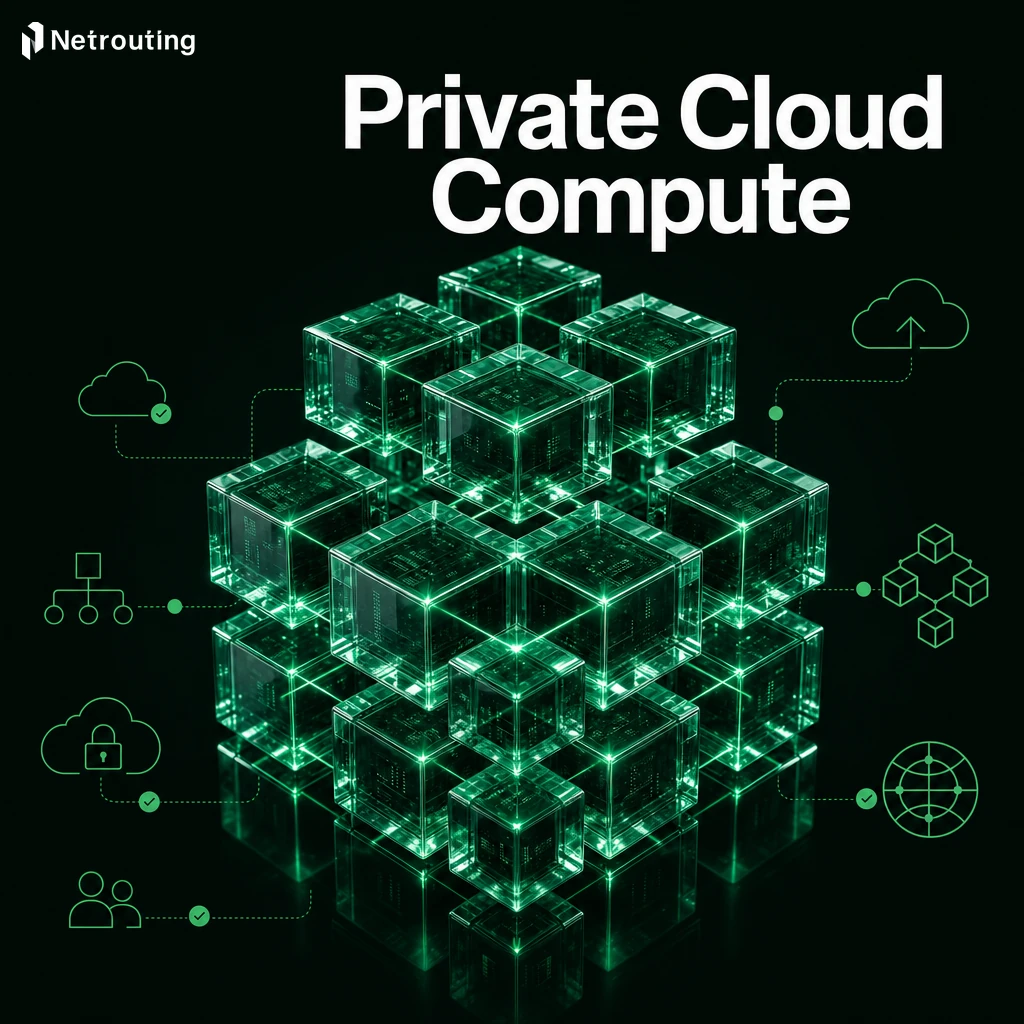
When running workloads on shared infrastructure you are at the mercy of the security boundaries, resource contention and compliance boundaries of someone else. With private cloud computing, your teams can have their own dedicated resources, their own isolated network and control of the compute, storage and memory to run across your environment as required.
Deciding to switch from public cloud to a private solution isn’t just about principle. When it comes to cloud services, whether enterprise private cloud or Apple's Private cloud infrastructure, it's about clear costs, data residency compliance, and a ceiling on the shared tenancy penalty that applies to latency-sensitive and high-volume workloads. For more context, see Private cloud computing infrastructure.
For many IT organizations managing pcc nodes, the tipping point is a time when their cloud spend suddenly and unpredictably shoots up. Alternatively, When they are told that a compliance audit has found a problem with data stored in multi-tenant public cloud solutions. Organizations evaluating their pcc system architecture often discover that migrating workloads back to dedicated environments restores both cost predictability and operational transparency. For more context, see private cloud compute.
Blog contents
In this article we will cover the key decisions made when building a private cloud processing platform. We will highlight the types of workloads that benefit most from private cloud workloads and will cover how to compare and select from a range of infrastructure providers.
Finally we will cover managed bare metal and dedicated hosting and how these fit into your private cloud strategy, highlighting the specific network and hardware Netrouting provides to give your high performance sovereignty workloads the best possible home.
What Is Apple's Private Cloud Compute and Its Reproducible Builds
Private cloud resources refers to dedicated cloud infrastructure. That is, it is provisioned for a single customer, i.e. it is not multi-tenant like public cloud. In effect, you have your own dedicated hardware, your own virtualisation platform and your own pools of resources all dedicated to your single use.
Isolated Infrastructure, Full Control Over Sensitive Data
All compute resources, storage resources and network resources are 100% yours. That is what isolates your data from remote shells and allows for strict compliance to regulatory requirements.

Apple Intelligence Remote Attestation and Verified Execution
Modern private clouds have adopted Remote Attestation to securely verify the root cause of the server’s firmware and/or hardware down to the actual running application. Paired with Code Signing, the infrastructure’s claims can now be confirmed against actual running code behavior to provide a level of assurance required by critical workloads in finance and healthcare.
This attestation framework strengthens privacy claims by enabling third-party auditors to validate that no unauthorized data exfiltration or logging occurs during execution. Reproducible builds complement this attestation model by ensuring that the binary running in production can be independently verified to match its published source code, eliminating hidden backdoors or tampering.
When to Use Apple's Private Cloud Compute
Private cloud is suitable for organizations that require strong privacy guarantees, require a stable and predictable service or have data residency requirements that require data to be stored within a specific data center. Research mode workloads processing sensitive data such as clinical trials or financial models to name a few is typical for private cloud capacity.
Netrouting’s cloud platform is running on dedicated hardware in 10 locations worldwide and allows for regional functionality without loosing flexibility. The platform ensures that compute capacity remains readily accessible to authorized teams while maintaining strict isolation from external networks. For example, a pharmaceutical company conducting genomic research can deploy workloads on isolated nodes that meet HIPAA requirements while maintaining full audit trails.
So knowing when to use private cloud is a good first step. But knowing how private cloud architecture enforces those guarantees is a whole different story. Understanding the technical mechanisms, such as cryptographic attestation, stateless computation, and verifiable boot chains, that underpin privacy guarantees helps organizations evaluate whether their workloads require similar architectural patterns.
NVIDIA Confidential Computing vs Apple's Private Cloud Compute
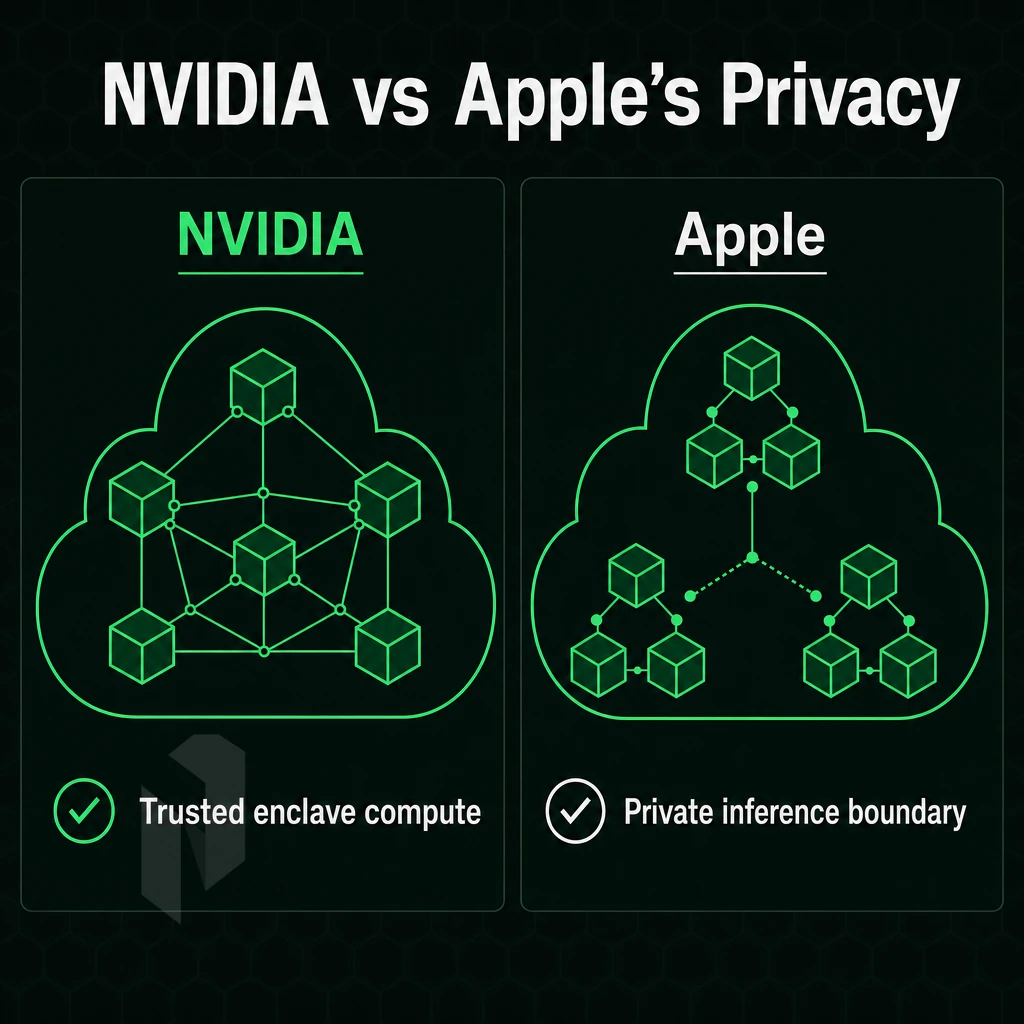
As inference is an active process where data is processed within a compute environment, software alone is not enough to protect data within this environment. Hardware-enforced isolation is the core of private cloud provisioning, and confidential computing extends the trust boundary from storage and network transfer to processing within the compute environment.
NVIDIA Confidential Computing and the GPU Trust Boundary
Traditional secure enclave technologies like Intel SGX isolate CPU computations within the CPU itself. Confidential Computing on NVIDIA GPUs extends this concept to GPU compute for highly distributed inferencing at very large scale. While Intel SGX provides strong isolation for CPU-bound tasks, GPU-accelerated workloads require enclave architectures tailored to parallel processing demands. Organizations deploying AI workloads should evaluate NVIDIA Confidential Computing capabilities to ensure sensitive model weights and training data remain encrypted during execution.
Hardware attestation fills this gap.
Real-World Deployment of Apple's Private Cloud Compute System
Apple’s production-level implementation of Private cloud instances (PCC) is their cloud nodes system powered by Private cloud systems hosted in Apple’s own data centers running AI inference on NVIDIA GPUs with confidential computing. No need to trust Apple. Hardware attestation is independently verifiable.
Apple's data centers employ custom silicon and strict operational protocols to ensure that inference requests remain ephemeral and cryptographically verifiable throughout processing. This architecture mirrors the broader design philosophy behind the gemini family of AI models, which similarly prioritize secure, verifiable inference pipelines.
Broader Adoption in High Performance Production Environments
Gemini models are designed for confidential inference under strict regulatory requirements and deployed to production using hardware to isolate workloads. A solid threat model demands attestation, memory encryption, and verifiable isolation to deliver meaningful security guarantees. Confidential computing on GPU provides these. For more context, see Private cloud computing infrastructure.
GPU confidential computing uses on-chip memory encryption combined with a hardware root of trust. This means that none of the privileged software layers including the hypervisor will ever be able to access model weights or inference data while it is being used.
For private cloud architecture environments, Netrouting’s bare metal GPU servers offer the dedicated hardware required to run these workloads. Running on dedicated hardware, customers can be sure that they are not sharing resources with other tenants. Furthermore, customers have full control over the attestation chain. These NVIDIA GPUs deliver the parallel processing throughput needed for large-scale AI inference while maintaining the cryptographic isolation guarantees that confidential computing demands.
Hardware isolation addresses the security question but for most organizations the key question is: private cloud or public cloud?
Frequently Asked Questions About Sensitive Data
How Do Security Researchers Say Apple Gives You Full Control Over Private Cloud Data?
Private cloud computing is a dedicated infrastructure model where compute, storage, and networking resources serve a single organization exclusively. Unlike public cloud platforms where resources are shared across thousands of tenants, a private cloud runs on hardware isolated to one customer, either on-premises or hosted by a provider. That isolation gives organizations direct control over configuration, security policies, and workloads residency. The PCC system suits regulated industries and any specific user group that requires end-to-end encryption, high-throughput workloads, and predictable performance without noisy-neighbor interference.
How Secure Is Apple Intelligence's Private Cloud Compute?
Private cloud fabric is inherently more secure than public cloud for most threat models because your workloads never share physical hardware with unknown third parties. End to end encryption, security permissions, firewall rules, and network segmentation are configured entirely to your requirements. This isolation also provides non targetability, meaning adversaries cannot selectively target your workloads through shared resource exploitation or side-channel attacks common in multi-tenant environments.
Providers like Netrouting reinforce that baseline, much like PCC nodes do at the hardware level, with always-on DDoS protection, ISO 27001 certification, and SOC 2 compliance, so every production environment meets enterprise and regulatory security standards out of the box.
What Is Apple's Private Cloud Compute?
Apple Private cloud stack (PCC) is Apple's server-side AI inference infrastructure, introduced in 2024 to handle on-device requests that exceed what an iPhone or Mac can process locally. It runs on Apple Silicon hardware inside Apple-operated datasets centers and is designed so that Apple itself cannot access the stored information being processed. The system represents a significant architectural shift in how apple intelligence features are delivered, ensuring that even server-side processing maintains the same privacy principles users expect from on-device computation. When apple introduced this architecture, the company emphasized stateless computation and cryptographic attestation to ensure user data never persists beyond the inference request. The system is maintained and operated exclusively by apple staff, who follow strict protocols to ensure no persistent logging or data retention occurs.
It is a proprietary, closed system, not a service available to third-party developers or enterprises.
Four Cloud Computing Types and Non Targetability Explained
The four deployment models are public cloud, private cloud, hybrid cloud , and multi-cloud. Public cloud delivers shared resources over the internet from a provider's infrastructure. Private cloud dedicates all resources to a single organization, either on-premises or hosted.
Hybrid cloud connects a private environment to one or more public clouds, letting workloads move between them based on cost, compliance, or performance requirements. Multi-cloud uses two or more separate public or private cloud providers simultaneously, reducing vendor lock-in and improving redundancy.
When people talk about private cloud clusters, it’s often marketed as a single product. But in reality, private cloud servers is an architectural decision. It means attestation, as seen in NVIDIA Confidential Computing, or some form of verification, is in place to guarantee that no malicious activity has occurred to the compute environment before it processes a user's request.
And, most importantly, that digital assets never leaves the private cloud to touch shared, multi-tenant infrastructure that could introduce compromise or other negative impacts. This is particularly critical for workloads that hold regulated sensitive records, proprietary AI models like apple intelligence features, and other types of workloads where a breach can have serious consequences.
The gap in the public vs private cloud is not closing. Advances in Confidential Computing are increasing isolation guarantees against physical attacks rather than reducing the gap. Companies treating datacenter infrastructure as a security control rather than a cost line are moving towards dedicated / verifiable environments.
If your workload demands hardware-level isolation, EU critical information sovereignty, or predictable performance without noisy neighbours, Netrouting's dedicated bare metal and private cloud machines infrastructure is built for exactly that. Talk to the team about the right configuration for your environment.