The choice of cloud compute platform is one of the most important decisions for a startup over the next 2-3 years. If you pick the wrong service provider you will be stuck with unpredictable billing, locked into underlying infrastructure in the wrong regions, and at the mercy of a faceless support organization treating you like just another ticket.
But choose correctly and your cloud infrastructure will grow with your team without the overhead of dealing with the complexities of the hyperscalers. The platform you select will shape your technical architecture and operational workflows in ways that matter far beyond the initial deployment phase. Teams that maintain a clear focus on their core product differentiation avoid over-engineering their cloud architecture in the early stages, preserving runway for customer discovery and iteration.
This guide is for technical founders and engineering leads who are serious about committing to cloud compute. We analyzed the various cloud compute options against the key criteria that are relevant for startups, such as performance per workload. Network quality and latency, geographic coverage, support quality and total cost of ownership compared to other cloud platforms. We also evaluated how each provider supports data analytics pipelines, which are critical for startups tracking user behavior and product metrics.
Blog contents
Beyond compute and analytics, startups must also consider how their cloud provider integrates with collaboration platforms like Google Workspace to streamline team productivity across distributed engineering teams. Our analysis maintains a deliberate focus on the metrics that directly impact startup velocity, such as deployment speed and cost predictability over multi-year horizons. Evaluating multiple cloud platforms in parallel allows technical teams to benchmark real-world performance across different workload profiles before committing to a single vendor.
By the end of this guide you will have a framework to innovate quickly and match workloads to providers such as Amsterdam, Miami, Singapore and more all at the same time. This guide will start from the bottom and explain what cloud compute delivers at the infrastructure layer for cloud compute. Startups that embrace this multi-region approach gain the agility to experiment with new architectures and deployment patterns, fostering innovation through rapid iteration cycles.
What Cloud Services Actually Mean for Startups
With cloud compute, the hassle of physically owning and managing servers to run your compute is taken away. No need to purchase and provision physical servers, to manage the physical racks in the datacenter, to manage the power and cooling in the datacenter.
What Cloud Services Actually Deliver
Cloud computing allows users to provision slices of shared infrastructure (i.e. CPU, RAM, storage) as virtual machines (VMs) on the cloud provider’s shared underlying physical infrastructure. The user can then deploy their application directly on top of the provisioned VMs without having to deal with the underlying physical servers.
For an early-stage startup, it is typical to provision 2 cloud servers: one for your application server(s) and one for your database(s). Both of these servers would be fully provisioned and live within minutes. There is no procurement cycle, lead time, or sunk cost with cloud servers. Developers can spin up isolated environments for testing, staging, and production in parallel, enabling continuous integration workflows that would be prohibitively expensive with on-premise hardware.
Why Startups Begin With Cloud Services
Having your own servers means you're spending money on physical hardware from the get-go for capital expenditure and disaster recovery before you've even validated any of your core assumptions. Cloud computing inverts this model. You only pay for what you use, scale as you get traction and shut down what you no longer need.
- No upfront hardware investment.
- Rapid provisioning: we launch instances in less than an hour.
- Grow infrastructure as needed, without running servers or hiring infrastructure people.
Cloud Provider Services at the Infrastructure Layer
Not all cloud services are created equal. Netrouting’s cloud compute is powered by dedicated hardware at 10 locations worldwide including Stockholm, Amsterdam, Frankfurt, Miami and Hong Kong. This allows for consistent and reliable performance without the risk of your servers being affected by noisy neighbors in shared servers that are oversubscribed in the cloud. Netrouting's approach ensures that startups receive enterprise-grade performance without the complexity of managing multi-vendor services or navigating convoluted support tiers common at larger providers.
Knowing what the cloud delivers is only half the story. The real value of the cloud for your growing startup is in the operational advantages it delivers. Understanding cloud computing from an operational perspective helps founders make strategic decisions about resource allocation and team structure.
Cloud platforms enable rapid experimentation cycles that accelerate innovation, allowing engineering teams to test architectural patterns and deployment strategies without waiting weeks for hardware approval. Cloud platforms empower developers to deploy and iterate on applications using modern tooling and APIs that abstract away low-level provisioning complexities. This operational lens helps teams focus on delivering customer value rather than managing hardware lifecycles and procurement workflows.
How Cloud Credits Help Small Businesses and Startups Scale
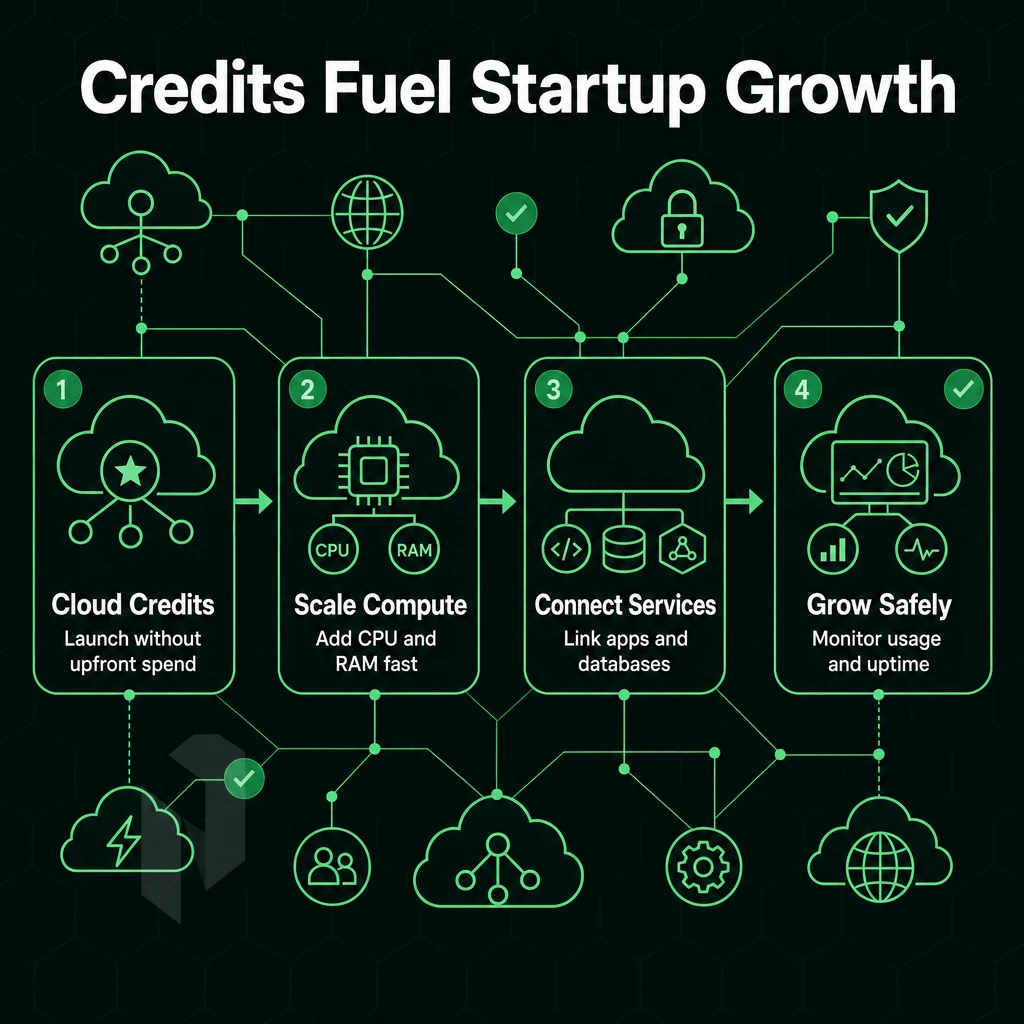
Cloud infrastructure removes the biggest single barrier to lean teams: the need to purchase hardware before they have any revenue. Startups can instantly provision compute, storage and networking and convert what would have been capital expenditure to running cost. This instant switch to operational expense instantly unlocks operational efficiency. By eliminating upfront hardware investments, early-stage companies can redirect capital toward product development and customer acquisition, often realizing significant savings in their first year of operation.
Launching Fast with Minimal Infrastructure
A startup doesn't need to set up a server room to start shipping a minimum viable product. A team of three people can set up production in less than an hour, gather feedback, and scale capacity the same day. As the startup grows from hundreds to thousands of users, resources grow without a hardware procurement cycle. The same cloud platform that hosts the production environment can simultaneously run development and staging environments, allowing teams to test software changes in isolated instances before deployment. Teams can integrate collaboration suites like google workspace directly with their cloud environment, enabling seamless document sharing and real-time communication across distributed engineering teams.
Cloud platforms also provide role-based access controls that let founders delegate specific permissions to team members, ensuring secure collaboration without granting unnecessary privileges. Cloud platforms empower developers to spin up isolated environments for feature branches, enabling parallel work streams without resource contention or deployment conflicts. This operational model allows engineering teams to maintain focus on building features that deliver customer value rather than managing provisioning queues or hardware refresh cycles.
Fundamental disaster recovery functionality is also embedded within the Cloud. Automated snapshots and cross-region replication are cloud services that offer a cost effective alternative to a second physical data center site, giving early-stage companies the same level of resilience at a fraction of the overhead. Many cloud providers bundle backup, monitoring, and recovery services into a single management interface, reducing the operational overhead of coordinating multiple third-party tools.
Data Analytics and Machine Learning for Your Startup Hire
With access to GPU compute, data analytics and machine learning workloads can be done by teams without having to spend dedicated infrastructure funds. For startups, this means you can stretch cloud credits further by running model training jobs on demand and only paying for the active compute time, shutting down instances when the job is done. Many accelerators and venture capital firms negotiate bulk cloud credits with providers, allowing portfolio companies to defer initial compute costs while validating product-market fit.
Best Cloud Compute for Startups Entering AI
Infrastructure is just as important as the model for AI start-ups. We offer a range of cloud solutions, available in 10 locations across Europe, North and South America and Asia. We also offer free private networking between all instances, 24/7 support with a 1hr ticket guarantee.
Startups gain immediate access to enterprise-grade compute resources across all regions without negotiating separate contracts or waiting for account provisioning delays. Our platform delivers these services through a unified control plane, allowing teams to manage compute, networking, and storage from a single interface without switching between multiple vendor dashboards.
Bare metal for low latency inference, cloud compute for burst training. In both cases capacity will scale with the workload and not with the lead time for procurement. Once you know what to look for in terms of scalability of capacity for mobile applications, you also need to find out how to check if a provider really delivers on that promise.
Developers benefit from this flexibility by spinning up test environments in seconds, iterating on code without waiting for provisioning cycles, and deploying changes across multiple regions simultaneously. This architectural flexibility lets engineering teams focus on optimizing application performance rather than managing provisioning workflows.
Key Criteria for Evaluating Cloud Services Providers
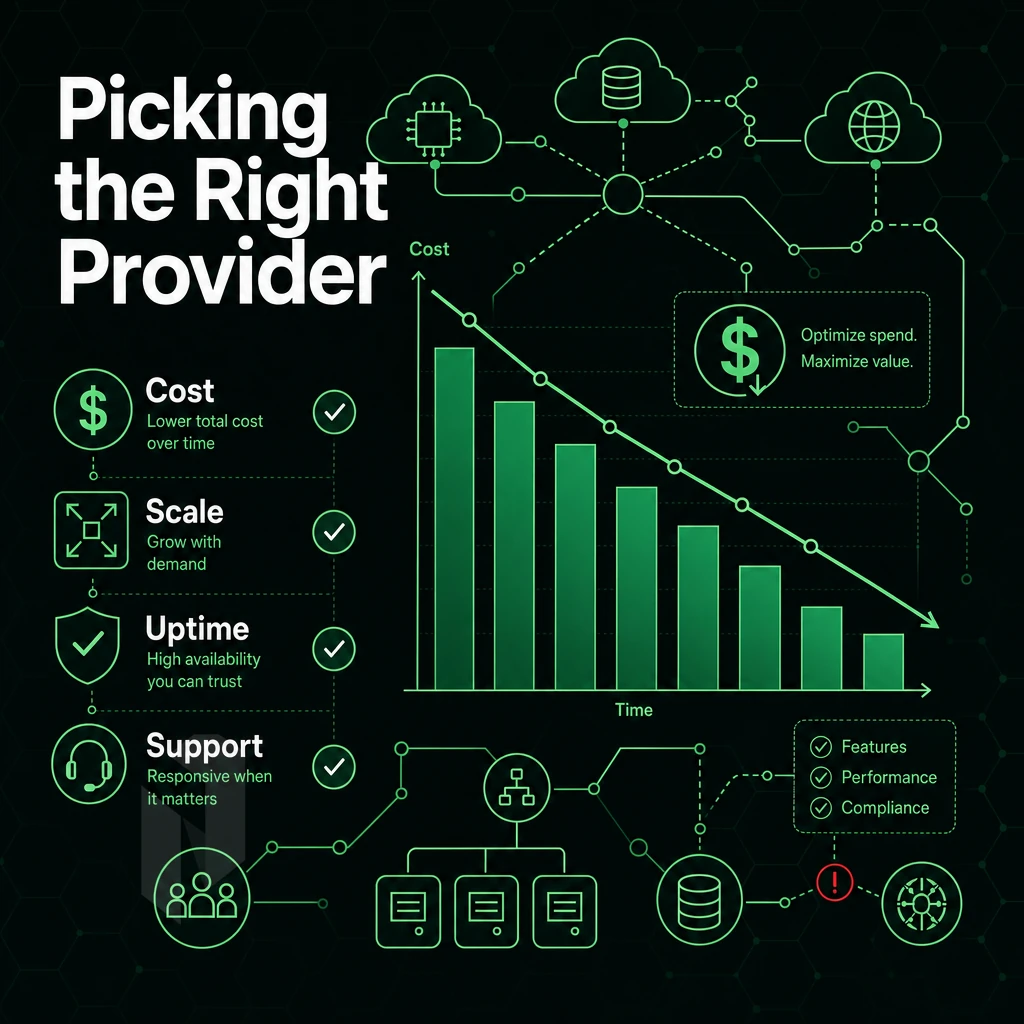
Choosing the right cloud provider for your startup can be a challenging task. To make an informed decision, you should evaluate your needs against six key criteria before signing a contract with a cloud provider. The specific requirements of your application architecture will matter significantly when evaluating compute performance, network latency, and regional availability across different providers. Evaluate whether the provider offers granular role-based access controls and audit logging capabilities that align with your team's security posture and governance needs.
Startups should focus on providers that offer transparent pricing models and clear documentation, ensuring that cost projections remain accurate as usage scales beyond initial estimates. Startups should also assess whether the provider's platforms support containerized deployments and orchestration tools that enable portability across different cloud environments. Evaluating managed database offerings, container orchestration, and API gateway capabilities ensures that the provider's core platform services align with your application's technical requirements and scaling roadmap.
Preparation: Costs and Compliance
- Demand pricing transparency. A free tier at launch that looks cheap at first but then suddenly jumps to expensive usage-based billing as users grow is not going to give users confidence in cost. Instead, emphasize a fixed, predictable monthly cost, with clear overages and rules around them. That’s where users can really get a handle on cost.
- Identify your compliance requirements early on. If you collect sensitive data such as health data, payment details or personal data. Your service provider will need to have the corresponding certifications (e.g. ISO 27001, SOC 2 or industry specific) before you start evaluating potential service providers.
- Auditing the identity management controls for role-based access, multi-factor authentication, and auditing are fundamental. This is the most common cause of cloud related security breaches for early stage startups.
Execution: Performance and Coverage
- Geographic coverage is also compared with that of the users. While latency is a product decision, the data centers of the provider are checked if they are located near the main user base. One provider with wrong locations is more expensive than a slightly more expensive monthly fee.
- Double check the SLA. A 99.9% SLA translates into roughly 43 minutes of downtime per year. And what are you going to get if you miss that SLA?!
Verification: Support and Scalability
- Test support before you commit. Open a pre-sales ticket to see how they react. Measure the response time. A 24/7 NOC with a one-hour ticket guarantee (like Netrouting has) is so much more important than a fancy monitoring dashboard when production is down.
- Can you scale without re-platforming? As your product grows, so does your infrastructure. Having Bare metal, Cloud compute and Colocation under one roof simplifies the path for growth.
Don't optimise for the cheapest entry point. Optimise for the lowest total cost of ownership at the scale you expect in 18 months. Focus on performance consistency, egress costs, and API portability, not promotional discounts.
The above mentioned criteria are important regardless of how you initially came across the provider. For many early-stage companies their initial contact with a provider is through a hyperscaler’s credit program.
Cloud Computing Credits and Free Tier Programs: What Hyperscalers Offer
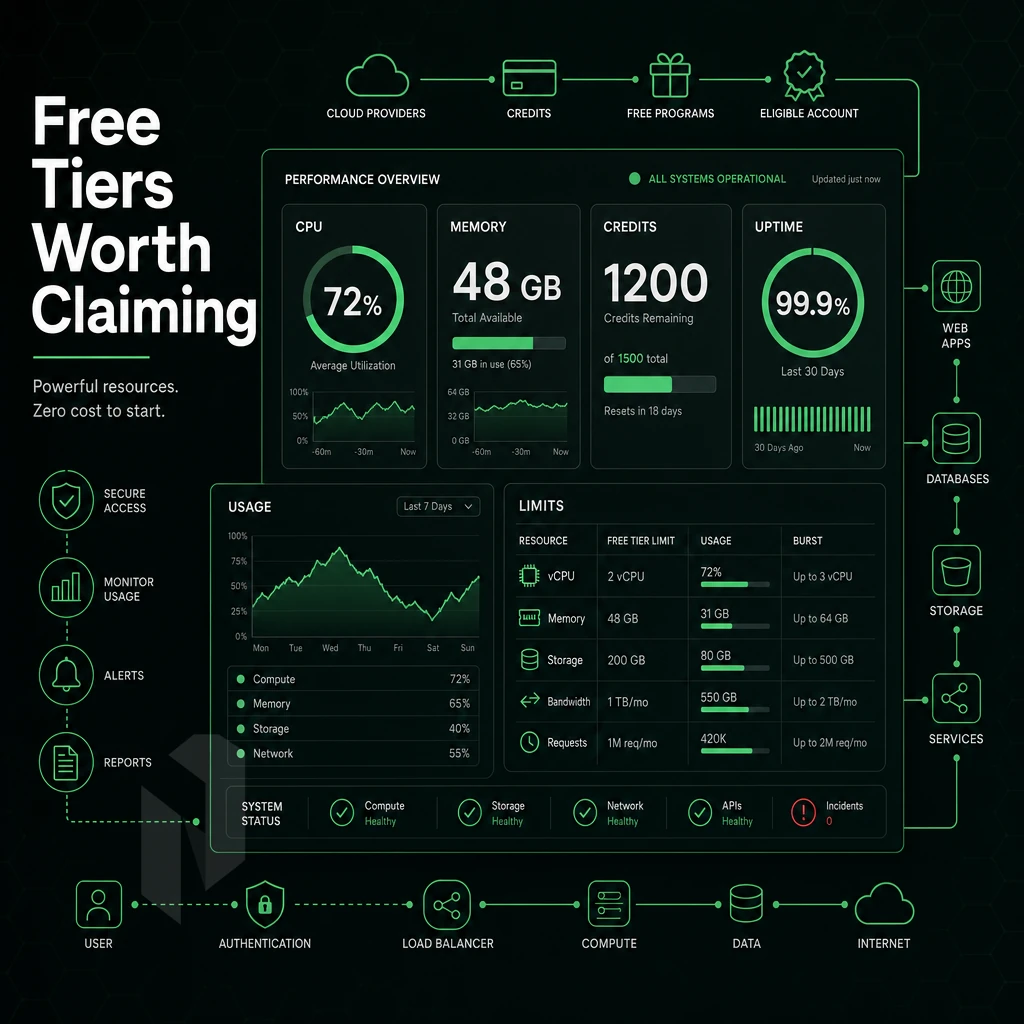
Hyperscalers use cloud credits and free tier programs to pull early stage startups into their ecosystem. The initial terms look attractive. The long-term terms are not.
How Credit Programs Work
The amount of platform credits offered by most credit programs, including those for google workspace, range from $5,000 to $100,000 in platform credits valid for 12 months up to 24 months.
These platform credits can be used to pay for compute, storage and managed services offered by the provider on their product catalog. Once your Google Workspace platform credits are completely used, you will start to be charged at the full rack-rate for all future usage. Startups should carefully track their consumption of platform credits across all provisioned services to avoid unexpected billing spikes when the promotional period expires.
This transition can create serious cost control and operational efficiency challenges for startups that built their stacks on managed databases, serverless functions, and proprietary ML pipelines. The free tier was a funnel for them, not a foundation.
Vendor Lock-In in Cloud Computing
But that’s to ignore the issue of vendor lock in, which makes billing shock a much bigger problem. API’s, storage formats, and managed services that are native to a platform and thus locked into it using proprietary services, create very real barriers to moving off a platform. And to top it all off, there are egress fees, charged per gigabyte to move data out of a platform, that eliminate any significant savings and further penalize a vendor for trying to leave.
For EU-based startups, data sovereignty is a growing concern. Many hyperscalers spread infrastructure across multiple countries, making it complicated to meet data residency and processing requirements.
The Cost-Effective Alternative
For Startups running on hyperscaler platforms, once their credits expire. Their monthly cost of running the exact same infrastructure on bare metal or in a dedicated datacenter can be 3-5 times less than they pay while running on the hyperscaler platforms with their credits expired.
By deploying on dedicated bare-metal servers (provisioned on open standards) you can save a lot of money in the long run.
Netrouting offers bare-metal as well as cloud compute in ten locations all over the world (Europe, North America and Asia). Since we use standard hardware and we are transparent and consistent with our pricing, it is cost effective for startups who want to grow beyond the first funding round.
Next, we'll explore why protecting your right to flexible infrastructure matters from the start.
Avoiding Vendor Lock-In: Why Infrastructure Flexibility Matters
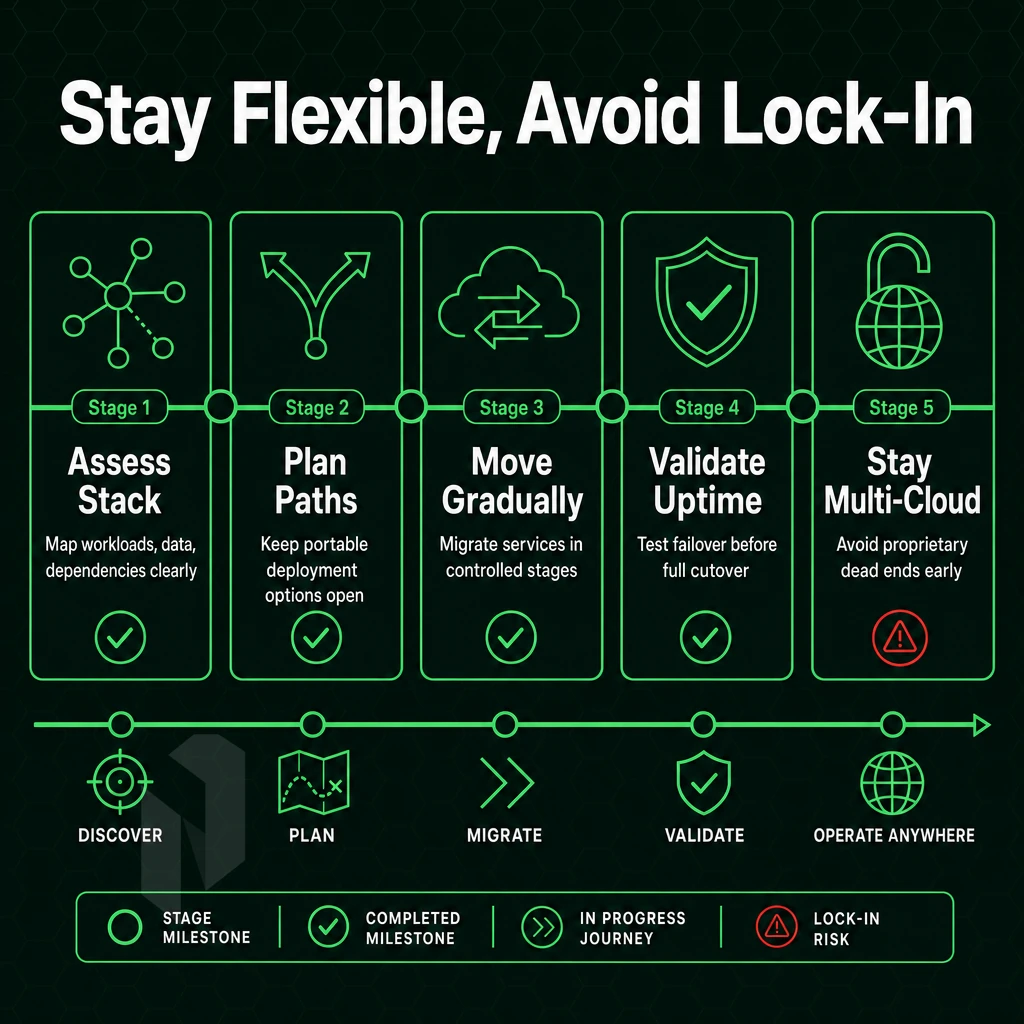
Vendor lock-in: one of the most underestimated strategic risks for startups. By committing too early to a provider’s proprietary stack, startups can soon find themselves trapped in a costly and inflexible architecture, unable to act quickly when the market turns.
The Hidden Costs of One Cloud Provider Dependency
First, proprietary APIs from your service provider that were used for building your application can become a roadblock to porting your workloads later on as a massive engineering project as opposed to a weekend migration.
Egress fees from your data storage also compound. The cost to egress your data from storage can be many times the cost of the storage itself. This is a key cause of “bill shock” that has been identified by many industry experts to negatively impact too many startups to name later.
The lock-in pattern repeats across cloud platforms:
- Proprietary managed services with no open-standard equivalent.
- Egress pricing that penalizes workload portability.
- Bundled software license tied to specific runtime environment.
- Mobile apps that depend on vendor-specific push and auth services.
How Open Standards Preserve Flexibility
A standards-based infrastructure, with BGP routing, BYOIP and bare metal servers, means you are in full control of your company’s IT infrastructure. Physical servers that you provision directly, can run any stack of software on them, without any proprietary abstractions in between your application and the network.
Our network supports Full BGP and BYOIP on all services.
Build to Innovate Quickly Without Painting Yourself Into a Corner
Our carrier-neutral colocation and bare metal servers allow for the best way to grow your business. We don’t limit you to scale up within one vendor. Our 10 locations around the globe, from Amsterdam to Singapore, enable your infrastructure to grow with your business, not against it.
This chart helps to compare different provider categories after we’ve already defined the flexibility principles. It also provides a clear view of where the productivity tooling ends and core compute infrastructure begins for each provider category.
Google Workspace and Productivity Tools vs. Core Compute Infrastructure
| Provider / Option | Performance | Support | Uptime SLA | Network | Best For |
|---|---|---|---|---|---|
| Netrouting Cloud Compute | Flexible virtual instances on Intel Xeon and AMD EPYC hardware. Scale CPU, RAM, and storage on demand. Rapid provisioning, bare metal under 60 minutes. | 24/7 NOC, 1-hour ticket guarantee. EU hours Mon-Fri 09:00-17:00 CET. | 99.9% SLA | 2.4 Tbps+ backbone (AS6206). Unmetered 10 Gbps. Free private network up to 40 Gbps. Always-on L3/L4 DDoS protection included. | Startups needing predictable costs, EU data sovereignty, and powerful tools without hyperscaler complexity. Strong fit for AI tools, big data analytics, and data-intensive workloads. |
| Major hyperscaler platforms (e.g., AWS, Azure) | Broad instance variety. Managed services include big data analytics pipelines, AI tools, and google workspace integrations via marketplace. | Tiered paid support. Basic plans have limited response SLAs. | 99.9%-99.99% depending on service and tier | Global regions. High egress costs. Variable latency across zones. | Startups already invested in a hyperscaler ecosystem needing managed PaaS services and technical resources at scale. |
| Boutique cloud providers | Entry-level VMs. Limited hardware generation options. Fewer powerful tools for data-heavy workloads. | Business-hours support only. Ticket response varies. | 99.9% typical | Shared infrastructure. Bandwidth caps common. No dedicated DDoS protection baseline. | Startups with minimal data requirements and low traffic, not suited for growth-stage workloads. |
For most cost conscious startups, Netrouting's cloud solutions offer the best balance of performance and price: a 2.4 Tbps+ network with always on DDoS protection and 99.9% uptime without any hidden egress charges.
AI, big data and other data intensive applications will benefit from the dedicated hardware and a free private cloud network up to 40 Gbps. Also, customers who require advanced functionality but lack the in-house technical expertise to manage it will benefit from working with Netrouting as a managed service provider, thanks to their 24/7 NOC and 1hr ticket guarantee.
Most decisions around cloud infrastructure are made singularly, without regard to how they will affect your company as your engineering team grows. The next section will outline a set of practices that will help you lock down a Google Workspace platform and keep it aligned with the rest of your company as you go about scaling your headcount.
Cloud Computing Comparison: Hyperscalers vs. Dedicated Infrastructure Providers
When choosing a cloud compute model for your startup, it becomes increasingly important to understand how that choice can greatly affect your costs, operational flexibility and exposure to vendor lock-in over time. Below is a table comparing the Hyperscalers, developer focused cloud platforms and the dedicated infrastructure providers with key characteristics that affect early stage workloads.
How the Models Differ
Their fine-grained pricing helps deal with sudden traffic spikes, but egress charges add up quickly. This means there are no surprises as traffic grows, and that’s where competitive pricing really matters for cost-sensitive startups.
Developer-focused cloud platforms are in the middle ground of cloud platforms. Egress cost and add-on security cost can quickly burn through margin as traffic increases.
Comparison Table
| Dimension | Hyperscalers | Developer-Focused Platforms | Dedicated Infrastructure Providers (e.g. Netrouting) |
|---|---|---|---|
| Pricing model | Per-second / per-hour metered | Metered with tiered plans | Flat monthly, predictable cost |
| Egress fees | Yes, significant at scale | Yes, tiered allowances | No surprise egress charges |
| Provisioning speed | Minutes (virtual) | Minutes (virtual) | Bare metal under 60 minutes |
| Support model | Tiered, premium plans required | Community + paid tiers | 24/7 NOC, 1-hour ticket guarantee |
| Vendor lock-in risk | High, proprietary APIs and services | Medium | Low, standard hardware, BGP, BYOIP |
| DDoS protection | Add-on, extra charge | Basic, often add-on | Always-on L3/L4 included, no config needed |
| Bare metal access | Limited or unavailable | Rarely available | Core offering, Intel Xeon and AMD EPYC |
| Geographic flexibility | Many regions, proprietary network | Select regions | 10 cities across Europe, North America, Asia |
Where Netrouting Fits
Startups that are focused on innovation (i.e. shipping product) and don’t want to deal with managing cloud bills benefit from having an infrastructure team that gets out of the way. Netrouting’s dedicated servers provide the full bare metal performance that your application needs, across 10 locations. The security is built in from day 1, so there's no nasty surprise down the line with cloud egress charges eating into your runway.
If this profile matches your workload, here’s what Netrouting can do for you.
Why Choose Netrouting for Startup Cloud Compute
When free-tier credits run out, startups need predictable cloud computing, not surprise egress bills. Netrouting delivers cost-effective cloud services built for small engineering teams that need to deploy applications fast and scale without vendor lock-in.
- Rapid provisioning across 10 data centers, cloud compute instances spin up quickly in Amsterdam, Frankfurt, Miami, New York, Hong Kong, Singapore, and more. Deploy applications wherever your users are.
- Always-on DDoS protection included, L3/L4 mitigation ships with every service at no extra cost. confidential data stays protected without added complexity.
- GPU servers for AI startups, NVIDIA A10, A40, and A100 options support AI/ML and large-scale data processing workloads as your startup grows.
- Compliance-ready infrastructure, ISO 9001, ISO 27001, and SOC 2 certifications cover regulatory requirements out of the box.
- 24/7 NOC with a 1-hour ticket guarantee, expert support without the overhead of maintaining servers or physical hardware in-house.
Lower TCO than hyperscaler cloud solutions, no egress surprises, and a network built on our own AS6206 backbone. Explore our cloud compute plans or contact sales to compare options for your workload.
Choosing cloud compute as a startup comes down to three things: flexibility, predictable costs, and avoiding lock-in. Free-tier cloud programs look attractive early on, but proprietary tooling and opaque billing can quietly trap you as you scale. The smarter move is building on infrastructure you can migrate, extend, or exit without penalty.
A provider with a genuine global backbone, not resold capacity, delivers the low-latency, high-throughput foundation that growing workloads demand. That's where bare metal and cloud compute on a carrier-grade network pull ahead of hyperscaler VMs at equivalent specs.
If your startup is ready to move past shared environments and unpredictable bills during application development, explore Netrouting's cloud compute options across Europe, North America.