The decisions you make around your infrastructure today will influence your ability to scale your business tomorrow. For IT departments, colocation data centers offer a middle ground. Enabling them to retain ownership of their own hardware while benefiting from a powerful facility that provides all the necessary power, cooling, connectivity and physical security. Colocation outperforms on-premises server rooms and fully managed cloud for specific workloads.
Not all colocation facilities are created equal. We detail how colocation works for servers and other equipment, and in considerable detail outline what distinguishes good colocation from very bad colocation. We then detail the various technical and commercial criteria that should be considered when evaluating a facility.
Additionally, how the choices made with regard to colocation versus an in house data center will affect issues such as uptime, latency and long-term total cost of ownership. The primary audience for this guide are individuals and organizations contemplating a move to colocation from aging on-premises hardware, building a hybrid cloud architecture, or expanding to new regions beyond their existing physical offices.
Blog contents
What Are Colocation Data Center Facilities?
Colocation is the practice of running your own servers in a third party data center facility rather than in your own data room. You own and manage the servers (hardware). The colocation facility provides the surrounding space and facilities. For community perspectives, see Colocation vs Hyperscale : r/datacenter.
How the Shared-Infrastructure Model Works
A colocation data centre is divided up into data center space. This can be rented out as rack space, in cages or as a whole suite of rooms. Customers bring their own servers and other computer equipment and install them in the rented space. The operator of the data centre facility provides shared infrastructure, i.e. power, cooling, physical security and connections to networks.
Some providers offer a caged off room option that provides dedicated physical barriers around your equipment for enhanced isolation and security. The data centre operator manages the shared infrastructure while customers retain complete administrative control over their equipment and can access it whenever needed. Organizations can lease data center space in increments that match their current requirements and expand as their infrastructure needs grow over time.
Facilities get economies of scale on power and cooling that no business could match running its own server room.
Colocation vs. Cloud and On-Premises for Lower Costs
Cloud hosting abstracts the hardware for you and means you never have to deal with physical machines. Colocation, on the other hand, is based around you hosting on your own hardware and that means you get to set up the configuration how you like. To tune for performance and, most importantly, to retain full data sovereignty.
Having an in-house data center means paying for the Capital Expenditure (CapEx) to build it out, power it, cool it, and harden the facility security for the data center. The alternative of renting rack space in a Colocation (CoLocation) facility removes all of that CapEx from your balance sheet and you get to keep owning the hardware. Businesses migrating from on premises deployments can transition gradually, moving critical systems first while maintaining existing local resources during the migration period.
A Practical In House Data Center Example
Media companies can run their own servers in our colocation suites in The Hague or Miami. They are connected to our 2.4 Tbps+ network and remain in full control of the servers and the hardware stack. These facilities are strategically located in carrier-dense regions to ensure optimal network performance and low-latency access to major internet exchange points.
Once you have a grasp of the basic structure of how we manage all of the systems, on a day to day basis. It would be best to discuss the specifics of what happens to your hardware as soon as it arrives at our facility. Our technical teams remain available to assist with initial rack installations and provide remote hands support when you need to manage servers without traveling to the location.
Types of Colocation Facility
We operate a number of different Colocation Data Centers, each designed for a specific market, workload and operational style. Learning about the different models will enable you to select the right colocation service for your needs prior to signing up. This selection process involves understanding how different deployment models align with your technical requirements, enabling informed decisions about rack density, network architecture, and redundancy levels. Understanding these distinctions helps you identify which deployment model best matches your workload characteristics and budget constraints.
Retail Colocation Data Centres Explained
- Rent space by the rack or U for Retail colocation. Retail colocation allows companies to put their own servers in retail colocation space, in a shared cabinet that has been secured. shared colocation space provides power, cooling and physical safeguards for the hardware that you as a company have acquired. Small to medium businesses as well as growing companies will find standard colocation space that they can use on an as needed basis before they are ready to take on a whole suite of other services and hardware.
- Keep costs proportional to footprint. You only pay for the space your servers actually use. Keeping costs on a monthly basis as predictable as possible is easily achieved by incrementally scaling up by one rack at a time.
Wholesale Colocation Data Center
- Rent out entire floors or buildings. bulk colocation is typically aimed at large enterprises that need a lot of dedicated power and real estate. Instead of renting out individual cages in a large hall of colocation, large-scale colocation providers rent out entire rows of cages or even data halls, all under one contract. This model is designed for maximum density and control, as opposed to flexibility.
- Negotiate custom SLAs. At wholesale scale, operators typically support bespoke power and cooling arrangements. Uptime commitments and response targets are negotiated directly.
Note: Wholesale contracts usually carry longer minimum terms. Avoid committing to large footprints before your capacity projections are validated.
Hybrid and Carrier-Neutral Colocation
- Using your on prem hardware in conjunction with cloud services to create a hybrid deployment where your physical servers are connected to your virtual infrastructure. Latency sensitive workloads would run on bare metal while elastic workloads would burst into cloud compute as needed.
- Choose your own upstreams. At a carrier-neutral colocation facility you can connect to the network providers of your choice. Instead of locking yourself into a specific vendor, you can select the best mix of upstreams for your performance needs and for redundancy. At Netrouting’s carrier-neutral colocation facilities in ten cities around the world, customers have full BGP control and dense IX peering from a single provider.
The other half of the decision is to determine how colocation stacks up against the alternative of most data center staff teams' currently deployed model, i.e.
Core Benefits of Data Center Colocation
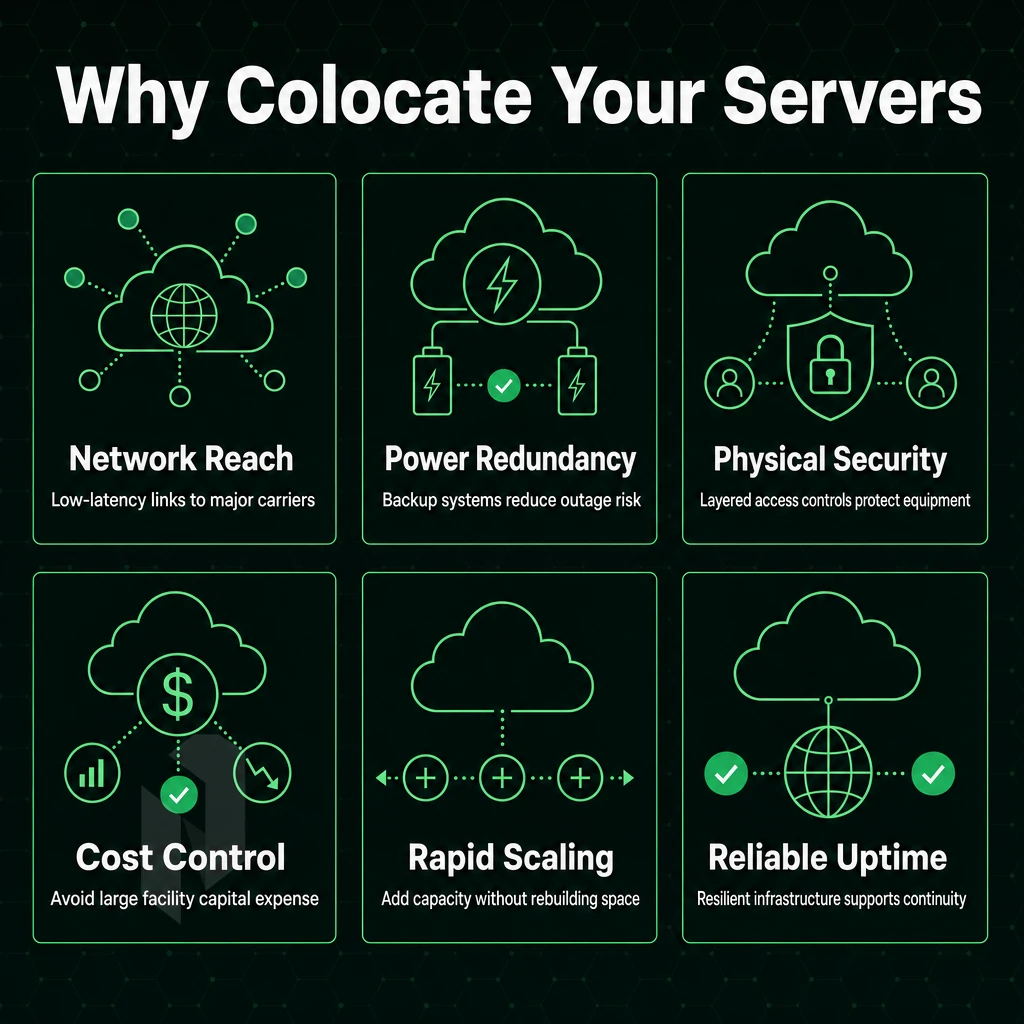
Colocation data centres deliver many benefits over a self-built facility, without the initial capital outlay of building and staffing a facility. The shared foundation of a colocation data centre will deliver cost savings over running a facility as a standalone entity, whilst also providing the tenant with access to enterprise class power, connectivity and premises security. By consolidating infrastructure expenses and eliminating redundant overhead, tenants achieve lower costs compared to maintaining equivalent capabilities independently.
Reliability, Physical Security, and Infrastructure
Reliable power is fundamental to good colocation. Carrier-neutral colocation facilities have N+1 redundant UPS, generators and cooling to ensure that single component failures do not result in outages. For example, our The Hague facility operates N+1 power and cooling across 215+ racks.
Our site security layers include biometric access controls, 24/7 video monitoring and caged-off suites within buildings. All of your hardware will be secured so only authorized personnel can access it. These layers of protection are cost effective to share between tenants and would be too expensive for single tenants to replicate in their own data center.
Connectivity and Network Performance
Dense IX peering and multiple carrier upstreams are what truly differentiate colocation from on-premises backbone. Our network comprises data center connectivity to over 40 exchange points, including major hubs like AMS-IX, DE-CIX, and FL-IX in Europe, North America and Asia. All connections are unmetered 10Gbps+ and scale with demand on a 2.4 Tbps+ backbone.
Scalability, Risk Management, and the Colocation Market
Growing rack space in the colocation market is usually a matter of adding more space on an incremental basis. In addition, our ten locations worldwide (Stockholm to Singapore) enable geographic redundancy and support DR strategies without the need for a second facility.
A clear service level agreement is in place to back up the uptime commitments and describe the associated risks in a contractually binding manner. Our facilities are strategically located in major metropolitan areas to minimize latency for end users while providing access to diverse carrier options.
There are some very real benefits of colocation, but like any hosting option, there are trade-offs and points of friction that can surprise you if you aren't prepared.
Common Use Cases for Colocation
Colocation is more suitable for a larger number of workloads than what most teams expect. Below are some common use cases or scenarios that are typical for Colocation. Many companies discover that workloads requiring predictable performance, strict compliance requirements, or high-throughput database operations benefit significantly from this hosting model.
Data Center Infrastructure and Recovery
- Offload core computer systems to a data center. Offload servers, storage arrays, and networking systems to a carrier-neutral facility where you retain full ownership of your gear. The data center then provides power, cooling, and architecture security for your systems.
- Secondary Disaster Recovery Location. A copy of your workloads will run in a geographically separate Colocation location. Replication of your Data Storage is ongoing to the Secondary Node.
Note: A recovery site only works if failover is tested regularly. Schedule quarterly drills.
High-Demand and Specialist Workloads
- High bandwidth applications such as Video on Demand, Online Gaming and Financial Trading require low latency and large burst capacity. Run them from your Colocation facilities that are directly connected to very dense peering fabrics.
- Support AI/Deep Compute workloads. High-density racks of GPU-enabled servers in colocation facilities consume far more power per rack than typical compute servers and don’t require special construction to support them.
Data Center Expansion and Connectivity
- accommodate your global expansion with an international presence in minutes. Deploy servers in local facilities instantly, without having to build them out first. Netrouting offers hosting in 10 cities across Europe, North America and Asia.
- Anchor network services. VPN/Transit operators require carrier neutral connectivity with direct IX access. Our Colocation at a highly connected facility provides a solid foundation for your services from day one.
If these use cases fit your roadmap, the next step is identifying which cloud provider can deliver across the geographies, data center network, and facilitation model your specific use case requires.
Why Choose Netrouting for Colocation
Netrouting operates carrier-neutral colocation data centres across ten cities, Amsterdam, Frankfurt, The Hague, Rotterdam, Stockholm, and Bucharest in Europe; Miami and New York in North America; Hong Kong and Singapore in Asia-Pacific. Our own AS6206 backbone has peered at AMS-IX since 2009, giving your colocation facility dense IX connectivity without third-party lock-in.
- Flexible rack space: 1U starter cabinets through private suites, up to 20 kW per footprint with N+1 power and cooling systems.
- Built-in security: ISO 9001, ISO 27001, and SOC 2 certified; hardware security and video surveillance on site at every data center.
- Always-on DDoS protection: L3/L4 mitigation included with every colocation service, no add-on required.
- Network control: BYOIP and BGP underpin, free private interconnect between your resources, and 2.4 Tbps+ bandwidth across the backbone.
- Guaranteed enable: 24/7 NOC with a one-hour ticket response and a 99.9% uptime guarantee.
Whether you're moving computing equipment out of an in-house data center or expanding an existing footprint, our team can match the right data center space to your workload. Explore our colocation options or contact sales to discuss your requirements.
Frequently Asked Questions
How Do Colocation Data Center Facilities Differ From In-Office Ones?
Colocation data centres provide the physical floor space, power, cooling, and network connectivity your own servers need to run. You own and manage the hardware, the facility handles the building framework. This gives you dedicated, enterprise-grade conditions without building or operating your own data centre. Unlike an own data center, carrier-neutral facilities add direct access to multiple network providers and internet exchanges, improving redundancy and reducing transit costs.
What are the disadvantages of using a data center for colocation?
You remain responsible for procuring, maintaining, and eventually replacing your own hardware. Physical interventions, drive swaps, reboots, cabling changes, require either a site visit or a remote hands request. Upfront capital expenditure on physical hardware is unavoidable, unlike cloud compute where you pay only for what you consume. Colocation also demands internal expertise to manage the OS, software stack, and hardware lifecycle.
How does colocation in a data center differ from cloud hosting?
Colocation means your physical hardware systems sit inside a shared facility, you own the hardware and control the entire stack. Cloud hosting runs your workloads on virtualised facilities owned and operated by the provider. Colocation delivers predictable, fixed monthly costs and no noisy-neighbour risk at the hardware level. Cloud compute, now offered by multiple companies, provides faster provisioning and elastic scaling, but at a higher per-unit cost over sustained, high-utilisation workloads.
What should I look for in a colocation data center provider?
Start with power density, confirm the facility supports your per-rack draw, especially for GPU or high-density compute. Verify N+1 or better redundancy on power and cooling, a clear uptime SLA, and same-day hardware replacement commitments. Network matters as much as the building when running ai workloads: unlike a typical in house data center, carrier-neutral facilities with dense IX peering give you routing flexibility and competitive transit options.
Certifications such as ISO 27001 and SOC 2 confirm that on site security and operational controls have been independently audited. Netrouting's colocation, anchored at DFDC THG1 in The Hague with up to 20 kW per footprint, checks all of these boxes.
What is the difference between retail and wholesale colocation?
individual colocation sells facility capacity in smaller increments, single rack units, partial cabinets, or full cabinets, allowing teams to manage dedicated machines with shared handle services and a per-unit cost structure suited to small and mid-sized deployments. enterprise colocation leases large blocks of raised-floor data center area, often entire suites or halls, to a single tenant who manages their own power distribution and cooling setup inside that footprint.
Retail suits businesses that want flexibility and managed sustain without operating a facility.
Colocation refers to a model where a Colocation Data Centre connects businesses to enterprise-grade power, cooling, and connectivity without the initial capital expenditure required to build and operate their own Data Centre facility. The key advantage is that the Business can utilize a carrier neutral facility that provides a dense peering environment. With redundant power and facility hardening to protect their Assets, all of which scale with demand and do not form a fixed cost.
The choice of facility is important. A shared cabinet may be all that is required for a very quick deployment but a private suite may be required for high density workloads, especially where compliance is a key factor. The network in the facility and the SLA of the facility determines the upper limits of uptime and performance.
Netrouting operates carrier-neutral colocation data centres across ten cities in Europe, North America, and Asia, including The Hague, Amsterdam, Frankfurt, Miami, and Singapore, with N+1 power and cooling, always-on DDoS protection, and a 99.9% uptime SLA. Explore Netrouting's colocation options or contact the sales team to discuss your specific requirements.