As your infrastructure matures beyond a single server room, colocation and interconnect services must deliver low latency, high uptime, and predictable costs. Choosing colocation involves more than picking rack space.
At a certain point most IT teams realize that the servers and storage they own are still fast and powerful, but the rest of their network is unable to grow with their company.
By moving that hardware into a carrier neutral facility and connecting to the upstream providers, exchanges and cloud on-ramps that your specific workloads need, the cost structure changes dramatically. Organizations that strategically select their connectivity partners can reduce costs while simultaneously improving network performance and eliminating unnecessary intermediate hops. Modern data centers increasingly support specialized requirements for ai workloads through high-density power configurations and low-latency network paths optimized for distributed training and inference tasks.
Blog contents
This guide explains colocation and connectivity in detail, and looks at what to look for in a data center facility. It then explains which workloads are best suited to colocation, and where the real differences in cost and performance between providers come in.
What Do Colocation and Interconnection Services Offer?
Colocation and interconnection are two related but distinct services offered by data centers and it is useful to understand them in more detail when evaluating a company’s requirements for physical infrastructure.
What Colocation Facilities Provide
By renting space, power, cooling and connectivity to connect to your servers in a professional data center facility, you can outsource the environment for your hardware and keep full control of your servers.

Your colocation provider handles the physical aspects of your infrastructure: multiple power feeds, air conditioning, physical security and remote hands assistance.
How Interconnection Services Work Inside a Data Center
Interconnection: Connecting above physical space, interconnection forms direct connections between your infrastructure and other networks around the world.
- Cross connects: dedicated physical cables linking two parties inside the same facility, low latency, no shared contention.
- Internet exchanges: shared switching fabrics where internet service providers, cloud providers, and content networks peer directly.
- Cloud on-ramps: private circuits to cloud service providers, bypassing the open internet entirely.
Why Colocation Providers Bundle Both
A warehouse is space without connectivity. A circuit without physical infrastructure is useless as well. However, a provider can deliver a complete production environment by bundling space and connectivity. At Netrouting we have several data center locations in Europe, North America and Asia, all offering carrier neutral colocation and dense peering on the IX's.
Netrouting maintains a strong presence across these strategic regions, ensuring customers benefit from consistent service quality and local support regardless of deployment location. Major providers like digital realty operate extensive global footprints that enable enterprises to deploy consistent infrastructure strategies across multiple continents with unified service agreements.
How Data Center Colocation Providers Work
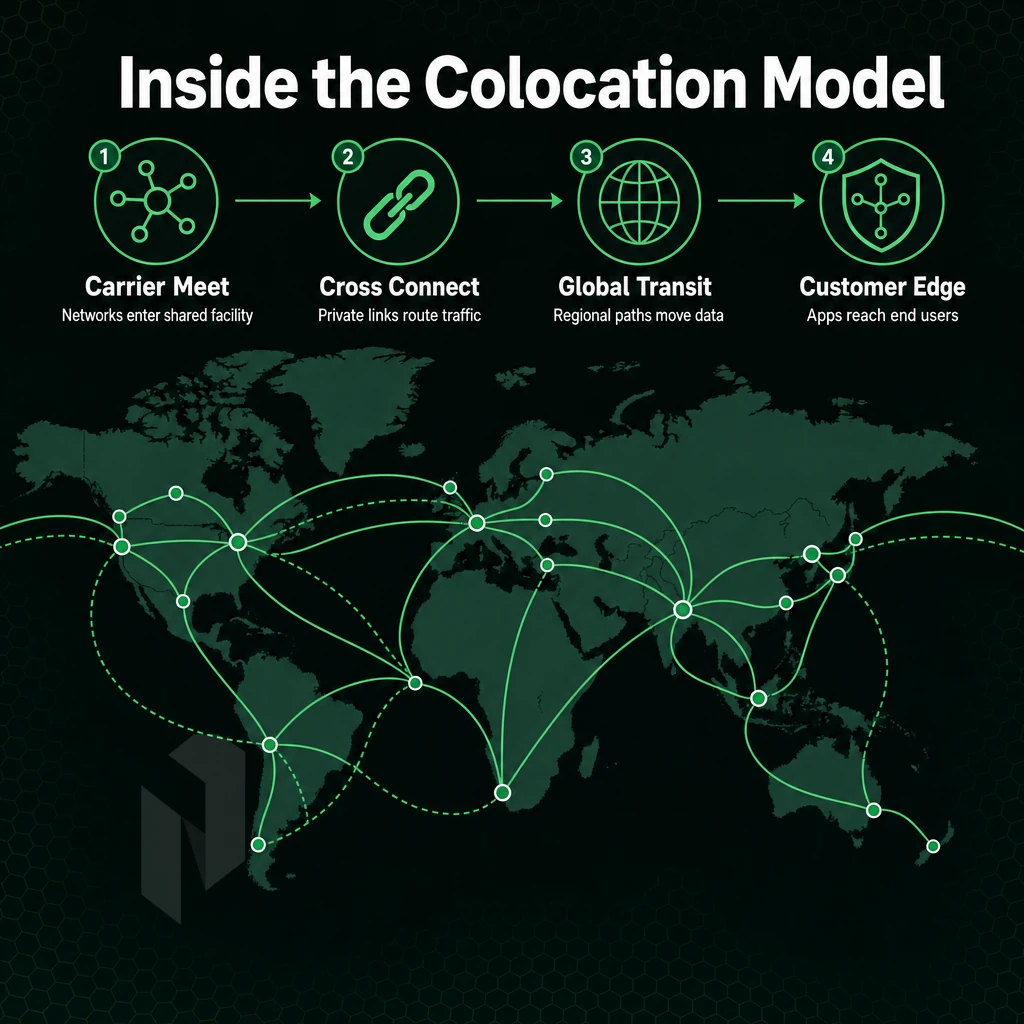
While this terminology is defined here, a look under the covers of the typical colocation data center is also in order. As opposed to leasing servers and storage in a hosted offering, in colocation you rent the space, the physical facility including power, cooling, and connectivity, and manage the servers yourself. Understanding the basic infrastructure of a data center will thus help you select the right service for your needs.
Physical Infrastructure and Facility Systems
Colocation facilities are built as a layered redundancy model. Power is backed up by UPS systems for short failures of utility power. Larger failures are handled by backup generators that can run for extended periods.
The physical layers include biometric access control to all cabinet rows, floor level CCTV and man-trap entry vestibules. Most data center facilities operate to N+1 levels of reserve capacity for both power and cooling, typically defining 99.9% uptime or better as standard service levels.
Modern facilities deploy advanced cooling systems using hot-aisle containment and variable-speed fans to maintain optimal temperature ranges while minimizing energy consumption. Redundant power cooling architectures ensure that thermal management continues uninterrupted even during maintenance windows or component failures, protecting sensitive equipment from temperature-related damage.
Colocation Data Centers: Three Main Types
Colocation data center operations follow three primary models: retail, wholesale, and hybrid.
| Type | Footprint | Best For | Network Access |
|---|---|---|---|
| Retail | 1U to a single cabinet or cage | SMBs, edge deployments | Shared cross-connects to network carriers |
| Wholesale | Half-floor to full suite | Enterprises, hyperscale workloads | Dedicated private connection to upstream fabric |
| Hybrid | Flexible, mixed cabinet and suite | Growing businesses, multi-site DR | Carrier-neutral with burst capacity |
Network Solutions and Carrier-Neutral Access
Cross-connects or meet-me rooms enable connection of your servers to the network infrastructure of our data center facility. As a carrier-neutral facility, we provide easy and direct access to all networks (IP transit, IX peering, Ethernet services) without tying you to a single provider.
This architecture allows your equipment to connect directly to partner networks, exchanges, and service providers through dedicated cross-connects within the same facility. Direct connections to major carriers and on ramps streamline traffic routing and eliminate unnecessary hops through intermediate networks. These physical connections establish dedicated pathways that bypass congested routes and deliver consistent bandwidth for mission-critical applications.
Netrouting's colocation at DFDC THG1 in The Hague is a good example: N+1 power and cooling, up to 20 kW per floor. Providers like Digital Realty run similar facilities across multiple continents, letting enterprises deploy consistent infrastructure standards in key metropolitan markets worldwide.
Most users will start out with retail colocation and only scale up to wholesale when their power density or floor area requires it. After you’ve gotten your hardware infrastructure sorted out, the next thing to think about is how to connect it.
Interconnection Mechanisms Inside a Colocation Facility
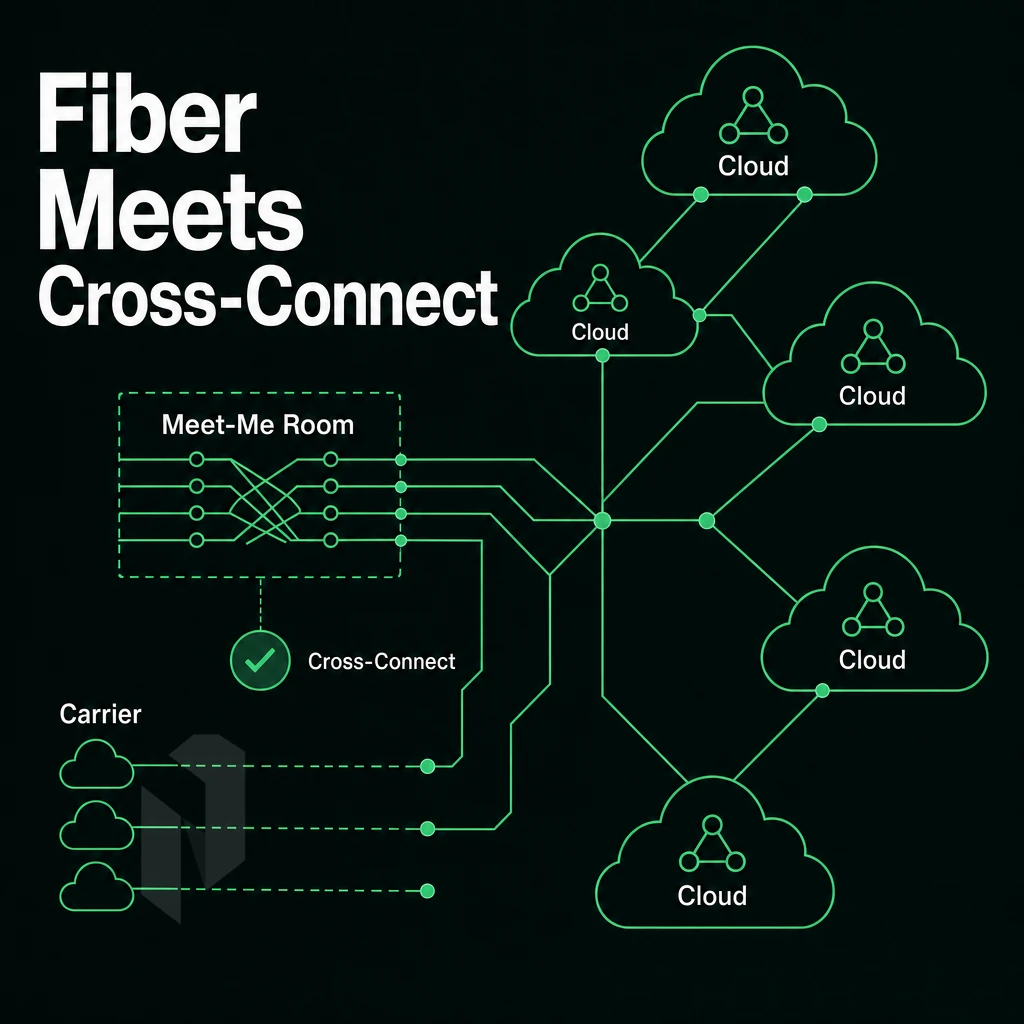
Carrier-neutral colocation facilities provide several interconnection options to reduce the burden of open internet connectivity and to increase performance. It is essential to understand all available options to mix and match the right ones for your specific work load. Evaluating connectivity options carefully ensures your infrastructure can scale efficiently while maintaining direct access to critical network resources and partners.
Direct interconnection paths are particularly valuable for latency sensitive applications that require consistent sub-millisecond response times between distributed components. Organizations running ai workloads benefit significantly from these direct paths, as machine learning inference and training operations demand both high throughput and minimal jitter between compute nodes.
Physical Cross Connects for Direct Connectivity
- Order a cross connect to the network you need a connection to. This is a dedicated cable run from your cage to a carrier or peer in the same facility as you. It means no external routing and thus near zero latency for that particular connection.
- Before you go live with a deployment verify the physical layer with the facility team for items such as fiber type, connectors and port speed. A mismatched handoff is the most common cause of failed turn-up.
Note: Cross connects bypass the public network entirely, but only for traffic to the directly connected party. All other traffic still needs a transit or peering strategy.
Internet Exchanges and Cloud On-Ramps
- Connect to an Internet Exchange (IX). Through an Internet Exchange you can peer with dozens of network providers from a single port. Peering with Content Delivery Networks (CDNs) and Internet Service Providers (ISPs) can even be set up without having to negotiate bilateral connections separately.
- Cloud on-ramps for private cloud access: Dedicated circuits to cloud platforms to access cloud services without traversing the open internet. Consistent latency and throughput.
Private Tenant Connections and Upfront Costs
- Create private cross-fabric links between your cages or those of your partners. We offer free private network connections between customer resources. Such traffic is kept out of shared infrastructure to guarantee extra security and improved network connectivity for multilocale installations.
These three functions together form the connectivity stack of a data center hosted in a colocation facility.
Key Benefits: Why Businesses Choose Colocation with Interconnection
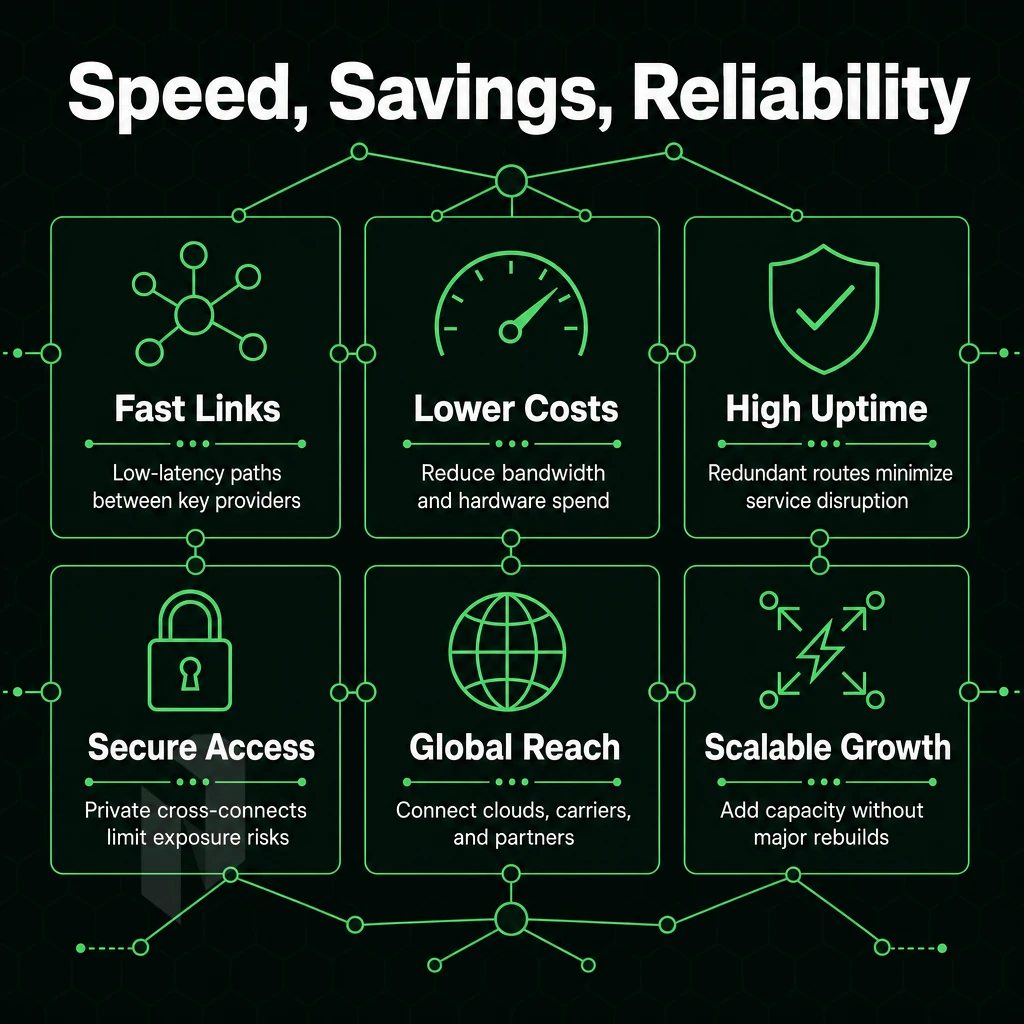
By combining colocation with interconnection you get a very real business case. Colocation frees you from the huge capital expenditure required to create a private infrastructure. Additionally, Interconnection gives you on demand access to the densest carrier and cloud ecosystems, something that building out independently would take years to create. Leveraging partner ecosystems within carrier-neutral facilities accelerates time-to-market for new services while reducing the complexity of managing multiple vendor relationships across geographic regions.
Cost Structure and Payback
Private data centers require a huge up-front investment in civil works, power, cooling and security. The capex is then converted into a manageable operating expense at a colocation facility. Outsourcing power cooling infrastructure to a professional facility also eliminates the ongoing burden of maintaining specialized HVAC equipment and managing thermal load distribution as server density increases.
While running same workloads in public cloud (e.g. Amazon Web Services, Microsoft Azure. Google Cloud Platform) platforms would result in higher Total Cost of Ownership for stable and highly utilized compute colocation offers better cost structure with no egress surprises and no billing per API call.
Operational Reliability and Business Continuity
Carrier-neutral colocation facilities deliver the same operational reliability as enterprise data centers, with features such as redundant power, N+1 cooling and physical security using biometric access control, as standard.
By interconnecting your primary colocation location to your cloud on-ramps and secondary colocation sites, business continuity is further enhanced. Disaster recovery failover traffic is kept off the general internet and sent over private, low latency paths to ensure continued operation in the event of a failure.
Optimal Performance for Latency-Sensitive AI Workloads
Colocating your infrastructure with direct interconnections reduces the physical distance between your systems. For highly latency sensitive workloads such as AI inference, real time financial transactions and live media streaming every millisecond counts. Cross-connects within a facility eliminate the need for multiple router hops.
The network characteristics also play a large role in how the colocation offering compares to public cloud for infrastructure decisions.
Colocation vs. Public Cloud: Choosing the Right Infrastructure Model
Most enterprises use a combination of colocation and public cloud and have to decide which workloads should run where. The key decision is how the different environments are inter-connected. The right balance allows for the desired performance, sufficient compliance and, most importantly, cost predictability in the long run.
Colocation vs. Public Cloud Service Providers
Public cloud providers offer quick provisioning and a wide array of managed services. Their costs and trade-offs include variable egress charges, shared resources, and lack of visibility into underlying physical facilities. For community perspectives, see What is the difference between a Google Colocation ....
Colocation provides you with dedicated hardware, fixed monthly charges and complete control of your environment. For regulated industries such as finance, healthcare and government, this is often required to ensure data sovereignty and compliance.
- Performance: Bare metal in a colocation facility eliminates the noisy-neighbor effect common on shared hypervisor platforms.
- Compliance: Physical isolation simplifies audits under GDPR, HIPAA, and PCI-DSS.
- Cost: No surprise egress fees, bandwidth is contracted, not metered per gigabyte.
Colocation Data Centers and Interconnection: The Hybrid Core
In the modern hybrid model, colocation facilities function as fixed compute resources. Cloud on-ramps provide a bridge to the primary cloud providers to support peak demand, access to Software as a Service, and regional reach.
Private cross-connects and Layer 2 circuits enable interconnection solutions that keep your traffic off the shared internet, making public and private clouds an integral part of your own infrastructure.
Our data centers in Amsterdam, Frankfurt, Miami and Hong Kong are located within major carrier-neutral exchange points. This allows for practical low-latency cloud on-ramp connectivity instead of purely theoretical offerings.
Where Edge Computing Fits
Workloads sensitive to latency, like real-time analytics, load balancing on the network edge or even content delivery, can greatly benefit from colocating closer to end users. Edge computing deployments make use of regional colocation facilities to process information locally before syncing it off to the cloud (or an on-premises core).
The geographic reach of Netrouting's colocation is included with all of their services and outlined below.
Netrouting Colocation and Interconnection: European, US, and APAC Coverage
Netrouting has 10+ carrier neutral locations for Colocation Services in Amsterdam, Frankfurt, The Hague, Rotterdam, Stockholm, Bucharest, Miami, New York, Hong Kong and Singapore. Our colocated services therefore are directly connected to several high density Internet Exchanges like AMS-IX, DE-CIX, NetNod and FL-IX.
- Carrier-neutral, vendor-neutral: Bring your own network carriers or use our IP transit. Full BGP support and BYOIP keep you in control of your routing.
- High-density ready: Colocation services scale from a 1U starter to 20 kW per footprint, with N+1 power and cooling, UPS systems, and backup generators throughout.
- Built-in DDoS protection: Always-on L3/L4 mitigation is included on every colocation service, no add-on required.
- Layer 2 interconnection: Ethernet services provide private, point-to-point and multi-site connectivity across our colocation facilities for low-latency data exchange and disaster recovery.
- Certified and monitored: ISO 9001, ISO 27001, and SOC 2 certified. Our 24/7 NOC backs every deployment with a one-hour ticket guarantee.
For teams evaluating leading colocation providers across Europe, North America, and Asia-Pacific, Netrouting offers the interconnection solutions and network performance to match. Contact our team to discuss your colocation and interconnect services requirements, or use the checklist below to build your evaluation criteria.
Frequently Asked Questions
Do colocation services support business objectives with advanced cooling for hosted equipment?
Colocation (colo) means housing your own servers and networking hardware inside a third-party data center. This separates the cost of building and operating a data center from the cost of running your infrastructure. Businesses choose colo to gain carrier-neutral connectivity, redundant power, and professional-grade facilities without the capital expense of a private data center.
Which top 10 colocation providers offer the best cloud on ramps?
The global colocation market mixes hyperscale campus operators, carrier-neutral exchange hubs, and regional specialists. Network-first providers like Netrouting deliver carrier-neutral colocation and cloud on ramps with consistent network performance across ten cities in Europe, North America, and Asia-Pacific on its own AS6206 backbone.
Netrouting's facilities are ISO 9001, ISO 27001, and SOC 2 certified, with N+1 power and cooling and up to 20 kW per footprint.
How much does a colocation server cost?
Colocation pricing depends on the space you rent (1U, half-rack, full cabinet, or private suite), power draw, and bandwidth commitment.
What are the three main types of colocation data centers?
The three main types are retail colocation, wholesale colocation, and carrier-neutral interconnection hubs.
Wholesale colo leases large blocks of raised-floor space and power to a single tenant, typically an enterprise or cloud provider building out a private environment. Carrier-neutral interconnection hubs focus on dense network connectivity, hosting hundreds of carriers, ISPs, and cloud on-ramps so tenants can exchange traffic directly without routing through the public web.
What Is a Cross Connect in a Single Data Center?
A cross connect is a dedicated physical cable, copper or fiber, that links two separate tenants or network ports inside the same data center facility. It creates a private, direct circuit between your cage and a carrier, cloud provider, or peering partner without traffic ever leaving the building.
Cross connects eliminate the latency and variability of routing over the global internet for that specific path. They are the foundation of colocation interconnection: every IX port, cloud on-ramp, and private network exchange starts with a cross connect to the relevant switch or meet-me room.
What is a cloud on-ramp and how does it work?
A cloud on-ramp is a physical interconnection point inside a colocation facility where a major cloud platform terminates a direct private circuit. Instead of sending traffic over the public IP network to reach cloud resources, you run a cross connect from your cage to the on-ramp port, which connects directly into the cloud provider's backbone.
The result is lower latency, higher throughput, and more predictable performance than internet-based access. Carrier-neutral colo facilities are the most common on-ramp locations because they already aggregate multiple networks and cloud providers under one roof.
How does interconnection inside a colocation facility reduce latency?
When two networks exchange traffic inside the same data center colocation facility, packets travel meters of fiber rather than hundreds of kilometers of internet backbone, cutting round-trip times from tens of milliseconds to fractions of a millisecond. This is the core value of colocation interconnection: physical proximity eliminates the hops, handoffs, and congestion points that accumulate on internet backbone paths.
Internet exchange points (IXPs) formalize this by letting dozens or hundreds of networks peer at a shared switching fabric inside the facility.
Using colocation with interconnection at a carrier-neutral colocation location allows you to have physical control over your servers, predictable pricing, and low latency data exchange through low-latency interconnections to all the carriers, as well as to your peers and partners. There is a measurable performance difference between a cross-connect provisioned through a colocation operator and a connection over the public-facing internet, and for certain workloads (very latency-sensitive, extremely high-bandwidth) this difference actually matters.
Most organizations with a mature IT infrastructure strategy use both colocation and public cloud computing.
Netrouting operates carrier-neutral colocation across ten locations, Stockholm, Amsterdam, Rotterdam, The Hague, Frankfurt, Bucharest, Miami, New York, Hong Kong. Additionally, Singapore, with a 2.4 Tbps+ backbone on AS6206, dense IX peering, and always-on DDoS protection included on every service. Explore Netrouting's colocation options or contact our team to discuss your specific requirements.