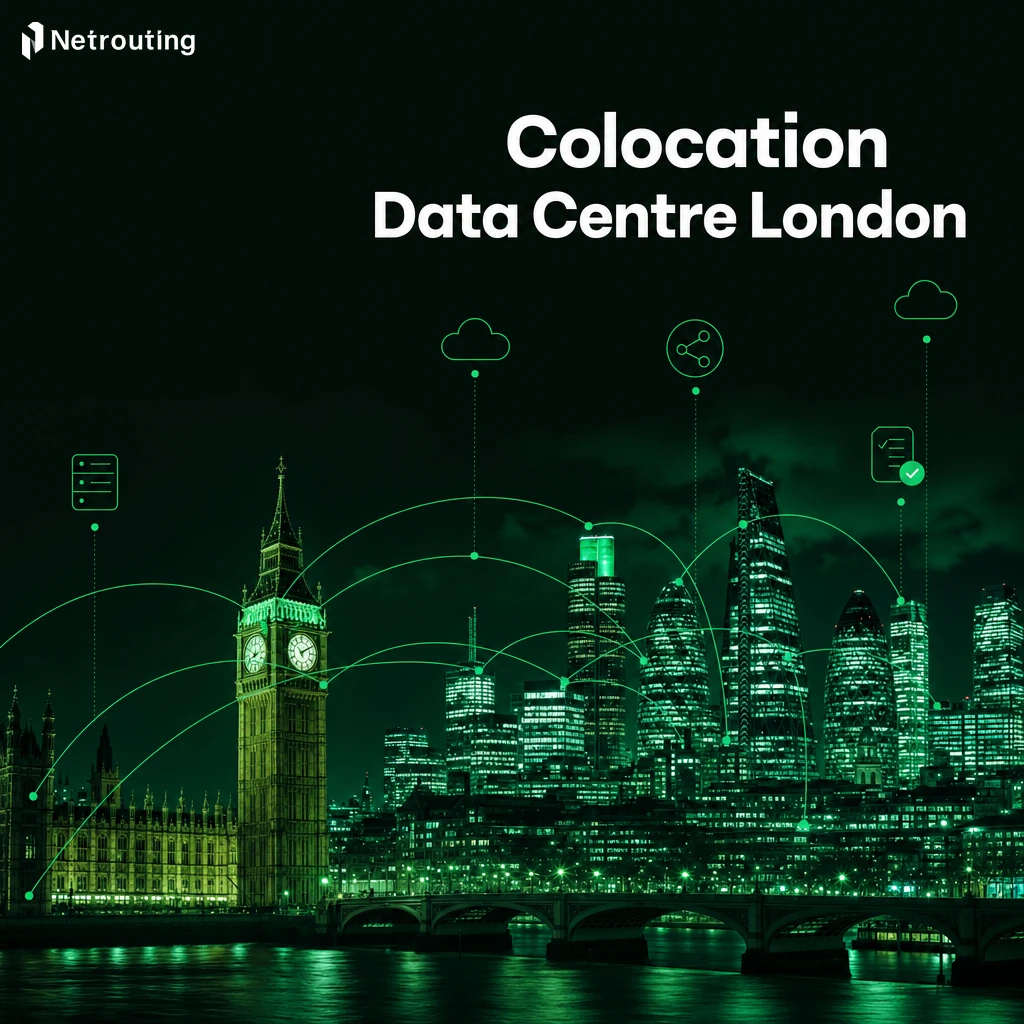
Choosing a colocation data center in London is more than a case of finding space for your servers on a rack. It is a matter of choosing a connectivity infrastructure to support you for years to come.
With London at the heart of Europe’s Internet Exchange system, it is one of the most strategic locations for low latency work, financial organizations and global content distributors. Organizations requiring ultra-low latency connections to financial markets or content delivery networks benefit significantly from close proximity to major exchange points and carrier hotels.
Choosing a colocation facility is not just about geography. Important factors include power density, the architecture of redundancy, carrier diversity, cross-connect capabilities, and service level agreements for support. Selecting the wrong colocation provider can lead to locking into long-term contracts with restrictive provisions and limited access to uplink options. Additionally, in the world of engineering, poor service reliability that only responds after things have gone wrong is exactly what slows teams down.
Blog contents
Organizations seeking predictable operational expenses should prioritize providers with transparent pricing models and low risk contract terms that allow for flexible scaling. Reputable colocation providers should clearly outline what levels of remote hands support, hardware replacement timelines, and network monitoring they provide as part of their standard agreements. Direct engagement with technical teams before signing ensures you can touch base on critical operational details that standard contracts often overlook.
A good London colocation facility is not a commodity item.
What Is a Colocation Data Centre London Offers
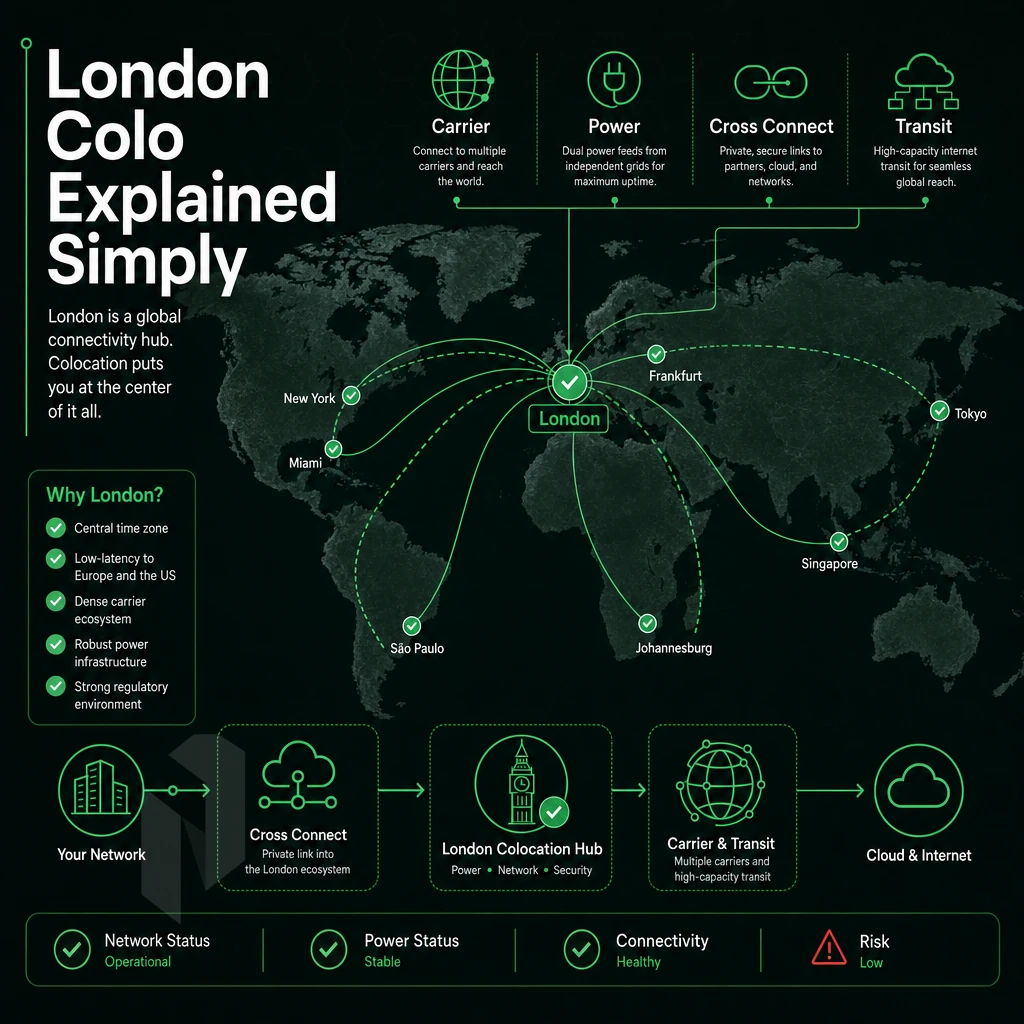
Colocation is simply renting space within a third party data center and housing your own servers and other IT equipment. The facility provides power, cooling, physical security and the ability to connect to the wider world, but you retain full ownership and control of your hardware. For community perspectives, see How does colocation work for individuals in London? ....
How London Data Centers Differ from Cloud and Managed Services
We own the servers in colocation, the cloud abstracts hardware entirely. Managed Services then adds an operational layer on top of that. Colo therefore sits in the middle of the range: your own infrastructure plus a very solid and knowledgeable third party's.
Why Businesses Choose Resilient Infrastructure at Colocation Sites
An on-premises data room typically doesn’t have the same up-time and physical security capabilities as a carrier. But by placing your co-location in a facility you gain access to redundant power, fire suppression and disaster protection, all without you having to build and run it yourself.
- Carrier-neutral connectivity to multiple network providers.
- N+1 power and cooling at enterprise scale.
- Predictable operational costs, No capital is required to build out the facility.
With the model now clear, it is worth explaining why London is such an in-demand market for this technology.
Colocation vs. Cloud for European Markets: Choosing the Right Model
Variable workloads suit cloud compute, but when you need complete hardware control, fixed costs, and compliance, server colo is the better solution for data-intensive businesses.
Netrouting offers colocation as well as cloud services from multiple data centers in London and other locations around the world. It provides businesses with a scalable and flexible way to grow their technical foundation.
Frequently Asked Questions About Power Availability
How Do London Data Centers Use Security Cages Against Natural Disasters?
A colocation data centre is a network colo facility where businesses rent physical space, racks, cages, or private suites, to house their own servers and networking hardware. The hosting hosting site provides the building, power, cooling, and physical security. You own and manage the hardware; the data centre operator manages the hosting framework around it. This model gives you the control of dedicated hardware without the capital cost of building and running your own colo site to connect to. Clients can choose from open racks in shared environments or deploy within secure cages that provide dedicated lockable enclosures for enhanced physical isolation and access control. These facilities serve organizations that need direct hardware control while benefiting from enterprise-grade physical and network resources.
Who Owns London Data Centers for Colocation?
Managed co-location data centres are owned and operated by specialist physical plant providers, ranging from large global operators with dozens of facilities worldwide who compete on speed and scale, to regional and carrier-neutral independents focused on specific markets. Telecoms carriers, real estate investment trusts, and privately held IaaS organizations all connect through the sector, competing on reliability and participation. Some enterprises also build and partially lease out their own facilities, though this is less common. The London market in particular is served by a dense mix of global operators and local independents. London's metro area hosts a particularly competitive landscape where proximity to financial districts and subsea cable landing stations drives provider differentiation. This competitive environment creates significant opportunities for businesses to negotiate favorable terms and select providers that align precisely with their technical and commercial requirements. Businesses evaluating providers should assess not only their current footprint but also their ability to reach emerging markets and expand connectivity options as requirements evolve. Providers that operate across multiple regions enable clients to share consistent operational practices and security policies across geographically distributed deployments.
What Is the Biggest London Data Centre in the UK?
The largest data centre campus in the United Kingdom by total capacity is located in Slough, west of London, and spans millions of square feet across multiple interconnected buildings on a single campus. London's broader metropolitan area, often called the Central Central Central London Internet Exchange (LINX) cluster, collectively forms one of the largest data centre markets in Europe. Several hyperscale facilities are also under construction or recently opened across the M4 corridor and in East London's tech hub's tech hub's tech hub, steadily expanding total Britain capacity.
Who Are the Big 5 London Data Centers?
The term "big 5" typically refers to the five largest global server co-location and interconnection operators by current footprint, revenue, and future expansion plans, and is widely used across industry media. These clients are large publicly traded or institutional-backed enterprises with presences across North America, Europe, and Asia-Pacific. Industry media outlets frequently analyze these operators' quarterly earnings and expansion strategies to track shifts in global colocation market dynamics.
Beyond those global giants, carrier-neutral independents like Netrouting, with facilities spanning Stockholm, Amsterdam, Frankfurt, Miami, New York, Hong Kong, and Singapore, offer an alternative: direct access to Tier 1 backbone core systems, dense IX peering via AS6206, and the flexibility of a provider that engineers each deployment to workload rather than fitting customers into a standardised product catalogue.
This approach ensures clients can negotiate directly with multiple upstream carriers to optimize routing and cost structures for their specific traffic profiles. Teams can collaborate directly with network engineers to design custom routing policies and peering arrangements that align with application-specific latency and throughput requirements.
Whilst Greater the City of the City of London is at the heart of European connectivity and is typically the first choice for information center colo hosting, rack space hosting on a Major Internet Exchange is only part of the story. Your digital center must also provide the necessary power density and redundancy to ensure your workloads are running effectively, as well as the necessary carrier diversity to guarantee uptime. Furthermore, 24/7 support is essential in order to handle any issues that may arise at any time.
Proper environmental controls and monitoring systems play a critical role in ensuring continuous operation across all infrastructure layers. Proper redundancy architecture should include N+1 or 2N configurations for critical systems, ensuring that single points of failure cannot disrupt operations. A resilient infrastructure design protects against both planned maintenance windows and unexpected hardware failures through proper redundancy layering. Operators should verify that physical access protocols include biometric authentication, mantrap entry systems, and detailed audit logs to maintain compliance with regulatory frameworks.
For stable, high-throughput workloads, server rack hosting generally offers lower, more predictable costs and better raw performance than cloud computing. Control is the key factor here, in off-site hosting you lease hardware, a whatever-network-connects-to-it and get an SLA for it, all for a fixed price rather than by the hour.
Netrouting operates carrier-neutral dedicated rack hosting across Europe, including Amsterdam, Frankfurt, and The Hague, with a 2.4 Tbps+ backbone, always-on DDoS protection, and a 24/7 NOC behind every rack. Explore Netrouting's European colocation options or contact the sales team to discuss your specific requirements.