This is where a remote hands support comes in to a resilient infrastructure strategy.
You have on-site, experienced staff at the colocation facility who can have your servers back up within the hour.
Distributed IT infrastructure in multiple data centers can be operated by IT teams only with the help of remote hands services.
Blog contents
This article explains what remote hands services are, how to evaluate provider SLAs, which tasks fall within the standard scope of remote hands, and how remote hands agreements should be set up before failure occurs.
What Is a Colocation Smart Hands Service?
Colocation Remote Hands is the service of having trained and experienced technicians resident on the floor of your data center. They can perform physical actions on your hardware as required while you own the boxes. These certified technicians undergo rigorous training to handle diverse hardware platforms and follow strict operational procedures to maintain service quality.
What a Colocation Facility Technician Actually Does
Remote hands covers routine and urgent physical work:

- Power cycling and rebooting unresponsive servers.
- Cable checks and reseating connections.
- Indicator light observation and visual inspections.
- Basic hardware swaps under customer instruction.
Data Center Infrastructure Support and Data Protection for Technical Challenges
Remote hands delivers fast technical assistance 24/7 for all your datacenter assets, from artificial intelligence workloads to legacy hardware, without requiring you to travel to and within your datacenter. The remote hands technician confirms a failed disk in critical systems, reseats a network interface card and reports back within minutes.
Remote Hands vs. Smart Hands Service
Remote hands refers to basic physical actions at a remote location. Smart hands refers to more complex actions such as scheduled maintenance diagnostics, reconfiguring, and even guided troubleshooting. Remote hands technicians execute straightforward hardware installations such as mounting equipment in racks or connecting power distribution units, while smart hands engineers handle complex deployments requiring configuration expertise. Remote hands technicians can also assist with receiving and staging new equipment deliveries, ensuring proper inventory tracking before installation begins.
As a courtesy Netrouting includes Basic Remote Hands for free on all locations where colocation is offered.
Why Remote Hands Services Are Cost Effective for IT Operations
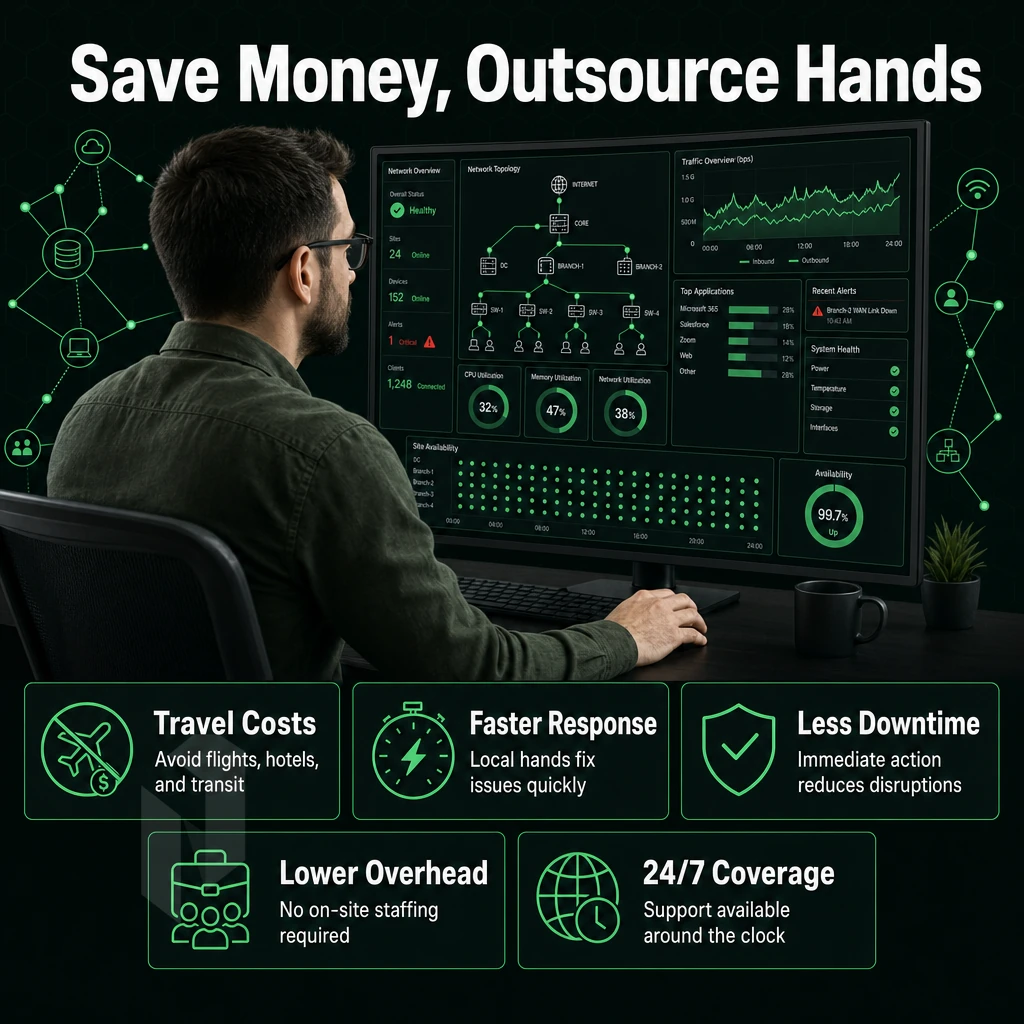
Sending your internal engineer to a remote colocation facility can end up costing you a lot of money. In addition to the cost of travel to be on site, there is their hourly rate plus lost productivity, and for the majority of issues a simple reboot or re-cabling of a connection is required. A on-site technical assistance removes all of these costs from your bottom line.
The high cost of emergency travel and unplanned engineer deployment often dwarfs the actual technical work required to resolve the issue. Comparing the fixed service fees of remote hands providers against internal engineer hourly rates reveals significant savings, especially when factoring in after-hours premiums and overtime.
Eliminating Travel and Staffing Costs
Unplanned site visits requiring hands services on-location have unknown costs: flights, hotels, and billable hours that generally exceed the cost of the task itself. With Remote hands you can use the on-site technicians already on site at the datacenter to perform tasks on your behalf. No travel costs and no scheduling delays.
Many organizations employ remote hands for ensuring optimal performance of their infrastructure on an as-needed basis, rather than employing additional staff on payroll as permanent members of their engineering team. Leveraging professional data center support on demand allows businesses to scale their technical capabilities without the overhead of full-time facility staff. This flexible approach enables organizations to adapt their support resources to match evolving needs without long-term commitments or fixed overhead.
This model proves especially valuable when internal teams lack the bandwidth to manage geographically distributed infrastructure or require specialized technical support during peak demand periods. This approach has become increasingly popular as many businesses recognize that maintaining permanent on-site staff at every facility location is neither cost-effective nor operationally necessary.
Reducing Downtime Through Rapid Response
While prolonged downtime costs more, rapid on-site response from experienced technicians cuts MTTR sharply.

The business cost of every hour of your downtime through infrastructure failure is substantial. That multi-hour effort to dispatch someone for assistance is converted to a few minutes of work by our remote hands.
Operational Efficiency and Strategic Value
The remote hands capability is a force multiplier for the IT operations team. It is this shift from traveling to react with hands services to designing to enable pro-active engineering that is of most strategic value.
As infrastructure evolves in complexity and even AI workloads go through frequent changes in hardware requirements, being able to remote in without delay is a huge differentiator. We provide remote hands for basic tasks free of charge. More advanced remote hardware deployment for infrastructure management (project-based rack-and-stack) can be provided for larger scale business operations projects. However, physical access controls to your hardware must also be of the highest quality in order to enable these types of remote hands services operations.
Remote Hands Services at Netrouting Colocation Facilities
The data center remote hands provided by Netrouting gives your team on-site expert support without travel costs.
- Courtesy remote hands included. Basic remote hands services are included free of charge on all colocation orders. We also offer remote project-based rack-and-stack services on an ad-hoc basis as required.
- 24/7 NOC with 1hr ticket guarantee. Our NOC proactively monitors your IT Infrastructure 24/7 and responds within the hour to critical incidents to ensure optimal performance and minimum downtime.
- Ten carrier-neutral colocation facilities are available: The Hague, Amsterdam, Rotterdam, Frankfurt, Bucharest, Stockholm, Miami, New York, Hong Kong, and Singapore.
- We have certified, process-driven operations for our smart hands services and physical access procedures that adhere to the standards of ISO 9001, ISO 27001 and SOC 2.
- swift incident response for mission-production systems. Our smart hands technicians are physically present for both scheduled and unscheduled maintenance.
Talk to us about how our smart hands support can also be used for your Data Center management needs.
Cable Management Frequently Asked Questions
How Does Smart Hands Use Physical Presence to Handle Complex Tasks in Remote IT Support?
Remote hands is a service where data center technicians perform physical tasks on your equipment without you traveling to the facility.
What Is the Difference Between Remote Hands and Smart Hands Service?
Remote hands covers straightforward, low-skill physical tasks: hard rebooting, cable checks, media swaps, and visual inspections.
What Is a Colocation Provider With Smart Hands Service?
A colocation provider owns and operates a data center facility and rents space, power, cooling, and connectivity to customers who bring their own servers and networking gear. The provider handles routine maintenance and management of the physical infrastructure, raised floors, power distribution, cooling systems, cable management, physical security, and network uplinks. Customers retain full ownership and control of their hardware. Netrouting operates carrier-neutral colocation across ten cities in Europe, North America, and Asia-Pacific.
Who Handles Data Center Management in Colocation?
The data center facility itself, the building, power infrastructure, cooling, and network fabric, is owned and operated by the colocation provider. The servers, storage, and networking equipment inside the racks belong to the customers who lease that space.
When should I use remote hands instead of sending my own engineer?
Use remote hands whenever the task is well-defined, time-sensitive, and doesn't require your engineer's specialized knowledge on-site. Typical triggers in data center operations include an unresponsive server that needs a hard reboot, a failed drive swap following a clear procedure, a loose cable causing a link-down alert, or a quick visual confirmation after a remote config change.
For everything else, remote hands is faster and more cost-effective.
Is 24/7 Data Center Support Available at Colocation Facilities?
Availability varies by provider, but enterprise-grade colocation facilities keep on site NOC staff around the clock precisely because hardware failures don't respect business hours. Netrouting operates a 24/7 Network Operations Center with a one-hour ticket response guarantee, so remote hands requests can be actioned at any hour. When evaluating a colocation provider, confirm whether after-hours remote hands carries a surcharge and what the guaranteed response window is, not just whether staff are physically present.
How do colocation providers protect sensitive data during remote hands tasks?
Reputable providers of smart hands service enforce strict access controls to prevent critical issues like unauthorized entry: only authorized technicians with verified credentials enter your cage or cabinet for hardware replacements or any other work, and all activity is logged via keycard systems and CCTV. on-site support work is performed against a customer-approved ticket with a defined scope, technicians act only within the instructions you provide.
Netrouting holds ISO 27001 certification and SOC 2 compliance, both of which mandate documented information security controls covering data center operations including on-site physical access and personnel handling of customer equipment.
By eliminating the need for on-site IT staff at every colocation, smart hands services can help reduce the overall cost of operational overhead. The most important aspect to understand about physical access to your data center colocation infrastructure is that it must be executed by highly skilled service technicians following strict change-control procedures in order to guarantee that incidents are repaired in time to prevent prolonged downtime. Combine this with well-documented data protection procedures and you have a scalable colocation model.
Netrouting provides courtesy data center technician backed by technical expertise across its carrier-neutral facilities in Amsterdam, The Hague, Frankfurt, Miami, New York, Hong Kong, and beyond, supported by a 24/7 NOC and a one-hour ticket response guarantee. If you're evaluating colocation for a latency-sensitive or compliance-driven workload, explore Netrouting's colocation options or contact the team to discuss your specific requirements.