Selecting the best dedicated server hosting service in the United States means more than finding the lowest price. It means choosing a network, a support team, and server hardware your applications will run on for years.
Your Guide to US Dedicated Server Hosting. We cut through the multitude of rubbish servers and provide you with an in-depth review of what makes good Dedicated Server Hosting and how you can tell a quality server from the rest. Whether you're looking to migrate from Shared Hosting to dedicated servers, trying to consolidate servers, or trying to find the perfect location for a low-latency edge server on the East Coast or West Coast of the US.
This guide will outline the key things to look for in a server and how your chosen hosting company operates their Dedicated Servers . We can tell you how our Dedicated Servers operate as we run them from our dedicated infrastructure in Miami and New York.
Blog contents
What Are Dedicated Hosting Servers in the United States?
A dedicated server is a rental of a full, physical machine, exclusively reserved and dedicated for use by a single tenant. It’s not shared with other users in terms of CPU time, RAM, storage etc. You rent and fully control the hardware. For community perspectives, see Looking for hosting suggestions, multiple VPS or dedicated ....
Dedicated Server Hosting United States: The Core Model
The primary characteristic of dedicated server hosting is that your workload runs on completely dedicated bare metal hardware, unlike shared or VPS hosting where many tenants are competing for resources on the same server. On a dedicated server there is no noisy-neighbor problem, because every core, every GB of RAM, every I/O operation, and the entire operating system is completely dedicated to your workload.
This isolation makes dedicated server hosting ideal for production workloads that require dedicated environments free from resource contention or security risks introduced by neighboring tenants. Organizations requiring multi-tenant isolation with dedicated resources often evaluate private cloud infrastructure as an alternative, though it typically involves higher capital costs than single-server deployments.
VPS hosting creates virtual servers on top of a physical server, adequate for very light usage but severely limited otherwise. Dedicated servers have no such limitations.
Why the Data Center Location Matters
Our US-based dedicated servers offer sub-10ms latency to customers on the East Coast and sub-40ms to those on the West. This contrasts with shared hosting offered from outside the US, where latency can reach into the hundreds of milliseconds from within the US.
Finally, having US jurisdiction for compliance reasons is important for healthcare, financial and SaaS companies. By choosing a US-based dedicated server provider, you lock yourself into a known compliance regime for your data.
Bare Metal as the Underlying Hardware Model
Bare metal means running your OS directly on hardware, no hypervisor involved.
We run dedicated servers at our 60 Hudson Street location in New York and our Miami facility, using the latest Intel Xeon and AMD EPYC processors. These are purpose-built for workloads that require large amounts of predictable high-throughput compute. So, now that we’ve outlined the core model, why US geography? Our facilities deploy enterprise grade hardware with redundant power supplies and hot-swappable components to ensure maximum uptime for mission-critical workloads.
Monitoring systems track network uptime continuously, alerting our operations team to any anomalies before they impact customer workloads. This reliable infrastructure ensures consistent performance for demanding applications that cannot tolerate unexpected downtime or hardware failures. This robust infrastructure supports demanding enterprise workloads that require both performance consistency and operational resilience across geographically distributed deployments.
Why Choose a USA-Based Dedicated Server?
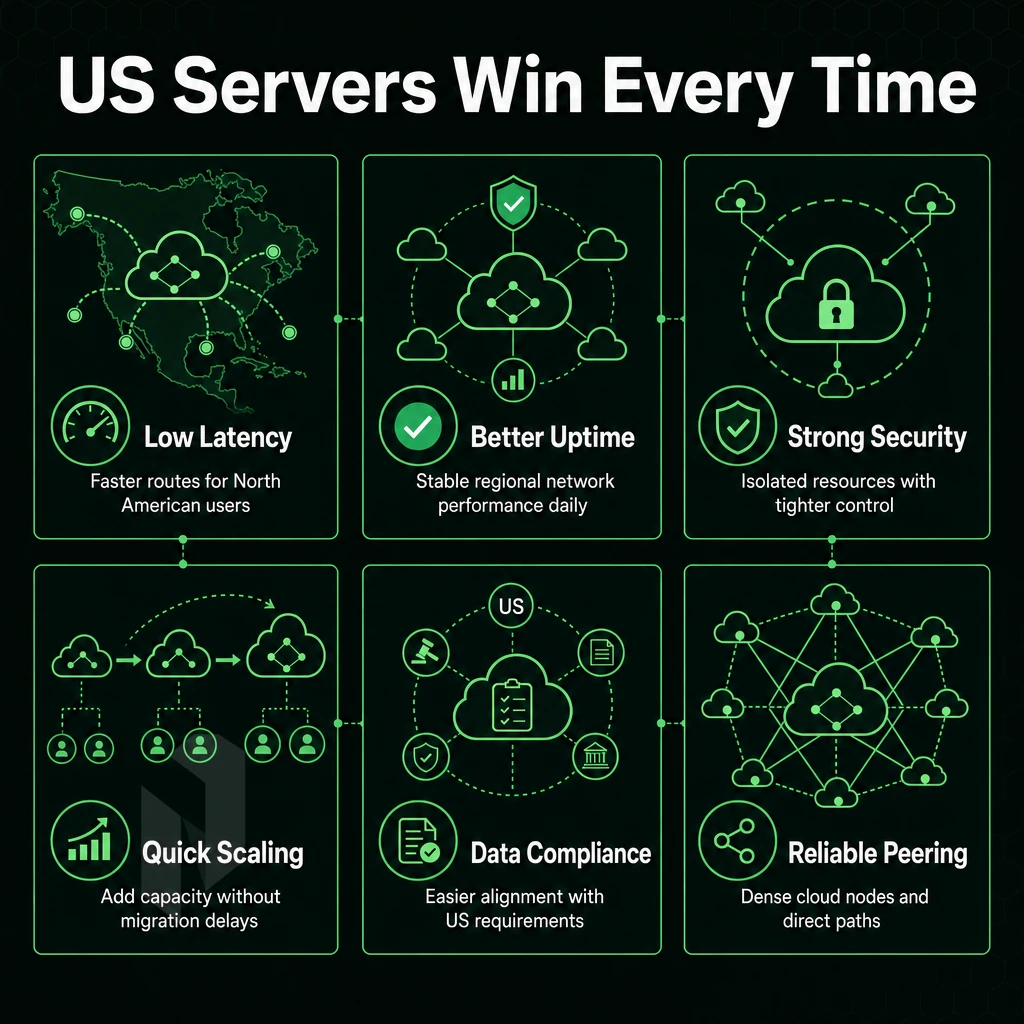
Choosing where to host your dedicated server shapes every downstream performance metric. For teams serving North American audiences, dedicated servers housed in a USA data center deliver measurable advantages, from raw latency to legal compliance, that generic offshore hosting simply cannot match. Organizations evaluating a dedicated server usa option should prioritize providers with direct peering agreements and redundant uplinks to minimize packet loss during traffic surges.
High Performance Network and Latency Optimization
Physical distance is the single biggest driver of round-trip latency. A dedicated server USA deployment in Miami or New York puts your infrastructure within 10-30 ms of the majority of the US population. That gap matters for real-time workloads: gaming servers, SaaS platforms, and live video streaming all degrade visibly above 50 ms.
US data centers connect directly to major internet exchange points and Tier 1 carrier backbones, meaning fewer hops, lower jitter, and consistent performance under peak traffic, not just during quiet periods.
USA Dedicated Servers: Compliance and Legal Fit
Regulated industries, healthcare, finance, legal, often require data to remain on US soil. A physical web hosting server with a compliant operating system located domestically satisfies HIPAA, SOC 2, and state-level data residency requirements without complex cross-border data transfer agreements. Keeping sensitive information within US borders simplifies data protection audits and reduces exposure to foreign surveillance laws.
Dedicated Servers vs. VPS: Which Makes Sense?
A VPS server shares underlying hardware with other tenants. A dedicated server gives you full administrative control over every resource, CPU, RAM, storage, and network, with no noisy-neighbour risk.
| Dimension | US Dedicated Server | Offshore Dedicated | US Cloud Instance |
|---|---|---|---|
| Latency to US users | 10-30 ms | 80-180 ms | 15-40 ms |
| US data residency | ✓ Native | ✗ Requires transfer agreements | ✓ Region-locked |
| Hardware isolation | ✓ Full | ✓ Full | ✗ Shared |
| Uptime SLA | 99.9%+ | Varies | 99.9%+ |
| Bandwidth capacity | Up to 10 Gbps unmetered | Varies widely | Typically metered |
Netrouting operates US bare metal out of Miami and New York, both carrier-neutral facilities with direct IX peering. Our support team is available 24/7 with a one-hour ticket response guarantee. For North American web hosting workloads that demand low latency, compliance, and dedicated resources, those two locations cover the full East Coast and Latin American gateway.
Understanding the advantages is one thing, knowing which workload actually needs them is the next step. Choosing between these data center locations depends on whether your primary user base is concentrated in the Northeast financial corridor or requires low-latency access to Caribbean and South American markets.
Who Uses Dedicated Servers in the USA?
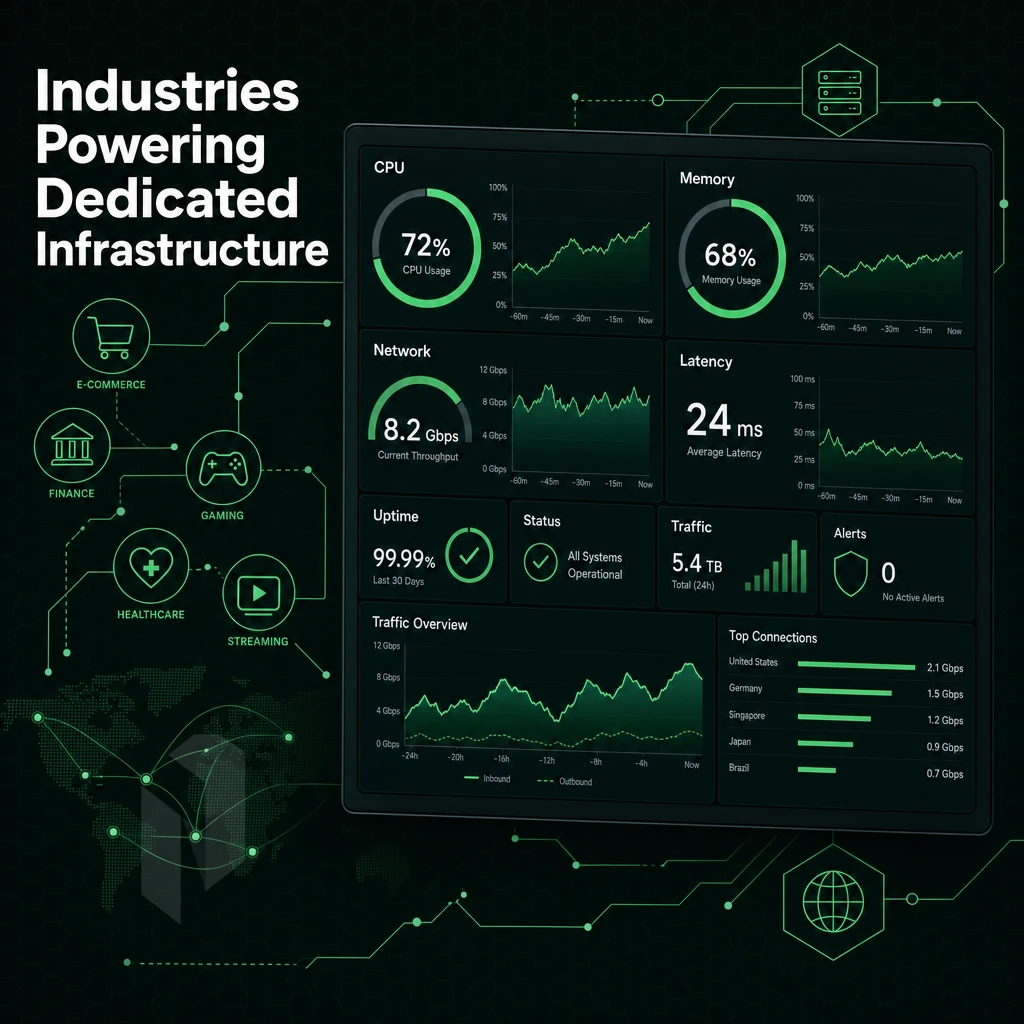
Dedicated servers in the USA are used by a wide variety of technical buyers. This includes web developers running highly trafficked web applications as well as large enterprises requiring full administrative control over their servers. We help determine the best solution for each buyer’s given workload from the start.
Evaluating the best dedicated servers means matching hardware specifications, support quality, and data center location to your specific performance and compliance requirements. Organizations operating high traffic websites particularly benefit from the predictable performance and resource isolation that dedicated servers provide at scale.
High-Demand Workloads and Dedicated Servers
- High-traffic websites and eCommerce platforms. These sites are typically best run on dedicated hardware rather than in shared environments. Their resources are too great for shared environments to guarantee. In high-traffic situations, a dedicated server means no CPU or memory “noisy neighbors” to contend with.
- Gaming server operators. The need to deliver low latency online gaming with sustained CPU performance makes Dedicated bare metal servers an attractive option as they don’t have the overhead of a hypervisor typically associated with virtual machines.
- Video streaming platforms. High-definition video streaming uses lots of bandwidth, so streaming companies need to be able to grow their number of viewers without worrying about their bandwidth costs increasing unexpectedly. With unmetered bandwidth on a 10 Gbps port, they can.
- VPN providers. Such companies require large IPv4 address spaces as well as high amounts of bandwidth. A carrier-neutral datacenter with BGP and dense peering at the Internet Exchanges (IX) is ideal for such a company and can be found at locations such as Netrouting’s Miami or New York datacenter.
Enterprise Applications and Hosting Providers
- For Enterprise application teams (running ERP, CRM and database workloads) they need root access to tune OS, kernel and storage stack. Root access unimpeded by your provider for configuration purposes.
- Hosting resellers. As a hosting reseller (e.g. web agency, web host reseller), you need full root access to a server to install a control panel, to create and manage hosting accounts and to enforce your security policy. You can’t do that in a shared hosting environment, you need dedicated hosting.
Teams Without In-House Sysadmins
-
Managed hosting for lean teams. Not every buyer has a dedicated ops team. A managed hosting service covers OS patching, security hardening, and proactive monitoring, so technical teams stay focused on their product, not the server.
Note: Managed options still provide full root access on request. You keep control; the provider handles routine maintenance.
Once you determine your application’s workload category, you need to make a decision about how much of the operational layer you want to own. Teams with strong internal expertise often prefer unmanaged models to retain granular control, while those lacking specialized staff benefit from managed services that handle routine operations.
Managed vs. Unmanaged Dedicated Servers: Which Is Right for You?
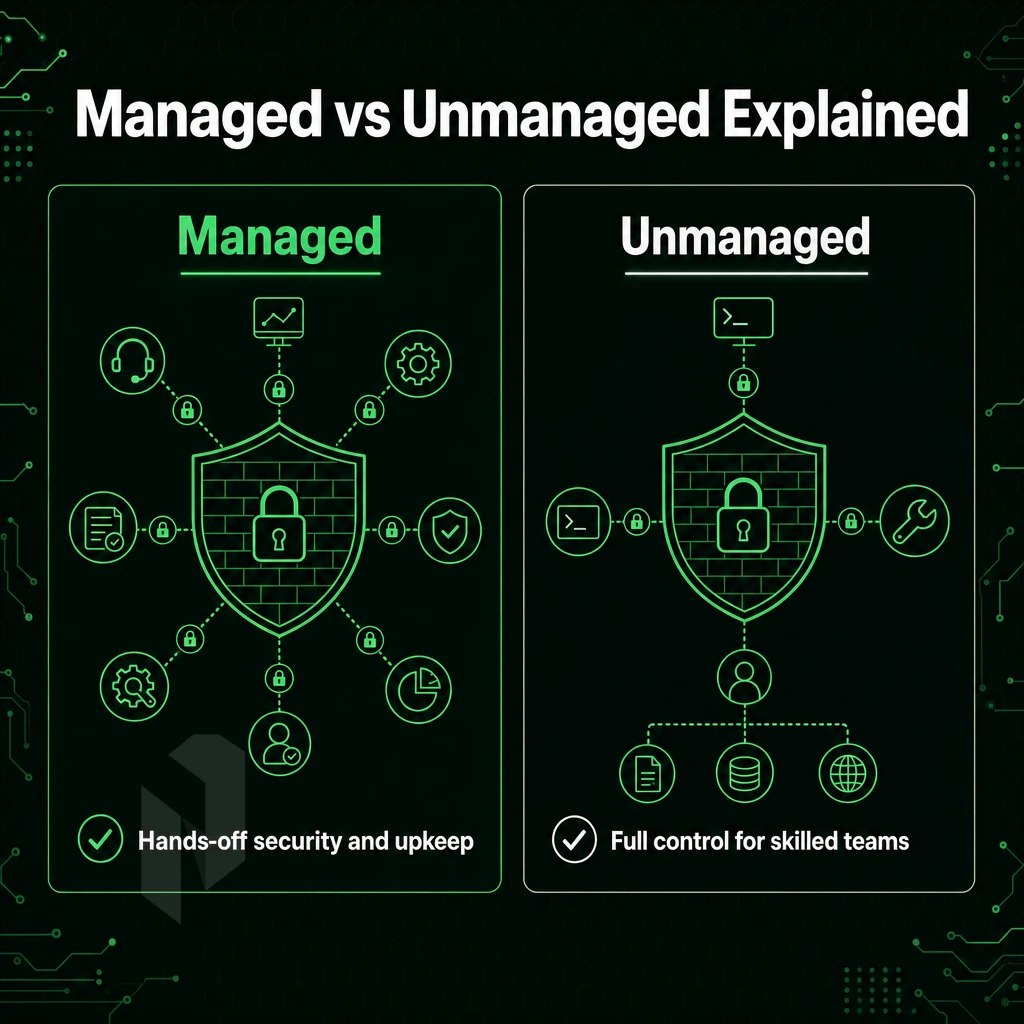
Dedicated server hosting models in the United States exist in two primary forms. Each dedicated hosting model serves distinct operational needs, from hands-on infrastructure teams to organizations prioritizing application development over server administration.
Operating System and Stack Ownership
Unmanaged dedicated servers give you full root access from day one, choose your OS, tweak the kernel, install your own software stack, handle security hardening, and manage patches yourself.
Managed hosting turns this model on its head. But you have root access and can set up your server however you like. With managed hosting, you retain full root access to customize configurations while the provider handles routine maintenance, security patches, and monitoring tasks on your behalf. This model is popular among agencies and businesses offering reseller hosting, where the provider's infrastructure team maintains server health while the reseller focuses on client acquisition and support.
VPS Server Hardware and Workload Fit
Both Unmanaged Dedicated Hosting and Managed Dedicated Services run on the same dedicated server hardware, unaffected by noisy neighbors in shared hosting environments.
Unmanaged dedicated hosting is ideal for companies with in-house Linux or Windows experts. Managed Dedicated Services, a form of managed services, are perfect for companies that need the power of dedicated servers but don't want to dedicate engineer time to manage them.
Managed hosting is not a downgrading of capabilities. Root access is still provided. On top of that the hosting provider offers an operational layer consisting of patching, alerting and hardening. As long as it is not forbidden by the provider, you can deploy whatever you like.
Control Panel Dedicated Servers: A Middle Ground
Many hosting resellers and web hosting companies need a third option. A Managed Control Panel Server (with cPanel/WHM or DirectAdmin) provides a completely managed environment for the server Operating System, software licenses and all updates etc.
This model is for the web hosting company who wants reliability but cannot afford to employ a full time sysadmin. Once you have decided on your operational model, this page describes the key technical specifications, from data center location to uptime guarantees, which will tell you how to pick a good web hosting company from the many on offer.
Key Technical Criteria When Evaluating US Dedicated Servers
When choosing a US dedicated server provider, the starting point is hardware. Getting the crucial web hosting specifications of CPU, RAM, storage and network wrong early on with dedicated hosting can lead to a lot of performance problems which can be very costly to rectify later. We explain the crucial criteria for you to choose a suitable provider.
CPU, RAM, and Storage
The enterprise hardware market is comprised of offerings from Dell and Supermicro, among others. Intel Xeon processors are designed to deliver consistent per-core performance, making them a popular choice for dedicated servers running latency-sensitive applications such as databases and real-time processing. Higher core counts at similar clock speeds make AMD’s EPYC processors suitable for parallel compute, virtualization, and AI inference workloads.
ECC RAM is a non-negotiable for production workloads. For most server configurations, we use a RAID 10 configuration that strikes a balance between performance and fault-tolerance.
Network Bandwidth and DDoS Protection
Enterprise hosting providers are distinguished from reseller hosting providers by port speed and unmetered bandwidth. A minimum 10 Gbps port with no transfer limits is required for high-volume workloads. We operate at 2.4 Tbps+, with the majority of connections at 100 Gbps or above.
DDoS protection should be always-on, not a bolt-on service. Our L3/L4 baseline DDoS protection automatically handles volumetric attacks, while our advanced L7 protection for applications includes application layer filtering and custom firewall rules where necessary. We include L3/L4 DDoS protection as standard on all our services.
Management, SLAs, and Managed Hosting
The remote console access via IPMI allows for out-of-band management of a server’s administrative console. For bare metal systems, this is a critical function.
This is a list of the things you should look for in a Service level agreement. We also offer managed hosting with full OS patching, security hardening and monitoring as well as technical support on all server tiers. However, the specifications for the Service level agreement only mean anything if the data center is located in the right place.
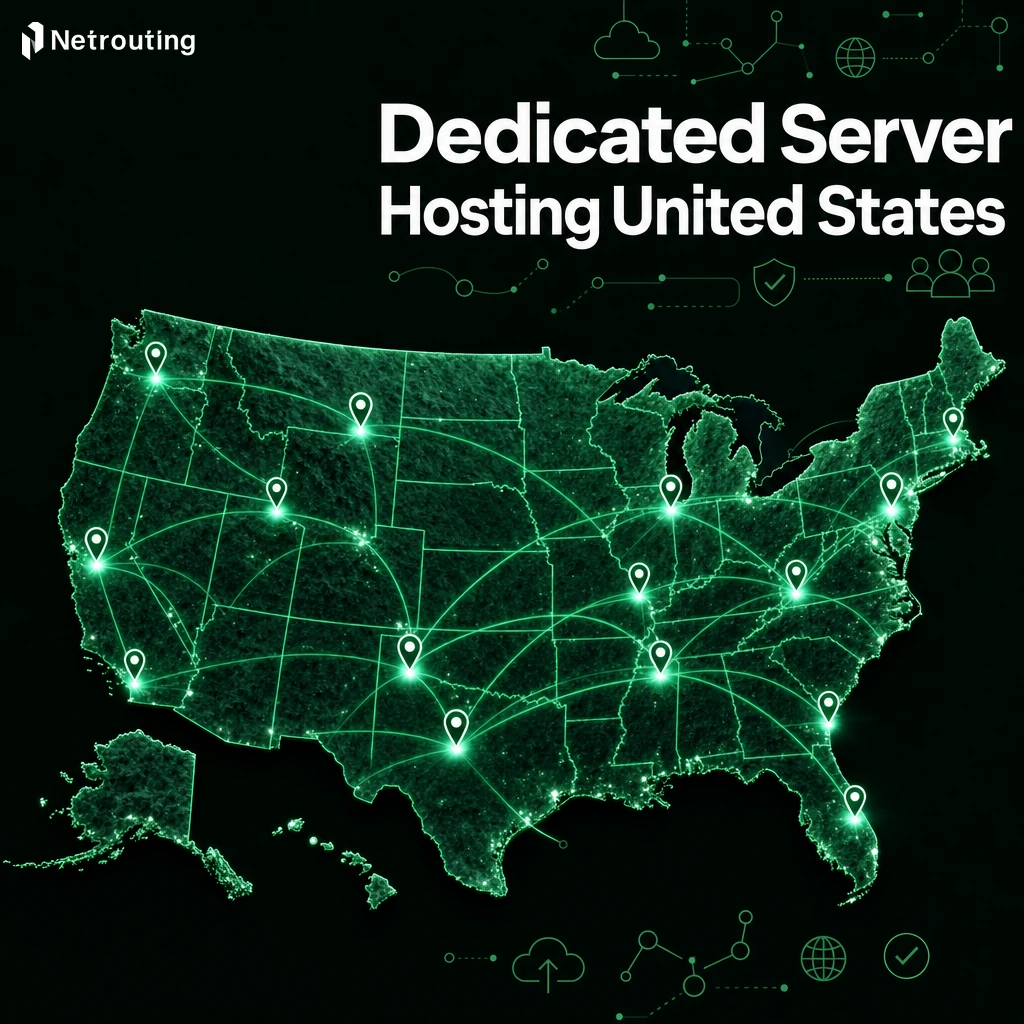
US Data Center Locations: Miami and New York
Netrouting has two US data centers. Together they cover the entire coast of the United States for dedicated server hosting.
Miami: Latin America Gateway
Our global headquarters is in Miami, a SOC 2-compliant facility and the company's primary connectivity point.
Miami is a strong location for workloads targeting the Southeast US and Latin American markets, offering a compliant data center environment with well-connected servers and strong southbound routing.
New York: Northeast and Transatlantic Reach
We are located at 60 Hudson Street, one of the world's premier carrier hotels.
New York is a great location for Northeast US traffic and financial workloads. The network infrastructure at 60 Hudson Street is among the most dense in North America.
Comparing the Two Locations
| Dimension | Miami | New York |
|---|---|---|
| Primary reach | Southeast US, Latin America | Northeast US, transatlantic |
| Services | Bare metal server, cloud compute, IP transit | Bare metal, cloud compute, IP transit |
| Compliance | SOC 2 certified | Carrier-hotel grade |
| Peering | FL-IX | DE-CIX New York |
Both locations offer private cloud servers with managed support and a choice of Operating Systems. Server management is provided via the same control panel interface regardless of the server's location.
Why Choose Netrouting for Dedicated Server Hosting in the United States?
Netrouting is an infrastructure-focused dedicated server provider built for teams that need a reliable server in the USA without hyperscaler complexity or unpredictable costs. Our US data center footprint spans Miami and New York, both carrier-neutral, both connected to our AS6206 backbone with 2.4 Tbps+ of network capacity.
- Rapid bare metal provisioning. Dedicated servers go live in under 60 minutes. No waiting days for dedicated server hosting to come online.
- Enterprise-grade hardware. Every physical server runs on Dell or Supermicro platforms with Intel Xeon or AMD EPYC processors, dedicated resources, no shared contention.
- Always-on DDoS protection. L3/L4 mitigation is included on every service at no extra cost. No add-on required.
- Free private network. Connect your servers over a private network up to 40 Gbps, ideal for multi-node deployments and replication.
- 24/7 NOC and proactive monitoring. Our support team guarantees a one-hour ticket response, backed by ISO 9001, ISO 27001, and SOC 2 certifications.
Whether you need unmanaged dedicated servers with full root access or managed hosting options with hands-on server management, we have configurations to match. Speak with our sales team to compare options for your workload.
Dedicated Servers in the USA: Key Takeaways
Dedicated servers deliver what shared or VPS hosting fundamentally cannot: exclusive access to a physical server, full root access, and consistent performance under real load. For teams targeting North American audiences, a server in the USA cuts network latency and keeps data close to your users. That combination makes dedicated server hosting the right call for high-traffic websites, gaming servers, and latency-sensitive applications.
When evaluating providers, weight hardware quality, network capacity, DDoS protection, service level agreements, and the support model equally. The best dedicated servers pair enterprise-grade hardware with a network built for scale. Explore Netrouting's dedicated server hosting options, bare metal deployed across US data centers, backed by a 2.4 Tbps+ network and 24/7 support.
Frequently Asked Questions
Where can I find cheap dedicated servers at a USA data center?
Cost-effective dedicated servers in the US are available from providers with their own network backbone and carrier-neutral facilities. Netrouting operates bare metal servers out of Miami and New York, both on its own AS6206 backbone with unmetered 10 Gbps included. Avoiding hyperscaler platforms keeps your total cost of ownership predictably low, no egress surprises, no per-hour billing spikes. Contact sales directly for current configurations and pricing.
Which Hosting Provider Offers the Best Data Center for Dedicated Servers?
The best provider depends on your workload and operating system requirements, but key criteria are network quality, hardware generation, support response time, and uptime guarantees. Netrouting stands out for dedicated servers and bare metal deployments: Dell and Supermicro hardware on Intel Xeon and AMD EPYC platforms, a 2.4 Tbps+ backbone, 24/7 support with a one-hour ticket guarantee, and a 99.9% uptime SLA.
What are the data center hosting costs for dedicated servers?
Dedicated server costs vary widely based on CPU generation, RAM, storage, and bandwidth commitments. Entry-level dedicated servers from data center providers like Netrouting are cost-effective for small teams, while high-core-count AMD EPYC or multi-socket Intel Xeon builds scale up for enterprise workloads.
Which top USA hosting providers offer the best dedicated servers?
The US dedicated hosting market includes large hyperscalers, regional colocation operators, and specialist bare metal providers. Netrouting operates dedicated servers across US data center facilities in Miami and New York, where Miami is a SOC 2-compliant global headquarters with direct connectivity to Latin America, while New York sits at 60 Hudson Street, one of the world's premier carrier hotels.
Both locations offer bare metal, cloud compute, and IP transit on Netrouting's own AS6206 network. For workloads that need genuine hardware isolation, predictable billing, and carrier-neutral connectivity, specialist bare metal dedicated servers consistently outperform hyperscaler alternatives on TCO.
What Is the Difference Between Dedicated Servers and VPS Hosting?
A dedicated server gives you exclusive use of a physical machine, no shared CPU cycles, RAM, or storage with other tenants.
Dedicated hardware is the right choice for high-traffic workloads, latency-sensitive applications, gaming servers, and compliance environments that prohibit multi-tenancy.
Do US dedicated servers include DDoS protection?
Quality providers include baseline DDoS mitigation on every server, not as a paid add-on.
How Quickly Can Dedicated Servers in the USA Be Provisioned?
Provisioning speed varies significantly between providers. Netrouting's Rapid Deployment program delivers bare metal servers in under 60 minutes across its US locations in Miami and New York.
Dedicated server hosting in the United States is ideal for companies that require unbridled computing resources and complete control over their connectivity infrastructure. When selecting a provider, it is essential to consider three key elements: server hardware, networking infrastructure, and customer service.
This type of hosting does not impose any operational overhead on you, while you still have root access.
Netrouting operates bare metal infrastructure across Miami and New York, backed by a 2.4 Tbps+ network on AS6206, unmetered 10 Gbps connectivity, always-on DDoS protection, and a 24/7 NOC with a one-hour ticket guarantee. ISO 9001, ISO 27001, and SOC 2 certified. If you're evaluating US dedicated server options, explore Netrouting's dedicated server configurations or contact the sales team to spec a deployment.