The trend of data center colocation is impacting how companies design their IT infrastructure. The choices companies make today will determine their operational expenses and ability to add capacity for the next three to five years. With capacity at a premium in data centers, increasing power densities, and a shift to distributed edge computing, it is time to reassess where specific workloads should run. Colocation is a design choice, not a fallback for companies that cannot build their own data centers.
Our piece on the data center colocation market today covers several key areas driving current change: high rack density from workloads dominated by GPUs and AI, carrier-neutral interconnection, ever-tightening regional compliance and hybrid deployments across multiple facilities.
If you are reading to sign your first colocation contract or are in the middle of re-negotiating an existing agreement.
Blog contents
What Are Colocation Data Centers and Why They Matter in 2025
The data center colocation market is built around renting space, power, cooling, and connections in a third-party facility so you can run your own servers while the facility handles the underlying infrastructure. Providers typically offer flexible contracts that allow tenants to scale their data center space allocation as workload requirements evolve without the delays associated with physical construction.
Modern colocation agreements increasingly include provisions for diverse data storage architectures, from high-performance NVMe arrays to cost-optimized object storage tiers, ensuring tenants can optimize both performance and economics. Tenants benefit from enterprise grade infrastructure that includes redundant power feeds, advanced fire suppression systems, and 24/7 security monitoring without bearing the full cost of ownership. Selecting a colocation partner with proven high availability infrastructure ensures that mission-critical applications remain operational even during component failures or maintenance windows.
How Colocation Data Centers Differ from the Alternatives
The cost of on-premises infrastructure (real estate, extra power, specialized personnel) is a huge up-front capital expenditure.
By eliminating the cost of buildout while allowing companies to retain ownership of their hardware, the data center colocation market is rapidly gaining traction with a host of verticals including financial services companies and media streaming services.
The Market Opportunity
The global colocation market is expected to reach $204.4 billion by 2030 compared to $104.2 billion in 2025. Investment analysts tracking the data center colocation market attribute this expansion to sustained enterprise migration away from on-premises infrastructure and the rising computational demands of AI workloads.
Recent report coverage on the forecast of revenue in various models for coverage of the market continues to highlight growth in wholesale colocation services and in data center construction driven by sustainability as the two segments expected to grow fastest. Enterprises are building out capacity but not headcount.
Why This Guide Matters Now
Identifying the trends that shape the colocation market today will allow you to select the best locations, contract forms and network suppliers. These trends are described in more detail in the following sections.
We host our data center colocation market presence across facilities in 10 cities around the world, including The Hague and Amsterdam in the Netherlands, as well as Miami, New York, Hong Kong and Singapore. This distributed footprint enables enterprises to position infrastructure closer to end users and support global operations with reduced latency.
Data Center Colocation Market Size, Growth, and Competitive Landscape
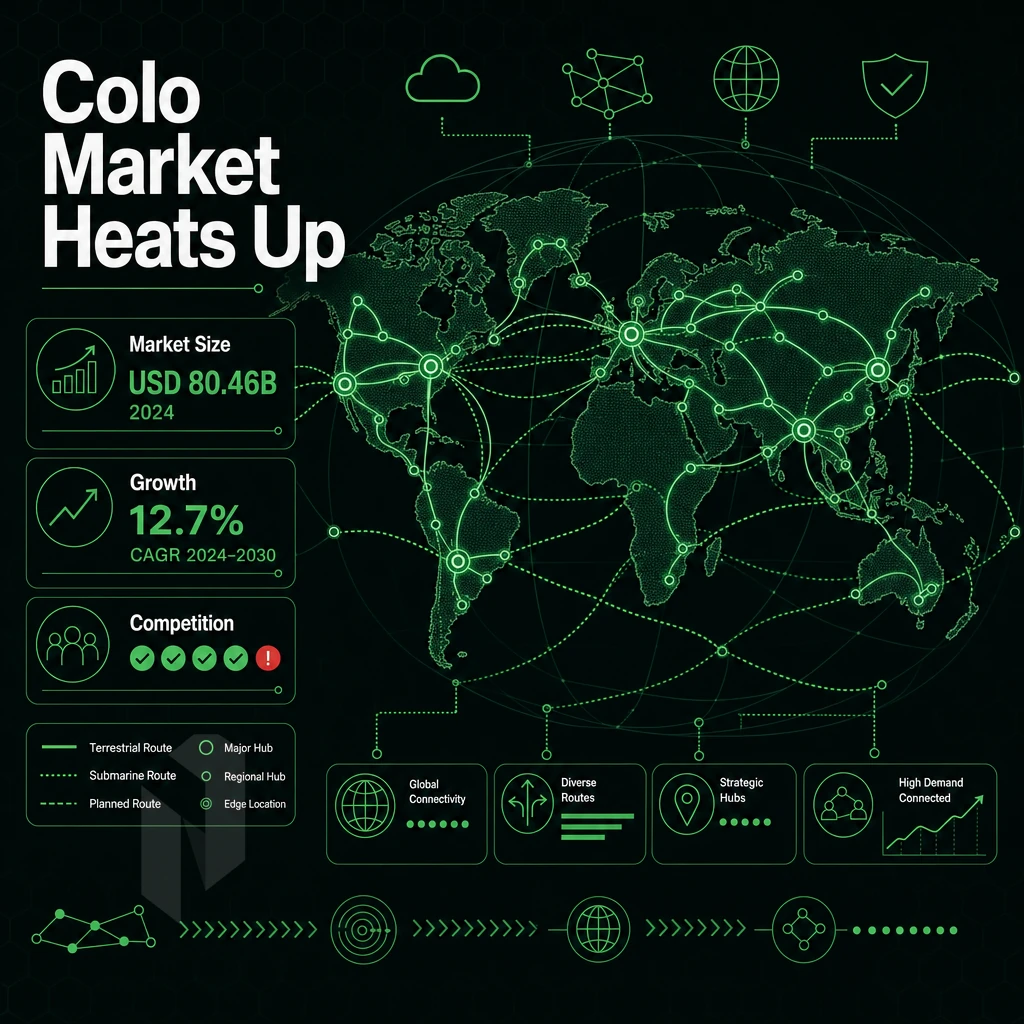
The data center colocation market is growing faster than most other infrastructure markets. In 2024 the market was valued at USD 80.46 billion, and by the end of 2025 it had reached USD 93 billion. By 2030-2033, the market is forecast to reach USD 204-296 billion depending on the source. This expansion reflects a compound annual growth rate that underscores the sector's resilience and the accelerating shift toward outsourced infrastructure models.
Growth Drivers for Colocation Data Centers
Digital transformation initiatives, cloud adoption and rising enterprise demand are driving these trends. With enterprises shifting large portions of their on-premises infrastructure to the cloud, sustained data center expansion across all regions is being fueled. The greatest pace of data center development is occurring in North America, Europe and Asia-Pacific. Organizations investing in digital services infrastructure are prioritizing colocation facilities that can support both current workloads and future expansion without requiring costly migrations.
Retail vs. Wholesale Data Center Colocation Market Segments
The data center colocation market can be divided into two markets: Retail colocation (smaller customers like SMEs and mid-market enterprises who require single cabinets or smaller suites of equipment) and Wholesale colocation (larger enterprises and cloud providers who require to lease larger halls or even multi-megawatt data center facilities).
| Segment | Typical Buyer | Scale | Key Priority |
|---|---|---|---|
| Retail colocation | SMEs, mid-market | 1U to full cabinet | Flexibility, managed support |
| Wholesale colocation | Large enterprises, cloud providers | Multi-cabinet to full hall | Power density, long-term capacity |
Competitive Landscape and Where Netrouting Fits
Constrained supply is the challenge data center operators from all tiers face. Netrouting serves both markets: carrier neutral data center colocation in 10 locations with a 99.9% SLA and up to 20 kW per rack. In data center land demand for data centers is no longer the problem, it is the lack of supply. And that problem is exacerbated by one thing above all: the rapid growth of cloud and hybrid IT.
Operators with strategically aligned data centers can better serve enterprises requiring consistent latency and compliance across multiple geographic markets. Operators must ensure their colocation environments can scale power and cooling capacity to meet the demands of modern GPU-intensive workloads without requiring facility-wide infrastructure overhauls.
Cloud Computing and Hybrid Cloud Solutions Reshaping Colocation
While cloud has not led to the demise of colocation, it has reshaped the model.
Understanding Cloud Computing Dependencies
- Map out your current workload split and determine which applications require deterministic latency and/or data residency. These will reside in your colocation. All others can be cloud burst.
- Requirements for audit logs for data storage for regulated data such as financial data. Health care data and even personal data of EU residents often dictate that such data cannot leave the physical jurisdiction where it was generated. Colocation offers physical controls that would not be available in a purely hyperscale offering.
Note: Data sovereignty regulations in the EU and APAC are tightening.
Connecting to Cloud and Colocation Providers and Data Centers
- Request direct cloud connectivity to cloud service providers such as Amazon Web Services, Microsoft Azure, Google Cloud Platform via private cross-connects offered by leading colocation providers. Public internet hops are eliminated, reducing latency and increasing throughput for hybrid cloud solutions.
- Take advantage of edge computing nodes. Cloud providers deploy edge computing within colocation facilities to service local traffic. As workloads are located within the same facility as your colocation, latency is dramatically reduced.
Note: Shared public internet connections to cloud platforms introduce variable latency. Always request a dedicated private interconnect at the facility level.
Validating Your Hybrid Architecture
- Test failover paths. Verify that colocated workloads can reach cloud-based resources within specified latency under load. This test should occur prior to go-live, not after.
- Please review with Netrouting as our locations in Amsterdam, Frankfurt, Miami and Singapore are all positioned at very dense peering points. This enables low latency hybrid hosting in Europe, North America and Asia-Pacific.
While hybrid architectures can solve the connectivity problem for new enterprises, larger forces are shaping the colocation market.
Key Trends Driving Colocation Data Centers in 2025 and Beyond
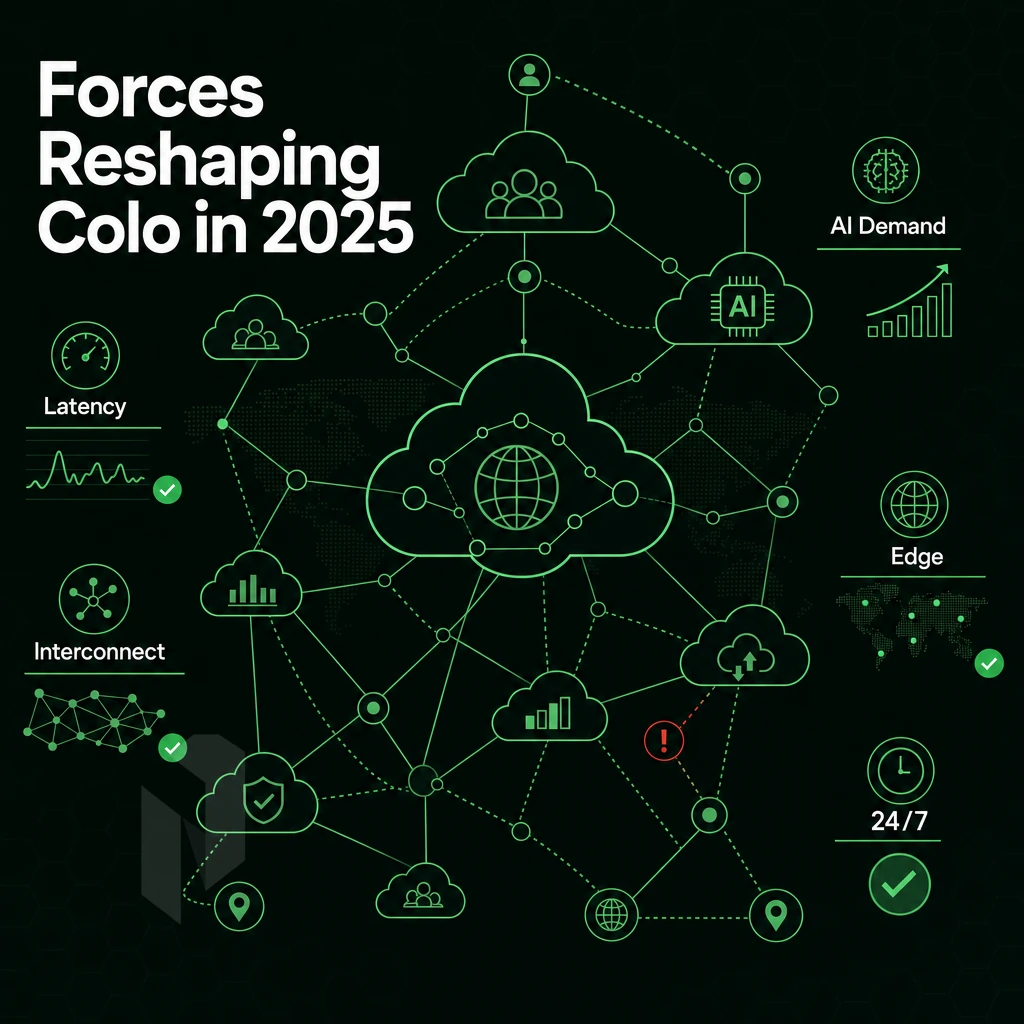
Several key trends are changing where and how companies colocate their IT infrastructure.
AI Workloads and High-Density Power Demand
Machine learning training clusters demand rack densities far above the traditional 8-10 kW/rack average, modern GPU servers can exceed 30-40 kW per rack, which standard air-cooled rows simply cannot handle.
Advanced cooling methods, such as direct liquid cooling or even full immersion, are becoming the new norm for modern colocation, designed to support AI workloads. Such solutions deliver outstanding PUE values of close to 1.03, allowing for significant reduction in power consumption compared to traditional air-based cooling with CRAC units.
Edge Computing and Sustainability Pressures
Edge computing has led to rapid growth in regional colocation markets. A new wave of latency-sensitive applications and services (e.g. autonomous cars, real-time analytics) require processing close to end users, shifting the data center colocation market away from hyperscale datacenter campuses and toward fragmented, distributed carrier-neutral colocation facilities.
The ‘Green Datacenter’ has gone from being a differentiator to a criterion for procurement decisions.
Data Sovereignty and Emerging Markets
Data sovereignty regulations are fragmenting the global demand for cloud services. In the EU, and in many countries in Southeast Asia and other parts of the world, data has to be stored within local borders. Large-campus operators who rely on a single provider for their cloud needs have significant compliance gaps.
In the world of colocation services, increasing numbers of customers require specific jurisdictional coverage. The cost savings of combining smaller sites into one facility mean nothing if that single facility’s deployment fails a regulatory audit.
This 10 city network spans the data center colocation market across Europe, North America and Asia-Pacific, allowing clients to fulfill residency requirements without moving to a completely new datacenter environment. After identifying trends in your datacenter usage, you can decide on the most suitable colocation model to fit your specific needs.
Retail Colocation vs. Wholesale Colocation: Choosing the Right Model
The colocation model divides into two tiers.
Retail vs Wholesale Data Center Colocation Market Distinctions
Retail colocation refers to the placement of your servers in shared data centers, which are managed by your retail colocation provider. The space is leased by retail colocation customers on a rack unit, cabinet or even small suite basis. The standard colocation provider handles issues such as power, cooling, security and networking infrastructure. This form of colocation is ideal for mid-market enterprises who require enterprise data centers but cannot afford to build and staff them themselves.
Wholesale colocation reverses the model of traditional colocation. In wholesale colocation, customers pay for large blocks of raw power and square footage in a data center, and set up their own data centers within a data center. Cloud providers and very large enterprises who are building their own data center or information infrastructure often take this route.
Cost Efficiency and Scalability Trade-offs
While Wholesale buyers can benefit from even better cost efficiency when placing large orders in terms of kilowatts in multiple data centers. Retail buyers have to pay a premium for flexibility in terms of shorter terms, smaller spaces etc. and even included managed services in colocation facilities.
A practical example for this would be a 50-server deployment in a retail colocation facility. A hyperscaler building out thousands of nodes in data centers across the globe needs wholesale density and direct power feeds.
Operational Reliability Across Colocation Services
In the data center colocation market, we bundle monitoring, remote hands and cloud services integration for our Retail customers while our Wholesale customers run their own data center operations as they see fit.
Our data centers are designed to host both small and densely powered colocation setups.
Why Netrouting for Carrier-Neutral Colocation Across Europe and Beyond
Our carrier-neutral colocation facilities span ten locations: Amsterdam, Frankfurt, The Hague, Rotterdam, Stockholm, Bucharest, Miami, New York, Hong Kong, and Singapore.
- Dense IX peering: Our AS6206 backbone peers at AMS-IX, DE-CIX, FL-IX, and NetNod, giving your hardware direct cloud connectivity and low-latency global reach.
- High-density colocation: Up to 20 kW per footprint with advanced cooling solutions. Suitable for high-performance computing and GPU workloads.
- Free private interconnect: Up to 40 Gbps between your resources at no extra cost, critical for data sovereignty regulations and hybrid cloud deployments.
- 24/7 NOC + remote hands: One-hour ticket guarantee, proactive monitoring, and courtesy remote hands across all colocation facilities.
- Scalable entry point: Colocation starts at a cost-effective 1U tier, scale to private suites as your data center expansion demands grow.
If you're evaluating colocation providers for regulatory compliance, managed services, or global connectivity, explore our colocation solutions or contact our sales team to compare configurations.
Frequently Asked Questions
What Is Driving Rapid Growth in the Data Center Colocation Market?
Three forces dominate: the explosion of AI and machine learning workloads demanding dense, high-power compute; accelerating enterprise cloud adoption that requires reliable, carrier-neutral interconnection points; and tightening data sovereignty regulations pushing organizations to place infrastructure in specific jurisdictions. Energy constraints in major metros are also pushing operators to expand into secondary markets. Together, these pressures are compressing build timelines and driving sustained demand for third-party colocation capacity.
How do retail and wholesale differ in the data center colocation market?
shared colocation sells space in smaller increments, single rack units, partial cabinets, or full cabinets, with shared power and cooling infrastructure, and typically includes managed services, remote hands, and cross-connects.
Wholesale colocation leases large blocks of space, often entire suites or halls, directly to a single tenant who operates the environment as their own.
How Hybrid Cloud Adoption Affects the Data Center Colocation Market
Hybrid cloud architectures require a neutral interconnection point within the data center colocation market where private infrastructure can reach multiple public cloud on-ramps with low latency and predictable performance. Colocation facilities at major peering hubs fulfill exactly that role. As enterprises move workloads between on-premises systems and cloud platforms, the data center colocation market sees growing demand for carrier-neutral facilities, particularly at well-connected sites like those in Amsterdam, Frankfurt, or New York. Netrouting's facilities at AMS-IX, DE-CIX, and FL-IX peering points are purpose-built for this hybrid model.
What certifications matter when choosing a provider in the data center colocation market?
At minimum, require ISO 27001 for information security management and SOC 2 Type II for operational controls around availability, confidentiality, and security of their data centers.
How Edge Computing Is Reshaping Data Center Colocation Trends
Edge computing shifts the calculus in the data center colocation market from 'build near power and fiber' to 'build near end users,' with operators deploying smaller, purpose-built facilities in secondary cities and regional hubs to cut latency for real-time applications, autonomous systems, live video, industrial IoT, and financial trading. Growth in the data center colocation market has expanded the colocation footprint well beyond traditional Tier 1 markets into cities like Stockholm, Bucharest, and Rotterdam, where proximity to specific user populations or submarine cable landings matters more than raw facility size.
What role does renewable energy play in modern colocation data centers?
Renewable energy has moved from a marketing differentiator to a procurement requirement. Enterprise customers with net-zero commitments demand Power Purchase Agreements or renewable energy certificates from their colocation providers.
How Do Data Sovereignty Regulations Influence Colocation Data Centers Decisions?
Data sovereignty laws shaping the data center colocation market, GDPR in the EU, national security legislation in various jurisdictions, and sector-specific rules in finance and healthcare, mandate that certain data be processed and stored within defined geographic boundaries. This forces organizations to select data center colocation providers with facilities in compliant jurisdictions rather than defaulting to the cheapest or most convenient option.
For EU-based workloads, this means placing infrastructure inside EU member states with providers that operate under EU legal frameworks. Netrouting's primary EU facilities in The Hague, Amsterdam, Frankfurt, Rotterdam, Stockholm, and Bucharest are all within the EU regulatory perimeter, making them a strong data center colocation market choice for customers who need a clear compliance path without sacrificing network performance.
The way you need to compare providers in 2025 for your Colocation needs goes far beyond simple retail/wholesale models based on rack and power.
The amount of actual work you can stuff into a given amount of real estate and connect to your cloud on-ramps becomes a major factor in your evaluation.
Two main factors to consider in selecting a good colocation provider vs. expensive poor provider: (1) choosing a carrier-neutral colocation facility with real network diversity. (2) choosing a provider with solid SLAs that actually hold under real load.
Netrouting is a key player in the data center colocation market, operating carrier-neutral colocation across Europe, North America, and Asia, backed by a 2.4 Tbps+ network, always-on DDoS protection, and 24/7 support with a one-hour ticket guarantee. Explore colocation options or contact sales to discuss your specific requirements.